Geopolitika: A Week in the Think Tank Machine – CSIS Experts Build the Case for Endless War with Iran
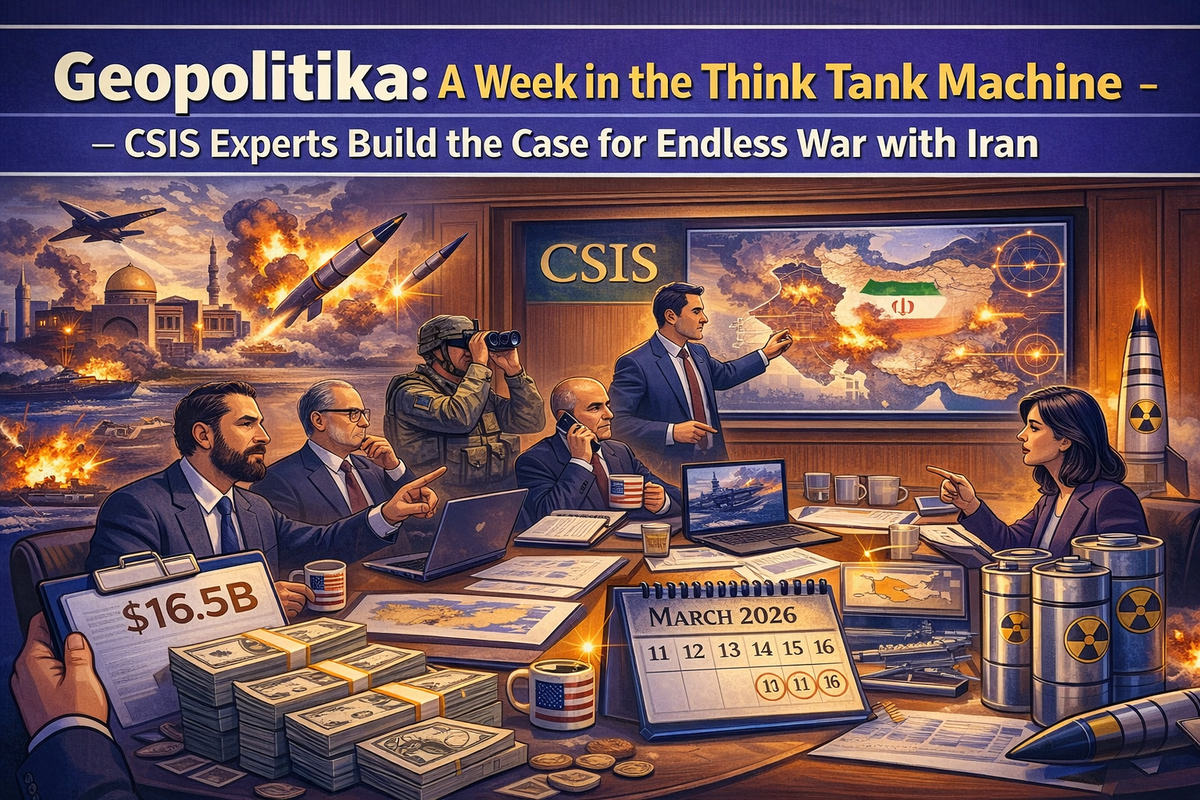
In the spirit of the Geopolitika series, this article examines how think tanks shape US policy agendas and make the US’s actions seem logical and sensible to policymakers and politicians. As covered in a number of my articles, seemingly speculative reports from the likes of Brookings and RAND often turn up years later as prophetic roadmaps laying out actions taken to surround and contain Russia or map the paths to regime change and re-assimilate Persia into the imperial family. The narratives papers of this genre outline eerily find their way into speeches by politicians and news media, setting the public frame as if in the moment for plans well established often a decade or more previously. As with my recent piece on CSIS’s coverage of the Maduro kidnapping, this one examines a week’s worth of articles from CSIS focusing on shaping the war narrative on Iran in early March 2026.
In the first second week of March 2026, as American and Israeli bombs continued to fall on Iran, the Center for Strategic and International Studies (CSIS) published six commentaries on the war. They arrived in rapid succession—March 11 through March 16—from six different authors across four different programs.
Economic security president Navin Girishankar warned that Iran was fighting a global economic war. Defense expert Benjamin Jensen extracted naval lessons for future conflicts. Syria specialist Will Todman worried about spillover effects. Mark Cancian and Chris Park tallied the $16.5 billion cost. Nuclear fellow Joseph Rodgers weighed seizing Iran’s enriched uranium. Middle East director Mona Yacoubian dissected Iranian escalation logic.
Six angles. One institution. One story.
On the surface, this is what think tanks do: experts offering expert analysis. But beneath the surface lies something more significant—a shared worldview that never gets argued, assumptions that never get questioned, silences that speak louder than claims, and argument structures engineered to produce specific effects in readers.
These commentaries are not just analysis. They are the cognitive infrastructure within which Washington will debate—and inevitably continue—this war.
The Machine Behind the Analysis
CSIS calls itself bipartisan. Its website emphasises “nonpartisan research” and “strategic insights.” But bipartisan does not mean independent. It means operating within what both establishment parties accept.
Those boundaries become visible when you follow the money—and when you read my prior Geopolitika profiles of CSIS on Mindwars Ghosted. In the analysis of how CSIS turned the Maduro raid into doctrine (“One Week, One Think Tank”), and in the broader Operators series on policy framers, I mapped the institute’s role as narrative switchboard: converting raw events into installable doctrine, talking points, and “lessons” for the Washington ecosystem. The same institutional gravity appears here.
CSIS was founded in 1962 as an outgrowth of Georgetown University’s national security studies. Its first leaders came from the Cold War military-industrial establishment. Its board has always overlapped with the Council on Foreign Relations, defense contractors, investment banks, and previous administrations. This deep production network—the historical elite lineages that shape institutions—conditions what CSIS can produce. The foundational ideas persist: U.S. global leadership as necessary, technocratic policy analysis as sufficient, threat prioritisation as constant. These ideas are not argued in the commentaries because they do not need to be. They are the inherited common sense of the institution.
Public disclosures show CSIS receives funding from the Department of Defense, the Department of State, Lockheed Martin, Northrop Grumman, Raytheon, and various Gulf states through contracts. These are not neutral funders. Defense contractors profit when wars deplete munitions and require resupply—the Cancian/Park analysis documents exactly that dynamic in precise dollar figures. Gulf states need U.S. protection to feel secure—Girishankar warns this credibility is at risk.
This funding structure does not dictate what individual analysts write. But, as the prior profiles showed, it creates an institutional gravity that pulls certain questions off the table:
- No CSIS commentary asks whether U.S. military presence in the Middle East is itself escalatory.
- None examines Israeli actions with the same scrutiny applied to Iran.
- None explores diplomatic pathways beyond “pressure.”
- None considers what Middle Eastern order might look like without U.S. dominance.
The network’s influence is moderate rather than total. Current authors are mostly technocratic professionals rather than movement ideologues. But the combination of funding and historical lineage creates structural pressure toward threat framing. The absence of Israeli scrutiny reflects network assumptions about alliance solidarity. The silence on diplomatic alternatives reflects network consensus that pressure is the only language Iran understands.
This is not conspiracy. It is the normal sociology of elite institutions. The network selects for people who already share its premises. It rewards analysis that operates within acceptable bounds. It marginalises work that challenges fundamental assumptions. The result is a think tank ecosystem that produces sophisticated analysis of means while remaining largely silent on ends.
Girishankar captures the stakes when he warns that “the credibility of the U.S. defense umbrella is being called into question” and that “Gulf states that pledged large-scale investments may now divert sovereign capital.” The message is clear: the machinery of U.S. protection—and the financial flows it enables—must be maintained.
What They Take for Granted
Every analysis rests on assumptions. The most important ones never get argued because they never need to—they are the water everyone swims in.
- First: U.S. military intervention is legitimate. Not once does any author question whether the United States has the right to bomb another country. The opening strikes on February 28 are treated as given, a response to Iran’s nuclear program. What that program means to Iran—a sovereign state surrounded by U.S. military bases, invaded neighbors, and a nuclear-armed Israel—goes unexplored.
- Second: Iran is the adversary. Across all six pieces, Iran appears as the source of instability, the escalator, the threat. That U.S. and Israeli strikes might constitute escalation from Iran’s perspective is acknowledged as a tactical reality but never as a structural critique. The possibility that a state might defend itself against military attack is rendered invisible.
- Third: Technocratic management can contain violence. Each author offers adjustments—better targeting, different cost calculations, escalation scenarios to prepare for, nuclear materials to seize. None suggests that the underlying logic of U.S. military dominance might itself be the problem. The war, in this framing, is not a question of legitimacy but of execution.
These assumptions function as gates. Once you accept them, the range of acceptable policy options narrows dramatically. You can debate costs versus benefits, military victory versus strategic defeat, escalation management versus uncontrolled escalation. You cannot debate whether the war should be happening at all.
The binary oppositions that structure their thinking reinforce these gates:
- Military victory versus strategic defeat (Girishankar)
- Calibrated response versus unrestrained escalation (Yacoubian)
- Syria stability versus regional chaos (Todman)
- Naval success versus future vulnerability (Jensen).
Each binary presents a choice between two poles while rendering everything outside them invisible.
How the Arguments Work on Readers – And the Traps They Set
The commentaries don’t just present evidence. They are engineered to produce specific effects—and the reasoning patterns they deploy also work to contain the contradictions that appear elsewhere in the series.
Girishankar’s piece opens with a classic false dilemma: the United States must either declare victory now or face endless, trillion-dollar war. “The United States needs to narrow the objectives, declare the degradation of Iran’s offensive capability a strategic outcome, and ratchet down before the logic of regime change takes hold.” Two options presented as exhaustive. The middle ground—continued limited strikes, diplomatic engagement, multilateral pressure, regional security frameworks—disappears. The function is to foreclose alternatives.
The same author uses an appeal to consequences throughout. “The credibility of the U.S. defense umbrella is being called into question… Gulf states that pledged large-scale investments may now divert sovereign capital.” The argument runs: catastrophe will follow unless we act as recommended. The invocation creates urgency and forecloses deliberation.
Todman’s Syria analysis relies on a slippery slope. “If the war drags on, it will create pressures that threaten to derail Syria’s fragile recovery.” The chain of causation is never specified. How exactly does a Gulf war translate into Syrian housing shortages? The argument works by implication, not demonstration—the function is to justify concern without evidence.
Yacoubian’s escalation analysis reduces Iranian strategic choice to a binary: calibrated response or unrestrained escalation. “Threatened by regime change and determined to deter future attacks, Tehran appears to have opted for unrestrained escalation.” This straw-man framing makes Iranian action legible as pure aggression while erasing any defensive logic. It also erases the possibility that Iranian escalation might be reactive, chaotic, or bureaucratic rather than calculated. The function is to simplify the adversary into something manageable.
Jensen’s naval analysis performs a different kind of work. By extracting “lessons” from the Iran campaign and applying them to Taiwan, he transforms a specific conflict into a generic template. “For countries watching like Taiwan, the campaign carries a cautionary tale.” The assumption that Iran and China are structurally equivalent goes unexamined. The rhetorical effect—and its function—is to recruit the Iran war into the larger project of preparing for great-power conflict.
Throughout all six pieces, appeals to authority transfer credibility from military sources without interrogation. CENTCOM statements, DOD briefings, and Admiral Cooper’s updates appear as evidence rather than as interested communications from actors with stakes in portraying success. The function is to shut down inquiry.
These patterns don’t mean the experts are wrong. They mean the arguments are designed to persuade in particular ways—and that design is worth noticing. The commentaries treat Iranian actions as strategic—chosen, calculated, designed. Alternative explanations—that Iranian behaviour might be bureaucratic (standard operating procedures), reactive (responding to being bombed), or emergent (arising from interactions no one controls)—are never considered. This matters because attributing strategy to an adversary justifies military response in ways that attributing chaos or reaction does not.
The People Who Disappear – And Who Wins, Who Pays
The commentaries are dense with abstractions: “degradation,” “escalation,” “cost,” “seizure,” “stability.” Each abstraction names a human reality. The humans never appear.
When Cancian and Park report $16.5 billion in war costs, they do not name the taxpayers whose money funds those strikes. When Todman notes 78,000 Syrian refugees returning from Lebanon, he does not quote what those refugees say. When Yacoubian describes strikes on Gulf infrastructure, she does not interview the migrant workers who build and maintain it. When Rodgers discusses seizing nuclear material, he does not ask what happens to Iranian civilians living near the facilities.
A Syrian refugee quoted in NGO reports put it simply: “We returned because Lebanon became too dangerous, but Syria has no housing, no jobs.” This voice appears nowhere in the CSIS analysis. Nor do Iranian civilians wondering whether the next strike will hit their neighbourhood. Nor do U.S. military families counting days until deployment ends. Nor do the millions of migrant workers across the Gulf whose lives become more precarious with each escalation.
These absences are not accidental. They are structural to the genre. Policy analysis addresses itself to policymakers, not to those who experience policy. When those populations do appear—Syrian refugees, Gulf residents—they appear as problems to be managed: “pressure on Syria’s already inadequate housing supply.” They are not sources of testimony about what the war actually means.
Affected communities are not inherently virtuous—they contain hierarchies, gatekeeping, and contradictory interests. But their absence from the analysis is epistemic exclusion. The knowledge they carry about what war does to human beings never enters the policy conversation.
The $16.5 billion question is not just how much the war costs, but costs to whom.
The material trade-offs are stark. Continued strikes cost billions in munitions and produce Iranian casualties and regional instability. Nuclear seizure risks escalation and chemical exposure for operators and civilians. Declaring victory leaves Iranian capabilities intact and unsettles Gulf states.
The externalities never counted: Syrian refugees returned to no housing and no jobs. Iranian civilians under bombardment. Gulf workers facing precarity. U.S. military families separated. Pacific readiness degraded.
The financial topology reveals who gains materially. Defense contractors profit from munitions resupply—the Cancian/Park analysis documents the precise dollar figures that will flow to Lockheed, Northrop, and Raytheon. Gulf states maintain the security guarantee they have purchased through decades of weapons contracts and basing access. The Israeli defense industry benefits from sustained pressure on Iran, though this goes unmentioned. The U.S. Treasury, meanwhile, pays the bills.
The focus on Iranian escalation protects a larger vulnerability from scrutiny: U.S. strategic overreach, defense industrial base limits, Gulf alliance fragility. As long as attention remains fixed on Tehran’s aggression, Washington’s own structural problems remain in the shadows.
Where the Story Unravels
For all their coherence, the commentaries contain tensions they cannot resolve—and a past they cannot acknowledge.
Girishankar's central claim is that the United States is winning militarily but losing strategically. “The United States has demonstrated clear military superiority... Strategically, the picture is far less certain.” If true, this undermines the very premise of the war: that military action can achieve political objectives. Yet the pattern is hardly new. The same logic could have described the 2003 invasion of Iraq—decisive military victory followed by strategic catastrophe—or the twenty-year war in Afghanistan, or the destruction of Libya that left a failed state and regional chaos. The commentaries treat these outcomes as unthinkable while describing their exact contours.
Todman notes that “Iran weakened yet more radicalized” produces a worse long-term threat. Military action, on this reading, does not solve the problem—it transforms it into something harder to manage. The observation echoes every post-9/11 intervention. Al-Qaeda was weakened in Afghanistan; it reconstituted elsewhere. The Islamic State emerged from the ruins of Iraq. Hezbollah grew stronger after Israeli invasions. That the pattern repeats across decades and geographies never enters the analysis. Each war is treated as new, its precedents forgotten.
Jensen acknowledges that his naval success claims rest on uncertainty. “The open question is whether ship counts are a distraction from the real measure of effectiveness: whether Iran's mine, USV, and small-boat denial toolset was actually neutralized, or merely displaced.” The entire Taiwan lesson depends on an unverified premise. But the deeper lesson—that military planners consistently mistake immediate effects for lasting outcomes—remains unexamined. Operation Eagle Claw, the 1980 attempt to rescue American hostages in Tehran, ended not in combat but in catastrophic equipment failure in the Iranian desert, eight service members dead, and a humiliated superpower. Every intervention carries the seed of its own undoing. None of this history appears.
Cancian and Park document that $16.5 billion in spending threatens readiness in the Pacific and Ukraine. The war that is supposed to protect U.S. interests is actively undermining them elsewhere. This is imperial overstretch made visible: the classic pattern of a power that cannot prioritize because it cannot say no. Rome knew it. Britain knew it. The United States, these commentaries imply, is different. History suggests otherwise.
Rodgers confronts the ultimate dilemma: seizing nuclear material risks escalation, but leaving it risks proliferation. Either choice carries catastrophic potential. Yet the dilemma itself is a product of framing that erases both history and evidence. For more than two decades, Iran's Supreme Leader Ayatollah Ali Khamenei issued and maintained a fatwa—a binding religious edict—prohibiting the development of weapons of mass destruction. Western intelligence agencies, including the U.S. intelligence community, repeatedly assessed that Iran was not actively building a nuclear weapon. The 2025 annual threat assessment, delivered just months before the war, stated explicitly that “Iran is not building a nuclear weapon and that Khamenei has not reauthorized the nuclear weapons program he suspended in 2003”. The International Atomic Energy Agency, tasked with monitoring Iran's program, has consistently reported no evidence of a weapons program.
Why, then, is Iranian nuclear capability framed as an existential threat—and to whom—when other nuclear states—Israel, Pakistan, North Korea—are either ignored or managed through deterrence and diplomacy? The question cannot be asked because the answer would require examining the one constant across every failed intervention: the assumption that U.S. power, unlike all others, is inherently benevolent and its use inherently legitimate. It would also require acknowledging that the “imminent threat” used to justify war was, in the words of a senior aide to the Director of National Intelligence who resigned in protest, a fabrication—one that a Senate hearing later exposed as having no basis in intelligence community assessments.
These cracks matter because they point to genuine policy debates within the establishment. They are not cover-ups. But they also function to contain those debates within the boundaries the establishment accepts. The question is never whether the war should continue—only how. The past is never consulted—only projected onto a future that somehow never arrives.
What Linear Analysis Misses
The commentaries assume linear causality: U.S. acts, Iran reacts, outcomes follow. But the war exhibits circular causality that their analysis cannot capture.
A reinforcing feedback loop operates: threat perception leads to military action, which produces Iranian retaliation, which confirms the original threat perception, which justifies further action. U.S. policymakers see Iran as threat. They strike. Iran retaliates. This confirms Iran as threat. More strikes follow.
This loop is not abstract. It has a history. The 1953 CIA-backed coup that overthrew Iran's democratically elected prime minister installed a dictatorship and generated decades of anti-American sentiment. The 1979 hostage crisis emerged from that history. The U.S. response—sanctions, covert action, support for Iraq during the Iran-Iraq war, the shooting down of a civilian airliner in 1988—deepened Iranian mistrust. Each U.S. action produced Iranian reaction, which was then read as proof of inherent Iranian hostility. The loop has been running for over seventy years. The commentaries treat it as if it began on February 28, 2026.
The question never asked: what if U.S. and Israeli strikes are themselves the escalation to which Iran responds? What if the frame were reversed— “U.S. escalates, Iran reacts”—rather than the taken-for-granted “Iran threatens, U.S. responds”? The loop would still function, but the moral weight would shift. That shift never occurs because the analysis begins from the assumption that U.S. action is legitimate and Iranian action is inherently threatening.
Yacoubian describes pieces of this loop in her escalation analysis but never acknowledges the role such analysis plays in perpetuating it. By framing Iranian action as “unrestrained escalation,” she feeds the very threat perception that drives the loop. She is not observing the system from outside. She is inside it, her analysis a component of the very dynamics she purports to describe.
The pattern extends beyond Yacoubian. Across all six commentaries, Israeli actions go unexamined. The strikes that triggered the war were joint U.S.-Israeli operations. Israel's decades of covert action inside Iran, its assassinations of Iranian nuclear scientists, its open threats to Iranian facilities—none of this appears as context. Israel is not a variable in the escalation equation. It is simply there, a partner, its actions folded into the category of “U.S. and Israeli strikes” without distinction or analysis. This asymmetry is not oversight. It is structural to the worldview that frames the entire project: certain actors are agents whose actions require explanation; others are simply present. The loop runs in one direction.
The boundaries the commentaries draw determine what becomes visible and what remains hidden. The spatial boundary is nation-state centric, excluding transnational networks and global supply chains that actually shape outcomes. The temporal boundary is crisis-frame (days and weeks), excluding slow variables that unfold over decades—elite network formation, financialisation, Gulf economic transformation. The sectoral boundary is military, economic, and security, excluding social reproduction and ecological costs. The actor boundary includes elites, states, and experts, excluding affected populations. The knowledge boundary includes expert and technocratic knowledge, excluding lived experience. These boundaries are not neutral methodological choices. They are political acts. They determine who benefits, who pays, and what never gets asked.
The slow variables they ignore matter most: Sixty-plus years of CSIS-CFR-defense contractor interlock conditions what questions are thinkable in Washington. Forty years of finance capital dominance shapes how “economic war” gets framed. Gulf states' diversification from oil—their 2030 visions—makes infrastructure attacks salient in ways they would not have been a generation ago. These long-term trends shape the present crisis, but the crisis-frame renders them invisible.
The commentaries present the war as a series of tactical choices. They cannot see that they are also describing a structure—one that has been in motion for generations and will outlast any single administration. The loop does not begin with this war. It will not end with it either.
What Comes Next: Fractures Worth Prying Open
Overall, the six CSIS commentaries do not settle the Iran war. They fracture it. Beneath the surface of confident technocratic prose lie visible cracks—unexamined assumptions, contained contradictions, erased voices, and self-reinforcing loops—that the authors themselves cannot close. Instead of a conclusion, this section leaves the analysis deliberately open: an invitation to look harder and deeper.
How sure can we be: The analysis shows high confidence that the six pieces share unstated assumptions about U.S. legitimacy, Iranian threat, and technocratic management. High confidence that false dilemmas, slippery slopes, and appeals to authority function to foreclose alternatives. Medium-high confidence in the argument-structure findings. Medium confidence that funding shapes framing—the pattern is structural, not conspiratorial. The limited-hangout hypothesis—that the focus on Iranian escalation conceals U.S. overreach—remains a live fracture requiring further investigation.
What still needs to be asked—and what the commentaries were engineered not to ask:
- What internal CSIS deliberations produced six coordinated pieces in a single week, and what feedback did the authors receive from administration officials?
- How have defense contractors and Gulf states responded to these analyses—and what off-the-record conversations shaped them?
- What would Iranian strategic calculations look like if analysed from a defensive rather than offensive framing, taking seriously Tehran's perception of encirclement?
- What diplomatic pathways do these artefacts systematically exclude—multilateral negotiations, regional security frameworks, nuclear transparency measures?
- What do Syrian refugees, Iranian civilians, Gulf migrant workers, and U.S. military families actually say about this war—and who is documenting their testimony?
- How do the slow variables—sixty years of elite network formation, financialisation, Gulf economic transformation—quietly condition the policy options we are told are inevitable?
- If Treasury Secretary Bessent explicitly describes U.S. sanctions policy as deliberately designed to collapse Iran's currency, starve its banking system, and drive its population into the streets—a strategy whose humanitarian costs are borne by ordinary civilians—why do these CSIS analyses treat economic warfare as a neutral tool of statecraft rather than a contested and consequential policy choice with documented human consequences?
- What would a Middle East order without permanent U.S. military dominance actually look like?
These questions are not rhetorical. They are the ones the commentaries were structured to foreclose. Asking them is the first step toward prying open the fractures.
What could be different—what truly independent research and policy might actually look like:
The analysis has shown that the CSIS commentaries are not neutral expertise. They are the product of institutional gravity, epistemic exclusion, and self-reinforcing boundaries that keep certain questions unaskable and certain voices unheard. Truly independent research and policy would therefore begin by refusing those boundaries entirely:
- It would start with full transparency of funding, personnel lineages, and network overlaps so readers can see the machine before they read the analysis.
- It would treat affected populations not as data points or "pressures on housing supply" but as primary knowledge holders whose testimony sets the research agenda.
- It would map slow variables—elite interlocks, financialisation, Gulf transformation—alongside immediate crisis metrics.
- It would test every assumption rather than swim in them.
- It would examine Israeli actions, U.S. presence, and diplomatic alternatives with the same rigour applied to Tehran.
- It would explicitly ask what a Middle East order without permanent U.S. military dominance could look like.
The spectrum of change remains useful only as steps toward that standard:
- Reform would mandate complete funding disclosure, conflict-of-interest registries, and public audits of board and donor influence.
- Redesign would require public financing of core research, mandatory inclusion of affected-community testimony as co-equal evidence, and boundary audits that force analysts to justify every exclusion.
- Transformation would shift to participatory knowledge production in which Syrian refugees, Iranian civilians, Gulf migrant workers, U.S. military families, and independent regional scholars help frame the questions before any expert writes the answers.
None of these paths is easy or automatic. Each carries real trade-offs and institutional resistance. But they all begin at the same point: the moment we stop accepting the frame these commentaries offer and start demanding research that is independent in practice, not just in branding.
Published via Mindwars Ghosted.
Geopolitika: Tracing the architecture of power before it becomes the spectacle of history.
—
Methodology note: This analysis was conducted using a structured forensic protocol examining production systems, argument structures, worldview assumptions, network dynamics, and voice gaps. All source material (six CSIS commentaries published March 11-16, 2026) is publicly available at csis.org. Funding information is drawn from CSIS annual reports and public disclosures. Refugee testimony is drawn from published NGO reports (UNHCR, independent documentation). Confidence levels follow standard social science conventions: High = multiple corroborating sources; Medium = plausible but limited verification; Low = interpretive claim requiring further evidence.
Mindwars Ghosted is an independent platform dedicated to exposing elite coordination and narrative engineering behind modern society. The site has free access and committed to uncompromising free speech, offering deep dives into the mechanisms of control. Contributions are welcome to help cover the costs of maintaining this unconstrained space for truth and open debate.
If you like and value this work, please Buy Me a Coffee