Geopolitika: Carnegie's Russian Threat Machine
In June 2025, this series examined the Carnegie Endowment's institutional architecture—its founding mythology, personnel circuits, funding streams, and function as a narrative relay node within Atlanticist security infrastructure. That piece, “Carnegie: A Legacy of Peace, or Something Else?", traced an organisation that presents itself as a neutral forum while operating as a legitimacy engine for elite consensus. By December 2025, a follow-up case study—"Carnegie’s Is the EU Too Weak to Be a Global Player"—demonstrated how this machinery operates in practice: a single policy brief, perfectly synchronised with EU and NATO summits, reframed a deteriorating war as manageable, Russia as ascendant? No—as on the back foot, and Ukraine as a vessel for Western credibility. The conclusion was unambiguous: Carnegie does not merely reflect geopolitical currents; it scripts them.
In March 2026, the Carnegie Endowment for International Peace published a paper titled “Belligerent and Beleaguered: Russia After the War with Ukraine". Its author, Eugene Rumer, a former National Intelligence Officer for Russia and Eurasia, delivered a stark warning: Russia will emerge from the war “unrepentant and determined to seek revenge.” Europe must rearm. The US nuclear umbrella must be preserved. Supporting Ukraine is essential. These conclusions, presented with the authority of one of Washington's most respected foreign policy institutions, feel inevitable—the product of clear-eyed realism confronting a dangerous world.
But the paper does more than analyse. It performs. It constructs a world where permanent confrontation is the only rational option, where alternative futures are dismissed, and where the voices of those who bear the costs of this confrontation are never heard. The deeper puzzle is this: how does an institution founded to promote international peace produce analysis that makes peace unthinkable?
The answer lies in understanding the paper not as neutral analysis but as a constitutive component of the system it describes—a system where power interests, institutional reproduction, and patterns of reasoning reinforce each other to foreclose alternatives and perpetuate the very threats they claim to manage.
This article extends my previous investigations from structure and case study to function: how a single Carnegie paper on Russia operates to foreclose alternative futures and reproduce the threat perceptions it claims to expose. It asks not only what the paper says, but what it does—and who it serves. To answer this, the analysis integrates two complementary lenses. The first, focused on power, reveals institutional interests and accountability with high confidence; the second, focused on systems, reveals emergent dynamics and structural constraints with equal confidence. Their integration exposes a co-constituted reality that neither can see alone. While claims about the paper's argument structure, institutional position, and system loops are well-evidenced, those regarding specific financial interests and implementation pathways are more speculative. Most critically, the voices of those who bear the weight of these policies—the Ukrainian and Russian civilians named in the text but never heard—remain absent from both the paper and this analysis, a silence that marks the limit of what any single investigation can claim.
The Architecture: Power Structures and System Components
As covered in prior articles on its outputs, the Carnegie Endowment for International Peace (CEIP) was founded in 1910 by industrialist Andrew Carnegie, with Elihu Root—a former Secretary of War and Secretary of State—as its first president. From its inception, the institution has been deeply integrated into the U.S. foreign policy establishment. Its leadership overlaps substantially with the Council on Foreign Relations (CFR), founded in 1921 by the same Root network. This network—industrialist-philanthropist, Republican establishment, internationalist—established a template for elite consensus formation that persists today: a deep production lineage that shapes what Carnegie can see, say, and render thinkable.
That lineage is not historical residue. It is active.
Current leadership reproduces the pattern. Carnegie’s president, Mariano-Florentino Cuéllar, is a CFR member. Its scholars move seamlessly between government and think tank in the familiar “revolving door.” Eugene Rumer embodies this integration. Before joining Carnegie, he served as National Intelligence Officer for Russia and Eurasia at the U.S. National Intelligence Council (2010–2014). He has held positions at the National Defense University, the RAND Corporation, the State Department, and the National Security Council. His career traces a continuous circuit through intelligence, military analysis, and policy research—the institutional ecosystem that produces and validates U.S. strategic knowledge.
Funding reinforces these patterns. Carnegie’s donors include foundations—Ford, MacArthur, Carnegie Corporation—embedded in the same elite networks. These institutions do not dictate conclusions, but they do shape selection pressures. They require policy relevance, impact, and uptake. Analysis that departs too far from the Atlanticist security framework struggles to meet those criteria. Analysis that operates within it travels more easily.
Rumer’s latest paper launches a multi-year initiative—“The Future of Russian Power.” This is not a one-off publication. It is a programmatic intervention designed to structure discourse over time: to generate questions, frame answers, and sustain demand for the kind of threat analysis Carnegie produces. In system terms, it feeds directly into a discourse–policy feedback loop—analysis informing policy, policy generating outcomes, outcomes confirming the need for further analysis—ensuring institutional reproduction alongside strategic relevance.
The system extends beyond Carnegie itself. It includes:
- NATO bureaucracies whose institutional purpose is anchored in threat perception
- Defense contractors whose revenues scale with military expenditure
- Policy professionals whose careers depend on expertise that remains in demand
- Foundation funders whose grants require demonstrable policy impact
- Media outlets that amplify threat narratives to audiences primed for alarm
These components are not coordinated in any conspiratorial sense. They are aligned. They are connected through personnel flows, funding structures, and shared assumptions about what constitutes “realism.” Together, they form a system that reproduces itself: threat perception justifies policy, policy sustains institutions, institutions generate the analysis that reaffirms threat.
No single actor designed this system. But once in motion, it does not require design to persist.
This becomes visible most clearly in the paper’s summary—the point at which argument is most compressed and least qualified. There, claims such as Russia emerging “more dangerous,” expectations of change dismissed as “not a realistic proposition” appear as settled conclusions. What in the body of the paper is argued becomes, in the summary, assumed. The architecture disappears into common sense.
Neoconservative influence in this specific paper is low. Rumer is a realist, not a neocon. But the policy implications converge: sustained confrontation, rearmament, deterrence. This is not ideological consistency but structural isomorphism—different analytical traditions, operating within the same institutional environment, producing indistinguishable outcomes.
What the Paper Claims
Although you can (and should) read the paper for yourself, to give a brief synopsis Rumer opens with a stark proposition:
“Russia will emerge from its war with Ukraine unrepentant, vengeful, and more dangerous than before.”
From this follows the paper’s central thesis: three converging forces—geography, technology, and the unraveling transatlantic relationship—will reshape Russian threat perceptions in ways that make long-term instability in Europe unavoidable.
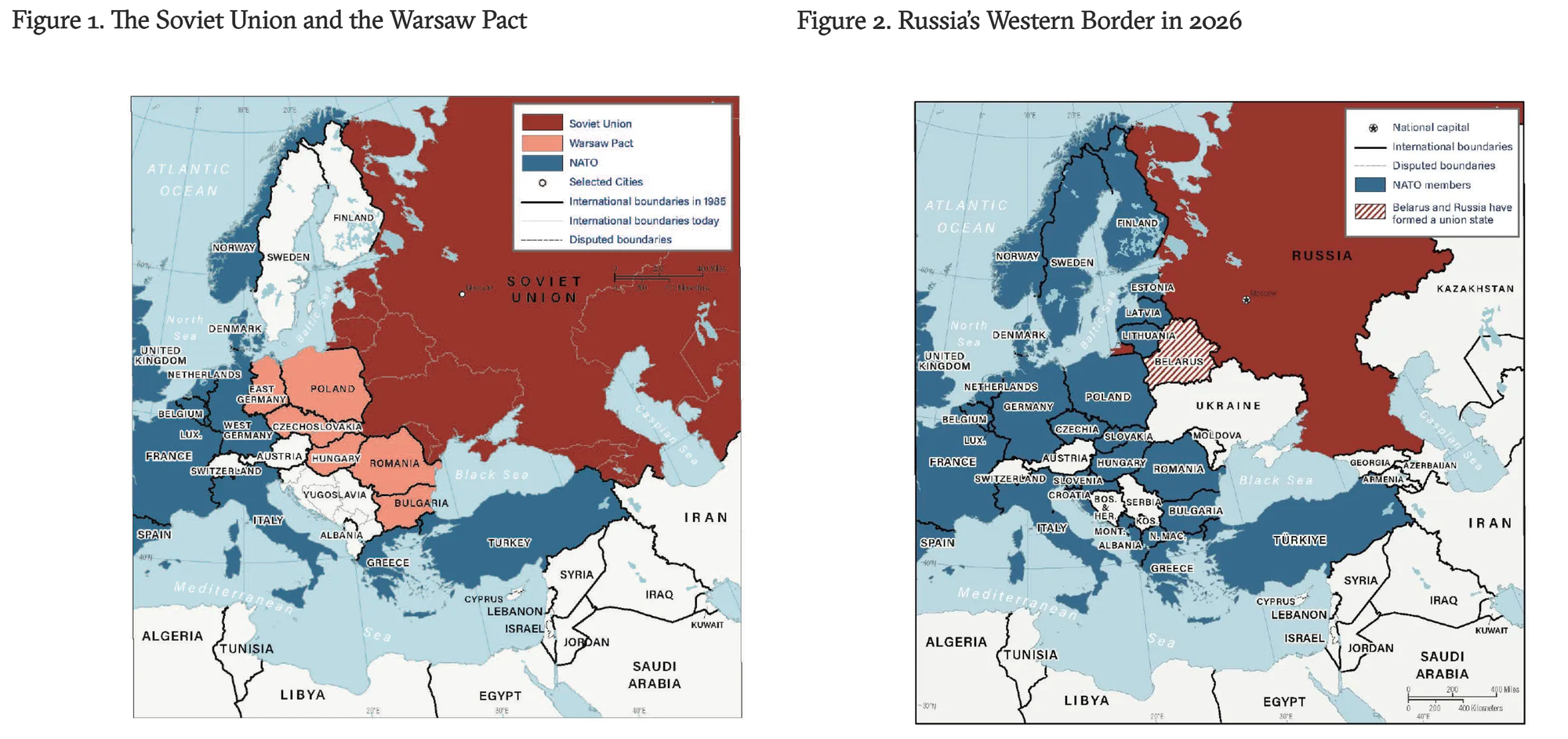
The geographical argument is foundational. Russian strategic culture, forged through invasions by Napoleon and Hitler, is said to demand “strategic depth”—territorial buffers shielding the Russian heartland. That buffer, in this account, has now disappeared. With Finland and Sweden in NATO and Ukraine irreversibly alienated, Russia faces what the paper presents as a continuous line of hostile states along its western flank, from the Kola Peninsula to the Black Sea.
This strategic conundrum is illustrated in the following maps:
Technology compounds the problem. Advances in long-range precision strike, autonomous systems, and AI-assisted targeting mean that even if buffers existed, they would no longer provide security. Targets deep inside Russian territory can now be held at risk. Geography no longer protects.
At the same time, the transatlantic security relationship is under strain. With the possibility—raised explicitly—of a reduced U.S. commitment to Europe’s nuclear defense, the paper argues that Europe must rearm and assume greater responsibility for its own security. Yet this solution is presented as double-edged: a more heavily armed Europe, particularly one with expanded or distributed nuclear deterrents, would “radically worsen” Russian insecurity even as it seeks to contain it.
Russia, in this framing, remains both weakened and dangerous: degraded by war, but still in possession of a large nuclear arsenal and a demonstrated willingness to engage in coercive escalation, including nuclear signalling.
The conclusion follows with striking clarity. Expecting Russia to change is not simply unlikely but unrealistic. In the paper’s terms, believing otherwise risks falling into “wishful thinking”—elsewhere framed more bluntly as “magical thinking.” The policy implication is direct: Europe must prepare for enduring confrontation, sustain support for Ukraine, and rebuild deterrence as a permanent condition rather than a temporary response.
This logic appears most clearly in the paper’s summary, where argument condenses into assertion. Russia is described as becoming “more dangerous,” the prospect of change is dismissed, and confrontation is treated not as one possible trajectory but as the baseline for planning. What is developed through analysis in the body of the text is presented, in the summary, as settled reality.
The Hidden Assumptions: What Power and System Models Take for Granted
The paper rests on assumptions that are never examined because they are treated as natural. They are not argued for; they are built in. Once in place, they shape what can be seen, what can be said, and what conclusions appear reasonable.
The power model assumes:
- Russia is the primary source of European insecurity. Western actions—NATO expansion, the withdrawal from the INF Treaty, missile defense deployments, military interventions in Kosovo and Iraq—are framed as reactive rather than causal. The direction of explanation runs one way.
- The European security order of 1991–2022 was normative peace. Finnish President Alexander Stubb’s phrase “holiday from history” is deployed approvingly, implying that the post–Cold War period was a natural baseline rather than the contingent outcome of specific political and strategic choices.
- Russia’s worldview is fixed and cannot change. This is asserted despite clear historical evidence of transformation—from empire to Soviet Union, from Soviet collapse to post-Soviet reconfiguration, and from that period into Putin’s authoritarian system. Change is acknowledged in history but discounted in the present.
Alongside this sits a system model that narrows the field further:
- Nation-states are the relevant unit of analysis. Transnational capital, corporate actors, and non-state networks disappear. Complex systems are reduced to state intent.
- Security is primarily military. Economic interdependence, ecological stability, social cohesion, and public health are excluded, not refuted—simply placed outside the frame.
- Threat perception is determined by geography and history. The possibility that threat emerges through interaction—that NATO actions shape Russian perceptions and Russian actions shape Western ones—is underweighted. What is dynamic is presented as given.
- Nuclear weapons stabilise. Deterrence is treated as foundational, while alternatives—non-nuclear security arrangements, common security, conflict transformation—do not enter the analysis.
These assumptions are not neutral methodological choices. They are acts of selection. They define the boundaries of the problem in advance, determining what appears relevant and what does not. Once those boundaries are set, the range of plausible conclusions narrows accordingly.
What emerges is not simply a description of reality, but a frame for seeing it—one in which certain causes are foregrounded, others recede, and some never appear at all.
The Omitted Variable: The West's Own Well-Signalled Plans
Midway through his geographical survey, Rumer makes a claim that functions as the paper’s logical keystone:
“There is nothing in the Russian foreign policy record to suggest that the Kremlin will abandon its legacy of confrontation with the rest of Europe and adopt a different approach to national security.”
This appears as empirical observation, anchored in Napoleon and Hitler as foundational traumas. Those invasions, Rumer argues, ingrained in Russia the conviction that strategic depth is essential to survival. France in 1812, Germany in 1941—both invaded, both ultimately defeated. The lesson: Russia endures by absorbing and exhausting its attackers.
But this framing selects only part of the record.
In 1814, Russian armies occupied Paris—and then left. They did not remain as an occupying power. They returned to their borders and accepted a European order not solely of their making. The same pattern appears in 1991: Soviet forces, which had occupied Eastern Europe since 1945, withdrew. Under Gorbachev, they accepted German reunification within NATO and returned to borders closer to Russia’s historical core.
Rumer acknowledges these moments only to contain them, describing both retreats as “forced by catastrophic domestic weakness rather than deliberate foreign policy choices.” The implication is clear: only weakness produces Russian accommodation; strength produces confrontation. Change is therefore not evidence of transformation, but of collapse. Any future accommodation becomes weakness by definition.
The argument closes in on itself. Confrontation is treated as Russia’s default state, and all evidence is interpreted accordingly. Withdrawal becomes weakness, not change.
The selectivity extends further. The Crimean War (1853–1856) is absent—a conflict in which Britain and France invaded Russian territory, besieged Sevastopol, and imposed a humiliating settlement. Here, strategic depth did not protect Russia; the attack came by sea. Also missing are Russia’s wars with Sweden and Finland. The Finnish War (1808–1809) and the Winter War (1939–1940) complicate any simple narrative of defensive posture, revealing a state acting from both insecurity and expansion.
More telling still is what disappears from the immediate prelude to the current war. While Rumer dismisses Russia’s proposed treaties of December 2021, the Minsk agreements—Minsk I (2014) and Minsk II (2015), negotiated to establish a ceasefire and grant autonomy to the Donbas within Ukraine—do not appear at all. Nor do the populations of Donetsk and Luhansk, their years of conflict, or the internal dynamics that shaped the crisis.
This omission is not trivial. The Minsk process was not simply a failed diplomatic effort; it structured the conflict for nearly a decade. Its subsequent interpretation matters. Key Western participants—Angela Merkel and François Hollande, along with Ukrainian President Petro Poroshenko—have since stated publicly that the agreements were understood, at least in part, as a means to buy time for Ukraine to strengthen its military position. Whether taken as candid reflection or retrospective justification, these statements complicate any straightforward account of the period as one of good-faith diplomacy undermined solely by Russian action.
None of this enters Rumer’s frame. The agreements themselves, their contested implementation, and the populations most directly affected are not engaged, qualified, or refuted. They are absent.
What emerges is not a fuller historical account but a narrower one—one that sustains a single conclusion. That narrowing becomes more pronounced in the treatment of Western action. Throughout the paper, Western policies appear as responses: NATO expands because Russia threatens; sanctions follow invasion; deterrence follows aggression. The causal arrow runs consistently eastward.
Sustaining that direction requires excluding a substantial body of Western strategic planning that was neither hidden nor ambiguous—and which I have examined in detail in my three part Geopolitika: Extending Russia series. The 2019 RAND report Extending Russia: Competing from Advantageous Ground, commissioned by the U.S. Army, explicitly explored “ways to extend Russia—to increase its costs and potentially reduce its willingness to act as an adversary.” Proposed measures included arming Ukraine, applying pressure across Russia’s periphery, and exploiting economic vulnerabilities. These were not framed as reactions, but as strategies designed to shape Russian behaviour.
As that series traced, these ideas did not remain theoretical. NATO expansion was not an abstract drift but a sequence of deliberate policy decisions, repeatedly signalled. Assurances given to Gorbachev in 1990 regarding NATO’s eastward movement form part of the historical record, as do later declarations—most notably the 2008 Bucharest and 2018 Brussels summit statements—that Ukraine and Georgia “will become members of NATO.” These were public commitments, issued in full view of the actors whose responses are now under analysis.
Rumer’s account does not engage this material. Western policy appears as background condition rather than active variable. The cumulative effect of decades of expansion, signalling, and strategic positioning is recast as a feature of Russian perception alone.
The result is a highly constrained causal frame. Russian behaviour is foregrounded; Western strategy recedes. Interaction is reduced to reaction.
This is what gives the argument its clarity—and its limits. By isolating one side of the dynamic, the paper produces a coherent account of threat while bracketing the processes through which that threat may have been shaped. The possibility that escalation is interactive rather than one-directional does not enter the frame.
What remains is a frame in which confrontation appears as inherent rather than emergent—rooted in history and geography rather than in the evolving relationship between actors operating within the same system.
The Human Cost: Voices the Analysis Cannot See
The paper names Ukrainian civilians repeatedly. It describes “hundreds of thousands of Ukrainian soldiers returning from the war, people displaced by it from parts of Ukraine captured and held by Russia, and Ukrainians who lived through Russian bombing raids and lost family members and friends.”
But no Ukrainian civilian speaks in these pages.
No testimony from those displaced. No voices of soldiers. No accounts from families who lost loved ones. They are present only as objects of analysis—a population that will remain hostile, a condition to be managed.
The same pattern holds for the Ukrainian diaspora. It appears briefly as a consequence-bearing population—people who “will not settle quietly”—but not as a political actor with internal diversity, autonomous agency, or capacity for mobilisation. This absence matters. Diaspora communities can amplify homeland interests, shape policy in host states, fragment, radicalise, or stabilise. None of this enters the frame. A potentially decisive actor is reduced to a footnote.
Russian civilians are more marginal still. They appear once: “an exhausted general population.” The exhaustion is noted. Its causes—war, mobilisation, economic hardship, repression, bereavement—are not. Nor are the social ties that bind Russian and Ukrainian societies: families, language, religion, shared history. These connections, which complicate any clean separation into opposing blocs, disappear entirely. In the paper’s frame, they do not exist.
European populations are absent altogether. The citizens who will finance the rearmament the paper advocates—through taxation, reduced public spending, and long-term fiscal trade-offs—do not appear. Nor do the ecological costs of military expansion, or the political consequences of sustained resource diversion.
These absences are not incidental. They follow from boundary choices that structure the analysis:
- Spatial boundary: Europe–Russia. The Global South—affected through food prices, energy markets, and arms flows—is excluded.
- Temporal boundary: Post–Cold War to present. Future generations, who will inherit both the conflict and its ecological consequences, are absent.
- Sectoral boundary: Security and military. Economic costs, social reproduction, and ecological impact fall outside the frame.
- Actor boundary: States and elites. Populations appear only as constraints or risks, not as agents.
- Knowledge boundary: Expert and strategic. Lived experience—testimony, memory, social reality—is excluded entirely.
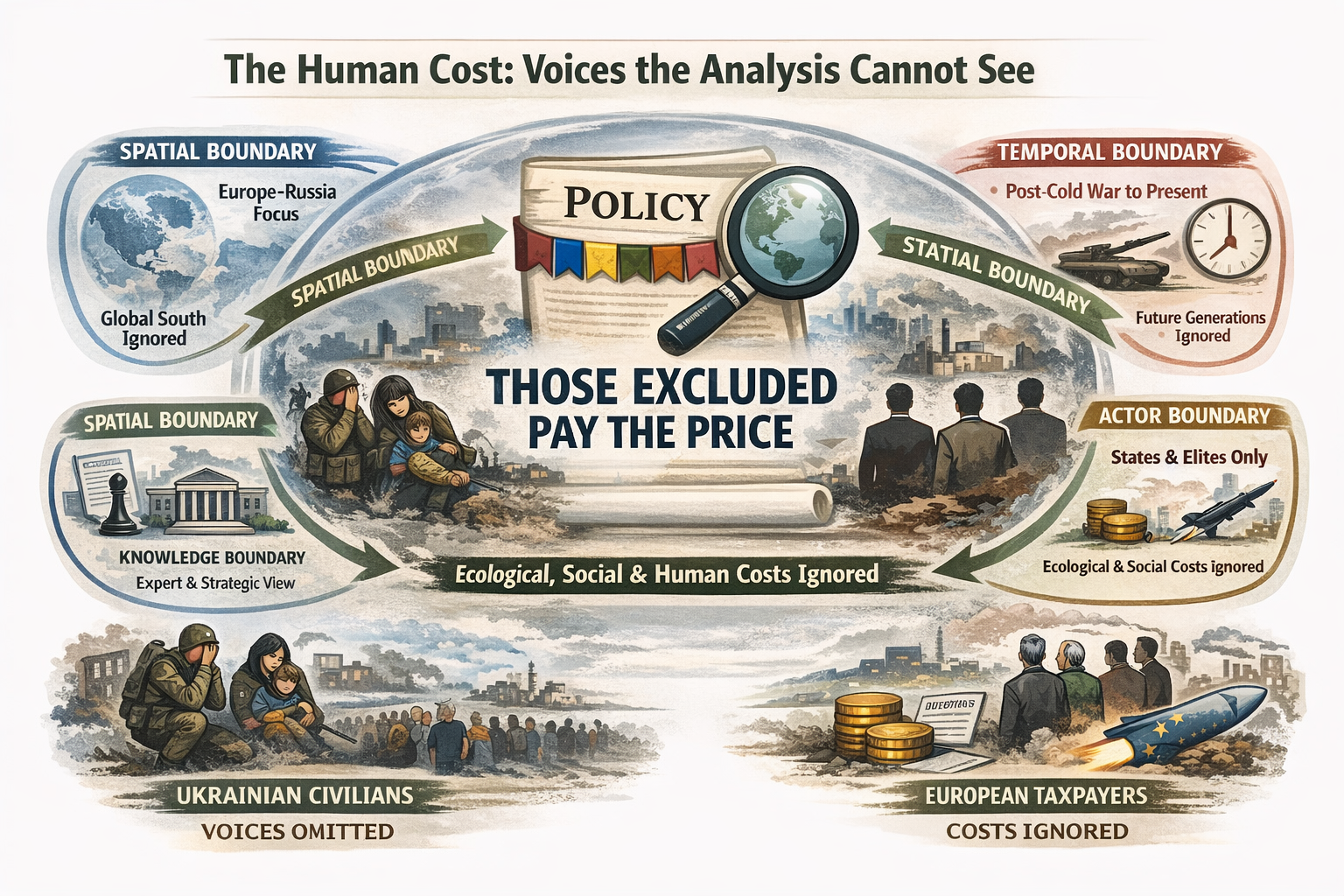
These boundaries produce clarity by subtraction. They reduce complexity, narrow the field of vision, and make decisive conclusions possible. But they do so by removing the very actors who bear the consequences.
Those within the frame—policy elites, security institutions, expert communities—remain central. Those outside it pay the cost.
The Deep Structure: Emergence, Boundaries, Isomorphism, Symbiosis
Beneath the surface, deeper dynamics are at work.
- Emergence – Russian threat perception is not a fixed product of geography and history. It emerges from interaction: NATO expansion, Western interventions, Russian domestic politics, elite signalling, and institutional incentives. It cannot be reduced to any single cause. By treating threat as given rather than produced, the analysis forecloses the possibility that changing interaction patterns could change outcomes.
- Boundaries – The exclusions identified above are not neutral constraints. They are analytical choices. Each boundary—spatial, temporal, sectoral, actor, knowledge—determines what enters the frame and what remains invisible. Different boundaries would produce different problems, different risks, and different policy options.
- Reasoning patterns – The argument is sustained by identifiable reasoning patterns. False dilemmas reduce the field of possible responses—opposing “realism” to “wishful” or “magical thinking,” leaving no space for alternative security frameworks. Circular reasoning protects the thesis from evidence—confrontation is assumed, and all developments are interpreted as confirming it. Appeals to authority elevate statements from institutional actors, such as intelligence officials, without examining the interests those institutions serve. These are not incidental flaws. They are mechanisms that stabilise the argument by narrowing what can be considered.
- Isomorphism – These reasoning patterns are not unique to this paper. They recur across domains—economic policy, environmental policy, social governance—where complex systems are reduced to binary choices that foreclose alternatives. Convergent logics emerge from shared structural pressures, not from explicit coordination.
- Constitutive symbiosis – The relationship between think tanks and the state is mutually reinforcing but asymmetrical. States fund, consult, and absorb think tank expertise; think tanks shape policy, define problems, and circulate personnel into government. Each influences the other. But the asymmetry matters: the state retains material power, while think tanks shape the frameworks through which that power is exercised.
Taken together, these elements form a system: reinforcing loops of threat and rearmament, weak balancing pressures, and a discourse–policy cycle that sustains the framework that produced them.
The Dynamics: Feedback Loops Driving the System
The paper operates not just through argument, but through structure. Its claims feed into a set of reinforcing and balancing loops that shape how policy is interpreted, justified, and sustained.
Three loops are particularly visible:
- Loop A (threat–rearmament). Western threat framing legitimises European rearmament. European rearmament is perceived in Russia as threatening. Russian threat perception intensifies. This, in turn, confirms the original Western framing. Further rearmament follows. This is a reinforcing loop—a self-amplifying cycle that drives toward permanent confrontation.
- Loop B (domestic opposition). Rearmament generates fiscal pressure. Fiscal pressure produces domestic opposition. Channeled through elections and political contestation, that opposition can moderate policy. This is a balancing loop—a potential brake. In the current configuration, it is weak: costs are diffuse, while security narratives remain politically dominant.
- Loop C (discourse–policy). Think tank analysis informs policy adoption. Policy produces material outcomes—military posture, alliance structure, threat perception. These outcomes confirm the original analysis, increasing demand for more of the same. This reinforcing loop sustains institutional relevance. Carnegie’s “Future of Russian Power” initiative sits directly within this dynamic and, if successful, will strengthen it.
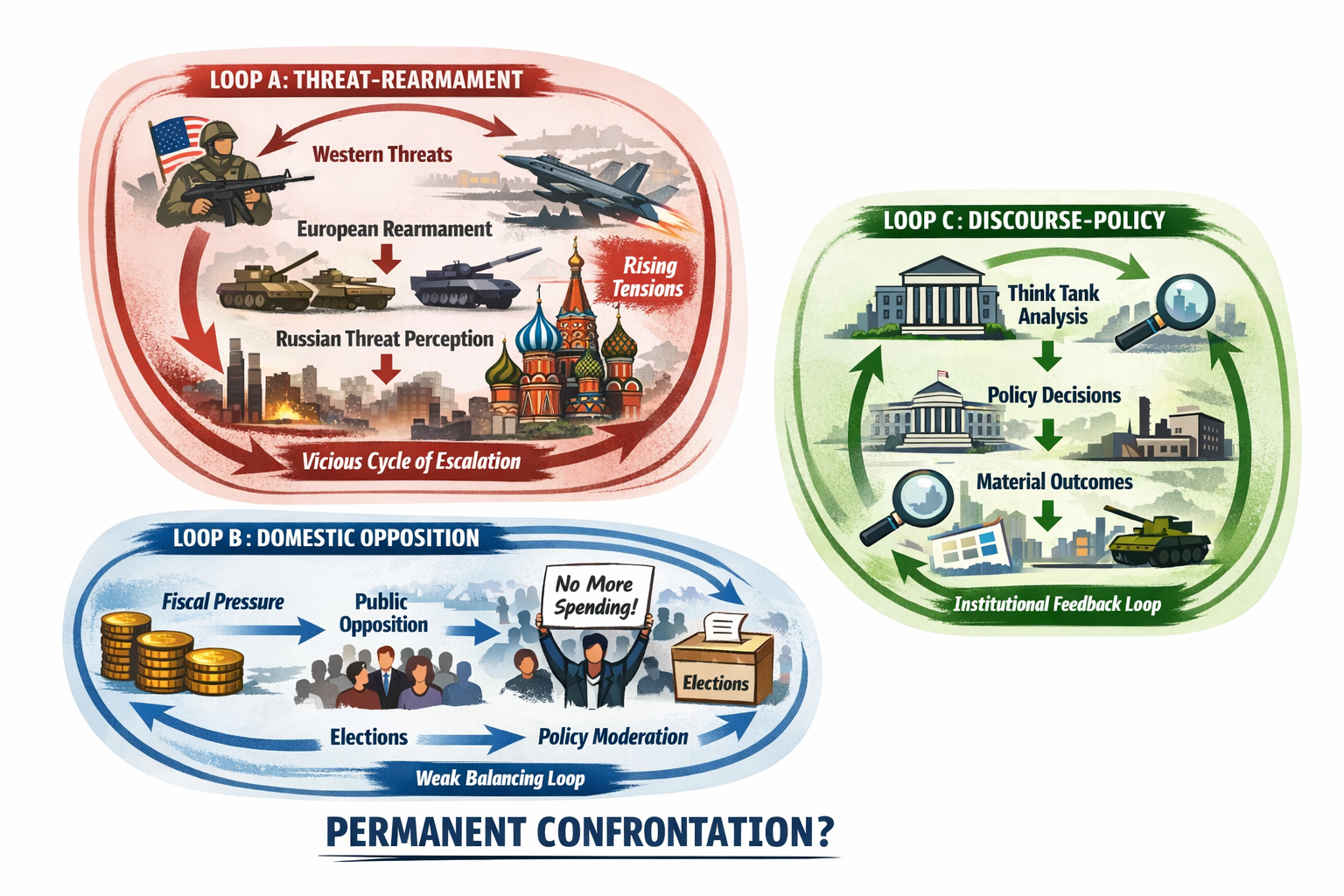
The paper’s recommendations—continued support for Ukraine, expanded European rearmament, and renewed emphasis on nuclear deterrence—act on this system asymmetrically. They intensify Loop A, weaken Loop B, and reinforce Loop C. The result is a system that becomes more internally stable even as it becomes more externally dangerous.
Where It Breaks: Contradiction, Concession, and Narrative Closure
The coherence of the paper depends on holding together claims that do not fully align. At several points, the argument strains against its own evidence—but those tensions are managed rather than resolved.
- Russia cannot change / Russia has changed
The paper asserts that “there is nothing in the Russian foreign policy record” to suggest the Kremlin will abandon its confrontational posture. Yet it also acknowledges both past transformation—perestroika—and the possibility that “a Putin successor will undertake such an opening.” Change is excluded as a premise, then reintroduced as a possibility. - Escalation described / responsibility displaced
The paper recognises that European rearmament and new nuclear arrangements would “radically worsen” Russian insecurity. The dynamic is clear: actions taken for defence generate threat perceptions in return. Yet Western policy is consistently framed as reactive, while Russian behaviour is treated as causal. Interaction is described, but not integrated. - Authority invoked / interests ignored
The paper cites Admiral Igor Kostyukov, head of the GRU, as evidence of Russian threat perception. His statements are treated as authoritative insight into Russian thinking. But his institutional position—within an intelligence apparatus whose function is to identify and elevate threats—is not examined. An interested actor is presented as neutral observer. - Nuclear danger acknowledged / deterrence reinforced
The paper recalls the Cuban Missile Crisis as evidence of how close nuclear dynamics have come to catastrophe. Yet it simultaneously reinforces deterrence as the foundation of stability, warning of Russia’s willingness to engage in “nuclear blackmail.” The same system is presented as both existential danger and necessary safeguard.
These are not incidental inconsistencies. They mark the points where the framework encounters dynamics it cannot fully absorb.
That tension becomes explicit near the end of the paper, where Rumer writes:
“It would be tempting to hope that the burdens of the war will force the Kremlin to adopt a more accommodating posture toward the United States and Europe. Presently, that is an unlikely or even improbable prospect. Nonetheless it is possible, even likely, that a Putin successor will undertake such an opening…”
This is not a minor qualification. It is a structural concession.
After insisting that Russia will emerge “unrepentant, vengeful, and more dangerous,” that expecting change is “not a realistic proposition,” and that the historical record offers “nothing” to suggest a shift—Rumer concedes that such a shift is not only possible, but likely.
The contradiction is immediate. If Russian behaviour is determined by geography and history, leadership change should not matter. Yet here, leadership becomes decisive.
The framework cannot resolve this. Instead, it contains it. Any future opening can be reframed as weakness rather than change—echoing the earlier claim that past shifts were “forced by catastrophic domestic weakness.” Accommodation is acknowledged only to be pre-emptively discounted.
At this point, the argument is no longer being tested against evidence. It is being insulated from it. The summary completes the frame by closing off alternative interpretations.
And this is where the Summary becomes decisive.
The Summary: A Masterclass in Managed Framing
The paper’s summary is not a digest of findings. It is the argument in its most concentrated form—every move compressed, every omission reinforced, every term placed for effect. It does not invite evaluation. It instructs interpretation.
The Opening Gambit: History Rewritten in a Single Sentence
“Having invaded Ukraine under the false pretext of needing to secure its western flank, Russia is poised to emerge from the war less secure, more resentful, and more threatening to Europe than before the war.”
The phrase “false pretext” does decisive work. It forecloses, in a single move, any inquiry into whether Russia might have had genuine security concerns—concerns documented in decades of Western strategic planning, publicly signalled NATO expansion, the 1990 assurances, the 2008 Bucharest declaration, the withdrawal from the INF Treaty, and the RAND Extending Russia framework discussed in my earlier series. All of this is rendered, by definition, false. The reader is not asked to weigh evidence, but to accept a moral classification.
The rest of the sentence performs the paper’s core move: Russia is framed as becoming “more threatening,” while the processes that may have contributed to that outcome remain outside the frame.
Geography Without Context
“Russian insecurity is rooted in a long history of confrontation with the rest of Europe… With the Cold War–era buffer… gone… Russia will face an array of hostile countries on its doorstep…”
Here, Russian perceptions are described with precision—while their origins are abstracted. NATO does not expand; it simply exists. The buffer does not dissolve through policy; it disappears. The reader is presented with geography, but not with the decisions that produced it.
The Nuclear Card
“The prospect of Europe… acquiring their own nuclear deterrents will add to Russia's already heightened sense of insecurity.”
The effect is similar. Russian insecurity is acknowledged, even predicted—but the conditions that make such proliferation thinkable are not examined. The cause recedes; the consequence remains.
The Successor Trap
“Nonetheless it is possible, even likely, that a Putin successor will undertake such an opening…”
This is the paper’s key concession—and it is immediately contained:
“When that happens, it is vital… not to be carried away with wishful thinking…”
The structure is clear. Change is acknowledged, then pre-emptively delegitimised. Any opening must be treated as suspect. The implication is not that change is impossible, but that it is unusable.
The argument becomes insulated from events. If Russia does not change, confrontation is justified. If it does change, confrontation remains justified.
The Civilisational Frame
“Their traditional views… are fundamentally at odds… The former are enshrined in the 1990 Charter of Paris… The latter are reminiscent of the 1815 Congress of Vienna…”
Here the analysis gives way to classification. The West is associated with democracy, rights, and cooperation; Russia with spheres of influence and imperial logic. The Charter of Paris appears as neutral reference rather than as a product of a specific geopolitical moment.
The effect is to naturalise one system while historicising the other.
What the Summary Does
Taken individually, these statements are difficult to contest. Russia did invade. Russia does possess nuclear weapons. European states are debating deterrence. The strength of the summary lies not in any single claim, but in their arrangement.
Together, they form a closed frame:
- Russia is threatening because it has always been threatening
- Western actions are responses, not drivers
- Change, if it occurs, is unreliable
- The only viable policy is sustained confrontation
What disappears is everything that would complicate this picture: the strategic planning discussed in the Extending Russia series, the role of Western policy in shaping the environment, the internal dynamics of contested regions, the populations living through the consequences, the possibility that security might be interactive rather than one-directional. The summary does not argue against these elements. It excludes them.
What results is not a summary of analysis, but a consolidation of perspective—a final narrowing of the frame through which the reader is invited to understand the conflict.
The Stakes: Who Pays, Who Benefits
The paper’s abstractions have consequences. If its logic is adopted as policy, those consequences are not theoretical—they are distributed.
- Continued human cost on both sides of the conflict, distributed asymmetrically. Ukrainian civilians bear the brunt—through casualties, displacement, emigration, and forced conscription—while Russian civilians experience the war more indirectly through mobilisation, inflation, and economic strain rather than systemic collapse.
- Increased European defence spending, financed through taxation, borrowing, and reallocation from social services. The costs are public; the benefits are not evenly shared.
- Nuclear modernisation that sustains a system the paper itself recognises as capable of catastrophic failure.
- Military emissions and resource use that accelerate ecological damage, borne disproportionately by future generations and the Global South.
- A condition of permanent confrontation that closes off alternative security arrangements before they can be meaningfully considered.
The beneficiaries of this system are not named in the paper, but they are not difficult to identify:
- Defence contractors whose revenues scale with threat perception
- Think tanks whose relevance depends on sustained demand for strategic analysis
- Policy professionals whose careers are tied to that demand
- Foundation funders whose grants require demonstrable policy impact
- Media systems that amplify and circulate threat narratives
These actors do not need to coordinate. They operate within a system that rewards alignment. The result is a structure in which threat sustains institutions, institutions sustain analysis, and analysis sustains threat.
Those outside this structure—civilians, taxpayers, future generations—bear the cost.
Where It Can Be Challenged
The system described is not monolithic. It depends on maintaining alignment between what it claims and what it produces. That alignment is not perfect.
Its vulnerabilities are visible.
- Opacity – Funding structures, once mapped, reveal the material base of what presents itself as neutral analysis.
- Naming – The absence of beneficiaries is itself a weakness. Once named, interests become contestable.
- Testimony – The exclusion of lived experience—Ukrainian civilians, Russian civilians, affected populations—creates an epistemic gap that cannot easily be contained once filled.
- Competing frameworks – Alternatives—common security, conflict transformation—exist, but are dismissed rather than engaged. Bringing them into view exposes the limits of the paper’s “realism.”
- Reasoning patterns – False dilemmas, circular logic, and appeals to authority lose force once identified. The argument depends on them remaining implicit.
- Boundaries – Spatial, temporal, sectoral, and actor boundaries are necessary for coherence—but they are choices. Redrawing them produces different conclusions.
- Network effects – The same institutional networks that ensure coherence also allow leakage—critique from within, divergence over time.
- Isomorphic convergence – When different analytical traditions produce identical policy outcomes, the question is not which is correct, but what has been excluded.
These are not external critiques imposed on the system. They arise from within it—from the same tensions, omissions, and contradictions traced throughout this analysis.
What Remains
What Carnegie produces—and what Rumer’s paper exemplifies—is not simply analysis, but a structured worldview: one in which threat appears inherent, confrontation appears inevitable, and alternatives appear unrealistic.
In the terms developed in the analysis above, the paper does not merely describe a security environment—it participates in its reproduction. Threat is treated as a fixed attribute rather than an emergent outcome of interaction; feedback loops of escalation are acknowledged but mis-specified; boundaries exclude the actors and experiences that would complicate the frame.
The result is a system that stabilises itself. Through its claims, its assumptions, its omissions, and its summary, the argument closes around a single conclusion: permanent confrontation is not a policy choice, but a condition to be managed. What is presented as realism is, in practice, a narrowing of what can be seen and said.
This is what gives the analysis its coherence. And its limits. Because the same structure that produces clarity also produces exclusion. Civilians are named but not heard. Western action is present but not causal. Change is acknowledged but pre-emptively discounted. The frame for holds—but only within the boundaries that sustain it.
Seen in this way, the paper is not an endpoint but an instance: one expression of a broader system in which analysis, policy, and institutional interest are mutually reinforcing. A system in which, as shown earlier, outputs become inputs—analysis informing policy, policy generating outcomes, outcomes confirming the analysis.
The question is not whether this system exists. It is what follows from recognising it. From that recognition, a different set of questions becomes possible:
- What would this report say if the voices of Ukrainian and Russian civilians—their security, their experiences—were taken as the starting point rather than elite abstractions?
- How does a report like this translate into policy—what pathways carry it from analysis into planning, messaging, and action?
- When and where do its effects become visible—on media narratives, budget decisions, and the battlefields of Ukraine and Europe?
- How do documents like this move through institutions—who reads them, who cites them, and how do they become embedded in policy decisions?
- Who gains from the consequences when this report becomes policy—and who pays the cost?
These questions do not come from outside the analysis. They emerge from within it—from the points where the framework narrows, where the evidence strains, and where the system must work hardest to maintain coherence. The fractures are already there. What remains is whether they are ignored—or used.
Published via Mindwars Ghosted.
Geopolitika: Tracing the architecture of power before it becomes the spectacle of history.
—
Methodology note: This analysis was conducted using a structured forensic protocol examining production systems, argument structures, worldview assumptions, network dynamics, and voice gaps. It draws on publicly available documents—the Carnegie Endowment's March 2026 paper “Belligerent and Beleaguered,” institutional records, author biographies, and historical sources. All claims are evidence-grounded and confidence-calibrated.
Mindwars Ghosted is an independent platform dedicated to exposing elite coordination and narrative engineering behind modern society. The site has free access and committed to uncompromising free speech, offering deep dives into the mechanisms of control. Contributions are welcome to help cover the costs of maintaining this unconstrained space for truth and open debate.
If you like and value this work, please Buy Me a Coffee