Geopolitika: Fabians Part 1. The Image on the Wall – A Curated Self-Portrait
The Fabian Society has been a shadow at the edge of my awareness for many years. I knew the basics—its links to the Labour movement, its famous members like George Bernard Shaw—but having never taken much interest in socialism or the Labour Party, I never looked closer. Following my earlier pieces dissecting think-tank outputs, I planned to do the same with a Fabian paper. Then curiosity pulled me deeper to ask:
“What exactly is this organisation?”
“What form of socialism is it actually espousing?” and finally
“What has socialism got to do with it anyway?”
This is the first part of a new series on the Fabians. It leverages a new custom analytic protocol designed to systematically deconstruct institutions—not just what they produce, but how they tick, what tensions they contain, and where their espoused positions diverge from what they actually do.
—
The Fabian Society does not hide its past.
On its website, under a section titled Our History, it presents a long narrative of its origins, its role in founding the Labour Party, and its influence on British politics. It names its most famous members—Sidney and Beatrice Webb, George Bernard Shaw—and describes its contribution to institutions such as the London School of Economics (LSE) and the New Statesman. It quotes Friedrich Engels on the society: “fear of revolution is their guiding principle.” It acknowledges, in a single sentence, that some of its early members “held racist prejudices” and engaged in debates on eugenics. It notes that views on the British Empire “varied.”
This is not a secret archive. It is a curated self-portrait, presented as transparency.
The question is not whether the Fabian Society hides its past. It does not. The question is what this transparency achieves—what the society chooses to emphasise, what it presents briefly and moves past, and how its own account of its history shapes what can be seen in the present. The society quotes its own critics. It names its own failings. And then it continues.
A Society That Defines Itself Through Its History
From the opening lines of Our History, the Fabian Society presents itself as an institution defined by continuity.
It describes itself as “Britain’s oldest political think tank,” a phrase that appears repeatedly across its materials. Its history is presented as a long arc of influence: from late Victorian intellectual circles, through the founding of the Labour Party in 1900, to the 1945 government, and into the present day. The narrative is one of steady contribution—ideas developed, institutions built, policies shaped.
History here does more than inform. It authorises.
By placing itself at the centre of key moments in British political development, the society frames its current role as the continuation of an established tradition. Influence appears not as something contested or achieved, but as something inherited. The past is not only described; it is used to explain why the society matters now.
But the society’s own history includes a voice that complicates this narrative. Friedrich Engels, writing in 1881, described the Fabians in terms the society now quotes on its website: “fear of revolution is their guiding principle.” Engels did not mean this as a compliment. Rather that the Fabians’ commitment to gradualism was actually containment, not principled patience—a way to channel working-class militancy into parliamentary reform managed by experts.
The society quotes Engels approvingly, as part of its historical record. It does not engage with his critique. The fear of revolution is presented as a historical fact about the society’s origins, not as a question about its present function. But the question lingers: what does it mean that an institution founded to contain revolutionary socialism now presents itself as the voice of the left?
Independence and Affiliation
Alongside this historical narrative, the Fabian Society presents its governance structure through a set of formal rules.
Two of these rules sit next to each other in a way that invites attention.
- Rule 2 states: “The Society shall be affiliated to the Labour Party.”
- Rule 3 states: “The Society as a whole shall have no collective policy… its research shall be free and objective in its methods.”
Both are presented without comment. Both are central to how the society describes itself.
Taken together, they establish a dual position. The society is formally part of the Labour Party’s institutional ecosystem, while also presenting its work as independent and non-binding. Its research is framed as objective, even as its affiliation places it within a particular political tradition.
The website does not attempt to resolve this tension. It simply holds both elements in place. A reader might ask: how can an institution be affiliated to a political party and yet have no collective policy? How can its research be “free and objective” when its governing structure ties it to one party’s electoral fortunes? The society does not answer these questions. It presents the rules as facts, not as tensions to be resolved.
Pluralism and Its Boundaries
A similar pattern appears in how the society describes its internal culture.
The Fabian Society presents itself as a space for “open debate,” where disagreement is “expected and respected.” It describes itself as a pluralist movement within the left.
But this openness is defined within clear boundaries.
Rule 4 limits full membership to those eligible for membership of the Labour Party.
This does not negate the claim of pluralism, but it specifies its scope. Debate takes place within a particular political tradition. The range of perspectives included is structured by that boundary. A member of the Green Party, a member of the trade union left who is not a Labour Party member, a socialist who believes the Labour Party has abandoned working-class politics—none of these can be full members of the Fabian Society.
Again, the webpages present both elements—the openness and the limit—without emphasising the relationship between them. The society does not ask what perspectives are excluded by its membership rules. It does not ask whether a left that claims to represent working-class interests should be open only to those who have joined a particular political party.
Acknowledgment and Distance
One of the most striking features of the Fabian Society’s self-presentation is how it handles its more difficult history.
The Our History page includes a direct acknowledgment:
“Leading members of the society held racist prejudices and opinions which were not in keeping with the society’s commitment to equality for all, either then or now. Fabians engaged in debates on eugenics and were racist towards people of Jewish, black and Asian origin. Views on the role of Empire varied amongst members, with some supporting rapid decolonisation and others seeing the British Empire as a potentially progressive force in the world.”
This paragraph is notable for its clarity. It names issues—racism, eugenics, empire—that many institutions avoid.
But it is also brief.
The society names eugenics but does not describe a single debate. George Bernard Shaw, its most famous early member, was a prominent advocate. In letters and speeches, he argued for “the elimination of the undeserving” and proposed that the state should manage human breeding. Sidney and Beatrice Webb, the society’s intellectual architects, held similar views. These were not peripheral opinions. The social engineering ideas present in the work of its founding members raise questions about how expertise is to be understood: if experts should manage the economy, why not manage the population?
What views on Empire “varied”? The society’s Colonial Bureau was established to “engage with questions of imperial administration and self-government.” It produced reports on how to transition colonies to self-government while preserving British interests. The view that Empire could be “a potentially progressive force” was not an eccentric opinion. It was the institutional position of the society’s Colonial Bureau.
The acknowledgment does not engage with any of this. It names the past and moves on. The effect is to create distance: these were views of their time, held by people who were otherwise progressive, and the society has moved beyond them. But the society does not ask what it means that its founding figures held these views. It does not ask whether the institutional logic of expert management—the belief that society should be governed by those who know best—is the same logic that produced these positions.
A Continuous Story
Across its historical narrative, the Fabian Society presents itself as a continuous institution.
Key moments are highlighted:
- The founding in 1884
- The development of early socialist ideas
- The role in Labour’s formation
- Contributions to the 1945 government
- Later involvement with Labour administrations.
Periods of tension or reduced influence receive less attention. The 1950s, when the society struggled to remain relevant after the Attlee government? Not explored. The 1970s, when Fabian ideas were under siege from the left and the right? Not explored. The society describes the 1945 Labour government as “an enormous Fabian School”—a quote from Zena Parker that appears on the website with evident pride. It does not ask what it means that the Labour Party is a school for Fabianism, or what it means that working-class representation is mediated through Fabian-trained experts.
The Corbyn period receives particularly careful treatment. The website states:
“After the 2015 election and the election of Jeremy Corbyn as Labour leader the role of the society as a pluralist, non-factional forum within the Labour movement came to the fore.”
This is a striking claim. During the Corbyn years, the society’s executive committee included Keir Starmer, Wes Streeting, Anneliese Dodds, and Rachel Reeves—all of whom were aligned with the wing of the party opposed to Corbyn and later went on to hold senior positions within it. The website presents this period as one in which the society functioned as a “pluralist, non-factional forum.” It does not ask what it means for a “non-factional forum” to include figures who were positioned on one side of a deeply contested internal conflict.
The overall impression is one of steady development rather than interruption or conflict. This does not make the narrative inaccurate. But it does shape how the institution’s history appears: as a largely unbroken trajectory of contribution.
How Influence Is Presented
Throughout the website, the Fabian Society’s influence is described in a particular way.
Its ideas are presented as having shaped policy. Its members are described as contributing to major political developments. Its role is characterised as that of a “critical friend” to Labour governments—supportive, but independent.
What is less developed is the mechanism by which this influence operates.
The website lists its executive committee, which includes current and former Members of Parliament. It describes its research outputs and events. It outlines its funding sources. But the relationship between these elements—how ideas move from the society into policy, how personnel circulate between the society and political institutions—is not elaborated in detail.
Influence is visible. Its pathways are less so.
The society does not ask how a “critical friend” that shares personnel with the government it critiques can maintain independence. It does not ask whether its research would be taken as seriously if its executive committee did not include sitting Labour MPs. It presents influence as the natural outcome of good ideas, not as the product of network position.
The Society as a Voice of Expertise
Across all sections of the website, a consistent image emerges.
The Fabian Society presents itself as:
- Experienced
- Evidence-based
- Democratically governed
- Open to debate
- Rooted in a long intellectual tradition.
Its history supports this image. Its rules reinforce it. Its language reflects it.
The society speaks as a voice of expertise—one that has accumulated knowledge over time and is positioned to contribute to public policy. What is expertise in this frame? It is never defined or contested. It is simply assumed as legitimate. The experts are those who have been trained in the institutions the society helped to found. The knowledge that counts is the knowledge produced by those experts. The working class is present in the society’s self-portrait only as abstraction—the population to be governed, not the source of knowledge about how to govern.
The Wolf in Sheep’s Clothing
The Fabian Society’s self-portrait—as painted on the website—describes an institution committed to open debate, to socialist principles, to the left. But its own chosen emblem suggests a different story.
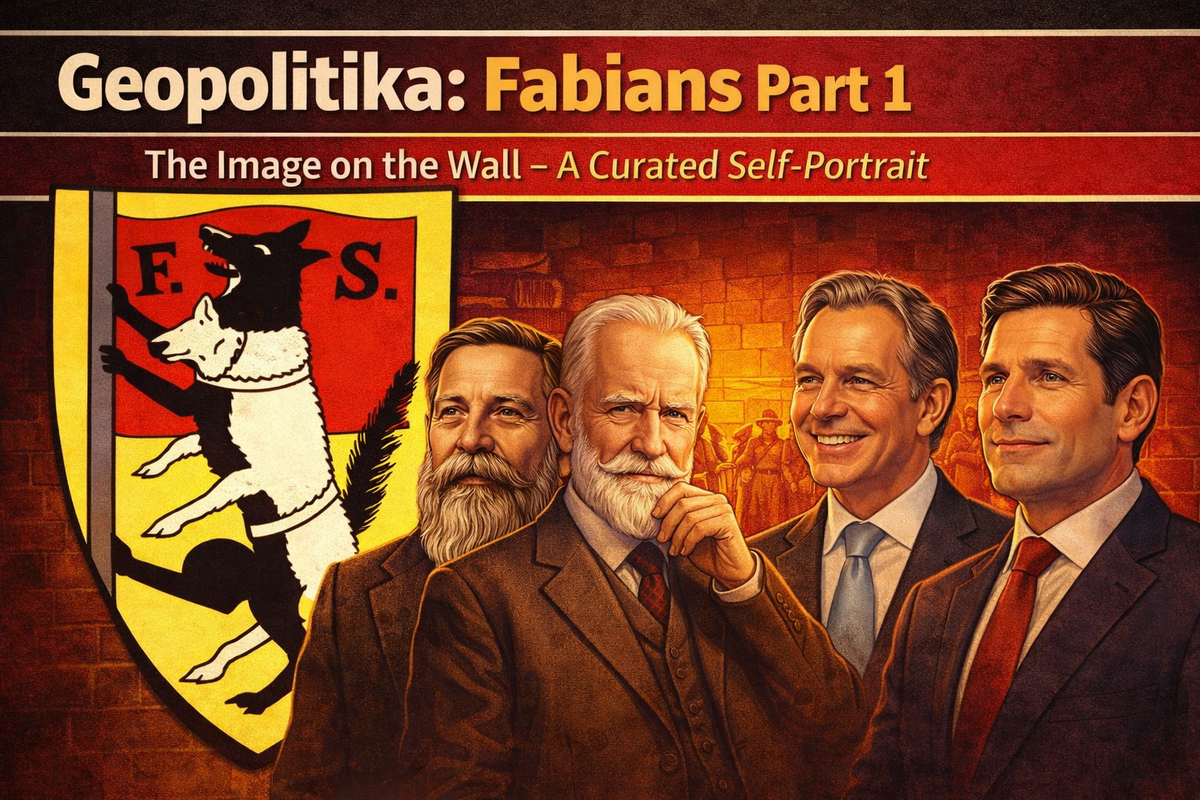
The society’s stained glass window—commissioned in 1910, installed in its former headquarters, now held in the LSE archive—depicts a wolf in sheep’s clothing. This is not a symbol the society hides. It is the emblem it chose. The wolf represents the revolutionary socialist tradition. The sheep’s clothing represents the patient, gradualist, respectable face the Fabians presented to the world.
The society’s founders did not pretend to be something they were not. They announced their strategy in glass and lead. They would enter the institutions of power—Parliament, the civil service, the universities—disguised as reformers, as experts, as the safe alternative to revolution. Their gradualism, on their own account, was a tactic.
The society acknowledges this in its history. It quotes Engels’ contempt. It does not ask whether the wolf remains in sheep’s clothing, nor does it ask whether the institution that chose as its emblem the image of concealment still practices the strategy the emblem represents.
The society’s website also does not explore what it means tha tits close political neighbour in the Labour ecosystem—Labour Friends of Israel (LFI)—operates in overlapping Westminster networks with shared personnel and political alignment on certain issues. The relationship is disclosed. Nowhere does it ask what this overlap means for its claim to be a voice for the left.
These are questions, not conclusions. The emblem hangs in the window. The relationship is disclosed. Later parts of this series will test whether these held contradictions remain stable when the society turns its attention to defence, devolution, NHS digitisation, and political delivery.
What This Self-Portrait Does
Taken together, the Fabian Society’s website constructs a particular kind of self-portrait.
It is an institution with a long history, a defined political affiliation, and a commitment to debate and research. It acknowledges aspects of its past that are difficult, but does not dwell on them. It presents its influence as the result of ideas and expertise. It describes itself as both embedded in a political tradition and independent of it.
These elements do not resolve into a single, simple picture. They sit alongside each other.
The society is affiliated and independent. It is open and bounded. It is continuous and evolving. It acknowledges its past and moves beyond it. It presents itself as a voice for the left while limiting membership to one faction of it. It claims pluralism while maintaining a proximity—of office, personnel, and political alignment—that it does not examine.
These contradictions are not necessarily failures. They may be structural features of an institution that has survived for 140 years by holding them in place. The self-portrait functions as a form of legitimising discourse. It invites the reader to see the society as a space of open debate, a voice of expertise, a continuous tradition. It does not invite the reader to ask what is concealed by this openness. It does not invite the reader to ask what agendas might be hidden behind the transparency.
The question for the rest of this series is whether the contradictions the society holds in place are stable, or whether they reveal something about the institution that the self-portrait cannot name.
The Questions That Follow
This is the Fabian Society as it presents itself. The portrait is displayed. The contradictions are visible. The questions that follow are not about whether this account is true or false. They are about what this way of telling its history—and structuring its identity—enables and forecloses. Later parts of this series will examine these questions in depth. For now, they are posed as openings:
- On continuity:
The society defines itself through an unbroken line from 1884 to the present. But what happens when a Labour leader emerges who is not a Fabian product? The website’s account of the Corbyn years is careful. What does carefulness reveal about the society’s commitment to pluralism? And what of the ruptures it does not name—the internal fractures, the alternatives it has contained? - On boundaries:
The society presents itself as a space for debate within a defined tradition. The Green Party, the trade union left, the socialist movements that do not centre parliamentary reform—these are its boundaries. But the boundaries are also within the Labour Party. What does its overlaps with the Labour Friends of Israel mean for what can be said within the tradition the society claims to represent? - On influence:
The society describes its influence as the product of ideas. But its executive includes sitting MPs. Its staff circulate into the Labour leader’s office. Its outputs are timed to Labour conferences. What does this architecture of partisan power reveal about how influence actually operates? - On the men it produces:
Blair addressed the society in 1995. Starmer was a member of its executive before becoming Labour leader. Both are Fabian products. Both became prime minister. Both governed within boundaries the society helped define. What does it mean that its schools produce leaders who manage the establishment rather than challenge it? - On the eugenic inheritance:
Shaw advocated eugenics. The society acknowledges this. But what became of this logic? Was it abandoned, or did it take new forms? What does it mean that the society’s operating system—the belief that experts should manage society—produced both the Colonial Bureau and the institutions that followed? - On socialism:
The society calls itself socialist. But what is socialism in its hands? Is it working-class power, or expert management? Is it transformation, or administration? Is it solidarity with the colonised, or the management of decolonisation? - On the wolf:
The society chose as its emblem the wolf in sheep’s clothing. What does it mean that an institution founded on a strategy of concealment now presents itself as a voice of transparency? What does it mean that the left has accepted the sheep’s clothing as the institution’s true face? And what would it mean to ask what the wolf has been doing all these years?
These are questions, not conclusions. They will guide the rest of this series. The portrait hangs on the wall. The contradictions are visible. The inquiry has only just begun, follow along as we dig deeper into the Fabians...
Published via Mindwars Ghosted.
Geopolitika: Tracing the architecture of power before it becomes the spectacle of history.
—
Methodology note: This analysis draws on publicly available materials from the Fabian Society’s website, including its Our History page, governing rules (Rules of the Fabian Society), executive committee biographies, and related publications. The approach is forensic: it examines institutional self-presentation, argument structures, historical selectivity, network disclosures, and the gaps between what is claimed and what is examined. All sourced material is accessible at fabians.org.uk.
Mindwars Ghosted is an independent platform dedicated to exposing elite coordination and narrative engineering behind modern society. The site has free access and committed to uncompromising free speech, offering deep dives into the mechanisms of control. Contributions are welcome to help cover the costs of maintaining this unconstrained space for truth and open debate.
If you like and value this work, please Buy Me a Coffee