Geopolitika: Fabians Part 2. The Architect and the Rupture – How G.B. Shaw Built and Then Destroyed the Early Fabian Mythos
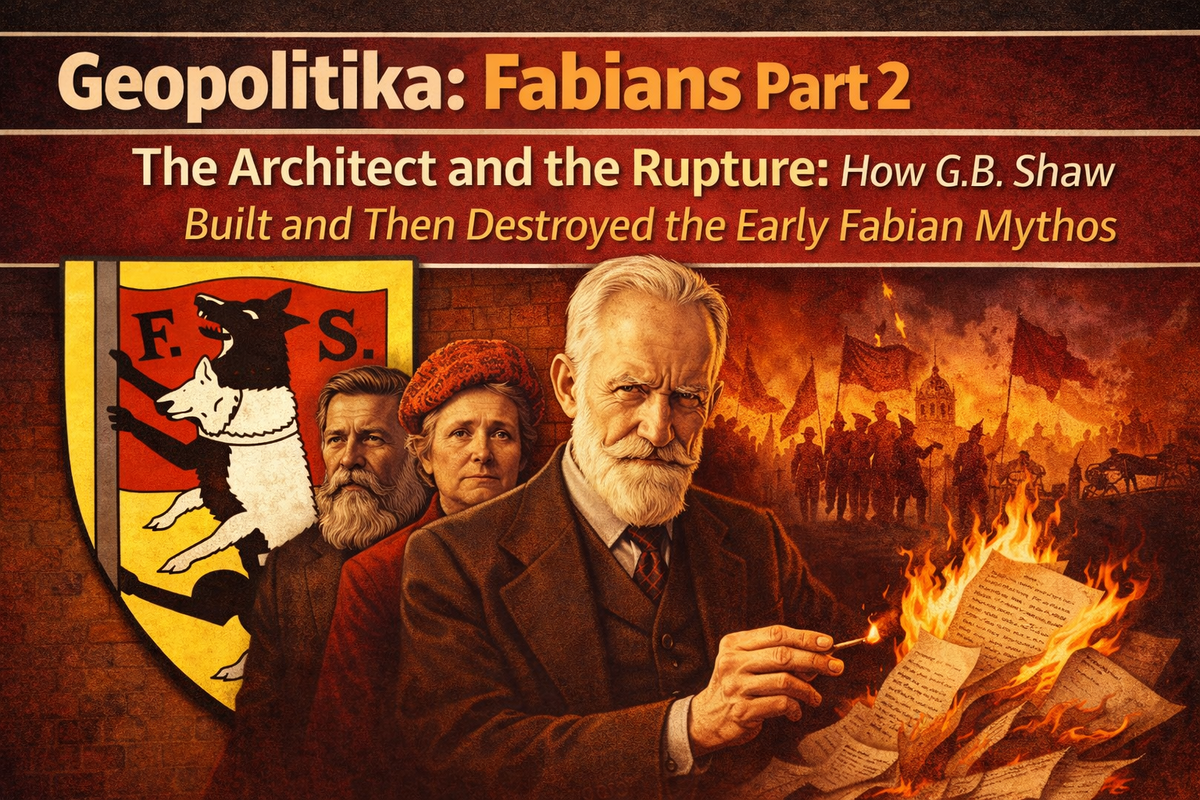
Following the curiosity that pulled me from “one paper” to “what exactly is this organisation” in Part1, I turned to the man who more than any other shaped its early self-image—G.B. Shaw.
This is not an academic exposé or a life-and-times biography of the man. People who want that should look to Wikipedia or any of the many excellent books and articles already written about George Bernard Shaw and his works. What follows is something narrower and, I think, more useful for the series: an exploration of his specific role in constructing—and ultimately rupturing—the Fabian mythos.
What I found was not a steady evolution but a more unstable arc: one of creation, consolidation, and eventual strain. In less than fifteen years, Shaw wrote himself into the role of the Fabian Society’s chief mythmaker, its historian, and finally a figure who pushed its assumptions into uncomfortable territory. By 1903, the man who had argued that socialism would come through patient, constitutional reform was advancing a far more unsettling vision of how society might be shaped. The movement from the Fabian Essays to the Revolutionist’s Handbook is not a straight line but a rupture—and within that rupture lies a question about what happens to progressive politics when its faith in democratic process begins to falter.
Act 1 – 1889: The Scientific Myth
“The Basis of Socialism: Economic”
In 1889, the Fabian Society published a volume of essays designed to do what no socialist text had quite done before: make socialism sound like science. The opening essay was Shaw’s, and it began with a declaration of method disguised as scene-setting.
“Thus is Man mocked by Earth his step-mother, and never knows as he tugs at her closed hand whether it contains diamonds or flints, good red wheat or a few clayey and blighted cabbages.”
The earth is not a neutral object to be studied. It is a “step-mother,” a deceiver, a closed hand hiding treasure or trickery. The passage does not argue; it reveals. Shaw is not presenting a theory for debate. He is unveiling a hidden truth.
Then he introduces his method:
“Let us, in the manner of the Political Economist, trace the effects of settling a country by private property with undisturbed law and order.”
A lone pioneer arrives on a vast green plain. He chooses the most fertile land, stakes his claim, and works it. Others follow, taking what land remains. Soon the best soil is all claimed, and later arrivals must work the poorer ground. The difference between what the first settler produces and what the last settler produces—that difference is rent. It is unearned, a gift of nature and circumstance. Over time, the landlord skims this rent, living idly on the labour of others. The workers who can no longer afford land must sell themselves—their labour, their time, their lives—to those who own it.
The story was elegant, memorable, and a highly abstracted account that removes historical contingency. Shaw acknowledges in passing that “cultivation did not begin in Western Europe with the solitary emigrant pre-empting his private property.” But he offered the fable anyway, because it made the logic visible. What he did not acknowledge was what the narrative leaves out—and renders invisible: the centuries of violence—the Enclosure Acts that drove peasants from common land, the colonial plunder that enriched British landlords, the laws that made working-class organising a crime—that created the conditions he described as natural.
Notice what Shaw’s opening line does. By setting the scene with “undisturbed law and order,” he strips the narrative of all political struggle. There are no enclosures, no soldiers evicting families, no parliament passing laws to criminalise the poor. The process appears clean, logical, and—by framing it “in the manner of the Political Economist”—scientific.
Shaw’s narrative relied on a classic false-cause pattern. His story implied that because the pioneer claimed the best land (A), and because later, with growing population, rent emerged and a proletariat was formed (Z), the former was the direct and inevitable cause of the latter. This is not history; it is deduction disguised as history. It transforms a complex, contingent process into an inescapable logic—and in doing so, it creates a powerful sense of inevitability.
Shaw reinforced this with a calculated appeal to authority. He quoted a litany of economists—Ricardo, Mill, Fawcett, Marshall—as if their consensus were unbroken and their authority unassailable. He did not mention that these same economists were in dispute with one another, or that many of them used the same tools to defend the system he attacked. He weaponised their authority against them, but he also borrowed their credibility. The move was brilliant and, in its way, strategically selective.
The “science” Shaw deployed had its own language. When he explained that “the exchange value, in fact, decreases with the supply,” he was performing economics, not simply stating it. The declarative authority of the sentence—“in fact”—sweeps aside doubt. Shaw was not arguing with economists; he was speaking as one.
The history Shaw omitted was the history of state violence. The Enclosure Acts—which from the 16th to the 19th centuries dispossessed English peasants of their common land, turning them into a landless proletariat by force of law—are absent. Colonial plunder is absent. The slave trade is absent. The brutal laws that made working-class organising a crime are absent. What remains is a clean, abstract system, governed by laws that function regardless of who holds power.
And the voices that are missing are the voices of those Shaw claimed to speak for. The “proletariat,” the “match-box maker,” the “white slaves” of the sweater’s den—all are described in detail, but none are quoted. The “match-box maker” appears as a figure of suffering, a prop in a moral drama, but she never speaks. She is spoken about, never from.
This abstraction served a larger rhetorical purpose: “Riches are not Wealth.” The distinction allowed Shaw to dismiss the prosperity of capitalism as mere accumulation of “frippery,” “tainted class literature,” “poison and mischief,” while claiming that true wealth—the welfare of the people—was being destroyed. It was a rhetorical move that allowed him to have it both ways: to acknowledge material abundance while denying it counted.
Then came the pivot. After pages of abstract economic reasoning, Shaw turned to the reader directly:
“It was terrible to feel this, and yet to fear that it could not be helped—that the poor must starve and make you ashamed of your dinner—that they must shiver and make you ashamed of your warm overcoat.”
The science gave way to moral outrage. The “deplorably simple” explanation of wages—the matter Shaw had promised to reveal—was not an end in itself. It was the foundation for a sermon. The reader was not merely being informed; he was being shamed.
The essay performed what might be described as a form of epistemic capture. It took the tools of the enemy—the “laws” of political economy—and used them to dismantle the enemy’s own ideological fortress. It transformed a moral and political argument against capitalism into a seemingly apolitical, “scientific” discovery. It positioned socialism not as a radical departure but as the true and logical conclusion of the science itself. And it positioned the Fabians—the experts who understood these laws—akin to a new scientific authority, the only ones who could guide society toward a just order.
The essay’s final lines were not about rent or value or wages. They were about the reader’s conscience:
“It is to economic science—once the Dismal, now the Hopeful—that we are indebted for the discovery that though the evil is enormously worse than we knew, yet it is not eternal—not even very long lived, if we only bestir ourselves to make an end of it.”
The argument was never only about economics. It was about converting the reader—making him see, making him feel, making him act. The science was the vehicle. The destination was a new kind of politics: one led by those who understood the laws, who could see what others could not, who could guide the masses toward a future they could not imagine for themselves.
Act 2 – 1892: The Institutional Myth
“The Fabian Society: Its Early History”
Three years after the Fabian Essays, Shaw delivered a paper at a conference of provincial Fabian societies. Its declared purpose was to inform members of the society’s history. Its function was to establish the official narrative of the society’s evolution, justify its current strategy, and distinguish it from its rivals—especially the Social Democratic Federation.
The opening line established the claim that would underpin everything that followed:
“The Fabian wisdom, such as it is, has grown out of the Fabian experience.”
Wisdom, Shaw insisted, was not a gift of intellect or a matter of political principle. It was earned. The Fabians had been foolish, and they had learned. The story that followed would be a story of maturation—a movement from youthful folly to sober pragmatism, from abstract idealism to concrete strategy. Experience was the teacher. The lesson was “permeation.”
The story Shaw told was clean and self-assured. The early Fabians, he explained, had been foolish idealists. They had flirted with anarchism, debated whether money should be abolished, and talked revolution while sitting in each other’s drawing rooms. But they learned. By the late 1880s, they had discovered the only sensible strategy for social change: “permeation”—the quiet, patient work of infiltrating existing political parties and shifting them from within. Meanwhile, their rivals, the Social Democratic Federation, remained trapped in sectarian error, denouncing the Liberals while taking money from the Tories, staging street protests that went nowhere.
The argument was structured as a false dilemma. Either you work within existing parties (Fabian “permeation”) or you form an isolated, sectarian party of the proletariat (the SDF). There was no middle ground, no possibility of a socialist party that worked with labour unions, no path that built independent working-class power while engaging with the state. The false dilemma forced the reader to choose between two starkly opposed poles, and because the SDF had been caricatured as foolish and sectarian, the Fabian choice became the only sensible one.
Shaw reinforced this with an appeal to authority dressed as modesty. He argued that the workers should choose their own leaders—except when a middle-class candidate had given “special proofs of his ability.” The proof of ability was implicitly defined by Shaw and his circle. This allowed him to position the Fabian leadership as the disinterested experts who were the exception to the rule, simultaneously flattering working-class readers (by urging self-reliance) while asserting his own right to lead.
The history Shaw told was a masterpiece of selectivity. He included the “Tory Gold” affair of 1885 and presented it as a moral failure. What he omitted was the SDF’s own strategic rationale: that the Tories and Liberals were both enemies of the working class, and that taking money from one to embarrass the other was a legitimate tactic in the class war. He erased their strategic logic, leaving only a morality tale.
He included the unemployed agitation of the 1880s but reversed its causality. The agitation, he claimed, “cleared the way for Fabianism.” In reality, the agitation was a grassroots movement from which the Fabians were largely absent. It ended not because Fabian wisdom triumphed but because trade revived. Shaw presented the end of the crisis as a result of the Fabians’ latent presence, giving his society a heroic role it did not play.
He excluded entirely the internal conflicts within the Fabian leadership. The absorption of the Fabian Parliamentary League—a rival internal body—was presented as a painless, natural merger. The personal and ideological disagreements between Webb, Shaw, and Annie Besant were never mentioned. The history was curated to show a clean, linear path toward a unified, pragmatic centre.
The rhetorical architecture of the tract was designed to naturalise this story. Shaw described the Fabians’ debate with anarchists not as a contest of ideas but as an operation:
“We demolished Anarchism in the abstract by grinding it between human nature and the theory of economic rent.”
The language transformed a complex political philosophy into a static object—something that could be grasped, processed, and discarded. The Fabians were not arguing with anarchists; they were performing science. They were the Sage, the wise elder, whose intellectual tools crushed the naive Innocent or the deceptive Trickster. The image was clinical, authoritative, and deeply self-flattering.
The deeper narrative followed the archetype of the Hero’s Journey. The Fabian Society started naive, faced trials, learned from experience, and defeated its rivals through superior wisdom. This narrative arc naturalised the Fabian strategy as the culmination of a heroic journey of learning, rather than one choice among many. It made their current position seem like the inevitable outcome of maturity and experience.
And what was the goal of that journey? Shaw’s finale was less a conclusion than a promise:
“Give us hundreds of thousands, as you can if you try hard enough, and we will ride the whirlwind and direct the storm.”
The image was deliberately chosen. The whirlwind was the chaos of politics, the storm the energy of the masses. The Fabians would not be swept away; they would ride the forces others could not control. They would direct, not be directed. The Sage would become the ruler.
The tract’s function was to enforce a particular version of the past to secure a particular version of the future. It was internal narrative, designed to align provincial societies with the London leadership’s strategy. And it worked. The narrative Shaw constructed became the official history of the Fabian Society, shaping how the organisation understood itself for generations.
What the tract did not say was that the “old gang” who ruled the society—Webb, Shaw, and their circle—had come to that position not through organic consensus but through strategic consolidation. The Parliamentary League had been a concession to members who wanted more direct political action. Its disappearance was not a natural merger but the quiet absorption of a rival faction. The history was curated, and the curation served a purpose: to make the leadership’s power seem inevitable, its strategy the only mature choice, its critics naive children who had not yet learned what experience would teach.
The tract was a work of mythmaking. It transformed a contested political history into a morality tale. It turned a strategic choice into a journey of maturation. And it positioned a small group of intellectuals as the sages who had earned the right to lead—not by election, not by mandate, but by wisdom, proved by experience, validated by science, and sealed by the story they told about themselves.
Act 3 – 1903: The Rupture
“The Revolutionist’s Handbook and Pocket Companion”
In 1903, Shaw appended a strange document to his play Man and Superman. It was called The Revolutionist’s Handbook and Pocket Companion, and it was supposedly authored by the play’s protagonist, John Tanner, a self-described “Member of the Idle Rich Class.” But the voice was unmistakably Shaw’s—and the message was unlike anything he had written before.
The Handbook was a work of systematic demolition. It attacked every existing political and moral framework: democracy, socialism, liberalism, Christianity, philanthropy, even conventional revolutionism. The opening aphorisms set the tone—sharp, dismissive, designed to shock:
“Democracy substitutes election by the incompetent many for appointment by the corrupt few.”
The line did not argue. It pronounced. Democracy was not a flawed system in need of reform; it was a fraud, a substitution of one kind of failure for another. The claim was structured as a false dilemma: either the corrupt few (aristocracy, oligarchy) or the incompetent many (democracy). There was no possibility of a competent many, no space for democratic education or organising. The choice was between two forms of unfitness, and the reader was left to conclude that neither could govern.
Then came the central claim, the one that would define the Handbook’s place in Shaw’s corpus:
“The only fundamental and possible Socialism is the socialization of the selective breeding of Man.”
The sentence was a bombshell. For fourteen years, Shaw had argued that socialism meant the collective ownership of land and capital, the redistribution of rent, the gradual, constitutional transformation of the economy. Now he declared that the only socialism that mattered was eugenics. Economic reform was a sideshow. The real revolution was biological.
But the Handbook did not merely dismiss economic socialism. It offered a diagnosis of why the Fabian project had failed—or rather, why it had been tolerated. The Fabian Society, Tanner/Shaw observed, was well-regarded by the establishment not because the public intended to adopt its policies, but because the establishment believed the Fabians had removed the element of intimidation from the Socialist agenda. As Tanner/Shaw wrote in the Handbook:
“Why are the Fabians well spoken of in circles where thirty years ago the word Socialist was understood as equivalent to cut-throat and incendiary? Not because the English have the smallest intention of studying or adopting the Fabian policy, but because they believe that the Fabians, by eliminating the element of intimidation from the Socialist agitation, have drawn the teeth of insurgent poverty and saved the existing order from the only method of attack it really fears.”
The insight was sharp. The Fabians were tolerated not because their ideas were gaining ground, but because they were perceived as harmless. Their constitutional, moral, economic methods—the patient work of “permeation,” the appeals to expertise, the faith in gradual reform—had made socialism safe for drawing-room discussion. The establishment was not being persuaded; it was being reassured.
But Tanner/Shaw did not stop there. If the nation were to actually adopt Fabian policy, he argued, it would require the same coercion as any other system:
“Of course, if the nation adopted the Fabian policy, it would be carried out by brute force exactly as our present property system is. It would become the law; and those who resisted it would be fined, sold up, knocked on the head by policemen, thrown into prison, and in the last resort ‘executed’ just as they are when they break the present law.”
The point was not that Fabianism was secretly violent. It was that all systems of law rely on force. The establishment’s tolerance of the Fabians was not a sign of their success but of their perceived irrelevance. They were being “patted on the back,” Tanner/Shaw wrote, while a Socialist who honestly stated that a revolution requires force was denounced and imprisoned. The contrast revealed the hypocrisy of those in power: they feared the militant socialist who told the truth about coercion, but welcomed the constitutional socialist whose methods were an illusion.
The argument was structured as a false dilemma, but the poles had shifted. Now the choice was between the failed project of democratic reform (which leads inevitably to decay) and the radical alternative of eugenic breeding (which offers the only hope of salvation). The urgency was manufactured by the looming threat of “national suicide” and civilisational collapse.
The reasoning pattern that did the heaviest lifting was the naturalistic fallacy. Shaw argued that what was “natural”—the evolutionary process of selection, the “voice of Nature”—was good and should be consciously imitated and accelerated by human policy. He argued for breeding humans as we breed animals, because this was “what Nature does.” This move naturalised a highly specific, culturally constructed program of social control, presenting a political choice as a matter of aligning with natural law and immunising it from moral critique. If “Nature” demanded selective breeding, then opposition was not just wrong but unnatural.
The term “Superman” was a floating signifier—a rhetorically powerful but undefined label that attracted all the positive connotations of “super” (superior, superhuman) while being vague enough to evade criticism. Shaw acknowledged this vagueness, noting that “you do not know what sort of man you want.” But the vagueness was strategic. The word itself did the rhetorical work, promising a solution without specifying it, functioning as a mythic figure onto which the reader could project their own desires for a better world.
The historical argument was a selective polemic. Shaw included the Reform Bill of 1832 (presented as achieved only by threat of violence), the Crimean War and Boer War (as evidence of no progress in governance), and the history of cruelty (flogging, torture) as evidence of unchanging human nature. He excluded the abolition of slavery, the Factory Acts, the expansion of suffrage, the rise of trade unions—any evidence of moral or political progress was systematically omitted. The claim was that “Man, as he is, never will nor can add a cubit to his stature by any of its quackeries.” The claim was structured to be unfalsifiable: any evidence of improvement could be dismissed as “illusion.”
The appropriation of Nietzsche was telling. Shaw took Nietzsche’s concept of the Übermensch—an aesthetic and philosophical ideal of individual self-overcoming—and transformed it into a program of state-sponsored eugenics. He did not engage with Nietzsche’s critique of the state or his emphasis on individual will to power. He stripped the concept of its complexity and repurposed it for a political project that Nietzsche would likely have rejected. The omission allowed Shaw to appropriate the powerful term “Superman” while discarding the philosophical nuances that might complicate his own program of social control.
The voice gap in the Handbook was at its most extreme. The “riff-raff,” the “unfit,” the “sterilized”—these were the people to be managed, selected, and ultimately superseded. They were objects, not subjects. Shaw made this explicit in a line that revealed the dehumanisation at the text’s core:
“We must eliminate the Yahoo, or his vote will wreck the commonwealth.”
The reference was to Swift’s Gulliver’s Travels, where the Yahoos were the brutish, degraded humanoids ruled by the rational horses, the Houyhnhnms. But Shaw was not writing satire. The line was a demand. The “Yahoo”—the ordinary man, the democratic voter, the “riff-raff”—was not to be educated, organised, or persuaded. He was to be eliminated. The text claimed to speak for the future of the race, but the people it designated as “unfit” were given no voice, no agency, no interests worth considering. They were defined solely in terms of their lack—health, intelligence, “fitness”—and their threat to the social order. This was not under-representation; it was the constitution of a population as a problem to be solved through its own elimination from the breeding pool.
Then came the pivot from philosophy to political program. The Handbook had spent its pages demolishing existing frameworks. Now it gestured toward what should replace them:
“The matter must be taken up either by the State or by some organization strong enough to impose respect upon the State.”
The language was careful—“impose respect”—but the meaning was clear. The breeders would not persuade. They would compel. The “organization strong enough” would not be a political party accountable to voters. It would be something else, something above democracy, something that could command the State itself. The authoritarian blueprint was drawn in outline, waiting to be filled in.
The text’s aphorisms reinforced the message. “Every man over forty is a scoundrel” was not a joke about middle age. It was a rejection of experience, of the slow accumulation of wisdom that Shaw had celebrated in the Fabian Essays and the institutional history. The Sage of 1889 and 1892 had become the iconoclast of 1903, dismissing not only his rivals but his own earlier self.
The Handbook represented a radical departure from everything Shaw had written before. The faith in democratic, gradualist, technocratic socialism—the faith that had animated the Fabian Essays and the institutional history—was gone. In its place was an anti-democratic, elitist, eugenicist philosophy that saw biological evolution, not political change, as the only arena that mattered. The same rhetorical toolkit—false dilemmas, selective history, voice omission, the deployment of archetypes—was deployed, but the target had shifted. In 1889, the target was capitalism. In 1892, the target was the SDF and other socialist rivals. In 1903, the target was democracy itself.
But the Handbook also turned its critique inward, toward the movement Shaw had helped build. The Fabians were tolerated not because they were winning, but because they were harmless. Their patient, constitutional methods were an illusion—not because they were secretly violent, but because they had mistaken the establishment’s tolerance for progress. The Revolutionist, in Tanner’s telling, was not the reformer working within the system. He was the prophet crying in the wilderness, the lone voice of truth, the man who saw that ordinary people could not govern themselves and that the only hope for civilization was to replace them.
The journey that began with the pioneer and the landlord, that passed through the “permeation” of the Liberal Party, ended here: with the demand that the unfit be eliminated, the state be placed in the hands of those strong enough to command it, and the movement Shaw had helped create be dismissed as a distraction from the only revolution that mattered.
Meta-Conclusion
Shaw’s method complicates any simple reading of the trajectory. His writing is theatrical, often ironic, frequently provocative, and deliberately paradoxical. At the same time, he was not alone: the Fabian Society contained a range of positions, including those of the Webbs and Besant, whose approaches to socialism, administration, and empire differed in important ways. Nor were these debates unique to the Fabians. They formed part of a wider late Victorian intellectual landscape shaped by evolutionism, social Darwinism, and competing visions of reform. Set against that context, Shaw’s arc appears less as an isolated aberration than as a particularly sharp expression of tensions already present within the Fabian project.
Across these three texts, Shaw traces an arc from democratic, gradualist, technocratic socialism toward a far more unsettled and, at points, explicitly anti-democratic horizon. The same rhetorical toolkit—false dilemmas, selective history, voice omission, the deployment of archetypes—is deployed throughout. But the target shifts: from capitalism, to rival socialist movements, and finally to democracy itself. What changes is not the method, but the object to which it is applied.
The early Fabian mythos that Shaw helped build does not collapse neatly into this later position, but it does not sit comfortably alongside it either. It rests on a set of assumptions—that an intellectual elite can guide society toward a rational order, that expertise can stand in for representation, that the path to justice lies in the patient management of existing institutions—which, under pressure, begin to show their limits. When those assumptions are strained—when democracy proves unpredictable, when reform appears too slow, when the relationship between leaders and led becomes unstable—Shaw’s later writings push beyond the earlier framework rather than resolving it.
The result is not a straight line but a destabilisation. The figure who had helped construct Fabianism’s intellectual and institutional self-image becomes, in the Revolutionist’s Handbook, a voice that exposes its tensions in their most extreme form. The faith in democratic gradualism is no longer secure; the role of the expert is no longer clearly bounded; the relationship between progress and control becomes harder to disentangle.
What emerges is not a settled doctrine, but a problem. How does a politics grounded in expertise relate to democracy when the two come into conflict? What happens when those who claim to guide society lose confidence in the capacity of society to guide itself?
These questions are not resolved in Shaw’s work. But they remain—and they mark the point at which the Fabian project begins to fracture under its own assumptions.
The Fracture and the Questions That Remain
What does this arc actually mean for the Fabian Society itself? How does the 1903 rupture sit alongside the Sage myth the institution still projects in 2026—the patient, evidence-based, pluralist voice of British socialism?
The eugenicist turn is not easily separable from the assumptions that had underpinned the early Fabian mythos—faith in expert guidance over messy democratic contestation. In Shaw’s work, those assumptions are not abandoned, but pushed into a form where their limits become visible. The same commitment to rational administration and intellectual authority that structured the earlier Fabian project appears here in a more extreme register, raising questions about how stable that framework was to begin with.
This is not simply a historical curiosity. It points to a deeper question within the Fabian project itself. What happens to a politics grounded in expertise when it encounters forms of democratic expression it cannot easily accommodate? How does a framework built on guidance and management respond when those it seeks to guide begin to act independently? How does the Sage self-portrait hold up when those voices organise, speak, and demand a politics that does not route through Fabian expertise? And what does it mean for the Labour Party—and for the left more broadly—that part of its intellectual inheritance was shaped in a moment when one of its central figures began to question the capacity of the people he claimed to serve?
These questions are not answered in Shaw’s work. Nor are they resolved in the society’s own account of its history. But they mark a point of tension that persists.
Gradualism in Shaw’s writing is never directionless. It moves toward a rationally administered social order, guided by those who claim to understand it. But the destination is defined more by the authority of those guiding the process than by any clear account of who governs in the end.
The fractures evident in Shaw's writings frame the questions to be exploring in the remainder of this series on the Fabians.
Published via Mindwars Ghosted.
Geopolitika: Tracing the architecture of power before it becomes the spectacle of history.
—
Methodology note: This analysis draws on publicly available materials from online sources such as archive.org and the London School of Economics’ Fabian Society Archive.
Mindwars Ghosted is an independent platform dedicated to exposing elite coordination and narrative engineering behind modern society. The site has free access and committed to uncompromising free speech, offering deep dives into the mechanisms of control. Contributions are welcome to help cover the costs of maintaining this unconstrained space for truth and open debate.
If you like and value this work, please Buy Me a Coffee