Geopolitika: Fabians Part 5. How the Same Machinery Still Runs the NHS Debate
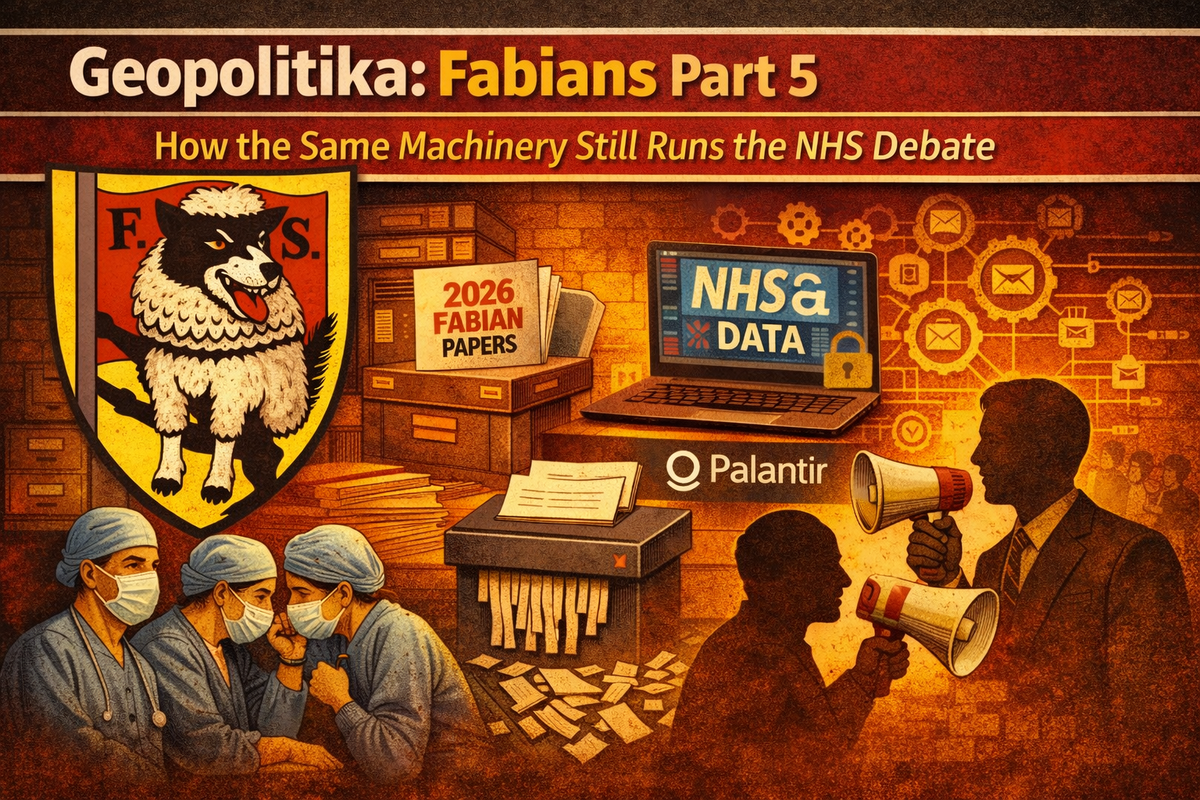
In the latest instalment of the Geopolitika Fabians series, two 2026 papers from the Fabian Society reveal how the same expert-led, boundary-managed gradualism that Shaw and the Webbs built in the 1880s–1900s is still running Labour’s NHS policy debate—only now it has been professionalised into a siloed machine that erases its own failures and contains patient voices as “communication problems”.
In Parts 1–4 of this series, we traced the Fabian Society from its Webbite origins through to its consolidation as Labour’s intellectual infrastructure. We saw how Sidney and Beatrice Webb built a machine: expert-led, gradualist, comfortable with state-private hybridity, and structurally allergic to mutual, cooperative, and democratic ownership forms. That machine survived the 1920s, professionalised after 1945, and embeded itself so deeply in Labour’s policy DNA that its assumptions became invisible—not ideology, just common sense.
Part 5—based on a forensic and systems analysis of the 2026 Fabian papers—reveals how the same machinery still runs the NHS debate. The two papers examined here, which were published in February and March 2026, offer the latest test of the Fabian mythos. Common Good, argues for public ownership as the NHS’s salvation, while Anatomy of Success: Digitising the NHS by 2035 sets out a roadmap for technology adoption. They appear back-to-back, both addressed to Labour policymakers. They seem to cover different terrain—one about ownership, the other about digitisation. But forensic and systems analyses reveal something deeper: that the gradualism Shaw and the Webbs built in the 1880s–1900s is not only intact—it has been institutionalised as the default frame for Labour health policy.
The 2026 Papers: What They Are
Common Good, published 10 February 2026, was authored by Zack Hassan, a resident doctor and YouTube health commentator. Its diagnosis: the NHS has been systematically “giving assets away” to private technology companies, using Frank Hester’s TPP as the emblematic case. The cure: public ownership—the NHS should retain equity stakes in spin-offs, leverage its data as a public asset, and reverse the 2012 internal market.
Anatomy of Success: Digitising the NHS by 2035, published 11 March 2026 under editorship of senior researcher Sasjkia Otto, is a collective product of the Fabian Society’s policy unit. Its diagnosis: the NHS has failed to digitise because of “dithering” and “past failures.” The cure: rapid technology adoption, learning from successful trusts and “moving at pace.” Palantir—the US data firm with intelligence community origins—features prominently as a partner in delivery.
Together, they cover the two dominant frames in Labour health policy: ownership and digitisation. What neither paper does is connect them. One demands state ownership of NHS assets; the other assumes private vendors will build them. One erases Labour’s own catastrophic IT failure—National Programme for IT (NPfIT)—the other erases a decade of Conservative digitisation efforts. The machinery runs—but the two hands do not speak.
Institutional Reasoning Culture
The two papers share a reasoning culture so consistent it looks like a template. Across both, a meta-analysis identifies eight reasoning patterns recurring at 100% frequency. This pattern is not isolated—it recurs across Fabian policy outputs.
Start with the false dilemma. Common Good presents “two futures” for the NHS: “The choice is between continued dilution of public ownership or a decisive return to public ownership as the organising principle.” Mutuals, cooperatives, worker-owned trusts, open-source development—none exist in this binary. Anatomy of Success does the same: the choice is between rapid digitisation or “dithering” that would be “more risky.” The possibility that digitisation might require democratic governance, or that some technologies should not be adopted at all, is not entertained.
Circular reasoning immunises both papers against falsification. In Anatomy of Success, legitimate concerns about Palantir’s role are contained: “The controversy around the Federated Data Platform has been a communication failure rather than a substantive policy issue.” If the model fails, it will be because communication failed—not because the model was wrong. In Common Good, the catastrophic failure of NPfIT—the largest state-led IT centralisation attempt in NHS history—is simply omitted. You cannot test a claim that state ownership corrects market incentives if you erase the largest state-owned failure. The structure of the argument makes it resistant to challenge by excluding or reframing counter-evidence.
Straw man caricatures do the work of dismissing opposition without engagement. Common Good reduces the 2012 internal market to Andrew Lansley’s ideological hostility to public ownership, ignoring efficiency, choice, and accountability rationales that actual policymakers cited. Anatomy of Success dismisses sceptics as “anti-technology”—as if concerns about privacy, equity, and workload were Luddism, not legitimate democratic deliberation.
Historical projection erases transformation. Common Good projects a linear decline of public ownership, ignoring that NPfIT was a massive state-led centralisation attempt. Anatomy of Success projects Aneurin Bevan’s vision unchanged across 75 years, as if the NHS had not been repeatedly restructured, marketised, and digitised since 1948.
These patterns are not occasional lapses. They are the institution’s reasoning machinery.
The Bevan Apparatus and the Great Erasures
Neither paper needs to invoke Aneurin Bevan. His name appears nowhere in Common Good. In Anatomy of Success, he surfaces early—and the invocation is telling.
The paper opens with Bevan’s founding vision: to put a “megaphone” to the mouth of every patient. The image is striking: the NHS founder as amplifier, turning whispered suffering into audible demand. But across the document, the paper performs a quiet substitution. The “megaphone” is re-engineered into a demand for better government communications. Patient voice becomes data capture. The democratic demand for responsiveness becomes a technical problem of “failing administrative processes” solvable by the Federated Data Platform.
When controversy erupts around that platform—over Palantir’s intelligence community origins, over redacted contracts, over 61 per cent of patients mistakenly believing a single record already exists—the paper’s response is telling. These are not framed as legitimate democratic concerns about private control of NHS data. They are “communication failures.” The government, the paper argues, has “struggled to articulate the purpose and value of the platform.” The problem is not Palantir’s history of supporting US national security surveillance, its contracts with the Israeli Ministry of Defense, or the fact that a defence contractor is being handed the medical records of an entire nation. The problem is that the messaging has not been clear enough.
This is the Bevan apparatus in action. The Sage’s authority is deployed to sanctify the policy preference. To question handing patient records to a defence contractor with documented ties to human rights abuses is not policy disagreement; it is failing to understand Bevan’s vision.
The erasures run deeper. Across both papers, the most consequential omission is the National Programme for IT (NPfIT). Between 2002 and 2011, the NHS attempted the largest state-led IT centralisation in history. It failed at a cost of over £10 billion. Common Good does not mention it. Anatomy of Success mentions “past failures” without naming them. One erases Labour’s failure; the other simplifies it into a vague warning sign.
The erasures are complementary. Common Good erases Labour’s NPfIT disaster. Anatomy of Success erases the Conservatives’ 2010–2024 digitisation efforts—a decade of policy that included real investment and real programmes. Together, they erase evidence that both parties failed. What remains is a Labour-redemption narrative: Labour tried once and failed, but the Conservatives made things worse, so now Labour must try again. Neither paper asks: if state ownership was the solution, why did the largest state-owned IT project fail catastrophically?
Palantir follows the same pattern of selective treatment: Common Good omits the £330 million contract entirely, while Anatomy of Success acknowledges it only to frame controversy as a “communication failure,” leaving unexamined its intelligence community origins, political networks, and the implications of a defence contractor handling national health data. These omissions are not incidental but structural. NPfIT disappears because its inclusion would challenge the claim that state ownership resolves systemic problems, while Palantir’s full context is constrained because it would expose geopolitical, ethical, and democratic tensions the framework cannot accommodate. The coherence of both papers ultimately depends on what they exclude.
Common Good does not need Bevan. Its inheritance is Webbite administrative socialism, not Bevanite militancy. But together the papers reveal the full machinery: when the argument is about ownership, the lineage is Webb; when it is about digitisation, the authority is Bevan. Either way, the Sage speaks and the policy follows. The patient voice gap—named but never heard—remains. The defence contractor’s role goes unexamined.
Power + System Co-Constitution
The hybrid analysis reveals how power and system dynamics co-constitute each other. Power sets boundaries; system dynamics operate within them. These outcomes emerge from the interaction of institutional incentives and system dynamics, not solely from design.
The boundaries drawn in these papers are not neutral. Common Good’s spatial boundary—UK domestic policy only—excludes the global US corporations (Epic, Cerner, Palantir) that actually determine NHS IT architecture. Anatomy of Success’s temporal boundary—2002–2035, with NPfIT simplified and 2010–2024 erased—excludes evidence that both parties failed. Anatomy of Success’s actor boundary—government, NHS leadership, suppliers—excludes the staff whose resistance to technology is framed as an “engagement problem” rather than a structural response to increased workload.
Once these boundaries are set, system dynamics operate within them. The reinforcing feedback loops that produce private dominance and vendor lock-in continue regardless of policy rhetoric. Staff resistance continues to function as a balancing loop, regulating adoption, but it is mis-specified as a communications problem. Public concern about data privacy continues to grow, but it is contained as a “communication failure.”
The most revealing contradiction is the ownership/digitisation silo. Common Good centralises ownership as the primary variable; Anatomy of Success does not mention ownership at all. Neither paper asks: who should own the digital infrastructure they advocate? Should the NHS own its software? If so, why are the vendors in Anatomy of Success private? If not, how does that square with Common Good’s ownership thesis? The institution is siloed. The left hand does not know what the right hand contracts.
Where Are the Patient Voices?
Reading these papers, one might conclude that patients exist only as a rhetorical device.
While Anatomy of Success opens with Bevan’s “megaphone”, what follows is a paper in which patients are spoken about, never by. They are the subjects of communication strategies, the targets of digital inclusion programmes, the statistical evidence of “declining satisfaction.” They are not, at any point, quoted.
The paper cites surveys: 61 per cent mistakenly believe a single patient record exists; 57 per cent recall receiving no information about data use; 42 per cent report being put off seeking care. These are presented as evidence of “communication failure”—as if better government messaging would resolve the underlying problem. What the paper does not do is ask patients what they actually think about handing their medical records to a defence contractor.
Common Good does not fare better. Patients are invoked as the ultimate beneficiaries of public ownership—the NHS is “dear to the nation” because it serves them. But they have no voice in the paper’s argument. The case for ownership is made through technology procurement history, not through the experience of people who depend on the NHS for their lives.
This is the voice gap that runs through both papers. Patients are named, but not heard. Their concerns are aggregated into statistics, then contained as communications problems. The amplified voice Bevan wanted to given them has been replaced by a loudspeaker that broadcasts government priorities. The question—what do patients actually want?—goes unasked.
Perhaps because the answer would be inconvenient.
Conclusion
As we have seen across this series, in 1898 the Webbs described the Fabian Society as an “engine for the conversion of the world to socialism.” By 1920, they had abandoned that ambition, settling for expert-led administration of a mixed economy. In 2026, their engine still runs—but its purpose has narrowed to something much smaller: maintaining the boundaries within which Labour health policy is thought, erasing the evidence that would disrupt those boundaries, and reproducing the same reasoning patterns that have structured Fabian thought for 140 years.
The mythos has not collapsed. It has been normalised and professionalised. The Sage still speaks—Bevan invoked to sanctify digitisation, his “megaphone” repurposed to amplify government communications rather than patient power. The Shadow is still managed—sceptics dismissed as “anti-technology,” legitimate concerns about handing patient records to a defence contractor contained as “communication failures.” The voice gap remains—NHS staff, patients, the digitally excluded—named but never heard.
The series began with Pease’s History of the Fabian Society, which promised an organisation dedicated to “the reorganisation of society by the emancipation of land and industrial capital from individual and class ownership.” This stop on the journey cannot imagine the NHS owning its own software, cannot analyse the corporate power that actually determines NHS IT, and cannot conceive of democratic governance as an alternative.
The machinery the Webbs built still runs. But reading these papers, questions linger:
- Why does the Fabian Society—an institution built on technocratic reform—systematically erase its own evidence when that evidence contradicts its preferred solutions? NPfIT, the largest state-owned IT failure in British history, is simply not there.
- What is the material interest that makes Palantir’s history unmentionable? The company’s intelligence community origins, its contracts with the Israeli Ministry of Defense, the geopolitical reality that a defence contractor is being handed the medical records of an entire nation—none of this appears. Why?
- How does an institution that claims to centre “patient voice” end up containing legitimate democratic concern as “communication failure” and no actual patient voices?
- Why can the Fabian Society not imagine mutual, cooperative, or commons-based ownership models? The binary is inherited, not argued. But 140 years of inheritance is not a reason; it is a habit.
- If both papers erase evidence that Labour failed (NPfIT) and the Conservatives failed (2010–2024), what kind of policy advice is being offered to the Labour government?
The only remaining question is whether the whether the time has finally come to examine the engine itself.
Part 6 will examine the production line—Blair and Starmer as Fabian products. The society produces Labour leaders who speak left but govern within elite boundaries.
—
Published via Mindwars Ghosted.
Geopolitika: Tracing the architecture of power before it becomes the spectacle of history.
Methodology note: This analysis draws on two Fabian Society papers published in February and March 2026 — Common Good by Zack Hassan and Anatomy of Success: Digitising the NHS by 2035 from the Fabian policy unit — alongside the archival record of Fabian Society publications, the Webbite founding texts (Minority Report, 1909; Pease’s History of the Fabian Society, 1916), and NHS IT procurement history including NPfIT inquiry reports (2011, 2013), the Palantir contract (2023), and contemporaneous health policy coverage. The analysis was assisted by AI tools using custom-built analytic protocols. Base analytic outputs are available on request.
Mindwars Ghosted is an independent platform dedicated to exposing elite coordination and narrative engineering behind modern society. The site has free access and committed to uncompromising free speech, offering deep dives into the mechanisms of control. Contributions are welcome to help cover the costs of maintaining this unconstrained space for truth and open debate.
If you like and value this work, please Buy Me a Coffee