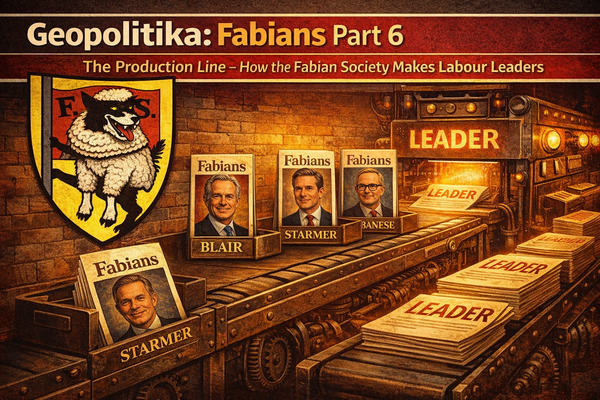
Geopolitika: Fabians Part 6. Addendum – The Fabian Texts – A Summary
This addendum provides a summary of the five Fabian Society texts analysed in Part 6, organised by leader. Each summary includes the paper's context, core argument, rhetorical architecture, and the strategic silences identified in the forensic analysis.
Tony Blair (1994–1995)
What Price a Safe Society? (Fabian Pamphlet 562, 1994)
Context: Delivered as part of the Fabian Society's 1994 New Year School, this paper was Blair's contribution to a collection on crime and society. He was Shadow Home Secretary, positioning himself for the leadership contest that would follow John Smith's death later that year.
Core Argument: Crime must be punished, but its root causes—inequality, poverty, family breakdown—must be addressed. The Left has wrongly treated individual responsibility and social conditions as mutually exclusive. Labour must combine a functioning criminal justice system with a strategy to prevent crime by promoting responsible citizenship. The paper is framed as a "tough on crime, tough on the causes of crime" manifesto.
Rhetorical Architecture: The paper constructs a false dilemma between social conditions and individual responsibility, then claims to resolve it. It invokes 1945 as the model of a government that understood this balance. It uses statistics on poverty and inequality to establish credibility while positioning Labour as the party of both compassion and competence.
Strategic Silences: The paper does not address Labour's own record on crime or welfare during the 1970s. It does not name the Thatcherite policies it implicitly critiques. The "root causes" it identifies—poverty, inequality—are presented without structural analysis of how they are produced. Trade unionists and the unemployed are spoken about; they do not speak.
Socialism (Fabian Pamphlet 565, 1994)
Context: Published in the same year as the New Year School paper, this pamphlet was Blair's first major statement on socialist ideology. It was written as the party debated the revision of Clause IV, the constitutional commitment to public ownership.
Core Argument: Socialism is a set of ethical values—social justice, community, equal worth—not an economic dogma. The socialism of Marx and state control is "dead." It misunderstood the modern market economy, failed to recognise that the state can oppress, and was based on a false view of class. True socialism—"social-ism"—recognises that individuals are interdependent and that society must act collectively to advance individual interests. This view liberates Labour from outdated prescriptions like wholesale nationalisation.
Rhetorical Architecture: The paper performs a semantic capture, redefining "socialism" from its historic content (public ownership, class struggle) to abstract moralism. It constructs a straw man of Marxism as monolithic and obsolete. It positions Blair as the Sage who has discovered socialism's "true meaning." The historical canon (1945, 1964, 1997) is invoked to authorise this redefinition.
Strategic Silences: The paper does not mention Clause IV by name, though it is clearly the target. It does not acknowledge that Clause IV was democratically approved by the party. It omits the radical socialist tradition—Chartism, the 1926 General Strike, the 1945 nationalisations as socialist achievements. It erases the 1970s Labour governments' social legislation. The left is caricatured as "student radicals" and "activists"; its arguments are not engaged.
Let Us Face the Future (Fabian Pamphlet 571, 1995)
Context: Delivered as the Fabian Society's 1945 anniversary lecture, this speech marked the fiftieth anniversary of Labour's first majority government. Blair was now Leader of the Opposition, having won the leadership after John Smith's death. The title deliberately echoes the 1945 manifesto.
Core Argument: The 1945 Labour government was the greatest peacetime government of the century. It achieved full employment, the welfare state, the NHS, and contributed to international relations. Labour won because it embodied the national mood for change, not because of detailed policy minutiae. Today's Labour must learn the lessons of 1945: clarity of purpose, winning the battle of ideas, and mobilising progressive minds. The rewriting of Clause IV is presented as "recapturing" Labour's traditions, not abandoning them. Socialism is defined as "social-ism"—the recognition that individuals are interdependent and that the good society backs up individual effort.
Rhetorical Architecture: The paper constructs a selective history that valorises 1945 while erasing the radical content of that government (nationalisations). It positions Blair as inheriting the Attlee tradition. It invokes the New Liberals (Hobhouse, Hobson) as part of Labour's intellectual lineage, justifying the move rightward. It presents Clause IV revision as a return to true values, not a break.
Strategic Silences: The paper omits the 1945 government's nationalisation program. It omits the 1970s Labour governments' achievements. It does not mention the 1992 election defeat that preceded Blair's project. The anti-war movement, trade union resistance to Blair's reforms, and the democratic socialist tradition are absent. The Iraq War, not yet fought, would later haunt the Blair/Brown invocation.
Keir Starmer (2015–2016, 2021)
Future-Oriented Public Services (UK Fabian Society collection, 2015–2016)
Context: Written after Labour's 2015 election defeat and before the leadership contest that would elect Jeremy Corbyn, this pamphlet was published in a Fabian collection on public services. Starmer was Shadow Immigration Minister, positioning himself as a credible moderate with frontline experience (former Director of Public Prosecutions).
Core Argument: Public services face unprecedented demographic and fiscal pressure. Labour's response "cannot simply be to reflate and recreate services designed for a different era." Reform must be based on three principles: prevention (investing early to avoid later costs), horizontal integration (breaking down silos between services), and local control (devolving power from the center). The 2015 defeat was because Labour failed to offer a compelling alternative. Labour has won power only three times in a century—1945, 1964, 1997—each time by "glimpsing the future."
Rhetorical Architecture: The paper constructs a false dilemma between "reflate and recreate" (bad, old) and "future-oriented reform" (good, new). It deploys Starmer's DPP experience as a rhetorical credential, positioning him as the Sage who knows how public services work. The selective historical canon (1945, 1964, 1997) authorises his reformism. The paper uses specific funding cut figures (CPS 30%, Camden 50%) to ground its critique.
Strategic Silences: The paper omits the 1945 government's nationalisations. It omits the 1970s Labour governments' social legislation. It does not mention the 2017 Corbyn manifesto (which would later contradict its historical claim). It critiques the Serco asylum contract but does not call for an end to outsourcing. The long-term privatisation trajectory since the 1980s is absent. Public sector workers and asylum seekers are spoken about; they do not speak.
2021 Speech to the Fabian Society (2021)
Context: Delivered virtually at the Fabian Society's New Year Conference, this speech came after Labour's 2019 election defeat, the COVID-19 pandemic, the Capitol riot, and Biden's election. Starmer had been Leader of the Opposition since April 2020.
Core Argument: Britain can and must be a "moral force for good" in the world. Labour is proudly patriotic and proudly internationalist. Boris Johnson has isolated Britain by cosying up to Trump, breaking international law, and cutting aid. Biden's election is a turning point—a President who is "everything that we haven't seen for the last four years." Britain's national interest lies in being the "bridge between the US and the rest of Europe." Labour will rebuild that bridge, working with the new US administration and Europe.
Rhetorical Architecture: The "bridge" metaphor simplifies complex geopolitical tensions into a technical problem of repair. The paper constructs a false dilemma between Labour's international engagement and Tory isolation. It invokes Blair and Brown as models, co-opting their authority. It positions Starmer as the Sage who understands Britain's true role. The temporal narrative moves from pre-Trump stability → Trump disruption → Biden restoration, erasing contested US-UK history.
Strategic Silences: The paper does not mention the Iraq War, the most contested legacy of the Blair/Brown era. It does not mention Palestine, Israel, or the BDS movement. Corbyn's foreign policy is neither critiqued nor defended. The anti-war movement is absent. UK arms sales to Saudi Arabia, Israel, and other states with human rights records are not mentioned. The "Brexit is settled" claim omits ongoing Northern Ireland Protocol disputes and trade friction.
Anthony Albanese (2006, 2020)
Secrets, Distortions and Distractions (Australian Fabians, 2006)
Context: Published in July 2006, during the Howard government's push for a nuclear energy "debate." Albanese was Shadow Minister for Infrastructure and Transport, a senior figure in Labor's left faction, positioning himself ahead of the 2007 election.
Core Argument: The Howard government's nuclear push is a sham—a "full blooded debate" that is one-sided, stacked with nuclear proponents, and riddled with secrecy and conflicts of interest. Nuclear power fails on economic cost, safety, waste, and proliferation grounds. The government's real agenda is GNEP (Global Nuclear Energy Partnership), which would make Australia "the quarry and the dump"—mining and enriching uranium while becoming the world's nuclear waste dump. Labor opposes nuclear expansion.
Rhetorical Architecture: The paper uses humor (Homer Simpson) to ridicule nuclear advocates. The "debate" frame argues that advocates do not want genuine debate but demand capitulation—a self-reinforcing claim that dismisses pro-nuclear arguments without engagement. The intergenerational responsibility frame elevates the debate to a moral issue, contrasting Labor's responsibility with government indifference (Brendan Nelson's "matter for the governments of the day"). The paper exposes government secrecy (1997 Cabinet Submission, ANSTO report withheld) and conflicts of interest (John Gittus's insurance role).
Strategic Silences: The paper omits Labor's own history of supporting uranium mining (Hawke/Keating governments). It does not address the renewable energy cost trajectory (which has since fallen dramatically). It uses a worst-case uranium reserve scenario to argue nuclear is not a climate solution, omitting advanced nuclear technologies. Indigenous communities affected by uranium mining are not mentioned. The anti-nuclear movement is invoked but does not speak.
2020 Vision (Australian Fabians Review, 2020)
Context: Published in December 2020, after the first year of the COVID-19 pandemic, the 2019–20 bushfires, and the 2019 election defeat. Albanese was Leader of the Opposition, positioning Labor for the 2022 election.
Core Argument: The pandemic creates a rare opportunity to "recover, reset and renew, rather than rewind." Labor is the party of future-oriented planning; the Coalition is reactive, ideological, and beholden to Thatcher/Reagan. Science should guide policy, especially on climate. Productivity growth requires skills, tax reform, childcare, and clean energy—not just industrial relations deregulation. Social solidarity ("all in this together") is a core Australian value that Labor will preserve. Curtin and Chifley provide a model for post-crisis reconstruction.
Rhetorical Architecture: The "all in this together" frame captures the pandemic experience while eliding its unequal impacts. The science frame reduces climate politics to a battle between reason and irrationality. The "soft heart, hard head" framing is a managed polarity that allows Albanese to claim both compassion and competence without specifying trade-offs. The paper invokes Curtin and Chifley as ancestors, linking Albanese's vision to Labor's most revered nation-building moment.
Strategic Silences: The paper omits the 2019 election defeat and its policy lessons. It omits the Hawke-Keating neoliberal reforms (deregulation, tariff cuts, financial liberalisation). It omits the Rudd-Gillard leadership instability and policy failures. It does not address Australia's structural dependency on fossil fuel exports. The transition for fossil fuel workers and regions is not discussed. First Nations peoples are mentioned (Uluru Statement) but do not speak.