Geopolitika: Fabians Part 6. The Production Line – How the Fabian Society Makes Labour Leaders
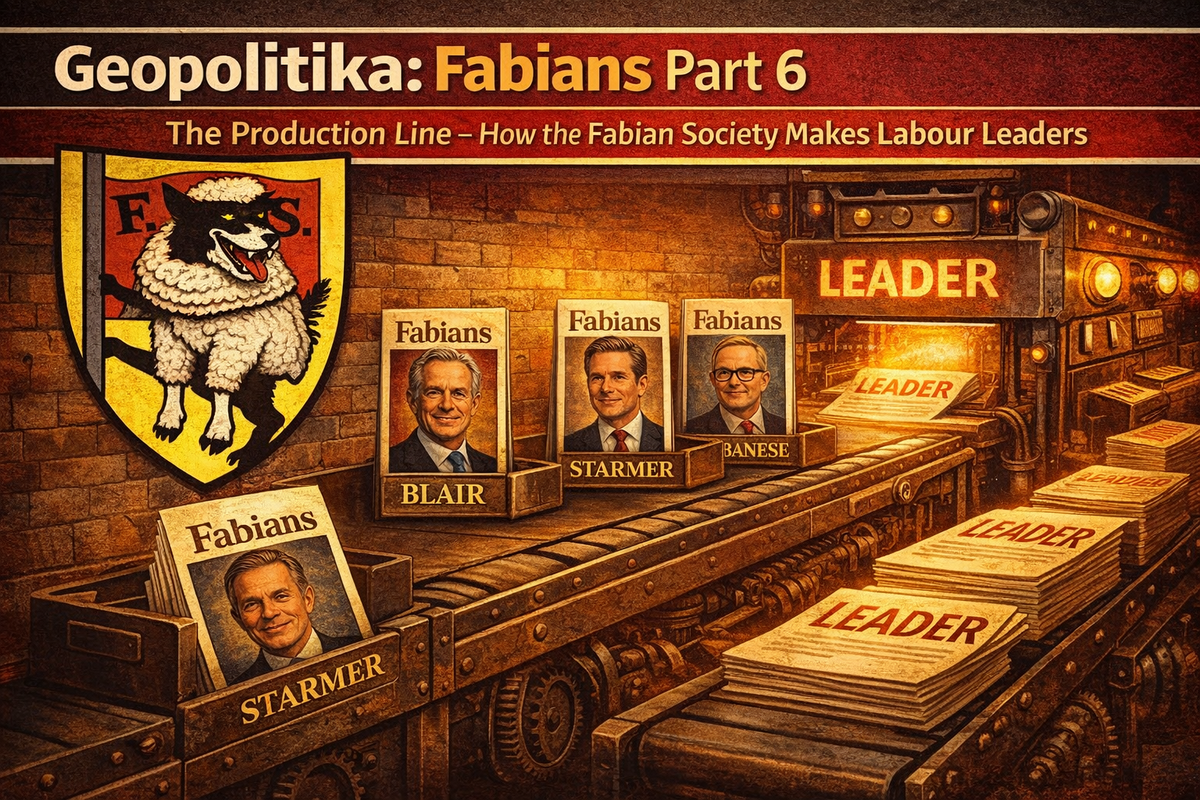
This instalment of the Geopolitika Fabians series turns from the NHS policy machinery examined in Part 5 to the institution that built it. The Fabian Society does not just produce policy papers. It produces leaders. Blair, Starmer, Albanese—all emerged from the same production line, their public personae constructed by a machine whose operating principles have not changed since the 1880s.
Over twenty-seven years, the Fabian Society in the UK and its Australia branch have published what can be regarded as foundational texts of three Labour leaders: Tony Blair, Keir Starmer, and Anthony Albanese. Five master analyses examined this corpus—each summarised in the separate Part 6. Addendum—the three Blair texts being processed as one.
Blair’s three pamphlets from 1994–1995 performed the foundational operation. What Price a Safe Society? argued for combining punishment with prevention, framing crime as both individual responsibility and social failure. Socialism performed a semantic capture, redefining socialism from public ownership to abstract ethical values—“social-ism”—while caricaturing the left as “student radicals.” Let Us Face the Future, a 1945 anniversary lecture, constructed a selective history that valorised Attlee’s government as Labour’s greatest moment while systematically erasing its radical content: the nationalisations of coal, rail, steel, and power. The lecture used this sanitised 1945—cleansed of its commitment to common ownership—to authorise the revision of Clause IV, the party’s constitutional pledge to “secure for the workers… the full fruits of their industry” through “common ownership of the means of production.” The erasure was strategic: by presenting 1945 as a triumph of ethical values rather than economic transformation, Blair could claim continuity while discarding the clause that had defined Labour’s socialist identity for seventy-five years.
Starmer’s two texts consolidated this tradition. Future-Oriented Public Services (2016), written after Labour’s 2015 defeat and before Corbyn’s leadership, deployed a false dilemma between “reflate and recreate” and “future-oriented reform.” It invoked the selective canon—1945, 1964, 1997—to authorise managerial reformism, while omitting the 1945 nationalisations and the 1970s achievements. His 2021 Fabian speech repositioned Labour’s foreign policy, co-opting Blair and Brown as models while remaining silent on Iraq, and framing Britain as a “bridge between the US and Europe”—a metaphor that simplified complex geopolitics into a technical problem of repair.
Albanese’s two Australian Fabian texts revealed the same patterns operating in a different national context. Secrets, Distortions and Distractions (2006) exposed the Howard government’s nuclear push as a sham, using humor to ridicule advocates while invoking Curtin and Chifley as ancestors. It omitted Labour’s own history of supporting uranium mining. 2020 Vision (2020) framed the pandemic as an opportunity to “recover, reset and renew,” deploying the “all in this together” solidarity frame and the “soft heart, hard head” managed polarity. It omitted Hawke and Keating’s neoliberal reforms and the 2019 election defeat.
Across all of these texts, the same patterns recur: selective historical canons that omit radical traditions; false dilemmas that foreclose alternatives; straw man caricatures of opponents; strategic silence on the party’s own failures; and the systematic prioritisation of agency over structure. Voice gaps are pervasive—trade unionists, asylum seekers, anti-war activists, Indigenous communities are spoken about; none speak.
The consistency across three leaders, two countries, and twenty-seven years reveals a system, not a series of coincidences.
If these texts share a common architecture, the question becomes: what does that architecture look like? Across all of the texts, the same rhetorical devices appear with such regularity they function as a template—a production line for political language that reproduces the same logical structures regardless of leader, policy domain, or national context.
The Patterns That Recur
The recurring patterns extend into reproduction of the same rhetorical architectures and logical devices, so we find:
- False dilemma (5 of 5 analyses). Every text presents a binary choice. Blair: modernise or become irrelevant. Starmer (2015): reform public services or reflate outdated models. Starmer (2021): engage with the world or retreat into isolation. Albanese (2006): expose government secrecy or accept a rigged “debate.” Albanese (2020): build a future-oriented recovery or rewind to the past. In Blair’s words: “The task is not to try to turn the clock back.” In Starmer’s: “cannot simply be to reflate and recreate services designed for a different era.” The structure is identical. Alternative political imaginaries—redistributive economics, anti-war foreign policy, de-growth environmentalism—are excluded from the frame before they can be articulated.
- Appeal to authority via selective history (5 of 5). Every text invokes revered ancestors. Blair: the 1945 Labour government. Starmer (2015): 1945, 1964, and 1997. Starmer (2021): Blair and Brown. Albanese: Curtin and Chifley, Australia’s wartime and postwar Labour leaders. Blair: “In 1945, as now, Labour spoke for the national interest.” Albanese: “Consider two Labour leaders, who faced another of our nation’s turning points. With the world in conflict around them, John Curtin and Ben Chifley spoke not just of Victory in War but of Victory in Peace.” The function is authorisation. Each leader claims continuity with the party’s “best moments” to justify a project that often abandons the policies those moments represented.
- Straw man caricature of opponents (5 of 5). Opponents are reduced to caricatures. Blair reduces the old left to “student radicals” reared in “activism.” Starmer (2021) reduces Johnson to “Britain’s Trump.” Albanese (2006) opens with a joke about Homer Simpson: “One of the world’s leading nuclear advocates has declared, ‘Thank God for nuclear energy, the safest, cleanest energy there is’... in this case the advocate is of course Homer Simpson.” The humor is effective. It also avoids engagement.
- Strategic silence on the party’s own history (5 of 5). Every text omits the radical or contested aspects of its own party’s past. Blair erases 1945 nationalisations and 1970s social legislation. Starmer (2015) erases the same. Starmer (2021) erases the Iraq War from his invocation of Blair. Albanese (2006) erases Labour’s history of supporting uranium mining. Albanese (2020) erases Hawke and Keating’s neoliberal economic reforms and the 2019 election defeat. The omissions are structural. They allow each leader to present the party as unified and forward-looking, its internal divisions and recent failures conveniently forgotten.
- Agency over structure (5 of 5). Every text prioritises explanations that center individuals and ideology over systems and material constraints. Labour’s defeats are caused by outdated ideology, not by the organised power of Thatcherism. Public service decline is caused by Conservative short-termism, not by a decades-long privatisation trajectory. UK foreign policy failure is caused by Johnson’s closeness to Trump, not by the structural imperatives of the US alliance. Australia’s nuclear debate is a problem of government secrecy, not of energy transition economics. The pattern is consistent: problems are framed as the result of bad actors or bad ideas, solvable by replacing them with good actors and good ideas. Structural forces—capital, empire, climate—remain outside the frame.
These patterns are not occasional lapses. They are the institution's reasoning machinery—reproduced across generations, national contexts, and policy domains. But alongside them, another set of features appears: contradictions that are not errors but structural necessities of the production line itself.
The Patterns and the System They Produce
Across these texts, a number of structural contradictions also appear. They are not errors. They are features of the production line:
- Mission vs output. Every text claims continuity with party values while abandoning the policies that historically expressed those values. Blair claims to rediscover socialism while discarding its core economic commitments. Starmer claims to defend public services while accepting private sector involvement. Albanese claims to oppose nuclear while silent on Labour’s uranium mining history. The gap between mission and output is not hypocrisy. It is the necessary operation of repositioning: claiming the authority of the past to justify the abandonment of its content.
- Independence vs network. Every text claims popular legitimacy while being produced within elite Fabian networks. Blair speaks for “the people” from the Fabian platform. Starmer speaks for “members” from the same platform. Albanese speaks for “Australians” from the Australian Fabian Review. The tension is structural. The production line produces texts that claim to represent a democratic base while being authored by party leaders and circulated within intellectual elite networks. The base does not speak. It is spoken about.
- Historical selectivity vs record. Every text constructs a usable past by omitting inconvenient history. The pattern is so consistent it suggests institutional memory—a learned practice of forgetting. Blair omits the radical 1945 Labour government. Starmer omits the same. Albanese omits the Hawke-Keating neoliberalism that transformed the Australian economy. What is omitted is as important as what is included. The usable past is a curated one.
From these contradictions, a consistent leader-type emerges. The Fabian production line produces a leader who is:
- The moderately modernising leader. Blair redefines socialism. Starmer redefines public service reform and foreign policy. Albanese redefines Labour’s post-pandemic vision. Each moves the party rightward from its radical traditions. The movement is incremental, framed not as abandonment but as adaptation. “Modernisation” is the keyword. It means accepting the market economy, accepting the US alliance, accepting the privatisation trajectory, and discarding the policies that once defined the party’s identity. The leader who emerges is not a radical. They are a manager of decline—the decline of the party’s radical aspirations, reframed as maturity.
- The historically authorised leader. Each leader is presented not as a break with the past but as a return to the party’s “true” values. Blair returns to 1945. Starmer returns to Blair. Albanese returns to Curtin and Chifley. The pattern of ancestral invocation is so consistent it suggests a ritual function. The leader is authorised by history. But the history is selective. The ancestors invoked are those who built the nation (1945, Curtin/Chifley) or managed it successfully (Blair/Brown). The ancestors omitted are those who challenged power—the trade unionists, the anti-war movement, the democratic socialists. The authorised leader inherits a usable past, cleansed of its radical content.
- The rhetorically constructed leader. Blair is the Hero, confronting the party’s outdated past. Starmer is the Sage, knowing how to repair public services and rebuild international alliances. Albanese is the Truth-Teller, exposing government secrecy, and the Protector, preserving the “togetherness” Australians discovered during the pandemic. The archetypes shift by context—founding requires a Hero, consolidating requires a Sage, exposing requires a Truth-Teller—but the pattern of archetypal construction is consistent. The leader is not a person who emerges organically from the party. They are a character constructed by the text, positioned within a narrative that makes their authority seem natural.
- The strategically silent leader. Every text is structured by what it does not say. Blair does not say that Clause IV was democratically approved. Starmer (2021) does not say that Blair’s foreign policy included the Iraq War. Albanese (2020) does not say that Hawke and Keating dismantled tariff protections and deregulated the financial system. The leader who emerges is one who has learned the party’s history—and learned which parts not to mention. Strategic silence is a competency. It is taught. It is practiced.
- The leader who speaks for those who do not speak. Voice gaps are pervasive across all of the texts. Trade unionists, the unemployed, the old left, asylum seekers, public sector workers, casual workers, Indigenous communities—all are spoken about. None speak. The leader is constructed as the voice of the voiceless. But the voiceless are not asked to speak. They are invoked, represented, championed. They do not appear in the text as subjects with their own language, their own analysis, their own demands. The leader’s authority depends on this silence. If the voiceless spoke, they might say things the leader does not want to hear.
- The reproducing system. The patterns identified—selective historical canon, false dilemma framing, strategic omission, agency over structure, archetypal construction—appear across the five analyses, two countries, and twenty-seven years. Convergence is strong. The Fabian production line is not a hypothesis. It is a documented operation. The system is coherent (consistent patterns recur), fractured (structural contradictions persist), evolving (the ideological content shifts rightward), reproducing (the same patterns appear across generations), and immunised (counter-evidence is systematically omitted).
If the system is reproducing, it is also vulnerable. The same features that make it coherent—its reliance on omission, its foreclosure of alternatives, its silencing of voices—are also points where it can be challenged.
Fractures and Interventions
The Fabian production line has structural vulnerabilities.
- The omitted return. The system depends on omission. The 1945 nationalisations, the 1970s achievements, the Iraq War, Hawke-Keating neoliberalism—all are erased. But omission is not destruction. These histories exist elsewhere. They can be recovered. When they are, the authority of the selectively constructed leader is challenged. Starmer’s invocation of Blair loses force when Iraq is remembered. Albanese’s invocation of Curtin and Chifley loses force when Hawke and Keating are recalled. The system’s strength—its ability to curate a usable past—is also its vulnerability. The past can be un-curated.
- The voice gap as organising point. The system speaks for others. It does not let others speak. This is a vulnerability. The trade unionists, the unemployed, the asylum seekers, the public sector workers, the Indigenous communities—they are not voiceless. They have their own analysis. They have their own demands. When they organise and speak, the leader who claims to represent them is revealed as a substitute, not a delegate. The voice gap is not a neutral absence. It is a space where alternative politics can grow.
- The false dilemma’s collapse. The system’s central rhetorical move is the false dilemma: modernise or die. But the dilemma is false. There are other paths. The 2017 Labour manifesto in the UK, the 2019 Labour manifesto in Australia, the anti-war movement, the climate justice movement—these represent alternatives that the false dilemma excludes. When those alternatives are articulated, the dilemma collapses. The choice is not between Blair’s modernisation and irrelevance. It is between different modernisations, different futures, different politics.
These vulnerabilities are not abstract. They suggest practical points of leverage. The most immediate and powerful of them is simply to restore what the production line has erased. When the omitted histories — the 1945 nationalisations, the 1970s social legislation, the Iraq War, Hawke-Keating neoliberalism, Labor’s uranium mining record — are put back into the story, the curated past collapses and a different narrative becomes visible. That counter-narrative does not merely contradict the Fabian texts. It reveals what they were designed to conceal.
The Counter-Narrative and the Stakes
Restoring what the Fabian texts omit produces a different story.
The 1945 Labour government was not just the welfare state. It was nationalisation—coal, rail, steel, power. The 1970s Labour governments were not just failures. They passed the Race Relations Act, the Sex Discrimination Act, SERPS. The Blair government was not just global poverty and financial crisis. It was Iraq. Hawke and Keating were not just economic modernisers. They dismantled protections, deregulated finance, began the privatisation trajectory. Labour's uranium mining history is not a secret. It is a fact.
This counter-narrative does not invalidate the Fabian texts. It reveals what they omit. The leader produced by the Fabian production line is not the only possible leader. They are a particular construction, dependent on a curated past, a silenced base, and a narrowed field of possible futures.
Who benefits from this construction? The leader benefits—their authority constructed, their historical lineage provided, their platform secured. The party's moderate wing benefits—its control consolidated, left alternatives marginalised, its politics presented as the only viable path. The institutions the party governs within benefit—the acceptance of market logic, the US alliance, the privatisation trajectory. These are not challenges to existing power. They are accommodations to it.
Who pays? The trade unionists whose power is diminished. The unemployed who are spoken about but not heard. The asylum seekers whose housing is contracted to Serco. The public sector workers whose services are outsourced. The Indigenous communities whose lands are mined for uranium. The anti-war activists whose movement is silenced. The democratic socialists whose tradition is erased.
The leader produced by the Fabian production line is a compromise. They are the leader the system can tolerate. They are not the leader the voiceless might choose.
But what kind of system produces such a leader—and what does it reveal about the institution that has been shaping Labour politics for 140 years?
Conclusion: The Leader the Machine Makes
Across twenty-seven years, three leaders, and two national contexts, the Fabian production line produces a remarkably consistent type. The leader is moderately modernising—moving the party rightward while framing adaptation as maturity. They are historically authorised—claiming continuity with a curated past that omits the party's radical traditions. They are rhetorically constructed—cast as Hero, Sage, Truth-Teller, or Protector, their authority built by narrative architecture rather than organic emergence. They are strategically silent—having learned which parts of the party's history to invoke and which to forget. And they speak for those who do not speak—their claim to representation resting on the absence of the represented.
This is not a series of coincidences. It is a system. A system that is coherent (patterns recur), fractured (structural contradictions persist), evolving (the ideological content shifts rightward), reproducing (the same operations appear across generations), and immunised (counter-evidence is systematically omitted).
The questions this system raises are not about individual leaders. They are about the institution that makes them:
- Why does the selective historical canon persist across generations and national contexts? Is it strategy or habit—and at what point does the distinction cease to matter?
- Why do the texts systematically prioritise agency over structure? What would a Fabian analysis look like that took structural forces—capital, empire, climate—as primary?
- Why do the voice gaps remain unfilled across twenty-seven years? If representation requires participation, what does the Fabian model actually produce?
- Why can the Society not imagine alternatives beyond the binary frames it constructs? What is foreclosed when the only choices are modernisation or irrelevance?
- What is the material interest that makes certain subjects unmentionable? What is being protected when the Iraq War, NPfIT, and Palantir's intelligence ties become unexaminable?
These are not questions about the leaders the machine produces. They are questions about the machine itself.
The Fabian Society has produced Blair, Starmer, and Albanese. But between Blair and Starmer, there was another leader—one the machine did not produce. Jeremy Corbyn was not a Fabian product. He did not emerge from the Society's intellectual infrastructure. He did not speak its language. He did not curate its history. And for five years, he led the Labour Party anyway.
Part 7—the final part of this series—will examine Corbyn as the exception that proves the rule. It will ask what happened when the production line was bypassed, what the machine did in response, and what that response reveals about the nature of the system this series has traced from the Webb's 1880s socialism to the 2026 NHS papers.
If the Fabian production line produces a consistent type of leader, Corbyn was the leader it did not produce. Understanding why he emerged, why he was contained, and what remains of the alternative he represented is the final piece of this architecture.
—
Published via Mindwars Ghosted.
Geopolitika: Tracing the architecture of power before it becomes the spectacle of history.
Methodology note: This analysis synthesises five master analyses of Fabian Society texts by Tony Blair (1994–1995), Keir Starmer (2015–2016, 2021), and Anthony Albanese (2006, 2020). All sourced material is publicly available. The analysis was assisted by AI tools using custom-built analytic protocols. Base analytic outputs are available on request.
Mindwars Ghosted is an independent platform dedicated to exposing elite coordination and narrative engineering behind modern society. The site has free access and committed to uncompromising free speech, offering deep dives into the mechanisms of control. Contributions are welcome to help cover the costs of maintaining this unconstrained space for truth and open debate.
If you like and value this work, please Buy Me a Coffee