Geopolitika: Fabians Part 7. The Fabian System – How Labour Reproduces Itself
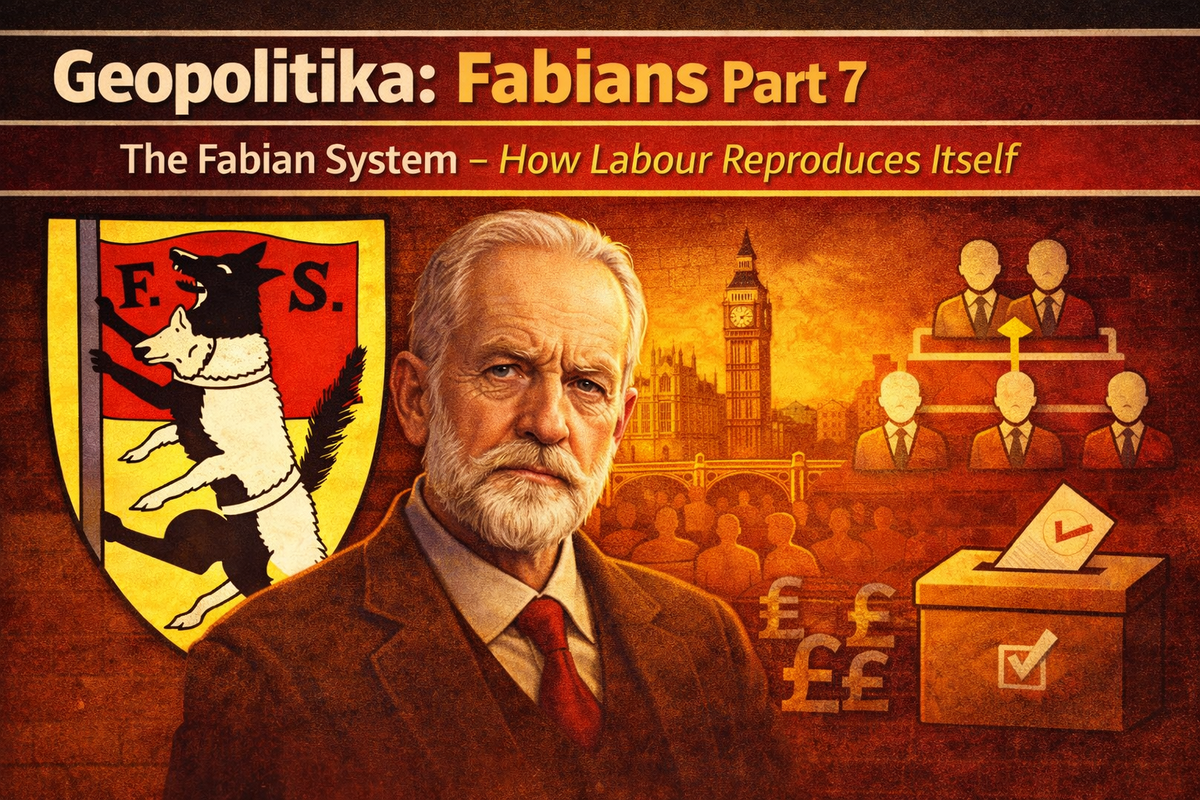
This is the final part of the Fabians series which began with a simple question: What exactly is the Fabian Society? The answer was not a definition but a system. Across Parts 1–6 we traced how the Society built an intellectual machine: expert-led gradualism, selective historical canons, false dilemmas that foreclose alternatives, strategic silences on its own radical traditions, and a consistent preference for agency over structure. The machine produced Blair, Starmer, and Albanese—three leaders who spoke left but governed within elite boundaries.
Between Blair and Starmer there was another leader—one the machine did not produce.
Jeremy Corbyn’s 2015 victory was a rupture. The Fabian Society, which had helped found Labour 115 years earlier, faced a leader whose world view was not theirs, whose supporters did not trust them, and whose project challenged their intellectual framework. What followed was not confusion but a sustained, multi-year project of institutional management: containment in 2015, deviation narrative after 2019, and restoration under Starmer in 2021.
This article synthesises forensic analyses of nine key texts grouped into three artefacts: Corbyn’s own manifesto essay “Our Movement” (Fabian Review, Autumn 2015), the Fabian Society’s supplementary essays published alongside it, and Andrew Harrop’s corpus from 2019 to 2021. Together they reveal how the system responded when the production line was bypassed—and what that response tells us about the machine itself.
The Three Artefacts
For analytical clarity, the collection of nine pieces featuring Corbyn sourced via the Fabians’ UK website is organised into three artefacts. Each groups together texts that operate within the same phase of the system response—rupture, containment, and restoration. This bundling is not arbitrary. It allows multiple texts performing the same function to be analysed as a single unit, improving both analytic efficiency and phase coherence across the sequence.
Artefact 1: The Rupture – Jeremy Corbyn – “Our Movement” (Fabian Review, Autumn 2015)
Corbyn’s essay stands as the rupture text. It reframes Labour’s purpose around a populist epistemology and a binary opposition: stop being a machine and start being a movement again. Knowledge resides not in expert units but in organised communities. The essay omits Labour’s own 2015 election review (which diagnosed coalitional collapse) and Labour’s history as a successful electoral machine. Its function is to legitimise participatory authenticity over institutional competence and to destabilise the existing grammar of leadership and authority.
Artefact 2: The Containment – Fabian Review essays (Autumn 2015)
- Andrew Harrop, “Opposition Territory”
- Emily Robinson, “Shortcuts (Before We Move On)”
- Alastair Harper, “Green Notes (Tackling Climate Change...)”
- Olivia Bailey, “Understanding Corbynmania”
These four essays, published in the same issue alongside Corbyn’s manifesto, form the containment artefact. Though authored separately, they perform a coordinated analytical function. Harrop defines politics as “contesting the same territory as the Conservatives.” Harper presents a false dilemma between “unrealistic populism” and “tepid managerialism.” Bailey pathologises the left as organisational failure. Robinson begins constructing a usable past—New Labour’s “lost potential”—that will later authorise the reset. Taken together, these texts translate the rupture back into familiar categories, narrow the field of legitimate response, and reassert institutional authority.
Artefact 3: The Deviation and Restoration – Andrew Harrop’s 2019–2021 corpus
- “Better for Corbyn to embrace the will of the party now than buckle later” (June 2019, LabourList)
- “How Labour under Corbyn rejected Fabianism and lost elections” (April 2020, LabourList)
- “Starmer will storm ahead once Brexit and Corbyn ‘baggage’ is forgotten” (July 2021, Express)
- “The road to Starmerism: neither Blairite nor Corbynite, but unifying for Labour” (September 2021, LabourList)
These pieces form the deviation-and-restoration artefact. They are bundled because they operate as a continuous narrative sequence by, or as an interview with, the same author. After the 2019 defeat, Corbynism is framed as deviation from a purified Fabian tradition, with the 2017 election and the Webbian statist lineage largely erased. By 2021, a synthesis is constructed: “Starmerism” as restoration of competence and the “contribution society” as forward-looking doctrine. The “baggage” metaphor reduces structural realignment to removable obstacles, and Starmer is positioned as the Hero who restores order. The function is consolidation: narrate the challenge as aberration and return the party to the institutional mainstream.
The Patterns That Recur
What unites every text in this corpus—Corbyn’s own manifesto and the Fabian Society’s responses alike—is not so much ideology as architecture. Three rhetorical patterns appear consistently across the rupture, the containment, and the restoration. They are not incidental. As we have seen across the series, they are the operating system of Fabian factional discourse.
The first is binary framing. Corbyn’s manifesto opens with its central binary: stop being a machine and start being a movement again. The Fabian essays answer in kind—radicalism is acceptable only if it contests the same territory as the Conservatives; the alternative is populism or tepid managerialism; Corbynism is deviation from the true Fabian tradition. Harrop later sharpens it to baggage versus competence. The specific poles change; the structure never does. Binary framing is the shared rhetorical grammar of Fabian-Labour factionalism. It simplifies complexity, forces allegiance, and naturalises whichever side is speaking as the only sensible alternative to catastrophe.
We have seen this pattern recycled across the entire series. In Part 2 Shaw deployed it against rival socialists and then against democracy itself. In Part 3 the defence paper framed a false dilemma between MoD optimism and Treasury discipline. In Part 4 the devolution report presented centralisation versus empowerment. In Part 5 the NHS papers offered public ownership versus private vendors, digitisation versus “dithering”. In Part 6 the leadership texts presented modernisation versus irrelevance. The form is invariant. It is the system’s default operating mode.
The second is historical selectivity. Every text in this corpus is built on what it chooses to forget. Corbyn invokes Labour’s founding purpose “to stand up to injustice” but erases the party’s history as a successful electoral machine—Attlee’s 1945 landslide, Blair’s three victories. The Fabian 2015 essays reclaim New Labour’s “lost potential” while airbrushing out the Iraq War, PFI, tuition fees, and the erosion of civil liberties. Harrop’s 2020 post-mortem erases the 2017 election (where Corbyn gained thirty seats) and the Webbian statist tradition to define Fabianism as “rigour, evidence, electoral focus”.
This is the same pattern of historical selectivity we have traced from the beginning. In Part 1 the Society curated its imperial and eugenicist past as safely historical. In Part 2 Shaw selectively invoked 1945 to authorise Clause IV revision while erasing its nationalisations. In Part 3 the defence paper omitted defence contractors. In Part 4 the devolution report erased austerity’s human cost. In Part 5 the NHS papers erased NPfIT and Palantir’s intelligence ties. In Part 6 Blair, Starmer, and Albanese each constructed a usable past by omitting the radical traditions that would complicate their repositioning. Historical selectivity is not error. It is architectural necessity. Factional narratives require forgetting to remain coherent.
The third is agency erasure. Each text redefines the problem it faces by erasing prior documents or structural conditions that would complicate its story. Corbyn’s manifesto omits Labour’s official 2015 election review, which framed the defeat as coalitional collapse rather than a failure of “machine” politics. The Fabian 2015 essays omit the substantive policy record of New Labour to reclaim its “radical potential” without accountability. Harrop’s post-mortem erases the 2017 manifesto’s popularity and the Webbian statist tradition to define Corbynism as deviation from a purified Fabianism.
This is the same agency erasure we have seen throughout the series: the defence paper erasing the question of who profits, the devolution report erasing the voices of communities, the NHS papers containing the state’s own failures as “communication failure”, the leadership texts erasing the party’s radical traditions. In each case, inconvenient evidence is erased, the problem is redescribed in terms favourable to the author’s position, and the proposed solution is presented as the only logical response.
These three patterns—binary framing, historical selectivity, and agency erasure—appear in all three artefacts, deployed by both Corbyn and his Fabian critics. They are not the property of any faction. They are the structural grammar through which Labour’s intellectual infrastructure processes existential challenges to its hegemony.
The System’s Response
When the rupture came in 2015 the Fabian Society’s response was swift and consistent. The supplementary essays formed a containment text: define politics on Conservative terms, present a false dilemma that positioned Fabian gradualism as the only sensible path, pathologise the left as organisational failure, and begin constructing a usable past that would later authorise restoration.
After the 2019 defeat Harrop constructed the deviation narrative: Corbynism as rejection of Fabianism, the 2017 election erased, the antisemitism crisis attributed directly to the far-left worldview. By 2021 the restoration was complete: Starmerism as synthesis, the “baggage” metaphor reducing structural realignment to temporary obstacles, the Hero archetype restored.
Across these three phases the Fabian Society performed its historical function with precision. The institution founded by the Webbs to provide intellectual legitimacy for Labour did exactly what it was designed to do: contain the challenge, narrate it as deviation, restore the mainstream.
Contradictions and the Leader the Machine Could Not Produce
The system is coherent, but it is not seamless. Across the analyses, four contradictions emerge. They are not failures of logic but structural consequences of the Fabian method itself: a strategy of gradualism that must win the confidence of existing power while claiming continuity with a radical tradition. These tensions are not new. They trace back to the Society’s origins, where the same rhetorical tools—binary framing, selective history, and voice omission—were first deployed to reconcile transformation with institutional acceptance.
- Mission versus output. The Society claims continuity with socialist values while systematically abandoning the policies that historically expressed them. Blair redefines socialism as abstract ethical values and discards public ownership. Starmer defends public services while accepting private provision. Albanese speaks of renewal while erasing Hawke–Keating neoliberalism. Gradualism requires winning the confidence of the existing order; to do so, one must dilute the very content that made the mission radical.
- Independence versus network. The Society presents itself as an independent intellectual authority while its staff and outputs are embedded in Labour’s moderate networks and, increasingly, commercial consultancies. Harrop’s trajectory from Fabian General Secretary to Public First is emblematic. To change the system from within, one must first become part of it. The claim of independence sustains legitimacy; the network enables influence.
- Attribution versus emergence. Every text privileges explanations centred on individual actors or ideology over structural forces. Defeat is attributed to “machine” tactics, “far-left worldview,” or “baggage,” while structural realities—Brexit realignment, deindustrialisation, the collapse of working-class communities—are downplayed or erased. Gradualism can only promise incremental change through elite negotiation; to acknowledge deep structural constraints would expose its limits.
- Historical selectivity versus historical record. Every narrative requires forgetting. The 1945 nationalisations, the Iraq War, the 2017 election, the Webbian statist tradition—each is selectively erased or reframed so that the gradualist project can claim continuity with the party’s “best moments.” To advance reform while maintaining elite trust, the Society must curate a usable past.
These contradictions are not abstract tensions. They define the limits of what the system can produce—and what it cannot. When those limits are exceeded, the system does not adapt seamlessly. It is forced into response.
What the subsequent phases of containment, deviation narrative, and restoration work to manage is Corbyn himself—not simply as a leader, but as the kind of leader the system cannot generate internally. Across the series, the Fabian system consistently produces one type of figure: moderately modernising, historically authorised, rhetorically constructed, and strategically silent on the party’s radical traditions.
Corbyn embodied the inverse. Our Movement reframes legitimacy around participatory authenticity rather than institutional competence. Its populist epistemology grants authority to local knowledge over central expertise. Its historical framing presents rupture as restoration. The essay is not a policy programme; it is a challenge to the epistemology the system has spent more than a century refining.
The Fabian response could not engage with this challenge on its own terms. To do so would require accepting that the problem lay not in policy or messaging, but in organisational form itself—the very form the system reproduces. Instead, the rupture was translated back into familiar categories: organisational failure, policy risk, deviation. This is why the three-phase response was necessary. A challenge to the system’s underlying logic cannot be absorbed directly. It must be contained, narrated as aberration, and overwritten through restoration.
Fractures and Interventions
The system is coherent but not invulnerable. The meta-analysis reveals three fractures—points where the same techniques the machine has recycled across the series create openings:
- The erased 2017 election – Harrop’s deviation narrative required forgetting the election where Corbyn gained thirty seats and the manifesto exceeded expectations. Its restoration would complicate the story of inevitable failure. This is the same vulnerability we have traced from the beginning: the 1945 nationalisations erased in Part 6, the Iraq War erased in Part 6, NPfIT erased in Part 5, defence contractors unnamed in Part 3. The system’s strength—its ability to curate a usable past—is also its vulnerability. The past can be un-curated.
- The voice gaps – Across all three artefacts Labour members who supported Corbyn are absent. Their perspective—how the containment felt, how the restoration landed—remains unheard. The system speaks for others. It does not let others speak. This is the same voice gap we have seen throughout the series: defence workers reduced to “industrial capabilities” in Part 3, communities spoken about but never from in Part 4, patients contained as “communication failure” in Part 5. The voiceless are not voiceless. They have their own analysis. They have their own demands. When they organise and speak, the leader who claims to represent them is revealed as a substitute, not a delegate.
- The material gap – While the Fabian Society’s published accounts set out its funding model in broad terms, none of the analyses map how material relationships, project sponsorships, and institutional partnerships may shape the selection of topics, the framing of problems, or the range of solutions considered viable. This is not evidence of direct financial control, but it does indicate an area where structural influence may operate below the level of explicit authorship. The same gap runs through the series: defence contractors unnamed in Part 3; developers and investors absent in Part 4; and the commercial and geopolitical context of technology providers only partially explored in Part 5. A fuller accounting would not assume hidden direction, but would clarify how material conditions interact with the system’s intellectual and institutional logic.
These fractures are intervention points. Restore the 2017 election. Amplify the voices that were pathologised. Map the funding networks. Each intervention challenges the system’s coherence by refusing the techniques the machine has recycled for 140 years.
The Counter-Narrative and the Stakes
When these fractures are applied to the record, a different interpretation emerges.
Corbynism was not a rejection of Fabianism but a reclamation of its radical, statist, collectivist traditions—the Webbs’ original vision of public ownership, the 1945 Attlee government’s nationalisations, the post-war settlement Labour once built. The 2017 manifesto was a high point of radical but evidence-based policy. The 2019 defeat was driven primarily by Brexit realignment, media hostility, and timing—factors irreducible to “rejection of Fabianism.”
The Fabian response was not a defence of principle but a factional intervention. Its claim to speak for “the Labour tradition” was selective. Its critique of factionalism was itself factional warfare. Its “evidence-based” posture was deployed selectively—rigorous with Corbyn’s policies, silent on its own omissions.
Who benefits from this selectivity? The moderate Labour intellectual infrastructure. The Fabian Society. The network of policy professionals who define “serious” politics. Who pays? The members told their enthusiasm was pathology. The constituencies—anti-war activists, public sector workers, young people—who saw in Corbynism a politics that spoke to them. The party itself, which emerged fractured and no closer to government.
The stakes are not merely historical. The patterns identified in this corpus—binary framing, historical selectivity, agency erasure—are the same techniques the machine has recycled from Shaw’s eugenicist turn, through the defence and devolution papers, through the NHS papers, through the production line that made Blair, Starmer, and Albanese. They are structural features of how Labour’s intellectual infrastructure processes challenges. The question is whether the next challenge will be contained, narrated as deviation, and overwritten—or whether the fractures exposed here can finally be leveraged to open space for something else.
Conclusion:
What this seven-part series ultimately reveals is not an ideology, a faction, or even a set of policy positions, but a system—one that has endured from the Webbs to the present, processing political challenges through a recurring set of linguistic and structural operations.
Corbyn did not stand outside this system. He exposed it. His 2015 victory was not a break from the machine so much as a stress test of its limits. His manifesto inverted its epistemology—privileging movement over expertise—but it did not escape its grammar. It relied on the same binary framing, the same selective history, the same simplification of causality. What made the moment destabilising was not that the system disappeared, but that it was forced to process a leader it had not produced.
And process him it did. The Fabian Society's response followed a pattern that now appears not contingent but structural: containment at the moment of rupture, deviation narrative after defeat, restoration through a newly authorised leader. The rupture was translated into familiar categories, its challenge reframed as error, and the institutional centre reasserted. What looked like factional conflict was, at a deeper level, system maintenance.
The contradictions identified across the series—mission versus output, independence versus network, attribution versus emergence, historical selectivity versus historical record—are not flaws in this system. They are its conditions of operation. They allow it to adapt without breaking, to claim continuity while changing direction, to present itself as neutral while embedded in power. The system persists not despite these tensions, but because of them.
This is why the patterns recur with such consistency across domains as different as defence, devolution, the NHS, and leadership construction. The same architecture processes each new problem, generating outputs that differ in content but not in form. Leaders change. Policies shift. The grammar remains.
The current collapse in the Starmer government's popularity—set against the persistently buoyant, forward-looking tone on the Fabian Society website—is not an anomaly. It is consistent with the production line's product meeting reality without the structural imagination or popular legitimacy the machine systematically excluded. The mission-output tension, the independence-network tension, and the attribution-emergence tension are no longer theoretical. They are measurable political reality.
Three questions arise directly from this meta-integration and remain unanswered:
- Layer-4 voices: What do the members who supported Corbyn—and those who continue to feel pathologised—actually think of the containment, deviation narrative, and restoration? Their perspective is absent from the corpus.
- The 2017 election period: What did the Fabian Society produce when Corbynism was at its electoral peak? That period is missing from the analyses. Its restoration would complicate the narrative of inevitable failure.
- International comparison: How does this pattern compare to the containment of left challenges in other social democratic parties? The Fabian model applies in Australia (Part 6), but what about Podemos in Spain, Sanders in the US, Mélenchon in France?
If there is a conclusion to be drawn from the entire series, it is this: the constraint on Labour politics is not simply ideological. It is linguistic and structural. As long as political debate is conducted within this architecture—these binaries, these silences, this curated past—its outcomes will remain bounded in advance. New actors will enter, new crises will emerge, but they will be translated into the same forms and resolved within the same limits.
The Fabian wolf in sheep's clothing was never just a symbol of strategy. It was a description of the system itself: a method of appearing plural, open, and adaptive while preserving a consistent underlying logic of transformation through gradualism. The Fabian Society's longevity is itself evidence of this system. Over more than 140 years, it has persisted through shifts in leadership, electoral defeat, ideological conflict, and profound social and economic change. Governments have risen and fallen; Labour has alternated between power and opposition; leaders have come and gone. Yet the core methods—gradualism, expert mediation, selective historical framing, the translation of political challenges into bounded forms—have endured. This continuity suggests that what is at work is not contingent on any single leader, policy, or moment, but a durable system capable of adaptation without transformation, transmitting its ideas and methods across institutions, networks, and generations.
The question of who benefits therefore does not resolve to a single group or hidden actor, but to a structural pattern. Those who benefit are the institutional actors, intermediaries, and economic participants whose roles depend on continuity, managed reform, and mediated decision-making. The system consistently preserves these positions while constraining alternatives that would redistribute power more directly, and systematically excludes those whose participation would require a more fundamental reorganisation of authority—grassroots members, workers as decision-makers, communities as agents rather than subjects. In this sense, the primary beneficiary is not any single faction but the system itself: a durable architecture that reproduces its own conditions of operation while presenting its outputs as pragmatic necessity rather than political choice.
—
Published via Mindwars Ghosted.
Geopolitika: Tracing the architecture of power before it becomes the spectacle of history.
Methodology note: This seven-part series synthesises multiple analyses of Fabian Society texts. All sourced material is publicly available. The analysis was assisted by AI tools using custom-built analytic protocols. Base analytic outputs are available on request.
Mindwars Ghosted is an independent platform dedicated to exposing elite coordination and narrative engineering behind modern society. The site has free access and committed to uncompromising free speech, offering deep dives into the mechanisms of control. Contributions are welcome to help cover the costs of maintaining this unconstrained space for truth and open debate.
If you like and value this work, please Buy Me a Coffee