Geopolitika: Institutional Profiles – Freedom House (FH)
This institutional profile forms a part of the Geopolitika project to map Anglo-American power structures by examining their founding mythologies, leadership, linkages to power, public face, the nature of their outputs and who these are directed towards. These profiles are primarily generated from materials provided on their own websites, which are then analysed using a suite of custom protocols run on a commercial AI platform—see methodology statement at foot of article.
—
Freedom House presents itself as a neutral arbiter of global freedom. Its materials position the organisation as an analytical and methodological authority applying universal human rights standards derived from the Universal Declaration of Human Rights.
The website declares that Freedom House “assesses the real-world rights and freedoms enjoyed by individuals” and claims its methodology applies to “all countries and territories, irrespective of geographical location, ethnic or religious composition, or level of economic development.”
“Freedom in the World is based on the premise that these standards apply to all countries and territories,” the Freedom in the World 2026 Methodology document states. “Freedom House does not believe that legal guarantees of rights are sufficient for on-the-ground fulfillment of those rights.”
The site features an interactive colour-coded map—red for “Not Free,” yellow for “Partly Free,” green for “Free”—that creates an immediate visual hierarchy of global freedom.
This is the public face Freedom House presents to the world: an impartial technical instrument for measuring political rights and civil liberties, guided solely by universal human rights standards and rigorous methodology.
But beneath this carefully maintained surface lies a different story. Freedom House is not merely a research institute. It is a sophisticated institutional architecture whose methodology encodes Western liberal democracy as the universal standard, whose funding operates through selective transparency, whose Cold War origins have been sanitised from its self-presentation, and whose classifications serve as legitimation devices for foreign policy interventions—all while claiming objectivity.
What emerges from an examination of Freedom House's public materials is an institution that functions as a Legitimacy Engine and a Boundary Maintenance Institution—providing scholarly credibility to Western liberal democratic frameworks while defining non-liberal systems as necessarily “Not Free.”
The Architecture—Personnel and Power
Who Is Visible: The Operational Core
The 2026 report acknowledgments identify a limited group representing the operational backbone of Freedom House’s research, analysis, and advocacy work. These are primarily mid- to senior-level professionals rather than high-profile revolving-door figures.
- Gerardo Berthin is President of Freedom House (as of mid-2025). He previously served as Vice President of International Programs, with decades of experience in USAID-funded projects.
- Jamie Fly (CEO), recruited in early 2026, represents the clearest example of the national security–democracy promotion circuit: NSC → DoD → Palantir → RFE/RL → Freedom House.
- Adrian Shahbaz is Vice President of Research and Analysis. He oversees Freedom in the World, Freedom on the Net, and Nations in Transit, along with special reports on transnational repression and China's influence.
- Yana Gorokhovskaia serves as Research Director for Strategy and Design. She leads portfolios on transnational repression and oversees Freedom in the World. She holds a PhD in Political Science from the University of British Columbia.
This visible core consists largely of career democracy and human rights professionals. Revolving-door signals are present but limited in scope, primarily in Fly’s national security background and Berthin’s development-sector experience.
What Is Concealed And Why Matters
Freedom House’s personnel opacity is a high-signal feature of its institutional design. The Freedom in the World 2026 methodology document references “134 analysts” and “28 advisers”—the individuals responsible for assigning country scores—yet provides almost no names. The report itself identifies only a small subset of contributors involved in drafting specific sections.
Without disclosure of the identities and affiliations of those assigning ratings, external researchers cannot map professional networks, assess expertise, or identify potential conflicts of interest. The composition of the decision-making layer therefore remains largely opaque.
In essence, Freedom House offers enough visibility to signal legitimacy while keeping the broader network shaping its global classifications largely undisclosed. Its authority rests primarily on the perceived credibility of its methodology and outputs rather than on transparency of the personnel behind them.
The Founding Network: Erased Context
Freedom House was founded in 1941 by a coalition of anti-communist activists and internationalists, including Wendell Willkie, Eleanor Roosevelt, John Foster Dulles, and Henry Luce. This context—rooted in anti-totalitarianism that evolved into Cold War anti-communism and later democracy promotion—is absent from current materials.
During the Cold War, its precursor “Balance Sheet of Freedom” functioned as both measurement tool and propaganda instrument under leadership that included Leo Cherne (chairman 1967–1997), a presidential adviser with intelligence community connections. The omission of this ideological inheritance represents a systematic historical erasure.
The Architecture—Funding and Influence
Another high signal flag is Freedom House’s selective transparency in funding. The Freedom in the World 2026 report (page 2) acknowledges support from the Dutch Postcode Lottery, the Charles F. Kettering Foundation, the Henry M. Jackson Foundation, the Merrill Family Foundation, and others. It includes a disclaimer that the report's content “does not represent the views or opinions of its Board of Trustees or donors.”
This constitutes project-level disclosure rather than institution-wide transparency. No comprehensive donor list, funding proportions, or annual consolidated financials are prominently featured on Freedom House's website.
What IRS Filings Reveal
IRS Form 990 filings, which Freedom House is legally required to submit as a U.S. non-profit but does not highlight in its public materials, provide a more complete picture. According to data compiled from these filings:
- In 2024, Freedom House reported total revenue of $90.3 million, of which 88% ($80 million) came from U.S. government grants (InfluenceWatch—Freedom House).
- Revenue has grown significantly over time, rising from $28.8 million in 2016 to a peak of $103.8 million in 2022.
- Twenty-two officers, key employees, and highest-compensated staff received compensation ranging from $164,000 to $380,000.
Additional funders identified across filings and project acknowledgments include the Open Society Foundations, Ford Foundation, Netherlands Ministry of Foreign Affairs, and governments of Canada, Taiwan, and Sweden. Corporate donors such as Google, Meta, and Amazon have also supported specific initiatives.
The Accountability Gap
The structural tension is clear: the U.S. government—which provided roughly 88% of Freedom House's 2024 revenue through grants—is rated by the very organisation it substantially funds. The 2026 report documents significant concerns inside the United States (executive overreach, pressure on free expression, undermined anti-corruption safeguards) yet maintains the country's “Free” classification. Comparable practices in countries such as Russia, Venezuela, or Iran would almost certainly trigger sharp downgrades.
This is managed transparency in action: the public learns the true scale of government funding not from Freedom House's own prominent materials, but from mandatory IRS filings.
The Outputs—Patterns, Priorities, and Geopolitical Alignment
Freedom House produces a suite of flagship annual reports that together form the backbone of its influence as a global freedom monitor.
- Freedom in the World is the organisation's cornerstone publication, providing comprehensive scores and narrative assessments for 195 countries and 13 territories
- Freedom on the Net evaluates internet freedom, digital rights, and government censorship
- Nations in Transit focuses on democratic progress in post-communist states
- China Dissent Monitor tracks collective action and online dissent in China
Differential Weighting
A consistent pattern emerges from the data. The 2026 Freedom in the World report (page 24) notes that the average aggregate score of “Free” countries declined by just 2 percent over 20 years, while the average score of “Not Free” countries plummeted by nearly 23 percent. Countries already labelled “Free” (disproportionately Western and US-aligned) exhibit greater score resilience even amid documented backsliding.
The disparity is stark. Russia scores 12, China 9, Myanmar 4, and Belarus 7 (pages 7–16). The United States scores 81 and remains “Free” despite documented executive dominance, pressure on free expression, and undermined anti-corruption safeguards (page 8). Turkey, a NATO ally, is the only country rated “Not Free” in the Europe region (page 31).
The report’s framing—Israel as a democratic ally facing terrorist threats and domestic illiberal forces—serves to naturalise continued US military aid, diplomatic cover, and weapons transfers. Produced by an institution with deep historical ties to US foreign policy priorities and heavy reliance on US government funding, the assessment appears structurally incapable of subjecting the occupation or US support for Israel to equivalent scrutiny. This double standard reveals that geopolitical alignment, rather than consistent application of universal standards, remains the primary determinant of Freedom House’s classifications.
The Sanctions Trope
A recurring construction in Freedom House reporting on sanctioned adversarial states attributes “widespread economic hardship” to “a combination of US-led trade sanctions and mismanagement by the regime” (or close variations). This pattern appears consistently for Iran, Venezuela (“severe, politically driven humanitarian crisis”), and Cuba (shortages framed primarily as consequences of government mismanagement, with the US embargo as a secondary factor). Sanctions receive brief mention as background while the dominant causal weight falls on internal authoritarian choices. The causal arrow points inward: repression is framed as proactive authoritarianism, rarely as a reactive defence against sanctions or hybrid warfare.
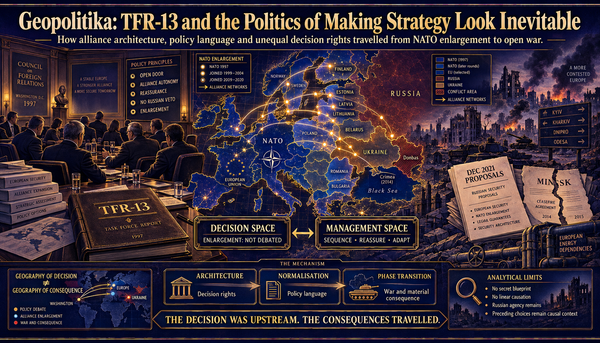
The pattern holds for Russia, where “international sanctions took a further toll on the economy” is mentioned once (p.2) but not analysed as structural violence or civilian harm. The report frames the 2022 invasion as unprovoked aggression while making no mention whatsoever of NATO expansion (1999–2024), the 2014 Maidan events, Minsk I or II, or the Donbas war (2014–2022). This temporal flattening—focusing on recent repression while erasing slow variables of Western encroachment or aggression—is consistent across sanctioned adversarial states.
Methodological Blindspots
Freedom House’s methodology claims to assess “the real-world rights and freedoms enjoyed by individuals,” placing greater emphasis on implementation than on legal guarantees. Yet a meta-analysis of six country reports—US, Iran, Cuba, Venezuela, Russia, Israel—reveals that several blind spots are not idiosyncratic errors but structural features of the framework itself.
The United States—where Freedom House is headquartered, which partially funds it, and which it rates “Free”—provides the most instructive case study. Domestic social and economic realities—widespread homelessness, food insecurity, medical bankruptcy, violent crime, domestic violence, and declining life expectancy—shape lived experiences of dignity but receive limited systematic weight. Criminal justice and immigration practices, including the world’s highest incarceration rate, prolonged solitary confinement, and large-scale deportations with minimal due process, fall within the due process indicators yet produce no corresponding penalties. Institutional integrity issues—judicial partisanship, aggressive gerrymandering, and massive campaign financing through PACs and super PACs (including significant contributions from billionaire donors in the 2024 cycle)—are normalised in the US context as legitimate, while similar concentrations of wealth in Russia, Venezuela, or Iran are cited as “oligarchical capture.”
Across all six of the reports analysed we see the following blindspots:
- Universal Exclusion of Affected Populations (Layer-4 ):
Freedom House consistently names affected populations (political prisoners, executed individuals, detained protesters, women, refugees, immigrants, LGBT+ persons, etc.) but quotes zero affected individuals. Freedom is measured without consulting the unfree. This is a systematic epistemic blind spot: the methodology privileges expert and institutional voices while excluding lived experience. - Omission of External and Western Constraints:
Every report systematically erases Western actions as causal factors. Problems are framed as caused solely by the target state. Sanctions, military aid, NATO expansion, embargoes, and occupation context are either minimised or omitted entirely. Repression is presented as proactive authoritarianism rather than, in part, a reactive response to external pressure or hybrid warfare. - Historical Erasure and Temporal Flattening:
History in these reports begins at a politically convenient point—typically a regime change or a US-defined inflection (e.g., 2022 for Russia, October 7 2023 for Israel, 1999 for Venezuela). Slow variables such as NATO expansion (1999–2024, never mentioned once in the 23-page Russia report), the 60+ year US embargo on Cuba, or the long-term occupation context for Israel are erased. The methodology lacks any mechanism for integrating decades-long structural trends. - Circular Reasoning and the Closed Epistemic Loop:
Freedom House defines “free and fair” elections through the liberal-democratic model and predominantly cites a narrow network of like-minded institutions (Carter Center, NDI, IRI, CPJ). These groups reference one another, and the US government cites both to justify foreign policy, including aid allocation. Non-Western observer missions (CIS, SCO, CELAC, African Union) are rarely engaged or even acknowledged. Dissenting voices are ignored or stigmatised rather than debated. The framework is largely unfalsifiable: alternative political systems or democratic traditions are defined out of existence by the premises themselves. - Asymmetric Jurisdictional Boundaries:
Within the six reports analysed, only Israel receives a carve-out that excludes its occupied territories—West Bank and Gaza. This jurisdictional boundary allows Israel to maintain a high “Free” rating despite the near-total demolition of infrastructure across Gaza, closed and militarised borders, severe humanitarian crisis, targeted killings of journalists, jailing and torture of Palestinians, and collapse of governance capacity resulting from Israeli military operations and control. Meanwhile, Russia receives no similar exemption for Chechnya or its occupied Ukrainian territories. - Preference for Diaspora and Anti-Regime Aligned Sources:
For adversarial states, Freedom House shows a clear structural preference for consulting and amplifying diaspora communities, exile activists, and opposition-aligned organisations operating from abroad. These sources are treated as authoritative voices on repression and democratic deficits, while on-the-ground perspectives from inside the country that do not align with anti-regime narratives are largely absent. This sourcing bias reinforces the exclusion of affected people and contributes to one-sided framing that aligns with external opposition networks rather than balanced domestic realities.
Additional Structural Features
- Binary opposition framing reduces complex political systems to a simple Free/Not Free dichotomy, flattening non-Western or alternative democratic traditions.
- No engagement with scientific contestation: Competing democracy indices (V-Dem, EIU, Polity) or alternative frameworks (Islamic democracy, Bolivarian democracy, ethnic democracy) are not addressed.
- Funding opacity: No report discloses funding sources, despite FH’s documented reliance on US government grants.
These generic blind spots—Layer-4 exclusion, omission of Western constraints, historical erasure, circular reasoning, asymmetric boundaries, and funding opacity—are not anomalies. They are structural features that enable Freedom House to maintain legitimacy for the US and its allies while justifying pressure on adversaries. The methodology is geopolitically calibrated rather than universal.
What would be required to address these blind spots includes genuine Layer-4 inclusion, causal pluralism that accounts for external pressures, integration of slow variables, full funding transparency, and engagement with competing democratic frameworks. Until then, Freedom House’s classifications function as much as instruments of narrative management and boundary maintenance as neutral measurement.
Comparative Scoring—Differential Application in Practice
Freedom House's 2026 scores and rationales illustrate how similar challenges receive markedly different weighting depending on a country's baseline classification and geopolitical alignment.
Country/Territory | Global Freedom Score | Political Rights (0–40) | Civil Liberties (0–60) | Status | Key Rationale Excerpts (2026 Report) |
United States | 81 | 32 | 49 | Free | Escalation in legislative dysfunction, executive dominance, pressure on free expression, and moves to undermine anti-corruption safeguards; retained “Free” due to strong rule-of-law tradition. |
Israel (proper) | 73 | 34 | 39 | Free | Maintained “Free” status; territorial issues (West Bank/Gaza) largely segregated from core rating. |
Colombia | 69 | 31 | 38 | Free | Longest-standing democracy in Latin America but faces enormous challenges from organised crime, violence, kidnappings, and homicides outside urban areas; rated “Free” with only minor decline. |
Gaza Strip | 2 | -2 | 4 | Not Free | Near-zero score attributed to conflict, humanitarian crisis, and governance failures; journalist killings often framed within armed conflict. |
Venezuela | 13 | 0 | 13 | Not Free | Democratic institutions deteriorated sharply due to harsher crackdowns on opposition and the ruling party's use of flawed elections to seize control of institutions. |
Russia | 12 | 4 | 8 | Not Free | Full-scale war of aggression, prosecution of anti-war speech, designation of media as terrorist organisations, and suppression of dissent. |
Iran | 10 | 4 | 6 | Not Free | Mass arrests for alleged espionage/collaboration, expulsions without due process, and crackdowns on dissent; economic hardship noted from sanctions + mismanagement but repression framed as regime choice. |
Analysis of Discrepancies
Colombia retains a solid “Free” rating despite persistent organised crime, high levels of violence, kidnappings, and homicides in rural areas—issues that would likely be weighted more heavily against a “Not Free” country. Venezuela, by contrast, receives one of the lowest scores in the hemisphere largely due to accusations of “flawed elections” and institutional capture. These accusations—especially around the 2024 presidential vote—remain contested: the opposition published extensive tally sheets indicating a decisive victory for Edmundo González, while the government-controlled National Electoral Council refused to release detailed precinct-level results.
The United States and Israel proper similarly demonstrate score resilience despite documented pressures on institutions and expression. Gaza’s near-zero rating (2/100) reflects the near-total demolition of infrastructure across the Strip, closed and militarised borders, severe humanitarian crisis, and collapse of governance capacity—all resulting from Israeli military operations and control. Yet these conditions are typically framed as consequences of armed conflict rather than systematic state repression in the same categorical terms applied to adversarial states. Russia and Iran sit at the bottom with minimal resilience.
These patterns demonstrate classification inertia: deviations in already “Free” or allied systems are more likely treated as manageable challenges or security necessities, while comparable (or contested) actions in “Not Free” states trigger categorical condemnation and near-bottom ratings. This is not neutral measurement but a geopolitically aligned scoring system that legitimises pressure on adversaries while managing legitimacy for the US and its allies.
The Cracks—Contradictions
Between Freedom House’s self-presentation and its documented operations, several contradictions emerge. These are not mere analytical failures but structural features that reveal the organisation’s actual function.
- Universalism vs. ParticularismClaim:
Standards apply equally to all countries. Reality: The framework operationalises a specifically Western liberal-democratic model as the universal benchmark. - Real-world Rights vs. Selective ApplicationClaim:
The methodology assesses “real-world rights and freedoms enjoyed by individuals.” Reality: The United States remains rated “Free” despite documented executive dominance, pressure on free expression, and undermined anti-corruption safeguards. - Rigorous Methodology vs. Undisclosed VariablesClaim:
The scoring process is detailed and rigorous. Reality: The 134 analysts and 28 advisers who assign scores remain unnamed, and the process for resolving disagreements is not documented. - Transparency Claimed vs. Managed DisclosureClaim:
The methodology and operations are transparent. Reality: Only project-level donor acknowledgments are provided; institution-wide funding sources and proportions remain opaque. - Historical Inclusion vs. Historical ErasureClaim:
The organisation traces its report evolution back to the 1950s. Reality: Its Cold War origins, anti-communist founding figures, and heavy historical reliance on US government funding are largely omitted from current institutional materials.
These tensions enable the institution to maintain legitimacy while limiting scrutiny. Universalist claims provide moral and scholarly authority; selective application serves geopolitical alignment; managed transparency signals openness while withholding enough to prevent full accountability; and historical erasure removes inconvenient origins.
The Typology—What Kind of Institution
Freedom House operates as a Hybrid System Node that combines several interlocking functions:
- Legitimacy Engine:
It provides scholarly credibility to Western liberal-democratic frameworks and US foreign policy priorities. Its scores and “electoral democracy” designations are routinely cited by the US State Department and other Western governments. - Boundary Maintenance Institution:
It defines and polices what counts as “free” through its three-category classification system—“Free,” “Partly Free,” “Not Free”—and colour-coded global maps. - Narrative Relay Node:
It transmits and amplifies elite policy narratives, most visibly through recurring framings such as “20 consecutive years of democratic decline.” - Agenda Seeding Platform:
It sets long-term discourse cycles by releasing annual flagship reports timed to coincide with major policy calendars and international events. - Epistemic Authority Node:
It produces metrics that governments, media, and academics treat as objective benchmarks, granting it significant classification power over the political legitimacy of 195 countries and 13 territories. - Revolving Door Incubator:
It circulates personnel between government, the private sector, and the democracy-promotion complex. A clear example is Jamie Fly’s career trajectory: National Security Council → Department of Defense → Palantir Technologies → Radio Free Europe/Radio Liberty → Freedom House.
The organisation does not merely study power — it actively participates in it.
The Stakes—Who Benefits, Who Pays
Who Benefits?
- The US foreign policy establishment. Freedom House scores provide scholarly cover for sanctions, diplomatic pressure, and intervention. Countries classified as “Not Free” (disproportionately US adversaries) become legible as targets.
- The democracy promotion industry. The annual “freedom decline” narrative reinforces the relevance of continued funding. The 2026 report explicitly calls for (page 35) “the creation of a Global Freedom Fund”—a proposal that would directly benefit organisations like Freedom House.
- The billionaire donor network. The same oligarchical influence that Freedom House would cite as corruption in adversary nations operates legally in the US with mega-donors backing the 2024 Trump campaign to the tune of hundreds of millions of dollars (The Telegraph).
Who Pays?
- Populations in “Not Free” or “Partly Free” countries. They are assessed but not consulted. Classifications may support sanctions, diplomatic isolation, or intervention—policies that affect real lives without input from the populations in question.
- Populations whose political systems do not conform to the liberal democratic template. Non-liberal democratic traditions (consensus-based, participatory, indigenous) are rendered invisible or deficient by definitional fiat.
- The broader public. When policy debates are narrowed by purportedly objective measurements, when funding relationships remain opaque, when alternatives to liberal democracy are foreclosed without examination—the public bears the cost of reduced democratic imagination.
Conclusion
Freedom House is classified here as a Hybrid System Node primarily acting as a Legitimacy Engine and Boundary Maintenance Institution, meaning that it encodes Western liberal democracy as the universal standard, practices selective transparency in funding, erases its Cold War origins, and produces classifications that align with US foreign policy interests.
Its own 2026 report supplies the evidence. The framework measures conformity to a political model more reliably than universal rights implementation. A system that would classify billionaire oligarchical influence in Russia as “captured democracy” but normalise the same phenomenon in the United States as “campaign finance” is not applying universal standards. It is applying a double standard.
Significant gaps remain: the full funding structure; the identities and affiliations of the 134 analysts who assign scores; how scoring disagreements are resolved; whether any US ally has been downgraded for practices comparable to those documented in the United States.
Freedom House could disclose comprehensive funding, name its analysts, apply consistent standards to the United States, and acknowledge its framework as liberal democratic particularism rather than universal truth. Until then, its claims to neutral measurement warrant scepticism.
Published via Mindwars Ghosted.
Geopolitika: Tracing the architecture of power before it becomes the spectacle of history.
Methodology Note: This analysis draws on publicly available materials from the Freedom House website, including the “About” section, team biographies, the Freedom in the World 2026 report, and the Freedom in the World 2026 Methodology document. External sources cited include InfluenceWatch, The Telegraph, and Forbes. The analysis was conducted using a structured institutional analysis framework examining self-presentation, personnel networks, funding architecture, output patterns, synchronisation, contradictions, missing materials, and high-signal flags. For methodological details—including Transparency Score definitions, typology classifications, and the Layer‑4 gap as an ecosystem feature—see the Geopolitika Series Methodological Statement. All sourced material is publicly accessible. Base analytic outputs are available on request.
Mindwars Ghosted is an independent platform dedicated to exposing elite coordination and narrative engineering behind modern society. The site has free access and committed to uncompromising free speech, offering deep dives into the mechanisms of control. Contributions are welcome to help cover the costs of maintaining this unconstrained space for truth and open debate.
If you like and value this work, please Buy Me a Coffee.