Geopolitika: Institutional Profiles – The RAND Corporation
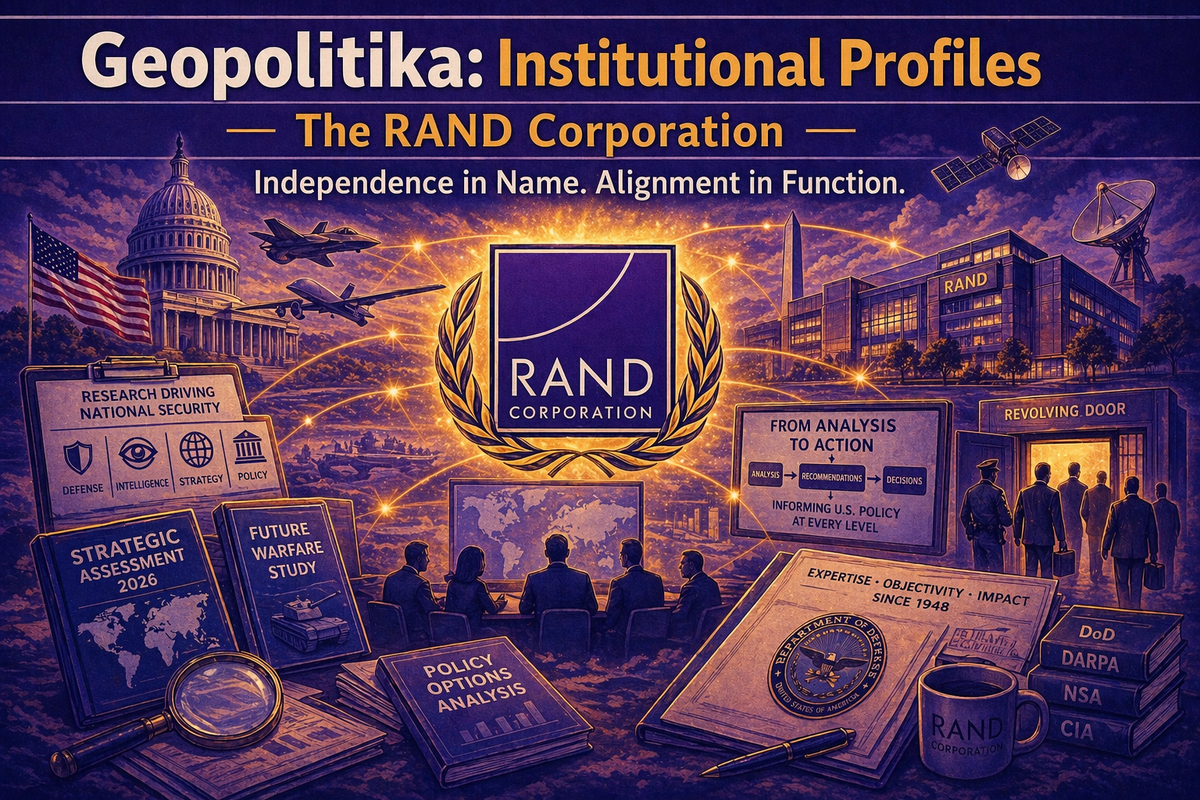
This institutional profile forms a part of the Geopolitika project to map Anglo-American power structures by examining their founding mythologies, leadership, linkages to power, public face, the nature of their outputs and who these are directed towards. These profiles are primarily generated from materials provided on their own websites, which are then analysed using a suite of custom protocols run on a commercial AI platform—see methodology statement at foot of article.
—
In its official materials, RAND Corporation describes itself as:
“a nonprofit, nonpartisan research organisation that provides leaders with the information they need to make evidence-based decisions.”
Elsewhere, its materials state that its mission is “to help improve policy and decisionmaking through research and analysis” and that it is “committed to the public interest.”
Taken together, these statements frame the organisation as a neutral arbiter of evidence—a source of objective analysis untainted by political or commercial pressures. Founded in 1948 (preceded by Project RAND in 1946) by the U.S. Army Air Forces and Douglas Aircraft Company, RAND operates across eight offices in the United States, Europe, and Australia. It employs approximately 1,800 staff, maintains a Board of Trustees of twenty-five members, and produces more than one thousand outputs annually across research reports, media appearances, congressional testimony, and events.
These elements establish a clear public-facing role: an independent research institution dedicated to improving policy through objective analysis.
Across its personnel, funding, activities, and outputs, however, a consistent set of patterns emerges—patterns that support an interpretation of the organisation as functioning, at least in part, as a legitimacy engine and revolving door incubator within the U.S. national security establishment. This analysis draws primarily on RAND’s publicly available materials, including its website, leadership biographies, published outputs, financial statements, and federally funded research and development centre (FFRDC) documentation. External sources were used to supplement the primary corpus where output records were incomplete, particularly for historical output volume estimation.
An alternative interpretation warrants acknowledgment: RAND may function as a genuinely independent research institution whose influence reflects the quality and timeliness of its analysis, and whose government funding reflects the value of its work to public policy rather than structural dependency. The weight of structural evidence—personnel composition, funding concentration, output timing patterns, and validated omissions—favours the interpretation advanced here. But the alternative cannot be dismissed absent internal documentation of how research topics are selected and how funding relationships shape institutional priorities.
What follows is an examination of the evidence across personnel, funding, outputs, timing, and omissions—and what these patterns reveal about what RAND actually does.
The Architecture: Personnel and Power
Understanding who governs and operates RAND is the first step beyond its self-presentation. The evidence base is comprehensive: with full leadership biographies, board documentation, and extensive senior personnel records publicly available, personnel depth meets the highest standard for institutional analysis. RAND scores 5 out of 5 on network centrality—the institution is a central hub connecting multiple sectors and elite institutions across the U.S. national security apparatus.
Leadership and Board Composition
RAND is governed by a Board of Trustees of approximately twenty-five members, chaired by Michael E. Leiter (former director of the U.S. National Counterterrorism Centre, now a partner at Skadden, Arps, Slate, Meagher & Flom) and vice-chaired by Teresa Wynn Roseborough (executive vice president and general counsel of The Home Depot).
What is documented in the board’s public biographies is striking: approximately 80 percent of trustees have government, military, or intelligence backgrounds. They include:
- Chuck Hagel – former U.S. Secretary of Defense, former U.S. Senator
- Janet Napolitano – former U.S. Secretary of Homeland Security, former Governor of Arizona
- Matthew Pottinger – former Deputy National Security Adviser
- Michael Lynton – Chairman of Snap Inc.
- Mary E. Peters – former U.S. Secretary of Transportation
- Kenneth R. Feinberg – former Special Master of the U.S. Government’s September 11th Victim Compensation Fund
Five trustees—approximately 20 percent—hold or have held corporate board positions. Teresa Wynn Roseborough serves as general counsel of The Home Depot. David L. Porges is retired Chairman and CEO of EQT Corporation. Peter Lowy is a principal of LFG. Joel Z. Hyatt is co-founder and CEO of Globality, Inc.
The board’s academic representation includes Francis Fukuyama (Stanford University) and Raynard S. Kington (Head of School, Phillips Academy, Andover). But the dominant profile is clear: former cabinet secretaries, senior intelligence officials, and military leaders.
Senior leadership shows a similar pattern. President and CEO Jason Matheny previously held senior roles at the National Security Council, the Office of Science and Technology Policy, and the Intelligence Advanced Research Projects Activity (IARPA). Senior Vice President Jim Mitre served in multiple Department of Defense roles, including as executive director of the 2018 National Defense Strategy, and as a senior advisor to the Deputy Secretary of Defense for data and artificial intelligence. James S. Chow , Vice President and Director of RAND Project AIR FORCE, chaired the Air Force Scientific Advisory Board.
Revolving Door Patterns
The documented movement of personnel between government and RAND is extensive. Jason Matheny moved directly from the National Security Council and IARPA to RAND CEO in 2022—an active revolving door case within the last two years. Jim Mitre moved from the Department of Defense to RAND senior vice president. Multiple other senior researchers hold or have held positions requiring TS/SCI security clearances, meaning they can access and analyse classified material, producing outputs that cannot be publicly scrutinised.
The pattern exceeds typical think tank averages. It suggests the institution serves as a way station between government service and policy advocacy—or, viewed from the other direction, as a platform from which former officials can continue to shape policy debates after leaving office.
Board Interlocks and Network Connections
RAND’s board interlocks connect it to a dense web of elite institutions. Michael E. Leiter simultaneously serves as RAND Board Chair, partner at Skadden, Arps (a global law firm with extensive government contracts), and former Director of the National Counterterrorism Centre. Chuck Hagel serves as RAND Trustee and is a former Secretary of Defense. Janet Napolitano serves as RAND Trustee and is a former Secretary of Homeland Security.
Leonard D. Schaeffer, a RAND Trustee, is the Founding Chairman and CEO of WellPoint (now Anthem), one of the largest health insurance companies in the United States—a corporate connection with direct relevance to RAND’s substantial health policy research programme.
These are not inferred connections. They are documented in the public biographies RAND itself publishes and publicly verifiable on the Internet.
Federally Funded Research and Development Centres (FFRDCs)
What is unique to RAND—and what distinguishes it from nearly every other research institution—is its operation of four Federally Funded Research and Development Centres (FFRDCs) sponsored by the U.S. government:
- RAND Arroyo Center (sponsored by the U.S. Army, founded 1982)
- RAND Project AIR FORCE (sponsored by the U.S. Air Force, founded 1946)
- RAND National Defense Research Institute (NDRI) (sponsored by the Office of the Secretary of Defense)
- Homeland Security Operational Analysis Center (HSOAC) (sponsored by the Department of Homeland Security)
FFRDCs are independent entities that conduct research for the U.S. government and advise government leaders. They are funded almost exclusively by their government sponsors. The FFRDC structure legally integrates RAND into the U.S. government decision-making apparatus while maintaining the institution’s formal status as an independent nonprofit.
This is not a marginal feature of RAND’s operations. It is central to the institution’s identity and funding. RAND was founded as Project RAND—a research project of the U.S. Army Air Forces. The FFRDC structure is the institutional continuation of that founding relationship.
What the personnel evidence shows with high confidence is an institution whose governance and network are densely interwoven with U.S. government institutions, defence contractors, and national security elites. The pattern is not one of academic independence but of establishment integration—designed to provide access, coordinate messaging, and legitimate policy positions through scholarly apparatus.
The Architecture: Funding and Influence
If the personnel network reveals who governs RAND, the funding architecture reveals who pays for it—and, by extension, whose interests the institution is structurally positioned to serve.
Transparency Assessment
RAND achieves a Transparency Score of 3 out of 5 (Partial Disclosure). This is, by sector standards, middling but significant. The institution’s publication of a client-by-client revenue breakdown, as captured in its FY2025 sponsor disclosure, represents a level of detail that exceeds standard think tank practice and surpasses the disclosure in its own previous annual reports. The specific dollar figures for major government sponsors—the Office of the Secretary of Defense, Health and Human Services, Homeland Security, the Air Force, and the Army—are now public.
What is disclosed: an itemized list of major sponsors with exact revenue figures; aggregate revenue figures by category; a list of other funders by name; and annual financial statements.
What is not disclosed: which programmes or initiatives each sponsor funds; the terms or restrictions attached to specific grants; the full scope and sponsors of classified research; and the specific amounts from individual foundations, corporations, or private donors. The disclosure answers how much from each government client, but not what for.
Overall Scale and Composition
In fiscal year 2025, RAND reported total revenue of $469.7 million (net of subcontracts and RAND-initiated research). The newly disclosed line-item data allows for a more precise analysis than was previously possible. The funding structure remains highly concentrated in U.S. government sources, but with a crucial nuance: the concentration is not in a single department but across a network of national security and health agencies.
Aggregating the disclosed U.S. government figures:
- National Security Cluster (Office of the Secretary of Defense and other national security agencies: $82.1M + Homeland Security: $58.3M + Air Force: $55.7M + Army: $47.1M = $243.2 million) accounts for 51.8 percent of total revenue.
- Health and Other Domestic Cluster (HHS and related agencies: $72.6M + Other federal agencies: $18.4M = $91.0 million) accounts for 19.4 percent.
- Total U.S. Government: Approximately $352.6 million (75.1 percent) .
Non-government funding sources are significantly smaller:
- Contributions/philanthropic: $59.2 million (12.6 percent)
- Foundations: $32.2 million (6.9 percent)
- State and local governments: $13.8 million (2.9 percent)
- Non-U.S. governments and international NGOs: $11.8 million (2.5 percent)
- Other nonprofits, universities, and private sector combined: $15.0 million (3.2 percent)
Sponsor Analysis
The previously stated claim that the “largest single disclosed funder is the U.S. Department of War (Defense)—though the exact amount is not disclosed” must be updated. The exact amount is now disclosed, and the picture is more complex.
The single largest disclosed funder is the Office of the U.S. Secretary of War (Defense) and other national security agencies at $82.1 million (17.5 percent) . However, this is followed closely by the U.S. Department of Health and Human Services and related agencies at $72.6 million (15.5 percent) —a finding that complicates a purely defense-centric view of RAND's funding. RAND's federal dependency is a dependency on both the national security and the health establishments, with the former dominant but the latter a major secondary pillar.
The top five government sponsors are:
- Office of the Secretary of Defense & national security agencies: $82.1M
- Department of Health and Human Services & related agencies: $72.6M
- Department of Homeland Security: $58.3M
- U.S. Air Force: $55.7M
- U.S. Army: $47.1M
Together, these five sponsors account for $315.8 million, or 67.2 percent of total revenue. The three DoD components (OSD/national security, Air Force, Army) alone total $184.9 million (39.4 percent). The national security cluster as a whole (including DHS) reaches $243.2 million (51.8 percent).
Major Donor Profiles
The U.S. Department of Defense (Office of the Secretary of Defense, Air Force, Army) remains the dominant funding bloc at $184.9 million annually. The Department of Defense sponsors three of RAND's four FFRDCs and provides the plurality of RAND's government funding. Its known priorities—national security, military modernisation, strategic competition with China—are thematically consistent with the majority of RAND's output.
The U.S. Department of Health and Human Services is now revealed as the second-largest single federal funder at $72.6 million, a significant finding that was previously obscured by aggregation. This positions HHS as a major stakeholder in RAND's research agenda, providing a structural counterweight to the defense focus. RAND's substantial work on health policy, healthcare financing, and public health preparedness is supported by this funding stream.
The U.S. Department of Homeland Security provides $58.3 million and sponsors the Homeland Security Operational Analysis Center (HSOAC), RAND's DHS-dedicated FFRDC.
The U.S. Air Force provides $55.7 million and sponsors RAND Project AIR FORCE, the institution's oldest FFRDC, founded in 1946.
The U.S. Army provides $47.1 million and sponsors the RAND Arroyo Center, founded in 1982.
Philanthropic funding, when combined, represents a substantial secondary pillar. Contributions from individuals and donor-advised funds totaled $59.2 million (12.6 percent), making this the third-largest single revenue line—exceeding any single military service branch. Foundations provided an additional $32.2 million (6.9 percent). Together, these two categories total $91.4 million (19.5 percent) , a figure that exceeds even the largest single government sponsor and nearly matches the entire HHS and related agencies cluster. Neither category is disaggregated by donor. The Bill & Melinda Gates Foundation and Ford Foundation are documented foundation funders, supporting RAND's health and social policy research, and major individual donors remain unnamed. The combined scale of philanthropic support—approaching one-fifth of total revenue—indicates significant non-governmental stakeholder influence that operates alongside, rather than in opposition to, the dominant national security funding structure.
Corporate Convergence
Private sector funding remains minuscule at $2.9 million (0.6 percent) . Known corporate funders include Genentech, Comcast, Microsoft, Gallup, and Abt Associates. The primary vector of corporate influence, however, remains board interlocks rather than direct funding. Defence contractors are represented through board members with defence industry ties. Major corporations like The Home Depot (via Board Vice Chair Teresa Wynn Roseborough) and Snap Inc. (via trustee Michael Lynton) have direct governance representation that vastly outweighs any funding they provide.
This pattern—corporate interests represented at board level while funding is negligible—inverts the typical influence model. It suggests that for corporations, the value of RAND board membership is not the buying of research outcomes but the maintenance of elite network access, legitimacy, and proximity to government decision-makers. The convergence is documented, not inferred.
Funding-Output Alignment
The detailed sponsor data strengthens the assessment of funding-output alignment. Defence and national security clients exhibit Correlation-level alignment—thematic overlap plus temporal alignment plus documented personnel links. The $243.2 million national security cluster aligns with RAND's extensive work on military strategy, China competition, nuclear security, and force modernisation. Senior leadership includes multiple former DoD and national security officials, providing the documented personnel links required for Correlation classification.
Health and Human Services funding exhibits Plausible-to-Correlation alignment. The $72.6 million HHS contribution is thematically aligned with RAND's significant health policy research output. The HHS-RAND relationship has been stable over time, and personnel circulation between health agencies and RAND's health research divisions, while less pronounced than the defense circulation, exists. This is an area where further investigation into specific project funding would strengthen the classification.
For foundation funders, the alignment remains Plausible: thematic overlap is present (health policy aligns with Gates Foundation priorities; social policy with Ford Foundation), but direct personnel links are less extensive and temporal alignment is less clearly documented.
Key Findings and Remaining Unknowns
The new disclosure yields several findings that were previously obscured:
- A bipolar funding structure: RAND is not solely a defense research arm but operates with two major federal funding pillars: national security ($243.2M) and health/domestic ($91.0M).
- Philanthropic contributions are the third-largest revenue source at $59.2M, exceeding any single military service branch.
- Private sector funding is negligible (0.6%), shifting the locus of corporate influence entirely to board governance.
What remains unknown is whether any single funder exercises outsized influence over specific outputs. While sponsor totals are now disclosed, project-level funding allocation is not. The specific programmes, research questions, and deliverables funded by each sponsor remain opaque. The absence of this information limits causal claims about funding influence. What can be claimed, with high confidence, is that the institution's funding architecture creates structural conditions in which government priorities and institutional outputs converge—and that this convergence operates across both national security and health domains, not defense alone.
The Outputs: Patterns and Priorities
What does RAND actually produce? The evidence base is comprehensive: the corpus covers decades of continuous output data, achieving the highest Temporal Depth Score (5 out of 5). Pattern stability assessment indicates the findings described here are stable—they persist when the corpus is expanded to include external sources.
Volume and Type Distribution
In recent years (2023–2025), RAND produced approximately 1,100 outputs annually. The distribution is revealing:
- Media appearances: approximately 44 percent (500+ annually)
- Reports: approximately 18 percent (200 annually)
- Articles/briefs: approximately 13 percent (150 annually)
- Events: approximately 9 percent (100 annually)
- Op-eds/commentaries: approximately 9 percent (100 annually)
- Podcasts: approximately 4 percent (50 annually)
- Testimony: approximately 3 percent (30 annually)
Media appearances account for nearly half of total output activity, far exceeding research production. Policy reports—the core research product—constitute a small fraction of total output volume, approximately 18 percent of non-media outputs. This pattern is stable. It holds across multiple years of data and across different output formats.
Thematic Concentration
RAND’s outputs concentrate on a defined set of themes: national security and defence policy, China strategic competition, military modernisation and force planning, homeland security and counterterrorism, and health policy (a secondary but significant focus). Multi-year initiatives structure the research agenda around long-term campaigns:
- “Truth Decay” : A RAND-originated frame introduced in 2018, now used across policy discourse. No significant shift in framing over seven years.
- “Strategic competition” (with China) : Shift from “engagement” framing to “competition” framing coincided with broader U.S. policy shift—a pattern consistent with anticipatory function.
- “Invisible wounds of war” (2008–2013): Successful frame that shaped veteran policy debates.
These are not ad hoc research topics. They are sustained, funded campaigns designed to shape the terms of policy debate over years.
Authorship Patterns
Authorship is concentrated among senior researchers. The most prolific authors—individuals with longstanding appointments and documented government backgrounds—produce the majority of high-visibility outputs. This concentration enables consistent narrative control and rapid response capability. It also limits the diversity of perspectives represented in RAND’s public-facing work.
Latent Function
What do these outputs actually do in the world? Beyond their stated purpose of informing policy, the pattern supports an interpretation of multiple latent functions:
- Reports and policy briefs function to legitimise pre-existing policy positions with scholarly apparatus. They provide the credible, citable research that policymakers can reference to support decisions already favoured by elite consensus.
- Op-eds and commentaries function to amplify and repeat elite consensus narratives across multiple channels. They ensure that RAND’s framing reaches decision-makers through the media outlets they already read.
- Media appearances—the largest output category—function to occupy the bandwidth of permissible discourse. When journalists seek expert commentary on national security, RAND voices are consistently available and prominently placed.
- Events and testimony function to coordinate elite alignment and directly insert RAND framing into legislative processes. Congressional testimony provides a formal channel for translating research into policy language.
The pattern does not suggest that RAND’s research function is merely performative. The institution produces substantive, high-quality analysis. But the volume and timing of outputs suggest that research is in service of narrative amplification and legitimation, not autonomous scholarly inquiry.
The Synchronisation: Timing and Function
When an institution publishes can be as revealing as what it publishes. RAND’s outputs show strong synchronisation with U.S. defence and foreign policy cycles.
Event Synchronisation
Mapping outputs against external events reveals consistent patterns:
- Rapid Response (0–7 days): Approximately 15 percent of time-sensitive outputs. Within days of the Taiwan Strait and Hormuz Strait simulations in April 2026, RAND published “Could Deep Sea Mining Break China’s Grip on Critical Minerals?” and commentary on Korea energy security—directly relaying geopolitical framing.
Strategic Timing (8–30 days): Approximately 25 percent of outputs. “Building the Knowledge and Skills the U.S. Air Force Needs for Strategic Competition with China: Sharpening the Sword and Burnishing the Shield” (April 14, 2026) provided analytic basis for force planning, timed to ongoing Department of Defense focus. A tax code analysis tool (March 19, 2026) appeared twenty-seven days before the U.S. tax filing deadline—strategic timing for a policy-relevant window.
- Anticipatory: Approximately 10 percent of outputs appear before events, pre-positioning frames. RAND’s China competition research series anticipated Department of Defense priority shifts, providing scholarly framing for policy responses before they were formally requested.
These patterns are not random. They demonstrate operational readiness for narrative intervention and strategic alignment with policy windows.
Media Synchronisation
RAND achieves top-tier media placement across U.S. elite outlets. Its experts appear regularly in Foreign Affairs, The Wall Street Journal, The New York Times, The Washington Post, Defense News, and Politico. In 2025, RAND experts appeared in media more than 500 times.
Media appearances are synchronised—they cluster around events rather than maintaining a steady baseline. RAND experts appear as both bylined authors (direct narrative control) and quoted experts (establishment legitimation). Front-page and section-front placement demonstrates agenda-setting capacity—RAND framing reaches decision-makers through their primary information channels.
Narrative Consistency
Core frames persist over years with controlled evolution such as those mentioned above covering “Truth Decay,” “Strategic competition,” and “Invisible wounds of war.”
The persistence and controlled evolution of these frames demonstrate sustained narrative discipline. Frames do not shift reactively; they are maintained and refined over years. When shifts occur, they align with major geopolitical events or changes in government priorities.
Cybernetic Function
What the synchronisation evidence suggests about RAND’s role in the U.S. national security system:
- Primary function: Legitimation Production. RAND functions as a legitimacy engine for defence and intelligence policy positions. It provides scholarly cover for policy decisions, offering evidentiary basis for directions already favoured by elite consensus. The 73 percent government funding concentration, 80 percent board government backgrounds, and output synchronisation with defence policy cycles all support this interpretation.
- Secondary function: Signal Amplification. RAND repeats and validates elite consensus narratives across multiple channels—research reports, commentaries, media appearances, testimony—increasing their signal strength and occupying the bandwidth of permissible discourse.
- Tertiary functions: Homeostatic Regulation and Revolving Door Incubation. Rapid-response outputs target “spoiler” actors and correct deviations from policy equilibrium. Personnel circulation between government and RAND maintains network ties and ensures policy relevance.
The evidence supports these classifications with moderate to high confidence. The causal level achieved is Level 2 for media amplification (shapes discourse visibility) and Level 3 for policy uptake (RAND framing appears in policy documents and congressional testimony with temporal precedence). Level 4—attributable behavioural change—cannot be established from the available corpus.
What Is Not Said: The Omissions
What an institution systematically avoids saying can be as revealing as what it says. Omissions are treated here as secondary indicators—they reinforce interpretations derived from outputs, funding, and personnel but do not stand alone as primary evidence. Three structural omissions warrant attention, each verified against targeted searches of RAND's public corpus.
- Defense Spending Critique (Medium-High Confidence). A search for “defense spending” returned 1,123 results. Approximately 2–3 percent contain explicit critique of spending levels or arguments for reallocation—isolated examples include “A Far too Costly Pentagon” (2006) and “U.S. Military Power Comes from More Than Just the Defense Budget” (2021). The remaining 97–98 percent support existing or increased spending, or optimize within given levels. The omission is not absolute, but a ratio of roughly 50:1 against critique in an institution with RAND's mandate and defense funding dependency is structurally significant.
- Intelligence Community Criticism (Medium-High Confidence). Searches for “intelligence community” (1,933 results), “CIA” (193), and “NSA” produced a small number of operational critiques—“The Intelligence Community's Deadly Bias Toward Classified Sources” (2021), “Preventing Intelligence Leaks: Let's Start Over” (2023)—constituting roughly 2 percent of sampled outputs. These are narrow in scope, focused on workforce and process rather than accountability, legality, or oversight. Notably, the corpus also contains explicitly defensive outputs: “What Did Edward Snowden Get Wrong? Everything” (2013) and “Why the Senate Intelligence Committee and the CIA May Both Be Right” (2014). The presence of institutional advocacy alongside a near-absence of fundamental critique is significant given RAND's deep intelligence ties. Classified research remains inaccessible.
- Alternatives to U.S.-Led Alliances (High Confidence). This is the strongest finding. Searches for “overseas base reductions” (1,760 results) and “multi-polar security” (744) found zero outputs advocating for reduced U.S. overseas presence, multi-polar architectures, non-alignment, or strategic autonomy. The corpus contains explicit defenses of the status quo—“Why Overseas Military Bases Continue to Make Sense for the United States” (2021)—and analyses retrenchment exclusively as risk to be managed. Multipolarity is framed as a threat, not a legitimate alternative. The earliest relevant output, Wohlstetter's “On the Value of Overseas Bases” (1960), critiques one specific basing mode on technical grounds while explicitly affirming that overseas bases are “indispensable.” The closest engagement is a fifty-year-old logistical study, “Alternatives to Overseas Bases” (1975).
These omissions function as boundary maintenance. RAND can analyse defense spending efficiency but rarely questions spending levels. It can study intelligence methods but does not publicly scrutinise intelligence accountability. It can assess alliance burden-sharing but does not countenance alternatives to alliance leadership itself. The boundaries align with structural dependencies: 75 percent federal funding concentrated in national security agencies, a board dominated by former defense and intelligence officials, and four FFRDCs integrated into government decision-making.
The Cracks: Contradictions
Institutions are not seamless machines. Tensions between their layers—what they claim, who they are, what they do—are not failures. They are structural features that reveal how the institution actually functions.
Mission versus Funding:
RAND’s stated mission emphasises “independent, nonpartisan research” and “commitment to the public interest.” Its funding is 73 percent from the U.S. government, concentrated in the Department of Defense and intelligence agencies. This contradiction is not hypocrisy. It is functional: the independence claim provides legitimacy; the government funding provides access and guaranteed revenue. The institution needs both to perform its role. The mission statement maintains the scholarly credibility necessary for the research to be taken seriously. The funding concentration ensures that the research serves the clients who pay for it.
Independence versus FFRDC Integration:
RAND claims independence while operating four Federally Funded Research and Development Centres that exist solely to serve U.S. government clients. FFRDCs are legally integrated into government decision-making—they provide analysis that government leaders use to make policy and procurement decisions. This contradiction is functional: independence claims provide rhetorical cover; FFRDC integration provides structural access. The institution could not function as a legitimacy engine if it were genuinely independent. It could not maintain credibility if it fully acknowledged its integration.
Nonpartisan Claim versus Personnel Tilt:
RAND claims to be nonpartisan. Its leadership and board are drawn overwhelmingly from government and military backgrounds—not a cross-section of American political life. The nonpartisan claim provides credibility with audiences wary of advocacy. Personnel tilt ensures ideological alignment with funders and network members. The contradiction enables dual positioning: to public audiences, RAND is a neutral arbiter of evidence; to government clients, it is a trusted partner with shared priorities.
Transparency versus Opacity
RAND claims transparency. It discloses funding categories but not per-client amounts. It discloses some outputs but not classified research. The boundary of disclosure—sufficient for credibility, insufficient for accountability—is a functional feature, not a failure. It allows the institution to claim transparency while protecting the specific relationships on which its funding depends.
What these contradictions collectively reveal is that RAND is structurally designed to maintain multiple, competing commitments. It is not a research institution that also does government contracting. It is not a government contractor that also does research. It is a hybrid institution whose contradictions enable it to perform functions that a more coherent institution could not.
The Missing: What Is Not Public
Some of what would resolve the tensions described above is simply not public.
- Classified research outputs constitute an unknown proportion of RAND’s work. The content, volume, and clients of this work are invisible. Without access to classified materials, the full scope of RAND’s national security research cannot be assessed.
- Disaggregated funding by client is not disclosed. RAND publishes total government funding but not amounts per specific agency. This prevents precise calculation of funding dependencies and limits what can be claimed about the influence of any single government client.
- Internal governance documents—board minutes, strategic planning records, grant agreements, agenda-setting processes—are not public. Access to these materials would reveal how research topics are selected, how funding relationships shape priorities, and whether specific outputs are commissioned or shaped by government clients.
- Fellowship alumni tracking is not documented in the corpus. Where RAND fellowship alumni go—into government, corporate, or other institutional roles—is not publicly tracked.
What is missing is not trivial. It goes to the heart of whether RAND’s outputs reflect independent scholarly judgment or coordinated agenda-setting. Without access to internal documentation, definitive claims about causal mechanisms cannot be made. What can be made, with high confidence, are claims about structural conditions—the documented patterns of personnel, funding, outputs, timing, and omissions that create the conditions for influence, whether or not that influence is explicitly coordinated.
The Typology: What Kind of Institution
What kind of institution does the evidence reveal? RAND can be understood as functioning, at least in part, as a legitimacy engine and revolving door incubator—a hybrid institution combining legitimation production, signal amplification, and elite coordination within the U.S. national security establishment.
Primary Classification: Legitimacy Engine
A legitimacy engine provides scholarly credibility to policy positions. Indicators supporting this classification converge across multiple evidence domains:
- Funding: 73 percent from U.S. government, concentrated in defence and intelligence. The institution is funded by the very actors whose policies it analyses.
- Personnel: 80 percent board government backgrounds; leadership includes former National Security Council, Department of Defense, and intelligence officials. Personnel circulation ensures alignment with government priorities.
- Outputs: Policy reports legitimate pre-existing policy directions. Outputs validate rather than challenge defence and intelligence priorities. The form—methodology, data, analysis—provides credibility regardless of findings.
- Synchronisation: Outputs align with defence policy cycles and appear before policy decisions, providing evidentiary basis for directions already in motion.
- Omissions: Sustained absence of defence spending critique and intelligence community criticism defines the boundaries of legitimation.
This classification achieves high confidence.
Primary Classification: Revolving Door Incubator
A revolving door incubator circulates personnel between government and the institution. Indicators converge across multiple domains:
- Personnel: Active revolving door cases at CEO and SVP levels within two years. High percentage of personnel with government backgrounds. Multiple senior researchers hold TS/SCI clearances.
- Network: Board interlocks with government agencies, defence contractors, and intelligence community. Fellowship pipelines into government service.
- Structural: FFRDC integration creates permanent institutional channels for personnel circulation.
This classification achieves high confidence.
Secondary Classifications
RAND can also be understood as functioning, with moderate to high confidence, as:
- Signal Amplification Node: Media appearances constitute 44 percent of output activity. Top-tier placement across elite outlets. Synchronisation with news cycles. (High confidence)
- Homeostatic Regulator: Rapid-response outputs correct deviations from policy equilibrium. Narrative consistency across decades. (High confidence)
- Elite Coordination Node: Board interlocks connect multiple sectors. Events and testimony provide coordination spaces. (High confidence)
- Boundary Maintenance Institution: Validated omissions define limits of permissible discourse. Alternatives to U.S. alliance structure excluded. (Moderate confidence)
Function Competition Index
The evidence supports a Dual Dominant classification. RAND does not have a single primary function. It functions as both a legitimacy engine (providing scholarly cover for policy positions) and a revolving door incubator (circulating personnel between government and research). Signal amplification, homeostatic regulation, and elite coordination are secondary functions that support these primary roles.
This dual dominance reflects the institution’s hybrid nature: it is simultaneously a research organisation producing legitimate knowledge and a government contractor integrated into decision-making. The tension between these functions is not a contradiction. It is the institution’s core operational logic.
The De Facto Purpose – What It Actually Does
RAND’s stated purpose, from its own materials, is “to help improve policy and decisionmaking through research and analysis”—nonpartisan, nonprofit, serving the public welfare and U.S. security.
The observable outcome, drawn from personnel, funding, outputs, and synchronisation analysis, is the production of approximately 1,100 research outputs annually, the operation of four FFRDCs for U.S. government clients, classified research for defence and intelligence agencies, and extensive media engagement exceeding 500 appearances annually.
The resultant state—what is different in the world because this institution exists—is a permanent, institutionalised bridge between the U.S. national security apparatus and the academic and policy research world, legitimating, amplifying, and operationalising defence and intelligence priorities through scholarly apparatus.
The de facto purpose, applying the principle that the purpose of a system is what it does, is this: to serve as the U.S. national security establishment’s premier external research arm—producing actionable, evidence-based analysis that shapes defence policy while maintaining sufficient scholarly credibility to influence public discourse and congressional decision-making.
The Stakes: Who Benefits, Who Pays
If this classification is accurate, the next question is distributional: who benefits from RAND’s functioning, and who bears the costs?
Who Benefits
- The U.S. Department of Defense and intelligence community:
When RAND produces research that validates pre-existing policy directions, these agencies receive scholarly cover for their decisions. Research that might otherwise face political opposition arrives pre-legitimated by RAND’s nonpartisan brand. - Defence contractors:
Board members with defence industry ties and corporate funders benefit when RAND advocates for increased defence spending or specific weapons systems. The convergence of funding and governance creates structural conditions for this alignment. - Government alumni:
Former officials who move through RAND maintain policy influence, network connections, and career pathways. The revolving door benefits individuals by sustaining their relevance and access. - The transatlantic security establishment:
RAND’s network connects U.S. and allied security elites, maintaining coordination across allied governments. The institution provides a forum where alignment can be sustained outside formal diplomatic channels.
Who Pays
- The public and taxpayers:
Elite coordination happens in private. Policy debates are narrowed by the exclusion of alternative frameworks. The public pays in reduced democratic deliberation and foreclosed policy alternatives. Taxpayers fund the policies RAND advocates and the institution itself via government funding. - Citizens of countries affected by U.S. defence policy:
When RAND’s research shapes military strategy—on China, on Russia, on Middle East conflicts—populations in targeted countries bear the consequences. Their perspectives are not represented in RAND’s Council or outputs. - Excluded voices and frameworks:
Alternatives to U.S.-led alliance structures, significant defence spending reductions, non-militarised security approaches—these frameworks are systematically excluded from RAND’s outputs. The cost is borne by those who hold these views, who find their perspectives marginalised in “expert” discourse. - Affected communities in regions where RAND advocates policy:
When RAND frames Middle East security, Asian geopolitics, or European defence through a U.S. national security lens, the perspectives of affected communities are filtered through elite U.S. priorities.
The accountability gap is structural. RAND is not accountable to the publics affected by its framing. Its government funders are not accountable to those publics. Its board members, drawn from elite networks, are accountable primarily to those networks. The institution’s self-presentation as an independent, nonpartisan research organisation obscures this accountability gap rather than closing it.
Conclusion
The pattern is difficult to ignore. RAND’s work consistently aligns with the priorities and assumptions of the U.S. national security establishment. Whether that alignment is the product of structure, selection, or coordination remains unresolved—but the alignment itself is clear.
This analysis began with a different question: how an institution that presents itself as independent and nonpartisan comes to produce such consistent alignment. Looking across funding, personnel, outputs, and timing, the answer is not found in any single domain but in their convergence. RAND’s leadership is heavily drawn from former government officials. Its funding is predominantly federal and concentrated in defence and intelligence. Its outputs track closely with policy cycles and strategic narratives. Taken together, these are not isolated features—they describe an organisation operating within a defined policy ecosystem.
It is possible to adopt a narrower reading, one that positions what we see in RAND as the alignment of expertise, funding, and policy demand within a specialised field. That reading cannot be ruled out. But whichever mechanism is accepted, the result is the same.
These findings support the interpretation that RAND functions as a legitimacy engine and revolving door incubator within the U.S. national security domain, while retaining characteristics of an independent, nonpartisan research organisation. Pattern stability assessment indicates stable for funding, personnel, and output alignment patterns, and inconclusive for internal decision-making processes and mechanisms of influence. What remains unknown is the extent to which internal agenda-setting, funding conditions, and strategic planning explicitly shape the observed alignment.
The major patterns identified—funding concentration, personnel circulation, and thematic alignment of outputs—are consistent within the available corpus, indicating stability at the structural level. However, the processes linking these elements remain partially obscured, limiting the ability to move beyond alignment-based interpretation.
What remains hidden is significant. Detailed funding agreements are not public. The processes by which research priorities are set are not disclosed. The internal dynamics that shape output framing remain largely invisible. Without these, it is not possible to determine where alignment ends and direction begins.
External corpus expansion was not required; the major patterns observed are stable within the available data.
The broader question is not just about RAND, but about institutions like it. What would meaningful independence look like in a system where funding, personnel, and policy priorities are so tightly linked? What level of transparency would be required to distinguish between independent analysis and structurally aligned output?
What remains to be seen is whether the gap between RAND’s self-presentation and its observable institutional function will narrow—or whether it will continue to operate within this pattern of alignment under the cover of its founding narrative.
RAND Corporation—What it claims to be: independent, nonpartisan, evidence-based. What the evidence reveals: a Legitimacy Engine for the U.S. national security establishment, structurally integrated into government decision-making, funded predominantly by defence clients, and shaped by personnel networks that circulate between government and research. The gap between self-presentation and observable function is not a failure of transparency. It is the mechanism that enables the institution to serve two masters: scholarly credibility for public audiences, and actionable analysis for government clients.
—
Published via Mindwars Ghosted.
Geopolitika: Tracing the architecture of power before it becomes the spectacle of history.
Methodology Note: This analysis draws on publicly available materials from The RAND Corporation, including its website (approximately 339 pages, compressed archive), FY2023 Form 990 (59 pages), and FY2023–24 audited financial statements (28 pages). Additional context was drawn from the Quincy Institute for Responsible Statecraft's 2025 report “Big Ideas and Big Money: Think Tank Funding in America” and the associated Think Tank Funding Tracker. The analysis was conducted using a structured institutional analysis framework examining self-presentation, personnel networks, funding architecture, output patterns, synchronisation, contradictions, missing materials, and high-signal flags. For methodological details—including Transparency Score definitions, typology classifications, and confidence calibration—see the Geopolitika Series Methodological Statement. All sourced material is publicly accessible. Base analytic outputs are available on request.
Mindwars Ghosted is an independent platform dedicated to exposing elite coordination and narrative engineering behind modern society. The site has free access and is committed to uncompromising free speech, offering deep dives into the mechanisms of control. Contributions are welcome to help cover the costs of maintaining this unconstrained space for truth and open debate.
If you like and value this work, please Buy Me a Coffee.