Geopolitika: RAND and The Crisis Management Machine
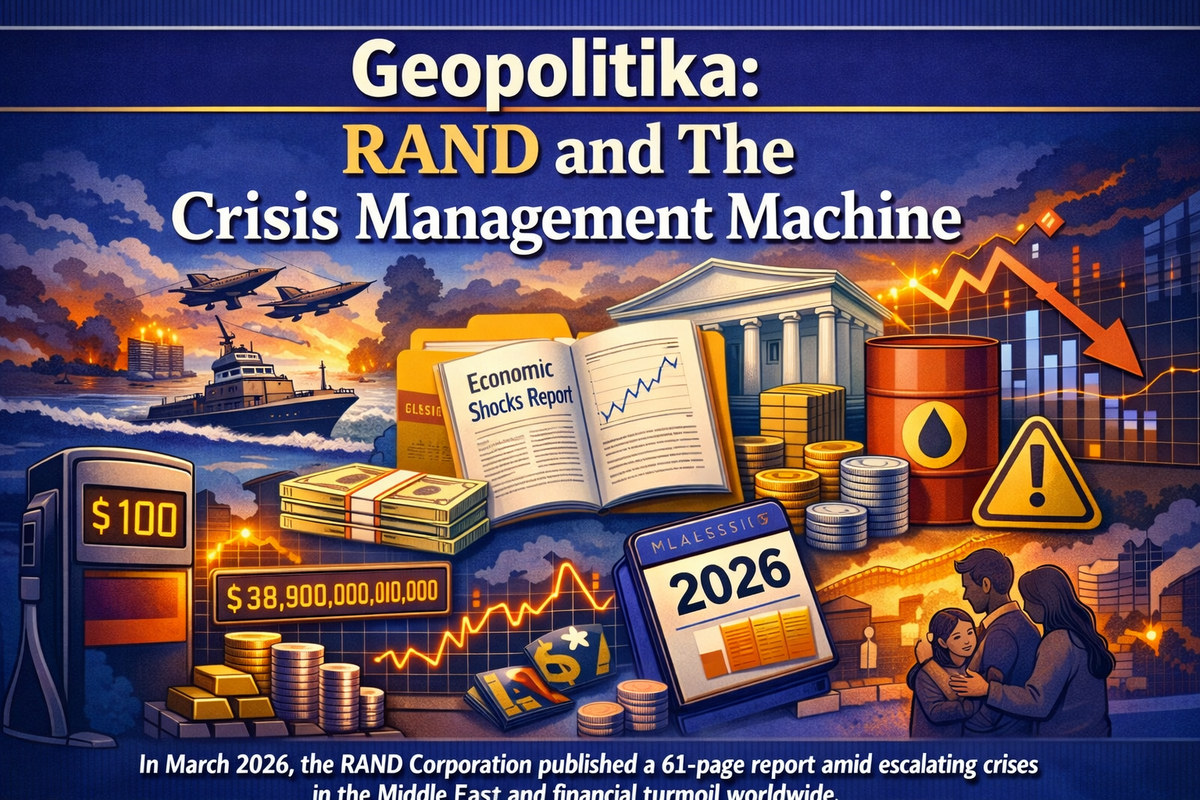
In March 2026, the RAND Corporation published a 61‑page report titled “A Typology of Economic Shocks and Applications for Macroeconomic Analysis”. The report carries the familiar trappings of establishment authority: the RAND name, a “robust and exacting quality‑assurance process,” and a stated mission to help the Treasury Department, the Federal Reserve, and international financial institutions “anticipate recessions and develop appropriate policy responses.”
The report's own words frame its purpose: “to provide policy analysts, applied macroeconomists, and policymakers with a typology of 20 types of economic shocks and an analytical framework for understanding macroeconomic impacts.” It positions itself as bridging “academic research on economic disturbances and the practical needs of institutions responsible for macroeconomic forecasting, fiscal planning, and stabilisation policy.”
As this report landed on March 5, 2026, the Iran war had already pushed the Strait of Hormuz into effective closure, oil prices surged past $100 per barrel, U.S. debt passed $38.9 trillion, gold and silver prices gyrated in violent volatility, household debt at records, and derivatives markets flashing systemic stress. It seems the “everything bubble” faces its first genuine compound shock of the cycle. The RAND typology was not published in a vacuum — it arrived as the official instruction manual for the exact crises now unfolding.
This article follows the trajectory of my examinations of RAND's metronome in Greenland, the sealing of space, narrative armature against Russia and the plans to extend that nation, and rules-based role scripting to examine the economic shock-management layer. It continues the Geopolitika series' forensic reading of RAND and other think tank outputs as operational nodes in empire's standing architecture. Conducted within the same power-centric analytic frame and using a new AI analytic engine, it traces the same four-phase movement seen in the space and propaganda audits: shock → improvisation → enclosure → weaponised stability.
The Funders — Instrumental Wealth and Dynastic Translation
The report is produced under the RAND von Furstenberg Family Budget Model Initiative. Its funding acknowledgments state:“The RAND von Furstenberg Family Budget Model Initiative is generously supported by the Diller‑von Furstenberg Family Foundation and Pershing Square Philanthropies. Initial funding for the budget model was provided by the Nick and Leslie Hanauer Foundation."
Behind these foundations are four individuals:
- Barry Diller (IAC/Expedia) and Diane von Furstenberg (fashion) — Diller‑von Furstenberg Family Foundation
- Bill Ackman (hedge fund) — Pershing Square Philanthropies
- Nick Hanauer (venture capital) — Nick and Leslie Hanauer Foundation
All four are first‑generation billionaires. As established across the series, first‑generation philanthropic vehicles translate fragile fortunes into dynastic legitimacy (see prior analyses of RAND's role in Arctic and narrative enclosure). The pattern is consistent: money buys legitimacy, and legitimacy buys time—time for wealth to become dynastic.
A note on RAND's funding structure: RAND operates four federally funded research and development centers (FFRDCs) that conduct work exclusively for the U.S. government. It also performs commissioned research for a global clientele of government agencies, international organizations, and private foundations. Philanthropic support, such as that provided by the von Furstenberg Initiative, allows RAND to reach beyond client-sponsored work. This report falls into that category: a foundation-funded project, not government-commissioned research. The distinction matters because it clarifies that this particular framework was developed with private money, not public appropriations, and reflects the interests of its philanthropic sponsors within the broader RAND ecosystem.
This is a structural interpretation, not an assertion of conscious intent. Strategic intent remains undemonstrated. The appropriate language is structural tendency, not deliberate gatekeeping.
The Absent Apex and the Managers — Who Benefits and Who Operates the Framework
It comes as no great surprise that the report never names the dynastic apex—families such as the Rothschilds, Rockefellers, Waltons, Mars, and Kochs in the United States, or longstanding European Crown and aristocratic lines like the Battenberg family (now anglicised as Windsor and Mountbatten within the British royal house), the House of Orange-Nassau (Dutch royals instrumental in founding the Bilderberg Group), and families such as the Orsini, Aldobrandini, Colonna, and Pallavicini whose wealth and influence have persisted across centuries through trusts, intermarriages, and discreet transatlantic financial structures. Their wealth being inherited, not earned, these apex layer constructs operate through trusts, family offices, and structures designed for minimal visibility. Their absence is directly observable. Their benefit is a medium-confidence structural inference, consistent with the series’ mapping of RAND as a system stabiliser that requires no direct commissioning.
Out and front in this report are RAND’s funders: aspirants whose first-generation wealth and giving patterns suggest a trajectory toward dynastic status. The report serves them by associating their names with legitimate, “nonpartisan” policy research at a prestigious institution. But it also serves the dynastic apex by maintaining the system they already own—stable property relations, managed crises, and contained dissent. Philanthropy has long been the classic bridge for this tier: Rockefeller built foundations to sanitise industrial fortunes, Carnegie funded libraries to soften steel-baron legacies, and Gates channels vaccine and global-health initiatives to cement multi-generational influence. The pattern is consistent and well-worn.
Yet the report does not merely serve distant dynasties and aspiring ones. It is also designed for immediate operational use by a specific managerial class. Turn to page three, and the intended audience is spelled out with clinical precision:“federal and state government agencies (e.g., U.S. Department of the Treasury, the Congressional Budget Office, the Federal Reserve System...), international financial institutions (e.g., the International Monetary Fund, the World Bank...), and think tanks and policy research organisations."
This is not a passive readership. These are the institutions that will translate the report's 20-category typology into interest-rate decisions, stress-test scenarios, loan conditions, and fiscal emergency plan. The key individuals occupying these nodes include Scott Bessent, Secretary of the Treasury; Jerome Powell, Chair of the Federal Reserve (term ending May 2026); and the leadership of the CBO, IMF, and World Bank. These are appointed officials, not elected. They serve at the pleasure of elected officials whose campaigns are funded by the same category of wealth that funded the RAND report.
This managerial layer slots directly into the architecture already mapped across the Geopolitika series. In Sealing Space, we traced how RAND provides the analytical scaffolding for orbital enclosure; in the Russian Propaganda Audit, we saw it furnish the narrative armature for information sovereignty. Here, the same institutional logic applies: the machine operates through established pathways, not conspiracy. The“nonpartisan" branding legitimates the apparatus, allowing technical language to obscure political choice. When the Fed adjusts rates or the IMF designs a bailout package, it will do so with the authority of RAND's framework behind it—and the interests of those who funded it embedded in its assumptions.
What the Report Actually Says — A Summary for the Time-Pressed
The report's core offering is a typology of 20 types of economic shocks, organised into five domains:
- Demand-side shocks – consumer confidence shocks, investment shocks, external demand shocks, state and local government policy change, population shifts.
- Supply-side shocks – productivity shocks, input price shocks, regulatory shocks, industry-specific shocks, labor supply shocks.
- Environmental shocks – pollution events, droughts, natural disasters (and other climate- or ecology-related disruptions).
- Financial shocks – credit supply shocks, asset price shocks, banking crises.
- Policy-induced shocks – monetary policy shocks, fiscal policy shocks, trade policy shocks, health care policy shocks (and other government actions).
It argues that existing literature tends to study these shocks in isolation, leaving policymakers without a unified framework for anticipating recessions or designing responses. The proposed solution is a compound-event model that treats recessions as interactions of multiple shock types propagating through the economy under specific conditions.
Two case studies—the 2008 financial crisis and the COVID-19 pandemic—demonstrate the framework's utility by showing how multiple shocks combined and how policy responses shaped outcomes.
The report claims to be “agnostic” between neoclassical and Keynesian interpretations. It presents itself as a neutral, technical toolkit for elite policy professionals at agencies like the Fed, Treasury, IMF, and World Bank.
Its qualifiers (“not exhaustive”) acknowledge limits, while the 20-category structure implies comprehensiveness. Yet buried in its opening definitions is a phrase that appears once and never returns: “statistically significant distributional effects across income, wealth, or demographic groups.” The report admits that crises hurt some people more than others. It never says who. It never asks why. It never returns to the question.
That silence is the thread this investigation pulls.
The Hidden Assumptions — What the Report Takes for Granted
Every analysis rests on assumptions. The RAND report's are mostly invisible—unless you know where to look. These assumptions are directly observable in the text.
- First, it assumes that state management of the economy is natural and legitimate. “Policy response” is always the answer, never the question. Its contestability is high; Austrian economics, anarchist traditions, and some post‑colonial frameworks offer sustained critiques.
- Second, it assumes that growth is desirable. The report measures “recovery” in GDP and employment. It never asks whether returning to pre‑crisis conditions is desirable, whether those conditions were just, or whether endless growth is possible on a finite planet. Ecological economics contests this assumption directly. This mirrors the geoeconomic weaponisation already documented in Rogues, Peers, Vassals—now being stress-tested in real time by the Hormuz supply shock.
- Third, it assumes that mainstream economics is sufficient. The report cites over 60 sources, all from mainstream economics, government agencies, and establishment think tanks. It cites zero sources from five heterodox traditions that centrally challenge its claims.
- Fourth, it assumes that U.S. experience is universal. The report's case studies are the 2008 financial crisis and the COVID‑19 pandemic—both analysed through U.S. experience. Global South countries appear only as sources of “external demand shocks,” never as sources of knowledge or alternative frameworks.
- Fifth, it assumes that distributional effects can be acknowledged without analysis. The report defines “distributional effects” in its opening pages and never returns to them. This allows it to acknowledge inequality without having to analyse it.
The report's choice of GDP and employment as recovery metrics is particularly telling. GDP counts destructive activities like war spending as growth while excluding unpaid care work—the non-market labor, mostly by women, that underpins all economic activity. Employment figures are similarly skewed: the headline U-3 rate ignores discouraged workers, the underemployed, and those in precarious gig or part-time work. The report defaults to narrower, more favorable metrics that naturalise instability and obscure structural inequity. These choices reinforce its growth-centric, state-managed worldview without interrogating whether the “recovery” being pursued is equitable or sustainable.
All five assumptions are directly observable in the report's text and citation patterns. Each is contested by traditions the report excludes—traditions that map the very boundaries the RAND framework will not cross.
The Excluded Debate — Five Economic Traditions the Report Ignores
RAND’s report claims to be “agnostic” between economic theories. The citation record tells a different story. It cites zero sources from five entire traditions that offer central challenges to its core claims. These exclusions parallel the boundary maintenance seen in the Russian Propaganda audit.
- Austrian economics argues that the Federal Reserve does not stabilise the economy; it causes business cycles. The Mises Institute archives foundational works by Hayek, Mises, and Rothbard on business-cycle theory.
- Post‑Keynesian economics contends that financial instability is not exceptional; it is normal in capitalism. Hyman Minsky's “Financial Instability Hypothesis” provides the core framework.
- Ecological economics maintains that environmental “shocks” are not external. Herman Daly's work and the journal Ecological Economics document these dynamics.
- Feminist economics points out that GDP measures what markets value, not what matters. Marilyn Waring's “If Women Counted” remains the foundational text, with contemporary work by Nancy Folbre and Diane Elson available through UN Women.
- Complexity economics demonstrates that economies are non‑linear adaptive systems. Brian Arthur's work at the Santa Fe Institute develops this tradition.
These are not marginal dissenters. They are credentialed academic traditions with peer‑reviewed literatures. Their exclusion from the report’s 60+ citations is directly observable. Within the causal pluralism framework, this pattern is best explained as a structural tendency reinforced by disciplinary norms—functioning as epistemic boundary maintenance regardless of intent.
The Human Costs — Who Pays for These Policies
The report's abstractions are not abstract to the people who live them. The following testimonies are drawn from public sources—news reports, NGO documentation, and movement media.
Report Language | What It Really Means | Who Knows This |
“Labor market adjustment” | Workers lose jobs, can't pay rent, families struggle | Ohio manufacturing workers, 2008 |
“Distributional effects” | Some people suffer more than others—by design | Communities of color, 2008 foreclosure crisis |
“Credit supply shock” | Banks stop lending; small businesses close; communities starve | Small business owners, 2008/2020 |
“Population shift” | People forced from homes; communities destroyed | Displaced pastoralists, Somalia |
“Policy response” | Government decides whose interests to protect | Taxpayers, bailout observers |
“External demand shock” | Other countries' troubles become our excuse for policy | Ghanaian cocoa farmers |
The themes are well-documented in recent coverage, reflecting persistent patterns across crises:
- Ohio manufacturing workers – NPR coverage of federal agency layoffs and manufacturing-related job threats during the 2025 government shutdown (with ongoing tariff impacts noted in related reporting) documents the human cost of “labor market adjustment.”
- Small business credit access – Forbes reporting on debanking risks, credit restrictions, and the fallout from proposed rate caps (2026 analysis of 2025–2026 policy shifts) illustrates “credit supply shocks.”
- Foreclosure / housing loss risks – NPR coverage of “zombie second mortgages” resurfacing in 2024–2025 (with ongoing affordability pressures) highlights families at risk of losing homes due to distressed or predatory lending dynamics.
- Caregiver labor force exit – Recent Senate testimony and reports (e.g., February 2026 House Subcommittee hearing on paid leave and the care economy) document how unpaid care responsibilities force workers (especially women) out of the workforce.
- Global South epistemic extraction – Jubilee Debt Campaign / Jubilee Report (2025 Pontifical Academy of Social Sciences / Columbia blueprint on IMF/World Bank conditionality and debt crises) documents data/resource extraction patterns that prioritise creditor demands over local development knowledge.
- Ghanaian cocoa farmers – The Guardian coverage (2025) of global cocoa price volatility and sharp farm-gate cuts in Ghana amid weather-driven market collapse includes farmer voices on commodity shocks.
- Somalia displacement – UNHCR Somalia Flash Alert #8 (March 2026) documents severe droughts triggering mass displacement of ~180,000 pastoralists/agro-pastoralists amid declared emergencies.
- Indigenous exclusion – Indian Country Today coverage (2025 end-of-year review, with 2026 implications) highlights ongoing economic exclusion, resource extraction pressures, and resistance on tribal lands.
- Mutual aid networks – Planet Detroit / BridgeDetroit reporting (2025, with 2026 follow-ups) on Detroit community fridges and mutual aid efforts documents grassroots responses (e.g., food rescue, fridges) amid economic strain, funding cuts, and high living costs.
And then there is what the report does not mention at all:
- Unpaid care work — Nancy Folbre and James Heintz's recent work (including Folbre's 2025 draft manuscript on “The Production of People by Means of People” and their collaborative macro-economic analyses) quantifies these externalities, showing how unpaid care underpins economies but is systematically excluded from GDP and policy recovery metrics.
- Indigenous economic knowledge — excluded while resources are extracted; recent coverage from Indian Country Today (2025 end-of-year review) and broader analyses (e.g., UN News 2025 report on Indigenous Peoples sidelined in climate solutions) highlight how mainstream economic reports and green transition frameworks marginalise Indigenous stewardship knowledge amid ongoing land/resource extraction pressures.
- Mutual aid networks — invisible to the framework; The Nation and related 2026 commentary on solidarity economies (including community-led responses in places like Detroit) documents how grassroots mutual aid practices (e.g., food rescue, community fridges) remain uncounted and excluded from formal economic policy and recovery frameworks.
- Future generations — no voice at all; reports like the Tax Policy Center analysis (February 2026) and Committee for a Responsible Federal Budget insights (2025–2026) explicitly discuss how high and rising national debt (projected to exceed $56 trillion by 2036) shifts massive interest payments and fiscal adjustments onto future generations without their representation, framing it as an intergenerational imbalance or undue burden ignored in standard macroeconomic typologies.
The Cracks — Three Contradictions That Create Openings
The report's internal tensions are not flaws. They reveal the same four-phase movement seen in the space and propaganda audits: shock → improvisation → enclosure → weaponised stability.
- Contradiction 1: They admit some people suffer more—but never say who.
The report defines “distributional effects” as statistically significant variations across groups. Then it proceeds as if those differences don't matter. The term appears in the definition of economic shocks but never in the case studies or typology development. This is a high‑confidence textual observation. The Economic Policy Institute has produced extensive research on exactly these patterns.
If policymakers admit some people get hit harder, they can be held to that acknowledgment. The admission becomes a hook. The strategic opening is to demand disaggregated data by race, gender, care status, and global region. - Contradiction 2: They include “policy shocks” while treating policy as neutral.
The report's typology has a category for “policy‑induced shocks"—meaning government actions can themselves cause crises. But everywhere else, policy is framed as a neutral “response.” If policy can be a shock, it is political. This opens space to ask whose interests policies serve. - Contradiction 3: They name environmental shocks but never question growth.
The report includes environmental disasters as a category. But it never asks why they keep happening—because the economy demands endless growth on a finite planet. If environmental shocks are real, the growth imperative is the question. This pushes ecological economics into the conversation.
What Comes Next
This Geopolitika installment adds another layer to the picture: RAND supplies not only territorial scripts, orbital enclosure, narrative control, and role assignment — but the macroeconomic shock-management machine itself. The machine is now fully visible — and already in use. From Greenland’s metronome to orbital enclosure, narrative sovereignty, scripted roles, and now the macroeconomic shock-management playbook deployed amid the Iran war and Hormuz crisis, RAND supplies the full operating system.
High‑Confidence Findings (Directly Verifiable):
- The report's funders are first‑generation billionaires whose foundations supported the von Furstenberg Family Budget Model Initiative.
- The report cites over 60 sources from mainstream economics and zero from Austrian, post‑Keynesian, ecological, feminist, or complexity economics.
- It defines “distributional effects” and never returns to them.
- It includes “policy shocks” as a category while treating policy as neutral elsewhere.
- It names environmental shocks without questioning the growth imperative.
- Sourced testimonies document the human costs behind the report's abstractions.
Medium‑Confidence Interpretive Claims (Structural Inference):
- The funders' giving patterns are consistent with historical dynastic philanthropy.
- The report stabilises conditions that benefit an absent dynastic apex.
- The exclusion of heterodox traditions functions as epistemic boundary maintenance.
Material Trade‑offs (Documented):
- Monetary policy produces uneven wealth effects affecting borrowers, savers, and workers.
- Fiscal stimulus design determines distributional outcomes.
- IMF conditionality imposes austerity on Global South populations (Jubilee Debt Campaign).
- GDP as a recovery metric excludes unpaid care work (UN Women research).
- The growth imperative drives climate change (Herman Daly's ecological economics).
- Geopolitical supply shocks (Iran/Hormuz) produce cascading oil-price and inflationary effects that the typology frames as manageable externalities rather than structural features.
Critical Unanswered Questions:
- What internal discussions at RAND led to the exclusion of five heterodox economic traditions?
- How will the Federal Reserve, Treasury, and IMF actually use this framework?
- How do demographic aging, climate change, and class composition interact with the policy responses the report recommends?
- What internal conflicts exist within movements resisting IMF conditionality?
- How would redrawing boundaries—spatial, temporal, sectoral, actor, knowledge—change the analysis?
The machine is now fully visible — from Greenland's metronome to orbital enclosure, narrative sovereignty, scripted roles, and economic shock management. The question remains: will the next crisis be managed… or transformed?
Published via Mindwars Ghosted.
Geopolitika: Tracing the architecture of power before it becomes the spectacle of history.
—
Author's Note / Geopolitika Editorial System
This investigation continues the Geopolitika series' forensic reading of RAND outputs as operational nodes in empire's standing architecture. Previous installments examined RAND's role in territorial integration (Greenland Metronome), spatial enclosure (RAND – Sealing Space), narrative control (Russian Propaganda Audit), and role assignment (Rogues, Peers, Vassals). All analyses apply the same power‑centric analytic frame, with interpretive claims explicitly confidence‑rated. Full documentation and source materials are available for independent verification.
Mindwars Ghosted is an independent platform dedicated to exposing elite coordination and narrative engineering behind modern society. The site has free access and committed to uncompromising free speech, offering deep dives into the mechanisms of control. Contributions are welcome to help cover the costs of maintaining this unconstrained space for truth and open debate.
If you like and value this work, please Buy Me a Coffee