Geopolitika: The Iran War Economy Chatham House Refuses to Count
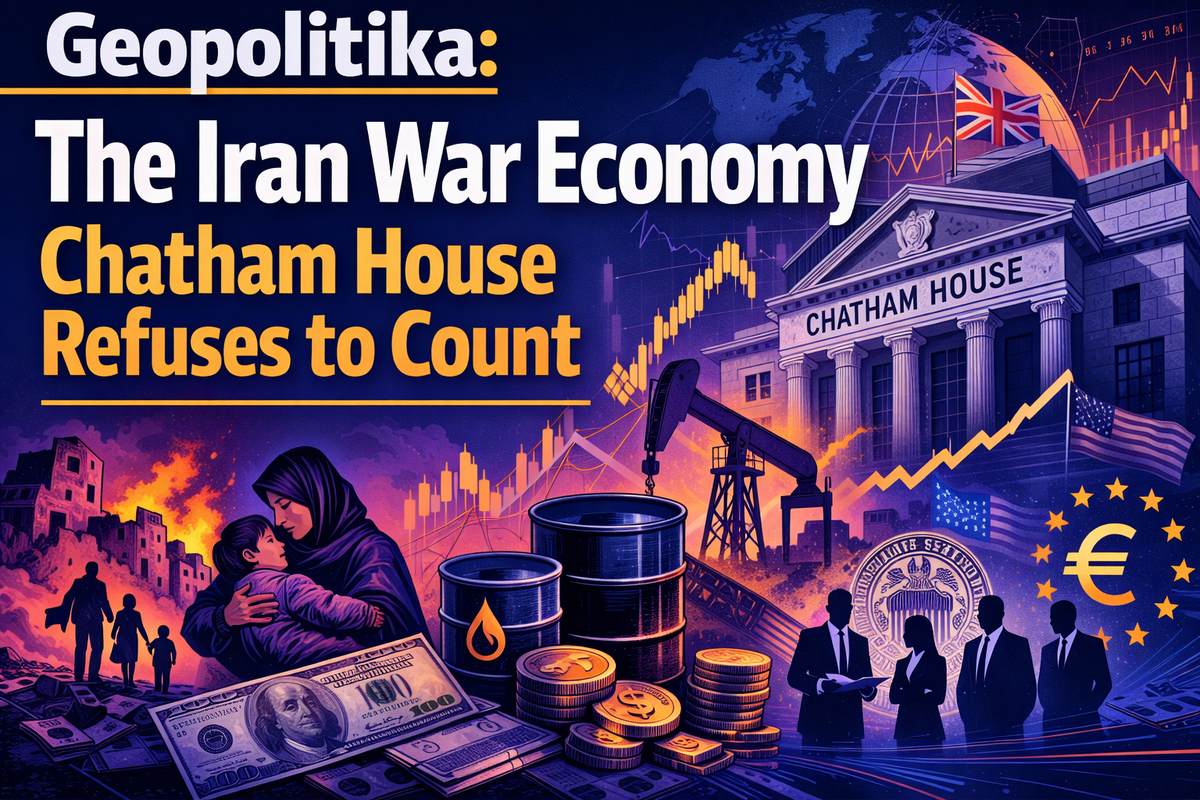
On March 6, 2026, with the Iran war entering its second week, Chatham House published its expert comment “How will the Iran war affect the global economy?” Neil Shearing opened with a single sentence acknowledging reality:
“With the Iran war in its second week, the most immediate and tragic costs are measured in lives lost.”
Then came the pivot that defines the entire piece:
“Yet economists are obliged to consider another dimension: the economic consequences.”
The article that followed was calm, technical, reassuring. Even a long war, it concluded, would have “limited consequences for global GDP.” But then, almost in passing, it delivered what may be the most telling line in the whole text:
“A more prolonged conflict would almost certainly inflict a deeper economic wound.”
Note the inversion. Human lives are the “immediate and tragic” surface cost. The real depth — the deeper wound — belongs to output, investment, and tourism. Children killed in a school strike in Minab, migrant workers dying under debris in Dubai, families watching their savings evaporate: these are the shallow layer. The profound injury is to GDP.
This single phrase reveals the architecture of the entire analysis. It does not merely separate human cost from economic consequences. It quietly redefines which one is deeper.
The Machine Behind the Forecast
To understand what the Chatham House analysis does, you need to understand the organisation that produced it.
As described in previous Geopolitika articles, Chatham House—the Royal Institute of International Affairs—is not neutral ground. It is a policy institution with significant convening power, funded by a mix of corporate donors, foundations, and governments. Its Global Economy and Finance Programme, where Shearing is an Associate Fellow, operates within an ecosystem of financial sector engagement. The institution's reputation depends on being taken seriously by treasuries, central banks, and international financial institutions. Its analyses circulate through policy briefings, email newsletters, and media citations—all designed to reach elite audiences.
The article cites one explicit source: a chart from Capital Economics, a macroeconomic research firm with its own client base of institutional investors. There are no citations from heterodox economists, feminist economists, or post-colonial scholars. No Middle Eastern sources. No community voices. The citation pattern itself defines what counts as valid knowledge.
A forensic power analysis maps the layers:
- Visible dynastic families – Gulf energy dynasties are implied but never named
- Instrumental wealth – “Investors” appear as beneficiaries but are never identified
- Operational political wealth – Central bankers at the Fed and ECB are explicitly named as key responders
- Operational infrastructure – Chatham House itself, Capital Economics
- Operating ideologies – Neoclassical economics, methodological nationalism, the separation of economics from ethics
- Visible manifestations – War, oil prices, inflation, central bank decisions
- Mass populations – Present only as aggregates: “households,” “vulnerable” economies
Ordinary people, those who actually experience the system's outputs, have no voice in the analysis. They are described, but never heard.
What the Forecast Sees—and What It Takes for Granted
The system Shearing constructs has identifiable components: energy markets, central banks, national economies, households, investors. It has a structure: nation-states are the primary units, energy prices transmit shocks, central banks respond. It has mechanisms: price signals, interest rate adjustments, household absorption of costs.
But every analysis rests on assumptions. The Chatham House piece is no exception. These assumptions are not neutral technical choices. They are decisions about what counts, who matters, and how the world works.
Declared assumption: “Economists are obliged to consider another dimension: the economic consequences.” This frames the separation of human from economic as professional obligation, not moral choice. It positions the author as speaking for a discipline, not making a judgment.
Operational assumptions: Energy prices are the primary transmission mechanism. This structures the entire analysis, focusing attention on a single channel and ignoring others: debt markets, migration flows, care work disruption, psychological trauma. The nation-state is the appropriate unit of analysis. This enables comparative claims—exporters vs importers, US “benefits slightly"—while obscuring internal inequality, transnational dynamics, and migrant labor circuits that cross borders.
Baseline assumptions: The neoclassical economic framework sufficiently represents the system. This legitimates the analysis without justification, treating one paradigm as exhaustive where multiple are possible. The present configuration is the natural starting point. There is no colonial history, no mention of IMF structural adjustment, no discussion of how Egypt, Tunisia, and Pakistan became “vulnerable” in the first place.
Together, these assumptions construct a world where human suffering is acknowledged then set aside, energy markets transmit shocks but colonial debts do not, nations are the relevant actors rather than the people within them, one economic paradigm suffices, and the present is natural while history is irrelevant. This is boundary-setting. And boundaries, once drawn, determine whose voices count, whose suffering matters, and whose interests are protected.
Pre-War Currency Attack: The Engineered Collapse the Report Ignores
What the Chatham House analysis entirely misses is the deliberate US policy that set the stage for Iran’s economic crisis. In January and February 2026, US Treasury Secretary Scott Bessent publicly confirmed that Washington engineered a severe dollar shortage inside Iran as part of the “maximum pressure” campaign. This strategy caused one of Iran’s largest banks to collapse and sent the rial into freefall — pushing it to historic lows (reportedly reaching 1.75 million to the dollar in some periods, up from around 700,000 a year earlier).
Bessent described the outcome in Senate testimony and at Davos as a “grand culmination” of US policy. In a Senate Banking Committee hearing on February 6, 2026, he stated: “What we have done is created a dollar shortage in the country. It came to a swift and, I would say, grand culmination in December, when one of the largest banks in Iran went under. The central bank had to print money. The Iranian currency went into free fall. Inflation exploded, and hence we have seen the Iranian people out on the street.”
This engineered devaluation triggered the first wave of widespread protests in December 2025 and January–February 2026, as food prices doubled, savings evaporated, and ordinary Iranians faced extreme hardship. PolitiFact (US fact-check) confirmed the rial's collapse and inflation surge (40% overall, 70% for food) fueled the demonstrations, which spread from Tehran shopkeepers to nationwide unrest, resulting in thousands of deaths from government crackdowns.
By airbrushing this episode, the Chatham House report erases both historical causation and geopolitical intent. It treats the rial’s weakness and the resulting social unrest as natural or war-related side effects rather than the direct result of a documented US policy of economic sabotage.
What the Forecast Doesn't See: Voices from Inside the System
The Chatham House analysis names “households” four times—as units that together with business will face “higher oil and gas prices,” “squeezing real incomes and eroding purchasing power.” It names “investors” once—acknowledging that “energy producers—and their investors—stand to benefit.” It names “vulnerable” economies—Egypt, Tunisia, Pakistan—as categories requiring monitoring.
But who are these households? These investors? These vulnerable populations?
When you search for their voices, a pattern emerges—one the tidy economic forecasts cannot capture.
Iranian Civilians
A 26-year-old teacher in Tehran, speaking to Al-Monitor on 5 March 2026 , described life under daily bombardment:
"For people like me, life has stopped. We spend almost all our time watching the news. We are all very stressed. We tried to prepare reserves of water, food and an emergency bag. When you hear the bombs, you have no idea where they will fall. I don't think anyone has the mental or physical capacity to endure the continuation of the war for long. The most vulnerable are the children. They are very afraid. The youngest do not want to be separated from their parents. We cannot even keep them occupied at home because there is no internet, so they can neither play online nor watch children's programmes."
In Bukan, Iranian Kurdistan, a 36-year-old cafe owner named Reza described how the governor's office and Revolutionary Guards base 200 metres away were destroyed by US-Israeli strikes. Yet people still come to his cafe, sitting outside to watch the bombardments “as if it were a show.” The real problem, he said, is money: banks are no longer distributing cash and many cards are blocked. His response was simple, as he told Al-Monitor :
"So in my cafe, I made a decision: for those who cannot pay for their coffee, it's on the house. At times like these, solidarity is the only thing war cannot destroy."
Economic pressure is compounding the fear. Ebrahim Momeni, a 52-year-old retired civil servant in Tehran, described the situation to ABC News / Associated Press on 25 February 2026 :
"The weaker class of people is being crushed. Wherever you go now people are talking about war... This state of limbo is worse than war."
The same ABC News / AP report documented soaring prices through the voices of Farhad Panahirad, a 44-year-old taxi driver, and Saeed Ebrahimi, a 43-year-old electrical technician, who described watching their savings evaporate as food prices doubled and families scrambled to stockpile emergency supplies.
A 33-year-old Tehran resident named Aryan initially felt elation when the bombs began falling, convinced he was witnessing the end of nearly five decades of theocracy. But a week into the onslaught, he began to wonder if his hopes were justified. He told The Telegraph India / New York Times on 10 March 2026 :
"They've hit everywhere. The night turned into morning, and morning into night. People are becoming more discouraged, like I am."
Children: The Brutality Measured in Lives Lost
The United Nations children’s agency, UNICEF, has documented the devastating toll on children as hostilities escalate in Iran. In its official statement released on 5 March 2026, UNICEF reported that approximately 180 children have reportedly been killed, with many more injured.
One of the deadliest incidents occurred on 28 February when a strike hit the Shajareh Tayyebeh Girls’ Elementary School in Minab, southern Iran, killing 168 girls aged between seven and 12 while classes were in progress. UNICEF noted that an additional 12 children were killed in strikes on other schools across five different locations in Iran.
UNICEF Executive Director Catherine Russell stated: “These child casualties are a stark reminder of the brutality of war and violence on children, which impacts families and communities for generations.” The agency emphasised that children and schools are protected under international humanitarian law and must remain places of safety.
This incident, combined with the broader pattern of school and hospital damage (at least 20 schools and 10 hospitals affected), underscores how civilian infrastructure — and especially children — are bearing the human cost of the conflict far beyond aggregate economic calculations.
Migrant Workers in the Gulf
As regional tensions spill beyond Iran's borders, migrant workers in Gulf states have emerged as one of the most exposed populations—and one of the least protected.
At least 12 civilians have been killed in attacks across the UAE, Saudi Arabia, Kuwait, Qatar, Oman and Bahrain since the war began. All but one were foreign nationals.
Murib Zaman worked as a driver in the United Arab Emirates for two decades, living more than a thousand miles from his family in northwestern Pakistan and sending home $300 each month. When debris from an intercepted Iranian missile struck his vehicle in Abu Dhabi, his family was shocked. His cousin, Farman Khan, told Deccan Herald on 10 March 2026 :
“Every family wants to send its youth to the Middle East because there are no jobs here, and the security situation is difficult. But now it appears that even those countries are no longer safe.”
Majid Ali, a 34-year-old Pakistani worker employed by a private dairy company in Dubai, described his daily terror to the same publication:
“For more than a week, whenever there is a blast or a missile interception, we rush outside our labor camps or workplaces to try to save ourselves, but we don't know what to do or where to hide. On Feb. 28, the day the war began, I saw police officers gathered around debris that had fallen in the area where I live. Since then, we have been hearing explosions almost every day. We fear the debris could fall on us and kill us.”
In a village in Sindh, Pakistan, Abdul Malick sat among mourning relatives after his nephew, Muzaffar Ali, a 27-year-old labourer, was killed in Dubai when debris fell on his vehicle. Ali left behind three young children. “It is a great tragedy for a family whose sole breadwinner was lost,” Malick told AFP. “We have nothing to do with this war. It is unfortunate that the poor are being used as fuel for a conflict they have no part in."
Mosharraf Hossain, a Bangladeshi cleaner and father of two, was killed alongside a co-worker when a “military projectile” fell on their company housing area in Saudi Arabia. His cousin, Mizanur Rahman, told reporters: “His death has left his family with an uncertain future. They are especially worried about the future of their children. He was the sole breadwinner.”
Marigold Tan, a 38-year-old Filipina coordinator at an e-commerce company in Dubai, described teaching her daughter how to survive:
“As a parent, you also try to stay calm for your children. The attacks jolted our family awake at ungodly hours, sending us scrambling to the basement. We have our emergency bags packed, but I don't know where we would go. The children mostly stay indoors, and I have begun teaching my eldest daughter what to do when the next alert of an attack sounds: ‘Take your sister to the hallway, and stay away from the windows.’”
The SOAS University of London blog on 9 March 2026 noted that approximately 30 million expatriates in GCC countries are experiencing the war through a painful combination of direct threat and remote witnessing—constantly checking on families back home while navigating their own vulnerability in host countries that offer them minimal protection.
Households Across the Continents
In rural Britain and Northern Ireland, households that rely on heating oil—with no gas grid connection, no storage capacity, no alternative—face price spikes they cannot buffer. BBC News on 9 March 2026 reported on the cascading impact, warning that if oil prices remained high, the effect “will start to cascade into other prices such as food, agriculture, industrial commodities."
In the United States, the national average for a gallon of gasoline hit $3.58, with peaks far higher in some regions. This comes on top of some 92,000 jobs reportedly lost in February 2026 . Yet the Chatham House analysis states flatly: “The US benefits slightly."
Across Asia, the impact is uneven but severe. Japan, which imports 95 percent of its crude oil from the Middle East, announced it would begin releasing petroleum reserves on March 16—emergency supplies typically reserved for worst-case scenarios. Vietnam saw gas station owners post “sold out” signs in Hanoi as fuel supplies tightened. In India, families mourning the dead discovered that some gas-fired crematories had been temporarily closed due to energy shortages.
In Europe, German economists calculated that if oil prices exceed $100 per barrel, GDP could shrink by 0.3 percent; at $150, losses could exceed €80 billion. Italy's Prime Minister Giorgia Meloni warned the government might impose windfall taxes on companies profiting excessively from the crisis.
In Latin America, Brazilian farmers confronted surging fertiliser costs—with urea prices up over 10 percent—threatening the next harvest. Brazil imports over 80 percent of its fertiliser, making the agricultural sector acutely vulnerable to any disruption in global supply chains.
In Africa, Kenyan tea growers watched their exports to Iran pile up on docks, unable to reach markets as shipping routes were disrupted.
The Unheard
For Egyptian, Tunisian, and Pakistani populations—named as “vulnerable” in the analysis—no voices were located. No English-language media has sought them out. No think tank has commissioned their testimony. They appear as policy objects, never as subjects. Their vulnerability is described, not heard.
This is not an accident. It is a boundary choice. The analysis draws a line around what counts as relevant knowledge. Inside that line: neoclassical economics, expert authority, aggregate statistics. Outside: lived experience, community knowledge, the voices of those who will bear the costs.
How the System Actually Works: Dynamics the Forecast Misses
Linear models assume that causes produce effects in straight lines: war causes energy prices to rise, which causes inflation, which causes central banks to raise rates, which causes households to adjust. But real systems don't work that way. They are circular. Effects circle back and amplify or dampen their causes. They have delays. They have tipping points.
The Chatham House analysis describes a linear world. But a systems lens reveals the dynamics operating beneath its surface—dynamics that shape outcomes regardless of whether anyone intends them.
A reinforcing loop. Investor benefit from price volatility increases financial sector influence. That influence shapes policy—central bank independence, capital mobility, investor protection. Policy, in turn, protects investor interests, generating continued benefit. No single actor designed this loop. It emerges from market interactions and institutional arrangements. But it operates, concentrating wealth and influence among those the analysis calls “investors” but never names.
A potential balancing loop. Rate hikes increase household debt. Rising debt creates political pressure. Pressure may moderate rate policy. This loop, if activated, could check investor-centric dynamics. But it operates with delays—12 to 24 months—and requires political organisation to function. The analysis does not consider it.
Delay dynamics. Rate changes take 6 to 18 months to affect inflation. This lag creates oscillation risk—over-shooting, under-shooting, missing the target. Central bankers manage this uncertainty, but the analysis presents rate adjustments as straightforward technical responses.
Emergence. Investor benefit is not designed; it arises from market interactions. “Vulnerable” economies are not naturally vulnerable; they were produced by centuries of colonial extraction, decades of IMF structural adjustment, and layers of debt and conditionality. Mutual aid—a cafe offering free coffee, neighbours pooling resources—arises from social fabric under stress. These emergent properties operate beyond any single actor's control, yet they structure who benefits and who pays.
The slow variable. Financialisation—the decades-long transformation toward finance-dominated capitalism—has produced the household debt levels that constrain central bank policy, concentrated wealth in the investor class the analysis names but protects, and made “investor benefit” seem natural rather than constructed. The analysis never mentions it. But fast variables—war, oil prices, inflation—interact with this slow variable in ways that determine outcomes. Rate hikes, the preferred solution, actually reinforce financialisation by transferring income from debtors to savers.
Contradictions That Matter
When you hold the Chatham House analysis against what it excludes—and against itself—contradictions emerge. These are not flaws. They are features of a system description that functions to stabilise elite crisis management.
Human acknowledged vs human set aside. The analysis opens by acknowledging “the most immediate and tragic costs measured in lives lost.” One sentence. Then: “Yet economists are obliged to consider another dimension...” The pivot reveals that the separation is a choice, presented as obligation.
US “benefits” vs US households pay. The analysis claims the US “benefits slightly” from higher energy prices. But the sourced data shows gas prices at up to $8 and 92,000 jobs lost. The aggregate national benefit hides internal inequality. Someone benefits; someone pays. The analysis names neither.
“Vulnerable economies” named vs history erased. Egypt, Tunisia, and Pakistan appear as technical categories requiring monitoring. There is no mention of colonial debt, IMF structural adjustment, coup histories, or the long-term production of vulnerability. The category is naturalised, its history erased.
Investors benefit vs investors unnamed. The analysis states that “energy producers—and their investors—stand to benefit.” But it provides no names. Meanwhile, migrant workers die, families grieve, and the human cost of that unnamed profit accumulates. The beneficiaries are protected from scrutiny.
Rate hikes as solution vs household burden as externality. Central bank rate adjustments are presented as the appropriate response. But economic literature documents their regressive distributional impacts: they burden debtors, benefit savers, and can trigger unemployment. The analysis does not consider these costs.
What Could Be Different: Strategic Openings
When you follow the system dynamics far enough, they begin to suggest their own undoings. Not guarantees—just openings. Places where the architecture reveals seams.
The household debt loop. Central banks raise rates to fight inflation; household debt deepens; political pressure accumulates. The loop exists whether anyone activates it or not. But what if it were activated—deliberately, collectively? Debt mutual aid networks. Debt strikes. Political demands organised around who bears the cost of “stabilisation.” The loop is dormant. It waits.
The boundaries. They're maintained, not natural. Vulnerable economies appears without Egyptian, Tunisian, or Pakistani voices—not because those voices don't exist, but because the boundary excludes them. Contesting boundaries means demanding those voices. Insisting that colonial history isn't optional context. Centering care work when the conversation centers GDP. These are acts of redrawing who counts.
The solidarity. A cafe owner in Iran handing out free coffee. Neighbors pooling resources. Families teaching children where to hide. These networks operate autonomously from power—that's their beauty and their limitation. What if they found each other? What if they were supported without being captured? The question lingers.
Financialisation. The slow variable everyone ignores. But debt cancellation exists. Public banking exists. Democratic control of credit exists—in fragments, in experiments, in historical memory. Financial transaction taxes exist as proposals. Each targets the long-term trend that conditions everything else. None are easy. But they're possible.
The contradictions. The US “benefits” while households lose jobs and face higher gas prices—that's a coalition waiting to be built. Investors benefit but remain unnamed—that's an investigation waiting to be done. Contradictions are just tensions until they're exploited.
What Comes Next
This analysis began with a simple question: what does the Chatham House forecast include, and what does it leave out? What we found is a system that functions through exclusion. Its boundaries are choices that serve some interests and erase others. Its feedback loops concentrate benefit among investors while transmitting costs to households. Its emergent properties operate beyond any single actor's design. Its slow variable, financialisation, conditions everything while appearing nowhere.
The evidence is strong. Multiple corroborating testimonies from Iranian civilians and migrant workers. Well-documented feedback loops and emergence findings. Thorough boundary critique. Voice gaps remain—Egyptian, Tunisian, and Pakistani populations named as “vulnerable” but unheard. Some claims require further evidence. But the composite confidence is high.
And yet confidence is not completeness. Every answer opens further questions.
- Who are the unnamed investors benefiting from the Iran war?
Energy trading records. Gulf sovereign wealth fund disclosures. Hedge fund position reporting. Energy company shareholder data. Accountability requires names. - What are the lived experiences of Egyptian, Tunisian, and Pakistani populations named as “vulnerable”?
Local journalism. Arabic, French, and Urdu language searches. Community organisation outreach. Their absence from public discourse is itself evidence. - How can accountability be pursued for emergent outcomes that no one designed?
Investor benefit emerges from system interactions—but specific investors benefit and can be held accountable for maintaining the system. Legal frameworks. Political organising. Naming conventions. Tax policies. - What would participatory boundary-setting look like, and who would have authority to redraw them?
What institutions, processes, and resources would support affected populations in defining what counts as relevant knowledge?
The Chatham House analysis is one way of seeing. It is not wrong in its predictions: energy prices may rise, central banks may respond, GDP impacts may be limited. But it is radically incomplete. It excludes what it cannot measure. It renders invisible those who pay its unacknowledged costs. It presents choices as obligations, boundaries as natural, interests as neutral.
The teacher in Tehran sees children's fear. The cafe owner in Bukan sees solidarity as survival. The Pakistani worker in Dubai sees debris that could fall and kill. The Filipina mother sees a daughter who needs to know where to hide.
Their voices are not “another dimension.” They are the dimension that economic analysis, in its current form, cannot afford to see.
Published via Mindwars Ghosted.
Geopolitika: Tracing the architecture of power before it becomes the spectacle of history.
—
Author’s Note
This article is based on an in-depth analysis us a custom analytic protocol which was run using Deepseek, integrating forensic power analysis and systems dynamics analysis against the Chatham House expert comment “How will the Iran war affect the global economy?” (March 2026).
Mindwars Ghosted is an independent platform dedicated to exposing elite coordination and narrative engineering behind modern society. The site has free access and committed to uncompromising free speech, offering deep dives into the mechanisms of control. Contributions are welcome to help cover the costs of maintaining this unconstrained space for truth and open debate.
If you like and value this work, please Buy Me a Coffee