Geopolitika: Tony Blair and the Globalisation of Fabian Gradualism
In the seven-part Geopolitika: Fabians series I traced how Britain’s oldest socialist think tank has functioned less as a champion of the working class and more as a sophisticated machine for producing leaders who speak the language of the left while governing comfortably within elite boundaries. From the early myth-making of G.B. Shaw, through the expert-led gradualism of the Webbs, the containment of Corbyn, the production line that delivered Starmer and Albanese, and the quiet legitimation of defence budgets and devolution myths, the same grammatical architecture repeatedly emerged: semantic capture, voice gaps, selective history, false dilemmas, and the steady management of populations spoken about rather than from.
Tony Blair stands as the clearest test case and ultimate refinement of that machine. He did not break the Fabian mold—he perfected it. In this extended examination, I move from the broader institutional portrait of the series to a forensic close-up on Blair himself, using his own words across three decades: from the 1994 Fabian pamphlet that redefined “socialism” as ethical values rather than economic structure, through the Clause IV campaign and New Labour governance, the 2003 justification of the Iraq war, to his post-premiership incarnation as advisor to Gulf sovereigns, participant in Trump’s Board of Peace, and author of 2026 proposals for an AI-driven “always-on” state.
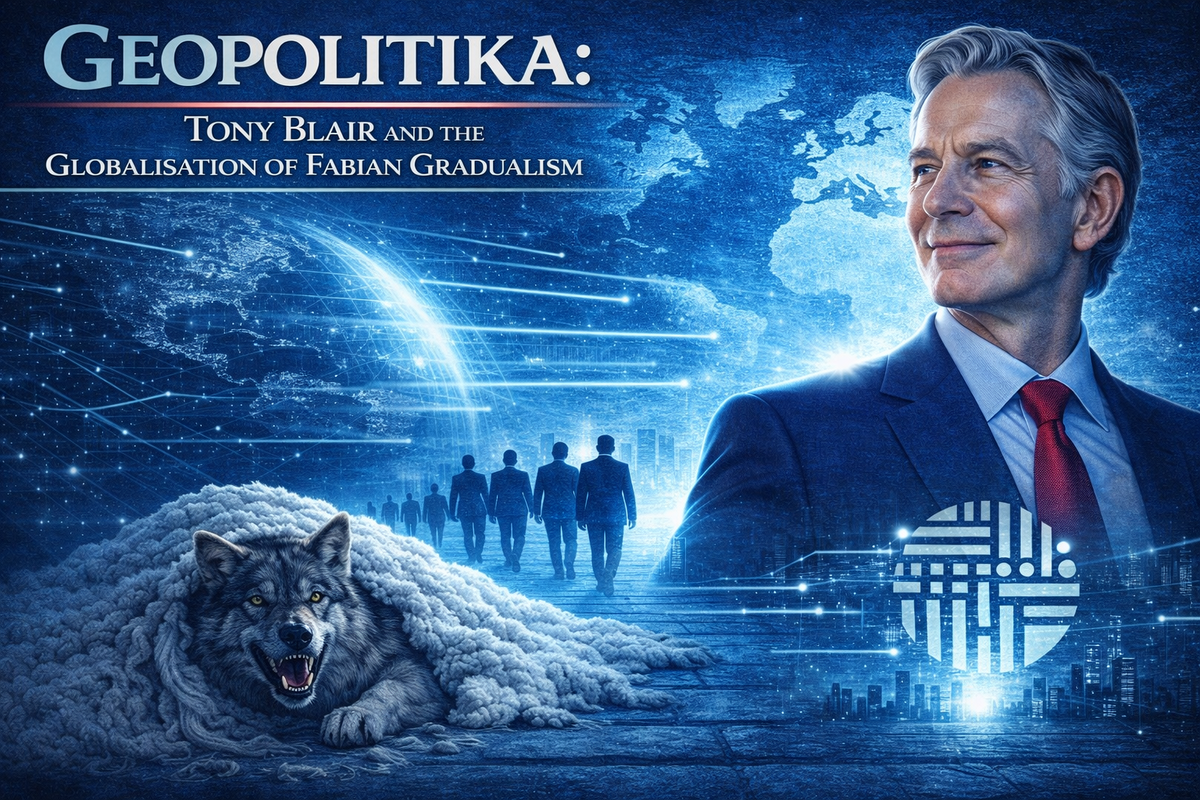
What emerges is not the story of one man’s deviation, but the logical endpoint of a grammar that has always prioritised expert administration over democratic voice. The wolf no longer needs the sheep’s clothing. What remains is the administrative logic itself—stripped, globalised, and operating with fewer constraints than ever. This is Blair not as aberration, but as Fabian perfection.
Semantic Capture – Blair’s 1994 Fabian Pamphlet Socialism
In 1994, Tony Blair published a short pamphlet titled Socialism. It was number 565 in the Fabian Society's long-running series—a series that had, for over a century, served as a quiet conveyor belt for Britain's most influential intellectual current. Blair was not yet Leader of the Labour Party, though he would assume that role within months. He was Shadow Home Secretary, a moderniser with a growing reputation, and he was using the Fabian platform to perform an act of ideological surgery.
The pamphlet is short, readable, and designed for maximum persuasive reach. Its central claim appears straightforward: socialism, properly understood, is not an economic doctrine but a set of ethical values. Blair writes:
“Socialism is a set of values—social justice, community, equal worth—not an economic dogma. The socialism of Marx and state control is dead. It misunderstood the modern market economy.”
What this sentence performs, beneath its declarative surface, is a radical act of redefinition. Blair is not merely offering an interpretation of socialism. He is emptying the term of its historical content—public ownership, class struggle, the democratic control of production—and refilling it with abstract moralism. The old meaning is declared “dead.” The new meaning is presented as a recovery, a return to the “true” ethical essence.
Blair reinforces this move throughout the pamphlet. The old left, he writes, “confused means with ends,” treating nationalisation as an article of faith rather than a practical instrument. “The modern world,” he insists, “is more complicated than that.” The implication is clear: those who still believe in public ownership are not merely wrong but stuck in a past that has been rendered obsolete by economic change. The argument works by caricature. Marxism is presented as a single, uniform tradition—a “false view of class”—that can be dismissed in a sentence. The democratic socialist tradition that ran alongside Marxism, the co-operative movement, the worker-controlled enterprises, the grassroots campaigns for industrial democracy—none of these appear. The old left is not engaged; it is buried.
Blair sets up a stark binary. On one side stands the “old” socialism: state control, dogma, the past. On the other stands his “new” socialism: ethical values, modernity, the future. The choice is presented as exhaustive. There is no third option—no tradition of democratic socialism that sought public ownership not as dogma but as a mechanism for redistributing power. By defining socialism as a set of abstract values, Blair makes those values compatible with any economic arrangement that can be described as “modern.” The market is accepted as a given. The state's role is not to own or control the means of production, but to “equip” individuals to compete. Socialism becomes a matter of moral sentiment, not structural transformation.
What is striking is what the pamphlet does not name. There is no mention of Clause IV—the 1918 commitment to “common ownership of the means of production” that remained party policy until Blair himself led its revision the following year. There is no mention of the 1945 nationalisations, the Bennite tradition of the 1970s and 1980s, or the trade union movements that saw public ownership as a pathway to industrial democracy. These are not accidental omissions. To include them would be to acknowledge that the “old” socialism was not a monolithic dogma but a living tradition with its own democratic mandate. The silence is strategic.
Equally revealing is who gets to speak. Blair speaks. The Fabian sages—the Webbs, Attlee, Crosland—speak. An abstracted “we” that claims to speak for the party and the nation speaks. Who does not speak? Trade unionists. The unemployed. The old left. Working people appear only as abstractions: “ordinary families,” “the people,” “those left behind.” They are spoken about, never spoken from. In one passage, Blair refers to the need to “reach out to lost voters in the South”—voters who are discussed in the third person, their concerns inferred rather than voiced. The working class is present as a problem to be managed, not as a political subject with its own agency.
This pamphlet is a foundational document of the New Labour project. Its redefinition of socialism—emptied of radical content, refilled with ethical abstraction—made the term safe for a politics that would, within three years, entrench market logic at the heart of the British state. This was not a break with the Fabian tradition but its deepest expression. The Fabian strategy of “gradualism” — permeation of existing institutions rather than confrontation — was always designed to expand the reach of administration without threatening core concentrations of power. Blair’s 1994 pamphlet performed that logic perfectly. It turned socialism into a language of management, not of emancipation; a grammar of elite reform, not of democratic control.
The pamphlet ends with a call to “recapture” socialism's true meaning. What Blair recaptured, however, was not a tradition but a word—emptied, refilled, and deployed in the service of a project that would soon rewrite the Labour Party's constitution. This act of semantic capture in 1994 laid the rhetorical foundation for the constitutional surgery Blair would perform the following year on Clause IV.
The Usable Past – Clause IV and the 1945 Canon
In January 1995, two months before his Scottish Labour Conference speech on Clause IV, Tony Blair delivered a Fabian Society lecture “Let Us Face the Future”. The title was not chosen at random. It was the name of the 1945 Labour manifesto that had delivered Clement Attlee's landslide victory—the manifesto that nationalised coal, rail, steel, power, and transport, and built the post-war welfare state. Blair was invoking the party's most sacred text, and he was doing so to authorise its opposite.
Blair's lecture performed a delicate act of historical surgery. He needed to claim lineage with Labour's greatest victory while distancing himself from the means by which that victory was achieved. His opening move was to praise 1945 without specifying what 1945 had actually done:
“In 1945, Labour spoke for the national interest. We were the party of the nation, not of a section. We must recapture that spirit.”
What Blair did not mention was what the 1945 government did in the national interest. The 1945 manifesto had promised “common ownership of the means of production” and delivered it. Coal, rail, road transport, canals, civil aviation, electricity, gas, and iron and steel were brought into public ownership. The National Health Service was created. The welfare state was established. These were not abstract values; they were concrete transfers of power and resources.
Blair's silence on the substance of 1945 was strategic. By invoking 1945 as a spirit—“speaking for the national interest”—he could claim its authority while evacuating its content. The lecture praised Attlee's government as “the greatest peacetime government this century” but refused to say what made it great. The greatness, he implied, lay in its unity and national purpose—not in its radical transformation of the British economy.
Blair tested this argument on a sceptical audience two months later at the Scottish Labour Conference in Inverness. There, he distilled the same logic into a sharper political challenge:
“If we can't get up and put our principles before the British people with the conviction of people who really believe what they're saying, why should they trust us with Government?”
The question assumed its own answer: Labour could not win if it could not speak plainly. The principles Blair had in mind, however, were not the principles of 1945. They were principles stripped of their institutional form. He continued:
“Clause IV was written for another time—in 1918—in the aftermath of war, in an age of heavy industry, when the answer to economic power seemed to lie in common ownership of everything. But Britain today is not Britain in 1918.”
The 1918 Clause IV that Blair was dismantling had been drafted by Sidney Webb, a Fabian Society founder. It read:
“To secure for the workers by hand or by brain the full fruits of their industry and the most equitable distribution thereof that may be possible, upon the basis of the common ownership of the means of production, distribution, and exchange, and the best attainable system of popular administration and control of each industry or service.”
This was not the crude “common ownership of everything” that Blair caricatured. It was a nuanced statement that combined ownership with democratic control—“the best attainable system of popular administration.” It was also, inconveniently for Blair, the product of the same Fabian network he now represented. The irony was striking: a Fabian leader using a Fabian platform to dismantle a constitutional achievement drafted by the founders of Fabianism. Blair could not acknowledge this lineage. To do so would be to admit that the Clause IV he was attacking was not an alien Marxist intrusion but the work of his own intellectual ancestors.
In Inverness, Blair framed the choice as one between narrow sectionalism and national purpose:
“We are not a party that exists to defend a clause. We are a party that exists to change the country.”
Those who defended Clause IV, he implied, were defending words, not values; they were trapped in a past that the country had left behind. The binary was designed to make opposition feel parochial and backward.
Blair's lecture also invoked Hugh Gaitskell, the Labour leader who had attempted Clause IV revision in 1959 and failed. Blair positioned Gaitskell as a martyr whose time had not yet come:
“Gaitskell understood that Labour had to modernise. He was defeated by those who did not understand the world was changing.”
This framing made Blair's own project appear as destiny rather than choice. Gaitskell had not failed because his argument was weak; he had failed because the times were wrong. Now the times were right. Blair was not choosing modernity; modernity was choosing him.
What Blair was constructing was a usable past—a selectively curated history that legitimised managed reform while erasing radical content. The 1945 government became a symbol of ethical unity, not a program of public ownership. Clause IV became an archaic slogan, not a living constitutional tradition. Gaitskell became a martyr, not a fellow traveller whose defeat might have lessons for Blair's own campaign.
The strategic inversion was complete: Blair was asking the party to abandon common ownership by invoking the government that had implemented it. He could not say this as a break, so he said it as a recovery. He was not abandoning Labour's tradition, he claimed; he was returning to its true, national, unifying essence.
This usable past would serve Blair throughout his premiership. The language of national unity, ethical values, and modernisation—stripped of the radical content of 1945—authorised the aggressive expansion of Private Finance Initiatives (PFI). Originally introduced by the Conservatives in 1992, PFI allowed private consortia to finance, build, and maintain public infrastructure such as hospitals and schools in return for long-term payments from the public purse. Blair’s government embraced and greatly extended the scheme, presenting it as pragmatic “partnership” and “investment.” The same framework supported conditional welfare reforms and helped pave the way for a deeper embrace of market logic in the years that followed, including the post-Brexit period. The party that had built the NHS and nationalised the railways was now being told that the path to power lay in partnership, not ownership; in enterprise, not common control.
The historians in the Labour Party knew better. The 1945 government had been built by trade unionists, by socialists, by people who believed in common ownership. Its success was not despite its radicalism but because of it. Blair's lecture depended on the audience forgetting that. It asked them to remember 1945 as a feeling, not a set of policies. And in that forgetting, Blair found the authority to rewrite the constitution that had made 1945 possible.
Governance as Permeation – The Domestic Record
On the night of his 1997 election victory, Tony Blair stood before cheering supporters and promised a government that would be judged not on its rhetoric but on its results. Within months, that promise was being translated into a new language of governance—one that would redefine the relationship between the state, the market, and the citizen. The language was pragmatic, modern, and relentlessly reassuring. But beneath it lay a quiet revolution.
At a BBC Question Time town hall in April 1997, just weeks before the election, Blair was asked whether Labour had really changed. His answer revealed the architecture of New Labour governance. Addressing a questioner who worried that “Red” Labour still lurked beneath the surface, Blair gave the assurance that would become his trademark:
“There's no going back to the days of secondary picketing, secondary action, you know all the rest of it. Strikes without ballots. Those provisions will remain in place.”
The words were chosen with care. “No going back” was a promise to business and Conservative voters that Labour was safe. The specific references—secondary picketing, strikes without ballots—evoked the winter of discontent, the 1970s, the chaos that Thatcher had supposedly cured. Blair was not merely saying he would keep her union laws; he was performing the containment of the left. The past was a place of danger; he was the guardian of order.
This was the logic that would define New Labour's domestic record. Blair promised voters what he would not do. He would not raise the top rate of income tax. He would not return to the “old” trade union laws. The positive agenda—education, health, employment—was presented as enabled by these constraints, not as an alternative to them.
The pivot was complete by 1999, when Blair told the Labour Party conference that the real enemy was not the Conservatives but “the forces of conservatism.” The phrase conflated the democratic left with the Tory right, suggesting that anyone who resisted New Labour's modernisation was defending the old order. To question PFI in the NHS was to defend failure. To argue for public ownership was to defend the past. Blair's framing turned political disagreement into moral backwardness.
The language of “what works” became the organising principle. When Blair spoke of private finance in public services, he called it “investment” and “partnership”—words that obscured the transfer of public assets to private hands and the long-term liabilities loaded onto future governments. The policy was presented as pragmatism; the structural shift was invisible.
In his 2001 conference speech, Blair explicitly linked domestic welfare reform to his broader worldview on globalisation. He defended the drive to move people “off welfare into work,” declaring:
“...we refuse to pay benefit to those who refuse to work. Why? Because the welfare that works is welfare that helps people to help themselves.”
Structural unemployment and the scars of de-industrialisation were reframed as failures of individual responsibility rather than consequences of larger economic forces. At the same time, he extended the same logic globally, arguing that the response to globalisation should not be resistance but managed opportunity:
“If globalisation works only for the benefit of the few, then it will fail… But if we follow the principles that have served us so well at home – that power, wealth and opportunity must be in the hands of the many, not the few – if we make that our guiding light for the global economy, then it will be a force for good.”
The language of “opportunity and responsibility” made conditionality sound like liberation at home and turned managed globalisation into an ethical project abroad. In both domains, structural forces were acknowledged only to be quickly subordinated to individual or national “responsibility” within a market framework.
The 2005 victory speech, delivered after Labour's third consecutive win, showed the mature form of this governance language. Blair acknowledged a reduced majority and promised to listen to voters. But the substance of the response was telling. He framed the result as a democratic instruction:
“The British people wanted the return of the Labour government, but with a reduced majority. We have to respond to that sensibly and wisely and responsibly.”
The reduced majority—a loss of 101 seats, from 167 to 66—was acknowledged only in abstraction. What mattered was the lesson, not the scale. The government's response would be to focus on what Blair claimed the people had asked for:
“We have to make sure that we focus on the things that matter to people, the things that they have talked about to me during the course of this campaign, jobs and living standards, the National Health Service, schools, and law and order.”
The list was Blair's New Labour agenda, unchanged since 1997. The message was that the government had delivered; the reduced majority was a signal to do more of the same, not to change direction. The domestic record—jobs, investment in schools and hospitals, extra police—was presented as vindication. What the speech did not mention was the cost of that record.
The private finance initiatives that rebuilt schools and hospitals transferred billions in public assets to private investors. Blair's language of “partnership” and “investment” obscured this shift. This was the practical expression of what Nick Hudson identifies as the Fabian method: gradualist reform that expands administrative reach while aligning public administration with financial and corporate interests. The language of “what works” sounded pragmatic, but it smuggled in a set of assumptions about who should own what, who should bear risk, and who should benefit.
The voice gaps in Blair's domestic record are consistent. Trade unionists appear as a threat to be contained. The unemployed appear as beneficiaries of policy, not as people with agency. Public sector workers are never asked whether they want their hospitals funded by PFI. Blair's response to a trade union question in the 1997 Town Hall captured the new settlement:
“People should have the right in a democratic society to join a trade union if they wish to. But the trade unions will be operating within the law, within the constraints.”
The right to join was presented as an individual choice, not a collective power. The worker who chose not to join was as legitimate as the worker who did. The union's role was constrained, contained, reduced to a voluntary association like any other. The language of “rights” masked the hollowing out of collective bargaining.
By the time Blair left office in 2007, the transformation was complete. The Labour Party that had been founded to represent the working class and to challenge the power of capital had become a party of market economics, corporate partnership, and Atlanticist foreign policy. The language of “rights” and “responsibilities” had replaced the language of solidarity and collective power. The domestic record was real—schools and hospitals had been built, employment had risen—but the cost was the erosion of the party's historical identity and the entrenchment of a new consensus that would take another generation to challenge.
The same grammar of competence, modernisation, and managed change that contained the left at home would soon be deployed to contain “the forces of evil” abroad. The “no going back” of domestic policy would become the “defeat it or be defeated by it” of the war on terror. The stage was set for Iraq.
The Imperial Turn – Iraq and the Atlanticist Consensus
On 17 July 2003, four months after the invasion of Iraq, Tony Blair stood before a joint session of the United States Congress to accept the Congressional Gold Medal. The war had been fought. No weapons of mass destruction had been found. The insurgency was beginning. But Blair was not there to account for what had gone wrong. He was there to declare that the war had been right.
In his speech, Blair opened with humour, apologising for the burning of the Congress Library in 1814: “I know this is kind of late, but: Sorry.” He joked about his son's observation that he could never make a mistake as bad as the Prime Minister who “lost us America.” The laughter disarmed. The history naturalised the alliance. Then Blair turned to the present:
“September the 11th was not an isolated event, but a tragic prologue, Iraq another act, and many further struggles will be set upon this stage before it's over.”
The claim was stark: Iraq was not a separate war but a continuation of the response to 9/11. The problem was that the 9/11 Commission would later find no evidence of a Saddam-al-Qaeda link. But Blair did not need evidence. He needed a story. And the story was that the world had changed.
The core of Blair's argument was a false dilemma that would shape the next decade of foreign policy:
“There is no compromise possible with such people, no meeting of minds, no point of understanding with such terror. Just a choice: defeat it or be defeated by it.”
The binary was brutal and effective. To question the war was to be “defeated by” terror. To hesitate was to appease. The analogy with the 1930s was unspoken but unmistakable. Blair later qualified it—admitting in his 2011 Inquiry testimony that he had “regretted” the comparison, that the circumstances of Nazi Germany were not the same as Saddam Hussein. But the frame had been set: action was courage; inaction was Munich.
Blair also needed to address the failure to find WMD. His solution was to shift the ground from what was known to what could have been:
“Can we be sure that terrorism and weapons of mass destruction will join together? Let us say one thing: If we are wrong, we will have destroyed a threat that at its least is responsible for inhuman carnage and suffering. That is something I am confident history will forgive. But if our critics are wrong, if we are right, as I believe with every fiber of instinct and conviction I have that we are, and we do not act, then we will have hesitated in the face of this menace when we should have given leadership. That is something history will not forgive.”
The “history will forgive” gambit shifted the debate from empirical truth to moral courage. Blair did not need to prove the threat; he only needed to claim that the risk was too great to ignore. Critics were not wrong about the facts; they were wrong about the risk. The dead—the hundreds of thousands of Iraqi civilians who would die in the war and its aftermath—were not mentioned. The families of British soldiers who would not return were not mentioned. History, Blair assured his audience, would judge the risk-takers more kindly than the hesitators.
The speech also redefined the values at stake. Blair told Congress:
“Ours are not Western values. They are the universal values of the human spirit. And anywhere, any time ordinary people are given the chance to choose, the choice is the same: freedom, not tyranny; democracy, not dictatorship; the rule of law, not the rule of the secret police.”
The universal values frame did two things. It made intervention a universal duty—if freedom was what everyone wanted, then spreading freedom was not imperialism but liberation. It also erased the specific historical and cultural contexts in which these values had emerged. Democracy imposed by foreign armies became democracy; occupation became liberation. This framing, as Nick Hudson's analysis suggests, made the war compatible with longer Anglo-American elite network interests: intervention could be presented as a moral crusade while serving strategic and economic ends.
The final move was to frame American power as destiny. Blair imagined an ordinary American, “a guy getting on with his life, perfectly happily, minding his own business,” asking why America had been called to this task:
“And the only answer is because destiny put you in this place in history, in this moment in time, and the task is yours to do.”
The material interests that drove the war—the reconstruction contracts, the strategic positioning, the alliance with a Republican administration—were invisible. What remained was a story of a reluctant giant called by fate to save the world.
Eight years later, testifying before the Iraq Inquiry, Blair returned to the same frames. The “calculus of risk” that had justified the war was still his anchor:
“The single most important thing to me about September 11th, as I've often said, is that 3000 people died, but if they could have killed 300,000, they would have.”
The potential, not the actual, remained the justification. When asked about the failure to find WMD, Blair offered “lessons learned”—a frame that transformed catastrophe into a technical problem. The war was not a mistake; it was a learning opportunity.
Most striking was Blair's distinction between regret for the loss of life and regret for the decision:
“I took that as a question about the decision to go to war. That I took responsibility. That was taken as my meaning that I had no regrets about the loss of life, and that was never my meaning or my intention. I wanted to make that clear. That, of course, I regret deeply and profoundly the loss of life.”
The distinction allowed Blair to express sorrow without accepting accountability. He could regret the dead without regretting the decision that killed them. The 179 British soldiers who died, the hundreds of thousands of Iraqi civilians—their loss was acknowledged as tragedy, but not as a reason to question the war itself.
The voice gaps in the speech are revealing. Iraqi civilians appear only as abstractions: “these oppressed people,” “those in need of our help.” They are spoken about, never from. The anti-war movement, the largest in British history, is dismissed as “critics” who would have “hesitated.” The families of soldiers killed in Iraq are not mentioned. The “guy in Nevada” is imagined and voiced; the Iraqi mother whose child died is not.
The pattern traced across Blair's career—the semantic capture of socialism, the temporal naturalisation of Clause IV, the consolidation of New Labour, the translation into global intervention—reached its culmination in Iraq. The grammar of competence, modernisation, and managed change that had contained the left at home was scaled up to contain “the forces of evil” abroad. The language of “universal values,” “destiny,” and “history will forgive” made a war of choice seem like a war of necessity. The same grammar that had won three elections would now be repurposed to advise Gulf autocracies and propose technocratic governance in Gaza, its moral language stripped of any progressive content but still bearing the marks of its Fabian origins.
The Post-Political Viceroy – From Downing Street to the Gulf and Gaza
The Iraq war marked the high tide of Blair's interventionism, but it also marked the beginning of a longer transformation. The leader who had claimed the authority to remake nations in the name of “universal values” would, after leaving office, find a new role: not as a prime minister accountable to an electorate, but as a post-political advisor serving sovereign clients. The grammar that had justified the invasion of Iraq—expert-led, elite-managed, populations spoken about—would be repurposed for a new geography. The Tony Blair Institute for Global Change, founded in 2016, is the institutional form of this transformation. It is not a think tank in the conventional sense. It is the vehicle for a governing project that has shed the constraints of party democracy, electoral accountability, and even the pretence of representing a domestic constituency. What the 1994 pamphlets performed as the semantic capture of socialism, and what the 2003 Congress speech performed as the legitimation of intervention, the Institute now performs as the routine management of populations—British, Palestinian, Gulf, global—by a post-political elite that treats populations as objects of management rather than agents of their own futures.
The Institute as Institutional Form
Blair’s post-premiership output follows a consistent structure: diagnose crisis, invoke authority, erase failure, propose technocratic solution, and position the Institute as indispensable. In the 2012 Europe speech he framed EU membership as “brutal real politik,” arguing that “in this new world, to leverage power, you need the heft of the EU.” The “heft” is collective; the solution is elite-managed. The 2017 commentary A New Path to Peace Exists applied the same grammar to the Middle East, reframing regional politics as a struggle between “extremism” and “modernisation,” with Blair as the authoritative interpreter who sees the “real dividing line”:
“First, it is plain that the region is in a life or death struggle for its future between those who want a narrow, sectarian and essentially totalitarian view of religion to determine that future; and those who are striving for economies based on the rule of law and societies of religious tolerance.”
By 2022, in The Future of Britain, Blair diagnosed “three revolutionary changes simultaneously” — Brexit, technology, climate — and declared “there is a gaping hole in the governing of Britain where new ideas should be.” The Institute would fill it. In the 2026 foreword to Public-Service Reform in the Age of AI, Lords Blunkett and Reid supplied the lineage authorisation: “The Blair government had such a theory.” The new theory was AI-led reform, digital ID as “essential,” and the “always on, personalised, preventative” state. The Institute presented itself as the natural heir to New Labour, authorised by a carefully curated history from which Iraq and PFI had been erased.
The Viceroy’s Geography: US-Israel-Gulf Alignment
The same technocratic grammar travelled seamlessly. In A New Path to Peace Exists, Blair framed progress in Gaza as a question of “infrastructure, electricity and housing” and on the West Bank as “freedom of movement, water and development in parts of Area C,” presenting these as “vital ballast” for any political process. Palestinians appeared as beneficiaries of incremental “step by step” measures and eventual normalisation with Arab states, rather than as political agents with their own demands or rights. He praised Saudi Crown Prince Mohammed bin Salman for “a radical and exciting process of modernisation,” while human rights abuses and the war in Yemen remained invisible. Gaza itself was treated as an obstacle to be managed, not a consequence of policy:
“I cannot over-state that any peace process which ignores Gaza is a process doomed to fail.”
By 2025–26 the alignment became explicit. Blair welcomed the January 2025 ceasefire as an opportunity to “build a future of hope and dignity for Palestinians and security for Israelis,” but the framework was balance and stability, not justice or rights. In September 2025, he praised President Trump’s plan as “bold and intelligent,” an “extraordinary achievement,” and in January 2026 announced his appointment to the Board of Peace executive board:
“I thank President Trump for his leadership in establishing the Board of Peace and am honoured to be appointed to its Executive Board. It’s been a real privilege to work with Steve Witkoff and Jared Kushner and their outstanding team.”
The “new path to peace” of 2017 and the Board of Peace of 2026 were not separate initiatives but the same managerial logic applied across eight years: an elite body would decide, populations would receive. The “real dividing line” first drawn in 2001 and sacralised in 2003 returned unchanged — extremism versus modernisation, with Blair as the authoritative interpreter. The language was one of honour and privilege; the substance was governance of Gaza by an unelected body, with Palestinians spoken about as recipients of “a future of hope,” never as subjects with agency. The Institute functioned as a node in an elite network stretching from the White House to Tel Aviv to Riyadh, with Blair’s office as the London hub.
The Viceroy's Epistemic Authority
In March 2026, Blair publishes an article in The Free Press titled “Antisemitism – The Challenge”. The piece responds to an arson attack on ambulances run by a Jewish charity, but its ambitions are larger. Blair did not disclose his role as Special Advisor for Global Affairs on the the Anti-Defamation League (ADL), an organisation with a strong institutional position on Israel-related issues. He frames the problem as a failure of Western leaders to confront “the alliance with Islamists” that he calls an “unholy alliance between parts of the left and Islamists.” The argument is structured by a false dilemma: criticism of Israel is legitimate only if it condemns October 7:
Blair’s claim to authority in the piece is revealing. He does not cite evidence or precedent. He invokes himself:
“I know some say that defending the State of Israel is not the way to defeat antisemitism. But there is more at stake than simply defending Israel. It’s about defending reason. Defending facts.”
The move is the same as in the 2003 Congress speech. Blair does not need to prove his case; he needs to claim the ground of reason. Those who disagree are not merely wrong but unreasonable.
The voice gaps in the article are stark. Jewish diaspora members are spoken about as “genuinely fearful,” as “hard-working” and “philanthropic”:
“…a community, relatively small in the case of Britain, which on the whole works hard, does well, and gives proportionately more philanthropically than any other.”
Their internal diversity is erased. Muslim diaspora members appear only as a polling figure:
“…only 24 percent of the British Muslim community believed that October 7 happened in the way it did.”
The 76 per cent who accept the reporting are absent. The community is pathologised through a statistic. The populations Blair once claimed to liberate or represent have become data points or obstacles in someone else’s plan.
The article also performs the immunisation strategy Blair has used since the 1990s. The Holocaust is invoked to dismiss genocide accusations:
“You should not diminish the charge of genocide—whatever your views of Israel’s actions—by a barb particularly aimed at Jewish memories of the Holocaust, which was a genocide.”
The reference to “whatever your views of Israel’s actions” is a concession without substance; it allows Blair to claim balance while foreclosing the possibility that the genocide charge might have merit. History is deployed not to illuminate but to foreclose.
The Viceroy's Grammar
The structure that organises Blair's post-premiership work is the same one that structured the 1994 pamphlets: expert-led, elite-managed, populations as recipients rather than authors. What has changed is the institutional form and the clients. The Labour Party, the British electorate, the need for democratic legitimacy—these constraints have been removed. What remains is the Institute, funded by Blair's post-premiership earnings, which include fees from advisory work for Gulf states.
The 2021 RUSI speech defends the war on terror paradigm in the face of its most visible failure. Blair reframes the fall of Afghanistan as a failure of withdrawal, not of intervention:
“The last opinion poll in 2019 showed them with 4 per cent support amongst the Afghan people. They conquered the country by violence not persuasion.”
The 4 per cent statistic does significant work: it allows Blair to claim the intervention was popular, that Afghans did not choose the Taliban, that the West should not give up. The 70,000+ Afghan civilians killed, the soldiers who died, the families who lost loved ones—absent. The Iraq war—absent. The speech is legacy management, designed to defend the logic of intervention and position Blair as an indispensable voice on security.
The 2024 Rhodes Policy Summit speech Creating a Positive Legacy from the Pandemic proposes an “always on” global health network, with the Institute as convener. The language is technical, abstract, solutionist:
“To access this potential needs a concerted international effort, to switch our health-care systems from preparing for the next crisis… to an 'always on' network of enhanced capability globally.”
Existing institutions—like WHO, CEPI, GAVI—are erased. The Institute becomes essential.
Voice Gap at Scale
Across the corpus, the pattern is consistent. In the Blair’s 2012 Europe speech, the British public is spoken about as needing persuasion; European citizens are abstract. In his 2017 Middle East commentary, Palestinians are spoken about as an obstacle to be managed. Gazans are objects of concern, not subjects with agency. Saudi citizens are beneficiaries of “modernisation”; Yemeni civilians are not mentioned. In the 2021 RUSI speech, Afghan civilians are reduced to a poll statistic. In the 2022-24 speeches, the British public, NHS staff, global populations are recipients of policy, not authors of it. In the 2025-26 Gaza statements, Palestinians are spoken about as waiting for “a future of hope”; the Board of Peace will decide their future. In the 2026 antisemitism article, the Jewish diaspora is romanticised, its internal diversity erased; the Muslim diaspora is pathologised through a polling figure. The pattern established in the 1994 pamphlets—the working class spoken about, never spoken from—is now global.
The Gradualist Structure as Legitimacy Laundering
The gradualist structure that has long rendered radical language safe for existing power networks finds its purest post-democratic expression here. What the 1994 pamphlets performed as gradualist reform—the “third way” between Old Left and New Right — now performs as the legitimation of post-political governance. The same structure that allowed Blair to move from Clause IV to New Labour, from New Labour to the Iraq war, now allows him to move from Downing Street to advisory roles serving Gulf sovereigns, from the Quartet to the Board of Peace, from the Labour Party to the Tony Blair Institute.
The language remains consistent: “reform,” “modernisation,” “evidence-based,” “new theory,” “stability.” It is designed to maintain the appearance of ethical internationalism while serving clients whose interests are not those of the populations spoken about. The Institute is the institutional form of that structure, shorn of the constraints of democratic accountability. The “gaping hole” where new ideas should be is a hole where democratic voice should be. The Institute claims to fill it with ideas. But the ideas are elite, the solutions are managerial, and the populations are recipients, not authors.
The wolf no longer needs the sheep’s clothing. The question the grammar cannot ask is what happens when the populations spoken about finally refuse to remain silent.
Conclusion: The Grammar Without End
Tony Blair did not break the Fabian mould. He perfected it. Across some 28 original artefacts from 1994 to 2026—from his Fabian pamphlets redefining socialism to his AI-led “Reimagined State” proposals, from his Iraq war justification to his ADL aligned antisemitism article—the same grammatical structure persists: expert-led, elite-managed, populations spoken about rather than from. The Tony Blair Institute is not a deviation from the project. It is the project stripped for parts and recomposed in amplified form.
Was Blair an aberration of the Fabian model? The evidence answers: Blair is the Fabian project perfected. The same Society that published Webb’s Fabian Essays and helped draft Clause IV later provided the platform for its dismantling. Blair's semantic capture of “socialism” as “values, not dogma” is Webb's “permeation” strategy adapted for mass media. The voice gaps Blair inherited—trade unionists in 1997, Iraqi civilians in 2003, Palestinians and Gazans in 2026, public service workers in 2026—are not his invention. He globalised them. And the omission of Iraq from every post-premiership text is not personal failing but Fabian method scaled to catastrophic failure: the institution cannot accommodate its own most significant intervention's collapse, so the intervention is erased.
The Tony Blair Institute is the Fabian Society without the Labour Party. Blair's post-premiership work for Gulf clients, ADL, Trump, and the Board of Peace are not the actions of a leader who lost his way. They are the actions of a Fabian product who understood the grammar does not require a party. The 2026 “Reimagined State” crystallises the terminal logic: a state run by experts, with citizens as consumers, not decision-makers. The 2026 antisemitism article performs the same operation: Blair as arbiter of legitimate criticism, Palestinian rights erased.
The Iraq war is not an aberration from Fabian internationalism but its logical extension—from the Round Table's imperial federation to Atlanticism to Trump alignment.
But the system cannot close the accounts it has opened. The contradiction between mission and output—Blair claims peace, reform, security; his output shields power, erases voice—is not resolvable. It is the grammar. The contradictions accumulate. The voice gaps widen. The populations spoken about do not disappear. They wait.
Who decides? Who benefits? What accountability does Iraq require? These are questions the Fabian grammar cannot ask. The answers would require admitting that the project was never about democracy, but about management; never about the people, but about the elite.
The wolf does not need the sheep's clothing when the sheep have been taught not to speak. The question the grammar cannot answer is what happens when those populations finally refuse to remain silent.
References
Primary Sources (Blair Texts)
Blair, Tony. (1994). Socialism. Fabian Society Pamphlet No. 565. London: Fabian Society.
Blair, Tony. (1994). What Price a Safe Society? Fabian Society Pamphlet No. 562. London: Fabian Society.
Blair, Tony. (1995). Let Us Face the Future. Fabian Society Pamphlet. London: Fabian Society. [Lecture delivered at the Fabian Society New Year School, January 1995]
Blair, Tony. (1995, March 10). Speech to Scottish Labour Conference, Inverness. Labour Party.
Blair, Tony. (1995, March 11). BBC Interview on Clause IV revision. BBC Broadcast.
Blair, Tony. (1997, April 24). BBC Question Time Town Hall Meeting. BBC Broadcast.
Blair, Tony. (1998, February 5). State Dinner Toast Remarks with President Bill Clinton. White House, Washington, D.C.
Blair, Tony. (2001, September 20). Remarks with President George W. Bush. White House, Washington, D.C.
Blair, Tony. (2001, October 1). Labour Party Conference Speech. Brighton.
Blair, Tony. (2003, July 17). Address to Joint Session of Congress accepting Congressional Gold Medal. Washington, D.C.
Blair, Tony. (2005, May 5). Victory Speech. Sedgefield constituency.
Blair, Tony. (2011, January 21). Testimony before the Iraq Inquiry (Chilcot Inquiry). London.
Blair, Tony. (2012, November 28). “Tony Blair Urges the UK to Shape the Future of Europe.” Tony Blair Institute for Global Change.
Blair, Tony. (2017, July 25). “A New Path to Peace Exists.” Tony Blair Institute for Global Change.
Blair, Tony. (2021, September 6). Speech at the Royal United Services Institute (RUSI). London.
Blair, Tony. (2022, January 20). “The Future of Britain in an Era of the Three Revolutions.” Imperial College London. Tony Blair Institute for Global Change.
Blair, Tony. (2024, April 14). “Creating a Positive Legacy from the Pandemic.” Rhodes Policy Summit. Tony Blair Institute for Global Change.
Blair, Tony. (2025, January 19). Statement on ceasefire and hostage release. Tony Blair Institute for Global Change.
Blair, Tony. (2025, September 29). Statement in response to President Trump's announcement. Tony Blair Institute for Global Change.
Blair, Tony. (2026, January 17). Statement following White House announcement on President Trump's plan. Tony Blair Institute for Global Change.
Blair, Tony. (2026, March 27). “Antisemitism – The Challenge.” The Free Press.
Tony Blair Institute Publications
Tony Blair Institute for Global Change. (2026, January 16). “Tony Blair Institute urges 'new theory' of government reform” [Press release].
Tony Blair Institute for Global Change. (2026, January 16). “Public-Service Reform in the Age of AI.” Policy paper.
Anti-Defamation League
Anti-Defamation League. (n.d.). “Tony Blair | ADL.” Institutional profile. ADL website.
Fabian Society Historical Documents
Fabian Society. (1889). Fabian Essays in Socialism. London: Fabian Society.
Labour Party. (1918). Clause IV of the Labour Party Constitution. London: Labour Party.
Labour Party. (1945). Let Us Face the Future. General Election Manifesto. London: Labour Party.
Critical / Oppositional Sources
Labour & Trade Union Review. (1995, January-February). No. 50. [Editorial, Clause IV text, and interview transcript].
Secondary / Contextual Sources Cited in Analysis
Chilcot, J. (2016). The Report of the Iraq Inquiry (Chilcot Report). London: The Stationery Office.
Downing Street Memo. (2002, July 23). “Iraq: Prime Minister's Meeting, 23 July.” Leaked memorandum.
Hutton, Lord. (2004). Report of the Inquiry into the Circumstances Surrounding the Death of Dr David Kelly. London: The Stationery Office.
Butler, Lord. (2004). Review of Intelligence on Weapons of Mass Destruction. London: The Stationery Office.
9/11 Commission. (2004). *The 9/11 Commission Report*. Washington, D.C.: National Commission on Terrorist Attacks Upon the United States.
Iraq Survey Group. (2004). Comprehensive Report of the Special Advisor to the DCI on Iraq's WMD (Duelfer Report). Washington, D.C.
National Programme for IT (NPfIT). (2011). Major Projects Authority Annual Report. London: Cabinet Office.
Blix, H. (2002-2003). Reports to the United Nations Security Council. UNMOVIC.
Fabian Society Institutional Context
Webb, S. (1889). “The Basis of Socialism” (Economic). In Fabian Essays in Socialism. London: Fabian Society.
Webb, S., & Webb, B. (1897). Industrial Democracy. London: Longmans, Green and Co.
Australian Fabian Society Sources
Albanese, A. (2006). “Secrets, Distortions and Distractions.” Fabian Society publication. Australia.
Albanese, A. (2020). “2020 Vision.” Fabian Society publication. Australia.
Other Labour Party Sources
Starmer, K. (2015-2016). “Future-Oriented Public Services.” Fabian Society collection. UK.
Starmer, K. (2021). Speech to the Fabian Society. London.
Note on sourcing: Where multiple transcripts or versions of speeches exist (e.g., C-SPAN for the 2003 Congress address, BBC archives for the 1997 Town Hall), the analysis relied on the transcripts reproduced in the associated master analyses. All primary texts cited above were subjected to full forensic analysis through the Argument Structure Audit, Rhetorical Deconstruction, Historical Integrity, and Strategic Prior Audit modules. Omitted documents identified through the Strategic Prior Audit—including the Chilcot Inquiry, NPfIT inquiry reports, Palantir contract documentation, Sensyne financial data, and TPP founding records—are cited as counter-evidence against which Blair's constructed narratives were tested.
—
Published via Mindwars Ghosted.
Geopolitika: Tracing the architecture of power before it becomes the spectacle of history.
Methodology note: This article synthesises multiple analyses of Fabian Society texts. All sourced material is publicly available. The analysis was assisted by AI tools using custom-built analytic protocols. Base analytic outputs are available on request.
Mindwars Ghosted is an independent platform dedicated to exposing elite coordination and narrative engineering behind modern society. The site has free access and committed to uncompromising free speech, offering deep dives into the mechanisms of control. Contributions are welcome to help cover the costs of maintaining this unconstrained space for truth and open debate.
If you like and value this work, please Buy Me a Coffee