Geopolitika: Fabians Part 1. The Image on the Wall – A Curated Self-Portrait (Revised)
The Fabian Society has been a shadow at the edge of my awareness for many years. I knew the basics—its links to the Labour movement, its famous members like George Bernard Shaw—but having never taken much interest in socialism or the Labour Party, I never looked closer. Following my earlier pieces dissecting think-tank outputs, I planned to do the same with a Fabian paper.
Then curiosity pulled me deeper to ask:
* What exactly is this organisation?
* What form of socialism is it actually espousing?
* What has socialism got to do with it anyway?
This is first part of a new series on the Fabians. It uses a custom analytic protocol designed to examine institutions not only through what they produce, but through how they reason, what tensions they contain, and where their stated positions diverge from their practical effects. Part 1 begins with the Society’s own self-description.
Note: 31 March 2026 – Now that the series is complete, I have taken the opportunity to slightly revise Part 1 to better reflect the arc of the journey. The original can be found here.
—
The Fabian Society does not hide its past.
On its website, under a section titled Our History, it presents a long narrative of its origins, its role in founding the Labour Party, and its influence on British politics. It names its most famous members—Sidney and Beatrice Webb, George Bernard Shaw—and describes its contribution to institutions such as the London School of Economics (LSE) and the New Statesman. It quotes Friedrich Engels on the society: “fear of revolution is their guiding principle.” It acknowledges, in a single sentence, that some of its early members “held racist prejudices” and engaged in debates on eugenics. It notes that views on the British Empire “varied.”
This is not a secret archive. It is a curated self-portrait, presented as transparency.
The question is not whether the Fabian Society hides its past. It does not. The question is what this transparency does—what it emphasises, what it abbreviates, and how its account of its own history shapes what can be seen in the present. The society quotes its critics. It names its failings. And then it continues.
A Society That Defines Itself Through Its History
From the opening lines of Our History, the Fabian Society presents itself as an institution defined by continuity.
It describes itself as “Britain’s oldest political think tank,” a phrase that appears repeatedly across its materials. Its history is presented as a long arc of influence: from late Victorian intellectual circles, through the founding of the Labour Party in 1900, to the 1945 government, and into the present day. The narrative is one of steady contribution—ideas developed, institutions built, policies shaped.
History here does more than inform. It authorises. By placing itself at the centre of key moments in British political development, the society frames its current role as the continuation of an established tradition. Influence appears not as something contested or achieved, but as something inherited. The past is not only described; it is used to explain why the society matters now.
But the society’s own history includes a voice that complicates this narrative. Friedrich Engels, writing in 1881, described the Fabians in terms the society now quotes on its website: “fear of revolution is their guiding principle.” Engels did not mean this as a compliment. He meant that the Fabians’ gradualism functioned as containment—a way to channel working-class militancy into parliamentary reform managed by experts.
The society quotes Engels. It does not engage with his critique. The fear of revolution is presented as a historical fact, not as a question about the present function. But the question lingers: what does it mean that an institution founded to contain revolutionary socialism now presents itself as a voice of the left?
Independence and Affiliation
Alongside this historical narrative, the Fabian Society presents its governance structure through a set of formal rules.
Two of these rules sit next to each other in a way that invites attention.
- Rule 2: “The Society shall be affiliated to the Labour Party.”
- Rule 3: “The Society as a whole shall have no collective policy… its research shall be free and objective in its methods.”
Both are presented without comment. Both are central to how the society describes itself.
Taken together, they establish a dual position. The society is formally embedded within the Labour Party’s institutional ecosystem, while also presenting its work as independent and non-binding. Its research is framed as objective, even as its affiliation places it within a specific political tradition.
The website does not attempt to resolve this tension. It simply holds both elements in place.
These rules, however, may be more than institutional facts. They suggest a pattern: affiliation without accountability, influence without formal responsibility, positioning without explicit commitment. If this is a tension, it is one that appears stable—reproduced rather than resolved.
What follows in this series will return to this pattern across other domains. The question is whether this is a feature of one institution, or the visible surface of a deeper architecture of reasoning that persists across leaders, policies, and contexts.
Pluralism and Its Boundaries
A similar pattern appears in how the society describes its internal culture.
The Fabian Society presents itself as a space for “open debate,” where disagreement is “expected and respected.” It describes itself as a pluralist movement within the left. But this openness is defined within clear boundaries.
Rule 4 limits full membership to those eligible for membership of the Labour Party.
This does not negate the claim of pluralism. It specifies its scope. Debate takes place within a defined political tradition. Perspectives outside that tradition—the Green Party, the trade union left beyond Labour, socialist movements that reject parliamentary reform—are not fully included.
Again, the webpages present both elements—the openness and the limit—without examining their relationship.
The question of who is excluded by these boundaries is not incidental. It begins to suggest a pattern that will recur across the materials that follow: a politics in which some speak, and others are spoken about. The working class, when it appears, does so largely as abstraction—the object of policy, not the subject of it.
If this is a gap, it is a consistent one. The question is whether it is accidental, or structural.
Acknowledgment and Distance
One of the most striking features of the Fabian Society’s self-presentation is how it handles its more difficult history.
The Our History page includes a direct acknowledgment:
“Leading members of the society held racist prejudices and opinions which were not in keeping with the society’s commitment to equality for all, either then or now. Fabians engaged in debates on eugenics and were racist towards people of Jewish, black and Asian origin. Views on the role of Empire varied amongst members, with some supporting rapid decolonisation and others seeing the British Empire as a potentially progressive force in the world.”
This paragraph is notable for its clarity. It names many issues that many institutions avoid.
But it is also brief.
The society names eugenics but does not describe a single debate. George Bernard Shaw argued for “the elimination of the undeserving” and proposed that the state manage human breeding. Sidney and Beatrice Webb held similar views. These were not peripheral positions. They emerged from a broader logic: that society should be organised and improved through expert management.
The acknowledgment does not engage with this logic. It names the past and moves on.
This pattern—acknowledge, then move on—creates distance. It situates these views as belonging to another time, held by otherwise progressive figures, now superseded. But it also raises a question: what holds the narrative together when difficult elements are compressed in this way?
If expertise is treated as a neutral good, what happens when its historical expressions include projects like eugenics or imperial administration? The society does not ask this.
The effect is not concealment, but selection. The coherence of the narrative appears to depend not only on what is said, but on what is left unexamined.
A Continuous Story
Across its historical narrative, the Fabian Society presents itself as continuous.
Key moments are highlighted: its founding in 1884, its role in Labour’s formation, its contribution to the 1945 government, and its ongoing influence. Periods of tension or reduced influence receive less attention.
The overall impression is one of steady development rather than rupture.
The Corbyn period receives particularly careful treatment. The website states:
“After the 2015 election… the role of the society as a pluralist, non-factional forum came to the fore.”
This is a striking claim. During this period, the society’s executive included figures aligned with the wing of the party opposed to Corbyn, many of whom later held senior positions.
The description is not necessarily inaccurate. But it raises a question: what does it mean for a “non-factional forum” to be composed of individuals positioned within a deeply contested internal conflict?
The society presents the period as one of pluralism. It does not examine what that pluralism consisted of, or how it functioned.
If the narrative is continuous, it is so in a particular way: tensions are incorporated, but rarely named as breaks. The question is whether this continuity reflects stability—or a capacity to absorb disruption without altering underlying patterns.
How Influence Is Presented
Throughout the website, the Fabian Society’s influence is described in a particular way.
Its ideas are presented as shaping policy. Its members are described as contributing to major developments. Its role is characterised as that of a “critical friend” to Labour governments.
What is less developed is the mechanism by which this influence operates.
The website lists its executive committee, including sitting Members of Parliament. It describes its research outputs and events. It outlines its funding sources. But the pathways between these elements—how ideas move into policy, how personnel circulate between institutions—are not elaborated in detail.
Influence is visible. Its mechanisms are less so.
This raises a question: is influence here the result of ideas alone, or of position within a network of political power?
The distinction is not explored. It is assumed.
The Society as a Voice of Expertise
Across all sections of the website, a consistent image emerges.
The Fabian Society presents itself as experienced, evidence-based, democratically governed, open to debate, and rooted in a long intellectual tradition.
It speaks as a voice of expertise.
What is expertise in this frame? It is not defined or contested. It is assumed as legitimate. The experts are those trained within the institutions the society helped to build. The knowledge that counts is the knowledge those experts produce.
The working class appears within this frame primarily as the population to be governed, rather than as a source of knowledge about governance itself.
This is not presented as a problem. It is presented as normal.
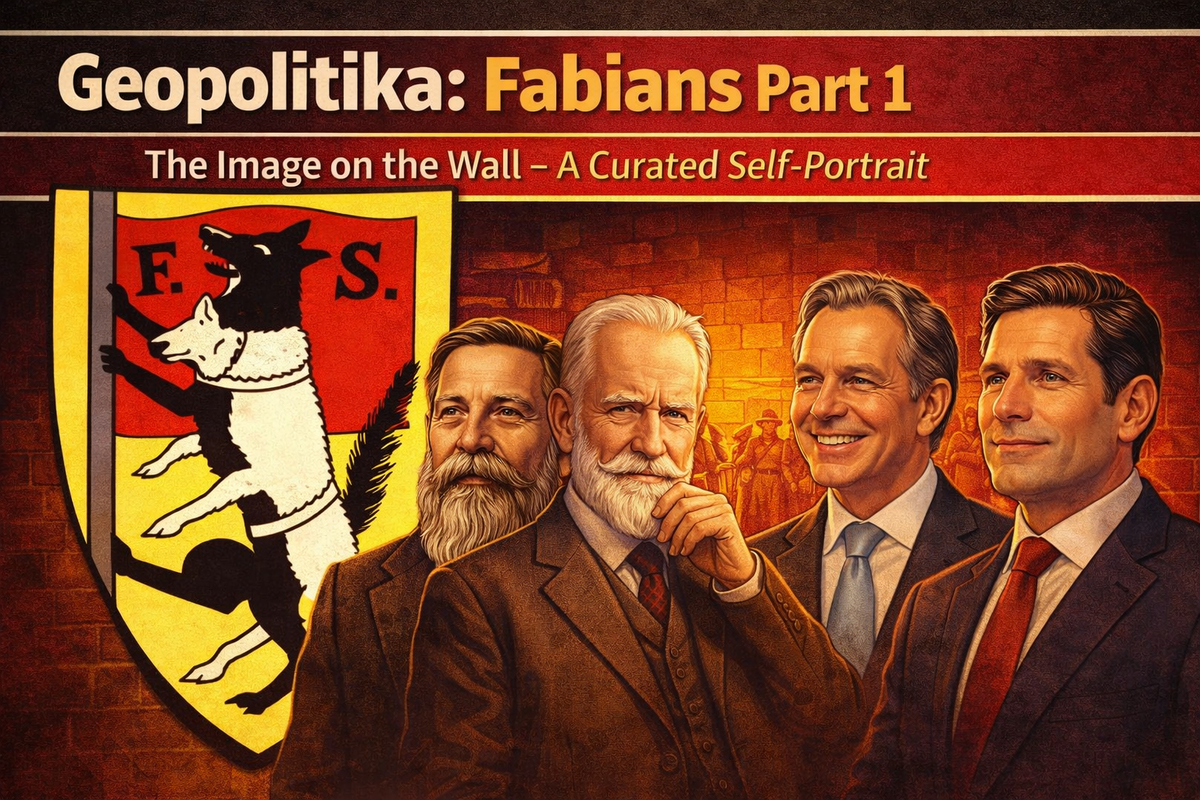
The Wolf in Sheep’s Clothing
The Fabian Society’s self-portrait describes an institution committed to debate, to socialism, to the left. But its chosen emblem suggests another dimension.
The society’s stained glass window depicts a wolf in sheep’s clothing. This was not a private joke. It was a statement of method.
The founders described a strategy: to enter institutions of power—Parliament, the civil service, the universities—not as revolutionaries, but as reformers; not as agitators, but as experts. Gradualism was not only a principle. It was a tactic.
The emblem remains. The society acknowledges it. What it does not ask is whether the method it represents persists.
If the wolf was a strategy, what happens when the strategy becomes indistinguishable from the institution itself? What happens when the language of reform, expertise, and moderation becomes the default vocabulary of politics?
The emblem hangs in the window. The question is not what it meant then, but what it may still explain.
What This Self-Portrait Does
Taken together, the Fabian Society’s website constructs a particular kind of self-portrait.
It is an institution with a long history, a defined political affiliation, and a commitment to debate and research. It acknowledges difficult aspects of its past, but does not dwell on them. It presents its influence as the result of ideas and expertise. It describes itself as both embedded and independent.
These elements do not resolve into a single picture. They sit alongside each other:
- Affiliated and independent
- Open and bounded
- Continuous and adaptive
- Transparent and selective
These are not necessarily contradictions to be resolved. They may be features that are maintained.
If so, they suggest something beyond a single institution. They suggest a pattern—a way of structuring political discourse in which tensions are stabilised rather than eliminated, in which authority is derived from history, expertise, and position, and in which certain voices are consistently mediated rather than heard directly.
Whether this constitutes a system—something that reproduces itself across leaders, policies, and contexts—is a question that cannot be answered from the self-portrait alone.
The Questions That Follow
This is the Fabian Society as it presents itself. The portrait is displayed. The tensions are visible. The questions that follow are not rhetorical. They will guide the rest of this series:
- On continuity: What happens when a leader emerges who does not fit the established pattern?
- On boundaries: What defines the limits of acceptable debate—and who defines them?
- On influence: How do ideas move from think tank to state? Through argument, or through networks?
- On leadership: What kind of political figures does this environment produce—and why do they recur?
- On inheritance: What became of the early logic of expert management? Was it abandoned, or transformed?
- On socialism: What does the term mean within this framework—power, or administration?
- On the wolf: What does it mean that an institution founded on a strategy of concealment now presents itself as a voice of transparency?
These are questions, not conclusions...
Published via Mindwars Ghosted.
Geopolitika: Tracing the architecture of power before it becomes the spectacle of history.
—
Methodology note: This analysis draws on publicly available materials from the Fabian Society’s website, including its Our History page, governing rules (Rules of the Fabian Society), executive committee biographies, and related publications. The approach is forensic: it examines institutional self-presentation, argument structures, historical selectivity, network disclosures, and the gaps between what is claimed and what is examined. All sourced material is accessible at fabians.org.uk.
Mindwars Ghosted is an independent platform dedicated to exposing elite coordination and narrative engineering behind modern society. The site has free access and committed to uncompromising free speech, offering deep dives into the mechanisms of control. Contributions are welcome to help cover the costs of maintaining this unconstrained space for truth and open debate.
If you like and value this work, please Buy Me a Coffee