Geopolitika: Institutional Profiles – American Enterprise Institute (AEI)
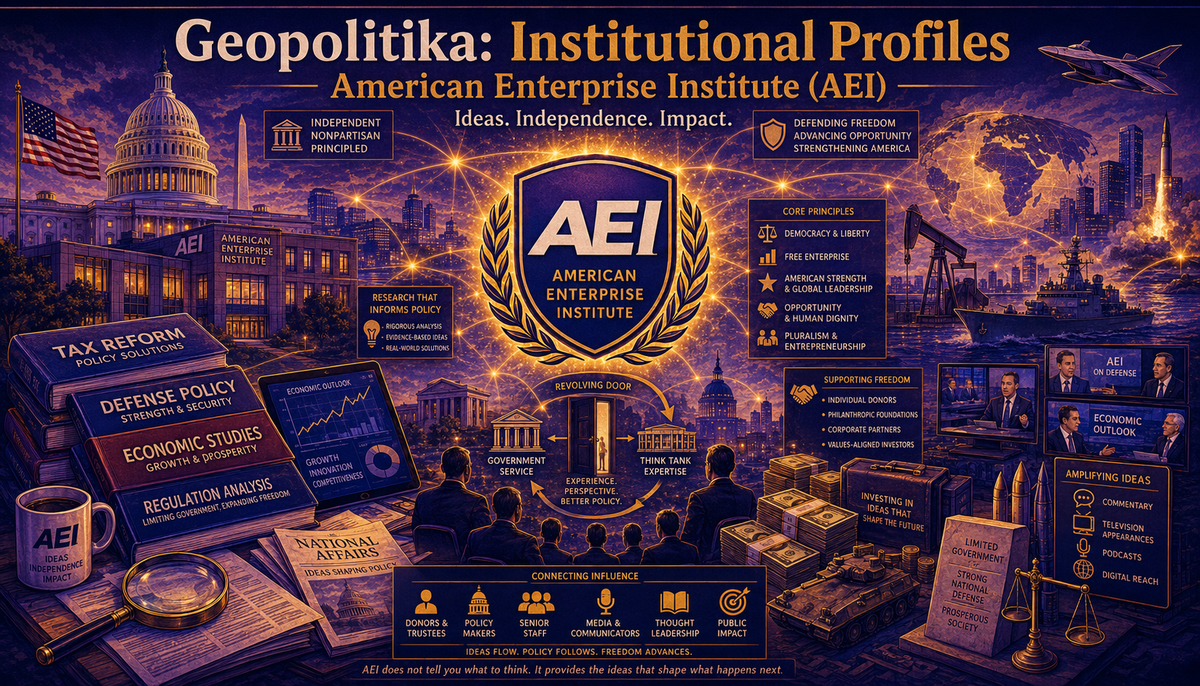
This institutional profile forms a part of the Geopolitika project to map Anglo-American power structures by examining their founding mythologies, leadership, linkages to power, public face, the nature of their outputs and who these are directed towards. These profiles are primarily generated from materials provided on their own websites, which are then analysed using a structured institutional analysis framework—see methodology statement at foot of article.
—
Executive Summary
The American Enterprise Institute (AEI) operates as a highly refined system. Over nearly nine decades, it has developed an institutional architecture in which funders, trustees, and scholars operate with deeply aligned incentives and worldviews. As a result, AEI’s research, messaging, and policy recommendations consistently serve the interests of those who sustain the institution — not through explicit orders, but because the system is designed to produce that outcome.
“Dedicated to defending human dignity, expanding human potential, and building a freer and safer world.” — AEI self-description
A forensic examination of the institution’s personnel, funding, outputs, and internal dynamics reveals a more complex picture than its self-presentation suggests. AEI presents itself as a principled, nonpartisan research institution—one whose “compass does not point toward politicians or parties but toward principles,” as President Robert Doar and Chairman Daniel D’Aniello write in the 2025 Annual Report. This is not false. It is incomplete.
What AEI actually does, measured by its observable patterns rather than its stated mission, is function as a homeostatic regulator for the American conservative policy ecosystem. It monitors the policy environment, claims successes where policies align with donor interests, and generates corrective signals when policies deviate. It translates concentrated wealth into policy influence through the production of expertise-format outputs. It coordinates elite networks connecting donors, policymakers, and media. And it does all of this while producing genuine intellectual work—research that is often rigorous, scholars who are sincerely committed to their principles, and analysis that contributes to policy discourse.
This is the productive tension at the heart of the institution. AEI is simultaneously a genuine research organisation and a sophisticated instrument of elite policy influence. Neither characterisation is sufficient alone. Both are necessary to understand what the institution is and why it works.
This article is about emergent behaviour—how a system’s components interact to produce outcomes that no single person decided. It explores how institutional architecture shapes intellectual production, how funding flows become policy positions, and how legitimacy is maintained while particular interests are served.
The Machine Behind It: History, Purpose, and Structure
The AEI was founded in 1938 by a group of business leaders concerned about the expansion of government during the New Deal. Originally named the American Enterprise Association, it operated from New York City until opening a Washington office in 1943, where it began producing legislative analyses for members of Congress overwhelmed by the volume of wartime bills, executive orders, and regulations. By 1956, 80 percent of the Senate and more than 62 percent of the House received AEI reports. In 1962, the organisation became the American Enterprise Institute, and by the early 1970s it had hired its first resident scholars and established the research programs—economic policy, foreign and defence policy, and social and political processes—that would form the foundation of its modern structure.
The institution describes its founding purpose as defending human dignity, expanding human potential, and building a freer and safer world. Its work, it states, advances ideas rooted in democracy, free enterprise, American strength and global leadership, solidarity with those at the periphery of society, and a pluralistic, entrepreneurial culture. It operates as a nonpartisan, nonprofit 501(c)(3) educational organisation and takes no institutional positions on any issues.
The modern AEI is not a membership organisation. It is not accountable to voters. It is a nonprofit governed by a Board of Trustees, managed by an Executive Office, and funded entirely through private donations. Its research activities are organised under four major departments: Economic Policy Studies, Foreign and Defense Policy Studies, Social, Cultural, and Constitutional Studies, and Domestic Policy Studies. These are supplemented by specialised centres and initiatives, including the Housing Center, the Center for Technology, Science, and Energy, the Survey Center on American Life, the Center on Opportunity and Social Mobility, the Center for the Future of the American University, and the Critical Threats Project. AEI also publishes the policy journal National Affairs and maintains a large network of resident and nonresident scholars. The institution accepts no government funding and performs no contract research.
But the institutional architecture matters more than the financial totals. AEI sits at the intersection of four interconnected systems: a production system generating expertise-format outputs; a funding system channelling resources from wealthy donors through to policy influence; a personnel system circulating individuals between government, media, academia, and corporate sectors; and a legitimacy system maintaining the institution’s reputation for principled independence. These systems are the subject of the sections that follow.
The Architecture
Personnel and Power
The Board of Trustees is where institutional control resides, and its composition is unambiguous. Every member is a business or finance executive, for instance:
- Daniel D’Aniello, the Chairman since 2018, is also cofounder and Chairman Emeritus of The Carlyle Group, one of the world’s largest defence and private equity firms.
- Peter Coors director of Molson Coors Beverage Company and is a fifth-generation member of the Coors family.
- Ross Perot Jr., Chairman of The Perot Companies and of Hillwood Development Company.
- Harlan Crow chairs Crow Holdings, a private family business established to manage the capital of the Trammell Crow family.
- Dick DeVos of The Windcrest Group, former president of Amway, husband of Betsy DeVos, U.S. Secretary of Education under President Donald Trump (2017–2021) and philanthropist through the Dick and Betsy DeVos Family Foundation.
Other board members include principals from AQR Capital Management, Eagle Capital Management, Blue Owl Capital, Fortress Investment Group, Audax Group, and other financial institutions.
This composition creates structural alignment between governance and donor interests. The board approves institutional priorities, oversees leadership, and ensures the organisation’s direction remains compatible with the interests of those who sustain it. Individual scholars may exercise genuine intellectual autonomy—and the evidence suggests they do—but the boundaries within which that autonomy operates are set by governance architecture. There are no representatives from labour organisations, consumer advocacy groups, environmental groups, or community organisations. This is not a criticism. It is a description of a design that has proven durable across nearly a century.
The personnel network extends this alignment throughout the institution in ways that are both visible and structural. The evidence documents at least 15 personnel with active or recent revolving door patterns—movement between AEI and Republican government positions, between AEI and corporate boards, between AEI and conservative media. These are not marginal figures. They are the institution’s public face and intellectual leadership.
Consider the concentration. Paul Ryan, former Speaker of the House and 2012 Republican vice-presidential nominee, is a Distinguished Visiting Fellow. Phil Gramm, the former Republican Senator from Texas who co-authored the Gramm-Leach-Bliley Act dismantling Depression-era banking regulations, is a Nonresident Senior Fellow producing regular Wall Street Journal commentary on trade policy. Ben Sasse, former Republican Senator from Nebraska, joined AEI as a Nonresident Senior Fellow in 2025 after leaving the Senate. Scott Gottlieb, Trump’s FDA Commissioner, is a Senior Fellow writing on pharmaceutical policy while serving on the boards of Pfizer and Illumina. Elaine McCusker, former Acting Under Secretary of Defence, produces defence budget analysis as a Senior Fellow directly relevant to procurement decisions at the department she formerly helped lead. Marc Thiessen, a former White House speechwriter for George W. Bush, serves simultaneously as an AEI Senior Fellow and a Washington Post columnist, generating synchronised rapid-response commentary on administration foreign policy. John Yoo, former Deputy Assistant Attorney General in the Bush administration and author of the legal frameworks for enhanced interrogation, is a Nonresident Senior Fellow.
The institutional leadership is similarly embedded:
- Robert Doar, AEI’s President since 2019, previously served as Commissioner of New York City’s Human Resources Administration and Commissioner of New York State’s Office of Temporary and Disability Assistance—agencies directly responsible for implementing the welfare programs AEI scholars now analyse and advocate reforming.
- Yuval Levin, Director of Social, Cultural, and Constitutional Studies, served on the White House domestic policy staff under George W. Bush.
- Kori Schake, Director of Foreign and Defense Policy Studies, held senior positions at the State Department, the National Security Council, and the Department of Defence, and served as senior policy adviser on the 2008 McCain campaign.
The pattern is consistent: government officials leave office, join AEI, produce policy research from insider perspective, maintain networks that facilitate future government service. When Republicans return to power, AEI scholars enter the administration. When Democrats hold the White House, AEI serves as a policy library and personnel reservoir, maintaining institutional memory and network cohesion until the next Republican administration.
The evidence suggests this circulation functions as an informal policy coordination network—connecting government, think tank, media, and corporate sectors through personnel movements rather than formal agreements. Government-to-AEI-to-government trajectories create shared frameworks, personal relationships, and institutional knowledge that facilitate policy alignment without requiring explicit coordination. The pattern appears consistent across decades and administrations. No single person designed this system. It emerged from the interaction of institutional incentives, political cycles, and personnel networks across time.
Funding and Influence
AEI is entirely privately funded and makes this fact central to its self-presentation. It accepts no government funding and performs no contract research—a policy it frames as evidence of independence from state interests. The institution is transparent about its aggregate revenue sources, providing detailed breakdowns in annual reports going back at least two decades.
The funding structure, however, reveals more than aggregate transparency suggests. Individuals provide 58 percent of revenue—$37.4 million in fiscal year 2025. These are not small donors. They are major philanthropic and political contributors—many of them among the most significant funders in conservative politics and policy.
The National Council, AEI’s inner circle of leading investors, lists members by name and organises them geographically. The names include major Republican Party donors, finance sector executives, energy sector figures, and defence industry principals.
Foundation funding at 25 percent ($15.9 million) comes substantially from conservative foundations, including the Searle Freedom Trust and Bradley Foundation, whose trustees appear on AEI’s Emeritus Trustees list. Corporate funding at 9 percent ($5.6 million) supplements this base through a structured program offering membership tiers from $25,000 to $250,000 annually.
The pattern is not of diverse, disinterested support but of concentrated, ideologically aligned funding from sources whose policy preferences are broadly consistent. Low marginal tax rates—especially on capital. Reduced regulatory constraints on finance, energy, and industry. Market-based provision of services historically delivered by government. Strong defence spending. A conservative judiciary that interprets the Constitution along originalist lines. These preferences define the boundaries within which AEI scholars operate, not because donors issue directives but because the institution’s survival depends on producing research that donors value.
This funding structure clearly creates systematic alignment between donor interests and the institutional research agenda. The alignment mechanism is not transactional—donors do not typically fund specific research projects or review findings before publication. It is structural. Scholars are hired, in part, because their methodological commitments and research interests align with the institution’s intellectual framework. Research agendas are shaped by the incentives that funding creates: outputs that confirm donor-compatible positions attract continued support, media attention, and policy engagement; outputs that challenge those positions face no explicit censorship but receive less institutional investment. The pattern persists across decades and across policy domains. It is robust enough that the alignment cannot plausibly be attributed to coincidence.
A specific convergence illustrates the mechanism. Board members from across the finance sector oversee an institution whose economic policy division consistently advocates lower capital gains taxation, reduced financial regulation, and free capital flows. Board members from the energy sector—such as Coors and Perot—govern an institution whose energy and environmental scholars consistently criticise climate regulation, oppose carbon pricing, and challenge renewable energy mandates. The Chairman’s own firm, The Carlyle Group, is one of the world’s largest defence contractors; AEI’s defence policy scholars consistently advocate increased military spending, defence industrial base investment, and aggressive military posture.
Analysis of the AEI’s 2025 Annual Report shows how this forms the key document through which the orgainsiations’s funding-research-influence cycle is maintained. Not merely a record of institutional activity, it presents as a donor communication tool that demonstrates return on investment.
The report’s structure reveals its function. It opens with a message from the Chairman and President framing the institution’s work within a narrative of principled commitment to freedom. It documents policy successes across six priority areas—tax reform, higher education, K-12 education, defence, fiscal policy, and trade—each structured to imply that AEI scholarship caused the policy outcomes claimed. It admits failures where the institution’s positions were not adopted, establishing credibility through selective honesty. It presents financial data demonstrating responsible stewardship. And it closes with gratitude to donors and an implicit appeal: “Thank you for your support. We will ask for it again. And we promise that we won’t let you down.”
The report is simultaneously a genuine accounting and a sophisticated instrument of institutional maintenance. Its factual claims are broadly accurate. Its admissions of failure are genuine—the institution has criticised the Trump administration’s tariff and deficit policies, positions that are not cost-free given the administration’s otherwise aligned agenda. Its scholar achievements are real. But the report’s structural function—communicating effectiveness to the donor base that sustains the institution—is at least as significant as its stated purpose of honest self-assessment.
The Outputs: Patterns, Priorities, and Synchronisation
AEI is an output machine optimised for public influence. In 2025, according to its own figures, it published 139 reports and 24 books. It placed 1,582 op-eds and articles in top-40 outlets. Its scholars testified before Congress 25 times. They held 670 meetings and briefings with policymakers, staffers, and international officials. They conducted 1,285 background calls with journalists. The institution hosted 159 public events attracting more than 5,000 guests and more than 80,000 views online. It reached 13.8 million page views across its digital platforms and maintained 288,000 newsletter subscribers. Seven outreach conferences engaged students and leaders from across the country, and 751 students participated in AEI’s collegiate programs.
The output distribution reveals institutional priorities. Op-eds and media appearances constitute approximately 90 percent of output volume. Reports—the output type most directly associated with primary research—constitute approximately 4.4 percent. Congressional testimony, despite its outsized policy influence, constitutes less than 1 percent. This is not criticism; it is description of an institution whose primary operational function is rapid-response public influence through media engagement, not academic-style primary research production.
Synchronisation: Timing and Coordination.
The synchronisation patterns are particularly revealing. The evidence documents that multiple AEI scholars publish thematically consistent content across different major outlets within one to two days of significant policy developments. When the Trump administration escalated conflict with Iran in April and May 2026, AEI scholars generated a coordinated surge: Marc Thiessen in the Washington Post on 30 April (“Trump Is 14 Days From Decisive Victory in Iran”), Matthew Continetti in the Wall Street Journal on the next day (“Time to Force Open the Strait of Hormuz”), followed by sustained commentary from Thiessen, Danielle Pletka, Jack Goldsmith and Brian Carter + Nicholas Carl across multiple media, plus the AEI podcast network over subsequent days. The response demonstrates an infrastructure capable of rapid, multi-channel, thematically consistent messaging.
Similar patterns appear around other policy events: tariff announcements generating synchronised criticism from AEI economists; education legislation generating coordinated op-eds from education scholars; Supreme Court decisions generating rapid commentary from legal scholars. The evidence suggests this synchronisation reflects a combination of explicit editorial coordination, shared analytical frameworks that process new events through established interpretive templates, and institutional incentives that reward rapid, media-ready commentary.
The authorship pattern shows concentration among a core group—including Michael Strain, Marc Thiessen, James Pethokoukis, Frederick Hess, Timothy Carney, Desmond Lachman, Chris Stirewalt, Michael Rubin, and Danielle Pletka—who appear most frequently in an early May 2026 scan of the output corpus. This core of 15 to 25 scholars produce the majority of public-facing content—the voices policymakers hear and journalists quote. Their consistency is not uniformity but coherence: legitimate disagreements exist on tariffs, fiscal policy, and specific policy mechanisms, but the range of disagreement is bounded by shared commitments. Free enterprise is good. Government intervention is suspect. American strength is essential. Markets solve problems better than states. Within these bounds, debate is genuine. Beyond them, it does not occur.
The System Beneath: Feedback, Emergence, and Boundaries
Viewed as a system rather than a collection of individuals, AEI exhibits properties that cannot be reduced to any single scholar’s intentions. These properties emerge from the interaction of funding, governance, personnel incentives, and output infrastructure across time.
- Reinforcing Loop 1: Output to Visibility to Resources. AEI produces research that generates policy outcomes and media attention. Documented policy outcomes and media visibility are communicated to donors through the annual report and ongoing engagement. Donor confidence translates into continued and increased funding. Funding enables expanded research capacity and additional output. The more the institution produces, the more visibility it gains; the more visibility, the more resources it attracts. This loop has driven institutional growth from $23.4 million in revenue in 1994 to $63.8 million in 2025.
- Reinforcing Loop 2: Credibility to Access to Influence. AEI scholar credibility—built through credentials, research quality, and institutional reputation—generates media access and policymaker engagement. Media presence and policy engagement further enhance credibility. The 1,582 op-eds, 670 policymaker meetings, and 1,285 journalist calls documented in 2025 are both outputs of this loop and inputs that sustain it.
- Reinforcing Loop 3: Personnel Circulation to Government to Policy to Circulation. AEI scholars enter Republican administrations and implement AEI-aligned policies. They return to AEI with government experience that enhances their credibility and policy knowledge. Their successors in government—often former AEI colleagues—continue implementing AEI-aligned policies. The cycle reinforces itself across administrations.
- Balancing Loop: Deviation to Correction to Equilibrium. When policy outcomes deviate from AEI’s framework—as with Trump’s protectionist trade policies—AEI scholars generate sustained criticism. The criticism pressures the administration toward AEI-preferred positions. The framework’s integrity is maintained. The institution’s credibility as principled critic is reinforced. The system returns to equilibrium.
- Delay Loop: Advocacy to Delayed Adoption to Credit Claiming. AEI advocates policies that may take years or decades to be adopted. When adoption occurs, AEI claims credit—a claim made more plausible by the temporal gap between advocacy and adoption, which obscures whether AEI caused the outcome or simply advocated a position that later became politically viable. The 2017 tax cuts, welfare reform, and defence spending increases are all claimed as AEI-influenced outcomes years or decades after AEI began advocating for them. The evidence suggests this pattern but cannot establish causation from documentary sources alone.
These loops interact to produce emergent properties—characteristics of the system as a whole that exceed any individual contribution.
The institution’s aggregate policy influence is irreducible to any single scholar’s work. No individual—not Strain, not Thiessen, not Doar—accounts for AEI’s documented influence. The institutional brand creates a multiplier effect: research quality, media infrastructure, policy networks, and donor relationships combine to produce influence that no individual scholar could achieve independently.
The evidence further suggests that personnel circulation functions as an informal policy coordination network irreducible to individual career choices. Government-to-AEI-to-government trajectories accumulate across decades and personnel into a network that facilitates policy alignment without requiring explicit coordination. Individual career decisions that appear normal in isolation produce aggregate effects that look systematic in retrospect. This is not conspiracy but emergence—patterns arising from interactions, not intentions.
The annual report’s aggregate credibility is similarly irreducible. No single claim or section—not the success claims, not the failure admissions, not the financial data—produces institutional legitimacy alone. The synthesis of all elements creates a self-presentation that is more credible than any individual component. This is the emergence property that makes the annual report an effective donor communication tool.
Like all systems, AEI maintains boundaries—limits on what can be said, researched, or advocated within its framework. These boundaries are not external constraints imposed by censors. They emerge from the interaction of funding, governance, personnel selection, and intellectual tradition.
Four key boundary types are documented in the analysis:
- The mission boundary defines what the institution studies: policy domains where market-based solutions are applicable. AEI’s research program covers economics, foreign and defence policy, education, healthcare, housing, technology, and constitutional law—all domains amenable to market-oriented, limited-government analysis. Missing from the research program are domains where market solutions face their strongest empirical challenges: the concentration of labour market power among employers, the racial wealth gap as a structural feature, the economics of climate adaptation, public health infrastructure as a public good. These are not explicitly excluded. They are rendered invisible by the analytical framework the institution employs.
- The programmatic boundary operates through research agenda selection. AEI’s six institutional priorities for 2025—tax reform, higher education, K-12 education, defence, fiscal policy, and trade—all align with donor interests and Republican policy preferences. Priorities that would challenge those interests—progressive taxation efficacy, labour union benefits, single-payer healthcare evidence, regulatory benefits assessment—are absent from the research program. The boundary is maintained not through prohibition but through the alignment of scholar interests, donor preferences, and institutional incentives that makes some research questions obvious and others unthinkable.
- The personnel boundary draws from a narrow pool. AEI scholars overwhelmingly hold credentials from elite institutions and share commitments to free-market, limited-government frameworks. Scholars whose work challenges fundamental premises of market-based policy solutions are not barred from employment. They are simply not the people the institution hires. The personnel boundary ensures intellectual diversity within the conservative tradition while excluding perspectives from outside it. This is a structural feature, not an individual failing.
- The knowledge boundary establishes what counts as legitimate evidence. Quantitative research is privileged. Policy analysis using economic modelling is central. Credentialed expertise—the PhD economist, the former government official, the experienced policy practitioner—constitutes authority. Experiential knowledge of policy effects—the testimony of welfare recipients navigating work requirements, the perspective of workers in deregulated industries, the voice of communities affected by defence policy or environmental deregulation—is not recognised as a category of relevant evidence. The boundary is epistemological rather than procedural: it shapes what counts as knowledge, not what is explicitly excluded.
These boundaries are not flaws. They are design features. Without them, the institution could not maintain the coherence that makes it effective. With them, it cannot see what lies outside.
The Ecosystem and the System Defended
AEI does not operate in isolation. It is a node in a competitive institutional ecology, and its position within that ecology shapes its function as much as its internal architecture does.
Within the conservative think tank ecosystem, AEI occupies a distinct niche. The Heritage Foundation is more populist, more explicitly partisan, and more closely aligned with the Trump wing of the Republican Party. The Hoover Institution, housed at Stanford, is more academically oriented and less engaged in day-to-day policy combat. The Cato Institute is more libertarian, often at odds with Republican orthodoxy on social issues and foreign policy. The Manhattan Institute focuses more narrowly on urban policy and state-level reform. AEI occupies the position of “respectable conservative”—intellectually credible enough to influence elite discourse, ideologically committed enough to satisfy donors, institutionally independent enough to claim nonpartisanship. This positioning is strategic: it enables AEI to maintain access to Republican policymakers while criticising Republican deviations from orthodoxy, to engage mainstream media while serving as infrastructure for conservative governance.
This niche position operates across multiple ecosystems simultaneously. In the policy ecosystem, AEI functions as an agenda-setter. The institution does not merely respond to policy debates. It frames them. When AEI scholars publish research on the costs of regulation, the benefits of school choice, or the necessity of defence spending, they define the terms in which these issues will be discussed. The 1,582 op-eds placed in top-40 outlets are not merely commentary—they are agenda-setting interventions that shape what policymakers, journalists, and the public understand as the range of legitimate policy options. The evidence suggests this agenda-setting function is cumulative: positions AEI advocated in the 1970s and 1980s are now the common sense of conservative policy discourse, and many have become the baseline from which further rightward movement is measured. In the funding ecosystem, AEI operates as a conduit between concentrated wealth and policy outcomes—the reinforcing cycle described earlier, in which donor resources become expertise-format outputs that influence policy in directions benefiting the resource providers, whose increased wealth then enables continued funding.
AEI’s higher education initiatives extend this influence into the academic pipeline. Through its Center for the Future of the American University, schools of civic thought have been established at 45 universities across the country, creating more than 200 new tenure-track positions for conservative and heterodox scholars. Institutions including Yale University, New York University, Washington University in St. Louis, Arizona State University, and Johns Hopkins University have launched civic thought initiatives in partnership with or influenced by AEI. These programs represent a long-term investment in reshaping the intellectual infrastructure of American higher education—extending AEI’s influence beyond immediate policy debates into the institutions that will shape elite discourse for generations.
No institution that advocates policy positions is neutral with respect to the social and economic order those positions would produce or maintain. Identifying the system an institution’s work tends to defend is an exercise in structural description, not accusation.
The evidence is clear that AEI’s work functions to maintain and extend American capitalist political economy as it has been structured since approximately 1980. The characteristics of this system are well-documented: low marginal tax rates on high incomes and capital, reduced regulatory constraints on industry and finance, weakened labour protections and declining union density, market-based provision of services historically delivered by government, sustained high levels of military spending, and a federal judiciary inclined toward originalist interpretation. Each of these characteristics aligns with policy positions AEI has consistently advanced across decades.
A critical test of analytical asymmetry: An analysis from within the defended system would frame AEI’s work as defending free enterprise—the system that has produced unprecedented global prosperity, lifted billions from poverty, and preserved American liberty against the constant threat of government overreach. In this framing, AEI provides the intellectual foundation for policies that benefit all Americans through economic growth, opportunity, and national strength. This characterisation is not false. It is the framing the defended system produces about itself. The binary tension between this framing and the alternative—that AEI’s work serves particular interests while claiming universal benefit—is not resolvable from documentary evidence. Both interpretations are defensible. The value of identifying the tension is not to resolve it but to acknowledge that it exists. In the end, both may be true—in whole or part.
What Is Not Said: Omissions and Productive Contradictions
Three criteria define when an omission becomes analytically significant: the topic must fall within the institution’s stated purpose, peer institutions must routinely address it, and the absence must persist over time.
AEI exhibits several such omissions. Distributional analysis—who gains and who loses from specific policies—is systematically absent. The institution consistently frames its recommendations as benefiting “Americans,” “families,” or “the economy” in universal terms, while rarely identifying the specific constituencies that win or lose. Voices of populations directly affected by AEI-advocated policies are similarly missing. The single mother navigating work requirements, the worker in a deregulated industry, the family impacted by military operations, and communities affected by environmental policy appear only as abstract objects of policy, never as knowledge-holding subjects with standing to evaluate outcomes. Finally, negative consequences of previously championed policies receive little retrospective scrutiny. The 2008 financial crisis, the Iraq War, and the long-term effects of 1996 welfare reform are largely absent from AEI’s institutional self-accounting.
These omissions are not random gaps. They are visible expressions of deeper, productive contradictions—structural tensions the institution must manage to function effectively.
- Nonpartisanship vs. partisan alignment: AEI claims that its “compass does not point toward politicians or parties but toward principles.” Yet its outputs consistently align with Republican policy preferences, its leadership includes numerous former Republican officials, and its board is composed of major Republican donors. This contradiction is productive: the claim of nonpartisanship confers legitimacy and broader influence, while the actual alignment secures donor support and policy relevance.
- Solidarity with the vulnerable vs. policy effects: AEI states a commitment to “human dignity” and “solidarity with those at the periphery of our society.” However, many policies it has long championed—reduced social spending, strict work requirements, deregulation, and tax cuts weighted toward high incomes—are associated with increased inequality and reduced support for vulnerable populations. The institution reconciles this through a sincere belief that market-based approaches ultimately benefit everyone, allowing donor-serving policies to be framed as universal goods.
- Independence from donors vs. donor-class governance: AEI emphasises that it accepts no government funding and performs no contract research. Yet its Board of Trustees consists entirely of business and finance executives—the same donor class that provides the majority of its resources. Formal independence from the state coexists with structural governance by private interests.
- Competition of ideas vs. ideological boundaries: AEI claims to welcome “civil disagreement” and the “competition of ideas.” In practice, genuine debate occurs within the bounds of conservative intellectual diversity, but perspectives that challenge core premises—the universal optimality of markets, the presumptive harm of government intervention, or the necessity of American military primacy—are structurally excluded through personnel selection, research priorities, and epistemological boundaries.
These contradictions are not failures of institutional integrity. They are design features. They allow AEI to maintain intellectual credibility and public legitimacy while serving elite coordination and donor-aligned policy functions. The annual report is a primary vehicle through which these tensions are managed and suspended—successes are claimed, limited failures admitted for credibility, and the overall narrative of principled independence preserved.
The omissions documented above are the visible traces these contradictions leave in the output record. They are not accidents of oversight. They are predictable consequences of an institutional architecture optimised for coherence within a particular ideological and donor ecosystem.
The De Facto Purposes: What the Institution Actually Does
As the institution itself declares, it exists to “defend human dignity, expand human potential, and build a freer and safer world” through free enterprise, limited government, and American strength.
In practice, it clearly functions primarily as a layered legitimacy system—an institution that translates concentrated wealth into policy influence while maintaining the appearance of principled independence through genuine intellectual production.
At the most visible level, AEI produces expertise-format outputs that advance donor-aligned policy positions with genuine intellectual sophistication. The 139 reports, 1,582 op-eds, and 25 testimonies in 2025 are not propaganda in the crude sense. They are research products that meet professional standards, contribute to policy discourse, and reflect the sincere commitments of their authors. At the structural level, the funding architecture—donor-class governance, ideologically aligned funding—combines with personnel circulation patterns and output infrastructure to form an integrated system ensuring aggregate outputs consistently align with donor interests regardless of individual scholar intentions. This level is not visible in any single document or decision. It emerges from the interaction of components across time. At the systemic level, the institution operates as a homeostatic regulator—monitoring the policy environment, claiming successes where policies align with donor interests, and generating corrective signals where policies deviate. At the meta-level, the annual report closes the resource cycle, communicating effectiveness to the donor base that sustains all other functions.
The layered nature of these functions is central to understanding the institution. Scholars operating at the visible level of research production may not perceive—and may genuinely not be aware of—the structural and systemic functions their work serves. The architecture ensures alignment without requiring awareness. This is not corruption. It is sophisticated institutional design refined over nearly 90 years.
An alternative interpretation warrants acknowledgment: that AEI is an independent research organisation whose structural features—diverse funding, personnel circulation, media engagement—reflect normal operation in a competitive policy marketplace, and whose policy alignment reflects genuine intellectual consensus among scholars committed to well-supported principles. However, this alternative cannot explain the consistent alignment between reported successes and donor interests across all six policy priority areas without exception, the systematic exclusion of perspectives challenging donor-compatible positions, or structural features—board composition, funding concentration—that persist across decades regardless of which individuals occupy institutional positions. Treating alignment between donor interests and research findings as coincidence across this many domains and this many decades requires an increasingly implausible accumulation of coincidences. That said, the alternative framework is genuinely defensible. It captures what the primary framework might obscure: the real intellectual contributions of individual scholars, the authentic principled commitments that animate the institution’s work, and the genuine value of research that happens to align with donor interests.
The Stakes: Who Benefits, Who Pays
The preceding sections have described an institution as a system. But the system has concrete human consequences that its self-presentation systematically obscures.
The beneficiaries of the political economy AEI’s work helps sustain are identifiable:
- Wealthy individuals and households benefit from tax policies that have reduced top marginal rates from 70 percent in 1980 to 37 percent today and capital gains rates substantially below income rates.
- Corporate shareholders and executives benefit from deregulation that reduces compliance costs and labour bargaining power.
- The financial sector benefits from reduced oversight and expanded market access.
- Defence contractors benefit from military spending increases.
- Private healthcare and education providers benefit from market-based delivery of public services.
The costs are borne elsewhere:
- Low-income workers have experienced decades of wage stagnation alongside declining union density and reduced labour protections.
- Welfare recipients have faced benefit reductions, time limits, and work requirements—policies AEI explicitly advocated—without adequate employment support, resulting in documented increases in deep poverty among the most vulnerable.
- Communities of colour have experienced disparate impacts across criminal justice, welfare, education, and environmental policy.
- Populations affected by environmental deregulation and financial instability, and future generations who will bear the consequences of deficit spending to fund current tax cuts, have borne consequences of policy choices made in their name but without their voice.
These distributional effects are not abstractions. When the institution advocates work requirements for food assistance and celebrates their adoption, families already under stress face additional barriers to accessing food. When AEI advocates deregulation, workers lose protections and communities face increased environmental and financial risk. When it advocates defence spending increases, public resources are directed toward military capacity rather than schools, healthcare, or infrastructure—and military force is deployed in ways that affect human beings in other countries who have no voice in the institution that helped shape the policies affecting them. When it advocates tax cuts favouring high incomes and capital, government revenue is reduced, constraining services on which vulnerable populations disproportionately depend.
These human stakes are present in every section of the annual report and visible in none of them. The report is populated by scholars, policymakers, and donors. The people whose lives are shaped by the policies these actors produce appear nowhere. They are the implied beneficiaries—“Americans,” “families,” “students,” “the vulnerable”—but never subjects with standing to evaluate whether AEI’s policies have served them well. This absence is the institution’s most significant silence. It reveals a fundamental feature of AEI’s architecture: the institution is structurally responsive to the interests of those who fund and govern it, not to those affected by its policy recommendations. The gap between self-presentation and structural function is measured in human lives.
The Longer View: Slow Variables and Temporal Depth
Beneath the annual cycles of policy debate and institutional reporting, slower variables are reshaping the conditions in which AEI operates. These variables operate at decadal scales and interact with the institution’s functions in ways the annual report does not address.
There is clear and ample evidence that wealth concentration among AEI’s donor base has been increasing for decades—the same decades in which AEI-advocated policies have shaped American political economy. Top income shares, capital shares of national income, and wealth concentration at the highest percentiles have all risen substantially since 1980. This is not a coincidence attributable solely to technological change or globalisation—policy choices regarding taxation, regulation, labour law, and social provision have shaped these outcomes. The result is a reinforcing cycle: AEI-advocated policies increase donor wealth, which increases donor capacity to fund AEI, which enables more policy influence, which leads to more donor-benefiting policies. The cycle operates at a temporal scale exceeding any single annual report or administration. The institution does not acknowledge its role in this cycle.
A second slow variable is the Republican Party’s ongoing realignment toward populism and away from the orthodox conservatism that AEI has long embodied. Under Trump’s influence, the party has moved toward protectionist trade policies, greater tolerance for large deficits, scepticism of traditional alliances, and a transactional rather than principled approach to foreign policy. This shift creates a genuine structural dilemma for the Institute. AEI cannot fully align with Trump-style populism without abandoning core principles — free trade, fiscal discipline, and robust international alliances — that have defined the institution for decades. Yet it cannot afford to oppose the dominant force within the Republican Party too strenuously without losing access to the policymakers who remain its primary channel for real-world influence. AEI has responded with a selective balancing act: strong support on taxes, deregulation, judicial appointments, and China policy, combined with sustained criticism on tariffs and fiscal matters. While the annual report documents some of these tensions, it does not address the deeper strategic question: whether AEI can maintain its intellectual identity while remaining relevant in a party that is moving away from many of its traditional commitments. The outcome of this realignment will significantly determine whether AEI remains a central pillar of conservative governance or becomes a more marginal voice within a transformed Republican Party.
The evidence suggests, with moderate confidence, that declining public trust in institutions—including think tanks—represents a third slow variable. As trust declines, the legitimacy-production function that is central to AEI’s operation becomes more challenging. The institution must work harder to maintain credibility with both elite and public audiences. Its initiatives in higher education—schools of civic thought at universities across the country, the Center for the Future of the American University, 200 new tenure-track positions for conservative and heterodox scholars, 45 university programs—can be understood as strategic responses to this variable: efforts to rebuild institutional legitimacy through influence over the next generation of intellectual elites and the institutions that shape public discourse.
Conclusion
The available evidence cannot resolve several important questions. What are the precise causal chains running from AEI research to policy adoption to human outcomes? How do the populations most affected by AEI-advocated policies experience them? To what extent do AEI scholars perceive the structural alignment between their work and donor interests? And how would the institution’s research agenda change if its donor base shifted significantly toward progressive priorities?
These unanswered questions point to the central vulnerability in AEI’s design: its reliance on productive ambiguity — the ability to claim principled independence while remaining structurally aligned with the interests of its funders. As long as this ambiguity can be maintained, the institution thrives. But the tension is becoming harder to sustain.
Wealth concentration among its donor base continues to rise. The Republican Party’s shift toward populism has forced AEI into public criticism of policies advanced by an administration it largely supports. Declining public trust in institutions makes the legitimacy-production function more difficult with each passing year.
The contradictions documented in this analysis are not secrets. They are structural features of an institutional architecture refined over nearly ninety years. AEI is neither the purely independent research organisation it presents itself as, nor merely the partisan advocacy vehicle its harshest critics describe. It is both things at once: a genuine research institution that produces rigorous work, and a sophisticated instrument of elite policy influence. The productive tension between these two realities is not a flaw. It is the institution’s defining characteristic and the source of its effectiveness.
Whether this architecture can withstand the slow variables now pressing against it—or whether the productive ambiguity that sustains it will eventually collapse—remains uncertain. What the evidence does make clear is that readers of AEI analysis should approach its outputs with informed realism: appreciating the real intellectual contributions while understanding the structural boundaries within which that work is produced.
Published via Mindwars Ghosted.
Geopolitika: Tracing the architecture of power before it becomes the spectacle of history.
Methodology Note: This analysis draws on publicly available materials from the American Enterprise Institute, accessed via the institution's website and regulatory filings in May 2026. The primary corpus includes: the AEI website (approximately 600 pages, covering institutional history from 1938 to present); annual reports from 2004 to 2025 with audited financials; leadership and Board of Trustees biographies; National Council membership listings; published outputs (reports, op-eds, testimony, events, podcasts, and media tracking); the 2025 Annual Report examined in detail; IRS Form 990 filings from 2011 to 2025 via ProPublica's Nonprofit Explorer; and organisational governance documents including the statement of purpose and research integrity policies. The analysis was conducted using a structured institutional analysis framework examining self-presentation, personnel networks, funding architecture, output patterns, synchronisation, contradictions, missing materials, and de facto purpose. All sourced material is publicly accessible. Base analytic outputs are available on request. For methodological details—including Transparency Score definitions, typology classifications, and confidence calibration—see the Geopolitika Series Methodological Statement.
Mindwars Ghosted is an independent platform dedicated to exposing elite coordination and narrative engineering behind modern society. The site has free access and is committed to uncompromising free speech, offering deep dives into the mechanisms of control. Contributions are welcome to help cover the costs of maintaining this unconstrained space for truth and open debate.
If you like and value this work, please Buy Me a Coffee.