Geopolitika: The April 2026 Senate Armed Services Committee Hearing – Maintaining the Map While the Territory Shifts
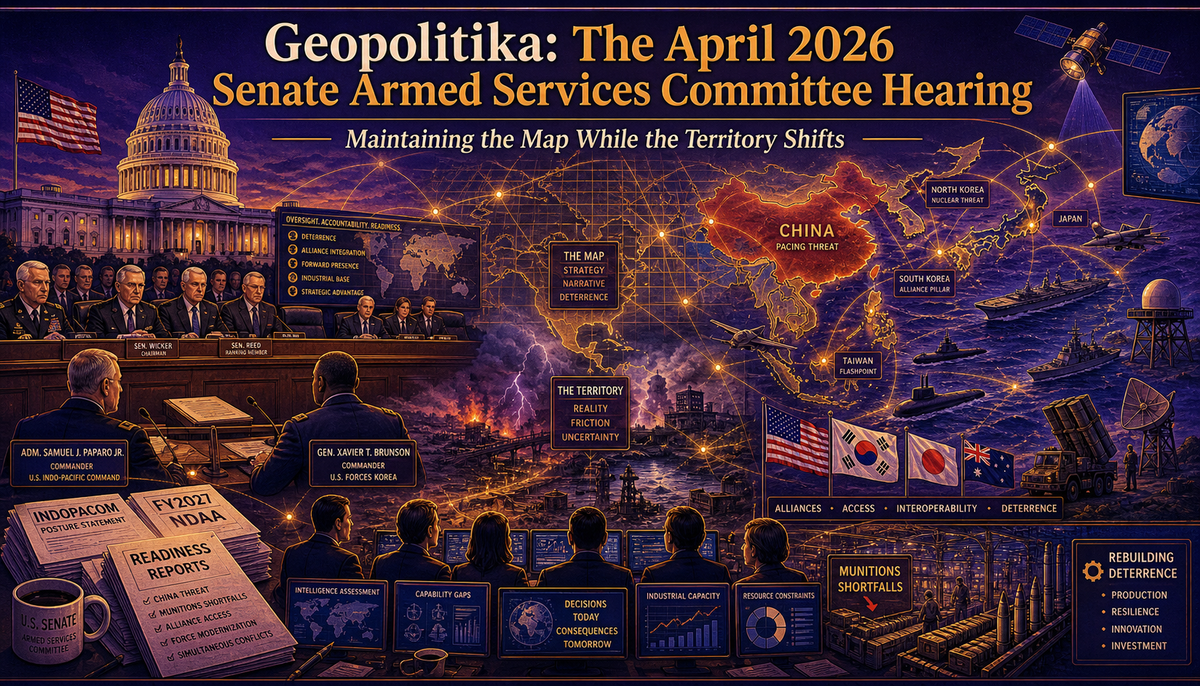
This analysis forms a part of the Geopolitika project to map Anglo-American power structures by examining their founding mythologies, leadership, linkages to power, public face, the nature of their outputs and who these are directed towards. These articles and profiles are primarily generated from materials provided on their own websites, which are then analysed using a structured analysis framework—see methodology statement at foot of article.
Note: The genesis of this article lies in a series of videos by analyst Brian Berletic where he breaks down the same Senate hearing and interprets it from his own perspective. Readers are encouraged to also access Brian’s series for a line-by-line review of the proceedings.
—
Executive Summary
This hearing is not just about Indo-Pacific posture. It is a window into how the United States security system processes contradiction—between expanding global commitments and finite industrial capacity, between deterrence and escalation, and between strategic narratives and lived consequences.
Formally, the April 2026 Senate Armed Services Committee hearing examines the readiness of U.S. Indo-Pacific Command and U.S. Forces Korea in support of the FY2027 National Defense Authorization Act. It documents real and material pressures: China’s accelerating military modernisation, strain on U.S. munitions and production timelines, alliance access constraints, and the operational demands of simultaneous engagements across multiple theaters.
Yet the hearing also performs a deeper institutional function. It operates as a mechanism of strategic stabilisation, translating these pressures into a coherent narrative that sustains continuity in U.S. posture. Core assumptions—forward deployment, alliance integration, and the maintenance of military advantage—are not debated as such. Instead, they are reaffirmed through the management of friction. Constraints become justification. Shortfalls become arguments for expansion. Tensions are acknowledged, but rarely allowed to reframe the underlying system.
This analysis advances three central claims. First, that the hearing reflects bounded strategic reasoning, in which the range of acceptable policy responses is implicitly constrained. Second, that it functions as a process of iterative legitimation, reinforcing U.S. strategic primacy not through explicit assertion but through repeated alignment of language, incentives, and institutional roles. Third, that this process systematically externalizes key costs—onto service members, allied populations, adversary societies, and taxpayers—while maintaining a focus on capability and deterrence metrics.
These dynamics are not accidental. They are produced through identifiable patterns: the use of high-abstraction language to define stakes, selective historical framing that privileges unidirectional threat narratives, and structured omissions that place human and environmental impacts at the margins. Together, they shape a discourse that is internally coherent but externally contested.
Understanding the hearing in these terms does not negate its value as oversight. It clarifies its role within a broader system—one that adapts under pressure while preserving its core logic. The result is not static stability, but a managed equilibrium, sustained through continuous adjustment and reinforced through institutional process.
The analysis that follows examines how this system is constructed, maintained, and contested within the hearing itself.
The Surface Story: What the Document Claims
On April 26, 2026, the Senate Armed Services Committee convened a hearing on the posture of US Indo-Pacific Command and US Forces Korea. Admiral Samuel J. Paparo Jr., Commander of U.S. Indo-Pacific Command (INDOPACOM), and General Xavier T. Brunson, Commander of United Nations Command, Combined Forces Command, and U.S. Forces Korea (USFK), appeared before senators led by Chairman Roger Wicker and Ranking Member Jack Reed. The session was presented as straightforward legislative oversight: an examination of American military readiness in the region that would inform the FY2027 National Defense Authorisation Act.
The surface narrative was clear and largely bipartisan. China stands as the central pacing threat. Chairman Wicker opened by declaring that “China is the leader of the axis of aggressors”—linking it with Russia, North Korea, and Iran—and stating that the People’s Republic “intends to and is capable of preventing an American-led 21st century.” Commanders reinforced this picture with concrete details. Admiral Paparo catalogued the rapid growth of the People’s Liberation Army Navy: since 2024 alone, China had delivered 12 submarines (including nuclear boats), one aircraft carrier, two cruisers, ten destroyers, and seven frigates. He and General Brunson spoke of adversary learning drawn from US operations in Ukraine and the ongoing Iran campaign, codenamed Operation Epic Fury. They emphasised the strategic value of forward-deployed forces, integrated exercises such as Balikatan, and the “positional advantage” provided by the Korean peninsula.
At the same time, the witnesses and senators did not ignore real strains. Senator Jack Reed pressed on the diversion of key capabilities to support operations in Iran, asking for an assessment of “the effect of these transfers on your capabilities,” while noting that reconstitution of expended munitions and systems “could take years at current production rates.” Paparo also offered a notably pragmatic assessment of alliances. While the United States seeks “unimpeded access” to allied bases in a crisis, Paparo stated that host nations retain domestic political sensitivities, meaning such access “is not currently realistic” and “involves ongoing negotiation” even in what he called the “unforgiving hour.”
Yet these frictions were consistently framed as manageable. The solution set presented included surging defence production—both “traditional defence primes” and “non-traditional vendors” for low-cost, attritable systems—accelerating AI-powered capabilities, and pressing allies for greater burden-sharing rather than burden-shifting. Admiral Paparo emphasised the need to “press the system” on industrial base capacity and stated that reconstituting expended munitions “could take one to two years” for traditional primes to scale. He called for going “all in” on low-cost munitions, including “hypersonics, low cost cruise missiles,” drones, and unmanned systems. On alliances, while the United States seeks “unimpeded access” to allied bases in a crisis, Paparo offered a pragmatic assessment: host nations “are sensitive for domestic reasons” and access “is always a negotiation,” even in the “unforgiving hour.” The overall message was one of resolve tempered by realism: the challenges are serious but solvable within the existing strategic framework of forward presence, alliance networks, and technological superiority.
The surface story, then, is one of responsible congressional oversight. Senators performing their constitutional duty, commanders providing candid professional assessments under oath, and a bipartisan committee working to ensure American forces remain ready to deter conflict in the Indo-Pacific—the theater repeatedly described as decisive for the 21st century.
The evidence is clear on the textual claims and capability descriptions: China’s naval expansion rates, the documented transfers of assets for Iran operations, and the explicit acknowledgments of production timelines and basing sensitivities all appear directly in the transcript. Functional interpretations—particularly around how the hearing translates acknowledged strains into continued advocacy for the existing system—carry medium confidence, as they rest on observable patterns of discourse and institutional incentives rather than direct statements of intent. Similarly, claims about adversary “lessons learned” remain projection-heavy and thus warrant careful qualification.
A closer look, however, reveals a more layered reality. The hearing does more than review posture. It also functions as an institutional mechanism that consolidates threat narratives, legitimises sustained high levels of defence commitment, and maintains the boundaries of acceptable strategic debate—even as material constraints, political frictions, and human consequences test the coherence of the current approach. This article therefore examines the production context and reasoning structures that shaped the hearing.
The Machine Behind It: Production System and Institutional Home
The April 2026 Senate Armed Services Committee hearing did not emerge in a vacuum. It was produced within a dense, long-established institutional ecosystem that connects the Senate Armed Services Committee, the Department of War, the combatant commands (INDOPACOM and US Forces Korea), defence industry contractors, allied governments, and the broader network of national security think tanks and policy shops that routinely feed into congressional processes.
Senators on the committee simultaneously wear multiple hats. They exercise constitutional oversight of the armed forces while also engaging in political positioning—advancing arguments that may shape future legislation, budget priorities, and public narratives. Admiral Paparo and General Brunson, for their part, delivered testimony under oath, drawing on operational expertise and access to classified information. Yet their statements were necessarily constrained by classification rules, service-specific institutional interests, and the professional imperative to maintain readiness and advocate for the capabilities their commands require.
The observable outcomes of this hearing go beyond information gathering. The transcript contributes to the legitimation of sustained forward military posture in the Indo-Pacific. It builds a public and legislative record that supports resource advocacy—particularly for scaling the defence industrial base, accelerating production of both high-end “exquisite” systems and lower-cost attritable munitions, and pressing allies for greater burden-sharing. It also serves a signaling function: to allies, it communicates continued US commitment (tempered by expectations of reciprocity); to adversaries, it projects resolve and highlights ongoing modernisation efforts.
A key structural feature is the division between open and closed sessions. Much of the most sensitive discussion of readiness assessments, specific munitions expenditures from Operation Epic Fury, and detailed adversary evaluations occurred in classified settings referenced but not disclosed in the public transcript. The open hearing therefore filters complex operational realities into a version suitable for public consumption and legislative use. This filtering process is not neutral. It reflects the incentives and hand-off patterns inherent to the system: commanders emphasise threats and capability gaps that justify investment, while senators translate those concerns into questions and statements that can support future NDAA provisions or supplemental funding requests.
In structural terms, the hearing functions as part of the routine machinery through which the US national security apparatus maintains alignment between military requirements, congressional authorisation, and public justification. Institutional incentives—career progression for officers, reelection considerations and committee influence for senators, and procurement pipelines for industry—converge to produce a document that simultaneously reviews posture and reinforces the case for continued high levels of commitment.
The evidence suggests this pattern is consistent with how such oversight hearings typically operate. Specific documented roles and statements (who said what on the record) carry high confidence. The functional mapping—how these incentives and networks translate into the observable legitimation and advocacy effects—carries medium confidence, as it rests on observable patterns of institutional behavior rather than explicit admissions.
Within this production environment, specific reasoning patterns narrow the range of acceptable strategic choices.
The Architecture: Personnel and Power
Understanding who speaks and who listens in the April 2026 Senate Armed Services Committee hearing provides essential context beyond the surface transcript. The key personnel—senators exercising oversight and military commanders delivering testimony—operate at the intersection of legislative authority, operational command, and long careers embedded in the U.S. national security apparatus. Their backgrounds, roles, state economic interests, and documented patterns of movement reveal a tightly integrated network.
Key Witnesses and Commanders
The primary military witnesses were Admiral Paparo and General Xavier T. Brunson.
Admiral Paparo, a surface warfare officer and naval aviator, assumed command of INDOPACOM in May 2024 after leading U.S. Pacific Fleet. His extensive operational experience across Pacific and Middle East theaters informed his detailed testimony on Chinese naval expansion, adversary learning, chip sales concerns, and allied basing realities.
General Brunson, an Army infantry officer from Fayetteville, North Carolina, took command of the Korea posts in December 2024 after leading I Corps and the 7th Infantry Division. He highlighted the Korean peninsula’s strategic “positional advantage” and the importance of alliance cohesion and troop readiness.
Committee Leadership and State-Based Influences
The hearing was chaired by Senator Roger Wicker (R-Mississippi), a former Air Force Reserve lieutenant colonel and consistent advocate for naval expansion and force modernisation. Mississippi hosts major Huntington Ingalls shipbuilding facilities, creating direct constituent ties to Navy procurement and fleet growth—priorities reflected in his emphasis on great-power competition and maritime capability.
Ranking Member Senator Jack Reed (D-Rhode Island), a West Point graduate and former 82nd Airborne officer, focused more explicitly on resource allocation trade-offs, particularly the impact of Operation Epic Fury on Indo-Pacific readiness. Rhode Island’s defence economy—anchored by General Dynamics Electric Boat and submarine production—links his oversight role to concerns about industrial capacity and sustainment timelines rather than expansion alone.
Beyond leadership, the broader committee composition reveals how state-level economic structures intersect with strategic positioning.
Several senators represent states deeply embedded in the defence industrial base:
- Connecticut – Richard Blumenthal (D) (D) – Major submarine production through General Dynamics Electric Boat in Groton (primary builder of Virginia- and Columbia-class submarines). Blumenthal on recent Electric Boat contracts
- Alabama – Tommy Tuberville (R) – Strong missile systems, aerospace, and advanced manufacturing hub, especially in Huntsville (Redstone Arsenal area). Key players include Lockheed Martin, L3Harris, and other missile defense contractors. Tuberville on Alabama’s role in defense
- Florida – Rick Scott (R) and others – Significant defence contracting and space/missile systems, with a major Northrop Grumman footprint in Brevard County (Space Coast). Northrop Grumman expansion in Florida
- Arizona – Mark Kelly (D) – Aerospace and missile systems powerhouse, led by Raytheon (RTX) facilities in Tucson. Raytheon/RTX activities in Arizona
- Arkansas – Tom Cotton (R) – Key munitions and defence production, including Pine Bluff Arsenal and growing investments in Camden area facilities. Cotton on Arkansas defence industry
- Indiana – Jim Banks (R) – Manufacturing base tied to defence supply chains, including major munitions campus developments at Crane Army Ammunition Activity. Banks on Indiana munitions campus
- Nebraska – Deb Fischer (R) – Aerospace, missile systems, and strategic assets (strong Northrop Grumman and Offutt AFB / STRATCOM ties). Fischer on Nebraska defence programs
Democratic members also represent states with significant defence linkages (e.g., Michigan, New Hampshire, Nevada, Hawaii), further illustrating how state economic interests intersect with committee priorities on posture, procurement, and industrial base expansion.
However, these differences operate within a broadly aligned framework. Both groups engage in questioning that ultimately reinforces the need for:
- Increased production capacity
- Sustained forward posture
- Continued investment in deterrence capabilities
This convergence is visible in exchanges where senators frame capability levels as insufficient and invite expansionary responses, and where commanders affirm those trajectories without introducing limiting conditions.
These patterns reflect more than individual preference. They are shaped by state-based economic incentives, institutional roles, and the structure of the defence policy ecosystem itself. Senators represent constituencies tied to shipbuilding, aerospace, munitions production, and military installations. At the same time, their committee role positions them as stewards of national security policy, aligning local interests with broader strategic narratives.
The result is a form of reinforcing alignment: economic interests, institutional responsibilities, and strategic framing converge to support continued investment in military capability and industrial expansion. Questions differ in emphasis, but they frequently point in the same direction—toward sustaining and scaling the system under discussion.
This alignment does not require coordination to operate effectively. It emerges from the overlap between constituency interests, institutional incentives, and the prevailing strategic framework, producing a hearing that appears deliberative, but remains bounded in its range of outcomes.
Revolving Door and Network Patterns
The personnel architecture shows classic circulation between military command, congressional oversight, and the broader national security ecosystem. Commanders like Paparo and Brunson represent the apex of uniformed careers that often lead to high-level testimony before the committees authorising their budgets. Senators with military service backgrounds (Wicker, Reed, and others) bring shared professional socialisation through academies, war colleges, and repeated interactions.
Donor and industry relationships further reinforce these ties. Defence contractors such as Lockheed Martin, Raytheon (RTX), Boeing, and General Dynamics maintain active engagement with Armed Services Committee members through PAC contributions, lobbying, and employment in key states. This pattern is standard in U.S. defence politics and helps explain the consistent translation of acknowledged strains (munitions depletion, production lags, basing politics) into calls for supplemental funding, accelerated procurement, and industrial base expansion.
What the personnel evidence shows with high confidence is an institutional setting in which oversight and operational command are performed by individuals deeply embedded within the same national security framework. Their documented careers reflect genuine expertise and commitment. At the same time, the combination of state economic interests, revolving door dynamics, and industry connections naturally favors continuity: incentives around constituent jobs, legislative influence, resource advocacy, and institutional reputation tend to reinforce rather than fundamentally challenge the prevailing strategy of forward presence and alliance management.
The hearing’s participants are central actors within the system they examine—shaping, defending, and adapting it in real time. This integration accounts for both the hearing’s strengths (operational insight, pragmatic acknowledgments) and its structural limitations (bounded discourse and Layer-4 omissions).
This personnel architecture sets the stage for the specific reasoning patterns and rhetorical choices that structured the hearing’s arguments.
Reasoning Traps and Rhetorical Architecture: How the Hearing Bounds Debate
Beneath the surface exchange of questions and answers, the hearing relies on recurring reasoning patterns and a layered rhetorical architecture that together narrow the range of acceptable strategic choices and give those choices meaning and emotional weight. These are not crude distortions. They are disciplined, familiar structures that perform practical work: consolidating consensus, protecting core assumptions, translating complexity into policy-relevant clarity, and constructing a version of reality that is legible, compelling, and actionable.
One of the most consistent reasoning patterns is the use of false dilemmas that compress a wide strategic landscape into binary choices. Chairman Wicker framed the competition as China seeking to prevent “an American-led 21st century,” positioning the strategic choice as US-led order versus China-led order. The discussion repeatedly distinguished “burden sharing” (good, collective responsibility) from “burden shifting” (abdication). When Wicker stated, “There’s a difference between burden shifting and burden sharing… Burden shifting implies abdication rather than collective responsibility,” intermediate possibilities—negotiated coexistence, selective retrenchment, or alternative security architectures—recede from view.
A second pattern draws on appeals to authority. Commanders such as Admiral Paparo and General Brunson speak from positions grounded in operational experience and classified access. Their assessments carry weight because they are credible. Yet this credibility also anchors broader policy preferences. When senators asked about transfers to Iran or adversary learning, the commanders’ responses lent institutional validation to calls for increased investment and accelerated production. Sceptical positions were frequently reframed as concerns to be addressed within the existing framework.
Closely related are appeals to consequence and slippery-slope projections. Senator Reid linked Iran operations to long-term Indo-Pacific vulnerability, noting that “long range strike weapons and missile interceptors are not quickly replaced at current production rates. Reconstituting what we have expended could take years.” Such projections encourage precautionary responses—more resources, faster production, tighter alignment—while leaving less space for alternative interpretations.
Complementing these reasoning structures is the rhetorical architecture. High-abstraction framing—“axis of aggressors,” “rules-based international order,” “American-led 21st century”—elevates policy questions to civilisational stakes. In this framing, “deterrence” means preventing China from achieving peer or superior status to U.S. primacy, particularly by blocking its ability to become a true sea power capable of defending its own sea lanes and trade. The South China Sea and Taiwan Strait function rhetorically as the first lines of defence in this contest.
Participants are assigned recognisable roles. The United States and its commanders are positioned as Hero and Sage—defenders of legitimate order. Adversaries are cast as the Shadow: capable but driven by intent to project power and coercion. Allies are sympathetic but constrained partners requiring U.S. leadership. This archetypal distribution simplifies the system into intuitively ordered relationships: America leads and protects; adversaries challenge and threaten; allies support but need reassurance.
The rhetoric is not monolithic. Pragmatic notes from commanders—production timelines of “one to two years,” allied domestic sensitivities, and the need for both “exquisite” and low-cost systems—introduce productive tension. These moments signal realism while reinforcing that challenges can be managed through investment and adjustment.
Taken together, the reasoning traps and rhetorical architecture perform a stabilising function. They maintain committee cohesion, build a legislative record for appropriations, and bound debate within an established deterrence and primacy framework. Acknowledged strains are interpreted as problems to be managed rather than premises to be reconsidered. These patterns are adaptive features of an institution operating under uncertainty and time pressure. The limitation lies in their cumulative effect: they make alternative strategic pathways more difficult to articulate, evaluate, or legitimise within the same forum.
This scaffolding rests on a selective historical foundation that shapes how threats are interpreted and continuity is constructed.
Selective Framing: History, Intellectual Foundations, and Omissions
The hearing’s rhetorical power derives in part from how it curates reality—selectively invoking the past, drawing on certain intellectual traditions, and omitting dimensions that do not fit the dominant narrative. What is included is as consequential as what is left out.
History is treated as a curated resource rather than a neutral record. Analogies to World War II alignments (via the “axis of aggressors” framing), Iran’s “47 years of aggression” since 1979, and Cold War precedents for alliances and forward deployment create a sense of unbroken continuity: the United States as persistent defender of order facing successive external challenges. This selection naturalises the current posture as logical inheritance rather than contingent choice. Episodes that adversaries view as formative—such as the 1953 Iran coup, the 1999 Chinese embassy bombing, or the 1988 downing of Iran Air Flight 655—are largely absent, as are precedents for strategic flexibility or policy feedback loops. The result is a unidirectional threat narrative that backgrounds interactive dynamics and mutual action-reaction cycles.
This selective memory is reinforced by a bounded intellectual genealogy. The hearing draws primarily on offensive realism and classical deterrence theory: great-power competition in anarchy, the necessity of forward presence, extended deterrence, and technological superiority. John Mearsheimer’s emphasis on great-power rivalry is selectively echoed on China, while his critiques of overextension, NATO expansion, and provocation risks (especially regarding Ukraine and Iran) are set aside. Defensive realist warnings about security dilemmas, moral hazard, and the mixed empirical record of forward basing receive little attention. Restraint-oriented or liberal institutionalist perspectives appear mainly as “sceptical” positions to be rebutted. The framework privileges primacy and military solutions while narrowing the menu of credible alternatives.
These patterns extend into the present through notable omissions. Human and environmental costs—civilian impacts of Operation Epic Fury, effects on host communities near bases, service member family burdens, and the ecological footprint of sustained operations—remain peripheral. Adversary perspectives are presented largely in projected form, with limited exploration of how U.S. posture itself may be interpreted as encirclement or constraint. Issues that resist easy translation into budgets or procurement (long-term reciprocity, domestic political sustainability of alliances, or environmental legacies) are backgrounded.
This selectivity is functional. By emphasising external threats, continuity of response, and a narrow set of intellectual tools, the hearing authorises current policy as necessity rather than choice. It provides a coherent narrative that supports decision-making under uncertainty, while narrowing the interpretive lens. A more complete account would introduce greater contingency—highlighting interactive dynamics, policy feedback loops, and alternative pathways grounded in the same historical record.
Recognising these patterns does not invalidate the real challenges raised. China’s modernisation, Iran’s activities, and North Korea’s capabilities are substantive. But the hearing’s curated framing shapes which questions are asked and which solutions appear reasonable. These structured inclusions and exclusions do not stop at history or ideas. They reveal deeper system dynamics of feedback, boundary maintenance, and adaptation.
The System Beneath: Feedback, Emergence, Boundaries, and Slow Variables
Taken together, the patterns of reasoning, rhetoric, selective history, and omission point to a deeper structure operating beneath the surface of the hearing. What emerges is not a static picture of policy evaluation, but a dynamic system characterised by feedback loops, adaptive responses, boundary maintenance, and slower-moving structural forces that condition long-term outcomes. The hearing does not simply describe this system; it participates in stabilising and reproducing it.
One of the clearest dynamics is a feedback loop between U.S. operations and adversary adaptation. Admiral Paparo explicitly noted that competitors are learning from recent conflicts. Responding to Senator Reid, he stated: “I think they’re impressed by the operational acumen that’s been demonstrated by the United States and our partners. Number two, I think they see the power of small, low cost munitions on the ability to hold key geography at risk.” He added that the U.S. must “accelerate that learning” because “our force has learned a lot, including a lot of combat experience… That’s a key advantage that the Indo Pacific forces that have engaged in combat in this operation that our would be adversaries have not had.” On Taiwan, he affirmed that lessons from Ukraine on “low cost munitions drone war” that “makes assault much, much more costly to assaulting forces” are a “key emphasis” through the Hellscape strategy. This generates pressure within the U.S. system to accelerate production, diversify capabilities, and innovate through AI-enabled systems and attritable platforms. The loop is self-reinforcing: as the United States adapts to perceived adversary learning, those adaptations become new inputs that competitors will study in turn.
A second dynamic centres on resource competition across theaters. The diversion of assets to Operation Epic Fury was repeatedly raised. Senator Reid highlighted the transfer of “a carrier strike group and amphibious ready group, various missile defence capabilities and other munitions,” noting that “long range strike weapons and missile interceptors are not quickly replaced at current production rates. Reconstituting what we have expended could take years.” This creates a system-level tension: commitments in one theater directly influence perceived risk in another. Industrial base limitations amplify the effect.
Beneath these immediate pressures lie slower-moving structural forces—“slow variables”—that evolve over years or decades. The capacity of the defence industrial base is one of the most consequential. Admiral Paparo stated that reconstituting expended munitions “could take one to two years” for traditional primes to scale, and that it “won’t be soon enough.” Scaling requires workforce expansion, supply chain stabilisation, and capital investment. The hearing acknowledges this lag but translates it into calls for accelerated investment (“press the system” with both traditional and non-traditional vendors) rather than questioning the scale of commitments generating the demand.
Political sustainability of U.S. presence in allied countries is another slow variable. Alliance arrangements may appear stable, but access to bases and operational freedom depend on domestic political dynamics that shift more slowly than military planning cycles. A third trend is the ongoing convergence and modernisation of adversary capabilities. Chairman Wicker highlighted China’s naval expansion since 2009 and North Korea’s learning from Ukraine as part of longer-term alignment. These are cumulative processes that gradually alter the regional balance.
The system exhibits homeostatic properties. Strains are acknowledged but consistently channeled into incremental adjustment rather than structural change. The solution set remains stable: increase investment, accelerate production, deepen alliances, and refine posture. Core assumptions—that forward presence deters, alliances multiply power, and maintaining primacy is both necessary and achievable—remain largely intact. This is bounded adaptability rather than rigidity. The system can absorb shocks and incorporate new technologies, but it does so within defined parameters. Alternative frameworks receive limited engagement. The boundaries of acceptable debate are maintained even as conditions evolve.
The hearing functions as one of the mechanisms through which this adaptation occurs—translating friction into policy signals that reinforce continuity while enabling adjustment at the margins. It unfolds within limits set by slow variables, even when they are not foregrounded. It is an artefact of a system that is both responsive and constrained—adapting in real time while being shaped by forces that move at a different pace.
The Ecosystem Position and the System Defended
Placed within the wider Indo-Pacific security architecture, the hearing functions as more than a discrete act of oversight. It operates as a node within a larger ecosystem of military, political, industrial, and diplomatic relationships that collectively shape regional order. Its role is both reflective and generative: it draws on existing dynamics while reinforcing and signaling them. At the same time, it defends a particular strategic system.
At its core is a U.S.-led security architecture built on forward-deployed military presence, extended deterrence guarantees, and dense alliance networks that integrate partner capabilities with American command structures. Military primacy—a sustained ability to project power and shape outcomes—operates as the system’s organising principle. Within this framework, “stability” is closely tied to the continued functioning of these arrangements. Chairman Wicker set the tone by positioning China as the leader of an “axis of aggressors” intending to prevent an “American-led 21st century.” Admiral Paparo reinforced this by declaring that “deterrence is our highest duty.” General Brunson emphasised the Korean peninsula as “key strategic terrain vital to defending the American homeland.” The transcript does not speak of “containment” or “supremacy.” Instead, it uses institutional language—deterrence, maintaining advantage, alliance cohesion, and the preservation of an “American-led 21st century.” Taken together, these point toward a functional objective: preventing the emergence of rival power configurations capable of constraining or displacing the existing U.S.-led system, particularly by blocking China from becoming a peer sea power able to defend its own sea lanes and trade.
The hearing consistently presents this configuration as both necessary and adaptable. Challenges from China, North Korea, Iran, and Russia are framed as revisionist pressures acting upon an otherwise legitimate order. The response is reinforcement and refinement: increased investment, accelerated production, deeper alliance integration, and technological advancement (including Paparo’s emphasis on INDOPACOM as an “AI powered headquarters”). Constraints—munitions, basing access, multi-theater demands—are treated as problems to be solved within the system rather than reasons to reconsider its premises.
Viewed from within this framework, the system appears stabilising and defensive. Viewed from outside it, the same configuration can look different. For instance, from a Chinese perspective, forward-deployed U.S. forces, expanding alliance coordination, and integrated deterrence may be seen as mechanisms of strategic constraint or encirclement. Actions described as reassurance to allies can appear as efforts to limit maneuver space and shape the environment to disadvantage emerging competitors.
This does not invalidate the hearing’s concerns. It underscores that the system being defended is perspectival—embedded in a particular distribution of power and security expectations. The hearing largely operates within one side of that perspective, projecting adversary intent while giving limited space to how U.S. posture itself may drive responses.
The beneficiaries are multiple and overlapping: U.S. military institutions gain resource flows and relevance; defence industry actors benefit from expanded procurement; allied governments receive guarantees and influence. More broadly, the system sustains American influence over regional and global security dynamics.
At the same time, the distribution of costs is less directly represented. Layer-4 (population level) impacts—on host communities, civilian populations in conflict zones, and service members and their families—remain peripheral. These are not denied; they are subordinated to strategic imperatives. Critiques questioning whether the system contributes to the dynamics it seeks to manage (overextension, escalation, counter-mobilisation) are reframed as challenges of execution rather than design.
This reframing is central to how the system is defended. The hearing absorbs criticism and translates it into actionable adjustments—more efficient production, better coordination, improved readiness, refined posture. In doing so, it preserves the core structure while appearing self-correcting.
The confidence in identifying this system is high. The elements—forward presence, alliances, deterrence, technological edge—are explicitly and repeatedly reinforced. The interpretive step lies in recognising how they cohere into a defended configuration that shapes both the questions asked and the answers considered acceptable.
What becomes visible is not a neutral assessment of options, but a structured process through which a particular model of international order is reproduced and legitimated under conditions of strain. The hearing does not deny pressure; it organises it into support for continuity.
Yet this coherence is not without tension. Productive contradictions run through the entire hearing.
The Cracks: Contradictions and the De Facto Purposes
The coherence of the system described in the hearing does not eliminate tension within it. On the contrary, the hearing transcript reveals a series of internal contradictions that are neither accidental nor destabilising, but structurally embedded. These are signals of a system operating under pressure, adapting while attempting to preserve its core logic.
One of the most visible tensions lies between advocacy for robust, forward military posture and the acknowledged strain on resources. Senators and commanders emphasise the necessity of sustained presence and readiness in the Indo-Pacific, even as they document the diversion of critical assets to Operation Epic Fury and the multi-year timelines required to replenish munitions and systems. The contradiction is managed through a familiar translation: strain becomes justification for expanded production, increased funding, and accelerated procurement. The underlying commitment to posture remains intact, even as its material basis is shown to be under stress.
A second tension emerges in the discussion of alliances. The hearing repeatedly calls for “unimpeded” or “uncaveated” access to allied bases in crisis scenarios, framing such access as essential. At the same time, commanders acknowledge that host-nation approval remains contingent on domestic political considerations, even in the “unforgiving hour.” Alliances are presented as reliable force multipliers, yet their practical implementation is conditional and negotiated.
A third tension appears in adversary learning and technological competition. The hearing underscores that competitors are actively learning from U.S. operations and closing gaps. This drives calls for innovation. Yet it coexists with U.S. policy decisions—such as advanced chip sales—that may contribute to the very capability growth being cited as a threat. The relationship between competition and interdependence remains unresolved.
A further contradiction lies in the coexistence of a moralised threat narrative (“axis of aggressors”) with the practical realities of ongoing economic interaction and diplomatic signaling. Adversaries are framed in stark terms rhetorically, while policy operates with pragmatism that acknowledges interdependence.
These contradictions are absorbed into the system’s functioning, serving as drivers of adaptation rather than triggers for reorientation. Each tension is translated into actionable responses—more resources, better coordination, refined policy instruments—that preserve the overarching framework.
Formally, the purpose of the hearing is to examine posture in support of congressional oversight and the FY2027 NDAA. What it actually does, however, extends beyond this. At a structural level, it operates as a mechanism of boundary maintenance for the U.S.-led security architecture in the Indo-Pacific. It reproduces core assumptions—that forward presence deters conflict, alliances multiply power, and China seeks to displace American leadership—while translating acknowledged frictions into arguments for continuity. Resource shortfalls, production delays, alliance constraints, and multi-theater trade-offs are reframed as problems requiring more investment, faster production, and tighter coordination.
Senators and commanders perform complementary roles in this co-productive alignment. Commanders provide operational credibility and pragmatic assessments. Senators translate them into policy signals that support future appropriations. The interaction is structured and patterned, with prepared lines and institutionally familiar language. The effect is a discussion that appears responsive in form but bounded in substance.
This produces homeostatic legitimation. The system acknowledges strain but responds by reinforcing itself. Adjustment occurs within defined parameters. The hearing helps convert complexity into actionable categories aligned with established tools: budgets, procurement, alliance negotiations. In doing so, it sustains path dependency on military primacy and forward posture, even as conditions supporting that posture become more contested.
An alternative interpretation remains plausible: the hearing can be understood as ritualised legitimation—a recurring process that contains dissent and normalises continuity. Within this frame, it channels debate into acceptable forms, limiting space for fundamental challenges. The persistence of strains may signal not just manageable friction but deeper overextension risks.
The available evidence favours the primary interpretation—boundary maintenance and homeostatic adjustment—because it aligns with observable patterns: the consistent translation of problems into reinforcement, the alignment between questioning and testimony, and the limited presence of sustained structural alternatives. At the same time, the alternative framing highlights unresolved trade-offs visible at the edges: the possibility that forward posture both deters and provokes, that alliance dependence introduces fragility, and that resource expansion may not fully resolve underlying constraints.
These tensions are not resolved. They are managed, contained, and carried forward. What becomes visible is an institutional process that does more than inform policy. It produces and stabilises a particular way of understanding the strategic environment—one that prioritises continuity while incorporating adjustment. The result is a system that sustains itself by translating friction into justification.
The Stakes: Who Benefits, Who Pays
The hearing’s function as an instrument of policy and legitimation carries consequences that extend well beyond the institutional setting in which it occurs. These consequences are unevenly distributed. The system being described, defended, and adjusted produces clear beneficiaries, while the associated costs are diffuse, layered, and often externalised across multiple societies.
At the most immediate level, U.S. defence institutions benefit from the continued reinforcement of their central role. The translation of strategic challenges into requirements for expanded capability, accelerated production, and sustained readiness supports ongoing resource flows and institutional relevance. Defence industry actors similarly benefit from the emphasis on industrial scaling, procurement expansion, and long-term modernisation programs. These outcomes are not incidental; they are structurally aligned with the system’s reliance on technological edge and material capacity.
Allied governments also derive benefit, though in a more complex form. The hearing signals continued U.S. commitment to their security, reinforcing deterrence and providing reassurance in the face of perceived threats. At the same time, this reassurance is paired with expectations—increased burden-sharing, expanded access, and deeper integration—that can generate internal political tension. The benefits of security guarantees are thus accompanied by ongoing negotiation over sovereignty, cost, and domestic legitimacy, including the expectation that allied taxpayers will absorb a growing share of the financial burden associated with sustaining the system.
This dynamic does not represent an abandonment of responsibility so much as a redistribution of it. As pressures increase across theaters, the system adapts by shifting portions of the financial, political, and social cost outward—onto allied governments and their populations, who must sustain higher defence spending, host expanded infrastructure, and manage domestic consequences of alignment.
The distribution of costs extends beyond the alliance network. Adversary states, reacting to U.S. posture and allied integration, are drawn into the same feedback cycle. Their own taxpayers and populations bear the costs of accelerated military investment, technological development, and strategic competition, often justified internally as necessary responses to external pressure. In this sense, the system generates reciprocal cost imposition, where actions taken to maintain deterrence on one side contribute to expenditure and mobilisation on the other.
On the operational side, U.S. service members and their families bear the direct burden of sustained forward posture. Repeated deployments, extended rotations, and readiness demands translate into cumulative strain—not only in physical terms, but across family life, mental health, and long-term stability. These effects are acknowledged in general terms but rarely explored in depth within the posture-focused discussion.
Host communities in locations such as Guam, Tinian, the Philippines, Japan, and South Korea experience the localised consequences of military presence. These include land use pressures, environmental exposure, noise from continuous operations, and social disruptions associated with base economies, alongside tensions around protest rights and political autonomy.
The effects extend further to civilian populations in active or adjacent theaters of operation. In the case of Iran, references to Operation Epic Fury focus on capability and resource implications, while the human consequences—casualties, infrastructure damage, and broader societal impact—remain largely outside the formal discussion.
More broadly, regional populations across the Indo-Pacific inhabit a security environment defined by increasing military activity, strategic competition, and the potential for escalation. While deterrence aims to prevent conflict, the concentration of forces and capabilities also creates conditions in which miscalculation could carry significant human and economic consequences.
Finally, the costs are borne domestically by taxpayers across multiple systems—not only in the United States, but also in allied countries and, indirectly, in competitor states engaged in reciprocal buildup. These expenditures carry opportunity costs, redirecting resources from domestic priorities such as infrastructure, healthcare, and social welfare. The hearing does not directly address these trade-offs, but they form part of the broader landscape within which its policy signals operate.
Across these dimensions, a consistent pattern emerges: benefits tend to be concentrated within institutional and strategic centres, while costs are more widely distributed across populations that are less directly represented in the decision-making process. The system sustains itself not only through internal alignment, but through a shared and shifting burden of escalation that extends across allies and adversaries alike.
The evidence supporting these observations is strongest where impacts are directly referenced or structurally evident—alliance burden-sharing, operational strain, and resource allocation. It is less precise where effects are diffuse or long-term, particularly in relation to cumulative social and economic consequences across multiple societies. This uncertainty does not negate their significance; it highlights the limits of the framework through which they are assessed.
Understanding the stakes in these terms does not resolve the underlying tensions. It clarifies them. The system distributes benefits and costs unevenly, while maintaining the conditions under which those distributions persist.
Any synthesis of the hearing’s significance therefore requires confronting not only what it claims and what it does, but also the basis on which those claims are granted authority.
Conclusion
The hearing ultimately reveals itself as more than a site of assessment. It is a mechanism through which a particular configuration of power is sustained—not by explicit declaration, but by repeated enactment. The system it supports does not rely on overt claims of supremacy; it is reproduced through the alignment of language, incentives, and institutional roles that normalise continued U.S. strategic primacy as both necessary and achievable.
This enactment occurs in several ways:
- By defining the problem space, the hearing establishes which threats matter, which metrics count, and which responses are legitimate.
- By translating friction into justification, it converts constraints—industrial lag, alliance politics, multi-theater strain—into arguments for deeper investment.
- Through institutional synchronisation, senators and commanders converge around shared assumptions, producing a discourse that is bounded but coherent.
The outcome is a system that sustains itself through iterative legitimation. Over time, this generates strategic inertia: alternatives become harder to articulate not because they are disproven, but because they fall outside the established grammar of discussion.
Any analysis of such an institutional artefact must, in turn, account for its own authority. The hearing draws credibility from constitutional oversight, sworn testimony, operational experience, and classified access—sources that confer real weight but are shaped by classification limits and institutional incentives. The present analysis rests on a parallel but distinct foundation: a forensic, reflexive method grounded in evidence gating, symmetry checks, dual framing, and a modest causal ceiling. It operates within its own constraints—dependence on the public transcript and interpretive frameworks—and cannot access the full classified record or internal adversary assessments. Mitigation efforts such as dual framing and attention to population level impacts help, yet limits remain. Confidence in this self-audit, and in the preceding analysis overall, is therefore moderate.
This does not resolve the hearing’s tensions. It makes them visible. The stakes of this institutional performance extend beyond the hearing room. Efforts to maintain advantage contribute to feedback cycles in which adversaries respond, allies adjust, and costs are distributed unevenly. The result is not resolution, but persistence: a managed equilibrium in which escalation is contained but not eliminated.
The openings that emerge are limited but consequential. They lie in the gaps between commitments and capacity, the tension between reassurance and constraint in alliances, and the growing visibility of costs that are not fully integrated into decision-making. Whether these pressures produce incremental adjustment or more substantial rethinking remains uncertain.
What can be said with greater confidence is that the Senate hearing demonstrates how primacy, in this context, is not asserted outright but maintained through process—through repeated acts of justification, alignment, and adaptation that together sustain a particular ordering of power over time.
—
Published via Mindwars Ghosted.
Geopolitika: Tracing the architecture of power before it becomes the spectacle of history.
Methodology Note: This analysis draws on publicly available materials from the April 2026 U.S. Senate Armed Services Committee hearing on the posture of U.S. Indo-Pacific Command and U.S. Forces Korea. The primary corpus consists of the official hearing transcript and associated public statements by participating senators and military commanders, as well as referenced contextual materials on force posture, industrial capacity, alliance dynamics, and ongoing operations. All materials used are part of the public record. The analysis was conducted using a structured institutional analysis framework examining self-presentation, personnel networks, funding architecture, output patterns, synchronisation, contradictions, missing materials, and de facto purpose. For methodological details—including Transparency Score definitions, typology classifications, and confidence calibration—see the Geopolitika Series Methodological Statement. All sourced material is publicly accessible. Base analytic outputs are available on request.
Mindwars Ghosted is an independent platform dedicated to exposing elite coordination and narrative engineering behind modern society. The site has free access and is committed to uncompromising free speech, offering deep dives into the mechanisms of control. Contributions are welcome to help cover the costs of maintaining this unconstrained space for truth and open debate.
If you like and value this work, please Buy Me a Coffee.