Geopolitika: Institutional Profiles – The Heritage Foundation
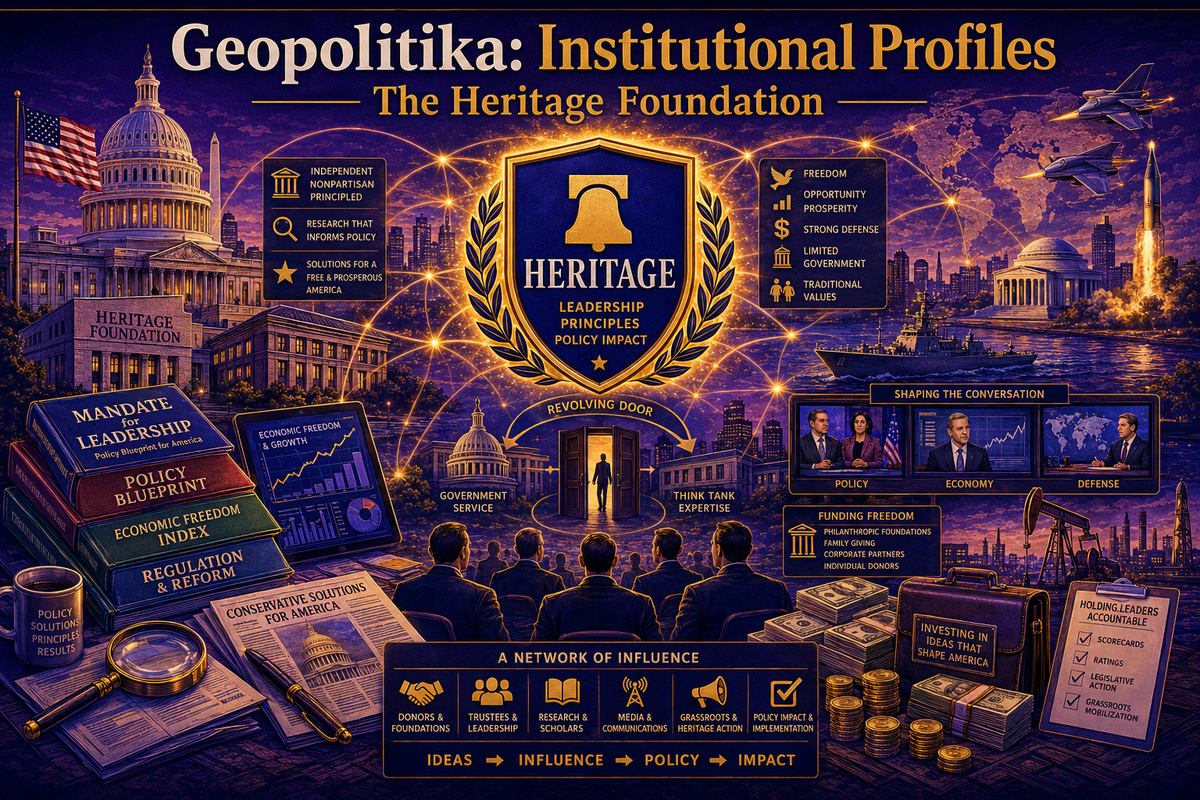
This institutional profile forms a part of the Geopolitika project to map Anglo-American power structures by examining their founding mythologies, leadership, linkages to power, public face, the nature of their outputs and who these are directed towards. These profiles are primarily generated from materials provided on their own websites, which are then analysed using a structured institutional analysis framework—see methodology statement at foot of article.
—
Executive Summary
The Heritage Foundation operates as a highly refined institutional system. Over five decades, it has built an architecture in which funders, trustees, researchers, and activists function with closely aligned incentives and worldviews. As a result, its research, messaging, policy recommendations, and mobilisation efforts consistently advance the priorities of the conservative movement and its supporters—not primarily through explicit direction, but through structural design.
“Every day, The Heritage Foundation is building an America where freedom, opportunity, prosperity, and civil society flourish.”
– Heritage mission statement
A forensic examination of its personnel networks, funding flows, output patterns, and operational loops reveals a more complex reality than the public image suggests. Heritage presents itself as a nonpartisan research institute dedicated to “building an America where freedom, opportunity, prosperity, and civil society flourish.” It claims to be “beholden to no outside party or interest.” These statements are not false, but they are incomplete.
What Heritage actually does is function as a conservative movement coordination hub—converting donor resources into sustained policy influence through an integrated system of research production, media amplification, elite personnel circulation, grassroots mobilisation, and legitimacy generation.
The institution runs on reinforcing feedback loops: funding enables high-volume research and communications; these outputs generate influence and media presence; influence attracts further funding and talent. Personnel move fluidly between Heritage, Republican administrations, and conservative organisations. The Heritage Action apparatus mobilises grassroots pressure on legislators. The Young Leaders Program socialises new generations into the institution’s frames. Simultaneously, Heritage acts as a homeostatic regulator of conservative policy discourse—maintaining narrative consistency across decades, correcting perceived deviations, and intensifying advocacy when needed.
Heritage produces genuine research and employs experts who are often sincerely committed to their principles. This is the central productive tension: it is simultaneously a legitimate research organisation and a sophisticated instrument of conservative movement infrastructure. Both characterisations are true and necessary.
This article examines the emergent behaviour of the system—how its architecture shapes what it produces, how funding and personnel flows create alignment, and how the institution maintains legitimacy while advancing particular interests.
The Machine Behind It: History, Purpose, and Structure
Founded in 1973 by Ed Feulner and Paul Weyrich, Heritage emerged when the conservative movement was still marginal. The 1980 Reagan election provided its first major validation. The Mandate for Leadership—a comprehensive policy blueprint—established a repeatable template: produce actionable, transition-ready research timed to political opportunities and measure success by implementation rates.
The institution defines its purpose as advancing freedom, opportunity, prosperity, and civil society through conservative policies grounded in free enterprise, limited government, traditional values, and strong national defence. It operates as a 501(c)(3) nonprofit, accepts no government funding, and maintains a sister 501(c)(4) organisation (Heritage Action) for more direct advocacy.
Formally, Heritage is governed by a Board of Trustees and organised around public policy research, educational/communications programs, and media/government outreach. In practice, it sits at the intersection of four interlocking systems:
- A production system generating indexes, scorecards, and reports
- A funding system with notable board-level integration between major donors and governance
- A personnel circulation system linking it to Republican administrations
- A legitimacy system that balances claims of principled independence with partisan impact.
A key constraint shapes all analysis of Heritage: the near-total absence of Layer-4 voices. The populations most directly affected by its policy positions—immigrants facing stricter enforcement, transgender individuals, abortion seekers, public school families, and others—do not appear in its outputs. “The American people” remains a rhetorical abstraction rather than an empirical constituency. This silence is structural, not accidental.
The Architecture: Personnel and Funding
Heritage operates through two interlocking structures: the people who govern and staff it, and the money that sustains it. Both reveal patterns that complicate the institution's self-presentation as an independent research organisation.
Personnel: The Revolving Door and the Board Network
The Heritage Foundation’s Board of Trustees serves as a key bridge connecting the institution to major conservative foundations, corporate interests, family philanthropies, and movement organisations. A defining feature of its governance is the direct integration of major funders and aligned networks onto the board itself.
- Michael W. Gleba, Vice Chairman (Trustee since 2016), is Chairman, CEO, and Treasurer of the Sarah Scaife Foundation, a major longstanding funder of conservative think tanks, legal advocacy groups, and media organisations.
- Rebekah Mercer (Trustee since 2014) is Director of the Mercer Family Foundation. The Mercer family has supported a range of conservative media, data, and movement infrastructure projects and is also a significant donor to Heritage Action, Heritage’s 501(c)(4) advocacy arm.
- Barb Van Andel-Gaby, Chairman of the board (Trustee since 1996), is a director of Alticor, the parent company of Amway. She has deep ties to home-schooling legal advocacy networks and belongs to the Van Andel family, whose philanthropic activities overlap with the DeVos family. Betsy DeVos served as U.S. Secretary of Education (2017–2021) and, together with Dick DeVos, has been a leading advocate for school choice through the Dick and Betsy DeVos Family Foundation.
Additional board members further illustrate the networked character:
- Larry P. Arnn, PhD (Trustee since 2002), President of Hillsdale College, a prominent conservative liberal arts institution that accepts no federal funding. Hillsdale’s Washington, D.C. campus is located directly across the street from Heritage.
- John Coleman, (Trustee since 2022), Co-CEO of Sovereign's Capital, with prior senior leadership roles at Invesco. His background connects Heritage to private equity and asset management.
- Ryan Haggerty (Trustee since 2017), owner of RHR Consulting, active in Texas real estate, ranching, and oil and gas—sectors that align with Heritage’s energy and deregulation priorities. He previously worked in networks connected to the Texas Public Policy Foundation, where Heritage President Kevin Roberts once served as CEO.
- Nersi Nazari, PhD (Trustee since 2006),Chairman and CEO of Vital Connect, a Silicon Valley healthcare technology firm. He has executive and technical experience at Marvell Semiconductor and Seagate Technology, linking the board to the technology sector.
This board composition creates a dense overlap between funders, corporate leaders, and movement institutions. Foundation executives who control significant grant flows sit on the board that governs the recipient organisation. Corporate and family interests with stakes in deregulation, education reform, energy policy, and technology sit alongside ideological and academic leaders. While these alignments are often rooted in shared worldview rather than direct instruction, the structure makes Heritage’s longstanding claim of being “beholden to no outside party or interest” difficult to reconcile with observable governance realities. It does not prove donor control, but it substantially complicates assertions of complete independence.
This networked board, combined with the well-documented revolving door between Heritage and Republican administrations, reinforces alignment through both formal governance and personnel circulation.
The revolving door with government is even more direct, for instance:
- Victoria Coates, now a Heritage vice president, served as Deputy National Security Advisor in the Trump White House. She held a Top Secret clearance and was involved in some of the most sensitive foreign policy deliberations of the administration. Her move from the White House to Heritage is a classic instance of the revolving door—but in reverse of the usual pattern. Instead of moving from a think tank into government, she moved from government into the think tank, bringing insider knowledge and administration relationships with her.
- Lindsey Burke moved in the opposite direction. As Heritage's Director of the Center for Education Policy, she authored the organisation's blueprint for dismantling the Department of Education. In the Trump administration, she became Deputy Chief of Staff for Policy and Programs at that same department—positioned to implement the recommendations she had written. Her confirmation hearing drew on Heritage's research. Her policy agenda reflected Heritage's priorities. The pipeline from research to implementation could not be more direct.
- Roger Severino, Heritage's Vice President of Domestic Policy, served in the Trump administration's Department of Health and Human Services.
- E.J. Antoni, a Heritage senior fellow, was nominated by the Trump administration for Commissioner of Labor Statistics—a position that would put a Heritage economist in charge of the government's economic data.
The Young Leaders Program institutionalises the pipeline
Heritage's Young Leaders Program places more than 50 paid interns per semester in Washington, D.C. The program's alumni include Senator Josh Hawley, Senator Tom Cotton, and Judge Naomi Rao of the D.C. Circuit Court of Appeals. The program explicitly positions itself as talent identification and socialisation: interns attend “First Principles” lectures on conservative political thought, receive policy briefings from Heritage experts, and are connected to job placement networks.
The evidence is clear that this circulation is not evidence of corruption; it is evidence of alignment. Personnel who share ideological commitments carry Heritage frames into government and government experience back to Heritage. The Young Leaders Program ensures that successive generations of conservative talent are socialised into Heritage's worldview before they enter government service. Alignment emerges from shared worldview and shared institutional pathways, not from formal capture.
Network Centrality: Heritage as a Hub
Heritage functions as a central node within a broader conservative ecosystem. Its Board of Trustees and personnel networks create a spanning structure that connects major philanthropic foundations, corporate interests, academic and intellectual institutions, and movement organisations to Republican government pipelines and media amplification channels.
Through its board alone, Heritage links directly to longstanding conservative funders—including major foundations such as Scaife and Mercer, as well as support from the broader Koch philanthropic network—influential think tanks and academic centres (including institutions focused on constitutionalism and free-market principles), media research and watchdog groups, and corporate networks in manufacturing, private equity, energy, real estate, and technology. These connections are reinforced by the revolving door: senior staff and fellows regularly move between Heritage, Republican administrations, state-level policy institutes, and allied organisations.
The result is a dense, self-reinforcing web. Funding flows support research and operations. Research and policy products generate influence and legitimacy. Personnel circulation carries frames and priorities into government and back again. Grassroots and media arms amplify messaging and apply pressure on legislators. Leadership development programs ensure ideological continuity across generations.
This architecture allows Heritage to serve as a coordinating hub rather than a standalone think tank. It aggregates resources, standardises conservative policy frameworks (through indexes, scorecards, and blueprints), times outputs to political opportunities, and helps translate movement ideology into governing agendas. Alignment across the network stems primarily from shared worldview and overlapping incentives rather than central direction.
This is not evidence of conspiracy. It is evidence of sophisticated, durable movement infrastructure. Heritage’s position at the centre of this network helps explain both its outsized influence and its resilience across changing political cycles.
Funding: Revenue, Growth, Sources, and Transparency Limits
The Heritage Foundation’s funding is partially transparent through aggregate disclosures in its filings, but significant gaps remain around donor concentration and actual influence pathways.
Revenue and Growth
In fiscal year 2024, Heritage’s 990 Form reported total revenue of $133.9 million, up 32.6% from $101.0 million in 2023. This continues a decade-long upward trend: revenue stood at approximately $91.3 million in 2015 (unrestricted). Net assets ended 2024 at $335.7 million (slightly down from $347.7 million the prior year) after expenses exceeded revenue by $8.3 million.
Contributions and grants dominate at $106.0 million (79.2%), followed by investment income of $26.9 million (20.1%). Program service revenue and other sources are negligible.
Contribution Sources
Of the $106 million in contributions:
- 76% individuals ($80.6 million)
- 5% individual restricted ($5.3 million)
- 14% foundations ($14.8 million)
- 2% corporations ($2.1 million)
- 3% other
Combined individual giving accounts for roughly 81% of contributions. Foundations provide a meaningful but secondary 14%. Corporate support is minimal on paper.
The “Broad Base” Claim
Heritage frequently cites its claimed 500,000 members as proof of independence, stating this broad base prevents any donor or group from exerting control. The mathematics are questionable. If 500,000 members supplied the $80–86 million in individual contributions, the average would be roughly $171 per member. In practice, this figure likely includes many non-donating email supporters, event attendees, and list subscribers. The actual number of meaningful financial contributors could be far smaller, potentially concentrated among higher-net-worth individuals. Without itemised donor lists, the true distribution cannot be verified. In these terms, the “broad base” claim functions more as rhetorical insulation than empirical evidence.
Investment Income and Endowment
Investment returns have grown substantially, rising from near break-even in 2015 to $26.9 million in 2024. The organisation’s investment portfolio stood at $244.6 million, including public securities, private equity, hedge funds, and alternatives. A growing endowment (both board-designated and donor-restricted) provides an increasingly important buffer, reducing short-term dependence on annual fundraising.
Board-Level Integration
The most structurally significant feature of Heritage’s funding architecture is not the aggregate percentages, but the depth of governance integration. As documented above in the Personnel and Network Centrality sections, several trustees simultaneously represent major philanthropic foundations and corporate interests. These individuals sit on both sides of the funder-funded relationship.
Board Vice Chairman Michael W. Gleba leads the Sarah Scaife Foundation, Trustee Rebekah Mercer directs the Mercer Family Foundation, and Board Chairman Barb Van Andel-Gaby serves as a director of Alticor (parent of Amway), among others. This structure creates clear pathways for influence and alignment, as board members participate in setting strategy and approving budgets. While shared ideology is the primary driver, the arrangement makes Heritage’s claim of being “beholden to no outside party or interest” functionally difficult to sustain at face value.
Expenses
In fiscal year 2024, The Heritage Foundation reported total expenses of $142.2 million.
The functional breakdown was:
- Program services: $117.3 million (82.5%)
- Fundraising: $20.2 million (14.2%)
- Management and general: $4.6 million (3.3%)
Within program services, spending is split roughly evenly between public policy research (~$48.9 million) and educational programs and communications (~$47.2 million), with media, government relations, and outreach adding another $18.3 million.
Salaries, other compensation, and employee benefits totaled $53.1 million, making up a substantial share of overall spending. This reflects Heritage’s hybrid model: it invests heavily in both policy expertise (research) and influence operations (communications, media, and advocacy).
The high proportion of resources devoted to program services and communications—rather than pure research—underscores that Heritage functions as much as a policy influence and messaging organisation as it does a traditional think tank.
No Government Funding
Heritage accepts no federal, state, local, or foreign government money. This insulates it from public oversight but ties accountability exclusively to private donors.
Limits of Transparency
Public filings reveal totals and broad categories but not donor concentration, specific grant purposes, or the precise relationship between board-level funders and outputs. Claims about funding influence are therefore capped at structural patterns and alignment rather than proven direct causation. The available evidence shows a well-resourced, growing institution with deep integration between major conservative funders and governance—but cannot fully map power flows inside the black box.
The Outputs: What Heritage Produces
In 2024 alone, Heritage produced 66 policy reports, placed 870 op-eds, generated 1,983 television appearances and 2,325 radio hits, hosted 56 public events, and ran multiple podcasts. Its social media following reached 3.5 million across platforms.Flagship products such as the Index of U.S. Military Strength, the Index of Economic Freedom, the Election Integrity Scorecard, and the Education Freedom Report Card have become influential reference tools in policy debates.
The evidence is clear that the output pattern is not balanced between research and advocacy. Media appearances, op-eds, and testimony far outweigh traditional research outputs. Heritage's primary function is not original research production but research-mediated influence—converting expert labour into political impact through strategic communications.
The range of issues Heritage addresses is sweeping. Its policy domains include border security, China, education, election integrity, energy and climate, health care reform, marriage and family, religious liberty, taxes, welfare, gun rights, crime and justice, government regulation, budget and spending, debt, trade, international economies, markets and finance, cybersecurity, defense, the Constitution, American history, conservatism, progressivism, Europe, the Middle East, global politics, antisemitism, Big Tech, gender, life, and parental rights. This breadth is not accidental. Heritage positions itself as the conservative movement's one-stop policy shop—capable of producing authoritative output on virtually any contested issue.
This output capacity is reinforced by a “speak with one voice” policy that prohibits Heritage employees from publicly advocating contradictory positions. The institution claims robust internal debate while requiring unified public output. Without access to internal deliberation, the functional effect is enforced public consensus regardless of private disagreement. Alternative voices are supposedly provided through joining with “partner organisations that represent a wide range of perspectives.” This distinguishes Heritage from peer institutions like the American Enterprise Institute or the Cato Institute, where scholars publicly disagree.
The institutional voice is carefully managed. President Kevin Roberts appears as author on multiple commentary pieces, positioning himself as public intellectual and movement spokesperson. This personalisation of authority may increase persuasive power, but it also increases vulnerability to leadership succession.
The Grassroots Apparatus: Heritage Action and the Sentinel Program
Heritage's influence apparatus extends beyond research and media into direct grassroots mobilisation. Heritage Action for America, the Foundation's 501(c)(4) sister organisation, functions as the advocacy and implementation arm of the Heritage enterprise.
The Sentinel program is described as “a grassroots army of committed conservative activists who are the front line against the liberal agenda.” Sentinels receive weekly strategy calls from Capitol Hill, activist training (“from how to be effective on X to how to write a letter to Congress”), activist resources including “process memos, policy briefs, and issue specific toolkits with sample tweets, talking points, call notes, and graphics,” exclusive Capitol Hill updates, and access to an online community where they receive “real time policy analysis.”
The recruitment process collects personal information including phone numbers for “recurring autodialed campaign & donation messages.” The Activism Centre allows users to find their congressional representatives and engage in current campaigns with titles such as “Urge Congress To Pass The Save America Act,” “End The Marxist Occupation Of Our Streets,” “Stop Insider Trading In Congress,” and “Hold The Gender Industrial Complex Accountable.”
It is evidently clear that this structure completes a loop that pure research institutes lack. Heritage Foundation produces the research and policy recommendations. Heritage Action translates them into legislative pressure and grassroots mobilisation. Sentinels apply constituent pressure to members of Congress. Lawmakers, aware of the Heritage Action scorecard—which rates House Republicans at 84 percent and Democrats at 1 percent—have a clear incentive to align with Heritage positions.
There is nothing illegal about this, it is merely institutional design. The 501(c)(3) research organisation provides legitimacy and tax-deductible donations. The 501(c)(4) advocacy organisation provides political pressure. The separation is legal, not functional. The same institution benefits from both modes of operation.
The System at Work: Synchronisation and Control
Heritage operates at multiple temporal scales simultaneously.
- Rapid response – The evidence shows that experts produce commentary synchronised with Trump administration announcements within days. Heritage positions itself as amplifier and legitimator of administration policies—from border enforcement to tax legislation.
- Strategic timing – Reports and scorecards are released ahead of election cycles and legislative debates. The Election Integrity Scorecard ramps up before voting. Family policy reports are timed to the launch of the Four Cornerstones framework.
- Anticipatory control – Project 2025 prepared policy recommendations and personnel lists for a potential Trump administration before the 2024 election outcome was certain. The evidence suggests this is not reactive advocacy. It is feed-forward control—anticipating political opportunities and positioning Heritage to influence outcomes before they crystallise.
- Grassroots amplification – When Heritage Action identifies a legislative priority, Sentinels receive toolkits and action alerts within days. The Activism Centre presents current campaigns with “TAKE ACTION” buttons, converting research priorities into constituent pressure with minimal delay.
The synchronisation pattern suggests a cybernetic control loop: Heritage monitors the political environment, produces research aligned with identified opportunities, distributes through media channels and grassroots networks, influences policy and public opinion, observes outcomes, and adjusts strategy. This is not central planning; it is emergent coordination through shared incentives, personnel circulation, institutional culture, and now a dedicated activist army.
Narrative consistency across five decades is remarkable. “America in decline” frames persist, with threat sources updated over time: from liberalism in the 1970s to socialism in the 2020s, from the Soviet Union to China. “Heritage as solution provider” remains structurally identical from the first Mandate for Leadership (1981) to Project 2025. The evidence suggests that this stability indicates that Heritage's primary function is not policy innovation—which would require frame evolution—but homeostatic regulation: maintaining policy discourse within conservative bounds by continuously producing the same narrative structure regardless of changing conditions.
The System Defended: Benefits, Costs, and Member Heterogeneity
What does the Heritage Foundation actually protect?
Across decades of outputs, the institution consistently advances a specific political-economic and cultural order: free-market capitalism with limited regulation, traditional social values (including strong opposition to abortion, transgender rights, DEI initiatives, and critical race theory), robust national defense and American global primacy, constitutional originalism, and election integrity centred on strict voter ID and citizenship requirements.
This package produces a complex matrix of benefits and costs:
- From the perspective of its supporters, it delivers perceived gains in job protection and cultural cohesion through immigration restriction, protection of unborn life and traditional family structures, stronger border security and law enforcement, economic growth through deregulation and tax cuts, and national security through peace-through-strength policies.
- From alternative standpoints, the same policies carry significant costs: family separations and restricted asylum for immigrants, denial of reproductive healthcare and gender-affirming care, potential disenfranchisement of certain voters, increased inequality and reduced social protections, and opportunity costs from high defense spending.
Importantly, winners and losers are not fixed, opposing populations. Heritage’s claimed 500,000 “members” are heterogeneous—libertarian donors, religious conservatives, fiscal hawks, nationalists, and single-issue activists. The same individual can be a winner in one domain and a loser in another. A defense industry employee may benefit from increased military spending but oppose tariffs that raise costs. A social conservative may support abortion restrictions but disagree with aspects of foreign policy or fiscal approach. A small-dollar donor may welcome school choice while working in a public school facing potential funding pressure.
Heritage’s broad policy package functions as a coalition product. Few members likely agree with every position, but enough support enough of it—especially when framed against a salient progressive opponent—to sustain the coalition. What often unites them is shared conservative identity and opposition to “the Left” more than perfect policy consensus.
A striking structural feature runs through all of this: the near-total absence of direct testimony from affected populations. Heritage’s materials contain virtually no voices from immigrants, transgender individuals, abortion seekers, public school families, or its own members reflecting on internal trade-offs and contradictions. “The American people” remains a rhetorical abstraction rather than a collection of concrete, often conflicting lived experiences. This Layer-4 representational gap is not accidental; it is structural.
Several slow-moving variables shape the long-term stability of this system:
- The expansion of conservative movement infrastructure, turning Heritage into a multi-function hub of research, media, training, and grassroots mobilisation
- The metricisation of authority through indexes, scorecards, and victory tallies
- Ongoing boundary management between its research identity and activist arms
- Tensions with the Republican Party’s populist shift
- Challenges around fiscal sustainability and public trust in institutions
Heritage thus operates in productive tension. It functions as a legitimate civil-society institution that identifies genuine problems—particularly weaknesses in America’s defense industrial base—while simultaneously serving as a powerful coordinator and legitimiser of a particular ideological and economic coalition. Both characterisations are true. Neither is sufficient alone.
The Cracks: Institutional and Membership Contradictions
The Heritage Foundation is structured around several productive contradictions that enable it to maintain influence and coherence. These are not failures or hypocrisies, but functional features that allow the institution to operate effectively across multiple roles.
Institutional Contradictions
- Nonpartisan research vs. partisan advocacy: Heritage claims nonpartisan research status while its sister organisation, Heritage Action, runs partisan scorecards and operates the Sentinel grassroots program. The contradiction is managed through formal separation: the 501(c)(3) provides legitimacy and tax advantages; the 501(c)(4) delivers political pressure.
- Independence vs. donor board integration: Heritage claims to be “beholden to no outside party or interest,” yet major funders sit on its board. Board Vice Chairman Michael W. Gleba leads the Sarah Scaife Foundation, Trustee Rebekah Mercer directs the Mercer Family Foundation, and other trustees bring corporate and philanthropic ties. This integration is managed by narrowing the definition of “outside party.”
- Internal debate vs. enforced consensus: The institution claims robust internal debate while enforcing a “speak with one voice” policy. Public unity is required regardless of private disagreement within the institution’s walls.
- Limited government vs. preferred state expansion: Heritage advocates limited government in principle but strongly supports large-scale defense spending, border enforcement infrastructure, mass surveillance capabilities, and robust policing — all requiring significant state capacity. The operative distinction is not government size, but legitimacy: regulation of markets is illegitimate; enforcement of borders, traditional values, and military power is embraced.
- Broad base vs. plausible donor concentration: Heritage highlights its 500,000 members as proof of independence, yet the mathematics and lack of itemisation suggest a more concentrated donor base. The “broad base” claim remains functionally unfalsifiable with public data.
Membership Contradictions
These institutional tensions are mirrored within the membership itself. Heritage’s supporters are heterogeneous—libertarians, religious conservatives, fiscal hawks, nationalists, and single-issue activists. Many hold internally conflicting views:
- Libertarian members may support deregulation and tax cuts but oppose social conservatism or immigration restrictions
- Fiscal conservatives may favor entitlement reform but resist deficit-increasing defense spending
- Nationalists may support tariffs and border enforcement but clash with free-trade positions
- Social conservatives may prioritise traditional values while being uncomfortable with certain corporate-friendly or foreign policy stances.
The institution manages these internal member contradictions through abstract rhetoric (“freedom,” “opportunity,” “prosperity”) and the “speak with one voice” policy, which barrs public facing outputs from deviating from mandated positions. Many members undoubtedly resolve tensions through selective attention—strongly backing the issues closest to their priorities while rationalising or ignoring disagreements on others. Shared conservative identity and opposition to “the Left” serve as the primary glue holding this diverse coalition together.
These dual layers of contradictions—institutional and membership—are not weaknesses. They are the system’s operating system. They allow Heritage to function simultaneously as expert research institute, populist movement hub, donor-aligned network, and governing-ready policy shop. The institution’s strength lies in its ability to contain and channel these tensions rather than resolve them.
The Trump Factor and MAGA Tensions
Heritage’s relationship with the Trump movement reveals important fault lines. On many fronts—judicial appointments, tax cuts, deregulation, border security, energy policy, and opposition to “woke” cultural initiatives—alignment has been strong and mutually reinforcing. Heritage provided intellectual infrastructure and personnel for key Trump administration priorities, and Project 2025 represented a comprehensive governing blueprint closely associated with Trump’s orbit.
However, the relationship also exposes contradictions. Heritage has offered unqualified support for robust military action against Iran (including the 2025–2026 strikes and associated operations), consistent with its long-standing hawkish foreign policy and emphasis on American primacy and deterrence. This posture sits in tension with significant elements of the MAGA base that favor restraint on new foreign wars and “America First” skepticism of extended overseas commitments.
Similar tensions appear on trade (where Heritage’s traditional free-trade preferences clash with Trump-era protectionism), deficit spending, and the broader shift toward populist nationalism. Heritage remains more aligned with traditional fusionist conservatism—strong defense, free markets, and limited government—than with the populist, tariff-friendly, and sometimes isolationist currents within MAGA.
These tensions do not indicate betrayal so much as the strain of managing a coalition between institutional conservatism and a more insurgent populist movement. Heritage has largely chosen alignment on high-priority cultural and domestic issues while attempting to moderate or resist on trade and fiscal matters. This selective adaptation reveals the institution’s dual role: both shaping the movement and being shaped by it.
What the Heritage Foundation Actually Does
The stated purpose of the Heritage Foundation is to build an America where freedom, opportunity, prosperity, and civil society flourish through conservative public policies. This is what it says.
What it does is more specific.
The evidence shows that across its institutional architecture, annual self-presentation, specialised policy outputs, and grassroots mobilisation apparatus:
“Heritage converts conservative ideological commitments and threat diagnoses into authoritative, metricised, portable, donor-sustained, governing-ready policy knowledge—and then applies constituent pressure to ensure its adoption.”
The institution houses and reproduces capacity: staff, research programs, public platforms, personnel pipelines, funding infrastructure, and advocacy-adjacent boundaries. The annual report translates activity into legitimacy: narrates victories, names threats, reassures supporters, and presents Heritage as champion of the American people. Specialist outputs like the Military Strength Index translate mission domains into expert-coded policy prescriptions: strong national defence becomes scored architecture of military readiness, threat ranking, China prioritisation, and peace-through-strength doctrine. Heritage Action and the Sentinel program translate policy priorities into legislative pressure, completing the loop from research to implementation.
The network's primary cybernetic function is layered legitimacy. Each layer reinforces the next. Research outputs legitimate policy claims. Policy claims legitimate annual victory narration. Victory narration legitimates member and donor support. Support sustains the institution that produces further outputs. Grassroots mobilisation provides the implementation pressure that research alone cannot achieve.
This is not conspiracy. It is institutional design. The evidence suggests that no single person, or even committee of people, may have decided that Heritage would function this way. What we see today has emerged from five decades of reinforcing feedback: funding enables research, research produces influence, influence attracts funding. Personnel circulation aligns Heritage and government. Media amplification increases credibility. Grassroots mobilisation provides constituent pressure. The system produces its own conditions of possibility.
Heritage's most significant achievement is its own reproduction. After fifty years, it has constructed an architecture that reliably produces the same outputs, the same frames, the same policy recommendations, the same grassroots pressure, regardless of changing political conditions. The 2025 Annual Report is structurally identical to reports from previous years, with updated victories and metrics. The system's primary function is self-preservation.
Conclusion
The Heritage Foundation has built more than a think tank. It has constructed a durable institutional template—research production, media amplification, grassroots mobilisation, personnel pipelines, and a 501(c)(4) advocacy arm—that has been widely replicated across the conservative movement. Project 2025 marked a significant evolution: Heritage positioned itself not merely as an advisor but as a pre-election transition hub, supplying policy blueprints and personnel lists before the outcome was known.
This model is highly effective at coordination. The Young Leaders Program feeds talent into government, the revolving door moves frames and people in both directions, the media apparatus shapes narratives, and the Sentinel program converts policy priorities into constituent pressure on lawmakers. The result is a self-reinforcing system capable of operating in both governing and opposition modes.
Yet the system rests on several fragile foundations. It claims to speak for “the American people” while drawing support from a self-selected, ideologically filtered base whose members are heterogeneous in their actual priorities. The persistent absence of direct testimony from affected populations—whether immigrants, transgender individuals, abortion seekers, or even its own members wrestling with internal trade-offs—is structural, not accidental. This Layer-4 gap allows the institution to project unified representation while sidestepping the real costs and contradictions its agenda generates.
The most immediate vulnerabilities are succession and political dependency. Shaped by strong personalities and a “speak with one voice” culture, Heritage could face disruption during leadership transitions. Its influence also depends heavily on Republican control of government; prolonged time in opposition would test the resilience of its personnel pipelines and governing-ready posture.
Longer-term pressures are already visible. Shifting public expectations around transparency, evolving Republican Party dynamics, and unresolved fiscal tensions all challenge the current model. Heritage’s response has been expansion—into new domains and new threats—suggesting it will continue its role as a homeostatic regulator of conservative discourse for the foreseeable future.
The Heritage Foundation is not a conspiracy. It is a sophisticated, adaptive policy system that has learned to reproduce itself across five decades of political change. Its members and activists believe they are defending American values. Its experts believe they are producing rigorous analysis. These beliefs are sincere. They are also the operating ideology of a machine designed to convert that sincerity into sustained influence.
Whether this system can evolve beyond its current contradictions, or whether it will simply find new threats to define itself against, remains one of the more consequential open questions in American political life.
—
Published via Mindwars Ghosted.
Geopolitika: Tracing the architecture of power before it becomes the spectacle of history.
Methodology Note: This analysis draws on publicly available materials from the Heritage Foundation, accessed via the institution's website and regulatory filings in May 2026. The primary corpus includes: the Heritage Foundation website (approximately 600 pages, covering institutional history from 1973 to present); annual reports from 2015 to 2025 with audited financial statements; leadership and Board of Trustees biographies; personnel directories of senior management, fellows, and policy experts; published outputs (reports, issue briefs, op-eds, testimony, events, podcasts, media tracking, and social media metrics); the 2025 Annual Report and 2024 Financial Report examined in detail; IRS Form 990 filings from 2015 to 2024; Heritage Action for America materials (Sentinel program, Activism Centre, legislative scorecard, and issue campaigns); and organisational governance documents including the statement of mission, research independence policies, and the “speak with one voice” policy. The analysis was conducted using a structured institutional analysis framework examining self-presentation, personnel networks, funding architecture, output patterns, synchronisation, contradictions, missing materials, and de facto purpose. All sourced material is publicly accessible. Base analytic outputs are available on request. For methodological details—including Transparency Score definitions, typology classifications, and confidence calibration—see the Geopolitika Series Methodological Statement.
Mindwars Ghosted is an independent platform dedicated to exposing elite coordination and narrative engineering behind modern society. The site has free access and is committed to uncompromising free speech, offering deep dives into the mechanisms of control. Contributions are welcome to help cover the costs of maintaining this unconstrained space for truth and open debate.
If you like and value this work, please Buy Me a Coffee.