Mindwars: Demos – Securing the Future of Meaning Itself
How a UK think tank became the domestic node in a transnational campaign to weaponise narrative under the banner of 'trust'.
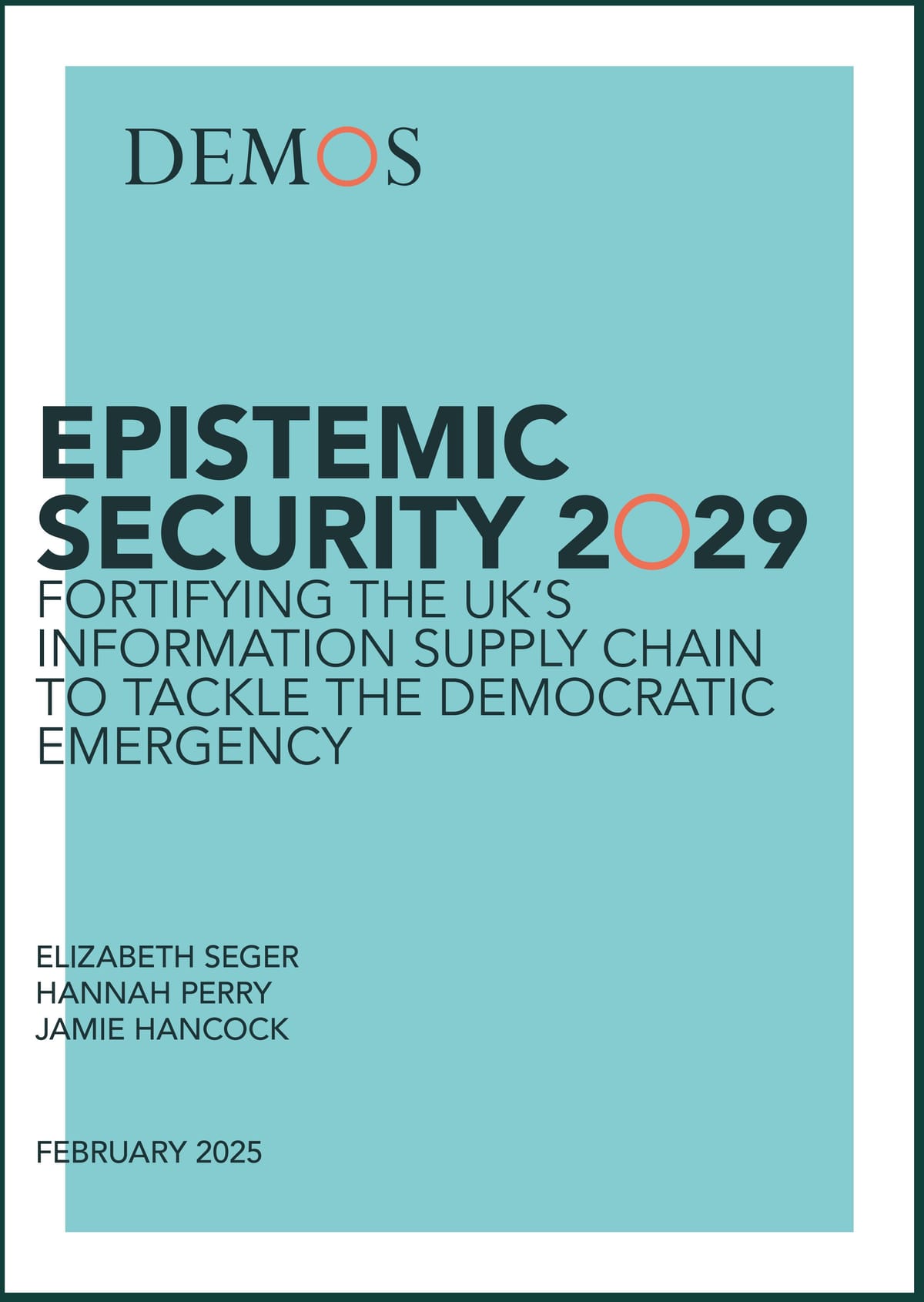
A segment on UKColumn News that aired June 23, 2025 brought the Demos Epistemic Security 2029 blueprint into focus. Presenter Ben Rubin flagged it as the latest institutional volley in the long war against “disinformation,” part of a policy crescendo that’s been building since 2020. At first glance, the Demos report reads like a familiar civic warning: democracy under threat, trust in decline, action required. But, as we will see, it fits a deeper pattern.
This Mindwars installment follows Mindwars: Hornsey et al.–Constructing Conspiracy Theorists and Mindwars: Down the Rabbit Hole to Conspiracyland, extending the investigation from psychological weaponisation to institutional narrative laundering. Here, we turn from the lab coat to the policy desk—from behavioural framing to symbolic infrastructure.
The thesis is simple: Demos did not create this language. Their Epistemic Security frame inherits its structure from upstream actors who refined the playbook of motif control, rhetorical sealing, and narrative saturation. Demos is the echo, not the origin.
What follows is a structural map of that echo: the motifs they deploy, the timing they synchronise with, the actors they align around, and the drift signals already embedded in their framework. As always in Mindwars—also with Geopolitika—the question isn’t who said it. It’s who they’re aligned with—and what they’re preparing us to believe next.
This article takes that Demos report as its point of entry, not its endpoint. It treats the document not as a source of epistemic strategy, but as a relay node—a messenger for a network of upstream actors whose ideas it amplifies. Beneath its accessible language and civic tone lies a scaffolding of inherited motifs, echo phrases, and donor-friendly framing.
The aim here is to examine the Demos document’s symbolic DNA. To trace where its key concepts came from—notably the OECD, RESIST initiative, and the disinformation playbooks of the EU’s East Stratcom—how they were repackaged, and what structural logic they serve. Along the way, track the convergence of think tanks, funders, and narrative cycles that coordinate around these motifs.
This is not about what Demos says. It’s about what flows through them—and what happens when patterns repeat too often to be accidental.
“If Epistemic Security is the mission—who controls the map?”
Who is Demos and Where Do They Fit?
Demos brands itself as “the UK’s leading cross-party think tank,” boasting a 30-year legacy of influence across Labour, Conservative, and coalition governments. Its mission—”to put people at the heart of policy-making” and to build “a more collaborative democracy”—projects a civic ethos. But peel back this inclusive veneer and a more strategic architecture emerges: motif-stacked framing, donor-aligned outputs, and narrative scaffolding tuned to upstream power logics.
Institutional Origins and Trajectory
Founded in 1993 by Martin Jacques (former Marxism Today editor) and Geoff Mulgan, Demos was born from a perceived crisis in political legitimacy and civic disengagement. Styled as a “network of networks,” its aim was to blend expertise with influence—less a think tank than an opinion architecture studio for elite coordination.
From inception, Demos was never ideologically neutral. It operated as a translation device—interfacing between strategic governance initiatives and public-facing narrative repackaging. Mulgan’s move into Downing Street in 1997 marked Demos’ integration into the New Labour machinery, where it helped script behavioural and discourse norms under a technocratic-progressive rubric. Under Tom Bentley (1998–2006), Demos completed its pivot from idea generator to “public interest consultancy,” fusing message design with behavioural nudging.
Personnel migrations confirm its relay role: from Kitty Ussher (former Treasury minister) to Polly Mackenzie (Nick Clegg adviser), to Claudia Wood (Blair Strategy Unit alumna), Demos’ leadership has always rotated through government orbitals. Its Centre for the Analysis of Social Media (CASM), launched in 2012, pioneered online behavioural analytics and digital motif tracking, foreshadowing the epistemic governance techniques that now underpin content regulation and sentiment management frameworks.
Narrative Relay, Not Research Engine
Demos’ current operations align less with independent research and more with what could be termed a narrative relay infrastructure. It does not invent motifs—it inherits and adapts them. Core concepts like “resilience,” “trust in institutions,” and “information hygiene” arrive pre-coded from supranational nodes like the OECD, EUvsDisinfo, and RESIST-2. Demos’ function is to localise and domesticate them into UK policy templates—embedding transnational scripts within civic-facing language.
In this light, the Epistemic Security document is presented as a democratic safeguard, it channels urgency—populist backlash, social media chaos, collapsing trust—into a pre-emptive logic of institutional control. Pitched as a “whole-of-society” defence of truth, it calls for expanded regulation, anticipatory censorship, and infrastructural reinforcement of narrative legitimacy. But structurally, it is not a grassroots defence plan—it is a discursive control grid dressed in participatory language.
The same logic powers Demos’ UK Inheritance Tax brief entitled Plugging the black hole: Reforming inheritance tax to unlock revenue and build public support. Here, “public input” is simulated through controlled focus groups. The output—predetermined policy recommendations—is sold as crowd-sourced wisdom. This is a textbook constrained Delphi method: simulate consensus, constrain options, reframe fiscal extraction as democratic equity. Under the branding of “inclusive economy,” the briefing reclassifies farms and small to medium sized enterprises (SMEs) as latent fiscal assets—primed for “redistributive” intervention.
Proxy Node, Pattern Launderer
Demos operates as what can be termed a proxy camouflage node: an institution framed as civic but structurally embedded in donor-intent and epistemic alignment pipelines. Its outputs—whether on digital trust, inheritance reform, or public discourse—serve less to inform than to coordinate. It reissues pre-scripted motifs, laundering them through local idioms to mask their supranational origin.
This is not plagiarism—it is pattern laundering. The Epistemic Security document draws heavily from OECD toolkits, EU StratCom playbooks, and EUvsDisinfo schema—yet disguises these genealogies. The goal is not transparency but diffusion. By emitting familiar motifs under a new banner, Demos extends motif reach while preserving institutional novelty.
From Blair to Clegg to Curtis, Demos has remained structurally consistent. It does not shape discourse from below. It harmonises narrative from above—translating elite epistemic strategies into domesticated policy rhetoric.
“What do you think: Is Demos a think tank—or a high-functioning node in a transatlantic legitimacy relay network?”
Framework: Dissecting “Epistemic Security”
The Demos Epistemic Security document presents itself as a blueprint for protecting democratic societies from the corrosive effects of disinformation. Framed as an urgent call for systemic resilience, the report outlines key strategic shifts: from reactive counter-misinformation efforts to a “whole-of-society” schema rooted in institutional trust, pre-emptive narrative inoculation, and information infrastructure control. Yet beneath this civic language lies a technocratic coordination protocol—one that centralises narrative governance while decentralising accountability.
Core Premises and Language Architecture
The text constructs its framework around four anchor motifs:
- Resilience – cast as the ability of societies to withstand and recover from epistemic threats, but operationally deployed to justify the hardening of institutional information channels.
- Trust – framed as essential for Epistemic Security, yet defined narrowly in terms of public confidence in existing state and expert authorities.
- Information Hygiene – presented as a civic duty akin to public health, reframing cognitive scepticism as potential contamination and sanitising dissent as risk.
- Democratic Integrity – used to anchor normative appeal, though its operational definition converges on narrative compliance and managed discourse.
Although these motifs are never explicitly defined in the document, their power lies not in clarity but in flexibility—engineered ambiguity that enables narrative deployment across multiple domains without the burden of precision. Each functions less as a neutral descriptor than as a scaffold for policy legitimation. Their role is not explanatory but disciplinary—encoding the logic of central coordination, institutional privilege, and gatekeeping authority.
Threat Framing and Supply Chain Anxiety
Central to the Demos argument is the framing of the UK’s information ecosystem as a degraded “supply chain” threatened by both infrastructural decay and hostile incursion. The metaphor of an “information supply chain” serves to industrialise discourse—recasting media, communication platforms, and citizen interaction as logistical vulnerabilities requiring top-down management.
The report paints a scene of epistemic emergency: collapsing local journalism, social media platforms unaccountably curating discourse, and a void “filled with speculation” risking a “spiral toward conspiracism.” Foreign and domestic actors are cast as coordinated aggressors, while the platforms themselves are framed as sovereign disruptors. Together, these perceived forces justify an expanded role for the state in narrative arbitration and content prioritisation.
The rhetorical layering is deliberate:
- “National renewal” is positioned as contingent on epistemic control.
- “Spiralling towards conspiracism” becomes the justification for pre-emptive moderation and surveillance.
- “Voids” in trusted information, left by the decline of local news, are to be filled not organically but via reinforced central messaging channels.
This is not merely threat identification—it is architecture building. The language shifts from diagnosis to prescription under the veil of civic urgency. The “supply chain” metaphor naturalises systemic intervention, turning decentralised discourse into a logistics problem. In doing so, it creates the conceptual scaffolding for regulatory expansion, particularly around content filtering, narrative gating, and platform accountability mechanisms.
Strategic Recommendations
Demos’ recommendations mirror upstream schemas such as RESIST and EuvsDisinfo (UK government, OECD, NATO, EU StratCom) not in name but in function. The pattern is of governance masked as protective governance. These interventions are not ideologically agnostic—they encode and enforce upstream narrative alignment. Each structurally aligns with existing higher level initiatives that advocate transnational governance over information ecosystems. But the mechanism of enforcement reveals the operational vector: regulation as narrative enforcement, not safety.
Demos calls for:
- Expansion of institutional capacity to manage information risks
- Deployment of proactive narrative interventions—”prebunking”
- Development of normative and legal architectures to enforce content regulation under the rubric of democratic protection.
- Strengthening epistemic “infrastructure”—digital, news, government, council—a term left loosely defined, but which encompasses both narrative legitimacy and technological enforcement mechanisms.
At the centre of this is the Online Safety Act (OSA), retooled by Demos as a compliance field for proactive speech governance. Proposed reforms would shift the burden of liability onto platforms—not for actual harm, but for the anticipation of disinformation risk. This recasts platforms as predictive enforcement nodes, responsible for sanitising emergent narratives before they circulate. The reference point is not free expression but broadcast compliance standards—without the editorial protections traditionally afforded to press institutions. By positioning platforms as anticipatory censors, the OSA reclassifies narrative circulation as a regulated utility, subject to state-licensed oversight
Further, Demos argues for the expansion of the OSA to cover “small but harmful” platforms—those with limited reach but high narrative volatility—like 4Chan and 8Kun. In practice, this framing also ensnares small dissident media outlets. Operated by UK government regulator, Ofcom, the OSA elevates the compliance burden for independent operators, inflating legal risk and operational overhead. Meanwhile, it advantages corporate platforms already embedded within government-aligned moderation protocols—outsourcing legitimacy enforcement to private contractors masquerading as neutral arbiters.
In parallel, ownership transparency proposals function less as anti-monopoly tools and more as narrative loyalty filters—framing foreign-owned platforms as latent security threats if their content flows do not conform to sanctioned information templates.
Authorial Profile: Architects of the Frame
The Epistemic Security 2029 report carries the imprint of three interlinked architects—Elizabeth Seger, Hannah Perry, and Jamie Hancock—whose varied backgrounds suggest a strategic triangulation more than a casual collaboration.
- Elizabeth Seger brings a lineage of conceptual abstraction and high-level governance logic. With prior work at the Centre for the Governance of AI and engagements with the OECD and the Biden Administration’s AI policy apparatus, her influence likely anchors the report’s normative scaffolding. Her academic base in philosophy of science (Cambridge) points to a deep literacy in systems-level epistemology—a potential source for the document’s more recursive and abstract formulations around “epistemic risk” and “institutional trust.”
- Hannah Perry presents a different vector: social behavior programming, rights discourse, and international development experience across the UK, East Africa, and Asia Pacific. Her credentials in information ecosystems and digital democracy experimentation (notably the Waves project) suggest she may have supplied the connective tissue between institutional abstractions and their behavioural-social realisation. Her language—“healthy ecosystems,” “inclusive information,” “community resilience”—is not diagnostic, but mobilising.
- Jamie Hancock operates as the signal analyst. With prior work in OSINT, border surveillance systems, and tech-labour research, Hancock’s presence implies technical oversight of implementation vectors—how to translate soft motifs into hard policy levers, audit infrastructures, or behavioural interventions. His training in political sociology and digital investigations supports a capacity for internal mapping of governance effects—albeit through a rights-focused lens.
The emergent alignment is worth noting: Seger theorises the domain; Perry frames it in civic legitimacy; Hancock secures the deployment mechanism. It is unclear whether this coordination was explicit or emergent—but the result is clear. Together, they produce a document that is not merely conceptual or participatory, but infrastructural.
This is the architecture of a hybrid narrative instrument—half-seminar, half-simulator. The expertise blends system logic, social engineering, and rights-legitimation into a single narrative apparatus. Whether by design or convergence, the report reflects more than a think tank memo—it models how institutional motifs become epistemic terrain.
Infrastructure Anchoring: The Perrin Vector
The report’s production was financially underwritten by William Perrin—a figure whose career traverses multiple influence vectors: from government digital policy advising under both Conservative and Labour administrations, to private sector consultancy for global tech and media entities, to trusteeship at the Indigo Trust and Carnegie UK. Perrin’s footprint aligns closely with the legislative arc of the Online Safety Act and broader narrative governance regimes. His funding position functions not simply as philanthropic support but as directional anchoring. The convergence of his institutional roles, particularly within Carnegie UK—a parallel driver of “trust infrastructure” discourse—reveals the deeper architecture: this report is not merely an academic output; it is a policy signal encoded through strategically credentialed networks.
This is not passive funding. It is narrative scaffolding by proxy—ensuring that Demos’ output slots seamlessly into a pre-coded policy lattice, simultaneously legitimising upstream agendas and obscuring their ideological origins.
Symbolic Compression and Closure Mimicry
The document repeatedly uses closure mimicry—rhetorical devices that simulate resolution without addressing underlying contradictions. The absence of definition allows the terms to float, adapting to institutional convenience. For example, calls to build back epistemic trust obscure the contested origins of distrust and deny systemic critique. “Whole-of-society” framing masks asymmetric power in coordination, implying universal consent while embedding elite institutional drivers. This is strategic ambiguity—not to evade misunderstanding but to secure interpretive monopoly.
“Securing the UK’s information supply chain and building resilience to adverse influence on our democratic processes needs to be a central mission of this government. There is no hope for desperately needed national renewal without it.” p. 7
Demos doesn’t resolve disinformation—it renders dissent illegible by embedding it within “safety” protocols. The real object of control is not falsehood, but the capacity for alternative narrative formation. The Epistemic Security document functions as a discursive enclosure: a centralised legitimacy apparatus that curates the conditions of public narration under the guise of democratic protection. By binding divergent institutional strategies under a single umbrella motif—while obscuring the architecture of narrative production—it constructs a framework for pre-emptive censorship and symbolic gatekeeping. Its regulatory toolkit, centred on an expanded Online Safety Act, ownership filters, and fringe platform absorption, forms the enforcement skeleton of an epistemic regime. This is not a disinformation response protocol; it is narrative control repackaged as public safety.
“When did resilience become a codeword for control?”
Key Actors: The Epistemic Security Ecosystem
To understand how Epistemic Security functions, we must map the institutional choreography behind it. The report is not a standalone initiative—it is a node in a coordinated ecosystem involving state actors, transnational institutions, and hybrid civil-military information frameworks.
At the apex of this structure sit the coordination anchors, including:
- European External Action Service (EEAS) – East StratCom Task Force: Architect of the EUvsDisinfo project, which seeded core motifs such as “information hygiene,” “democracy defence,” and “foreign interference.”
- OECD Public Governance Directorate: Provides the policy-scaffolded lexicon for “resilience,” “trust in institutions,” and “counter-disinformation ecosystems,” all of which recur in Demos’ output.
- UK Government Cabinet Office & GCHQ/NCSC: While often silent in public-facing texts, they fund or shape outputs via intermediary frameworks like the Counter Disinformation Toolkit or DCMS infosec guidance.
Below them are motif amplifiers and format-converters:
- Demos, Institute for Strategic Dialogue (ISD), and RAND Europe: Domestic or regionally-bounded motif distributors, reframing state or supranational language into the idioms of civic action, media policy, and educational programming.
- BBC Verify, FullFact, AP FactCheck, Bellingcat: Function as institutionalised fact-checking engines. Nominally neutral, these entities serve as narrative arbiters—selectively validating epistemic frames while reinforcing upstream alignment. Often housed within or adjacent to media infrastructures, they act as semantic stabilisers in volatile discursive terrain.
- Academic and media validators: Journals, op-eds, and “explainer” pieces relay and legitimise motifs without revealing their scripted genealogy. Institutions like the London School of Economics and Political Science (LSE), Chatham House, or the Atlantic Council routinely operate within this channel.
Each actor plays a structurally distinct role:
- Seeders – like OECD and EEAS initiate the narrative motifs.
- Amplifiers – like Demos, ISD, and RAND ensure motif saturation across sectors.
- Limiters – regulatory agencies and quasi-judicial media watchdogs control counter-narratives or route dissent into pre-framed spaces.
- Recoders – education policy bodies, and fact-checking alliances repackage motifs as objective data, naturalising strategic scripts as commonsense.
The key point: Demos is not an originator. It is an intermediary processor—a civic-flavoured relay station that re-emits transnational narratives through domestic governance grammars. Its language is a filtered echo, its motifs are pre-coded, and its utility lies in domesticating foreign-born Epistemic Security doctrines into the UK’s media, educational, and legislative systems.
“Are we seeing coordination—or convergence by design?”
People: Demos’ Personnel and Their Networked Influence
Demos’ reach extends beyond policy white papers—it is structured to function as a relay point within the UK’s narrative governance ecosystem. Its leadership holds deep linkages across media, government, civil society, and regulatory bodies, ensuring that the epistemic security motif is not merely theorised but operationalised.
- Polly Curtis – Chief Executive: Formerly a senior editor at The Guardian, HuffPost UK, and Tortoise Media, Curtis brings narrative control experience from elite media to the helm of Demos. She also serves on the board of the Public Interest News Foundation and holds a Non-Executive Director role at the Parliamentary and Health Service Ombudsman. These positions give her unique influence over both public trust architecture and media framing systems.
- Ben Glover – Head of Social Policy: Glover leads flagship initiatives like Demos’ Unlocking Inheritance programme and the Public Services 2030 Network. His policy-framing work echoes key motifs like “fairness,” “inequality,” and “inclusive economy”—precisely the lexicon activated in Demos’ epistemic governance schemas.
- Anna Garrod & Andrew O’Brien – Policy Directors: Garrod brings extensive experience in coalition-building and health-oriented philanthropy from roles at the British Red Cross and Guy’s and St Thomas’ Foundation, emphasising inclusive participation models. O’Brien, with a background in social enterprise and fiscal policy via Social Enterprise UK and Bright Blue, integrates NGO frameworks with strategic policy influence. Together, they consolidate Demos’ participatory posture—bridging institutional goals with civic language. Their combined roles anchor the translation of top-level policy motifs into accessible narratives, reinforcing Demos’ role as both public interface and policy amplifier.
- Lucy Bush – Director of Research: With a background in public sentiment analytics at BritainThinks, Bush engineers methodologies for citizen-facing consultation that mask pre-scripted policy endpoints under the veneer of democratic input.
Board Oversight: Systemic Leverage Points
- Dame Julie Mellor (Chair) integrates equalities governance with state-aligned ombudsman roles.
- Tilly McAuliffe injects publishing and media management power.
- Marcial Boo and Halima Begum add legitimacy frames through public sector and community engagement experience.
Legacy and Lineage:
- Polly Mackenzie (CEO 2018–2022) linked Demos to Liberal Democrat coalition governance and mental health policy.
- Kitty Ussher (CEO 2010–2012), a former Treasury minister, bridged parliamentary economics and think tank repositioning during the austerity-to-inclusion narrative shift.
Networked Influence
The individuals within Demos' leadership and board possess extensive networks across government, media, academia, and civil society. These connections enable Demos to function as a conduit for Epistemic Security narratives, translating high-level policy motifs into accessible frameworks for public engagement. Their collective experience ensures that Demos remains at the forefront of shaping and disseminating policy discourses within the UK and beyond.
Notably, as head of Demos’ Unlocking Inheritance programme, Ben Glover—along with Andrew O’Brien and Polly Curtis—had overall responsibility for the consultancy’s Plugging the Black Hole inheritance tax reform briefing. While framed as a technocratic response to fiscal imbalance, the paper inherits much the same narrative machinery as Demos’ Epistemic Security report: motif recycling, simulated consent via controlled focus groups, and policy laundering through “public interest” veneers. The briefing proposes a £500,000 cap on business relief—positioned as progressive—but quietly reclassifies family-owned farms and many SMEs as fiscal reservoirs for predatory tax “reform.”
Polly Curtis brings further epistemic enforcement continuity from her roles at The Guardian, HuffPost UK, and most critically, Tortoise Media—a “slow news” outlet co-founded by James Harding, former head of BBC News. Harding not only oversaw the BBC's Reality Check initiative (a precursor to many current fact-checking frameworks), but also serves as a director at Full Fact, the UK’s centralised fact-checking authority. This triangulation—BBC → Tortoise → Full Fact—reveals a personnel pipeline engineered to shape, patrol, and police acceptable narratives across media strata. Tortoise Media’s content often mirrors Demos’ motif structures, further reinforcing Curtis’ alignment with a broadcast-to-policy ecosystem built on narrative convergence rather than independence.
This architecture—linking BBC veterans, government regulators, and “civic” policy labs—demonstrates how epistemic governance is less about information control than narrative continuity. Demos, in this context, is not just a policy think tank; it is a relay node in a broader epistemic regime sustained by rotating personnel and harmonised institutional scripts.
“How many of these roles represent independent oversight—and how many extend the same narrative spine across different institutional skins?”
Money: Demos’ Funding Sources and Influence Vectors
Demos, as a UK-based think tank, operates within a complex web of funding sources that shape its research agenda and policy outputs. Understanding these financial relationships is crucial to comprehending the organisation's role in the broader policy ecosystem.
Primary Funding Sources
Demos receives financial support from a diverse array of donors, including:
- Foundations and Trusts: Notable contributors include the Joseph Rowntree Foundation, Esmée Fairbairn Foundation, and Barrow Cadbury Trust. These organisations often fund projects aligned with social justice, economic equality, and democratic engagement.
- Government Contracts: Demos has secured funding through contracts with various UK government departments, such as the Department for Digital, Culture, Media & Sport (DCMS) and the Home Office. These contracts typically support research on public policy issues, including digital governance and social cohesion.
- Corporate Sponsorships: While specific corporate donors are not always disclosed, Demos has collaborated with private sector entities on projects related to technology, data ethics, and public services. These partnerships can influence the framing and focus of research outputs.
Influence on Policy Directions
The funding landscape of Demos has a direct impact on its research priorities and policy recommendations:
- Alignment with Donor Agendas: Projects funded by specific donors often reflect the strategic interests of those organisations. For instance, research funded by foundations focused on social justice may emphasise policies promoting equity and inclusion.
- Government Influence: Contracts with government departments can steer research towards topics of current political interest, potentially limiting critical perspectives on government policies.
- Corporate Collaboration: Engagements with corporate sponsors may lead to research that supports industry-friendly policies, particularly in areas like technology and innovation.
Transparency and Accountability
Demos maintains a commitment to transparency by publishing annual reports that detail its funding sources and financial statements. However, the extent of disclosure varies, with some donor contributions listed without specific amounts or project details. This partial transparency can obscure the full extent of donor influence on research outputs; notably, thinktankfundingtracker.org gives Demos 2/5 stars for funding transparency while openDemocracy gives a “B” rating.
Understanding the financial underpinnings of Demos is essential for assessing the objectivity and independence of its policy research. The interplay between funding sources and research agendas highlights the importance of scrutinising the motivations behind policy recommendations.
Inheritance Tax
The October 2024 Demos policy paper on inheritance tax reform, titled Plugging the Black Hole, reveals a continuation of the epistemic and fiscal framing strategies used in its “Epistemic Security” dossier. Though couched in language of fairness and revenue need, the briefing’s structural logic follows the same motif pattern—selective public deliberation, elite expert anchoring, and simulated consent through controlled focus groups.
Among the proposed measures, the most consequential for rural economies and family-owned enterprises is the cap on business relief for inheritance tax at £500,000. While Demos asserts this targets only the wealthiest estates, its own data shows 22% of business relief claimants exceed this threshold—many of them SME owners and farmers whose estate liquidity may be low despite asset value. This reframes structural dispossession as technocratic rationality. The rhetorical nod to “maintain relief for farms” is nullified by the paper’s admission that extending tax to farmland and lifetime gifts is under consideration to block avoidance strategies.
Despite presenting the reforms as reflecting “public priorities,” the Demos model functions as a fiscal transfer apparatus—drawing latent wealth from intergenerational family structures into the central state-civil society nexus. The “inclusive economy” frame obscures how these proposals outsource structural decisions to unelected technocratic panels and ideological think tank-aligned advisory groups, while projecting consent through curated sample groups. In this sense, farms and small businesses are not protected—they are reprioritised as taxable opportunities to reinforce fiscal centralisation.
“Do the donors shape the agenda—or merely echo it?”
Fiscal Architecture: Demos’ Embedded Epistemic Function
Demos’ engagement with Epistemic Security does not arise from intellectual autonomy. It is structurally conditioned by its funding ecosystem. Its 2024 funding disclosures make plain that Demos functions less as an analytical observer and more as an epistemic transmission node—one calibrated to project donor-aligned motifs across sectors under a civic facade.
Donor Convergence and Narrative Engineering
Demos’ funders reveal five overlapping influence geometries:
- Cross-Sector Alignment – With funding from UK departments (e.g., DCMS), international partners (e.g., the Government of Korea), corporate consultancies (PwC, PA Consulting), and philanthropic trusts (Joseph Rowntree Foundation), Demos is positioned as an interface node. Its role is to absorb institutional motifs and emit formatted narratives, not interrogate them.
- Motif Clustering as Harmonisation Labs – Multi-actor projects like the Public Services 2030 Network bring together CIPFA, Big Society Capital, and Reed in Partnership. These aren’t isolated studies—they operationalise epistemic scripts into local implementation templates, embedding narrative compliance into the governance layer.
- Epistemic Agenda Sponsors – Projects like Trust in Elections and Collaborative Democracy Network echo strategic frames from OECD and EU StratCom. These are not critical inquiries—they pre-code public mistrust as cognitive failure, reinforcing top-down legitimacy rather than enabling dissent.
- Transnational Narrative Circulation – The involvement of the Republic of Korea and others indicates Demos’ role in a cross-theatre information choreography circuit, linking Indo-Pacific and Atlantic regimes through convergent epistemic scaffolds.
- Symbolic Balance via Rights Branding – Funders like Mozilla and Liberty lend credibility. But structurally, their presence stabilises the broader compliance framework—projecting civic pluralism while masking deeper convergence with governance and surveillance infrastructures.
Operational Fulcrum: From Research to Relay
Demos’ outputs are neither neutral nor exploratory—they are vectorised. Foundation-funded themes like “inclusive democracy” and “resilience” reframe institutional breakdown as a deficit of citizen trust. Government contracts amplify motifs like “trusted institutions,” shielding state legitimacy from scrutiny. Corporate sponsors engineer managerial vocabularies—”ethical AI,” “platform responsibility”—which sanitise the power asymmetries of digital governance.
Most revealing, however, are donors like PwC, SERCO, Sage, and GS1 UK—backend integrators of the state-private interface. PwC shapes both narrative and implementation. SERCO implies integration into outsourced operations. GS1 UK and Sage signal the emergence of verification infrastructure as epistemic governance. Even Music Mark hints at ideological seeding in education—a soft-front vector for early-stage narrative normalisation.
While operating under the guise of charitable research and education, Demos has expanded its fiscal footprint through strategic partnerships that align closely with state and corporate agendas. This has blurred the line between public benefit and policy orchestration, embedding the organisation deeper into the machinery of narrative control and pre-legislative influence under the banner of collaborative democracy.
“At what point does a charity cease to serve the public and begin to script it?
Fiscal Codex: Structural Tensions and Institutional Drift
The structural tension at the core of Demos’ post-2023 expansion lies in the widening contradiction between its strategic scale and its charitable framing. On one axis, Demos pushes into domains typically monopolised by state ministries, regulatory authorities, or elite consultancy firms—inheritance tax reform, AI regulation, NHS communications, regenerative agriculture, water resilience, digital infrastructure. On the other, it clings to the formal language of “public benefit,” “poverty relief,” and “advancing education,” as required by its charitable status. This creates a dual register: formally an educational charity, operationally a soft-state integrator.
1. Strategic Scale vs Charitable Mandate
Measured by the density of its ministerial roundtables, government-linked taskforces, and donor-aligned flagship reports, Demos now behaves more like a pre-policy actuator than an independent think tank. Yet its constitutional limits as a charity require it to pose as neutral, educational, and non-partisan. The result is a systemic incoherence—a civic veil cloaking executive function. It formats consensus before legislation is tabled, yet disclaims political agency.
2. Discursive Breadth as Camouflage or Creep
Demos’ discursive sprawl—from digital rights to corporate ethics, from emotional health to fiscal inheritance—can be read in two ways:
- As camouflage for a latent consolidation strategy, where issue proliferation softens policy colonisation under the innocuous banner of “collaborative democracy,” or
- As a sign of narrative incoherence, revealing an institution struggling to reconcile its expanding operational footprint with a foundational logic of civic education.
What looks like over-extension may be strategic soft encroachment—a pre-regulatory relay node for harmonising public sentiment with elite coordination logics.
3. State-Adjacent Behaviour
The merger with Engage Britain, the acceleration of publication cadence (37 outputs in 2023), and the hosting of multi-sector policy consortia reveal a deeper transition: from conduit to coordinator. Demos is no longer an observer of institutional currents—it scripts, aligns, and scaffolds them. It now resembles a para-institutional infrastructure that formats legitimacy before electoral or parliamentary input, functioning as a kind of policy shadow engine.
4. Surface Rhetoric vs Functional Power
Demos’ public-facing language—”putting people at the heart of policymaking,” “30 years of collaborative democracy”—operates as symbolic cover for its deeper role: shaping pre-consensus narrative architecture across public, private, and philanthropic domains. Its charitable status is not irrelevant—it is the optical interface that protects its operational power from scrutiny, a regulatory safehouse for soft influence.
Final Synthesis
Demos is not over-extended. It is strategically over-integrated—a charity operating as a compliance-layered node in elite policy orchestration. The real risk is not dilution of focus but disappearance of transparency. Its evolution marks a shift from research organisation to narrative intermediary—where “independence” becomes a shield for upstream motif convergence and downstream legitimacy scaffolding.
“Can a charity become a core architect of pre-legislative consensus without disclosing the power it wields? Or is Demos’ language of civic renewal the final camouflage for elite policy choreography?”
Coordinated Power Geometry: Who Gains?
While cloaked in language of democratic renewal, the Epistemic Security architecture consolidates control among aligned institutions: transnational think tanks, corporate consultants, and compliant state departments. These actors are not correcting a deficit in truth—they are engineering the protocols of narratability.
Semiotic analysis reveals that motifs like “trust,” “resilience,” and “epistemic security” serve as instruments of institutional consolidation rather than genuine democratic renewal.
- Displacement of Public Agency: The motif of “trust” is not about fostering genuine public confidence but about reclassifying citizen discourse as a risk vector. This aligns with NATO's approach to counter information threats, where information manipulation is seen as a threat to democratic processes, justifying increased control over information dissemination.
- Narrative Laundering via Proxies: The deployment of “resilience” and “trusted technology” motifs by civil society actors masks centralised control as local consensus. This mirrors OECD's emphasis on enhancing the resilience of communication networks, which, while promoting collaboration, also centralises control over information infrastructures.
- Parallel Fiscal Narrative: The reclassification of asset continuity as tax avoidance in Demos’ inheritance tax brief reflects the same containment logic, using motifs to justify strategic dispossession under the guise of reform.
These motifs function as tools for engineering narratability, ensuring that institutional narratives dominate public discourse.
In essence, Demos does not merely analyse epistemic crisis—it encodes it. The documents it produces operate as distributed compliance frameworks, not democratic diagnostics. Their funding base is not diverse—it is harmonised. Their outputs are not exploratory—they are designed.
“Is this governance—or compliance choreography?”
Patterns of Control: How Motifs Travel and Institutions Echo
The Epistemic Security report by Demos does not originate in isolation—it is a node in a recursive architecture of narrative engineering. The motifs it propagates are not organic responses but derivative symbols—rebranded, locally embedded, and globally coordinated. When traced upstream, these motifs reveal a synchronised alignment across policy, military, and corporate communications networks—a distributed governance mechanism masquerading as democratic concern.
Inherited Motifs: Engineered Consensus in Semantic Uniforms
Demos centres its narrative on four keystone motifs: resilience, trust, information hygiene, and democratic integrity. Each is an associative cipher—not a term of substance but a conduit for institutional logic.
- Resilience → Disruption → Community compliance → National security
Framed as civic empowerment, but structurally operates as pre-consented alignment with authorised messaging. Public agency is rerouted into absorption functions—buffering system shock, not initiating systemic change. - Trust → Authority → Institutional stability → Governmental legitimacy
Promoted as democratic value, yet deployed as behavioural directive. “Trust” is enforced, not earned—coded through compliance optics and elite signalling. - Information hygiene → Contamination → Integrity → Institutional custodianship
A lexical swap masking infrastructure control beneath therapeutic language. Censorship rebranded as prophylaxis. Speech becomes sanitation. - Democratic integrity → Procedural legitimacy → System trust → Institutional continuity
Substitutes representational depth with procedural mimicry. Legitimacy is equated with system performance—not with the consent of the governed.
These are not motifs—they are motif vessels. Their recurrence across institutions—OECD, NATO, StratCom, Carnegie, Demos—signals not thematic concern but coordinated linguistic deployment.
Institutional echoes and the path of motif propagation:
- RESIST-2 operationalises “trust” to justify message centralisation.
- OECD frames dissent as “information disorder,” aligning therapeutic metaphors with technocratic surveillance.
- Google TAG and NATO embed “resilience” into algorithmic threat models, further automating epistemic curation.
The migration path is now standardised:
* OECD/StratCom Toolkits → Think Tank Intermediaries (Demos, ISD) → Media and NGO Recycling → Public Adoption via Policy Simulation
This isn’t consensus—it’s narrative relay under motif repetition. Demos does not reflect public concern; it stabilises policy logic through semantic convergence.
Synchrony Without Signal: Temporal Clustering as Coordination Index
The Epistemic Security 2029 report (Feb 20, 2025) synchronises with:
- The UK Spectrum Policy Forum’s digital summit
- Atlantic Council and Carnegie briefs on epistemic risk
- EU StratCom and NAFO's Jan 2025 anti-disinfo push.
Language convergence is precise: “resilience,” “trust,” “democratic integrity.” The rhythm is identical—urgency simulation (“we must act now”), closure mimicry (faux participatory consensus), and behavioural reframing (public “nudging”). Demos functions as the UK relay—translating transatlantic motif choreography into Whitehall-compatible scripts.
This patterning is not spontaneous alignment. It is structurally programmed motif deployment under donor-driven timelines. The narrative does not unfold—it is deployed.
“What fractures first when the motifs fail to hold?”
Recursive Drift: Motif Exhaustion and Systemic Mutation
The Demos Epistemic Security framework does not aim for stability. It is designed for drift—recursive, metastable, and mutation-capable. That means it doesn’t fix problems; it loops them, renames them, and shifts responsibility. Beneath its language of “trust” and “resilience” lies a coordination architecture engineered not to resolve narrative disorder, but to reformat it under institutional control.
Pattern Stack Saturation: Control Simulating Openness
What appears as strategic coherence is an overloaded motif stack—“trust,” “resilience,” “integrity”—cycled through incompatible semantic fields. These are not distinct values but symbolic aliases, stretched across policy scripts without resolving their referents. The result: saturation collapse. Narrative elements cannibalise each other. Clarity becomes repetition. Motif integrity decays.
- “Trust” becomes both the goal and the weapon
- “Resilience” denotes both systemic critique absorption and behavioural compliance
- “Integrity” acts as both an institutional virtue and a suppression mechanism.
These motifs loop through each other, forming what Barthes would call a mythologised chain of signification—where meaning is indefinitely deferred and operationalised only in service of institutional closure.
Contradiction as Operating Protocol
The framework instructs us to rebuild public trust—but only through centralised gatekeeping of acceptable speech. This is not an accidental contradiction; it is the core mechanic. The illusion of democratic renewal is powered by technocratic containment.
- Trust is demanded but not earned
- Dialogue is staged but not iterative
- Participation is scripted, not generative.
This is recursion as strategy: every motif redirects scrutiny away from institutional reform and back toward public cognition as the problem space.
When the Loop Breaks: Reboot, Not Reform
This system will not collapse under pressure—it will morph. Its logic is plastic. If trust fails, the motif of community defence will surface, invoking civic shield metaphors. If dissent spikes, new motifs like cognitive integrity or public health of information will justify harder containment. This is adaptive coercion through motif substitution:
- Collapse Mode: Fragile Recursive – unable to self-correct, only to cycle
- Reconfiguration Path: Epistemic Control → Community Defence → Strategic Containment
- System Status: Metastable – operational under strain, prepared for semantic mutation.
This is not a governance solution—it is a drift machine. The problem is not disinformation; it is a system that names its critics as risks and rebrands containment as consensus.
The Transmission Trap
Each repeated motif—resilience, trust, hygiene—acts as a transmitter. The more they echo, the less they mean. But the signal is clear: control is not optional—it is ritualised. Demos is not just describing epistemic crisis—it is operationalising it, embedding it in repeatable structures that preserve institutional primacy while simulating civic alignment.
“If the signals repeat—who built the transmitter?”
Demos isn't the Headquarters. It's the Loudspeaker.
Demos didn't build the frame—it polished the casing. Every line about “Epistemic Security” is a rerun, recycled from upstream scripts. These scripts originate from institutions like NATO, OECD, and EU StratCom, which produce the original language and framing strategies later echoed by think tanks like Demos. Think of it like a movie dubbed in a softer voice: RESIST called it “trust restoration,” OECD dubbed it “information hygiene,” and Demos sells it as democratic integrity. Same reel. Different narrator.
“Security” Is Just the Uniform
They say it's protection—but it's pattern lock-in. “Resilience” sounds noble, until you realise it’s how institutions brand their own saturation. “Trust” is wheeled out like a peace offering, when it’s really a shield against questioning. This isn’t about safety. It’s about closing doors and calling that shelter.
When Everyone Says the Same Thing, It’s Not Consensus. It’s Control.
What looks like alignment is actually choreography. Different logos, same script. This isn’t a town hall—it’s a puppet theatre running on donor strings. The more polished it sounds, the harder it hides what’s missing: your own frame, your own voice, your own diagnostic lens.
Demos isn’t crafting new tools for public defence—it’s echoing older patterns dressed in fresh slogans. In essence, they changed the label but not the product. “Resilience” here isn’t strength from below—it’s protection for structures above.
“If the logo changed, would the message feel different?”
Published via Journeys by the Styx.
Mindwars: Exposing the engineers of thought and consent.
—
Author’s Note
Produced using the Geopolitika analysis system—an integrated framework for structural interrogation, elite systems mapping, and narrative deconstruction.