Mindwars: Fluoridating the Rabbit Hole
How a media–academic complex pathologises dissent to enforce a policy agenda.
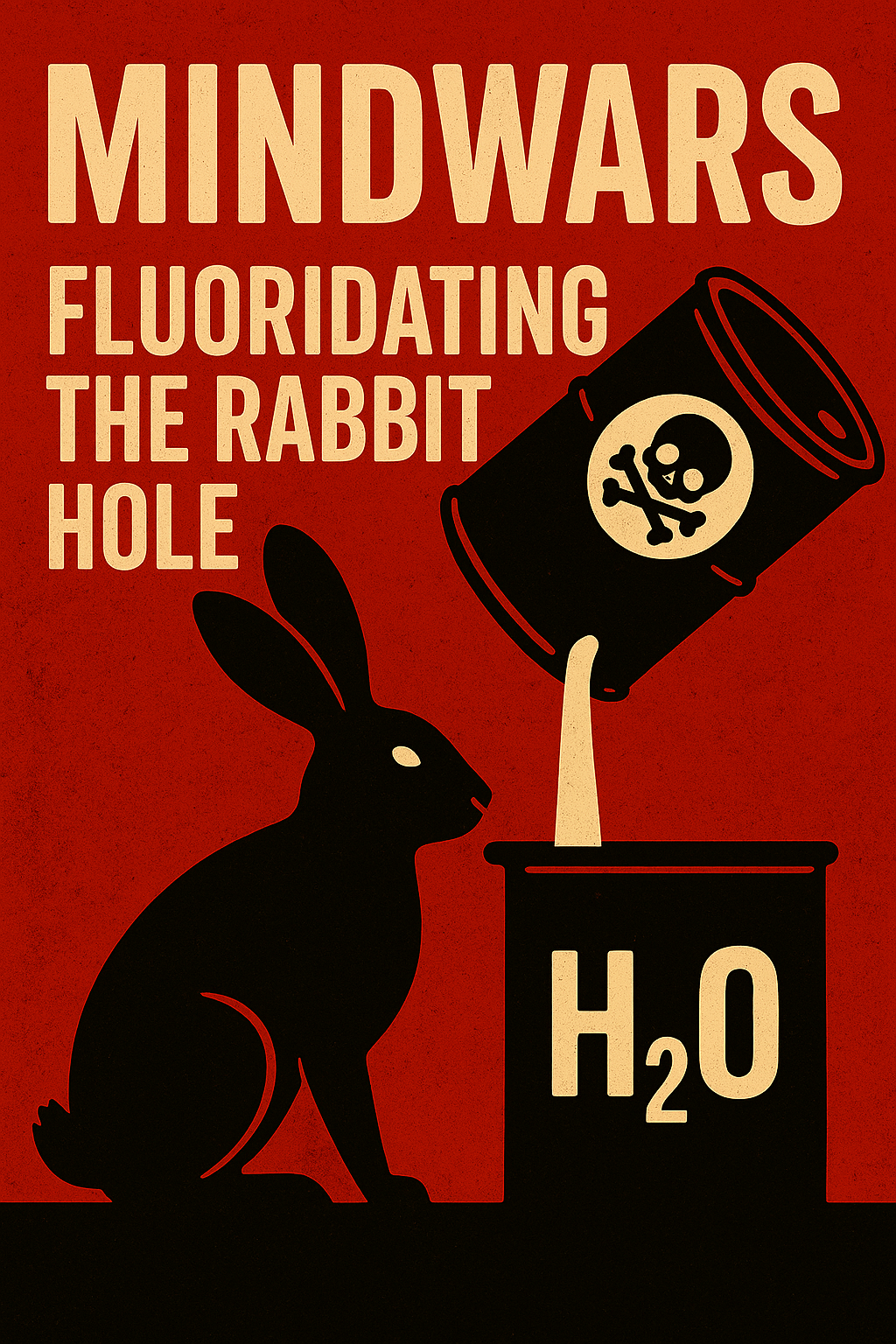
Previously in Mindwars: Down the Rabbit Hole to Conspiracyland showed how legacy outlets manufacture a mood—fear cues, contagion metaphors, guilt-by-association—to defend authority. Hornsey – Constructing Conspiracy Theorists showed how academia upgrades a label into a diagnosis, shifting debate from claims to claimants. This article is where those two engines fuse.
The hook
A glossy 1News state media explainer (via The Conversation) asks “What really causes people to go down conspiracy theory rabbit holes?” Second paragraph in it swings to fluoride. Not the policy. The people. It diagnoses citizens who ask questions—then calls that public health education. That’s the Mindwars playbook in the wild: Conspiracyland’s media mood + Hornsey’s academic manual = coercion laundered as care.
The context that never makes print
The New Zealand government is driving a strict nationwide fluoridation mandate for local body water supplies. Councils face daily fines for non-compliance. The live questions—consent, dosing, evidence thresholds, who decides—are treated as noise. Against that backdrop, the article quotes the classics:
“Conspiracies do happen. The Watergate scandal in the 1970s… The questioning of authority and the official narrative is something that should be encouraged… some people believe conspiracy theories that are contrary to evidence… 8.9% of New Zealand participants and 10.1% of Australian participants agreed with the (false) claim fluoride is being intentionally added to the water supply by the government to make people less intelligent and easier to control. What draws people to conspiracies like these?”
This is the lip service + rug-pull. Acknowledge one safe, historic conspiracy to look fair. Then shove today’s dissent into the unreality box. Ethos granted, then weaponised.
The bait-and-switch
We start with neutral “conspiracy psychology.” We jump to a lurid fluoride-as-control vignette. We return to generalities as if that fringe claim stands for everyone. That’s classic pacing-and-leading:
- Setup: neutral explainer → authority posture
- Interrupt: fluoride “mind control” → emotional spike
- Return: “why people believe” → smear anchored to control
The trick anchors the word control, diverts attention from dose/consent/governance, and plants the suggestion that sceptics are unstable. The frame sticks; the facts never arrive.
The academic smokescreen
The study itself finds little evidence that distress leads to belief and no evidence that belief causes distress. That describes stability, not fragility. Yet stability is spun as incorrigibility—as if a consistent view were a defect. That’s the Hornsey & Spring move: replace truth-testing with trait-testing, then prescribe “interventions” for a population, not arguments for a citizen.
The editorial turn
The article fixates on the fringe (“mind control”) and deletes the policy context (consent, dosing, local vs central authority). That’s Conspiracyland stagecraft: emotion first, facts later—or never. The spectrum gets tarred by its noisiest edge. The debate shifts from “Is this policy justified?” to “What’s wrong with these people?”
Local deployment
Once published, the frame becomes a tool. Officials can point to the explainer and tag a critic as a “conspiracist.” Conversation over before it starts. The mandate moves ahead. Public deliberation is treated as a symptom to be managed.
The tactics, laid bare:
- Straw-man conflation: spotlight the extreme to smear the rest.
- Pathology trap (CT label): once tagged, your argument becomes a symptom.
- Circular logic (CL): mandate = rational by default → opposition = irrational → “irrational” opposition proves the mandate needed.
- Weaponised nulls: neutral findings (“no distress loop”) twisted into a defective-worldview story—permission to sort a population instead of debating a policy.
These are the same tools flagged in Conspiracyland (emotive staging, extremism glue, foreclosing substance) and Hornsey (segmentation, profiling, prebunking). Governance by psychology, not by argument.
Cui bono? Follow the power:
- The state wins. Reclassify dissent as a mental-style issue and democracy becomes a management task. Councils are bypassed under the magic words “public safety.”
- The media–academic complex wins. Universities supply the diagnostics. National outlets distribute them. Both collect an authority halo.
- The public loses. We lose the right to debate what goes into our bodies. We lose informed consent as a live variable. We risk being branded unstable for asking basic questions. (As Hornsey showed, “interventions” target behaviour, not institutional transparency. The system adjusts us, not itself.)
The questions that give the game away
Why this article now? Were there state/academic/media linkups on placement and amplification? If belief is “stable,” why choose stigma + mandate over persuasion + consent? Where is the line between “conspiracy” and legitimate scepticism of mass medication?
In the end, they pathologise because they can’t persuade. They diagnose because their evidence can’t carry the policy on its merits. That’s the confession, wrapped as concern.
Published via Journeys by the Styx.
Mindwars: Exposing the engineers of thought and consent.
—
Author’s Note
Produced using the Geopolitika analysis system—an integrated framework for structural interrogation, elite systems mapping, and narrative deconstruction.