Mindwars: The Pandemic Report That Named the Wounded And Left Out Those Responsible
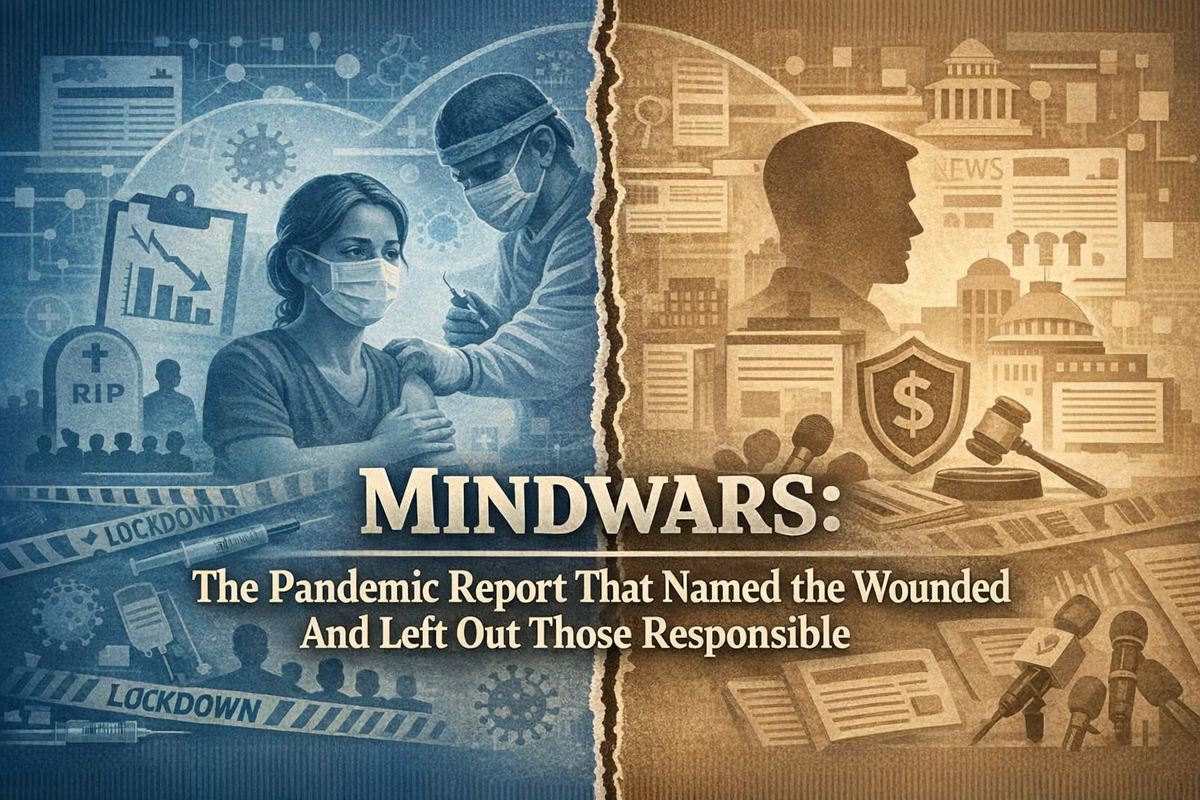
How New Zealand's official inquiry into COVID-19 documented devastating harms while protecting the power structures that produced them—despite having the two most comprehensive formal shadow submissions on its desk and sitting through the Commission’s hearings, which I dissected in at the time. Note: this article is quite long and may be cut-off in emails—please go to the website to see the whole.
In February 2026, New Zealand's Royal Commission into COVID-19 released its Phase Two report—a 526-page investigation into the country's pandemic response during 2021–2022. The findings seemed admirably honest. The report acknowledged that vaccine mandates caused “employment and wage scarring” for thousands of workers, that testing delays left communities vulnerable, that Māori were inadequately consulted, and that critical expert advice never reached decision-makers. It offered 24 recommendations for doing better next time.
The government accepted the findings. Media coverage focused on the “lessons learned.” Closure, supposedly, was achieved.
But a closer reading reveals a more complicated story. I had seen this pattern before.
In October 2024—sixteen months before the Royal Commission released its final Phase Two report—along with numerous others I wrote to the New Zealand Ministry of Health and then the Office of the Ombudsman requesting the release of New Zealand's contract with Pfizer for the COVID-19 vaccine. The Ombudsman’s response was a masterclass in proceduralism: “recent consideration,” “no new information,” “investigation unnecessary.” The request was processed, logged, and dismissed without substantive engagement. The contract—containing liability shields, indemnity clauses, and pricing terms that directly affect taxpayers—remains secret to this day.
I did not know it then, but I was witnessing a rehearsal for what the Royal Commission would later perform at scale. The same mechanism—receive, witness, erase—would be applied to perhaps the most comprehensive citizen submissions ever produced in New Zealand.
Before the Commissioners wrote a single word, two formal shadow documents already existed on their desks.
The first was The People's Position (Voices for Freedom, August 2025)—the 276-page citizen counter-report with pharmacovigilance data, ACC claims, exemption rejections, Māori consultation failures, and raw lived testimony. It was formally submitted.
The second was NZDSOS's Critique of the Official New Zealand Covid Response (June 2025, 375 pages)—the doctor-led submission from New Zealand Doctors Speaking Out with Science. It detailed vaccine harms known to the government since February 2021, pharmacovigilance collapse at every level (hospital wards to mortuary), ethical breaches in pregnancy and children, spike-protein toxicity, myocarditis signals, suppressed early treatments, and the persecution of dissenting physicians. It was formally presented.
During the public hearings the Commissioners presided over, I published the article Mindwars: A Ritual of Containment, documenting Day 4 as an eight-scene containment ritual:
Levy KC's procedural framing → emotional victim videos → expert anchoring → VFF and NZDSOS testimony → Bragg → FACT Aotearoa → Le Gros closure
The pattern was visible as it happened—a carefully staged spectacle designed to process dissent without being changed by it.
It is no great surprise, then, that the fruits of the Royal Commission's containment theatre evidence the total absence of both the NZDSOS and VFF reports and what they had to say.
What follows is my breakdown of how the Commissioners’ report achieves that, what it does, and—most importantly—what its own boundaries exclude.
The Architecture: What the Report Leaves Out
The Royal Commission was appointed by the government and reported to the government. This position shapes everything it can see and say. The report draws boundaries that systematically exclude critical actors. But the boundaries are not only in what it says—they are encoded in its very structure, in the chapters it includes and the chapters it does not, in the questions it asks and the questions it renders unaskable.
Part 1: Setting the Scene—The Official Frame
The report opens with 34 pages of context: legal framework, policy context, pandemic chronology. This is standard for an inquiry. But notice what is being set: the scene is official. The legal context means statutes and Orders in Council. The policy context means Cabinet decisions and public service advice. The pandemic context means when strategy met virus—as if the virus were the only actor outside government.
What is absent from this scene-setting is any context about the pharmaceutical industry, about global supply chains, about the history of vaccine development and corporate liability, about the Great Barrington Declaration or other scientific controversies. The scene is already bounded before the analysis begins. The frame excludes:
- Pharmaceutical industry power. Pfizer, AstraZeneca, and Novavax appear as passive suppliers, their contracts described neutrally as if they were utility companies rather than powerful actors shaping global supply, pricing, and intellectual property regimes.
- Transnational capital. The economic analysis notes house price inflation and debt increases but never asks who benefited from asset inflation or who profits from government debt.
- Future generations. Debt burdens are acknowledged—$70.4 billion in response costs, net debt rising from 31 percent to 48 percent of GDP—but not analysed as intergenerational transfer. Costs imposed on those too young to have voice are simply noted, not counted.
- Ecological systems. Pandemic origins in zoonotic spillover, environmental degradation, climate change—all relevant to future preparedness—appear nowhere.
Part 2: Key Decisions – What Is Examined and What Is Not
The heart of the report examines four areas: vaccine safety and approvals, vaccine mandates, testing technologies, and lockdowns. These are the visible controversies—the things the public fought about.
Notice what is not given its own chapter:
- Pharmaceutical procurement. Contracts, pricing, liability shields, indemnity clauses—these appear only in passing, never as subjects of investigation. Testing protocols, the novel mRNA platform itself, true informed consent standards, and the secret procurement contracts (including liability shields and confidentiality clauses) are either passed over in a few neutral sentences or omitted entirely.
- Informed consent. Despite NZDSOS's extensive documentation of consent failures, there is no chapter examining whether the legal and ethical requirements for consent were met. The report never examines whether the provisional consent process met ethical thresholds, never addresses the government's repeated refusal to release the full Pfizer contract despite OIA requests, and never grapples with the fact that officials knew the absolute risk reduction was under 1% when they rolled out mandates.
- Scientific dissent and its suppression. No chapter asks why certain experts were listened to and others silenced, or what the persecution of dissenting physicians cost the country.
- Natural immunity. No chapter examines whether the millions who recovered from COVID-19 should have been treated differently, or what role natural immunity played in population protection.
- The shadow submissions. As detailed above the VFF and NZDSOS are not even acknowledged as deserving of a response.
Even the most basic elements of the response are allowed to stand unexamined. The report never interrogates how the very definition of “vaccine” was silently expanded to include mRNA gene therapies—products that function by instructing human cells to produce viral proteins, a mechanism that would, under prior regulatory frameworks, have been classified differently. If the public was told they were receiving a “vaccine” under a definition that had been quietly amended to accommodate novel technologies, was informed consent possible? The question is not asked.
Nor does the report examine the validity of the PCR tests that generated the case counts driving lockdowns. Every PCR test uses a cycle threshold (Ct) value—the number of amplification cycles required to declare a sample “positive.” This threshold is not fixed by nature. It is a laboratory choice. A high threshold (35-40 cycles) can detect non-infectious viral fragments— “dead nucleotides”—rather than active infection. If New Zealand used high thresholds, case counts were systematically inflated. People who were not infectious were counted as cases. Their isolation, their contact tracing, their contribution to the narratives that justified mandates—all based on an invisible laboratory cutoff. The Commission had the NZDSOS submission raising these questions. It chose silence.
These upstream architectural choices—the very ones NZDSOS and The People's Position urged the Commission to interrogate—remain outside the boundary. The structure tells us what the Commission considered worthy of investigation. The absences tell us what it considered unworthy—or too dangerous to touch.
Part 3: Lessons and Recommendations – The Nature of the Prescriptions
Four lessons organise the report's conclusions: decision-making systems, legislation, economic policy, and social readiness. Each is framed as a technical fix—better systems, better laws, better data, better communication.
- Lesson One: Systems that promote good government decision-making – Recommendations include a new strategic function, better modelling, real-time data. The assumption is that better information will produce better decisions. The possibility that the right information was available but ignored—the COVID-19 Vaccine Technical Advisory Group (CV TAG) advice, the NZDSOS critique—is not addressed.
- Lesson Two: Legislation – the guardrail for fundamental rights and freedoms – Recommendations include standing pandemic legislation, stronger safeguards, enhanced transparency. The assumption is that better laws will protect rights. The possibility that existing laws were adequate but disregarded—informed consent requirements, the Bill of Rights Act—is not examined.
- Lesson Three: Agile and robust economic policy – Recommendations include fiscal buffers, better coordination between Treasury and Reserve Bank, more frequent economic data. The assumption is that better economic management will cushion future shocks. The possibility that the stimulus was a wealth transfer to asset-holders—documented in the report's own pages—is not pursued.
- Lesson Four: Readiness for social impacts and post-pandemic recovery – Recommendations include researching the impacts of the response, better transparency, monitoring trust and social cohesion. The assumption is that studying problems will solve them. The possibility that trust is depleted because of who benefited—the personal enrichment trajectories, the board appointments, the speaking fees—is not considered.
The recommendations all point to reform within existing structures. None contemplates redesign—community governance, Treaty-based partnership—let alone transformation. The structure assumes that the system is basically sound and needs only fine-tuning.
The Public Submissions: Heard, Acknowledged, and Erased
The report boasts of its engagement with the public, citing 31,000 submissions, 50 witnesses, and 54 community engagements. Yet where, in its 526 pages, is what these thousands of submitters actually said? A handful of quotes appear—six lines from a Canterbury mother, three from a Hawke's Bay woman, three from an Auckland worker—framed as illustrations of harm rather than evidence that could reshape analysis. The vast majority of those voices are reduced to a statistic, their collective testimony processed through a framework that was already complete before they arrived. The report quantifies engagement to create an impression of thoroughness, but quantity is not the same as heeding. The numbers say “we listened.” The silence of the pages that follow says otherwise.
The Appendices – What the Report Chooses to Include
Appendices are where documents place material that supports the main text but is not essential to it. They reveal what the authors think readers might need to understand—and what they think readers can safely ignore.
Appendix 1: Understanding the Science of Vaccines, is the report's most telling act of boundary maintenance. Whether drafted by Commission staff or shaped by advisors like immunologist Graham Le Gros—whose Day 4 testimony delivered the closing verdict of expert authority—the appendix functions as a declaration that certain questions are settled and need not be engaged.
This 32-page appendix responds to “vaccine safety concerns raised by submitters,” addressing mRNA and DNA modification, manufacturing changes, clinical trial timelines, adverse events, pregnancy, and long-term effects. It is the report's attempt to settle scientific questions by fiat—presenting the official view as settled truth. Yet what it omits is more telling than what it includes.
Notably, it does not include:
- The absolute risk reduction (0.84%) behind the 95% efficacy claim
- The legal histories of the vaccine suppliers
- The indemnity clauses in the contracts
- The consent failures NZDSOS documented
The appendix validates the official narrative, delegitimises dissent, forecloses inquiry, protects institutions, and erases the shadow submissions. NZDSOS's 40-page statistical critique, consent analysis, and documented harms are reduced to “concerns” from “sincere” voices—dismissed without engagement. Its heavy weight of references studies creates the impression of scientific rigour and authority, while simultaneously suppressing opposing a growing body of views and studies to be found in the current scientific literature.
The irony is sharp: an appendix titled “Understanding the Science” offers certainty where the report elsewhere acknowledges “science speaks in probabilities” (p. 466). It is not an explanation. It is a performance—a ritual of authority designed to close debate, not illuminate it.
Appendix 2: Lockdown decisions and criteria for changing alert levels – This appendix provides chronology. It is technical, procedural, neutral. It does not include the human costs of those decisions—the employment scarring, family destruction, trust depletion documented elsewhere in the report. Those appear in Part 2 as evidence of impacts, not in the appendix as factors to be weighed.
Glossary – The glossary defines terms like “elimination strategy,” “lockdown,” “vaccine mandates.” It does not define “informed consent,” “absolute risk reduction,” “indemnity clause,” “behavioural insights team,” “propaganda,” “perceptual massaging,” “institutional autoimmune response.” The language of critique is excluded; the language of officialdom is enshrined.
What the Structure Accomplishes
Together, the report's architecture performs several functions:
- It naturalises the official frame: By opening with legal and policy context, it positions government as the only relevant actor. The pharmaceutical industry, global capital, ecological systems—these are outside the frame from the start.
- It elevates visible controversies while burying structural ones: Mandates and lockdowns get chapters. Pharmaceutical procurement, informed consent, scientific suppression—these get silence.
- It prescribes reform within existing structures: The recommendations all assume the system is sound. Redesign and transformation are not even contemplated.
- It appends science as settled truth: Appendix 1 attempts to close debate by presenting the official scientific view as beyond question—while omitting the data that would complicate it.
- It erases the shadow submissions: VFF and NZDSOS do not appear in the contents. They are not given the dignity of a response. They are processed, witnessed, and erased.
The Telling Absence
What is most telling is what is not in the table of contents. No chapter on “Pharmaceutical Procurement and Accountability.” No chapter on “Informed Consent and Rights Violations.” No chapter on “Scientific Dissent and Its Suppression.” No chapter on “The Shadow Submissions and What They Contained.”
Most damning of all: the Commission possessed the formal alternative frameworks produced in New Zealand—VFF's People's Position and NZDSOS's medical critique—and sat through the hearings I had already exposed as theatre. None became co-knowledge. The ritual of receipt replaced the duty of engagement.
These are not neutral omissions. They are choices. And they serve power by making certain questions unaskable.
Forensic analysis of the report suggests the Commissioners did not need to conspire. The system was designed to receive submissions without being changed by them. VFF and NZDSOS were processed, not engaged. This is more damning than alleging some conspiracy, because it means the system was designed to exclude such knowledge before anyone sat down to write.
The report's structure is the final act of containment. It defines what matters by what it includes, and what does not matter by what it excludes. The wounded are named in the chapters. The wounders are absent from the contents entirely.
The Hidden Assumptions
The report operates on assumptions so basic they are almost invisible. They are not stated as assumptions—they are embedded in the frame, in the chapters chosen and not chosen, in the questions asked and the questions never posed.
What the Report Takes for Granted
The nation-state is the unit of analysis. Global supply chains, transnational pharmaceutical power, international disinformation networks—these appear only at the edges, if at all. The report treats New Zealand's pandemic response as something that happened within the country, not as something shaped by forces that transcend borders. The contracts with Pfizer were signed by New Zealand, but the power to set prices, control patents, and demand indemnities resided elsewhere. That reality is invisible.
Parliamentary sovereignty is natural. The concentration of emergency power in executive government is never questioned. The COVID-19 Public Health Response Act 2020 gave ministers authority to make orders that restricted fundamental rights—and the report treats this as legitimate by assumption. The possibility that emergency powers should be subject to higher scrutiny, or that the Act itself may have been constitutionally dubious, is not explored.
Institutional reform is sufficient. The 24 recommendations all operate within existing structures—a new strategic function here, stronger legislation there, better data and modelling. None contemplates transformative change: community-led response, Treaty-based co-governance, ecological integration. The assumption is that the system is fundamentally sound and needs only fine-tuning.
What the Report Never Questions About the Science
The foundational assumption that asymptomatic transmission was a significant driver of the pandemic. This premise justified universal lockdowns and mass testing regardless of symptoms. Throughout 2020 and 2021, it was treated as settled science—yet the evidence was far more ambiguous.
Kary Mullis, the Nobel Prize-winning inventor of PCR, warned that the test “doesn't tell you that you're sick.” Detection of viral RNA does not equate to infectious virus capable of transmission. Studies claiming asymptomatic transmission often failed to distinguish presymptomatic individuals (who later developed symptoms) from those who remained truly asymptomatic. A living systematic review found that the secondary attack rate from asymptomatic cases was significantly lower than from symptomatic cases. The NIH published research stating that “the risk of transmission from asymptomatic patients to healthcare providers has not been reported.”
The policy of treating asymptomatic individuals as silent superspreaders rested on a scientific proposition far less certain than the public was led to believe. The Commission had the opportunity to examine this uncertainty. It chose instead to treat asymptomatic transmission as an unquestioned fact.
The assumption that PCR tests, as used, were valid indicators of infectious cases. The report never examines the cycle threshold (Ct) values used to determine positivity—a laboratory choice with enormous consequences. A high threshold (35-45 cycles) can detect non-infectious viral fragments rather than active, transmissible virus. If New Zealand used such thresholds, case counts were systematically inflated. People who were not infectious were counted, isolated, contact-traced. The narratives justifying lockdowns were built on numbers that may have had no relationship to infectious reality.
The assumption that the definition of “vaccine” was stable and uncontroversial. The report never interrogates how the term was silently expanded to include mRNA gene therapies—products that function by instructing human cells to produce viral proteins, a mechanism that would, under prior regulatory frameworks, have been classified differently. If the public was told they were receiving a “vaccine” under a definition that had been quietly amended, was informed consent possible? The question is not asked.
What the Report Assumes About Causality
The report assumes a linear model: decisions lead directly to outcomes. Ministers decided; the system implemented; results followed.
But the pandemic response was not linear. It was a complex system with feedback loops that no one designed:
- Trust enabled compliance, which enabled success, which built more trust—until mandates triggered resistance, which eroded trust, which increased hesitancy. The system that worked in 2020 sowed the seeds of its own delegitimation.
- Lockdowns caused fatigue, which reduced compliance, which extended lockdowns. The measure designed to shorten the outbreak prolonged it.
- Mandates traded short-term compliance for long-term trust depletion. The policies that achieved high vaccination rates in 2021 produced a population less willing to accept public health advice in 2026.
These dynamics operated regardless of intent. Policy choices initiated them, but once in motion, they escaped any actor's control. The linear model cannot see this. The report's frame excludes it.
What the Assumptions Accomplish
These assumptions are not neutral. They are choices that make certain questions unaskable:
- If the nation-state is the unit of analysis, you cannot ask about transnational pharmaceutical power.
- If parliamentary sovereignty is natural, you cannot ask whether emergency powers exceeded constitutional limits.
- If institutional reform is sufficient, you cannot ask whether the system needs transformation.
- If asymptomatic transmission is settled science, you cannot ask whether lockdowns were proportionate.
- If PCR tests are valid by assumption, you cannot ask whether case counts were inflated or cycle thresholds were excessive.
- If “vaccine” has the redefined meaning adopted during the pandemic period, you cannot ask whether consent to a novel untested gene treatment was truly informed.
- If causality is linear, you cannot ask why the system escaped control.
The questions the Commission refused to ask are not obscure. They were in the submissions it received, in the testimony it heard, in the scientific literature it ignored. They were rendered unaskable not by accident, but by the assumptions embedded in the frame before the first word was written.
What Was Engineered: The Machinery of Manufactured Division
The Royal Commission report would like us to believe that social division simply “emerged”—an unfortunate byproduct of pandemic stress, social media, and overseas disinformation. This framing is itself a strategic choice. It allows the Commission to pose as a neutral observer of forces beyond its scope.
The reality is different. The report erases the coordinated institutional machinery that cultivated division.
It makes no mention of the behavioural insights “nudge unit” that crafted messaging designed to maximise compliance and marginalise dissent. Every “team of five million” slogan, every expert flanking a minister, every binary framing is absent from its analysis.
The report is silent on cross-party parliamentary refusal that turned the 23-day Parliament tent city into a spectacle of universal rejection. Labour, National, ACT and Greens coordinated to deny engagement; the Commission received testimony on this but wrote as if it never happened.
Institutional co-option of professional bodies—Medical Council, Nursing Council, Pharmacy Council—to police dissenting members is documented in the NZDSOS submission the Commissioners received. The report stays silent.
The violent removal on 2 March 2022 is treated as a policing footnote rather than a political choice with universal official endorsement. Police, courts and media operated in concert; the Commission had the evidence and erased the coordination.
These were not emergent phenomena. They were documented institutional choices the report chose to bury:
- Social division was cultivated through messaging the report never interrogates.
- Vaccine hesitancy was produced by mandates the report frames as “valid but excessive” while ignoring the citizenship test they created.
- Protest dynamics were predictable responses to exclusion the Commission itself practised during the theatrical public hearings I documented at the time.
The language of “emergence” serves the report’s purpose. It turns deliberate institutional actions into weather. The Royal Commission—which had this history before it, heard testimony from those affected, and received NZDSOS’s detailed documentation of institutional co-option—wrote as if none of it happened. Its silence on the nudge unit, cross-party coordination, professional-body policing and the violent clearance is not oversight. It is the final act of institutional self-protection: erasing the machinery of division while lamenting that division occurred.
The Human Cost
The numbers tell part of the story. Four point two percent of the education workforce and 2.8 percent of health workers left employment due to mandates. Years later, unvaccinated workers who left their jobs experienced 12 to 14 percent lower employment rates. Average annual wage growth for those who declined vaccination was 2.5 to 3.9 percent lower.
But numbers are not the whole story.
"My son could not attend or participate in certain events and activities and as a result missed out on opportunities and lost his motivation for professional sports.” —35-44 year old Pākehā female, Canterbury
"I still have a daughter who won't talk much to me. It has done irreversible damage to my family.” —55-64 year old Pākehā female, Hawke's Bay
"I was stood down in my job... I have to pay my mortgage, pay the bills etc. I had to decide—keep my job or die of hunger. I kept my job. I went to take the injection.” —55-64 year old female, Auckland
"I think the effects on the mental health of some of our whānau is still being felt today and will be for many years to come when they think back to those anniversaries of when their loved ones [passed] and how they weren't able to have a proper tangihanga.” —Ngā Maia Trust representative
These are not abstract statistics. They are the exact clinical patterns documented in the NZDSOS submission—myocarditis in young people, fertility signals, wage scarring for unvaccinated workers, denied tangihanga, family rupture. The same harms VFF's People's Position catalogued in raw testimony captured in the moment those voices were allowed onstage only to be bracketed and filed away. The report names the wounded. It refuses to name the wounders who orchestrated the performance.
The report includes these voices as evidence. But it does not centre their framings, does not treat their experience as analytical, does not ask them what should be done. They are data, not knowledge. The report's epistemic frame—what counts as evidence—was drawn before VFF or NZDSOS arrived. Institutional documents were knowledge. Citizen testimony was data. Medical dissent was “misinformation.” The submissions were never going to be engaged because the frame excluded them in advance.
The Reasoning Traps
The report deploys specific reasoning patterns that foreclose alternatives. Examining what it actually says—and what it refuses to say—reveals the machinery of containment.
The False Dilemma
Choices are framed as binary—lockdowns or uncontrolled spread, mandates or overwhelmed hospitals, elimination or catastrophe. On mandates, it notes they were “valid” but some went “too far” (p. 197). On lockdowns, it cites modelling of “15,000 hospitalisations and 2,000 deaths” without mandates (p. 286). It never mentions Singapore's testing alternative to mandates. It never examines community-led approaches that worked—iwi-led testing (p. 214-215), public trust and social cohesion (p. 441)—as design alternatives. It never engages the Great Barrington Declaration's Focused Protection framework. It buries the advice that mandating two doses for 12-17 year olds was “not justified” (p. 188) but never asks: if young people were at near-zero risk, why were their lives destroyed by mandates?
Circular Reasoning
The 90 percent vaccination target is presented as the benchmark for exiting lockdowns. It admits the target was “slightly arbitrary” (p. 301) and that “no level of vaccination would ever entirely prevent transmission” (p. 301). It never explains how the 90 percent figure was derived. It never discloses that the modelling producing it assumed high vaccination rates were necessary—an untested assumption. It never asks whether other targets were considered. It never connects the target's arbitrariness to the human costs of the 107-day Auckland lockdown it prolonged—the families destroyed, businesses failed, trust depleted documented elsewhere in its own pages.
The 95 Percent Mirage
The Pfizer vaccine's “95 percent protection” is presented as established fact (p. 92). It notes that “data on long-term safety was not available” (p. 92) and documents myocarditis as a rare adverse event (p. 127-135). It never discloses that 95 percent is a relative risk reduction statistic. It never provides the absolute risk reduction—0.84 percentage points. It never mentions that NZDSOS spent 40 pages deconstructing this statistical sleight-of-hand in their submission. It never asks whether applying the 95 percent framing to young people—whose risk from the virus was near zero—constituted a failure of informed consent. It never conducts the calculation that matters for them: their vaccine risk versus their virus risk.
The Straw Man
Vaccine hesitancy is framed as a “misinformation” problem (p. 450-452). It notes that distrust of government correlated with hesitancy (p. 450). It acknowledges the exemption system was too narrow, that “people who should have been granted exemptions were not” (p. 162). It never engages the substantive reasons for hesitancy—historical Māori distrust from generations of medical harm, rational risk calculation by young people facing near-zero virus risk, ethical objection to mandates on principle. It never connects the consent failures NZDSOS documented—vaccinators withholding risk information because they “did not want to worry people” (p. 134)—to the “misinformation” frame. It never asks whether people denied legitimate exemptions and forced to choose between vaccination and their livelihoods were “misinformed” or simply lived the consequences. It never examines the history of legal awards for fraudulent practice of the companies contracted to provide the vaccines (mRNA treatments).
The Assumption That a Vaccine Was Needed
Vaccination is presented as the necessary path out of the pandemic. Officials advised it was “the only way” (p. 82). Relying on natural immunity “would have involved a significant burden of sickness and deaths” (p. 83) as evidenced soley in a paper cited titled “The WHO estimates of excess mortality associated with the COVID-19 pandemic.” It never mentions the Great Barrington Declaration or its Focused Protection framework. It never discusses the demographic reality that from earliest data, COVID-19 mortality was concentrated in those over 55, with no sign of mortality in young people. It never asks whether universal vaccination of young people could be justified given their negligible personal risk. It never examines natural immunity as a variable—whether the millions who recovered by late 2021 should have been treated differently. It never asks the foundational question: what if resources had been directed at protecting the vulnerable through other means—better aged care ventilation, treatments, isolation support—rather than universal mandates with documented social costs?
The Missing History: What the Report Never Examines About Its Vaccine Suppliers
The Royal Commission devoted an entire chapter to “vaccine safety and approvals.” It examined Medsafe's processes, the provisional approval pathway, and post-marketing surveillance. It did not examine the companies whose products it was validating—their histories, their legal settlements, their patterns of conduct. The report treats Pfizer, AstraZeneca, and Novavax as neutral suppliers rather than corporate actors with decades of legal exposure for fraudulent practices.
A minimal inquiry would have revealed: Pfizer paid $785 million in 2016 to settle whistleblower claims over fraudulent drug rebates, and in 2025 paid $41.5 million over allegations it supplied adulterated ADHD medication to children. AstraZeneca has paid over $800 million since 2009 for illegal marketing, Medicaid rebate fraud, and schemes to delay generic drugs. Novavax paid $47 million in 2024 to settle securities fraud claims that it concealed manufacturing failures while assuring investors of success.
These are patterns—adulterated drugs, fraudulent marketing, deceptive communications—across decades. The report never asks the obvious questions: Did the government consider these histories when awarding contracts? Were indemnity clauses structured to protect taxpayers from corporate misconduct? If Pfizer altered testing protocols to hide quality failures before, what assurance exists it did not do so again?
Most critically, the report never examines the liability shields built into the vaccine contracts—the very contracts the Ombudsman continues to protect from disclosure. These indemnity clauses shield manufacturers from liability for harms, transferring risk from corporate balance sheets to taxpayers. If companies with documented fraud patterns are granted immunity, who bears the cost when patterns repeat? The public. The same public whose trust the report documents as “permanently depleted.”
The Commission had the power to demand these contracts. It chose not to. The same logic that protected Pfizer from scrutiny at the Ombudsman's office protected it from scrutiny at the Commission.
What the Report Leaves Hanging
The report cannot avoid leaving traces of what it excludes:
- The CV TAG advice that mandating two doses for 12-17 year olds was “not justified” (p. 188) sits unconnected to any analysis of whether the mandates that followed were defensible.
- The admission that vaccinators withheld risk information because they “did not want to worry people” (p. 140) sits unconnected to informed consent as a legal requirement.
- The acknowledgment that the 90 percent target was “slightly arbitrary” (p. 301) sits unconnected to the human costs of the lockdowns it prolonged.
- The documentation that trust is permanently depleted (p. 455) sits unconnected to any analysis of who spent that trust and on what.
- The legal histories of the vaccine suppliers—and the indemnity clauses that protect them—sit entirely outside the frame.
These are cracks. Through them, the questions the report tried to bury remain visible—embedded in the official record, waiting to be followed.
The Real Stakes
The Royal Commission's 526 pages document harms in exhaustive detail—employment scarring, family destruction, trust depletion, inequitable impacts. But they are silent on the most obvious question: if so many paid, who benefited?
The answer requires following the money, the status, and the institutional rewards that flowed to those who designed and defended the response.
Who paid?
Unvaccinated workers lost jobs, income, and identity. Four point two percent of the education workforce and 2.8 percent of health workers left employment due to mandates. Years later, those who left experienced 12 to 14 percent lower employment rates and 2.5 to 3.9 percent lower wage growth. These are not abstract statistics. They are people who will never recover what was taken.
Renters and fixed-income households bore inflation costs while asset-holders saw wealth increase. The stimulus that protected businesses also drove house prices up by one-third, transferring wealth from those who don't own to those who do.
Future generations inherit debt—$70.4 billion in response costs, net debt rising from 31 percent to 48 percent of GDP. They had no voice in incurring this obligation. They will pay for decades.
Māori and Pacific communities bore inequitable health and economic burdens. The report acknowledges this. It does not explain why consultation was inadequate or why Treaty obligations went unmet.
Students experienced educational disruption with long-term consequences. The full cost—in lifetime earnings, in civic participation, in human flourishing—will not be known for decades.
Who benefited?
The report is structured to make this question unanswerable. But the answers are visible if you know where to look.
- Pharmaceutical companies secured massive contracts and intellectual property protection. Pfizer alone reported billions in COVID-19 vaccine revenue. The contracts—still secret, still protected by the Ombudsman's refusal to disclose—contain liability shields, indemnity clauses, and pricing terms that ensure public money flows to private profit while risk remains socialised. The pharmaceutical industry is entirely invisible in the report's analysis. Not a single finding examines who set the prices, who controls the patents, who lobbied for mandates, who profited.
- Asset-holders saw house prices increase by one-third between mid-2020 and end-2021. The stimulus designed to protect the economy became a wealth transfer to those already holding assets. The report notes the inflation. It does not name the beneficiaries.
- The vaccinated majority gained protection and freedom of movement while unvaccinated were excluded from venues. Vaccine passes created a two-tier society—and those in the favored tier had every incentive to support the system that privileged them. The report treats this as “balance.” It is not balance. It is a distributional outcome that benefited the majority at the expense of a minority.
- Government preserved legitimacy through the “lessons learned” frame. The act of inquiry itself became a legitimacy-restoring mechanism. The government that presided over the response also appointed the Commission that evaluated it. The circularity is structural: the institution judges itself and finds that it did well, with lessons.
- Institutional elites maintained authority. The public service officials who advised on mandates, the scientific advisors whose models shaped policy, the experts who appeared at every press conference—all emerged with their status intact, their careers advanced, their positions in the institutional architecture secure.
And then there are the individuals who really stand out, primary examples being:
Jacinda Ardern, the Prime Minister who led the response, resigned from Parliament in January 2023. Her official salary as Prime Minister was approximately NZ$470,000. In the years since, she has accumulated:
- A damehood (Dame Grand Companion of the New Zealand Order of Merit)
- Appointments with Harvard University (Fellow at the Kennedy School)
- Appointments with the University of Auckland
- A leadership role with the Earthshot Prize (Prince William's charity)
- Multiple board positions and speaking engagements globally commanding six-figure fees
- A new life in Australia, with all the benefits of transnational elite status
The mechanisms by which public service translates into this level of international platform and financial opportunity have never been investigated. The pecuniary interests register shows a family home, retirement schemes, a mortgage, and gifts of tickets to events. It does not explain the trajectory from there to Harvard, to the Earthshot Prize, to the global speaking circuit.
Ashley Bloomfield, the Director-General of Health who became the public face of the response, resigned in July 2022. His official salary was approximately NZ$460,000. Since resigning, he has:
- Been appointed to the University of Auckland as a Professor
- Taken on multiple board positions
- Joined the World Health Organization's panel on pandemic preparedness
- Become a highly paid international speaker
- Received the Order of New Zealand—the country's highest honor
The pattern is consistent: those who managed the crisis are rewarded with status, platform, and opportunities far beyond their public salaries. The temporary symbolic sacrifice—a few months of reduced pay—is dwarfed by the permanent material rewards that follow.
The Royal Commissioners themselves—Grant Illingworth KC, Anthony Hill, Judy Kavanagh—were appointed to conduct the inquiry. They were paid for their work. They have emerged with enhanced reputations, professional standing, and the kind of institutional credibility that translates into future appointments, board seats, and consultancies.
None of this is illegal. None of this is even unusual. It is how the system works: those who manage crises are rewarded; those who bear the costs are forgotten.
But the report's silence on this distribution—its refusal to name beneficiaries, to follow the money, to ask who gained while others lost—is not analytical neutrality. It is the final act of protection. The document that documents the harms was produced by people who benefited from the system that produced them, and it names none of the beneficiaries.
The deepest silence is in how the report tells us that trust is depleted, but fails to tell us who spent that trust and on what. It tells us that unvaccinated workers lost jobs. It does not tell us who gained from their exclusion. It tells us that future generations will pay debt. It does not tell us who incurred it.
The answer is not hidden. It is visible in every damehood, every professorship, every board appointment, every speaking fee, every contract clause that remains secret. The system transferred wealth, status, and security upward while documenting the harms suffered by those below.
That is not a “lesson learned.” That is a robbery memorialised in an official report.
The System Beneath
Trust—accumulated over decades—was drawn down during the pandemic and is now permanently depleted for some populations. “New Zealand would start from a different place if another pandemic broke out next week,” the report notes. Future governments will inherit this depleted resource. The system spent what it did not build.
Trust is a slow variable—it changes gradually over decades, not months. The pandemic drew down this accumulated resource through fast dynamics: mandate impositions, communication failures, perceived betrayals. The report acknowledges the depletion but treats it as recoverable through better communication—as if trust could be mandated back into existence. It cannot. Trust repair requires generational accountability, not PR.
Feedback loops will operate in any future pandemic regardless of design changes. The mandate-resistance-trust loop traded short-term compliance for long-term trust depletion. The lockdown-fatigue loop means extended restrictions will again generate resistance. These dynamics cannot be designed away—they must be anticipated.
What worked that was ignored? Iwi-led testing operated when the official system failed. Community food networks filled gaps. Mutual aid operated autonomously. The report notes this—then does nothing with it. These are not just “community resilience.” They are alternative design possibilities, demonstrating that another way is not only possible but already here.
The intense public debate over mandates and lockdowns—which dominates the report's reception—functions as a limited hangout: a smaller controversy disclosed to protect larger vulnerabilities. The Ombudsman's refusal to release the Pfizer contract exemplifies this mechanism. The public fights about whether the contract should be released while the contract itself—with its liability shields, indemnity clauses, and pricing terms—remains invisible.
Strategic Openings
What must be named? Pharmaceutical industry power cannot remain invisible. Who decided distribution? Who profits from intellectual property? Who bears risk? The Ombudsman protected the Pfizer contract. The Commission protected pharmaceutical invisibility. Both must be forced into the light.
What must be centered? Future generations have no voice in this report—they must be centered in the next. Māori knowledge cannot remain consultation; Treaty-based co-governance means epistemic partnership, not just engagement.
What must be redesigned? Trust can be rebuilt through transparency, accountability, and community-led governance—not mandated, but earned. Boundaries can be redrawn to include what was excluded: pharmaceutical industry as accountable actor, future generations as stakeholders, ecological systems as relevant.
What already exists? Mutual aid networks, iwi-led initiatives, and community solidarity systems operated alongside official responses. They can be resourced, scaled, defended from co-optation. The question is not whether alternatives exist—they do. The question is whether power will resource them or continue to exclude them.
The Royal Commission had The People's Position and the NZDSOS medical critique formally on its desk, and sat through the very hearings I dissected. The Commissioners had the statistical critique, the consent analysis, the contract concerns, and the real-time ritual documentation in front of them—and chose to leave every element of the foundational architecture untouched.
But they could not avoid every crack. Buried in the report's 526 pages are findings that, read against the grain, expose the vulnerabilities the Commission worked so hard to contain.
The mandate decision for teens and children. Tucked into Chapter 2.2 (p. 188) is the admission that the COVID-19 Vaccine Technical Advisory Group advised on December 9, 2021, that requiring two doses for 12-17 year olds was not justified. “Risks associated with the transmission of COVID-19 throughout Aotearoa New Zealand among those aged under 18 are insufficient to justify mandating a 2 dose schedule of the Pfizer vaccine prior to working in any environment.” This advice—supposedly—never reached ministers. The story goes that it was lost in the bureaucracy.
The report treats this as an administrative failure. It is not. It is a legal vulnerability.
If the Government mandated vaccines (mRNA treatments) for young people against the explicit advice of its own technical experts—advice that was never transmitted, never considered, never weighed in the proportionality analysis required by the New Zealand Bill of Rights Act—then every mandate enforced against a 12-17 year old rests on a decision-making process that was structurally corrupted. The advice existed. The Commission confirms it. The ministers never saw it. The mandates proceeded anyway.
This is not a “lesson learned.” It is a cause of action.
The consent failure. NZDSOS's submission detailed at length how informed consent protocols were systematically violated—vaccinators pressured to meet targets, risk information withheld, the “experimental” nature of novel mRNA technology never adequately disclosed to those receiving it, particularly children and pregnant women. The report's own evidence (p. 139-140) confirms that communications were fragmented, that vaccinators sometimes did not discuss myocarditis risks because they “did not want to worry people,” that key information was lost in the volume of official messaging.
The Commission notes these failures. It does not name them as the systemic rights violations they were. But the evidence is now on the public record, embedded in an official government report.
The statistical sleight-of-hand. The report repeats the “95% efficacy” claim without qualification. But it also acknowledges—elsewhere, indirectly, buried in appendices—that clinical trial data was limited, that long-term safety was unknown, that rare adverse events only emerge with population-wide use. The 0.84% absolute risk reduction—the real number behind the 95% relative risk reduction—appears nowhere. But the Commission's own acceptance of that framing, juxtaposed against its documentation of myocarditis cases, employment scarring, and trust depletion, creates a record that future legal challenges can use.
The Ombudsman parallel. The same institutional logic that protected the Pfizer contract from disclosure protected the Commission from engaging NZDSOS and VFF. But the Ombudsman's refusal—“recent consideration,” “no new information,” “investigation unnecessary” —is now part of the same public record. Two institutions, two refusals, one pattern. The machinery of containment is documented.
These are the chinks. The Commission could not avoid leaving evidence of its own failures—the lost advice, the consent violations, the statistical framing, the parallel refusal pattern—because those failures are structural to how it operated. The report had to acknowledge the CV TAG advice to maintain even the appearance of honesty. It had to note communication failures to address public submissions. It had to include the relative risk reduction figure because that is the official story. But in doing so, it created a record that can be used against the very system it was designed to protect.
The mechanism is consistent across institutions: process the input without being changed by it. Log the receipt, then proceed as if it never happened. The Ombudsman did it with perhaps dozens of requests. The Commission did it with thousands of pages of citizen testimony and medical expertise. But both left traces. Both created documentary evidence of the containment.
This is not bureaucratic failure. It is institutional autoimmune response—and like any autoimmune response, it leaves damage that can be read in the tissue.
WHAT COMES NEXT
The report was designed to be the final word—a 526-page edifice of closure, balancing acknowledgment of harm against affirmation of success, translating systemic failure into manageable lessons. But closure is not what it achieved. By documenting so much while protecting so much, by leaving traces of what it excluded, by admitting arbitrariness while insisting on certainty, the Commission created something its architects may not have intended: a roadmap for the accountability it refused to deliver. The questions it buried are now on the public record. The evidence it could not erase is now in the public's hands. The work begins where the report ended.
How sure we can be?
The evidence for documented harms—employment scarring, family destruction, trust depletion—is strong. The patterns of boundary exclusion and reasoning traps are clearly established. The pharmaceutical industry hypothesis is suggestive but requires investigation. The immune response mechanism—receive, witness, erase—is confirmed across two separate institutions. And the chinks the Commission could not avoid are now on the public record as foundations for legal action.
What still needs to be asked?
What role did pharmaceutical industry lobbying play in vaccine procurement and mandate decisions? What would a full accounting of pandemic costs include if extended intergenerationally and ecologically? What would Māori-designed pandemic response look like? How can trust be rebuilt, and over what timeframe? What feedback loops will structure future responses regardless of design changes? Why do multiple institutions produce the same response to citizen input? What would it take for an inquiry to treat citizen submissions as knowledge rather than data?
What could be different?
Reform—better communication, monitoring, transparency—is possible within the current system. Redesign—boundary redrawing, community governance, Treaty-based partnership—requires organised constituency. Transformation—paradigmatic change, ecological integration, participatory democracy—requires worldview shift and long-term movement building. The next inquiry could be designed differently—with citizen submissions as co-equal evidence, with pharmaceutical accountability as a required line of inquiry, with trust repair as a measurable outcome rather than a noted concern.
But the most immediate difference is this: the Commission's own report, designed to contain and close, has instead created a documentary record that can be used to pry open the very questions it tried to bury. The lost CV TAG advice is not a “lesson.” It is evidence. The consent failures are not “communication gaps.” They are rights violations. The Ombudsman's refusal is not a “procedural decision.” It is part of a pattern.
The machinery of containment left traces. Those traces are now in the New Zealand public’s hands.
Published via Mindwars Ghosted.
Mindwars: Exposing the engineers of thought and consent.
—
Methodological note: This analysis was conducted using a structured AI based forensic protocol. All sourced material is from the publicly available Royal Commission report, the formally submitted People's Position (VFF), the formally submitted NZDSOS critique, the contemporaneous Mindwars article I originally published on Substack (now here on Mindwars-Ghosted.com), and my correspondence with the New Zealand Office of the Ombudsman regarding the Pfizer contract.
Support: Mindwars Ghosted is an independent platform dedicated to exposing elite coordination and narrative engineering behind modern society. The site has free access and committed to uncompromising free speech, offering deep dives into the mechanisms of control. Contributions are welcome to help cover the costs of maintaining this unconstrained space for truth and open debate.
If you like and value this work, please Buy Me a Coffee