Nations Under Attack (Part 4): Propaganda Narratives in Action — Revised
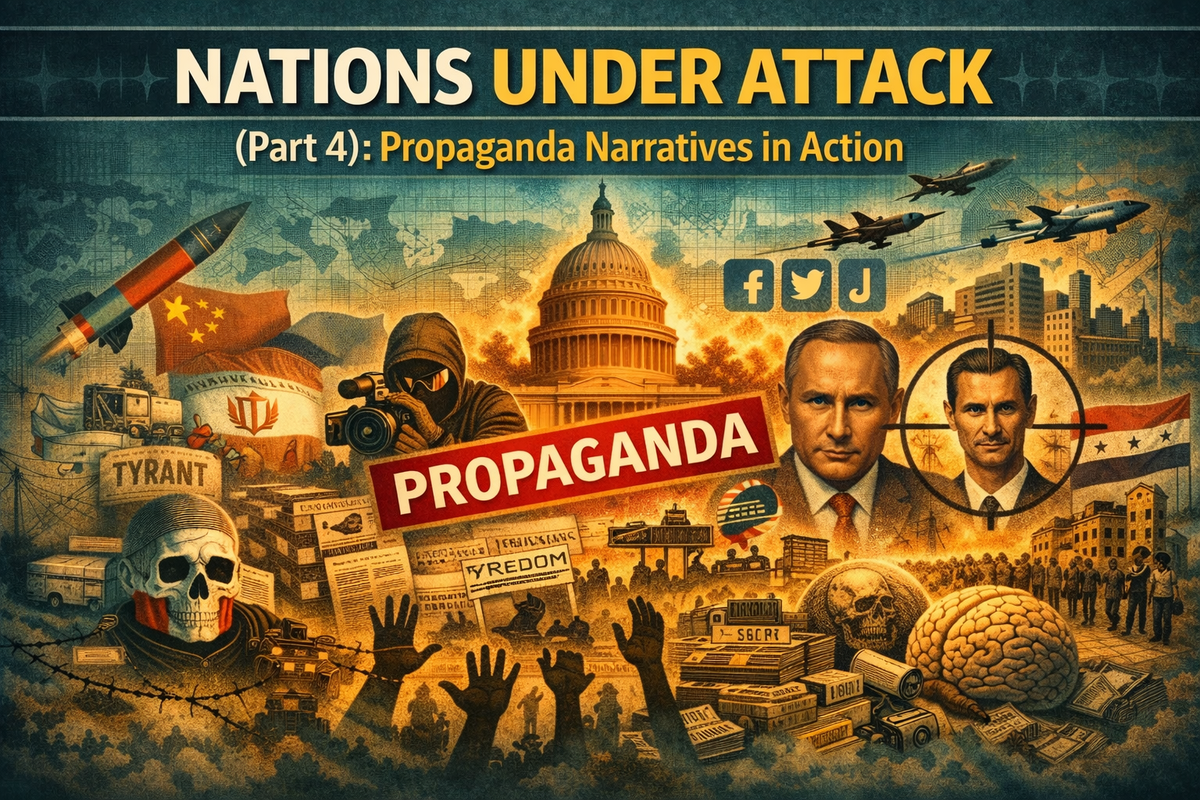
This article was first posted in early 2023 as Part 4 of my Nations Under Attack series. It moved from theory to application by cataloguing the specific propaganda narratives the US-led West has recycled against its main geopolitical targets over the past two decades: China, Russia, Iran, Syria, Libya, Iraq, Afghanistan, North Korea, Cuba, Venezuela—and any other state that resists absorption into the transnational capitalist order.
Where the earlier parts mapped the terrain—elite resource grabs and the Transnational Capitalist Class (Part 1), the US War Machine’s operational toolkit (Part 2), and narrative itself as a weapon of war (Part 3)—this instalment provides the field guide: the modular scripts and recurring tropes (“evil leader,” “human rights abuses,” “threat to democracy/freedom,” “economic predation,” “support for terrorism,” “military expansionism,” “WMDs/nuclear threat,” “socialist failure”) that are adapted to each target to manufacture consent for sanctions, subversion, regime change, or direct military action.
The same patterns are discernible across the cases: demonisation of the leader as an inhuman tyrant, portrayal of the government as a brutal dictatorship that oppresses its people, framing of the economy as a failed socialist disaster caused by mismanagement rather than external pressure, accusations of sponsoring terrorism or destabilising neighbours, and insistence that the country poses an existential threat to freedom, regional stability, or global security. These elements are not improvised; they are recycled templates, pulled from the same playbook and reshaped only enough to fit the cultural or geopolitical context of the moment.
In March 2026, as Operation Epic Fury enters its second week—Khamenei assassinated in the opening decapitation strike, thousands of “precision” targets destroyed, Iranian retaliation branded as unprovoked terror, civilian suffering minimised under humanitarian gloss—the patterns listed here are playing out live. The same interchangeable narratives once applied to Saddam, Gaddafi, Assad, and others are now locked onto Iran with only the names updated.
Part 4 therefore doubles as both diagnostic checklist and caution: when the familiar chorus begins—“tyrant,” “oppression,” “threat to freedom,” “economic ruin,” “support for terror”—recognise the script. The narratives come first; the carnage follows. The con rolls on...
Note: The original posting article was a rambling affair that was very long, quite repetitive and went into considerable detail, I have therefore restructured and cut each section down to the essentials using ChatGPT and Deepseek to make a better read and emphasise the essence of the transportable narratives.
Originally published: 2023-03-04
Part 1 of this series argues that elites aggressively seek to acquire and control resources and power—primarily for their own personal enrichment. Part 2 outlines how the Western elites enact this agenda against nations that are targeted for resource pillage and inclusion within the broader sphere of Western influence for ongoing power projection and exploitation. Part 3 deals with narrative as a tool of war. This part provides an overview of the common propaganda narratives used against key targets of the empire.
“So I came back to see him a few weeks later, and by that time we were bombing in Afghanistan. I said, “Are we still going to war with Iraq?” And he said, “Oh, it’s worse than that.” He reached over on his desk. He picked up a piece of paper. And he said, “I just got this down from upstairs” — meaning the Secretary of Defense’s office — “today.” And he said, “This is a memo that describes how we’re going to take out seven countries in five years, starting with Iraq, and then Syria, Lebanon, Libya, Somalia, Sudan and, finishing off, Iran.””
― GEN. WESLEY CLARK interview with Amy Goodman of Democracy Now!
“The conscious and intelligent manipulation of the organised habits and opinions of the masses is an important element in democratic society. Those who manipulate this unseen mechanism of society constitute an invisible government which is the true ruling power of our country. …We are governed, our minds are molded, our tastes formed, our ideas suggested, largely by men we have never heard of. This is a logical result of the way in which our democratic society is organized. Vast numbers of human beings must cooperate in this manner if they are to live together as a smoothly functioning society. …In almost every act of our daily lives, whether in the sphere of politics or business, in our social conduct or our ethical thinking, we are dominated by the relatively small number of persons…who understand the mental processes and social patterns of the masses. It is they who pull the wires which control the public mind.”
― Edward Bernays, Propaganda
The following sections catalogue the principal propaganda narratives employed by the United States and its allies against key target nations of recent decades—namely Cuba, Russia, China, Iran, Libya, Iraq, Afghanistan, North Korea, Syria and Venezuela.
These narratives are presented largely without detailed criticism or rebuttal. Effective propaganda typically contains elements of truth that lend credibility to its broader story, making it persuasive to the casual observer. The purpose here is not to adjudicate the accuracy of each claim or allegation from which these narratives are constructed, but to document the recurring patterns through which they are framed and disseminated.
Accordingly, this article catalogues the principal narrative templates, tropes, and storylines used to shape public perception of these states. It does not attempt to resolve every factual dispute contained within them. Rather, its aim is to illuminate how such narratives function collectively to manufacture public consent for sanctions, intervention, and war. Readers are encouraged to examine a range of sources and perspectives before forming their own conclusions about the underlying events and claims.
In my view, propaganda—whatever its source—inevitably involves distortion or selective representation, and the narratives examined here frequently undermine the prospects for peaceful coexistence among nations.
A. Cuba
Propaganda narratives against Cuba have framed the island as a persistent communist threat and rogue state in the Western Hemisphere, justifying the decades-long US economic embargo, covert operations, invasion attempts, and diplomatic isolation.
Key high-level narratives assert that:
- Cuba is a threat to democracy, human rights, and economic stability
- Cuba’s government is oppressive and repressive
- Cuba’s economic policies are responsible for the country’s poverty
- Cuba’s government is a repressive dictatorship that suppresses the people’s freedom and civil liberties
- Cuban government has provided sanctuary and support for terrorists.
The key propaganda narratives employed by the USA and Western allies against Cuba include:
- Communist Threat: Cuba is depicted as a dangerous exporter of Marxist-Leninist ideology, destabilising Latin America and Africa through support for revolutions and anti-Western movements. This Cold War-era script—casting the island as a Soviet proxy spreading subversion—sustained the embargo and justified efforts to prevent “another Cuba” across the region.
- Human Rights Abuses: The regime is accused of systematic repression, including arbitrary arrests, torture of dissidents, suppression of free speech/press/assembly, and persecution of political opponents, religious groups, and LGBTQ+ individuals. These claims—amplified by US-funded exile groups, NGOs, and media—portray Cuba as a prison-state denying basic freedoms.
- Economic Failure: Cuba’s poverty, shortages, and underdevelopment are blamed entirely on socialist policies, central planning, and mismanagement rather than the embargo’s impact. This narrative discredits socialism as inherently unviable, warning other nations against similar models and framing the embargo as necessary pressure for “reform.”
- Dictatorship: The government is characterised as a one-party authoritarian regime with Fidel and Raúl Castro (and successors) as long-reigning tyrants who crush opposition, rig elections (or avoid them), and maintain power through fear. This framing denies legitimacy to the revolution and justifies calls for “democratic transition” via external force.
- Support for Terrorism: Cuba is accused of being a state sponsor of terrorism, harbouring fugitives (e.g., Assata Shakur), aiding groups like FARC, ETA, and providing sanctuary/support to revolutionary movements in Latin America and Africa. This label—despite Cuba’s removal from the US terrorism list in 2015 and reinstatement debates—rationalises sanctions and isolation.
- Evil Leader: Fidel Castro (and by extension the Castro brothers/system) was demonised as a ruthless dictator exporting revolution, sponsoring terror (e.g., alleged Cubana Airlines bombing), and oppressing his people. The caricature—tyrant, communist menace, regional destabiliser—personalised the threat, making regime change seem morally urgent.
Cuba represents one of the longest-running propaganda narratives in modern geopolitics. Since the 1959 revolution, the island has been framed in Western discourse as the archetypal communist dystopia—an impoverished police state whose repression and economic hardship are presented as the inevitable outcome of socialism. Episodes such as the Cuban Missile Crisis, the Mariel boatlift, and the enduring image of political prisoners have been repeatedly invoked to reinforce this storyline, while the profound economic impact of more than six decades of sanctions and embargo is rarely acknowledged as a central factor shaping the country’s development. In this narrative framework Cuba functions less as a nation than as a cautionary symbol: proof that defiance of the Western economic and political order leads inevitably to failure. By sustaining this image across generations, the narrative has helped legitimise one of the longest economic sieges in modern history while discouraging a more nuanced understanding of the island’s complex political and social reality.
B. Russia
According to dominant Western propaganda narratives, Russia is framed as a threat to global security and democracy, ruled by a repressive authoritarian regime marked by rampant corruption and weak rule of law. These accusations underpin economic sanctions, diplomatic isolation, and military posturing.
Key high-level narratives assert that:
- Russia poses a threat to global security
- Russia poses a threat to global democracy
- Russia is a repressive and authoritarian regime
- Russia is a country where the rule of law is weak and corruption is rampant.
The key propaganda narratives employed by the USA and the West against Russia include:
- Aggression towards neighbouring countries: Russia is depicted as an expansionist aggressor that violates sovereignty and destabilises Europe, with the 2014 annexation of Crimea, support for Donbass separatists, and the 2022 special military operation in Ukraine cited as evidence of imperial revanchism and threats to regional stability.
- Election Interference: Russia is accused of systematically meddling in foreign elections to sow discord and undermine democracy, most prominently through alleged hacking and disinformation in the 2016 US presidential election (targeting Democrats to favour Trump), as well as similar claims in France, Germany, and the UK.
- Human Rights Abuses: The regime is portrayed as brutally repressive, silencing dissent through arbitrary arrests, torture, extrajudicial killings, and suppression of free speech/press. High-profile cases include alleged poisonings of critics and defectors (Litvinenko with polonium-210 in 2006, Skripal with Novichok in 2018, Navalny in 2020), the death of Sergei Magnitsky in custody (leading to the Magnitsky Act), and persecution of journalists, opposition figures, LGBTQ+ communities, and minorities.
- Support for Authoritarian Regimes: Russia is said to prop up repressive governments worldwide (Syria, Belarus, Venezuela) with military aid, economic support, and political backing, undermining democratic movements and international human rights efforts in pursuit of geopolitical gain.
- Corruption and Oligarchy: Russia is characterised as a kleptocracy where a small circle of oligarchs and Putin associates control wealth and power through crony capitalism, offshore schemes (e.g., Panama Papers revelations), and state capture, prioritising elite enrichment over public welfare despite anti-corruption rhetoric.
- Evil Leader: Vladimir Putin is consistently demonised as a ruthless, corrupt dictator who murders opponents, suppresses freedoms, and threatens global order—framed as the personal embodiment of Russia’s aggression, authoritarianism, and moral bankruptcy.
Taken together, these narratives transform geopolitical rivalry into a morality tale centred on the figure of Vladimir Putin. Events such as the Litvinenko poisoning, the Magnitsky affair, the Skripal incident, MH17 downing and the death of Alexei Navalny are woven into a cumulative storyline in which Russia’s leader appears not merely as a strategic adversary but as a uniquely malevolent actor whose personal depravity reflects the nature of the Russian state itself. Through this lens, sanctions, NATO expansion, and proxy confrontation can be presented not as power politics but as a necessary defence of democratic civilisation against tyranny. By personalising the conflict and reducing a complex society to the actions of a single demonised leader, the narrative performs its essential task—mobilising public opinion while obscuring the deeper strategic calculations that shape the confrontation.
C. China
Western propaganda narratives about China are designed to portray the country and its leadership under the Communist Party of China (CPC) as a threat to global security and regional stability, as well as global democracy and human rights. The narratives commonly used promulgate an image of China that includes human rights abuses, economic aggression, military expansionism, and propaganda and disinformation.
Key high level narratives assert that:
- China is a destabilising force and a threat to global security and regional stability
- China is an economic predator that steals intellectual property and unfairly competes in the world market
- China does not respect human rights or democratic values and a threat to the global community
- China is a dangerous country that is not to be trusted and is willing to use any means necessary to achieve its goals.
The key propaganda narratives employed by the USA and the West against China include:
- Human Rights Abuses: China is accused of widespread repression against its citizens, including political dissidents, religious and ethnic minorities, and censorship of information, with allegations of forced labour, mass surveillance, and suppression of free expression. The most prominent examples are the treatment of Uyghurs in Xinjiang (detention camps, indoctrination, forced labour, sterilisation) and the 2020 national security law in Hong Kong, which critics say crushed civil liberties and jailed pro-democracy activists after the 2019 protests.
- Economic Aggression: China is portrayed as an unfair competitor that steals intellectual property, manipulates currency, subsidises state firms, and engages in predatory trade practices. The ongoing US-China trade war, tariffs, and restrictions on Chinese companies are justified by claims of massive IP theft harming American industries, while the Belt and Road Initiative is framed as debt-trap diplomacy used to extract resources and secure strategic footholds.
- Military Expansionism: China is depicted as aggressively building military power and territorial claims that threaten regional stability, especially through artificial islands and bases in the South China Sea (allegedly violating international law and freedom of navigation) and through alleged tacit support for North Korea’s nuclear programme, allowing it to continue despite sanctions.
- Propaganda and Disinformation: China is said to deploy state-controlled media, fake social media accounts, and digital influence operations to spread falsehoods, sow discord abroad, and shape global opinion in its favour, with accusations peaking during the COVID-19 pandemic over origins theories and promotion of its own response.
- Authoritarianism: The CPC is presented as a repressive one-party regime that enforces strict media/internet control, deploys mass surveillance (including the social credit system), and suppresses dissent through censorship, extrajudicial detention, and persecution of minorities, posing a fundamental threat to democratic values worldwide.
- COVID-19 Lab Leak: The theory that the virus escaped from the Wuhan Institute of Virology is promoted to depict China as incompetent, dishonest, and dangerous in global health matters, fuelling broader claims of cover-up and untrustworthiness.
- Evil Leader: President Xi Jinping is vilified as a dictator who oppresses his people, consolidates absolute power, and threatens global order, with similar historical framing applied to Mao Zedong to discredit the entire CPC system.
In the case of China the propaganda narrative shifts away from the singular villain archetype toward the portrayal of a systemic civilisational threat. Here the storyline depicts an emerging techno-authoritarian superpower bent on economic domination, ideological infiltration and global surveillance. Narratives surrounding Xinjiang, Hong Kong, Taiwan, intellectual property theft, and technological competition reinforce the perception of a rival system whose rise threatens the political freedoms and economic prosperity of the democratic world. Controversies such as the COVID-19 lab-leak theory and accusations of “debt-trap diplomacy” through the Belt and Road Initiative are incorporated into this broader narrative architecture, portraying China not simply as a competitor but as an existential challenge to the existing global order. In this way the narrative prepares Western populations psychologically for prolonged confrontation with China—economic, technological, and potentially military—by framing that conflict as a defence of freedom rather than a contest between great powers.
D. Iran
Iran has been subjected to persistent propaganda narratives by the US and its allies, framing it as a rogue state that poses a grave threat to international peace, regional stability, and human rights. These scripts have long justified sanctions, sabotage, assassinations, and now open military action.
Key high-level narratives assert that:
- Iran is a rogue state actively pursuing nuclear weapons
- Iran is a destabilising force in the Middle East and a threat to human rights
- Iran is a hotbed of anti-Semitism and hatred towards Jews.
The key propaganda narratives employed by the USA and the West against Iran include:
- Nuclear Ambitions: Iran is portrayed as secretly racing toward nuclear weapons in defiance of international law, despite its repeated denials and IAEA-monitored peaceful program. The narrative, amplified by Israeli leaders (e.g., Netanyahu’s 2012 UN “bomb cartoon”), justifies crippling sanctions, Stuxnet cyberattacks, scientist assassinations, and pre-emptive strikes as necessary to prevent an “existential threat.”
- Support for Terrorism: Iran is accused of being the world’s leading state sponsor of terrorism, funding and arming proxies like Hezbollah, Hamas, Houthis, and Shiite militias in Iraq/Syria to destabilise the region and attack Israel/US interests. This framing casts legitimate resistance movements as terrorist networks, rationalising sanctions, proxy wars, and direct military action.
- Human Rights Abuses: The regime is depicted as brutally repressive, torturing dissidents, executing protesters, suppressing women’s rights, and persecuting minorities. Reports from Western NGOs and media highlight crackdowns (e.g., on MEK, women’s protests, religious minorities), used to delegitimise the government and portray it as a moral abomination requiring external “liberation.”
- Anti-Semitism: Iran is labelled a hotbed of Jew-hatred, with leaders (especially former President Ahmadinejad) accused of Holocaust denial and genocidal rhetoric against Israel (“wipe off the map” misquotes). This narrative, heavily promoted by Israel and allies, frames opposition to Zionism as existential anti-Semitism, justifying isolation and aggression.
- Destabilising Influence in the Middle East: Iran is said to fuel sectarian chaos through proxy wars in Syria, Iraq, Yemen, and Lebanon, seeking hegemonic control via “Shia crescent.” This portrays defensive alliances as aggressive expansionism, legitimising US/Israeli/Saudi countermeasures.
- Evil Leader: Supreme Leader Ayatollah Ali Khamenei is cast as the fanatical, irrational theocrat directing every evil—nuclear pursuit, terrorism sponsorship, rights abuses—making him the personal embodiment of Iran’s threat. This archetype (echoing Saddam, Gaddafi) justifies decapitation strikes and regime-change rhetoric.
For Iran the narrative template combines several familiar propaganda tropes into a portrait of existential menace: the fanatical theocracy, the nuclear outlaw, the sponsor of terrorism, and the destabiliser of the Middle East. Each crisis—from the 1979 hostage episode to successive disputes over nuclear development and regional proxy conflicts—reinforces the image of a regime portrayed as uniquely irrational and dangerous. Figures such as Qassem Soleimani, and now the posthumous caricaturing of Supreme Leader Ali Khamenei, become symbolic embodiments of this threat, allowing assassinations, sanctions, and military escalation to be framed as acts of defensive necessity rather than geopolitical strategy. Through this narrative lens Iran’s resistance to Western influence is recoded as aggression, enabling sustained pressure and periodic warfare to be presented to Western audiences as unavoidable responses to an irredeemable regime.
E. Libya
A series of propaganda narratives about Libya were deployed to shape public opinion and build support for the 2011 NATO intervention, framing Muammar Gaddafi and his regime as brutal oppressors whose removal was a moral and humanitarian necessity.
Key high-level narratives asserted that:
- Libya was ruled by a brutal dictator who ruled with an iron fist
- Libya was a state sponsor of terrorism and a dangerous destabilising force in the region
- Libya was a rogue state willing to commit acts of terrorism on foreign soil
- Libya needed Western intervention to liberate it from an oppressive regime and prevent a humanitarian crisis.
The key propaganda narratives employed by the USA and the West against Libya include:
- Human Rights Abuses: Gaddafi’s regime was accused of systematic torture, extrajudicial killings, suppression of dissent, and widespread repression, painting him as a merciless tyrant who crushed his own people. These claims—amplified by Western media and NGOs—were used to portray the 2011 uprising as a popular revolt against unbearable cruelty, justifying intervention as protection of civilians.
- Support for Terrorism: Libya was depicted as a major state sponsor of terrorism, funding and arming groups like Al-Qaeda, Hamas, Hezbollah, and various African insurgencies. Historical incidents (e.g., alleged links to the 1986 Berlin discotheque bombing) reinforced the image of Gaddafi as a global menace, framing the intervention as part of the broader War on Terror.
- Responsibility for Lockerbie Bombing: The 1988 Pan Am Flight 103 bombing (killing 270) was pinned on Libya, with Gaddafi’s government accused of orchestrating the attack. This narrative—despite contested evidence and alternative theories—sustained UN sanctions in the 1990s and was revived in 2011 to underscore Libya’s rogue status and justify regime change.
- Necessity of Regime Change: The intervention was sold as a moral imperative to overthrow Gaddafi, end his dictatorship, and usher in democracy and freedom. This narrative invoked Responsibility to Protect (R2P), portraying Libya as a failed state crying out for Western liberation from tyranny.
- Protection of Civilians: The NATO campaign was framed as a humanitarian mission to prevent a “massacre” in Benghazi and stop Gaddafi’s forces from slaughtering civilians. UN Resolution 1973’s no-fly zone mandate was leveraged to authorise airstrikes, with claims of imminent genocide used to rally support and deflect criticism of mission creep into full regime change.
- Evil Leader: Gaddafi was caricatured as a mad, ruthless dictator—sexually deviant, sponsoring terror, hoarding WMDs, and oppressing his people with barbaric cruelty. The “mad dog” archetype (echoing Reagan-era framing) reduced him to a cartoon villain whose removal was self-evidently just.
Libya demonstrates how the propaganda framework can pivot from demonisation to humanitarian urgency. Muammar Gaddafi had long been depicted as a rogue dictator associated with terrorism and instability, most notably through the Lockerbie bombing narrative. When unrest erupted in 2011, these existing tropes were rapidly fused with a new storyline of imminent genocide in Benghazi, creating the moral imperative for a NATO “responsibility to protect” intervention. The subsequent destruction of the Libyan state and its descent into chaos illustrate the power of such narratives: once the story of a tyrant massacring his own people had been firmly implanted in public consciousness, military intervention could be presented not as regime change but as a humanitarian obligation. The narrative frame thus achieved its purpose—clearing the political and psychological path for war while concealing the strategic and economic motives that lay behind it.
F. Iraq
Propaganda narratives against Iraq, especially in the lead-up to the 1991 Gulf War and the 2003 invasion, framed Saddam Hussein’s regime as an immediate, existential threat requiring decisive Western action to protect global security and liberate the Iraqi people.
Key high-level narratives asserted that:
- Iraq was a rogue state willing to use weapons of mass destruction against its enemies
- Iraq was a sponsor of international terrorism and a danger to the Western world
- Iraq was a repressive regime that suppressed freedom of expression and political opposition
- Iraq was a country in need of liberation from an oppressive regime
- Iraq was a key player in the global oil industry, with invasion aimed at securing access to its resources
- Saddam Hussein was a brutal dictator who oppressed his own people and posed a significant threat to global security.
The key propaganda narratives employed by the USA and the West against Iraq include:
- Weapons of Mass Destruction: Iraq was accused of possessing and actively developing stockpiles of chemical, biological, and nuclear weapons in violation of UN resolutions, posing an imminent threat to neighbours and the West. Claims of mobile labs, aluminum tubes and uranium from Niger—promoted by the Bush administration and amplified in media—were central to justifying the 2003 invasion, despite post-war findings that no active WMD programs existed.
- Links to Al-Qaeda: Saddam’s regime was alleged to have operational ties to Al-Qaeda, providing safe haven, training, and support for terrorism post-9/11. This narrative—despite scant evidence and known ideological hostility between secular Ba’athism and jihadist groups—was used to fold Iraq into the “War on Terror” and portray the invasion as pre-emptive defence against a terrorist state.
- Brutality and Oppression: The government was depicted as a savage dictatorship guilty of mass torture, executions, chemical attacks on Kurds (Halabja 1988), suppression of Shiite uprisings, and systematic human rights violations. These claims—drawn from exile testimony, NGO reports and historical atrocities—framed Saddam as a monster whose removal was a moral imperative.
- Regime Change: The US and allies claimed a moral duty to overthrow Saddam, end tyranny, and install democracy, liberating Iraqis from fear and oppression. This narrative invoked humanitarian intervention and post-9/11 security imperatives, positioning the invasion as liberation rather than conquest.
- Oil Resources: Beneath humanitarian and security rhetoric, critics noted the invasion’s alignment with securing Iraq’s vast oil reserves (second-largest proven at the time), ensuring Western access, and preventing rivals (e.g., China, Russia) from dominating supply—framing economic motives as a hidden driver of the “liberation” story.
- Evil Leader: Saddam Hussein was reduced to the archetypal tyrant—brutal, irrational, genocidal—personally responsible for every atrocity, WMD pursuit, and terror link. The caricature (echoing earlier “madman” framings) justified targeting him directly and made regime change seem inevitable and righteous.
Iraq remains perhaps the most striking example of how propaganda narratives can be constructed to justify war. Over the course of the 1990s and early 2000s Saddam Hussein was progressively cast as the archetypal villain—first through stories such as the subsequently discredited “babies in incubators” testimony used to justify the Gulf War, and later through the also proven false claims that Iraq possessed weapons of mass destruction and maintained links with al-Qaeda. These narratives created a climate in which invasion appeared not merely justified but urgent to prevent catastrophic threats. Even after the central claims collapsed, the narrative architecture shifted seamlessly toward the language of liberation and democracy promotion. Iraq thus demonstrates how a carefully cultivated storyline can mobilise public opinion for war, sustain support during the conflict, and retrospectively sanitise the consequences of one of the most consequential strategic decisions of the modern era.
G. Afghanistan
Prior to the 2001 US-led invasion, propaganda narratives framed Afghanistan under Taliban rule as a global menace requiring immediate military action to eliminate terrorism and liberate its oppressed population.
Key high-level narratives asserted that:
- Afghanistan was a haven for terrorists
- The Taliban government was responsible for human rights abuses
- The Taliban supported the drug trade
- The Taliban’s rule was destabilising the region.
The key propaganda narratives employed by the USA and the West against Afghanistan include:
- Haven for Terrorists: Afghanistan was portrayed as the epicentre of global terrorism, with the Taliban providing safe haven, training camps, and operational support to Al-Qaeda and Osama bin Laden. The 9/11 attacks were directly linked to this sanctuary, justifying the invasion as a necessary strike to dismantle terrorist infrastructure and prevent future atrocities.
- Human Rights Abuses: The Taliban was depicted as a medieval, misogynistic regime committing systematic atrocities, especially against women (forced veiling, bans on education/work, public executions for minor offences) and minorities. These claims—amplified by Western media, NGOs, and feminist advocacy—framed the war as a humanitarian mission to rescue Afghans (particularly women and girls) from barbaric oppression.
- Support for Drug Trade: The Taliban was accused of profiting from and protecting Afghanistan’s massive opium production (the world’s largest source), using drug revenues to fund terrorism. This narrative—despite earlier Taliban bans on poppy cultivation—was revived to portray the regime as a narco-state threatening global security and justifying eradication efforts tied to counter-terrorism.
- Destabilising the Region: Taliban rule was said to export extremism and instability, particularly into Pakistan (via support for militants), fuelling regional chaos and threatening neighbours. This cast Afghanistan as a failed/rogue state whose collapse was necessary for wider stability.
- Failure to Cooperate with International Community: The Taliban’s refusal to extradite bin Laden or dismantle Al-Qaeda camps, despite US/UN demands, was presented as proof of complicity in terrorism and defiance of global norms. This non-cooperation narrative positioned the invasion as a last-resort enforcement of international law.
- Evil Leader: Mullah Omar (and by extension the Taliban leadership) was caricatured as fanatical, brutal tyrants harbouring terrorists, oppressing women/minorities, and enforcing medieval cruelty—reduced to an archetype of evil whose removal was morally imperative.
Afghanistan illustrates another dimension of narrative warfare: the ability of propaganda narratives to evolve in order to sustain prolonged conflict. The war began under the banner of counter-terrorism and the pursuit of Osama bin Laden following the attacks of September 11. As that objective faded, the narrative shifted toward defeating terrorism globally and preventing Afghanistan from becoming a safe haven for extremist groups. When those rationales also began to lose persuasive power, the storyline evolved again—this time emphasising nation-building, democracy promotion, and the liberation of Afghan women from Taliban rule. Each successive narrative reframing helped maintain public acceptance for a military occupation that lasted two decades. The eventual collapse of the Afghan government in 2021 exposed how fragile these justifications had become, demonstrating how narrative adaptation can prolong wars long after their original rationale has disappeared.
H. North Korea
Propaganda narratives against North Korea consistently frame it as a rogue, isolated pariah state whose regime poses an existential threat to regional and global security, justifying perpetual sanctions, military encirclement, and regime-change pressure.
Key high-level narratives assert that:
- North Korea is responsible for human rights abuses
- North Korea is a propaganda state
- North Korea is a pariah state isolated from the rest of the world
- North Korea is an aggressive state that threatens its neighbours and the world
- North Korea’s leader is a brutal dictator who starves his people, executes political dissidents, and threatens the world with nuclear weapons.
The key propaganda narratives employed by the USA and Western allies against North Korea include:
- Rogue State: North Korea is depicted as an unpredictable, lawless actor outside international norms, pursuing nuclear weapons and missiles in defiance of global non-proliferation regimes. This framing—centred on alleged violations of UN resolutions—underpins sanctions, naval deployments, and pre-emptive threat rhetoric.
- Human Rights Abuses: The regime is accused of running a vast network of political prison camps (kwanliso) with torture, forced labour, starvation, and executions, alongside widespread repression of dissent, religious freedom, and basic liberties. Defector testimony and NGO reports are used to portray North Korea as a modern-day gulag state whose citizens suffer unimaginable cruelty.
- Propaganda State: North Korea is characterised as a totalitarian brainwashing machine, with state-controlled media, education, and mass rallies enforcing a cult of personality around the Kim dynasty. This narrative dismisses any internal support as manufactured indoctrination, reinforcing isolation and portraying the system as inherently illegitimate.
- Isolation: The country is presented as a hermetic pariah deliberately cut off from the world, reliant on China for survival, with limited diplomatic or economic ties. This image justifies continued containment and sanctions as necessary to prevent the regime from normalising its outlaw status.
- Aggressor: North Korea is cast as a constant provocateur, launching missile tests and nuclear demonstrations to intimidate neighbours (South Korea, Japan) and threaten the US homeland. These actions are framed as unprovoked aggression rather than defensive responses to encirclement, justifying annual war games and THAAD deployments.
- Evil Leader: Kim Jong-un (and predecessors) is reduced to the archetype of a deranged, ruthless tyrant—starving his people, executing rivals (e.g., uncle Jang Song-thaek), assassinating family (e.g., half-brother Kim Jong-nam), and recklessly brandishing nuclear weapons. The caricature personalises the threat, making regime change seem morally urgent.
North Korea occupies a peculiar place within the propaganda landscape, functioning almost as a caricature of totalitarian menace. The dominant narrative portrays the country as an irrational nuclear rogue state led by an unpredictable dictator whose behaviour defies normal diplomacy. Missile tests, military parades, and the state’s own theatrical propaganda reinforce the image of a regime detached from reality and perpetually on the brink of catastrophic aggression. This caricature simplifies an extraordinarily complex geopolitical situation into a stark morality play in which containment and confrontation appear as the only reasonable policy responses. By reducing the Korean conflict to the image of a bizarre and unstable regime, the narrative obscures the deeper historical and strategic dynamics that continue to shape tensions on the peninsula.
I. Syria
Propaganda narratives about Syria collectively framed the government as the sole perpetrator of barbaric violence while casting opposition groups as innocent victims, justifying Western arming of rebels, sanctions, no-fly zones, and proxy intervention.
Key high-level narratives assert that:
- Syria engages in barbaric and inhumane acts against its own people
- Syria is a destabilising force in the region and is responsible for various terrorist attacks
- Syria is a pawn of Russia and Iran
- Syria is a failed state that is unable to provide for the basic needs of its people.
The key propaganda narratives employed by the USA and the West against Syria include:
- Chemical Weapons Use: The Assad regime is accused of repeatedly deploying chemical weapons (e.g., sarin in Ghouta 2013, Khan Sheikhoun 2017, chlorine in Douma 2018) against civilians, portrayed as signature atrocities. These allegations—promoted by Western governments, media, and OPCW reports—triggered US/UK/France missile strikes and calls for regime change, despite contested evidence, false-flag claims, and disputed OPCW investigations.
- Support for Terrorism: Syria is depicted as a state sponsor of terrorism, harbouring and aiding groups like Hezbollah and Hamas, while the government itself is blamed for enabling jihadist violence. This narrative justifies sanctions, arming “moderate” rebels, and portraying the conflict as a fight against Assad-backed terror rather than a multi-sided proxy war.
- Human Rights Abuses: The regime is accused of systematic torture, arbitrary detention, extrajudicial killings, barrel-bombing civilians, targeting hospitals, and using starvation as a weapon. Reports from Amnesty, HRW, and defectors highlight mass arrests, rape, and disappearances, framing Assad as a butcher of his own people to delegitimise the government and rally support for intervention.
- Russian and Iranian Influence: Syria is presented as a puppet of Russia and Iran, used as a proxy battleground in their anti-Western agenda. This narrative casts Assad’s survival as dependent on foreign backers, justifying Western counter-support for rebels and portraying the conflict as part of a larger civilisational struggle against authoritarian expansion.
- Refugee Crisis: The government is blamed for creating the massive refugee outflow through repression and indiscriminate violence, with Syria depicted as a failed state unable to meet basic needs. This oversimplifies external roles (including Western-backed regime-change efforts) while deflecting responsibility and framing intervention as humanitarian necessity.
- Evil Leader: Bashar al-Assad is consistently cast as the cold, calculating tyrant personally responsible for chemical attacks, torture, and mass murder—reduced to a caricature of evil to justify calls for his removal and moralise the war as a fight against barbarism.
The Syrian war demonstrates how atrocity narratives can play a decisive role in shaping international responses to internal conflict. From the earliest stages of the uprising the dominant Western storyline depicted a peaceful democratic movement brutally suppressed by a dictator determined to slaughter his own people. Reports of chemical attacks, besieged cities, and humanitarian catastrophes reinforced this narrative, generating strong public pressure for international intervention and regime change. Yet the complexity of the conflict—including the role of foreign intelligence services, jihadist organisations, and regional power struggles—was often marginalised in favour of a simplified morality tale. As in Libya, the narrative framework transformed a multifaceted geopolitical conflict into a humanitarian drama in which intervention appeared both morally necessary and strategically uncomplicated.
J. Venezuela
Propaganda narratives against Venezuela have framed the country as a failing socialist rogue state whose government threatens regional stability, democracy, and security, justifying decades of US-led sanctions, recognition of parallel governments, coup attempts, and threats of military intervention.
Key high-level narratives assert that:
- Venezuela’s economic crisis is due to government mismanagement, corruption, and socialist policies
- Venezuela is a brutal dictatorship oppressing the Venezuelan people
- Venezuela’s government is illegitimate and the opposition is oppressed
- Venezuela’s government is involved in drug trafficking and is a threat to regional and global security
- Venezuela’s leaders have systematically oppressed their own people and violated human rights.
The key propaganda narratives employed by the USA and Western allies against Venezuela include:
- Socialist/Communist Dictatorship: The Maduro (and formerly Chávez) government is portrayed as a repressive socialist/communist regime that has destroyed democratic institutions, tortured opponents, suppressed free speech/press, and imposed authoritarian control. This framing delegitimises the Bolivarian Revolution and justifies sanctions/intervention as defence against a “dictatorship” threatening freedom and the hemisphere.
- Economic Mismanagement: The severe crisis—hyperinflation, shortages, migration—is blamed solely on government corruption, expropriations, price controls, and socialist policies, ignoring sanctions, oil price crashes, and external sabotage. This narrative discredits socialism as inherently ruinous, warning other nations against similar models.
- Human Rights Abuses: The regime is accused of widespread torture, extrajudicial killings, arbitrary detention of opposition figures, violent crackdowns on protests, and persecution of journalists/dissidents. NGO reports and exile testimony are used to paint Maduro as a brutal tyrant whose removal is a moral imperative.
- Electoral Fraud: Elections are claimed to be systematically rigged, with the opposition suppressed and results illegitimate (e.g., 2018 presidential vote, National Assembly contests). This narrative supported recognition of Juan Guaidó as “interim president” in 2019 and refusal to recognise Maduro, framing the government as a stolen regime.
- Drug Trafficking: Venezuela is accused of becoming a narco-state, with high officials (including Maduro) allegedly involved in cocaine trafficking (“Cartel of the Suns”), using the country as a transit hub for drugs to the US/Europe. This label—despite contested evidence—rationalises sanctions and portrays the regime as a criminal enterprise threatening global security.
- Evil Leader: Nicolás Maduro (and Hugo Chávez before him) is caricatured as a corrupt, authoritarian thug who starves his people, rigs elections, tortures opponents, and allies with terrorists/narco-traffickers. The personal demonisation makes regime change seem both necessary and righteous.
In Venezuela the propaganda narrative centres less on military threat and more on ideological failure. The dominant storyline presents the country as the inevitable outcome of socialism: a once prosperous nation reduced to economic collapse, authoritarian repression, and humanitarian crisis. Images of food shortages, mass migration, and political unrest reinforce the perception of a failed state whose suffering population must be rescued from dictatorship. Yet this narrative often downplays the role of economic sanctions, financial isolation, and external political pressure in exacerbating the country’s crisis. By attributing Venezuela’s difficulties exclusively to ideological mismanagement, the propaganda framework helps legitimise external intervention while masking the extent to which economic warfare itself contributes to the conditions it claims to condemn.