Nations Under Attack (Part 6): The Long War on Iran
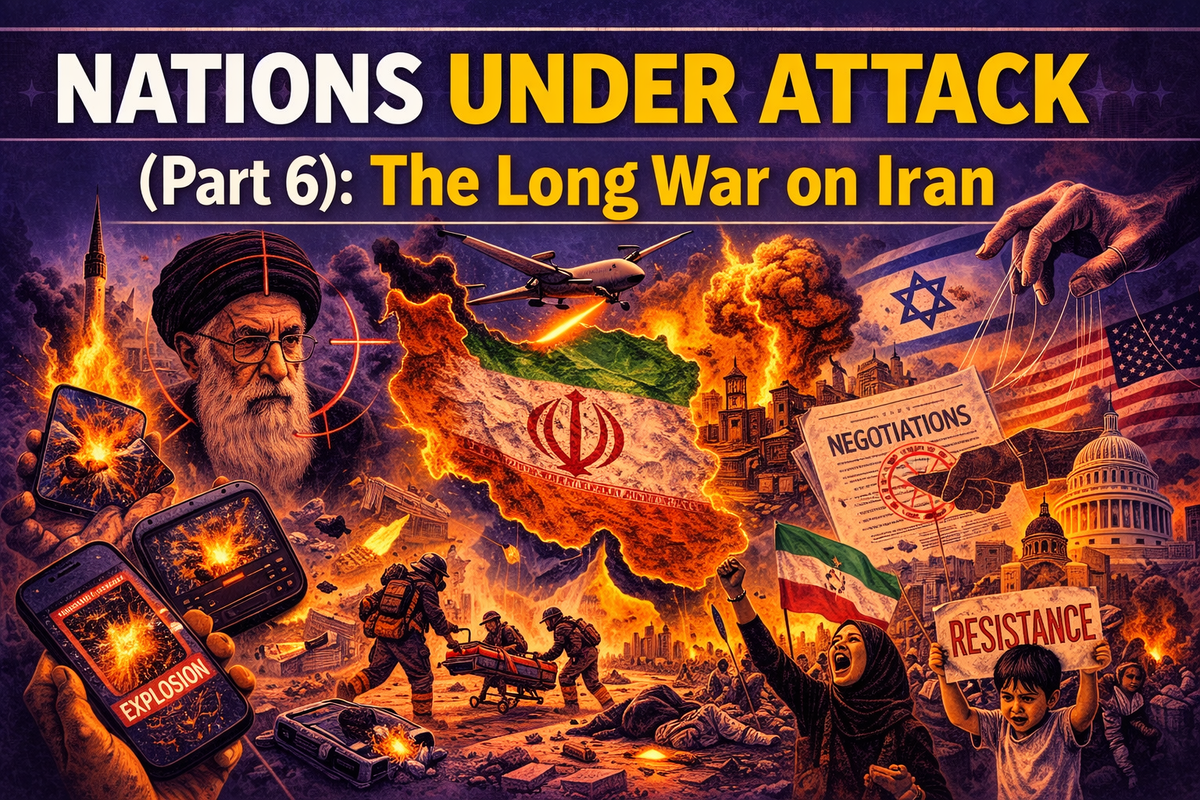
This article has been written mid-March 2026 in the immediate shadow of Operation Epic Fury. It continues the arc begun in the Nations Under Attack series on mindwars-ghosted.com: after Part 1 mapped the elite drivers and the rise of the transnational capitalist class, Part 2 dissected the US War Machine's operational toolkit, Part 3 analysed narrative as weapon, Part 4 catalogued the modular propaganda templates recycled across targets, and Part 5 examined how states resist across seven pressure points—propaganda & media control, economic warfare, arms race, terrorism, false-flag actions, military conquest, and civil-cultural subversion. This piece applies that same framework to the live war on Iran, revealing how the empire has evolved its arsenal and how the hands directing it are no longer fully concealed.
The assassination of Supreme Leader Ali Khamenei, the double-tap strikes that killed first responders rushing to the rubble, the pager explosions that turned consumer devices into mass-casualty weapons in Lebanon, the repeated pattern of "negotiations" used as targeting opportunities, and the mobilisation of far-right Islamophobia in the West to legitimise the war—all of this marks a qualitative shift. What we are witnessing is the operationalisation of what many commentators are now calling Pax Judaica: a financialised, tech-enabled world order in which Zionist strategic imperatives increasingly serve as the cutting edge of transnational capitalist domination—more to say on this aspect in a later article..
The aim here is to examines how these tactics function across seven coordinated fronts, why Iran's resistance—however imperfect—was built precisely to survive this moment, and what the unfolding war tells us about the nature of the beast we face. The same tactics roll on—deception first, decapitation second, extermination third—but so does the counter-response. Where there is organised pressure of this intensity, organised resistance of corresponding depth has already been prepared.
Disclaimer: This article does not claim to offer an authoritative or insider account of Iran itself. It is a work of pattern recognition: it applies the seven pressure-point framework first established in Parts 4 & 5 of the Nations Under Attack series (propaganda & media control, economic warfare, arms race, terrorism, false-flag actions, military conquest, and civil-cultural subversion) to documented, publicly reported events of Operation Epic Fury and the broader confrontation with Iran. The focus is on how the empire’s evolving tactics match the attack–resistance patterns traced across the series, not on comprehensive analysis of Iranian internal affairs or moral judgement of any party. Readers seeking specialist knowledge of Iran should consult primary sources or regional experts. Produced with AI assistance.
The Seven Fronts of Hybrid Warfare (The Visible Layer)
The current war against Iran is not an isolated event. It forms the latest chapter in a long sequence of actions by Western interests aimed at controlling the country's resources and strategic position, stretching back at least to the 1953 coup that overthrew Prime Minister Mohammad Mossadegh.
In 1951 Mossadegh nationalised the Anglo-Iranian Oil Company (predecessor of BP), ending British monopoly control over Iranian oil. The nationalisation was overwhelmingly supported inside Iran and was rooted in demands for economic sovereignty. Britain responded with a boycott of Iranian oil, economic strangulation, and covert planning with the United States. In August 1953, Operation Ajax — a joint CIA–MI6 coup — removed Mossadegh from office and reinstated Shah Mohammad Reza Pahlavi as an absolute monarch.
The Shah's regime, heavily backed by Washington and London, became a reliable client state. It suppressed domestic opposition through SAVAK (the secret police trained and funded by the CIA and Mossad), provided basing rights for US forces, and ensured uninterrupted Western access to Iranian oil at preferential terms. This arrangement lasted until the 1979 Islamic Revolution forced the Shah into exile and ended the monarchy.
From 1979 onward the relationship flipped to sustained hostility. The United States imposed sanctions almost immediately after the hostage crisis in November 1979, froze Iranian assets, and supported Iraq during the 1980–1988 Iran–Iraq War. The pattern continued through the 1990s and 2000s with dual containment policies, the Bush’s Axis of Evil designation (2002), and escalating sanctions tied to the nuclear programme. The 2015 JCPOA briefly eased pressure, but the US withdrawal in 2018 under Trump re-imposed "maximum pressure" sanctions that targeted every sector of the economy.
Between 2019 and the end of 2024 the confrontation intensified. Israel conducted repeated covert operations inside Iran: the assassination of nuclear scientist Mohsen Fakhrizadeh (November 2020) , sabotage at Natanz (April 2021 and July 2020) , explosions at missile facilities (2020–2024), and drone attacks on military sites. The United States maintained secondary sanctions, blocked humanitarian trade exemptions, and conducted joint naval exercises in the Gulf designed to signal readiness for escalation. Iran responded with missile and drone strikes on US bases (January 2020 retaliation for Soleimani), seizures of tankers, and support for regional proxies.
By late 2024 the stage was set. Israel's multi-front operations in Gaza, Lebanon, and Syria had already normalised high-intensity air campaigns, supply-chain sabotage (e.g., exploding pagers and walkie-talkies used by Hezbollah), AI-assisted targeting, and double-tap strikes on first responders — tactics later deployed against Iran in February 2026.
This assault is no improvisation. As detailed in the 2009 Brookings report “Which Path to Persia?”, analysed in my article dated 29 April 2025, Western strategy has long contemplated airstrikes, sanctions, and regime subversion as paths to dominate Iran. Epic Fury combines them all, with added tech layers like AI targeting. Each phase—coup and client monarchy, sanctions and proxy war, covert sabotage, open air campaign—builds on the last. Operation Epic Fury is not a rupture; it is the present expression of a seventy-year campaign.
A. Propaganda & Media Control: Manufacturing Consent for Genocide
The propaganda war against Iran operates on multiple fronts: delegitimising the state through decades of media distortion, weaponising the “nuclear threat” as a pretext for aggression, and selectively framing “terrorism” to obscure Western entanglements—a pattern refined since the 1953 coup, when Western outlets depicted Mossadegh as a "dangerous lunatic" while ignoring British exploitation.
The Nuclear Pretext: 30+ Years of False Deadlines
Central to the campaign has been the repeated accusation that Iran is on the verge of developing nuclear weapons. Benjamin Netanyahu has driven this narrative for three decades, declaring Iran "three to five years" from a bomb in 1992, warning at the 2012 UN General Assembly with a cartoon bomb, and opposing the 2015 nuclear deal as paving Iran's path to weaponisation. Each prediction proved false. IAEA assessments repeatedly confirmed Iran had no active weapons program after 2009. Days before the February 2026 strikes, Omani mediators confirmed Iran had agreed to zero enriched uranium stockpiling. Yet the narrative persisted. President Trump repeated the nuclear threat at least 74 times across 15 years, escalating before Operation Epic Fury. Secretary of War Pete Hegseth amplified the message with eschatological (end-times) overtones, framing the strikes as pre-emptive. The strikes reportedly killed more than 700 Iranian civilians, including 165 schoolgirls in Minab.
Civil Unrest: From Mahsa Amini to the Protest Information War
Mahsa Amini’s 2022 death in custody drew international attention and became widely portrayed in Western media as emblematic of Iranian misogyny. A subsequent forensic report, however, concluded that Amini died from cerebral hypoxia linked to pre-existing health conditions, including a history of brain surgery and hormonal disorders, rather than direct physical abuse. Meanwhile, enforcement of hijab rules in Iran has varied: Vice President Mohammad Javad Zarif noted in late 2025 that women in Tehran frequently do not cover their hair, and President Masoud Pezeshkian suspended a stricter hijab law citing public discontent. Independent journalists such as Maram Susli (“Syrian Girl”) and Patrick Henningsen have documented women in Tehran without headscarves, indicating that narratives of uniform state coercion are more complex than some Western portrayals suggest.
Accusations of repression in Iran persist in western media and NGO reports; execution statistics are frequently cited as evidence. Yet available case data show that most executions stem from homicide and narcotics prosecutions rather than political offenses, making the causal link between execution totals and suppression of dissent far less clear than advocacy narratives suggest. Western media reported that security forces killed many hundreds of people during the December 2025–January 2026 protests, with “Other estimates place the death toll at more than 5,000 -- and possibly as high as 20,000 -- with the internet blackout severely hampering independent verification, IHR said.” However, a number of independent analysts have characterised the protests as a failed CIA/Mossad instigated colour revolution. This latter interpretation is supported by the fact that during those protests the US covertly smuggled 6,000 Starlink terminals to circumvent the internet blackout. Iranian authorities, reportedly using Russian-supplied jammers, nullified up to 80% of satellite traffic, after which the protests subsided.
Exile politics introduces its own distortions. Diaspora media such as Iran International frequently amplify opposition voices—unsurprising given that exile communities disproportionately consist of dissidents and political refugees—while other activists insist that Iran’s political future cannot be determined from abroad.
The Terrorism Tapestry: Selective Outrage
The accusation of "state sponsorship of terrorism" is central to every Western justification for action against Iran. Iran supports Hezbollah, Hamas, and the Houthis—movements that have fought Israel through armed resistance. Yet the narrative systematically erases Western entanglement with groups that fit any definition of terrorism.
The MEK, an Iranian dissident group that fought alongside Saddam Hussein killing thousands of Iranian soldiers, was until 2012 a US-designated terrorist organisation—yet received funding, weapons, and intelligence from Israel and the US. ISIS was incubated, armed, and sustained by a coalition including NATO members, Gulf monarchies, and Israel. According to investigative journalist Gordon Duff, every NATO nation was involved, with Mossad establishing headquarters in Mosul as early as 2003. Thousands of specially modified Toyota trucks flowed into ISIS hands, paid for by Saudi funds and upgraded in Israel.
Most brazen is the rehabilitation of Hayat Tahrir al-Sham (HTS), the former al-Qaeda affiliate now ruling Syria. Until weeks before its December 2024 takeover of Damascus, HTS was designated a terrorist organisation, with leader Abu Mohammad al-Julani (now Ahmed al-Sharaa) carrying a $10 million US bounty. Within days, Western governments and media began rehabilitation: the US lifted the bounty, the UK moved to overturn HTS's designation, and media began referring to al-Sharaa as a “statesman-in-the-making.” His administration signalled willingness to drop Syria's claim to the Golan Heights, accept demilitarisation, and cut arms to Hezbollah—usefulness to Western interests outweighing his terrorist pedigree.
The framing of Yemen often contrasts Iran’s backing of the Houthi movement—which some states have designated or labeled as supporting armed actions beyond Yemen’s borders—with Western portrayals of the Saudi‑led coalition’s campaign as a legitimate intervention, even as UN and human rights bodies have repeatedly criticised coalition airstrikes for causing large numbers of civilian casualties and possible violations of international humanitarian law. The terrorism narrative is thus not a description of reality but a weapon of war. It tells us nothing about which groups commit violence, and everything about which violence serves Western interests.
B. Economic Warfare: The Financial Stranglehold
The economic war against Iran is a meticulously constructed siege sustained for over four decades. From the first sanctions imposed during the 1979 hostage crisis to the “maximum pressure” campaign preceding Operation Epic Fury, the goal has remained consistent: strangle the Iranian economy, deprive the state of revenue, and force capitulation or fracture.
The architecture was laid in November 1979 when revolutionary students stormed the US embassy. Within a year, Washington broke diplomatic relations and imposed commerce restrictions. In 1984, following the Beirut barracks bombing, the US designated Iran a “state sponsor of terrorism”—a blacklisting that remains in force today and ironically mirrored when Iran conveyed the same designation on the US in 2019. The 1995 Clinton administration ordered a total trade and financial embargo targeting Iran’s oil sector.
Sanctions War
Sanctions as “maximum pressure” were outlined in the 2009 Brookings report as a path to force concessions or collapse. Between 2010 and 2012, sanctions became surgical: Washington targeted refined petroleum imports, tightened banking access, and authorised punishment of any financial institution buying Iranian oil. The EU sanctions simultaneously banned oil purchases and froze central bank assets. Iran’s ghost tankers (shadow fleet vessels deliberately outside London insurance control) and shift to yuan settlements were direct countermeasures to this sanctions-as-coercion blueprint.
The 2015 JCPOA temporarily eased pressure, but President Trump’s 2018 withdrawal reimposed and expanded every measure. By April 2019 the Revolutionary Guards were designated a “foreign terrorist organisation”—the first such label applied to a state military force. This move was accompanied by intensified attacks on the rial: currency manipulation, SWIFT exclusion, and secondary sanctions that criminalised third-country trade with Iran.
Attack on the Currency to Foment Unrest
In January–February 2026, the siege escalated with a deliberate attack on the rial. Treasury Secretary Scott Bessent openly stated Washington had created a dollar shortage to trigger the rial’s freefall, driving inflation to 60% and sparking nationwide protests over prices, energy shortages, and pharmacy bankruptcies. The currency collapse was timed to ignite and amplify unrest: by February 2026, many protesters were reportedly killed in regime crackdowns as demonstrations spread amid internet blackouts. Iranian media blamed CIA/Mossad instigation, while the US covertly smuggled 6,000 Starlink terminals to bypass restrictions. This was no side effect; it was economic warfare weaponised to fracture internal cohesion and manufacture the conditions for escalation.
Hormuz as Response
Iran’s ultimate economic lever is the Strait of Hormuz, through which roughly one-fifth of global oil flows daily. A senior adviser to the Revolutionary Guards commander warned Iranian forces “won’t allow a single drop of oil to leave the region.” By early March 2026, ship traffic through the strait had effectively halted after five tankers were struck. Saudi Arabia’s Ras Tanura refinery suspended operations; Kuwait’s Mina Al-Ahmadi and Oman’s Duqm port were targeted; the UAE’s Musaffah fuel terminal sustained damage. Kuwait, Qatar, and Bahrain have no alternative pipeline routes—their oil is hostage to the strait.
Oil prices surged accordingly. Front-month Brent crude rose above $83 in early March, with analysts estimating oil could reach “well over” $100 if flows are not restored. Gold broke $5,300 per ounce; European gas futures nearly doubled as Qatar’s Ras Laffan—the world’s largest LNG export facility—temporarily shut down after Iranian drone attack.
The United States and Russia, as an energy exporters, gain in the short term. US crude export freight costs hit record levels as Asian buyers turn to American barrels. The losers are Asia’s oil importers. India, Thailand, and the Philippines face inflation and currency pressure. China plays the long game, privately securing discounted Iranian oil through independent refiners who buy roughly 90 per cent of Iran’s exports at steep discounts.
Effect of Weaponised Dollar
The most profound consequence may be structural. By weaponising the dollar, the United States has forced its adversaries to seek alternatives. Over 90 per cent of Russia–China trade now settles in rubles or yuan; Saudi Arabia has signalled openness to non-dollar oil trade. Iran’s Central Bank governor announced: “We have concluded a monetary agreement with Russia and have completely eliminated the US dollar.” The BRICS bloc, now including Iran, has operationalised multiple mechanisms bypassing SWIFT. President Trump has threatened 100 per cent tariffs on nations pursuing monetary alternatives, but the momentum persists. The empire depends on dollar hegemony; every yuan oil payment, every ruble–rial settlement is a crack in the edifice. Iran, the target of four decades of financial warfare, has become both the test case and the catalyst for its unravelling.
C. The Arms Race: Asymmetric Deterrence vs. Hi-Tech Precision
The physical assault on Iran spans 73 years. Operation Ajax (1953) , the CIA-MI6 coup that overthrew Mossadegh, included CIA operatives bombing a cleric's home to stir anti-communist sentiment. The 1980s brought direct clashes: Operation Praying Mantis (1988) sank two Iranian warships, killing 56; two months later, the USS Vincennes shot down Iran Air Flight 655, killing all 290 civilians aboard. Between 2003 and 2011, the Pentagon attributes at least 603 US troop deaths to Iranian-backed militias in Iraq. The covert war intensified after 2010: the Stuxnet worm destroyed Natanz centrifuges, and a decade-long assassination campaign killed nuclear scientists including Mohsen Fakhrizadeh (2020) using remote-controlled guns and complex ambushes.
The Current Attack Surface: Epic Fury
Operation Epic Fury, launched February 28, 2026, represents the culmination of this arc. US and Israeli aircraft struck nuclear facilities, missile production sites, and the compound of Supreme Leader Ali Khamenei. Within the first minute, approximately 40 senior Iranian leaders were killed. By March 7, Iran's UN ambassador reported at least 1,332 Iranian civilians killed. The Israeli Air Force flew more than 700 sorties in the first 36 hours.
Technological innovations now target Iran directly. AI programmes like “Lavender,” “The Gospel and “Where's Daddy”—which generated kill lists in Gaza—are reportedly deployed against Iranian commanders, with machine learning algorithms authorising strikes based on risk scores. The double-tap tactic, perfected in Gaza, arrived in Tehran within hours: rescue workers rushing to bombed IRGC facilities were killed by second-wave missiles. By March 3, the Iranian Red Crescent reported 105 civilian sites destroyed, including 14 health centers and 7 Red Crescent branches. Supply-chain sabotage, demonstrated by September 2024's pager attacks in Lebanon, now threatens Iranian infrastructure with mysterious failures consistent with embedded sabotage.
Iran's Asymmetric Arsenal: Missiles and Drones
Iran possesses an estimated 2,500 ballistic missiles with ranges up to 2,000 kilometres—sufficient to strike Israel and US bases across the region. Systems include the Khorramshahr, Emad, and Sejjil. During the conflict, Iran has launched more than 500 ballistic missiles and 2,000 drones. The Shahed drone, costing tens of thousands per unit, creates a devastating cost asymmetry: a 541-drone attack on the UAE cost Iran $11–27 million; the UAE spent $253–759 million shooting them down—a ratio of up to 30:1.
Iranian Responses: Retaliation and Proxy Activation
Within hours of Epic Fury, Iran struck US bases in Bahrain, Qatar, Kuwait, and the UAE, including the Navy's Fifth Fleet headquarters and al-Dhafra Air Base. The missile campaign against Israel has killed at least 10 people in Israel. Iran's proxy network activated simultaneously: the Houthis resumed Red Sea attacks; Kataib Hezbollah pledged strikes on US bases; Hezbollah fired across the Lebanese border. This distributed response is deliberate strategy: "when you remove a state's conventional deterrent, you produce a state with every incentive to fight asymmetrically, indefinitely".
Iran’s strategic genius lies in building a network that survives leadership loss. Hezbollah reconstituted command after Nasrallah’s 2024 killing and as at March 2026 is again targeting Israel with missiles; the Houthis operate autonomously; Kataib Hezbollah remains embedded within Iraq’s state apparatus. The IRGC-Quds Force maintains directorates across Asia, Europe, Africa, and the Americas—its efficacy never contingent on one individual. In the chaotic first hours of Operation Epic Fury, Supreme Leader Ali Khamenei was killed along with some 40 other leaders and his step-daughter and grandson—Mojtaba Khamenei’s wife and son—in the initial wave of strikes on Tehran. Yet within days, the Assembly of Experts—under intense pressure and with regime loyalists dominating proceedings—has elected Mojtaba as the new Supreme Leader. A known hardliner long groomed for succession, the now bereaved Mojtaba inherits a fractured but still-functioning command structure. Notwithstanding the Israeli threat to kill Mojtaba, the apparent result has been to replace an ageing moderate with a young motivated hardliner. For now, the decapitation has failed to decapitate because the system was designed to absorb exactly this kind of blow.
D. Terrorism: The Empire's Shadow War
For four decades, Iran has endured a sustained terrorist campaign. The West's definitional monopoly transforms these atrocities into “precision strikes” while Iran's retaliation is branded terrorism—a linguistic weapon serving power, not truth. The hypocrisy of this was demonstrated when in the 1980s, the CIA ran the Iran-Contra affair, secretly selling arms to Iran (despite the embargo) to fund Nicaraguan Contras illegally, exposing the selective “terrorism” label—arms to Tehran when useful, condemnation when not.
The MEK: Saddam's Terrorist Army and Its Western Rehabilitation
The most sustained terrorist campaign against Iranian civilians has been waged by the Mojahedin-e-Khalq (MEK). Relocated to Iraq in 1986, the MEK fought alongside Saddam Hussein's forces against their own countrymen during the Iran-Iraq War. According to Iranian officials, more than 17,000 Iranians—overwhelmingly civilians—have been killed by MEK terrorists since the 1979 Revolution.
The MEK's bloodiest attacks include the June 1981 bombing of the Islamic Republic Party office, which killed more than 70 senior officials including Chief Justice Mohammad Beheshti. Two months later, the group assassinated President Mohammad Ali Rajaei and Prime Minister Mohammad Javad Bahonar. In April 1999, MEK operatives assassinated Major General Ali Sayyad Shirazi, deputy chief of staff of the Iranian army.
Despite this record, the MEK was designated a Foreign Terrorist Organization (FTO) by the US State Department only in 1997—and then delisted in September 2012 following a multi-million dollar lobbying campaign featuring prominent US politicians. The delisting occurred despite the State Department's own acknowledgment that the MEK had engaged in “the killing of U.S. citizens in Iran in the 1970s and an attack on U.S. soil in 1992”. The group now operates freely from Albania, its members advocating for regime change in Tehran while enjoying Western protection.
The Assassination Campaign: From Nuclear Scientists to Commanders
The 1990s–2000s saw Operation Merlin, a CIA effort to feed false nuclear data to Iran, backfiring and exposing covert sabotage. Between 2010 and 2020, Iran suffered the systematic assassination of its top nuclear scientists in operations widely attributed to Israel, often with MEK logistical support. In January 2010, Masoud Alimohammadi was killed by a remote-control bomb outside his Tehran home. Later that year, Majid Shahriari died when explosives detonated in his vehicle. In July 2011, Darioush Rezaeinejad was shot dead by motorcycle gunmen. In January 2012, Mostafa Ahmadi Roshan was killed by a magnetic bomb.
The pattern culminated in November 2020 with the assassination of Mohsen Fakhrizadeh, chief of Iran's nuclear program, outside Tehran. A remote-controlled machine gun smuggled into Iran in pieces and assembled locally—part of an operation orchestrated by a 20-member team of Israeli and Iranian nationals—killed Fakhrizadeh and his bodyguards. A former Iranian intelligence minister later conceded that investigators were "unable to identify those who committed the crimes" in the first four assassinations.
The Double Tap Doctrine: Arriving in Iran
The double-tap tactic—striking a target, waiting for first responders to arrive, and striking again—has now been deployed against Iranian civilians. On March 1, 2026, a US-Israeli strike hit the Shajareh Tayyebeh girls' elementary school in Minab, killing approximately 175 people, most of them young children. School officials had moved students to the prayer hall for safety after the first bomb and called parents to collect them. "The second bomb hit that area as well," a paramedic said. "Some parents recognised their children only because of the gold bracelets they were wearing".
The same evening, a double-tap strike hit Niloofar Square in Tehran, where people were celebrating the end of their daily Ramadan fast. A survivor described the scene: "When the second one hit, suddenly everything exploded. One of my friends was severed in half". The Iranian Red Crescent reported by March 3 that more than 1,000 Iranian civilians had been killed in the first four days of bombing. IRCS spokesperson Mojtaba Khaledi warned the public: "Do not rush to bombed areas. The first moments after an explosion are the most dangerous—some munitions are programmed to detonate again, turning rescuers and survivors into additional victims".
The Definitional Monopoly
The linguistic framework of "terrorism" is itself a weapon of war. Iran's retaliatory strikes against US bases are labeled terrorism; US-Israeli assassinations of Iranian scientists are "precision strikes." The MEK, responsible for thousands of Iranian civilian deaths, is rehabilitated through lobbying; Hezbollah, which emerged to resist Israeli occupation, remains proscribed.
This selective application serves a clear function: the terrorism narrative "tells us nothing about which groups commit violence, and everything about which violence serves Western interests." The MEK's attacks were terrorism when they targeted a US-backed Shah; they became realpolitik when the group became useful against the Islamic Republic. The double-tap strikes killing children in Minab are investigated; the children of Gaza, killed by the same doctrine, are counted and forgotten. In this hall of mirrors, the only consistent principle is power.
E. False Flag Actions: The Architecture of Deception
The Brookings report explicitly recommends manufacturing pretexts for strikes, such as provoking incidents to justify airstrikes. For four decades, Iran has faced operations designed to frame it for attacks it did not commit, lure its leaders to their deaths under the guise of diplomacy, and manufacture casus belli for Western escalation. From Mossad's Jundallah campaign to the Soleimani assassination and unfolding 2026 provocations, the pattern reveals a consistent strategy: deception as warfare.
The Historical Pattern: Mossad's Jundallah Operation (2008–2012)
The blueprint for false flag operations against Iran was exposed in 2012, when Foreign Policy published declassified CIA memos detailing how Mossad officers posed as American spies to recruit the Sunni terrorist group Jundallah during the George W. Bush administration. The operation was a classic false flag: Israeli agents, “flush with American dollars and toting U.S. passports,” met with Jundallah officials in London to orchestrate attacks inside Iran, including the assassination of Iranian nuclear scientists and the bombing of civilians. When CIA Director of Operations Stephen Kappes reported the operation up the chain, President Bush went “absolutely ballistic”—but ultimately did nothing. Jundallah's attacks included a May 2009 suicide bombing of a Zahedan mosque that killed 25 worshippers and the December 2008 execution of 16 Iranian border guards, filmed and distributed online. The message was unmistakable: Israel would rather the world believe America was killing Iranians than reveal its own hand. This was a documented false flag—Mossad agents explicitly impersonating another nation's intelligence service to recruit a terrorist group against Iran.
Negotiations as Targeting: The Soleimani Precedent (2020)
The pattern of using diplomacy as cover for assassination reached its zenith with Qassem Soleimani in January 2020. According to Iraqi Prime Minister Adel Abdul Mahdi, Soleimani was in Baghdad at his invitation to discuss a Saudi–Iranian rapprochement mediated by Iraq. Abdul Mahdi revealed that President Trump had personally requested Iraqi assistance to open dialogue with Iran, and Soleimani's visit was a direct response to that request. The morning Soleimani was killed, he was scheduled to meet Abdul Mahdi to deliver Iran's reply to Saudi messages. Instead, he was met by a US drone strike that killed him and his delegation. The precedent—diplomacy as geolocation service—was not lost on Tehran: a leader invited for peace talks, killed while en route to deliver a diplomatic message.
Ceasefire as Kill Box: Nasrallah (2024)
The pattern repeated in September 2024 with Hezbollah Secretary-General Hassan Nasrallah. According to Lebanese Foreign Minister Abdallah Bou Habib, Nasrallah had agreed to a 21-day ceasefire proposed by the United States and France. Lebanese officials, including Speaker Nabih Berri, consulted with Hezbollah and confirmed their agreement, informing US and French intermediaries that Hezbollah was on board. White House senior adviser Amos Hochstein was scheduled to travel to Lebanon to finalise the arrangement. Days later, Israeli bunker-busting bombs killed Nasrallah and over a dozen commanders in their Beirut headquarters. A Western source confirmed Hezbollah had agreed to the truce shortly before the US proposal was publicly released. The Biden administration later retreated from pushing the ceasefire once they learned Israel might attempt the assassination. The evidence confirms Nasrallah was killed while engaged in ceasefire negotiations—a documented instance of diplomacy preceding assassination.
Regional False Flags in Real-Time (March 2026)
The current war has unleashed a cascade of alleged false flag operations requiring verification:
- Azerbaijan Drone Attack (March 3, 2026): Azerbaijani President Ilham Aliyev condemned drone strikes on the Nakhchivan exclave that injured civilians and damaged the airport terminal, blaming Iran and calling the attack an "act of terror" and "shameless". Tehran denied involvement, suggesting it was an Israeli false flag designed to drag Baku into the war. Israeli Foreign Minister Gideon Sa'ar immediately condemned Iran's "overt and deliberate aggression" against Azerbaijan. Status: Unverified. Iran denies responsibility; no independent evidence confirms either claim.
- Saudi Oil Facility Strikes (March 2026): Iranian news agency Tasnim reported that strikes on Saudi Arabia's Ras Tanura refinery were an Israeli "false flag operation," citing an intelligence source who claimed Israel seeks to frame Iran. The same source alleged the UAE's Fujairah port was also a target of Israeli false flag planning. Status: Unverified. Iranian state media assertion; no independent confirmation.
- Qatar Mossad Arrests (March 2026): Tucker Carlson claimed that Qatari and Saudi authorities had arrested "Mossad agents" planning bombings, describing it as an unreported "fact". Qatar's Foreign Ministry spokesperson Majed Al-Ansari explicitly denied the claim, stating Doha has "no information about Mossad cells operating in the country". Status: Likely False. The allegation was denied by Qatari officials. Notably, Qatar simultaneously announced the arrest of two IRGC-linked cells involved in espionage, detaining 10 suspects.
The Al-Aqsa Threshold: Eschatological False Flag (March 2026)
The most dangerous alleged false flag scenario involves the Al-Aqsa Mosque. On March 6, 2026, Iran's ABNA news agency, citing an official at Iran's Ministry of Intelligence, reported that Israeli authorities had begun evacuating Jewish residents around the Al-Aqsa compound in preparation for a “false flag” missile strike that would be blamed on Iran. The report claimed the “Netanyahu gang” planned to exploit such an attack to turn Arab nations against Iran ahead of Quds Day. Status: Unverified. The claim originates from Iranian intelligence sources and has not been independently confirmed. Given the sensitivity of the Al-Aqsa site and the catastrophic consequences of its destruction, this alleged plot—if true—represents the ultimate false flag, capable of igniting a religious war.
Iran's Counter-Narrative
Tehran has learned from four decades of false flags. Its officials constantly warn that US and Israeli aims are to “disintegrate and divide” the country, pointing to CIA efforts to arm Kurdish groups, Mossad's long entanglement with Jundallah and MEK, and the pattern of negotiations-as-traps. This view finds support in Israeli commentary. The history of deception is central to Iran's counter-propaganda war—not because it excuses domestic repression, but because it accurately identifies the architecture of the empire's shadow war.
F. Military Conquest: The Impossible Victory and the Proxy Architecture
The actions against Iran over some 49 years now have taken the form of a succession of proxy wars, which is ironic given the incessant accusations of Iran being a destablising state employing terror through proxies itself. From US-backed chemical attacks in the Iran-Iraq War to today's open bombardment, military conquest has been a constant threat. Iran's response was not to build a conventional army capable of meeting the Pentagon head-on, but to forge an alliance of resistance—Syria, Hezbollah, Hamas, the Houthis—when combined with its BRICS ties, each is alliance designed to defer and and insulate the country from military engagement. As its stands, the current actions against Iran under Epic Fury were made possible by removal of the Assad government in Syria and a perception that both Hamas and Hezbollah had been successfully neutralised.
The Iran-Iraq War: America's Chemical War Against Iran
The longest and most destructive military campaign against modern Iran was the 1980–1988 Iran-Iraq War, in which the United States actively supported Saddam Hussein's war machine. When Saddam invaded Iran in September 1980, he did so with US encouragement and strategic backing. The CIA provided Iraq with satellite intelligence identifying Iranian troop concentrations, which Saddam used to target chemical weapons attacks.
The chemical weapons themselves had American origins. US companies exported biological warfare materials to Iraq throughout the 1980s, including anthrax, botulism, and other pathogens. The Atlanta-based Centers for Disease Control sent 14 biological agents “with warfare significance” to Iraq between 1985 and 1989. When Saddam used these weapons against Iranian soldiers and civilians—employing 101,000 chemical munitions during the war—the Reagan administration blocked UN condemnation of Iraq and falsely implied Iranian use of chemical attacks on its own people.
US military support was extensive: Washington provided $200 million in arms (1983–1990), funneled $5 billion in loans, and escorted Iraqi oil tankers through the Gulf while US warships attacked Iranian oil platforms and navy vessels. In July 1988, the USS Vincennes shot down Iran Air Flight 655, killing all 290 civilians aboard—the US Navy's official “human error” explanation remains contested.
The Architecture of Resistance – Iran's Forty-Year Hedge
From this devastation, Iran built not a proxy network but an alliance of resistance. Hezbollah's arsenal (150,000 rockets), Yemen's Ansarallah (the Houthis), Iraq's Kataib Hezbollah, and Hamas are not mercenaries taking Iranian orders; they are movements with indigenous roots and shared strategic objectives. Hezbollah was born fighting Israel's 1982 invasion; Hamas emerged from the occupation; the Houthis rose against Saudi-backed authoritarianism. Iran provides support, but these are genuine allies with their own constituencies and command structures.
This architecture was designed precisely to survive leadership decapitation. Khamenei's death has not paralyzed the network and his role as Supremem Leader was soon filled by his son’s election to the role; within days of Epic Fury, Hezbollah launched missiles into Israel, Houthis resumed Red Sea attacks, and Kataib Hezbollah pledged strikes on US bases. Yet the alliance shows the strain of the concerted US/Israeli actions taken to undermine it: Syria's loss as a logistical hub and Nasrallah's 2024 assassination have eroded coordination.
The Greater Israel Project
The ideological driver behind this escalation is Greater Israel. In February 2026, US Ambassador to Israel Mike Huckabee told Tucker Carlson that it would be “fine” if Israel expanded “from the Nile to the Euphrates”—encompassing Lebanon, Syria, Jordan, Iraq, and parts of Saudi Arabia, Turkey, and Egypt. Fourteen governments condemned the remarks as a “grave threat” to regional stability. Netanyahu has openly embraced this vision, telling an Israeli interviewer he feels “very much connected to the map of the Promised Land”; Israeli soldiers even bear an arm-patch signifying it. Former Prime Minister Naftali Bennett has declared: “Turkey is the new Iran”, illustrating how the war on Iran is but a step in a much larger project.
What Epic Fury Actually Destroyed
US-Israeli strikes have damaged nuclear infrastructure, missile factories, and command nodes. What remains intact: Hezbollah's tunnel networks, Houthi launchpads capable of closing the Bab al-Mandab Strait, and the social embeddedness of Iraqi militias within state security apparatuses. The nuclear program—always the headline threat—was never the primary strategic instrument. The alliance of resistance was.
Amid this, the Gulf States are fragile; the region possesses only 1% of global renewable freshwater while hosting 6% of the world's population. Gulf countries import 85–90% of food and rely on energy-intensive desalination. No major rivers flow through them; aquifers are rapidly depleting. As of mid-March 2026, Dubai has ten days of fresh food left after the closure of the Straits of Hormuz cut off imports. One drone strike on a desalination plant could collapse a nation. The American missile security umbrella has been shown to be a mirage—and Iran knows exactly where to strike.
G. Civil & Cultural Subversion: The War on Identity
For decades, Iran has faced an organised campaign to sever its people's faith from their national identity, using foreign-funded media, NGOs, and cultural seduction to alienate youth and foment unrest from within. Tehran's response—fortifying cultural space, criminalising foreign ties, and framing resistance as a civilisational duty—reveals both the depth of the threat and the limits of the remedy, as rigid enforcement of culture often provokes resistance that undermines the very norms it seeks to protect. The Epic Fury strikes—supposedly aimed at “liberating” the people of Iran—have paradoxically galvanised hundreds of thousands of Iranians into the streets and public spaces, mourning, protesting, and demonstrating visible support for the government. Rather than eroding legitimacy, the actions of the US and Israel have reinforced public solidarity in the face of an external enemy.
The Empire's Cultural Arsenal: Funding Dissent, Manufacturing Rebellion
Since at least 2009, the United States has funneled hundreds of millions into Iran's internal opposition under the guise of democracy promotion. The 2025 US budget allocated $268.4 million for “independent media and free flow of information” before Trump froze foreign aid, funding over 30 Iran-focused outlets including BBC Persian. Former culture minister Ataollah Mohajerani estimated USAID alone gave $60 million to Iran's opposition. In 2023, USAID funded 6,200 journalists, 707 non-state outlets, and 279 media NGOs across 30 countries, including Iran—groups like the Boroumand Center and IranWire.
The State Department's Near East Regional Democracy (NERD) program has spent $65–85 million annually since 2009, allegedly to support civil society but documented by Iranian intelligence as infiltrating minority communities and staging "mock national referendums" to simulate dissent. The National Endowment for Democracy (NED), founded in 1983 as a US government-funded non-profit historically linked to the CIA, has long supported Iran-focused regime change initiatives. Leaked documents obtained by The Grayzone reveal that after retiring in 2021, former NED head Carl Gershman sought to channel US State Department resources into a private “Iran Freedom Coalition,” composed of pro-Western Iranian activists and neoconservative operatives advocating military action against Iran. This initiative attempted to consolidate control over grassroots protest movements by positioning US-backed exiles as the movement’s international leadership.
The Seduction of Youth: Liberal Values as a Weapon
The cultural war targets Iran's youth most aggressively. Western media frames the struggle as young Iranians “flinging off their hijabs” against “cruel mullahs,” portraying any resistance to Western values as primitive oppression. These narratives are amplified on social media by expatriate voices—both real and assumed. Yet Tehran-based observers note a more complex reality: women now ride motorcycles without headscarves, attend underground concerts, and navigate a legal landscape where enforcement of hijab rules has become markedly inconsistent. The West's monolithic narrative—of a nation yearning to be saved—serves propaganda, not truth.
Tehran's Counter-Strategy: Fortifying the Citadel
Iran's response has been to fortify every cultural entrance. Since 1979, the state has developed domestic internet platforms (Aparat, Bale, Soroush) to replace Western social media, enforced foreign-agent laws targeting NGOs, and framed Western culture as decadent and corrupt. The October 2025 "anti-infiltration" bill criminalised cooperation with foreign media, requiring prior intelligence approval for academics or commentators to give interviews abroad. Even transmitting photos or videos to Persian or English-language outlets outside Iran became punishable by prison. Films financed by foreign entities were declared illegal, targeting directors who rely on international festival prizes.
The crackdown intensified after the January 2026 protests, when authorities imposed the harshest media restrictions in decades—internet blackouts, whitelisting access only to approved outlets, and surveillance drones hovering outside apartment windows to identify protesters chanting from their homes.
The Brittleness of Survival
Yet the strategy is brittle. Over-hardening risks alienating the urban youth the regime most needs to persuade; insufficient hardening invites collapse. The January 2026 protests demonstrated this tension: when Fars News opened comment sections, readers flooded the site with angry remarks aimed at the government, forcing moderators to shut comments down entirely. Even state-approved newspapers like Etemad could only publish casualty figures authorised by officials—widely seen as fractions of the real numbers.
The government's “anti-infiltration” legislation has drawn criticism for expanding espionage definitions to include social media activity—following, liking, or commenting on accounts “affiliated with the Zionist regime” can now be prosecuted as a criminal offense. Legal scholars warn the law's vague language risks prosecuting ordinary citizens instead of actual agents, making it “a tool to prosecute ordinary people at the bottom of society.”
This is the balance of evils that defines the cultural war. Every measure Iran takes to insulate its youth from foreign influence lays it open to accusations of repression; every Western-funded NGO that amplifies dissent provides the regime with evidence of foreign conspiracy. The attack strategy is precisely to force this trade-off—to make survival indistinguishable from tyranny in the eyes of the world, while making openness indistinguishable from surrender in the eyes of the state.
Conclusion: The Visible War and the Path Ahead
Operation Epic Fury has laid bare the visible layer of a sustained war for global hegemony: a meticulously coordinated assault across seven fronts that combines air supremacy, narrative saturation, economic strangulation, covert decapitation, false-flag deception, proxy attrition, and cultural subversion. What began as “precision” strikes on nuclear sites quickly revealed itself as a broader campaign of terror and attrition—double taps on rescuers, pager-style supply-chain sabotage, AI-driven family targeting, and selective terrorism labels that shield allies while demonising resistance.
Yet, so far Iran has endured—and it likely to continue doing so. Its forty-year architecture of distributed deterrence—proxies that function without central command, missile reserves that survive initial salvos, economic rerouting through yuan and gold, and cultural hardening that turns siege into unifying identity—has been built precisely for this moment. Survival is not victory; it is denial of the hegemon’s clean win. Civilian suffering is immense, repression is real, and the costs are brutal—but the regime still stands.
This visible war is only the surface. Beneath it lie the containment of China and the hidden convergence of a transnational elite that profits from managed chaos.
Recognition of the pattern is the first act of refusal.