Personal Perspectives: Part 4. The Deconstruction
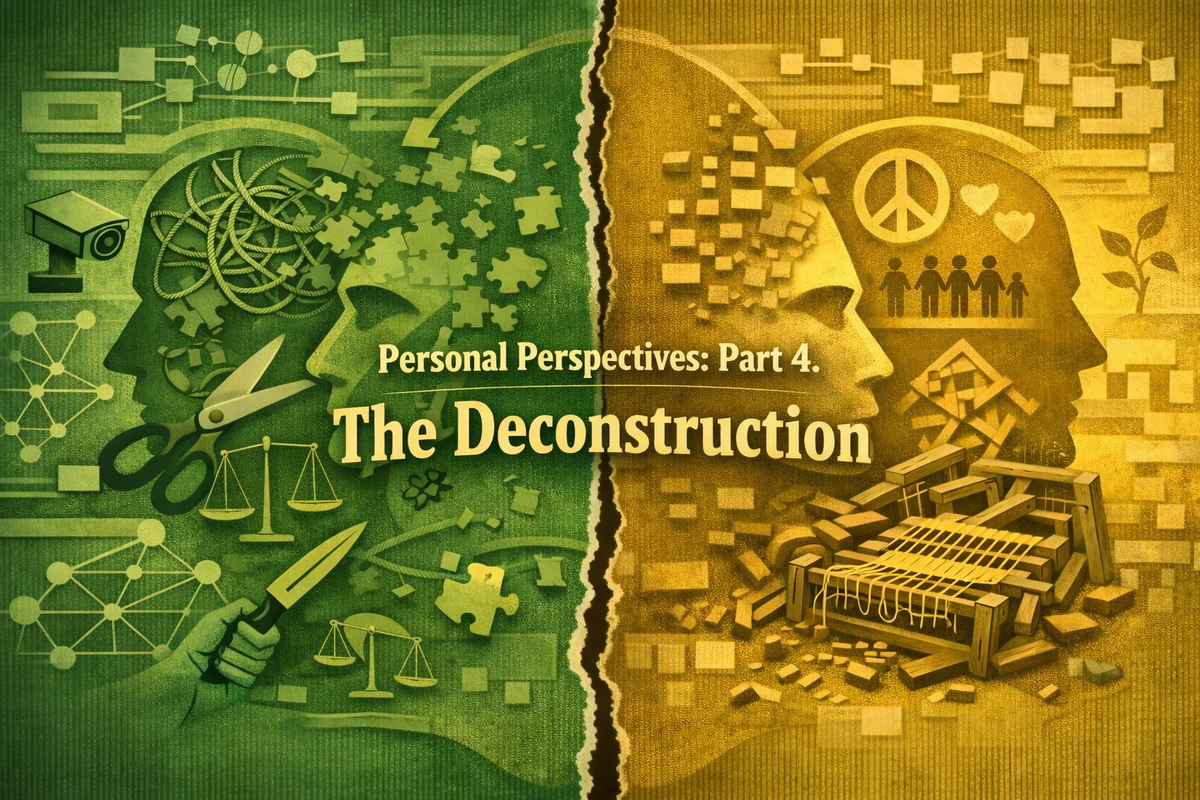
Following on from Part 3, losing faith in the West as a benevolent force was just the start of a journey of unwinding and re-examining past understandings of the shape of the world and events we have been taught. As they say, “He who writes history makes history” and, more often than not, that history is the winner’s story.
The COVID-19 pandemic marked a definitive turning point. Initially I believed the story. The first crack was a man falling in Wuhan. Footage looped on news networks—proof of a population dropping in the streets. People falling dead don't crumple in slow motion with their hands out to break the fall, then lie still in a position suggesting arrangement. The man in Wuhan fell like theatre. Then came fogging trucks sanitising empty streets. You don't disinfect open air and building frontages for a virus. Performance for effect.
Then encountering contrarian scientific voices—the Great Barrington Declaration, researchers questioning lockdowns—and found this strange enough to investigate. What we found shook us: decades of mask research showed little to no protection against respiratory viruses. The CDC's own May 2020 review of ten randomised controlled trials concluded no significant reduction in influenza transmission. Yet governments and media suddenly insisted masks were essential. The official narrative, we realised, was built on shaky foundations—or outright falsehoods.
By October 2020, I'd written two weblog articles: “COVID-19 — Facemasks and Psychologists” and “Notes on the COVID-19 Pandemic.” The first documented the lack of mask efficacy and the role of behavioural psychologists in engineering compliance—the UK's SPI-B explicitly tasked with breaking and remaking social norms. The second traced PCR test flaws, manipulated death statistics, and the economic and geopolitical context.
I used these articles as a test, sending them to friends and family. Most didn't respond. Some dismissed: “Cherry-picking.” “You're not a scientist.” One intelligent friend wrote: “I trust the scientists. I'm not going down that rabbit hole.” He hadn't read a word. The narrative had already decided what counted as worthy of attention. The facemask article became a gauge of who could still think, still question. The results were devastating. Most could not. Fear had paralysed the masses. The act of offering the test cost me relationships I'd assumed solid.
The PCR revelations were worse. Kary Mullis, who developed the method, had warned against using it diagnostically. Cycle thresholds varied between labs—35, 40, 45 cycles. The higher the count, the more likely false positives. After 35 cycles, Mullis asserted, more than 95% of positive tests would be false positives—too much genetic code is shared across organisms. A positive result couldn't distinguish live virus from dead fragments cleared weeks earlier. The virus itself had never been truly isolated. The PCR test was designed from a genetic sequence—a computer model posted online—before any physical sample had been validated. That sequence was uploaded, and the WHO adopted the test in three days. No questions asked. The foundation was sand.
Cases were counted not as clinically sick people but as positive tests. Asymptomatic “cases” multiplied. The UK instructed doctors to record COVID-19 as cause of death for anyone testing positive or showing symptoms—no autopsy required. DNR orders were issued for people over 45. Patients moved from hospitals to care homes seeded deaths. The rules later adjusted to a 28-day window, but the bias remained. It seemed no longer possible to die of old age in the United Kingdom. Midazolam and respirators in the UK, remdezivir and respirators in the US. Some 95% of those put on a respirator died—mostly elderly and infirm—all counted as covid deaths.
The psychologists arrived with their charts and campaigns. Dominika Kwasnicka of Melbourne University spoke of breaking social norms, comparing mask mandates to seatbelt campaigns—ignoring that seatbelts had evidence, masks did not. Behavioural scientists were tasked not with evaluating evidence but with engineering consent. I came across Biderman's Chart of Coercion, developed for prisoners of war: Isolation, Monopolisation of Perception, Induced Debility, Occasional Indulgences, Threats, Degradation, Enforcing Trivial Demands. Quarantine mapped to isolation. Constant case coverage mapped to monopolised perception. The floor dots, the QR codes—trivial demands training compliance. The toolkit was recognisable mind control and social compliance theatre.
In early 2021, we found others. A small group of sceptics in Brisbane, met through a cryptocurrency network, became a lifeline. We gathered for picnics, shared meals, quietly resisted—walking into supermarkets without masks or QR scans, exchanging knowing looks with unmasked checkout workers, “Nice to see your smiling face.” At the first Brisbane protest rally, we nervously approached the Botanical Gardens resolved to walk on by if it was a flop. Four thousand people had gathered. My wife burst into tears. People replete with the obligatory masks scowled from balconies as the unmasked protesters passed. By late 2021, marches swelled to 150,000. Public sentiment shifted—people clapped from café tables. Yet many still clung to the narrative.
It was during this period of painful retreat—after the articles had been sent, the relationships frayed, the conversations fallen silent—that I began to read differently. Not for confirmation, but for the architecture of events. These new understandings were later reflected in my 2025 articles on Event 201 and Crimson Contagion. Not conspiracy theories, but institutional artefacts: rehearsal schedules, after-action reports, funding flows, participant lists. Event 201, staged weeks before the pandemic, had gathered the very figures who would later steer the global response—Gates, Hopkins, the World Economic Forum—to simulate a coronavirus outbreak and rehearse its management. Among them was Australia's Jane Halton: narrative architect of the children overboard Tampa psyop, bank director, sister-in-law to Victoria's Chief Health Officer, and wife of a senior figure at the Australian Bureau of Statistics. Crimson Contagion, run across 2019 by the US Department of Health and Human Services, had tested federal override mechanisms, legal pre-emption, and the collapse of local authority under pandemic pressure. These were not predictions. They were preparations—scripts written, actors cast, stages lit before the virus arrived. Reading them, I understood that what I had taken for chaos was choreography; what I had experienced as confusion was, for someone, a plan unfolding. The falling man in Wuhan, the fogging trucks, the behavioural psychologists, the PCR tests counting nothing—all of it snapped into focus as execution, not accident. I was not watching a pandemic. I was watching a simulation activate.
As a group we researched vaccines, finding control groups disbanded, adverse events excluded, placebos that weren't placebos. Negligible absolute efficacy. We shared findings; friends refused to engage. We over-shared with family; our urgency came across as conspiracist alarmism. We realised we couldn't “save” everyone. The propaganda was too refined, the compliance too deep. We stepped back, grieving that loved ones might be harmed through turning to official voices that reassured them—offered social conformity and acceptance.
What began as a health crisis became a crisis of truth—rewiring our understanding of authority, trust, and freedom.
This unravelling didn't stop at the pandemic. Once you see one system construct reality to serve power, you see it everywhere. I began tracing the architecture beneath events—economic, geopolitical, societal.
The 2008 financial crisis had never been resolved, only papered over. By August 2019, the Federal Reserve was rescuing overnight bank markets. The pandemic enabled the largest wealth transfer in history: the US CARES Act printed $7 trillion; only $1.5 trillion reached the population. The rest went to investment banks, toxic debt, failing corporations. BlackRock was placed in charge of US Treasury operations. Globally, nations depleted reserves, turned to the IMF—the IMF chief predicted a $345 billion financing gap for Africa alone, debt burdening future generations, imposing austerity.
Geopolitically, the pandemic weakened China, disrupted supply chains, accelerated decoupling. The Wuhan lab, blamed for releasing the virus, had been funded and staffed in part by US institutions. Gain-of-function research on bat coronaviruses had been transferred there after being banned in the US. Then we started questioning the whole of virology—but that’s another story.
And then there was the Great Reset—the World Economic Forum's openly published programme for societal re-engineering, never voted on. “Build Back Better,” Agenda 21, the Fourth Industrial Revolution—language permeating official responses. The Rockefeller Foundation's 2010 paper “Scenarios for the Future of Technology and International Development” outlined four futures. The first, “Lock Step,” anticipated a pandemic producing rising authoritarianism and tighter population controls. Reading it in 2020 was like reading a blueprint.
This pattern—agenda driving science, not science driving agenda—became unmistakable. It explained the shifting narratives I'd lived through.
I remembered the 1970s “global cooling” scare. Newsweek warned of “a new ice age.” Scientists spoke of catastrophic cooling. Then, by the 1980s, it became “global warming.” Then, when temperatures didn't cooperate, “climate change.” Then “climate change driven by CO2”. Each iteration adjusted the story to fit the agenda, the science manufactured to serve the narrative.
The thread led to the Club of Rome. Their 1972 report “The Limits to Growth” wasn't about environmental protection—it was about population control. The underlying goal, traceable through their publications and those of affiliated organisations, was eugenics: reducing global population, particularly in the developing world, to preserve resources for elites. Climate change became the perfect vehicle—a moral panic that justified carbon taxes, reduced consumption, deindustrialisation, and population management under the guise of saving the planet.
The science was made to fit. Computer models, not empirical data, drove predictions. Inconvenient evidence—like medieval warm periods warmer than today—was ignored or explained away. The agenda drove the science, not the reverse.
This is why my focus shifted to the artefacts of the systems themselves. Not the surface debates about temperatures or CO2 levels, but the think tank reports, the government policy papers, the media narratives crafted to shape perception. Documents from RAND, Brookings, Chatham House—analysed for discourse, power, intended audiences. The Geopolitika custom GPT I developed was designed to deconstruct these narratives, to show how language projects specific worldviews to shape policies and actions.
The pandemic revealed the machinery. Climate change operates the same way. Both are managed narratives, constructed to maintain stability for the few while extracting compliance from the many.
What I've lost across these years is the comfort of not seeing. There is loneliness in watching loved ones choose stories that cost them nothing while you carry the weight of what those stories obscure. But there is also clarity—not the brittle certainty of the convert, but the quieter discernment that comes from watching too many narratives collapse to trust any fully.
I don't know who ultimately designed the architecture, or whether it emerged from coordinated intention or convergent interests. But I know the questions now. I know that power, left to its own devices, constructs the reality that serves its continuation. I know that agendas drive science, not science agendas. I know to look at the artefacts—the think tank reports, the policy papers, the manufactured media narratives—because that's where the real architecture reveals itself.
The pandemic did not create these logics. It revealed them. From a man falling like theatre in Wuhan to the Club of Rome's eugenicist origins driving climate policy, the pattern is consistent: reality is managed, narratives are constructed, and the task of the awakened mind is to see through to the machinery beneath.
Which brings me to Karl Rove. In 2004, he was interviewed by The New York Times Magazine about the Bush administration's approach to reality. The reporter, Ron Suskind, wrote that a senior adviser—later identified as Rove—told him:
“We're an empire now, and when we act, we create our own reality. And while you're studying that reality—judiciously, as you will—we'll act again, creating other new realities, which you can study too, and that's how things will sort out. We're history's actors... and you, all of you, will be left to just study what we do.”
I'd read that quote years ago and filed it away as political cynicism. Now I understood it as a mission statement. The falling man in Wuhan, the behavioural psychologists engineering compliance, the PCR tests counting cases that weren't cases, the climate models predicting catastrophes that refused to arrive, the Club of Rome's eugenicist dreams dressed as environmentalism—all of it was the creation of reality by those powerful enough to impose their constructions on the rest of us.
We are left to study what they do. But studying is not the same as accepting. Deconstruction is not the same as defeat.