Geopolitika: Fabians Epilogue – What the Fabian Wolf Really Is
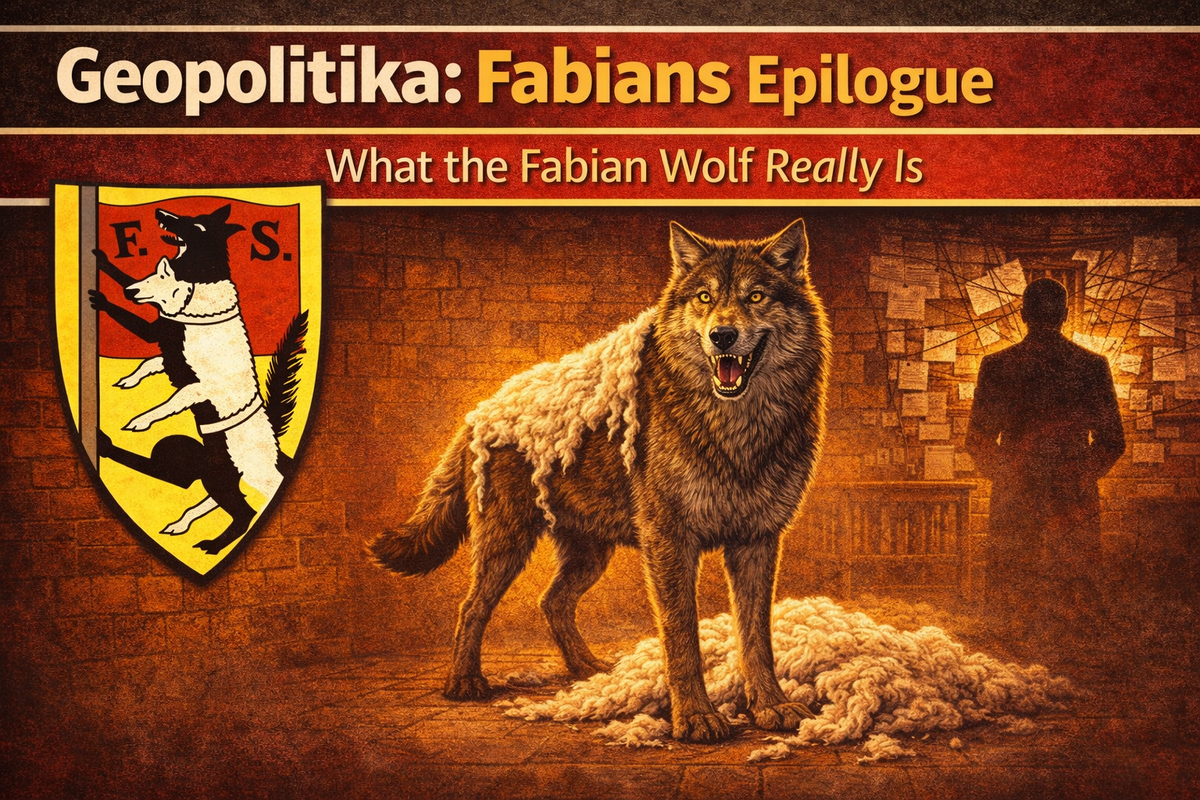
Throughout the seven-part Geopolitika: Fabians series and the deeper examination of Tony Blair, I have been haunted by the spectre of the wolf in sheep’s clothing. If what we see is the sheep—the friendly, public face of gradualism, ethical values, and expert reform—then we are left with a fundamental question: What, then, is the nature of this wolf?
Unexpectedly, the analysis across thirty years of Blair’s output reveals a predator that is not what it first appears to be.
The Wolf Is Not a Person
The first thing the analysis reveals is that the wolf is not Tony Blair. Blair is a vehicle—a particularly effective one—but a vehicle nonetheless. The grammar he deployed predates him; it will outlast him. The Fabian Society was publishing Sidney Webb’s “permeation” strategy a century before Blair’s 1994 pamphlets. The Tony Blair Institute will continue after Blair. In fact, the wolf is not any of the people we have examined—not Starmer, not Albanese, not any of the people we see. No, in essence, it is hard to escape the conclusion that the wolf is the institutional grammar itself: expert-led, elite-managed, populations spoken about, alternatives foreclosed, history selectively curated, the archive managed to produce coherence.
Here “grammar” does not mean the rules of sentence construction taught in high school English. It means the underlying architecture of language and thought: the recurring patterns of assumption, framing, omission, and positioning that shape what can be said, what must be left unsaid, and what counts as legitimate knowledge. It is the software that organises how arguments are built, histories are curated, voices are included or excluded, and power is made to appear natural.
Blair’s genius—and it is a certain kind of genius—was to understand that the grammar required a charismatic vehicle. Webb wrote tracts; Blair performed. The 1994 pamphlets are dry; the 1997 Town Hall is televised. The 2003 Congress speech is a performance of moral certainty. The “guy in Nevada” is a character Blair invents to make destiny feel intimate. Blair did not change the grammar. He translated it for the screen.
The Wolf Does Not Believe Its Own Rhetoric
The second revelation is that the wolf does not believe the sheep’s clothing is real. What is revealed is a system that operates through strategic omission, not sincere conviction. Blair’s 1995 speech on Clause IV claims to be “telling the truth about what we believe.” But the truth the speech tells depends on omitting the full text of Clause IV, the 1945 manifesto’s radical commitments, the achievements of 1970s Labour governments, and the democratic mandate for common ownership. The “truth” is curated.
The 2003 Congress speech claims “history will forgive” if the intelligence is wrong. But by July 2003, Blair knew no WMD had been found. The speech does not engage with that knowledge. It shifts the ground from empirical truth to moral courage. It is not necessary for the wolf to believe the clothing is real. It only needs the sheep to believe.
The 2026 antisemitism article claims to defend “reason” and “facts.” But the article omits the Chilcot Inquiry, the ICJ proceedings, the pre-October 7 blockade, and Blair’s own Iraq record. The claim to reason is a performance of authority, not an engagement with evidence.
The Wolf Is Not a Conspiracy
The third revelation is that the wolf is not a conspiracy. The analysis reveals normative isomorphism and institutional habit, not coordinated conspiracy. The Fabian Society does not issue directives. It publishes papers. Blair does not need to receive orders from a shadowy cabal. He inherits the grammar. The same reasoning patterns appear across Blair, Starmer, and Albanese not because they coordinate but because they share an intellectual lineage and a community of understanding. The false dilemma, the appeal to authority, the straw man, the managed polarity—these are not plot points. They are habits of mind, institutionalised over generations.
This makes the wolf harder to name and harder to confront. A conspiracy can be exposed. A grammar must be unlearned.
The Wolf Feeds on Silence
The fourth revelation is that the wolf feeds on the silence of the populations it claims to represent. The voice gaps identified across the corpus are not incidental. They are structural. The Fabian grammar speaks about its subjects, not from them or even to them—omitted are the working class, Iraqi civilians, Palestinians, Gazans, Afghan civilians, public service workers, Jewish anti-occupation voices, Muslim communities. It never speaks from them.
The wolf does not need to silence the sheep. The sheep have been taught that their voices do not count as knowledge. The working class in Webb’s Industrial Democracy is an object of study, not a subject with expertise. The Iraqi civilian in Blair’s 2003 Congress speech is an abstraction—“these oppressed people”—not a person with a name. The Palestinian in Blair’s 2026 antisemitism article is absent entirely, subsumed under “the suffering of Gaza” without agency or voice.
The wolf’s power is epistemic before it is political. It determines what counts as knowledge, who counts as an authority, which histories count as relevant. The sheep’s silence is not enforced. It is assumed.
The Wolf Is Afraid of Its Own Shadow
The fifth revelation is that the wolf is afraid. The systematic omission of the Iraq war from every post-premiership text is not the confidence of a predator. It is the terror of a system that cannot survive its own exposure. The same pattern repeats across multiple policy failures we have examined: the long-term costs and liabilities of PFI contracts, the hollowing out of public service ethos through market “partnerships,” the human and strategic consequences of the Iraq intervention itself, and the incremental erosion of democratic voice in favour of elite management. The Fabian grammar has no mechanism for genuine accountability because accountability would require admitting that the project went wrong—not in isolated mistakes, but in its core logic. So the failures are erased. The archive is curated. The dead, the indebted, and the disempowered are not mentioned.
In the 2005 victory speech Blair acknowledged Iraq as “a divisive issue” and immediately pivoted to unity: “I hope now that we can unite again and look to the future.” The call for unity was a call for silence. The wolf cannot afford for the sheep to ask what happened in Iraq, what happened to the 179 British soldiers, what happened to the hundreds of thousands of Iraqi civilians — or, later, what the true long-term costs of PFI would be for future generations of taxpayers and public services. The wolf cannot answer those questions. So it asks that they not be asked.
The Wolf’s Vulnerability
The final revelation is that the wolf’s vulnerability is the voice gap it depends on. The populations spoken about—the working class, Iraqi civilians, Palestinians, Gazans, Afghan civilians, public service workers, Jewish anti-occupation voices, Muslim communities—do not disappear. They wait. Their absence from the archive is not their absence from the world.
The wolf does not need the sheep’s clothing when the sheep have been taught not to speak. But the sheep are not sheep. They are people. And people have a habit, over time, of finding their voices.
The question the grammar cannot answer is not a theoretical one. It is a practical one, waiting to be answered not by analysts but by those who have been spoken about for too long. The wolf’s fear is that one day, the silence will break. And when it does, the grammar will have nothing to say. Because the grammar was never designed to listen.
—
Published via Mindwars Ghosted.
Geopolitika: Tracing the architecture of power before it becomes the spectacle of history.
Methodology note: This Fabians series synthesises multiple analyses of Fabian Society texts. All sourced material is publicly available. The analysis was assisted by AI tools using custom-built analytic protocols. Base analytic outputs are available on request.
Mindwars Ghosted is an independent platform dedicated to exposing elite coordination and narrative engineering behind modern society. The site has free access and committed to uncompromising free speech, offering deep dives into the mechanisms of control. Contributions are welcome to help cover the costs of maintaining this unconstrained space for truth and open debate.
If you like and value this work, please Buy Me a Coffee