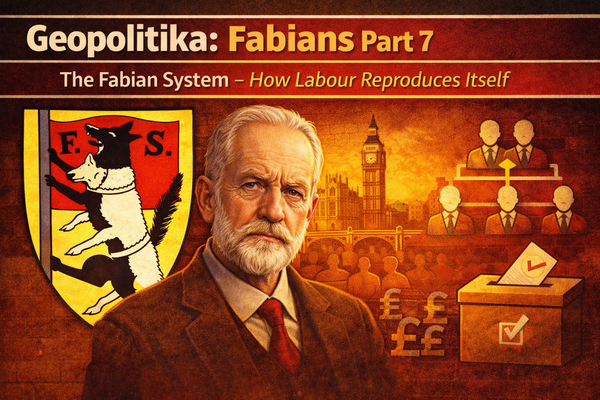
Geopolitika: Fabians Part 3. How Britain's “Socialist” Think Tank Legitimates the Defence Establishment

This is the third part of a series examining the Fabian Society—Britain's oldest socialist think tank, founded in 1884 by Sidney and Beatrice Webb as the intellectual engine of gradualist "permeation." Part 1 examined the institution's own self-portrait: the curated history that acknowledges its imperial and eugenicist past while framing it as safely historical. Part 2 traced the arc of George Bernard Shaw, the archetypal Fabian, from the democratic gradualism of the 1889 Fabian Essays to the anti-democratic eugenicist rupture of the 1903 Revolutionist's Handbook—revealing the instability of a politics built on expert management.
Part 3 turns to a contemporary Fabian Society product. What does the “permeation” strategy produce when applied to UK defence policy? Beneath the surface—what interests are foregrounded, who is being spoken to, and who is excluded.
This is not a review of whether the paper's proposals are good or bad. It is an examination of what the paper reveals about the institution that produced it—and what happens when a strategy built to influence power forgets the people it claims to represent..
The Surface Story
On 4 March 2026, the Fabian Society’s website published a policy commentary on Britain's delayed Defence Investment Plan. Hard Wired by Josh Arnold-Foster, argues that the standoff between the Ministry of Defence (MoD) and the UK Treasury can be resolved through better planning, smarter cost assessments, and learning from European allies. It reads as a measured, insider-focused brief—concerned with making the system work more efficiently.
The paper names genuine pathologies: “optimism bias” in MoD procurement, Treasury rules that penalise personnel over equipment, over-reliance on US technology. It proposes procedural reforms within existing frameworks. It cites Treasury guidance approvingly, compares UK personnel numbers unfavourably with European allies, and suggests repurposing frozen Russian assets.
On the surface, this is sensible reformism from a centre-left think tank with deep Labour Party connections. But beneath that surface, the paper performs a more complex function—one that becomes visible only when we examine what it assumes, what it excludes, and who it addresses.
What Would a Shop Floor Unionist Make of This Paper?
Put yourself in the shoes of a union steward—not in defence, but in a different industry. You work in a hospital, or a school, or on the railways. You've been elected by your mates to represent them. You deal with the daily realities of your job: pay and conditions, health and safety, the constant pressure for productivity, the gap between management rhetoric and shop floor reality.
You pick up Hard Wired, a Fabian Society paper on defence spending. What do you make of it?
To be clear: a defence worker might see things differently. For the roughly 0.4 per cent of the UK workforce employed directly in defence—around 100,000 to 130,000 people—more spending could mean job security, overtime, maybe even better pay. With supply chains included, the figure rises to perhaps 300,000 jobs, still around one per cent of the workforce. That's not nothing, but it is a specific interest. For the other 99 per cent of working people, the trade-offs look different.
But from where you stand—outside the defence sector—the paper's priorities are harder to recognise as your own.
The first thing that strikes you is the language. RAB. RDEL/CDEL. DIP. “Cost-effectiveness analysis.” “Social value assessment.” This is not the language of the shop floor. It's the language of management, of civil servants, of the people who make decisions about you without ever asking you. The paper is written for them, not for you. You're not the audience; you're the subject.
You flip through it looking for something relevant to your daily life. Pay? No. Conditions? No. Job security? Not really—“investing in and on shoring the necessary industrial capabilities” is mentioned, but that's a policy abstraction. Health and safety? Nothing. The right to organise? Not a word. Defence workers appear exactly once, indirectly, as “industrial capabilities”—reduced from people with agency to a resource to be managed.
You notice that Unite union is mentioned approvingly:
“Our Ukrainian and European allies, Unite and other unions, many party members, and much of the British public, hope that the forthcoming defence investment plan will demonstrate that both the legendary disputes between different military services within MoD and the complex debates between senior MoD and Treasury leaders have been at least partially resolved.”
But no union voice appears. You're being name-checked for political cover, not consulted for your knowledge.
And then there is the money. The paper notes that the difference between 3 per cent and 3.5 per cent of GDP on defence is £13.5bn. That is not Monopoly money. That is your hospital's budget, your school's funding, your railway's maintenance backlog. Every pound spent on tanks is a pound not spent on the things you, your mates and your family rely on every day. The paper never acknowledges this trade-off. Defence is treated as exceptional, exempt from the normal politics of resource allocation.
This gap—between a paper that claims to speak for workers and the actual experience of working outside a sector that employs less than one per cent of the workforce—raises a question that runs through everything that follows: what happens when the left stops listening to the people it claims to represent?
The Scripted Architecture
Institutional Lineage and Audience
As explored in Part 1, the Fabian Society was founded in 1884 by Sidney and Beatrice Webb, architects of gradualist “permeation”—the strategy of working within existing institutions to slowly steer policy toward reform. The Webbs built institutions designed to produce generations of experts who would occupy positions of power: the London School of Economics (LSE), the New Statesman, the society itself.
Hard Wired is permeation in action. Its readers are not the labour movement. They are the policy professionals, the shadow ministers, the journalists and advisors who constitute the ecosystem of New Labour and its contemporary heirs. The paper speaks their language—“resource account budgeting (RAB),” “the split between resource and capital departmental expenditure limits (RDEL vs CDEL)”—because it wants to be heard in their rooms. It is written by an expert for other experts, circulating in the narrow circuit of Westminster think tanks and parliamentary briefings.
But permeation has a cost. To be heard in those rooms, you must accept their terms. You cannot question whether the Treasury should control defence spending. You cannot ask whether NATO serves British interests. You cannot centre the voices of those who build the weapons, because they are not in the room.
The Fabian name carries weight. When a Fabian report criticises Treasury rules or US technology dependency, it creates the impression that the left is engaging seriously with defence. This impression is valuable to the defence establishment. A critique from the left that stays within mainstream parameters authenticates those parameters. It shows that even progressives accept the basic framework.
Foundational Assumptions
Hard Wired assumes, without argument, that increased defence spending is necessary. It assumes NATO membership is permanent and beneficial. It assumes Treasury control over the fiscal framework is legitimate—even as it critiques specific Treasury rules.
Consider how the paper discusses Treasury guidance:
“The latest Treasury spending guidance explicitly recognises this, calling for the application of ‘appropriate adjustments for optimism bias’ including, amongst other things, ‘increasing estimated costs and timeframes, and decreasing estimated benefits’.”
The Treasury is presented as the rational actor, the source of wisdom. The framework is accepted; only its application is questioned.
These are not the priorities of the labour movement. Nowhere will you find the concerns that organise working-class life: fair pay, safe conditions, secure employment, the right to collective bargaining. The paper is interested in the machinery of state, the efficiency of procurement—not in whether defence workers can afford their rent.
These are boundary markers that define who belongs in the debate. To accept them is to meet entry requirements. If you question them—if you ask what defence spending means for the people who do the work—you are outside. The Fabian Society, with its leftist credentials, helps enforce these boundaries.
Binary Structure
The following table illustrates binary structure of the positions being argued:
Pole A | Pole B | Work Done | Who's Excluded |
MoD (optimistic) | Treasury (disciplined) | Positions Treasury as rational actor | Defence workers |
UK (lagging) | European allies (ahead) | Creates pressure for UK action | Those bearing costs |
Current rules | Reformed rules | Frames reform within system | Those needing structural change |
As discussed in Part 1, the society's chosen emblem—a wolf in sheep's clothing—announced this strategy of concealment. In every case, the debate is between elite actors—departments, nations, policy frameworks. The working class was never meant to appear. They are not a pole in any opposition because they are not recognised as relevant. The working class is the background against which elite debate occurs, not a participant in it.
The Hidden Levers
Behavioral Design
The paper is engineered to influence its readers. European personnel numbers are made vivid:
“France currently has about 200,000 regulars and intends to increase its reservist personnel to 100,000 by 2035. The German government wants to increase its regular personnel to 260,000. Poland intends to increase its regulars from 215,000 to 300,000 by 2039. Why do UK ministers seem to disagree with our key European allies?”
The numbers create normative pressure: allies are increasing, Britain is lagging.
The £24 billion in frozen Russian assets is presented as a pool of money waiting to be claimed:
“...why should British taxpayers be content with only using the interest from these funds?”
The question makes alternative funding sources salient.
Early passages adopt a technocratic tone, establishing credibility. Later sections introduce urgency:
“Given the accelerating threats to UK national security, addressing these problems swiftly must be attempted.”
The question makes alternative funding sources salient.
Early passages adopt a technocratic tone, establishing credibility. Later sections introduce urgency: “Given the accelerating threats to UK national security, addressing these problems swiftly must be attempted.”
The closing biblical quotation: “Every kingdom divided against itself is brought to desolation”— Matthew 12:25 lends moral weight, framing Treasury-MoD unity as a matter of existential consequence.
These techniques show how the paper works on its readers—readers who are assumed to share its assumptions. Those readers are not defence workers. They are the policy class.
Reasoning Patterns
The paper's argument is structured by recurring logical moves that shape what readers can conclude—and what they are prevented from questioning:
- False dilemma: The core framing presents a binary: either Treasury and MoD resolve their disputes through better planning, or defence problems will continue. The paper opens by noting “ongoing delays provide an opportunity to think further about some of the problems that have long beset attempts to implement defence reviews.” The implied solution is better planning within the same framework. This excludes the possibility that the Treasury-MoD relationship itself might require fundamental restructuring. It also excludes the possibility that defence workers might have something to say.
- Straw man: “Why do UK ministers seem to disagree with our key European allies about the need for an increase in military personnel numbers?” frames ministerial divergence as irrational without examining alternative strategic rationales. Different threat assessments might justify different force structures. By framing divergence as inexplicable, the paper implies a policy conclusion (increase numbers) without defending it.
- Selective appeal to authority: The paper cites Treasury guidance approvingly—on “optimism bias,” on “social cost-effectiveness analysis”—even as it critiques Treasury rules. This immunises the critique against charges of fiscal irresponsibility. But it ensures the critique never questions whether Treasury should have this authority at all.
These patterns are not neutral argumentative tools. They actively foreclose the questions that would lead outside the paper's carefully bounded frame—including the most basic one: why should those who do the work have no voice in how it is organised?
The Human Cost
One group is entirely absent: the people who do the work. Defence workers appear only as “industrial capabilities.” Military personnel are numbers not voices. The paper states:
“At the moment, the UK has about 147,00 regular and 30,000 reservist service personnel; only 'when funding allows' will these numbers be allowed to increase.”
No service member describes what it's like to serve with current personnel levels. No defence worker discusses pay or conditions.
This is a hierarchy of knowledge. Expert analysis ranks above lived experience. Policy professionals know what workers need better than workers do.
The paper mentions Unite union approvingly but quotes no union voice. The labour movement is reduced to a name-check. Its knowledge, its organising experience—irrelevant. The experts know best.
Taxpayers are also voiceless. The paper notes that:
“...the difference between 3 per cent and 3.5 per cent may seem minimal, but if British GDP is around £2,700bn, it does constitute a £13.5bn gap.”
But every pound spent on tanks is a pound not spent on health, education, housing. Defence is treated as exceptional, exempt from trade-offs.
This is a class position. It assumes working people will pay for whatever the defence establishment deems necessary, without debate, without democratic input. But the reasoning flaws and selective inclusions/exclusions create gaps and points of conflict within the document.
Fractures and Flashpoints
The paper's own arguments contain tensions it cannot resolve. These are not oversights. They are structural contradictions—points where the logic of reform within existing frameworks breaks against the limits of those frameworks:
- Sovereign capability claimed / US technology dependency acknowledged:
The paper advocates “investing in and on shoring the necessary industrial capabilities we need for our sovereign national security” while noting that “the costs of acquiring advanced US technology have, at times, outweighed the marginal benefits, as well as creating gaps in the UK's defence tech and industrial capabilities.” This exposes a structural contradiction. The paper notes it but does not resolve it—because resolving it would require questioning the US alliance itself. - European numbers compared / UK strategic posture unexamined:
The paper presents European figures and asks why UK ministers disagree. It never examines whether different strategic postures justify different numbers. The people who would become those increased numbers have no voice. - Treasury rules critiqued / Treasury authority accepted:
The paper criticises specific rules—“What incentive do defence planners have to build up large numbers of cheap drones if Treasury-imposed RAB regulations define these as stockpiles and penalise MoD for holding them?”—while appealing to Treasury guidance as authoritative. This paradox is never resolved because resolving it would require questioning Treasury's authority. For workers, this is daily reality: rules that constrain their lives are made by people who have never done their work.
These fractures are not incidental. They are symptoms of something deeper. Each contradiction marks a point where the paper's reformist logic encounters a limit it cannot cross—not because the authors are insufficiently clever, but because the limits are structural. To resolve the contradictions would require questioning the frameworks the paper accepts as given: the US alliance, the Treasury's fiscal authority, the strategic assumptions behind European personnel comparisons. The paper cannot ask these questions because its entire function is to operate within them.
What lies beneath these fractures is not a set of errors to be corrected but a system of dynamics that reproduces itself regardless of which party is in power or which reforms are attempted.
The System Beneath
The paper treats Treasury-MoD friction as a problem of planning and culture—something better processes can fix. But the dynamics it describes are not isolated failures. They are embedded in deeper structures that reform within existing frameworks cannot reach.
Feedback Loops:
The Treasury-MoD relationship is not a linear chain of cause and effect. It is a set of circular dynamics where today's solutions become tomorrow's constraints:
- A balancing loop constrains personnel spending: Treasury caps what must be funded from taxation, MoD requests exceptions, Treasury denies, numbers stay flat, pressure builds, cycle repeats. The paper notes: “There is also a longstanding Treasury dictat that spending on people (resource spending) must be funded from taxation.”
- A reinforcing loop drives procurement problems: MoD planners are optimistic, programmes underfunded, costs overrun, capability gaps emerge, pressure builds, optimism persists.
These are not technical problems to be solved by better planning. They are expressions of deeper structures—the fiscal regime, the procurement culture, the alliance framework. The paper acknowledges both loops but proposes solutions that work within them. Worker voice never enters the loop.
Boundary Choices:
What the paper sees—and what it does not—is determined by where it draws its lines:
- Spatial: Euro-Atlantic. Global South security perspectives, non-aligned defence postures excluded. Workers in the Global South affected by UK arms sales invisible.
- Temporal: Near-term. Slow variables—decades-long trajectory of UK-US relations, industrial decline, demographics, climate—invisible. Workers whose futures are shaped by these trends never register.
- Sectoral: Defence alone. Opportunity costs—what is foregone in health, education, climate—never appear. Workers who need hospitals expected to accept defence comes first.
- Actor: Elites only. The defence industry is never named. No company examined. Who profits from current arrangements? Completely invisible. Workers know who their employers are. The paper does not.
- Knowledge: Expert only. Lived experience excluded.
Slow Variables Ignored:
The paper treats the present as the relevant timeframe. But the problems it addresses are shaped by slow-moving trends that operate over decades. UK dependence on US technology is product of post-war alliance structures, industrial policy choices stretching back to the 1950s. The Treasury's fiscal framework is embedded in administrative routines accumulated over generations.
These slow variables constrain what is possible. The paper's proposals would operate within parameters set decades ago. Increasing personnel numbers within the existing fiscal framework does not change that framework. Diversifying procurement within the US alliance does not alter underlying dependency. Workers experience this as the eternal return of the same problems.
The Networks Behind
The Fabian network—LSE, New Statesman, Labour Party connections, the revolving door between think tanks and government—is an active mechanism of elite reproduction. Young policy professionals enter, learn the language, absorb the assumptions, make the connections. Years later, they become the officials the network exists to influence.
Hard Wired trains readers in acceptable critique. It shows what questions to ask and which to leave unasked. It is pedagogy for the policy class—a class that does not include defence workers.
The network's leftist identity is essential. A critique from the left, authenticated by the Fabian name, shows that the bounds are reasonable—that even progressives accept them.
As discussed in Part 1, the society's close organisational ally, Labour Friends of Israel (LFI), overlaps and shares political alignment. Both patrol boundaries acceptable to the establishment. This is why the defence establishment tolerates Fabian interventions. They patrol the left boundary of acceptable debate. They absorb energy that might otherwise go toward fundamental challenges—including challenges from the labour movement.
The Real Stakes
The paper's preferred solutions carry costs it does not count. Increasing personnel numbers would require significant funding. The £13.5bn gap between 3% and 3.5% of GDP is noted, but not where the money would come from or what would be foregone.
The costs will be paid by working people—through taxation, through cuts to other public services. The benefits will flow to defence contractors like BAE Systems and Rolls-Royce, to Israeli firms such as Elbit Systems that supply drone and surveillance technology to the UK, and to a growing raft of newer AI and tech defence companies whose names rarely appear in parliamentary debates. The paper never asks whether this distribution is fair.
US technology dependency benefits specific companies—Lockheed Martin, Boeing, Raytheon—and the US state. It costs UK taxpayers, UK defence workers. The paper notes costs but never names beneficiaries. Naming them would require analysing the political economy of the transatlantic alliance—a step too far for reformist discourse.
Repurposing £24 billion in frozen Russian assets sounds radical. But the paper never asks who would control that money, how it would be spent, or the legal and financial implications of this appropriation. The assumption is that the defence establishment would receive it. This is not democratic control. It is the state seizing money to give to itself and its favoured “stakeholders.”
Where Does That Leave Us?
The paper is published by an institution that calls itself socialist, founded to serve the Labour movement. Its target readers are the policy professionals, shadow ministers, and influencers of New Labour—the layer that manages the system on behalf of those who own it. Its assumptions reflect elite priorities, not worker concerns. Its binaries exclude workers from the frame.
But these silences are also the fracture—the point where the paper’s claim to represent the left breaks apart. Because the workers it excludes still exist. They still build the weapons, serve in the forces, pay the taxes. And they are not fooled by name-checks.
What the fracture reveals:
- The paper’s audience occupies a specific class position: These are the advisors, civil servants, and experts who translate between political power and administrative reality. They are not the owners of capital—the defence contractors, the financiers who ultimately benefit—but they serve those owners, managing the state on their behalf.
- The paper never names those owners: It never mentions BAE Systems, Rolls-Royce, Babcock. It never examines their profit margins, their executive pay, their political influence. It never asks whether the £13.5bn gap might flow to shareholders rather than workers. The instrumental wealth—those who own and profit—remains invisible.
This exclusion is not limited to British workers. The same boundary operates globally. Defence supply chains stretch into factories in Eastern Europe, South Asia, and beyond; UK arms exports reach conflict zones where local workers and communities bear the human cost; NATO-standard procurement decisions ripple through allied and non-aligned economies alike. None of these workers—neither the British shop steward nor the overseas machinist whose labour subsidises the system—appear in the frame. They remain objects of policy, never subjects with voice or agency.
This is not an oversight. It is the condition of the paper’s existence. To name the beneficiaries, domestic or international, would be to ask questions the paper cannot answer within its reformist framework. It would require analysing the class interests that defence spending serves. It would require centring the workers and working class people—British and global—who are currently excluded.
The fracture is visible in the questions the paper cannot ask—and that the Sage myth the institution still projects cannot contain:
- Who are the defence contractors profiting from current arrangements? What are their profit margins, their executive pay, their political donations?
- How do these companies influence policy—through lobbying, through think tank funding, through the revolving door between industry and government?
- What do defence workers themselves—in Britain and in the countries whose labour and security are shaped by UK policy—identify as priority needs? What would they say if asked?
- Why does a “socialist” think tank produce analysis that excludes workers, both domestic and international, and ignores the companies that profit from their labour?
- How does the society’s historical role in managing decolonisation relate to its current role in managing defence policy while excluding defence workers at home and abroad?
Those questions mark the limit of the mythos. They are the point at which the expert-management model, inherited from Shaw’s time and still operating under a left brand, begins to fracture under its own assumptions. Part 4 will examine how this focus shapes the Fabian Society’s approach to local democracy.
Published via Mindwars Ghosted.
Geopolitika: Tracing the architecture of power before it becomes the spectacle of history.
—
Methodology note: All quotes from the Fabian Society paper are drawn from the document itself, which is publicly available materials from the fabians.org.uk. The analysis and composition was assisted by AI tools using a suite of custom-built analytic protocols. Base analytic outputs are available on request.
Mindwars Ghosted is an independent platform dedicated to exposing elite coordination and narrative engineering behind modern society. The site has free access and committed to uncompromising free speech, offering deep dives into the mechanisms of control. Contributions are welcome to help cover the costs of maintaining this unconstrained space for truth and open debate.
If you like and value this work, please Buy Me a Coffee