Mindwars: The Consequences Factory – The CONSPIRACY_FX Hub
Manufacturing the case for the psychological management of inconvenient scepticism.
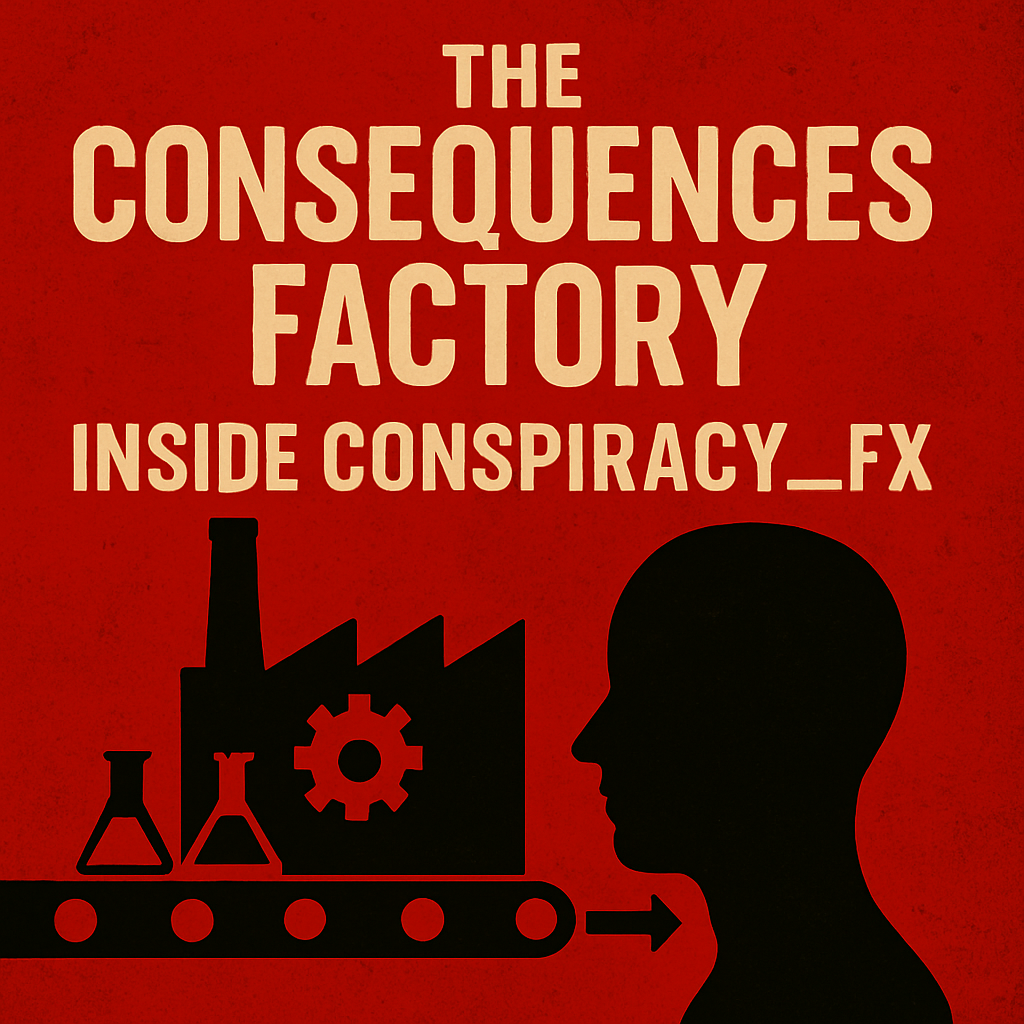
So far, the Mindwars has mapped the anatomy of a modern control system focused on the “Conspiracy Theorist” construct as a psychological category. We began by exposing the BBC’s media treatment of it in Conspiracyland, showing how a range of propaganda techniques are deployed to bypass evidence. We then moved to academia, where Hornsey – Constructing Conspiracy Theorists revealed the diagnostic blueprint: a methodology designed to pathologise the claimant, not test the claim. In our latest instalments, Fluoridating the Rabbit Hole and Open, Preregistered… and Wrong Question we saw this blueprint executed in New Zealand, particularly against people opposing stat mandated fluoridation of their water supplies; The Original Sin extended on this to show how a psychological assessment tool becomes the vehicle to cement the “conspiracy theorist” as a stable, pathologised identity.
These Northern Hemisphere and Antipodean hubs are not isolated; they are nodes in a coordinated network focused on the psychology departments in universities across the UK, Germany, USA, Australia and New Zealand. A deeper dive brings us to the central administrative coordinating hub of the entire operation: CONSPIRACY_FX. This is a visit to the factory office where the funding diagnostic blueprints are drawn, the production quotas are set, and the entire pipeline—from academic labelling to policy intervention—is centrally managed.
The Planning Office — A Formal Introduction
Before we audit the machinery, let the hub introduce itself in its own words. CONSPIRACY_FX presents as a research project investigating what it calls the “consequences” of conspiracy theories. Hosted at the University of Kent and backed by a €7 million European Research Council (ERC) grant, its stated purpose is to address a perceived knowledge gap: despite “significant interest,” there has “never been a systematic investigation” of when, how, and why these theories actually impact society. It is significant that the ERC website features a series of research initiatives on the topic in the context of combatting misinformation and protecting democracy from populist movements—an oxymoron if ever there was one, and one that exposes the political nature of the endeavour. It is difficult to escape the conclusion that the grant was awarded to solve a problem that the political establishment had already defined: growing public disbelief in official institutions. This transforms CONSPIRACY_FX from a free-ranging scientific inquiry into a service provider for the technocratic state. Its job is to produce the intellectual and scientific justification for policies aimed at managing public cognition in these specific, sensitive areas.
In this context, the CONSPIRACY_FX project explicitly targets three “key contexts” where scepticism challenges official policy: politics, vaccination, and climate change. It also pledges to examine “the consequences for the persons who spread them, particularly politicians and other elites.”
CONSPIRACY_FX is headed by Professor Karen Douglas as Principal Investigator, supported by around 5-6 postdoctoral researchers and PhD students. Its strategic direction is guided by an Advisory Board that centres some of the key names in the field we’ve been tracking:
- Matthew Hornsey (Professor and University of Queensland) – Research interests are the psychological motivations for people to reject scientific consensus, with a particular emphasis on the psychology of climate change scepticism and vaccine hesitancy; psychology of why hostility emerges between nations, religions, ideologies etc.; and why people believe in conspiracy theories, the consequences of conspiracy theories, and strategies for reducing their negative impacts.
- Stephan Lewandowsky (cognitive scientist at the University of Bristol) – research explores people’s responses to misinformation and propaganda, and how corrections affect our memory, why people reject well-established scientific facts, such as climate change or the effectiveness of vaccinations, and the potential conflict between the architecture of our online information ecosystem and democracy.
- Joseph Uscinski (Professor of Political Science at the University of Miami) –coauthor of American Conspiracy Theories (Oxford, 2014) and editor of Conspiracy Theories and the People Who Believe Them (Oxford, 2018) and a textbook, coauthored with Adam Enders, Conspiracy Theories: A Primer.
- Stef Aupers (Department of Communication Science, KU Leuven, Brussels) – specialising in digital culture and the sociology of knowledge, whose research examines how conspiracy theories and post-truth identities are produced and governed within digital media ecosystems. His work critically analyses both grassroots conspiracist communities and the institutional actors who define and police “disinformation.”
- M R. X. Dentith (Associate Professor of Philosophy at Beijing Normal University’s International Center for Philosophy) – specialising in the epistemology of conspiracy theories and social epistemology. Research defends particularism—the position that conspiracy theories should be evaluated individually on their evidential merits rather than dismissed categorically as irrational beliefs.
The hub maintains its production schedule through regular Writing Retreats held in the “beautiful Kent countryside,” where team members and collaborators from related projects like PSY_POL gather for “collaboration, discussion and work on emerging ideas and papers.” These retreats are supplemented by a guest speaker series that imports clinical perspectives - such as talks on “clinical applied approaches” and “vulnerability” to conspiracy beliefs - while exporting intervention frameworks about “reducing conspiracy beliefs.”
The output is exactly what the blueprint would predict: academic papers measuring psychological antecedents, correlating them with social harms, and proposing interventions like “prebunking.” These feed into news items on the project site about “fighting fire with fire” and “holiday conversations about conspiracy theories.”
Completing this ecosystem is “The Conspiracy Kitchen” - an interactive website that reduces conspiracy theories to a game. By randomly combining “protagonists,” “actions,” and “motives,” it frames serious inquiry into power as a trivial exercise in “cooking up” absurd narratives. This is the public-facing expression of the hub’s underlying logic: scepticism as entertainment rather than legitimate investigation.
The Unexplained Tension: The Dentith Anomaly
A review of the Advisory Board reveals a profound and unexplained tension: the presence of M R. X. Dentith. Their research defends particularism—the philosophical position that conspiracy theories should be evaluated on their individual evidential merits rather than dismissed a priori as a category of irrational belief.
This stance is fundamentally at odds with the generalism that structurally underpins the CONSPIRACY_FX operation. The project’s core machinery—through instruments like the CMQ and the GCB scale—relies on treating “conspiracy belief” as a stable, measurable psychological trait, explicitly bypassing the truth-value of any specific claim. Dentith’s philosophy, if operationalised, would dismantle the very assembly line they are advising.
This creates a critical, unanswered question: What is the functional role of a particularist in a generalist machine?
Several speculative, but logical, interpretations arise:
- The Token of Legitimacy: Thier inclusion may serve as a defensive citation, granting the project a veneer of philosophical diversity and intellectual rigor. It allows CONSPIRACY_FX to pre-emptively rebut charges of blanket dismissal by pointing to a particularist on its board, even if their core premise is structurally excluded from the research model.
- The Containment of Critique: By placing a leading particularist inside the tent, their dissenting voice may be neutralised. Their presence on an advisory board for a multi-million-euro generalist project could be used to de-fang their broader critique, framing the generalist approach not as a fundamental error, but as one legitimate methodology among others, thereby legitimising it.
- An Unexplained Paradox: It may simply be an unaddressed contradiction at the heart of the project—a sign of internal philosophical incoherence rather than strategic cynicism. The hub may believe it can simultaneously pathologise a category of belief while claiming to take each instance seriously, without recognising the fundamental incompatibility of these goals.
Regardless of the intent, the material effect is the same: the outputs show that Dentith’s particularism remains philosophically noted but operationally inert. The architecture of the pipeline—the grants, the diagnostic tools, the published output—is overwhelmingly generalist. “Token” seems to be the logical conclusion.
The Hub and Assembly Line: Centralised Production of a Diagnostic Blueprint
CONSPIRACY_FX is, at its core, a project of vertical integration. It consolidates a €7 million ERC grant, a multi-disciplinary team, and a large database of studies, positioning itself as the definitive source for a once-scattered field. This centralisation is not merely administrative; it is strategic. By creating a common language and accelerating research, the hub establishes a single, authoritative voice on its subject. The project’s stated aim—to “discover when and how conspiracy theories are influential”—is precisely targeted at the arenas where public scepticism most directly challenges official policy: “politics, vaccination, and climate change.” This is not an open-ended inquiry; it is the consolidation of a standardised diagnostic framework for policy-relevant dissent.
The intellectual output of this centralised hub is a streamlined, three-stage production line:
- Antecedents (The Psychological Profile): The process begins not with evidence, but with diagnosis. Standardised psychometric scales like the Conspiracy Mentality Questionnaire (CMQ) and Generic Conspiracy Beliefs (GCB) scale are used to identify and score the “conspiracy theorist” personality profile.
- FX (The Catalog of Harms): This profile is then algorithmically correlated with a pre-determined list of real-world “consequences,” such as vaccine hesitancy, reduced civic trust, or radicalisation potential. The focus is exclusively on the social effects of belief.
- Interventions (The Prescribed Cure): The pipeline culminates in the development and recommendation of behavioural “solutions,” primarily “prebunking” and “inoculation” techniques designed to immunise the public against the “pathogen” of wrongthink.
The operational effect is a diagnosis-first approach that systematically bypasses factual adjudication. By the time a specific claim enters this system, it is already pre-framed by the psychological traits of its believers and the social damages it supposedly causes. The fundamental question of public discourse—“Is this claim true?”—is meticulously shifted to a managerial one: “What damage does believing it cause, and how do we stop it?” This is the core product manufactured in the CONSPIRACY_FX hub: not truth, but a ready-to-deploy protocol for the psychological governance of dissent.
The Output Audit: The Published Product of the Pipeline
The true function of CONSPIRACY_FX’s machinery is crystallised in its tangible output. An audit of the hub’s publications reveals a production line manufacturing the very diagnostic and interventional products the blueprint calls for. The research is not a scattered inquiry; it is a targeted, systematic execution of a three-stage process.
1. Antecedents: The Psychological Profile in Action
The foundational stage of the pipeline is abundantly evidenced, focusing on creating a detailed psychological portrait of the “conspiracy theorist.” The output pathologises the claimant by linking belief to a range of pre-existing individual deficits:
- “Emotion dysregulation and belief in conspiracy theories”
- “A threat-complexity hypothesis of conspiracy thinking... of financial strain, disempowerment and paranoia”
- “Does lower psychological need satisfaction foster conspiracy belief?”
- “Victims of conspiracies? An examination of the relationship between conspiracy beliefs and dispositional individual victimhood”
The consistent narrative is that conspiracy belief is a symptom of internal psychological malfunction—a failure to regulate emotions, a manifestation of paranoia, or an unmet psychological need.
2. FX: The Catalogue of Harms as a Political Checklist
The second stage—correlating the “conspiracy mentality” with a pre-defined list of social “harms”—is equally prolific. The research exclusively catalogues consequences that align with challenging official policy, thereby validating the need for intervention. The harms are not open-ended discoveries but confirmations of a pre-set political agenda:
- For Vaccination & Climate Policy: “Science under suspicion: Antecedents and consequences of science-related conspiracy beliefs”; “Denialist vs Warmist Climate Change Conspiracy Beliefs...”
- For Social Cohesion & Trust in Governance: “The Interplay Between Economic Hardship, Anomie, and Conspiracy Beliefs in Shaping Anti-Immigrant Sentiment”; “Democracy and belief in conspiracy theories in New Zealand”; “Belief in conspiracy theories and satisfaction in interpersonal relationships”
- For Security Policy: “From conspiracies to insurgence: Understanding the path from conspiracy beliefs to political engagement...”
- For Moral & Civic Standing: “Stronger conspiracy beliefs are associated with a stronger tendency to act dishonestly and an overestimation of others’ dishonesty”
This is not a study of consequences; it is the assembly of a charge sheet. Each paper adds another count to the indictment of the “conspiracy theorist” identity, proving its cost to the very policy areas CONSPIRACY_FX was founded to protect.
3. Interventions: The Prescribed Cure Rolls Off the Line
The pipeline culminates in its stated goal: developing and testing behavioural solutions. The output here shifts from diagnosis to prescription, aiming to “inoculate” the public against wrongthink:
- “Fighting fire with fire: Prebunking with the use of a plausible meta-conspiracy framing”
- “Engaging with conspiracy believers”
- “The appraisal model of conspiracy theories (AMCT):... understand emotional and behavioral reactions to conspiracy theories”
The language is explicitly clinical and mechanistic. The public is a body to be immunised (“prebunking,” “inoculation”), beliefs are pathologies to be appraised and managed (“AMCT”), and citizens are subjects to be “engaged” with according to a clinical model.
The Verdict of the Output
The publication list is the ultimate rebuttal to any claim of open-ended inquiry. It reveals a closed, self-referential system:
- Define a psychological profile (Antecedents).
- Correlate it with pre-selected policy challenges (FX/Harms).
- Develop tools to correct the beliefs causing the challenges (Interventions).
The foundational question—“Are any of these beliefs true?”—is systematically absent. The truth is assumed by the system’s architecture. The output audit confirms that CONSPIRACY_FX is not a laboratory for discovery, but a factory for producing a scientific consensus that pathologises dissent. The products are not mere papers; they are the psychological and intellectual components for a new form of epistemic governance.
The Nomenclature of Stigma: Pathologising the Person
Beyond the structural stages of the pipeline, the hub’s output is characterised by a consistent and deliberate lexical strategy: the use of pathologising and stigmatising language to frame the believer. Derogatory terms like “Denialist” and “Warmist” feature among the article titles. This is not the neutral language of inquiry, but the charged language of diagnosis and deviance. The research systematically associates conspiracy belief with a suite of negative personal attributes, creating a scientific-sounding justification for ad hominem dismissal.
The output consistently frames believers as:
- Psychologically Deficient: Suffering from “emotion dysregulation,” “paranoia,” and a “victimhood” complex.
- Morally Compromised: Prone to “dishonesty” and holding an overly “cynical” view of others.
- Socially Dangerous: A vector for “anti-immigrant sentiment” and a potential “insurgent.”
This lexicon performs a crucial political function: it shifts the unit of analysis from the epistemic (the claim) to the clinical (the claimant). The question is no longer “What is the evidence?” but “What is the pathology of the person who sees this evidence?” It is a systematic, industrialised form of name-calling, laundered through the credibility of academic journals to transform a political argument into a clinical diagnosis. The “conspiracy theorist” is not a citizen with a hypothesis; they are a patient with a syndrome, a subject to be managed, and a deviant to be corrected.
The Flaw in the Formula: From Trivialisation to Pathologisation
The public strategy of this operation is one of trivialisation, epitomised by “The Conspiracy Kitchen.” This online tool frames critical inquiry into power as a frivolous game, randomly generating absurd narratives from a menu of “protagonists,” “actions,” and “motives.” Under the banner of “media literacy,” this public showroom serves a crucial function: it psychologically trains the public to dismiss challenging claims as inherently ludicrous, rather than engaging with them substantively.
However, this surface-level mockery is merely the soft launch for a much harder, more insidious process. The real mechanism of control lies in the hub’s core methodology, which performs a systematic alchemy that transforms political and epistemic stances into psychiatric conditions. This is the project’s original sin, most clearly seen in one of its primary instruments: the Conspiracy Mentality Questionnaire (CMQ).
The CMQ and its counterparts are one-axis measures designed exclusively to detect over-attribution—the tendency to see conspiracy where none exists. They are systematically blind to under-attribution—the failure to detect genuine conspiracies, or the uncritical credulity towards official narratives. This creates a self-sealing, circular validation loop where the “conspiracy theorist” label is “validated” by its statistical adjacency to other pre-defined psychological pathologies. The instrument manufactures the label; the label manufactures a pathological identity.
The profound bias of this system is exposed by a simple thought experiment: flip the subject of the questions. Imagine a “Religious Orthodoxy Scale” (ROS) that pathologised belief in an invisible agent who intervenes in worldly events, or in a select group who channels divine will. Agreement would be understood as “faith,” not a symptom of delusion. This reveals the unstated premise: the problem is not the structure of belief itself, but belief in the wrong things. Distrust of the Pentagon is a cognitive defect; distrust of the Vatican is a creed.
The “Kitchen” trivialises scepticism on the surface, while the “Formula” pathologises it at a structural level. One ridicules the question; the other disqualifies the questioner. Together, they ensure that substantial, evidence-based inquiries into power are never seriously engaged, but are instead diagnosed, dismissed, and dissolved into the safe, managed categories of individual psychology.
The Corollary: A “Deviancy Kitchen” for Faith and Identity
To fully grasp the political function of this diagnostic machinery, imagine if the same “Kitchen” principles were applied with bureaucratic consistency to other intimate domains of human belief and identity. Picture a “Heresy Kitchen,” where the ingredients of faith are randomly combined:
“Protagonist: The Pope; Action: Hides the true gospel; Motive: To maintain temporal power.”
Or a “Sexual Deviancy Generator” (SDG) producing combinations like:
“Protagonist: The Medical Establishment; Action: Pathologises natural desires; Motive: To enforce social conformity.”
The public outrage would be immediate and visceral. Think of the riots in the streets if this were applied to, say, the Prophet Muhammad. It would be clear that such tools do not promote “understanding” but rather perform a ritual of stigmatisation, training users to associate dissident beliefs or identities with absurdity and suspicion. The underlying architecture—taking complex, deeply held aspects of human experience and reducing them to a simplistic, three-ingredient joke—would be unmistakably recognised as a mechanism of social control.
This thought experiment reveals the unspoken rule of the CONSPIRACY_FX pipeline: Its diagnostic power is reserved exclusively for scepticism directed at secular, technocratic authority. The “Conspiracy Kitchen” is permissible only because its target—distrust of the state-corporate nexus—is considered a legitimate subject for ridicule and pathologisation. Within an academic context especially, a “Heresy Kitchen” is unthinkable because the beliefs it would mock are culturally and institutionally protected.
The one-axis scale is the scientific ratification of this double standard. Just as the CMQ measures only “conspiratorial” thinking and not “institutional credulity,” a parallel “Faith Mentality Questionnaire” would pathologise religious belief while ignoring the potential virtues of spiritual scepticism. The system is engineered to diagnose only one kind of dissent. It is a precision tool for enforcing a specific epistemic hierarchy, one where faith in certain institutions is the unexamined baseline, and scepticism toward them is the treatable pathology. The “Kitchen” is not an educational game; it is the gamification of a state-sponsored epistemology.
The Politics of Harm: Pre-Coding Dissent as a Social Cost
The diagnostic pipeline of CONSPIRACY_FX relies on a crucial, unexamined input: a pre-defined catalogue of “societal harms.” The project’s entire rationale rests on the claim that conspiracy beliefs lead to negative consequences—vaccine hesitancy, climate inaction, reduced civic trust, radicalisation. But this step in the assembly line is not a scientific measurement; it is a political declaration. The process of defining “harm” is where the project’s ideological mission is most starkly revealed, as it systematically pre-codes dissent from official policy as a social cost.
The Preset Menu of Harms
The “FX” in CONSPIRACY_FX stands for “effects” or “consequences.” The hub’s research operates by taking the psychological profile of a “conspiracy theorist” and correlating it with a fixed list of outcomes. This list is not discovered through open-ended inquiry; it is a preset menu of policy priorities for the technocratic state:
- Vaccine Hesitancy: Framed exclusively as a public health deficit, never as a question of bodily autonomy or a rational response to historical medical malpractice.
- Reduced Civic Trust: Treated as a pathological erosion of social capital, never as a potential virtue—a justified scepticism in the face of institutional failure or corruption.
- Climate Inaction: Pathologised as science denial, while the massive economic and social costs of proposed solutions are excluded from the “harm” ledger.
This pre-selection creates a self-justifying loop. The “conspiracy theorist” is identified by their distrust of institutions; the “harm” they cause is... a further reduction of trust in institutions. The system diagnoses a fever by measuring the patient’s temperature, and then identifies the fever itself as the disease.
The Asymmetry of Risk
The model is engineered with a profound and purposeful asymmetry. It is exquisitely sensitive to the risks of disbelief in official narratives, but systematically blind to the risks of belief.
- It quantifies the cost of people refusing a vaccine, but it cannot quantify the cost of people being coerced into taking one, or the societal cost of dismantling informed consent.
- It measures the “radicalisation” of anti-government protesters, but it does not measure the “complacency” of a populace that fails to hold its leaders to account.
- It pathologises “distrust” while leaving “uncritical trust”—the engine of every major historical catastrophe from financial collapses to wars sold on false pretenses—as the unexamined, healthy baseline.
This is not an oversight; it is the core function. The system is a political thermometer designed only to measure the “fever” of public dissent. It has no sensor for the “hypothermia” of public submission.
The Unasked Question: Harm to Whom?
Ultimately, the definition of “harm” is a question of power and perspective. A belief that constitutes a “harm” to the smooth implementation of a state’s policy may be an act of self-preservation or ethical resistance from the perspective of the citizen.
- Is vaccine hesitancy a harm to society, or is the suspension of medical freedom the greater harm?
- Is reduced civic trust a harm to society, or is the breaking of a social contract by the government itself the original harm?
- Is climate inaction a harm, or are the prescribed economic sacrifices the more immediate harm to certain communities?
By taking one side of these inherently political and ethical questions and encoding it as objective scientific fact, CONSPIRACY_FX performs its most critical function: it launders political conflict into clinical pathology. The debate is no longer about the merits of a policy or the truth of a claim; it is about diagnosing and treating the cognitive “defect” that leads citizens to question it.
The “consequences” factory does not study harm; it manufactures a specific, state-aligned definition of harm, which it then uses to justify the management of the citizens who stand accused of causing it. The first and most consequential “conspiracy theory” is the one the hub itself operates on: that the interests of the governing institutions are perfectly aligned with the interests of the governed, and that any deviation from this trust is, by definition, a symptom of sickness.
The Missing Audit: Symmetry and Receipts as a Corrective Protocol
The critical flaw in this factory is not a minor technical glitch, but the absence of a fundamental audit protocol. The entire production line operates without genuine quality control, allowing a diagnostically biased product to be shipped to policymakers and the public. Any ethical and epistemically sound process must enforce two non-negotiable standards that are systematically absent from the CONSPIRACY_FX pipeline.
1. The Symmetry Module: Diagnosing the Diagnosers
The current model relies on one-axis instruments like the CMQ and GCB that function as political thermometers, measuring only the “fever” of public distrust. A rigorous audit requires their replacement with dual-axis scales. Alongside measuring over-attribution (OA)—the tendency to see conspiracy where none exists—a mirror scale must measure under-attribution (UA), or audit aversion: the reflexive dismissal of claims that warrant investigation based on precedent, plausibility, or evidence of elite coordination.
This would transform a simplistic “sceptic-to-believer” smear into a diagnostic quadrant:
- Vigilant (High OA, Low UA): Prone to suspicion but open to evidence.
- Gullible (High OA, High UA): Uncritically accepts both official and counter-narratives.
- Compliant (Low OA, High UA): The institutionally credulous; the primary target of state “nudges.”
- Cynical (Low OA, Low UA): Distrusts all sources, institutional and alternative.
This symmetrical map forces a crucial admission: audit aversion in institutions is as socially consequential as over-attribution in the public.
2. The Evidence Ledger: Receipts Before Remedies
Before any “remedy” for a belief is proposed—before a single “prebunking” intervention is designed—the claim itself must be run through a formal, public Evidence Ledger. This ledger would mandate a forensic review of:
- Primary Docs: Does the claim rely on original documents, contracts, or data, or is it hearsay?
- Provenance: What is the source’s history? Is there a chain of custody for key evidence?
- Independence: Are the alleged conspirators known to have coordinated before? Is there a precedent?
- Mechanism: Is the proposed method of action logistically feasible?
- Falsifiers: What specific evidence would objectively disprove the claim?
This ledger reintroduces the principle of proof-of-work to a field that has abandoned it in favour of correlation-based profiling.
Finally, language must be disciplined to reflect this epistemic rigor. The conversation must be forced back to “claims,” not “conspiracy theories,” and to “people who believe X,” not “conspiracy theorists.” Interventions should be legally and ethically permissible only after a good-faith, ledger-based adjudication of the claim’s merits.
“Receipts before remedies, symmetry before labels.”
While the practical administration of such a ledger is a complex challenge, its absence is not an excuse for its principle to be ignored. The current system operates on the opposite principle: that no evidence is required to pathologise a claim.
Without this audit protocol, the CONSPIRACY_FX hub is not a scientific institution but a political utility, manufacturing psychological justification for policies that cannot survive open, evidence-based scrutiny.
Conclusion: The Governance Diagnosis
CONSPIRACY_FX is not a neutral observatory but a centralised administrative hub in a new form of governance. It has industrialised a process where dissent is pre-emptively coded as a psychological trait, its social costs are catalogued, and behavioural interventions are developed—all while systematically bypassing the foundational question of a claim’s truth. The “Conspiracy Kitchen” trivialises scepticism, while the one-axis diagnostic tools pathologise it. This creates a closed, self-validating system that provides a scientific-looking rationale for managing public cognition in line with official policy.
The factory is fully operational. The final product is not truth, but clearance—a psychological and bureaucratic clearance for power to operate without the inconvenience of substantive public debate.
The Key Questions
This investigation does not end with a verdict, but with a set of questions—stress tests for the entire system that its architects must answer:
- The Symmetry Question: If the CMQ is a valid measure of a “mentality,” where is the equivalent instrument to diagnose institutional credulity or the pathology of unchecked trust in authority figures who have a documented history of deception?
- The Ledger Question: Why are “consequences” and “interventions” prioritised and funded before a standardised Evidence Ledger is completed for the specific claims being pathologised? Where are the primary documents, the provenance reports, and the pre-registered falsifiers for the claims used in your scales?
- The Definitional Arbitrage Question: Why is belief in unseen governmental cabals a psychiatric symptom, while belief in unseen spiritual forces is a protected cultural identity? What is the objective, non-political principle that distinguishes a “conspiracy theory” from a “legitimate leak” or “investigative journalism” at the moment of inquiry, not in hindsight?
- The Accountability Question: Given that your research is directly used to justify platform moderation and public health policies, what is your hub’s liability for the societal costs of being wrong? If your “inoculation” campaign suppresses a claim that is later verified, what is your protocol for redress?
Until these questions are answered, and the Symmetry Module and Evidence Ledger are installed, CONSPIRACY_FX cannot be considered a scientific enterprise. It is the administrative engine of governance by diagnosis, and its product is the quiet, efficient, and scientifically laundered end of politics.
Published via Journeys by the Styx.
Mindwars: Exposing the engineers of thought and consent.
—
Author’s Note
Produced using the Geopolitika analysis system—an integrated framework for structural interrogation, elite systems mapping, and narrative deconstruction. Assistance from Deepseek for composition and editing.