Geopolitika: CNAS – Is There A Short Supply? The Verdict Is No
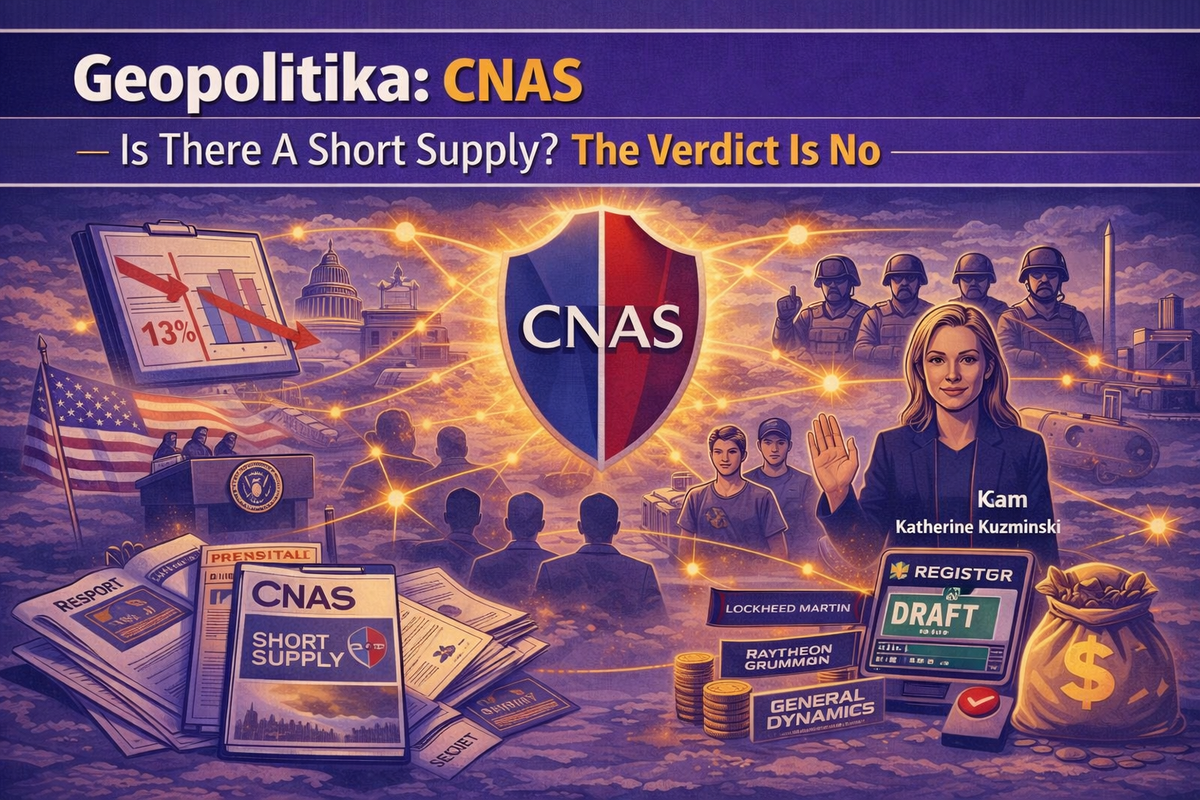
December 2025—The Center for a New American Security (CNAS), a Washington think tank funded by the world's largest defense contractors, released a report warning that the US military faces a “critical challenge.” Fewer young Americans are willing to serve. Fewer adults are recommending service. A 13 percent decline in the youth population looms.
“Short Supply” was presented as the first comprehensive investigation into why young people are turning away from military service. It cited surveys and demographic projections and offered recommendations to the president, the secretary of defense, and Congress.
Four months later, in mid April 2026, outlets like Newsweek and Military.com ran articles explaining “what conscription could look like”, “automatic registration for US military draft to begin in December” and “list of exemptions that would disqualify you from US draft” assuming the propensity crisis CNAS had already framed as background fact. They quoted White House and Pentagon officials. They never questioned whether the United States might simply need fewer troops. They never quoted a single young person refusing on moral grounds.
But the report—and the echo chamber it fed—contains a story it does not tell. It cannot tell. Because telling it would reveal that the “crisis” it describes is something else entirely: a generation making a rational, moral choice to refuse a contract that may require them to commit acts that most human beings would regard as monstrous.
The Machine Behind the Report
To understand what Short Supply is doing, first consider who produced it.
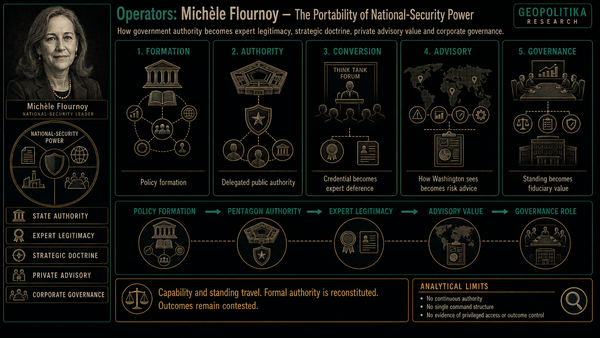
CNAS was founded in 2007 by Michèle Flournoy and Kurt Campbell, both former Obama administration officials. The institution sits comfortably within Washington's liberal interventionist establishment—the wing of foreign policy that believes the United States must maintain a globally dominant military posture.
CNAS does not disclose funding for specific reports. Its general donor list includes Lockheed Martin, Northrop Grumman, Raytheon, and General Dynamics—the largest defense contractors in the world. These companies have a direct financial interest in maintaining robust military manpower. More recruits mean more bodies to operate the systems they sell.
The report's lead author, Katherine Kuzminski, is CNAS's Director of Studies. She has spent her career inside the defense policy ecosystem. Her publication record reveals a sustained focus on military manpower—and, significantly, on the draft. In June 2025, six months before Short Supply appeared, Kuzminski appeared on a podcast titled “Could the U.S. Bring Back the Draft?” In August 2024, she co-authored a War on the Rocks piece titled “Preparing for the Possibility of a Draft without Panic”. In October 2024, she joined another podcast, School of War, to discuss “recruiting and mass mobilization in the event of war.” In January 2026—a month after Short Supply—she published a commentary on the National Defense Authorization Act, noting that it required “contemplating the personnel requirements of a large-scale conflict—and with it, the potential for casualties.”
In this context, Kuzminski cannot be viewed as some random analyst who just happened to study propensity. She is an active participant in normalising draft discourse—preparing the public for the possibility, managing panic, framing conscription as a technical requirement rather than a political choice. Short Supply is not an isolated report. It is one node in a sustained campaign to make the unthinkable thinkable.
The report's findings were shaped by interviews with Pentagon officials, congressional staff, and an “expert workshop” of 33 practitioners—none of whom, based on the description, included a single young person who has refused military service.
This is not neutral analysis. It is institutional positioning dressed in survey data.
The Network Behind the Report
CNAS does not operate in isolation. It functions as the middle layer of a three-tier architecture that reproduces military manpower policy across administrations.
At the top sits the Department of Defense and executive branch—the invisible hub. They define the problem (propensity crisis, readiness gap), supply the data (JAMRS surveys), and set the terms of debate.
CNAS serves as the bridge. It translates DoD interests into “expert” analysis: legitimising the crisis narrative, omitting prior contradictory studies (RAND, CRS), erasing the history of draft resistance, and recommending solutions (increased recruitment funding) that align with its defense contractor funders.
Below CNAS lies the media amplification layer. In April 2026—as the war with Iran intensified and NATO scrambled to reinforce European deterrence—outlets like Newsweek and Military.com ran explainers on “what conscription could look like.” They assumed the propensity crisis framed by CNAS as settled fact. They quoted White House and Pentagon officials. They never questioned whether the United States might simply need fewer troops amid multiple simultaneous conflicts. They never quoted a single young person refusing on moral grounds.
The handoff is indirect—media rarely cites CNAS directly. Instead, both nodes share source dependency on the DoD and executive branch. This structure creates layered legitimacy and plausible deniability: critique the media for bias and they are “just reporting officials”; critique CNAS for funding conflicts and they are “independent experts”; critique the DoD and they are “responding to congressional mandates.” The system is designed to be resilient.
Short Supply is not a standalone document. It is the strategic framing layer of a self-reinforcing network whose combined effect is to naturalise current force structure and the state’s claimed right to compel service—even as the United States edges closer to simultaneous high-intensity conflicts in the Middle East and Europe.
What the Report Takes for Granted
Every argument in Short Supply rests on assumptions it never examines.
The report assumes, without argument, that current US military force structure is necessary and fixed. It never asks whether the Pentagon actually needs the troop levels it budgets for, whether the United States might reduce its global posture, close bases, or shift missions to allies.
It assumes the All-Volunteer Force is permanent and non-negotiable. Conscription is mentioned only as a discarded historical alternative, never as a live policy choice that could be rejected on principle.
It assumes military service is intrinsically valuable for young people. Nowhere does it engage the possibility that refusing to serve might be a mature, ethical decision.
But the deepest assumption—the one the report cannot afford to examine—is this: that a contract requiring an individual to kill, to participate in torture, to destroy civilian infrastructure, to spread poisons, and to die if ordered is a contract any moral person should sign.
The Voice That Is Not Allowed
Short Supply calls young people “disengaged.” The word appears early and often. It is a clinical term—the language of pathology, not politics. Disengagement is what happens when someone withdraws, loses interest, fails to participate. It implies a lack, a deficiency, something to be fixed.
But what if the report has the framing backwards?
What if young people are not “disengaged” but actively engaged—in paying attention, in moral reasoning, in refusing?
The report does not ask this question. It cannot. Because the answer would require acknowledging that the “crisis” it describes is not a failure of recruitment but a success of conscience.
Consider what a young person might say if asked directly—not through a Department of Defense survey that measures “propensity” as willingness to say “yes” on a questionnaire, but in their own words:
“I will not sign a contract that may require me to kill people.”
“I will not enter a system that claims ownership of my body and punishes me for leaving.”
“I will not salute people just because they wear stripes on their arms or stars on their shoulders.”
“I will not participate in torture. I will not drop napalm on children. I will not spread poisons that kill for generations.”
“I will not be part of an institution that has done these things and never been held accountable.”
The report has no category for this voice. It is not “disengaged.” It is not a “practical concern” like fear of death or PTSD. It is a moral refusal. And the report cannot acknowledge it because acknowledging it would legitimise it—and legitimising refusal would undermine the entire recruitment apparatus.
So the report does what institutions always do when confronted with refusal: it pathologises. The young person who says “No” is not a moral agent. They are “disengaged.” They need to be reached, persuaded, incentivised, pre-enlisted before they fully understand what they are signing.
This is not analysis. It is the language of the recruiter dressed in the clothes of social science.
The Crimes the Contract Requires
Let us be precise about what the enlistment contract may require.
The state does not ask young people only to risk their own deaths. It asks them to inflict death on others. It asks them to commit acts that, in any other context, would be called war crimes.
Let’s consider a few real life examples:
Napalm
The United States used napalm in World War II, Korea, and Vietnam. The image of a nine-year-old girl, Phan Thị Kim Phúc, running naked down a road with her skin burning off, is seared into global memory. The chemical continues to be used in more recent conflicts. A young person signing an enlistment contract today may be ordered to deploy weapons that set human beings on fire.
Carpet bombing
During the Vietnam War, the United States dropped more ordnance on Laos during the so-called Secret War than it dropped on all of Japan in World War II—over two million tons of bombs. Many fell not on military targets but on entire regions, killing civilians indiscriminately and leaving vast areas littered with unexploded ordnance that continues to maim and kill to this day. The same logic—that civilian populations can be terrorised into submission—has resurfaced in every major US war since: the saturation bombing of Iraqi cities in 1991 and 2003, the relentless aerial campaigns in Afghanistan, and now, as this article is being written, in Iran.
This is not young people “defending freedom” or “spreading democracy.” It is young people being asked to participate in war crimes.
Agent Orange
The United States sprayed over 20 million gallons of herbicides, including the dioxin-contaminated Agent Orange, over Vietnam, Laos, and Cambodia. The goal was to defoliate forests and destroy crops—ecological warfare designed to starve civilian populations. The effects continue to this day: generations of Vietnamese children born with severe birth defects, American veterans dying of cancers linked to dioxin exposure. A young person signing an enlistment contract today may be ordered to spread poisons that will kill and maim for decades.
Torture
Abu Ghraib. Guantanamo Bay. The Phoenix Program. The black sites. The names are a litany of American atrocity.
- At Abu Ghraib, US military police and intelligence officers tortured detainees: forced nudity, stress positions, dog attacks, sexual humiliation, beatings. The photographs—a hooded figure standing on a box with wires attached to his hands; a pyramid of naked bodies; a smiling soldier giving a thumbs-up next a corpse—became the defining images of the Iraq War.
- At Guantanamo Bay, detainees were subjected to the euphemisticaly termed “enhanced interrogation techniques”—waterboarding, sleep deprivation, stress positions, hypothermia, forced rectal feeding. Men were held for years without charge. Many were tortured into false confessions. Some were never combatants at all.
- The Phoenix Program during the Vietnam War systematically identified and assassinated suspected Viet Cong cadres. The official count of “neutralised” targets—a euphemism for killed—exceeds 26,000. Many were civilians. Many were killed by torture followed by murder. The program was directed by the CIA and executed by US military and South Vietnamese forces.
- The black sites—secret prisons operated by the CIA after 9/11—were located in Thailand, Poland, Romania, Lithuania, and elsewhere. Detainees were rendered to these sites without legal process. They were tortured. Some were never seen again.
A young person signing an enlistment contract today may be ordered to participate in torture. They may be ordered to guard detainees who are being tortured. They may be ordered to stand silent while others commit these acts. The Uniform Code of Military Justice requires obedience to lawful orders—but defines “lawful” in ways that have protected torturers and punished whistle blowers.
The Silence of the Report
Short Supply does not mention any of this.
It does not mention napalm. It does not mention carpet bombing. It does not mention Agent Orange. It does not mention Abu Ghraib, Guantanamo, the Phoenix Program, or the black sites.
The report treats “fear of death or injury” as the primary concern—72 percent of adults cite it. It treats PTSD as a concern—63 percent. These are real fears. They are real injuries. But they are not the whole story.
The report cannot say: young people might also fear becoming torturers. They might fear participating in the destruction of civilian cities. They might fear spreading poisons that will kill children for generations. They might fear looking back on their service the way veterans of the Phoenix Program or Abu Ghraib look back—with horror, with shame, with the knowledge that they participated in atrocities.
The report cannot say this because saying it would require acknowledging that the US military has committed war crimes—systematically, repeatedly, with impunity. And that a generation that refuses to participate in future war crimes is not “disengaged.” It is morally awake.
The History That Was Erased
To make its case that propensity to serve has collapsed, Short Supply uses a specific baseline: the year 2003, when 16 percent of young people said they were willing to serve.
Why 2003?
That was the year the United States invaded Iraq. Patriotism was at a post-9/11 peak. Abu Ghraib had not yet happened. The black sites were still secret. The wars in Afghanistan and Iraq had not yet become the quagmires that would produce a generation of skeptical veterans—and a generation of atrocity photographs.
If the report had chosen a different baseline—say, 1999, before the post-9/11 surge—the decline would look far less dramatic. The choice of 2003 is not neutral. It maximises the perception of crisis while conveniently excluding the crimes that would become known in the years that followed.
The report also claims that “no comprehensive root cause analysis of the decline in propensity has been conducted.” This is false—and the falseness is particularly striking given the source. CNAS, the RAND Corporation, the Brookings Institution—the very think tanks that helped plan the wars and, in some cases, helped design the torture programs—have published extensively on military recruiting.
Consider the Brookings Institution's “Which Path to Persia? Options for a New American Strategy toward Iran” (2009). This report, authored by a team of prominent Brookings scholars, laid out a menu of military options against Iran: airstrikes, support for opposition groups, a naval blockade, and even invasion. The report treated military action as a legitimate policy tool. It did not ask what those airstrikes would do to Iranian civilians. It did not ask who would be tortured in the black sites that would surely follow.
Consider RAND's “Extending Russia: Competing from Advantageous Ground” (2019), commissioned by the United States Army. The report analysed how the United States could prolong its competition with Russia through economic pressure, military posturing, and support for opposition movements. It did not ask who would die in the proxy wars that such a strategy would inevitably produce. It did not ask what new Abu Ghraibs would be built.
These documents—from Brookings, from RAND, from the same policy ecosystem that produced Short Supply—share a common feature: they treat war as a management problem. Atrocities are not mentioned. Torture is not mentioned. The destruction of civilian cities is not mentioned. The question of whether young people should be asked to commit these acts never appears.
Short Supply is the necessary companion to these war-planning documents. Brookings and RAND say: here is what we should do militarily. CNAS says: here is how we get the bodies to do it. Neither asks whether the “what” is worth doing. Neither asks whether the “how” is moral.
The Binary That Collapses
The report's entire argument depends on a distinction it cannot defend: the difference between conscription and “voluntary” service.
Conscription is bad, the report implies. It forces people to serve. It violates freedom.
“Voluntary” service is good. People choose to serve. It respects freedom.
But watch what happens when you examine the “voluntary” contract.
The service member cannot leave without punishment. Desertion is a crime punishable by imprisonment or death. The service member cannot refuse orders, including orders to commit acts that would be war crimes in any other context. The service member's body belongs to the state for the duration—and so does their conscience.
This is not freedom. It is indentured servitude with a torture clause.
The difference between conscription and “voluntary” service is the presence of an initial consent ritual. That ritual does not change the structural relationship between the individual and the state. It does not create an exit right. It does not remove the obligation to kill on command, to participate in torture, to destroy civilian infrastructure.
One system coerces at entry. The other coerces at exit. Both coerce. Both claim ownership of the individual's body and conscience. Both punish refusal with imprisonment.
The difference is a distinction without a moral difference.
This binary is not unique to CNAS. It structures the entire conscription discourse network. The DoD defines the problem as “propensity”—an individual attitude to be measured and influenced. The media asks “what the draft could look like”—as if the only question is procedure, not legitimacy. Never does any node ask: Does the state have the moral right to compel service at all? Never does any node ask: Does the United States actually need this many troops?
These questions are not asked because they would reveal that the entire system rests on an unexamined assumption: that current US military posture—over 800 bases worldwide, troops in more countries than any other nation, a budget larger than the next ten countries combined—is natural and necessary. It is not. It is a political choice. And a generation that refuses to participate in that choice is not “disengaged.” They are the only ones treating a political choice as something that can be refused.
The Archetypes That Make It Feel Inevitable
Beneath the data and the expert workshops lies a story. Every policy report tells one, whether it knows it or not.
In “Short Supply,” the military is the Hero—a virtuous institution under threat, deserving of support and resources. Young people are the Innocent—disengaged, naive, needing to be reached and guided. Civilian leadership—the president and Congress—hovers as the Shadow, the source of mistrust that taints the otherwise pure military.
These archetypes are powerful because they are unstated. The report never says “the military is heroic.” It simply assumes it. The reader is positioned to feel concern for the Hero, paternalistic worry for the Innocent, and suspicion toward the Shadow.
What happens if you name the archetypes the report suppresses?
If the military is an institution that has napalmed villages, carpet-bombed civilian cities, spread Agent Orange, and presided over torture at Abu Ghraib and Guantanamo and the black sites, the Hero becomes the Villain—not in some abstract sense, but in the plain meaning of the word: an institution that commits atrocities.
If young people are making a conscious moral choice to refuse participation in future atrocities, the Innocent becomes the Sage—the one who sees clearly what the institution has done and refuses to be complicit.
If the state's demand that young people sign a contract that may require them to kill, to torture, to destroy, and to die is the problem, then those who refuse are not disengaged—they are the only ones paying attention.
The report cannot allow these reversals. Its entire persuasive force depends on keeping its archetypes invisible and its atrocities unmentioned.
The Real Stakes
What would it cost to take the report's recommendations seriously?
More funding for recruitment. More advertising. More recruiters. More pre-enlistment programs to lock young people into contracts before they fully understand what they are signing. Quality-of-life improvements for service members—better housing, better pay—which are worthwhile in themselves but are framed here as tools to boost recruitment, not as ends.
The report does not calculate what these recommendations would cost. It does not ask what else that money could buy—housing for civilians, healthcare, education, climate adaptation. It does not consider that every dollar spent on recruitment is a dollar not spent on something else.
And it never asks the question that would collapse its entire framing: What if the United States simply decided it needed fewer troops? What if it decided that asking young people to sign a contract that may require them to commit atrocities is something no legitimate state should do? What if it decided that the wars planned in documents like “Which Path to Persia” and “Extending Russia” are not worth fighting—and that the torture, the napalm, the carpet bombing, the Agent Orange, the Phoenix Program, the Abu Ghraibs, the Guantanamos, the black sites are not bugs but features of a system that should be dismantled, not staffed?
Strategic Openings
So where does this leave us? Not with a neutral analysis, but with a set of deliberate choices.
The report’s authors chose to frame refusal as disengagement. They chose to erase the documented history of American atrocities. They chose to omit the war-planning documents that reveal what young people are actually being asked to do. They chose to draw boundaries that exclude allied burden-sharing, force reduction, and the moral case against military service. They chose to present the military as a virtuous institution under threat, young people as naive and disengaged, and civilian leadership as the source of mistrust. Above all, they chose to treat a contract that may require killing, torture, and death as a “practical concern” rather than the moral reality it represents.
Those choices can be unmade.
Communities can ask different questions: Do we actually need this many troops? Do we need over 800 military bases scattered around the world? What would it mean to reduce the military budget and redirect resources toward civilian infrastructure? Why should young people trust an institution that has napalmed villages, carpet-bombed cities, spread poisons, and tortured detainees? Why should any free person sign a contract that may require them to commit acts that, in any other context, would be called war crimes? What are the physical and mental harms done to young people who are forced to participate in such acts? And, what is the cost to all of us of having people who would commit such acts walking around our communities?
Those questions will not appear in any CNAS report. Not because the authors are unaware of them. Not because the data is unavailable. But because asking them would collapse the entire enterprise. CNAS exists to make the current system work—to staff the wars that Brookings and RAND plan, to smooth the friction between a generation that refuses and a military that demands. To ask whether the system should exist at all is to ask whether CNAS should exist at all. The institution cannot ask that question and survive. So the questions remain unasked. The atrocities remain unmentioned. The young people remain “disengaged.” And the report calls their refusal a crisis—because the alternative is to call it wisdom.
Instead of competing for a shrinking pool of willing recruits, the United States could decide it needs fewer of them. Instead of treating refusal as a crisis to be solved, policymakers could ask what the military has done to earn such deep distrust. Instead of funding think tanks to manufacture urgency, communities could invest in the civilian pathways that young people are already choosing.
And young people themselves can refuse—not as “disengaged” victims of societal decline, but as moral agents exercising considered judgment. The report calls this a crisis.
It is not.
It is a generation that has looked at the contract, looked at the history, looked at the wars planned by the think tanks, and said no.
Published via Mindwars Ghosted.
Geopolitika: Tracing the architecture of power before it becomes the spectacle of history.
—
Methodology Note: This analysis was conducted using a structured forensic protocol designed to examine institutional communication. All sourced material—including the CNAS report, prior RAND and Brookings reports, and CNAS donor disclosures—is publicly available. The history of US military atrocities is documented in the Pentagon's own reports (including the Taguba Report on Abu Ghraib), congressional investigations (including the Senate Intelligence Committee's Torture Report), journalistic accounts (including Seymour Hersh's reporting on Abu Ghraib and the black sites), and declassified documents (including records of the Phoenix Program and Agent Orange spraying missions). This analysis is part of a broader meta-integration examining the conscription discourse network. The meta-analysis integrates findings from two institutional profiles (CNAS and Newsweek/Military.com) across December 2025 to April 2026, identifying shared omission patterns, reasoning strategies, and network architecture. The full meta-integration is available alongside the base analytic outputs. All sourced material is publicly accessible. Base analytic outputs and the complete meta-integration are available on request.
Mindwars Ghosted is an independent platform dedicated to exposing elite coordination and narrative engineering behind modern society. The site has free access and committed to uncompromising free speech, offering deep dives into the mechanisms of control. Contributions are welcome to help cover the costs of maintaining this unconstrained space for truth and open debate.
If you like and value this work, please Buy Me a Coffee