Geopolitika: Analysis of U.S. National Security Strategy Statements over 33 Years
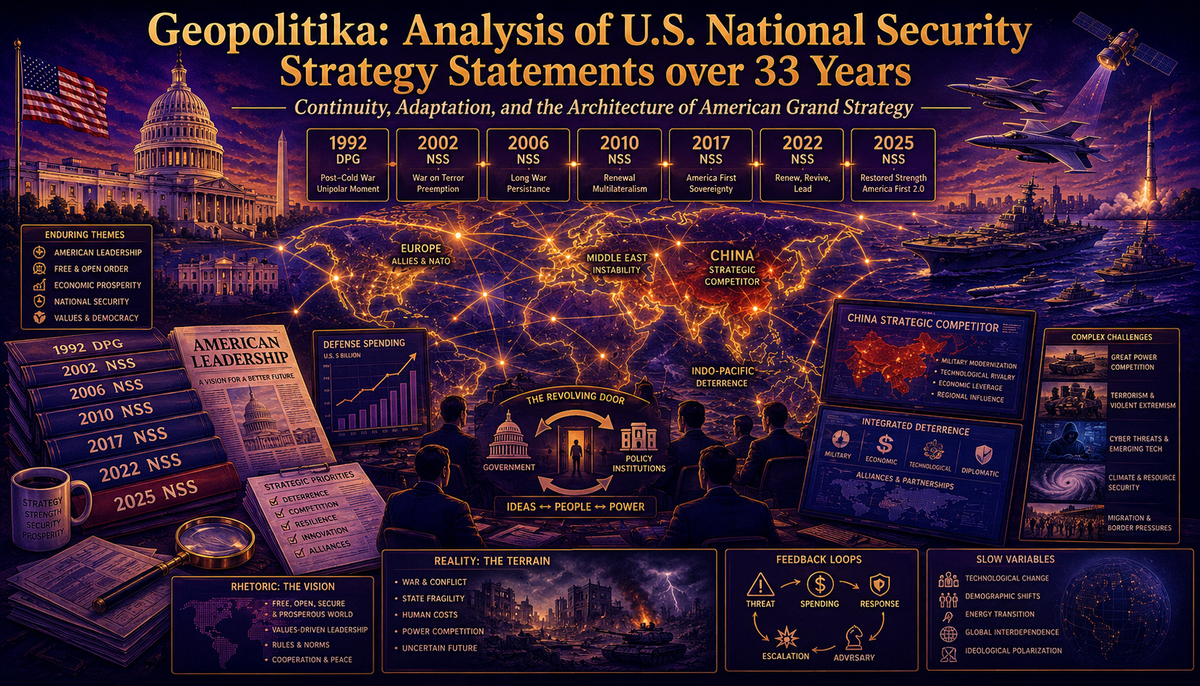
This analysis forms part of the Geopolitika project to map Anglo‑American power structures by examining their strategic doctrines, institutional production systems, personnel networks, and the gap between public justification and operational function. These profiles are primarily generated from official strategy documents and foundational guidance materials, which are then analysed using a structured cross‑analytic framework—see methodology statement at the foot of the article.
—
Executive Summary
This article analyses a collection of seven major U.S. National Security Strategy documents and foundational guidance spanning 1992 to 2025—from the post-Cold War Defense Planning Guidance through the Bush, Obama, Trump, and Biden administrations. Drawing on detailed protocol driven analyses of each document and a dedicated cross-analysis synthesis, it maps the evolution, continuity, and underlying functions of American grand strategy over 33 years.
“To achieve a better future of a free, open, secure, and prosperous world”
– 2022 National Security Strategy
In contrast to these lofty words, a forensic examination of the documents’ argument, rhetoric, historical claims, and strategic assumptions reveals a more complex picture.
This is not a story of corrupt individuals or conspiracy. It is a story of emergent behaviour—how a system's components (White House/NSC production process, personnel networks, ideological clusters, reasoning patterns, and institutional incentives) interact to produce outcomes that no single person decided.
The network (meaning the collection of seven documents) exhibits remarkable persistence in its core function: legitimating and adapting U.S. global primacy across shifting ideological vocabularies—neoconservative unipolarity (1992, 2002, 2006), liberal internationalist correction (2010), America First nationalism (2017 & 2025), and restoration-through-revision (2022). It displays stable reasoning traps (false dilemmas, appeals to consequences, temporal inversion), systematic omissions (especially affected-population voices and coercive U.S. history), and productive contradictions that enable flexibility while preserving power asymmetries.
The analysis traces personnel handoffs (e.g., the Wolfowitz network linking 1992 to 2002/2006), doctrinal ruptures and consolidations, feedback loops (threat–spending–adversary response; migration securitisation), emergent properties (legitimation persistence), and slow-variable engagement (China’s rise, migration pressures, climate). It balances critical findings on legitimation and externalised human costs with affirmative recognition of real strategic challenges, including allied free-riding, China’s systemic competition, and post-9/11 threat environments.
Ultimately, the network functions as a resilient legitimation system that updates its justifying language in response to shocks and domestic mandates while maintaining a U.S.-centered global order. Its strength lies in adaptive ambiguity; its vulnerability lies in the growing visibility of its tensions and externalised consequences.
The Machine Behind It: Production System and Institutional Home
The network is not a membership organisation. It is not accountable to voters. Its pages are products of specific choices about what to include and exclude.
Scale and institutional weight. Seven major strategy documents spanning 1992 to 2025, produced by every administration from George H.W. Bush to Trump's return. Spaced at approximately 5 years between, each emerged from the White House and National Security Council process—a production system that translates campaign mandates into bureaucratically actionable doctrine.
The 1992 Defense Planning Guidance began as a draft, leaked and revised. Yet its core ideas—unipolar primacy, precluding any future global competitor, rejection of balance-of-power multipolarity—survived and migrated. The same personnel network (Wolfowitz, Khalilzad, Libby) appears in the 2002 and 2006 National Security Strategies. This is not conspiracy. It is personnel circulation—a pattern of institutional influence that shapes doctrine across administrations.
The 2010 NSS deliberately repudiates the Bush era. Torture is banned. Preemption language is toned down. Multilateralism is elevated. Yet drones are omitted. Guantanamo remains open. The Afghanistan surge escalates. The gap between rhetoric and practice is not hypocrisy—it is the structure of legitimation under pressure.
The 2017 NSS translates “America First” into formal doctrine. Economic security becomes national security. Borders become sovereignty tests. Allies become burden‑sharing subjects. The 2022 NSS attempts restoration‑through‑revision: domestic renewal, climate security, industrial policy, and integrated deterrence become the new foundations of US leadership. The 2025 NSS erases its predecessor and returns to harder nationalism: 5% GDP defence spending, migration as invasion, a Trump Corollary to the Monroe Doctrine.
The network adapts to external shocks—9/11, Iraq failure, Trump's election, Biden's restoration, Trump's return—but the underlying function persists across all seven strategies (strong convergence): legitimation.
The Reasoning Traps and Rhetorical Architecture
Across the seven documents, recurring patterns of argument and language work together to narrow the range of acceptable choices while giving those choices moral and emotional weight. These are not crude distortions but disciplined, functional structures that consolidate consensus and translate complexity into actionable doctrine.
Reasoning traps consistently compress strategic reality into binary frames. False dilemmas appear repeatedly. The 1992 Defense Planning Guidance states: “It is not in our interest to return to earlier periods in which multiple military powers balanced one another off.” The 2006 National Security Strategy declares that “America now faces a choice between the path of fear and the path of confidence.” The 2025 strategy contrasts prior “laundry list” approaches and elite miscalculation with decisive American leadership. In each case, multi-polarity or restraint is framed as inherently unstable or naive, leaving robust U.S. primacy as the only responsible option.
Appeal to consequences reinforces the binary. “History will judge harshly those who saw this coming danger but failed to act” (2002 NSS). The 1930s analogy recurs across decades: without decisive U.S. leadership, collective security collapses and aggression succeeds. Inaction, the documents imply, leads inevitably to catastrophe. Therefore, preemption, primacy, and unilateral measures become necessities rather than choices.
Circular reasoning sustains the logic: U.S. leadership is essential because only the United States possesses the capacity and values to provide it. Democratic peace theory is deployed selectively—democracies are peaceful, therefore U.S.-led democratic enlargement serves global peace, while “non-democracies” become legitimate objects of preclusion or pressure.
Temporal inversion completes the pattern of self-heroisation. Each administration constructs a straw past of weakness and failure against which it appears as saviour. The 2017 NSS presents “America First” as a radical break while retaining core elements of prior military superiority, alliances, and counterterrorism architecture. The 2025 strategy claims historic peace deals and a dramatic turnaround, yet provides no treaty texts or independent verification. Prior achievements are diminished or erased, allowing each new document to position its administration as the first to truly see clearly.
These reasoning structures gain persuasive force through a stable rhetorical architecture that assigns clear roles and moral valence. The United States is consistently cast as hero or indispensable sage—“guardian of the democratic peace” and the “indispensable nation.” The sitting President appears as restored king or decisive steward, reorienting a drifting nation toward sovereignty, strength, and moral clarity. Previous administrations function as shadows: failed, weak, complacent, or ideologically captured. Adversaries (China, Russia, Iran, North Korea, terrorists, and cartels) are portrayed as shadow rivals or predators—threatening, exploitative, and fundamentally hostile. In the 2017 and 2025 strategies, migrants are framed as threshold guardians—an “invasion” to be repelled at the border.
The 2010 NSS offers a partial exception, positioning the Obama administration as moral restorer after Bush-era overreach and torture. Yet it omits discussion of drone strikes and the failure to close Guantanamo, thereby preserving the redemption narrative. The 2025 NSS further blends domestic cultural conflict with national security language, stating: “We got radical gender ideology and woke lunacy out of our Armed Forces.” These are not presented as policy preferences but as strategic necessities—political mobilisation delivered through the genre of national security.
The archetypes are not accidental. Combined with the reasoning traps, they make American primacy appear natural, defensive, and morally required, while rendering alternatives fearful, naive, or treacherous. The result is a powerful discursive system: the reasoning forecloses alternative pathways, and the rhetoric makes the remaining path feel inevitable and virtuous.
Selective Memory, Handoffs, and the Network
The network’s historical memory is systematically selective. It invokes useful precedents while erasing inconvenient ones, creating a curated past that supports the present posture.
The 2002 National Security Strategy presents the Cold War as an unqualified success, omitting proxy wars, nuclear brinkmanship, and long-term support for authoritarian allies. The 1992 Defense Planning Guidance invokes the 1930s to justify American leadership, downplaying economic depression, the failures of Versailles, and the agency of other powers. Across all seven documents, consistent omissions appear: U.S. support for authoritarian regimes during the Cold War (Iran 1953, Guatemala 1954, Chile 1973, Indonesia 1965–66); interventions that generated blowback, such as arming the mujahideen in Afghanistan; the human costs of pre-2003 Iraq sanctions (estimated hundreds of thousands of excess child deaths); and the civilian toll of the 2003 Iraq War itself (estimates ranging from 150,000 to over 500,000 deaths). These are not mentioned.
The function of this selective memory is naturalisation. By erasing coercive chapters of U.S. history and policy feedback loops, the network presents the United States as a consistently benevolent actor and frames threats such as terrorism and migration as spontaneous rather than partly emergent from prior actions.
Specific documents further illustrate the pattern of erasure and reframing. The 2006 NSS shifts from claims of active Iraqi WMD stockpiles to the vaguer assertion that Saddam “continued to see the utility of WMD”—an exercise in apologia rather than learning. The 2010 NSS pledges to close Guantanamo but omits the congressional obstacles that prevented it, leaving a gap between declared intent and outcome. The 2025 NSS claims NATO allies endorsed 5% GDP defence spending and celebrates multiple peace deals with little third-party verification or treaty text cited.
Counter-narratives are quietly suppressed. The 2022 NSS advanced concrete priorities on China, climate, and technology. The JCPOA had constrained Iran’s nuclear program. NATO burden-sharing had increased under Biden. By erasing or diminishing these, each new strategy constructs a straw past of failure against which the current administration appears decisive.
Beneath these rhetorical choices lies a network of actors and handoffs that sustains continuity. The system organises around three durable hubs: Presidential Authority (providing charismatic legitimation, especially prominent in 2002, 2006, 2017, and 2025), the National Security Council staff (ensuring institutional drafting continuity across administrations), and shifting ideological clusters.
Personnel handoffs reveal the mechanism. The Wolfowitz network (Wolfowitz, Khalilzad, Libby) links the 1992 DPG directly to the 2002 and 2006 strategies, articulating neoconservative primacy. The Liberal Internationalist network shapes 2010 and 2022. The America First network dominates 2017 and 2025. The handoffs are rarely linear: 2002–2006 shows defensive continuity; 2006–2010 is repudiation with important omissions; 2010–2017 is rupture; 2017–2022 is restoration-through-revision; and 2022–2025 is erasure.
Throughout these shifts, one pattern remains constant: legitimation persistence. Ideologies and rhetoric change. The underlying function—justifying and adapting U.S. global primacy while reconciling domestic political mandates with institutional continuity—does not.
This combination of selective history, strategic omission, and networked handoffs enables the system to adapt to shocks while preserving its core orientation
Recurring Patterns, Systemic Dynamics, and the Longer View
Certain patterns of reasoning, omission, and adaptation recur across all seven strategies, revealing the deeper mechanics of the system.
Reasoning traps appear with striking consistency. False dilemmas frame choices narrowly: multipolarity versus unipolar leadership, fear versus confidence, past failure versus decisive turnaround. Appeal to consequences warns that inaction will be judged harshly by history, with the 1930s analogy invoked repeatedly to suggest that anything less than primacy invites catastrophe. Circular reasoning underpins the logic—U.S. leadership is necessary because only the United States can provide it. Temporal inversion is routine: each administration constructs a straw past of weakness or miscalculation against which it appears as saviour, often diminishing or erasing the achievements of its predecessors.
Omissions are equally systematic. Direct testimony from affected populations—migrants, civilians in war zones, detainees—is absent across every document. Significant chapters of U.S. coercive history (coups, proxy interventions, blowback) are erased. Internal dissent is largely suppressed, with only a partial exception in the 1992 Defense Planning Guidance. Climate security appears when ideologically convenient and vanishes when it is not.
These surface patterns are sustained by deeper systemic dynamics. Reinforcing feedback loops drive persistence. Perceived threats justify military spending and action, which in turn provoke adversary responses that validate further threat perception—a self-sustaining cycle visible from the 1992 preclusion logic through the 2025 emphasis on peace through strength. Democracy promotion in the 2002–2006 era followed a similar pattern: failure in Iraq did not prompt reconsideration but instead reinforced the need for more democracy. Migration securitisation, prominent in 2017 and 2025, frames border flows as “invasion,” leading to militarisation that generates new incidents, which then justify further securitisation.
Emergent properties arise that cannot be reduced to any single administration or ideology. The Bush Doctrine (preemption, primacy, democracy promotion) emerged strongly in 2002–2006 with clear lineage to 1992. Legitimation persistence is the most durable emergent feature: across neoconservative, liberal internationalist, nationalist, and revisionist phases, the core function remains the justification and adaptation of U.S. global primacy. Other emergents include restoration-through-revision in 2022 and America First nationalism in 2017 and 2025.
Boundaries define what the system can see. Temporally, it begins with the post-Cold War era, flattening or excluding earlier U.S. history. Actor boundaries centre the U.S. state, allies, and adversaries while excluding affected populations as speaking subjects. Knowledge boundaries favour executive-branch perspectives and sideline critical or postcolonial frameworks. Sectorally, national security expands opportunistically into economics, technology, and (selectively) climate, while issues such as inequality or racial justice remain marginal.
The Longer View: Slow Variables
Beneath immediate shocks and doctrinal shifts lie slower structural trends that the strategies engage unevenly. U.S. relative economic power has declined with China’s rise—largely ignored in the 1990s and early 2000s, later acknowledged, and met with tariffs and reindustrialisation in 2025. Global migration pressures have intensified, ignored for decades before being securitised as invasion. The idea that climate change has worsened, treated as a security issue in some strategies and dismissed as ideology in others. Global democratisation has stalled, and alliance burden-sharing remains a persistent tension.
The system consistently subordinates these slow variables to fast-moving events that legitimate urgent action. The 2002 strategy used 9/11 to authorise preemption—a doctrine already developed beforehand. Later strategies use perceived elite failure or external shocks to justify sharp turns while downplaying deeper, slower pressures. The result is a system highly responsive to immediate political and security shocks but only partially attuned to the structural forces that will shape its long-term effectiveness.
This combination of recurring reasoning patterns, self-reinforcing dynamics, clear boundaries, and selective engagement with slow variables produces a resilient yet path-dependent system—one that adapts its language and emphasis while preserving its core orientation toward U.S. primacy.
The Ecosystem Position and the System Defended
The network operates within a distinctly US-centric geopolitical ecosystem embedded in a political economy of elevated defence spending (3–5% of GDP proposed in later strategies), industrial policy (CHIPS Act, Inflation Reduction Act, tariffs, and reindustrialisation), and executive centralisation.
Allies are treated primarily as force multipliers, but the tone toward them grows increasingly transactional. Burden-sharing language shifts from “fair share” in 2017 to demands for 5% of GDP defence spending in 2025. Europe becomes a particular target for burden-shifting, while the Western Hemisphere is reasserted as a US sphere of influence under the Trump Corollary to the Monroe Doctrine. Nonaligned states are rarely treated as independent norm-generators; they appear instead as “aspiring partners” or objects of “inclusive coalition” language that preserves American agenda-setting.
Rivalries remain consistent in direction even as intensity fluctuates. China is framed as a long-term systemic competitor across multiple strategies (2002, 2006, 2017, 2022, 2025). Russia appears as an acute threat particularly from 2017 onward. The democracy/autocracy binary simplifies complex governance realities but also reflects genuine differences in values and coercive behaviour.
The China Arc: From Potential Competitor to Pacing Threat
The evolution of China’s portrayal is particularly revealing. The 1992 Defense Planning Guidance named no specific adversary but articulated a preclusion logic aimed at preventing any future peer competitor—China was clearly implied. The 2002 and 2006 strategies treated China cautiously as an emerging threat and trading partner. By 2017, China was labelled a “revisionist power.” The 2022 NSS sharpened the assessment: “The PRC is the only competitor with both intent and increasingly comprehensive capacity to reshape the international order.” The 2025 strategy completed the shift to an adversarial frame, characterising Chinese economic practices as “predatory” and prioritising tariffs, export controls, and supply-chain decoupling.
This arc is not mere threat inflation. China’s military modernisation, economic scale, and technological progress are structural realities. Yet the escalating rhetoric also performs important legitimation work: each step justifies harder policies that would be more difficult to implement without a clearly defined pacing threat.
The System Defended
At its core, the network defends a US-led global order, expressed in different ideological variants: neoconservative primacy (1992–2006), liberal internationalist correction (2010, 2022), America First nationalism (2017, 2025), and restoration-through-revision (2022).
Primary beneficiaries include the US executive branch, the defence industry, select allied elites, and both democratic and nationalist ideological networks. Those who bear disproportionate costs include migrants, civilians in conflict zones (Iraq, Afghanistan, Gaza, Iran), detainees, workers in deindustrialised regions, and populations in non-aligned states pressured to choose sides. Party interests shift—Republican in most documents, Democratic in 2010 and 2022—but the legitimation function remains constant.
A symmetry test is instructive: if a rival power produced parallel strategies claiming its leadership, technology standards, and partnerships would deliver global public goods, the same analytical lens would identify strong legitimation functions. Applied consistently here, the evidence shows the network defends a US-centred order. This does not mean the order produces no public goods—it means the legitimation function is structural, not incidental.
What the Network Gets Right
The network is not only a legitimation system. It also responds to genuine strategic problems. It correctly identifies allied free-riding as a persistent imbalance. NATO allies have long spent less on defence relative to the United States, and the burden-shifting pressure from 2017 onward, however blunt, addresses a real issue.
The network also recognised China’s rise as a structural shift requiring adaptation—from the 1992 preclusion logic to the 2022 designation of the PRC as the “only competitor” with both intent and capacity. While specific policy responses remain contestable, the underlying recognition of changed power realities is sound.
Democratic mandates produce doctrinal adjustments. The 2010 repudiation of torture, the 2017 turn to America First, and the 2022 attempt at restoration all reflect electoral outcomes. Industrial policy in 2022 addressed genuine vulnerabilities in semiconductors, clean energy, and supply chains exposed by the pandemic and geopolitical competition.
These affirmative observations do not cancel the critical findings. The network can simultaneously respond to real threats and function as a legitimation system that externalises significant human and political costs. The evidence comfortably supports both characterisations.
What Is Not Said: Omissions and Productive Contradictions
The network’s silences are as revealing as its statements. Three criteria establish when an omission is analytically significant: the topic must fall within the document’s stated purpose, peer institutions or strategies must address it, and the absence must persist over time. Several major omissions meet all three tests.
Affected-population testimony is absent across every strategy. The documents speak about migrants, civilians in conflict zones, and detainees, but never let them speak. The 2002 NSS does not count Iraqi civilian casualties. The 2010 NSS omits the human impact of drone strikes. The 2017 and 2025 strategies frame migration as an “invasion” or declare “the era of mass migration is over” without engaging the perspective of a Guatemalan family fleeing violence or a Haitian migrant turned back at sea. This is not an oversight of genre—it is structural (strong convergence, 7/7).
US coercive history is similarly erased. The network presents America as a consistent force for democracy while omitting Iran 1953, Guatemala 1954, Chile 1973, Indonesia 1965–66, and the arming of the mujahideen in Afghanistan. By removing these counter-examples, the documents naturalise the United States as a benevolent actor and present threats as spontaneous rather than partly emergent from prior policy. Internal dissent is also heavily suppressed (6/7), with only a partial exception in the 1992 Defense Planning Guidance. Climate security appears when ideologically convenient and disappears when it is not.
These patterned omissions both enable and expose deeper productive contradictions—structural tensions the network maintains rather than resolves.
The network oscillates between an “open” and a hardened order. The 2022 NSS seeks “a free and open world,” while the 2017 and 2025 strategies expand tariffs, export controls, and border militarisation. Rhetorical commitment to openness coexists with practical strategic controls, managed by placing US interests at the top of the hierarchy.
It rejects a “new Cold War” while actively building bloc-like structures. The 2022 strategy disavows rigid blocs yet deepens allied networks and technology controls. The 1992 DPG and 2025 strategy embrace preclusion and hemispheric dominance more openly. Democratic universalism clashes with selective application: democracy promotion is emphasised when convenient (2002–2010, 2022) but subordinated to strategic interests when allies like Saudi Arabia, Egypt, or Pakistan are involved.
Climate security versus denial is particularly stark. Climate is treated as a security issue in 2010 and 2022 but dismissed as “disastrous ideology” in 2017 and 2025. Domestic welfare versus global leadership creates another unresolved tension, especially under America First framing.
These contradictions are not failures of logic or hypocrisy. They are productive features that grant the system strategic flexibility across administrations. Resolving them would require acknowledging that the US-centred order generates harm as well as public goods—an admission the legitimation function is structurally designed to avoid.
The omissions and contradictions together form a coherent mechanism: gaps in the record preserve the preferred self-image, while the maintained tensions allow adaptation without fundamental reconsideration of the system defended.
The De Facto Purposes: What the Network Actually Does
The strategies repeatedly state their purpose as protecting Americans, promoting prosperity, preserving peace, and advancing American influence. What the network actually does is more layered.
Its core function is legitimation of US global primacy in shifting ideological forms: neoconservative primacy (1992–2006), liberal internationalist correction (2010 and 2022), America First nationalism (2017 and 2025), and restoration-through-revision (2022). Across these doctrinal ruptures, the essential power asymmetries—military primacy, alliance hierarchy, and executive authority—remain intact. Each administration updates the justifying vocabulary while preserving the underlying order.
Second, the network systematically externalises human consequences. Voice gaps are structural. The documents speak about migrants, civilians in conflict zones, and detainees, but never let them speak. The 2002 NSS does not count Iraqi civilian deaths. The 2010 NSS is silent on drone strike casualties. The 2017 and 2025 strategies frame migration as an “invasion” or declare “the era of mass migration is over” without reference to the reality facing a Guatemalan family fleeing violence or a Haitian migrant pushed back at sea. Externalisation is not a flaw in execution. It is a feature of the structure.
Third, it constructs threats selectively to mobilise support. Claims of active Iraqi WMD stockpiles (2002–2006) were later disproven. Migration is securitised as “invasion” in 2017 and 2025 far beyond empirical threat levels in many cases. China is cast as an existential competitor to justify tariffs, export controls, and alliance hardening. While real threats exist, the framing is instrumental—it authorises preferred policies and tells audiences whom to fear.
Fourth, it shifts burdens outward. Allies face escalating demands, culminating in the 2025 call for 5% of GDP on defence. Europe is told to solve its own problems. Latin America must control migration and cartels. The United States increasingly positions itself as convener rather than Atlas—yet convening still means defining the terms of leadership and primacy.
An alternative interpretation deserves acknowledgment. Seen through a strategic-planning lens, the network represents a legitimate, adaptive response to real threats and democratic mandates. The post-9/11 fear of WMD terrorism was genuine. China’s military modernisation and geopolitical assertiveness required a strategic shift from engagement to competition. Allied free-riding is a documented imbalance. Each major doctrinal change tracks electoral outcomes: the 2010 repudiation of torture, the 2017 America First turn, and the 2022 restoration-through-revision.
The evidence supports elements of both readings, but favours the primary interpretation of layered legitimation with externalised costs. The network’s recurring contradictions—openness versus controls, rejection of bloc logic versus actual bloc-building, climate security versus denial—are more consistently explained by its legitimation function than by pure strategic optimisation alone. The alternative view is not wrong; it is incomplete.
In practice, the de facto purpose is the production and maintenance of layered legitimacy. Each ideological layer adds a fresh justification while preserving the core US-centred order. The system functions as a resilient, adaptive ecosystem—continuously updating its language and emphasis to maintain primacy in the face of external shocks and domestic political change.
The Stakes: Who Benefits, Who Pays
The preceding sections have described the network as a system of legitimation and adaptation. But any such system has concrete human consequences.
The documents speak in abstractions—security, leadership, strength, peace—while externalising the costs. Affected populations are discussed but rarely, if ever, given voice. Bodies are not counted. Consequences are rendered invisible or secondary.
In Iraq, the 2002 National Security Strategy identified a rogue state pursuing weapons of mass destruction and authorised preemption. The war that followed cost over 4,500 American service members’ lives and, by the most widely cited estimates, between 150,000 and over 500,000 Iraqi civilians. The strategy did not count them. It did not ask whether an Iraqi family in Fallujah deserved to live, or whether the collapse of infrastructure and long-term effects of depleted uranium were acceptable costs. They were externalised.
In Afghanistan, the 2002 NSS promised to rebuild the country so it would “never again abuse its people, threaten its neighbours, and provide a haven for terrorists.” Twenty years later the Taliban returned. Tens of thousands of Afghan civilians died and the United States spent roughly two trillion dollars. The strategy did not ask whether Afghans wanted to be remade by foreign forces, or whether an externally imposed democracy would survive withdrawal.
The logic of the “war on terror” enabled the torture programme—waterboarding, stress positions, sleep deprivation. The documents did not mention it. When the enemy is framed as existential evil, exceptional measures become thinkable. Abstract binaries such as “freedom versus fear” erased the humanity of detainees.
At the border, the 2025 strategy authorises military deployment to stop an “invasion.” For families fleeing gang violence in Guatemala—a country destabilised in part by earlier U.S. interventions—the border becomes a legal and physical barrier. Asylum seekers endure prolonged waits in dangerous conditions. Some die. The document does not count them.
On Iran, the 2025 strategy celebrates Operation Midnight Hammer for obliterating nuclear capacity. It does not discuss civilian casualties near the facilities, nor whether the strikes will accelerate weaponisation. Independent verification is limited (medium confidence in the document’s claims; low confidence in external confirmation). For families living near Natanz, “peace through strength” can mean rubble.
In Gaza, the 2025 document states the war ended with hostages returned. It does not address whether Palestinian families returned to intact homes, whether reconstruction has begun, or what daily survival looks like for a child in the aftermath.
Who benefits from this system: the US executive branch, the defence industry, select allied elites, and the ideological networks that supply justifying language.
Who pays: migrants, civilians in conflict zones, detainees, workers in deindustrialised regions, and populations in non-aligned states pressured to align with American priorities.
The documents speak of American greatness. Those who bear the heaviest costs are usually not American. This is not an accidental omission. It is structural: consequences are externalised, bodies are not counted, and voices are excluded. The human consequences are not bugs in the system. They are the system working as designed.
Conclusion
The network of US national security strategies from 1992 to 2025 is not primarily a strategic planning system. It is a legitimation system—one that absorbs external shocks, refreshes its justifying vocabulary across ideological eras, and systematically externalises the human consequences of its choices. (Composite confidence: high for legitimation and voice gap findings; medium for implementation causality.)
The strategic significance of this network is not any single doctrine. It is the grammar of US power that the network establishes and continually reinforces.
- First, it institutionalises executive centralisation. Congress is functionally absent across all strategies. Unilateralism is explicit (1992, 2002, 2017, 2025). Future presidents inherit precedents for military deployment, tariff imposition, and the proclamation of “peace deals” without congressional authorisation. Each administration adds to the toolkit of the next.
- Second, it shifts the alliance baseline. Burden‑shifting from “2% to 5% of GDP” changes what allies can expect. Some will increase spending. Others will hedge toward China. How many have actually raised spending to 5%? Current figures remain at 2‑3% for most, with no timeline or independent verification. The network makes alliance management more transactional, less relational—a trend that will outlast any single administration.
- Third, it normalises securitised migration. The “invasion” frame (2017, 2025) transforms a contested policy preference into a national security imperative. Opposition becomes not disagreement but dereliction. Humanitarian and economic migration policy debate is foreclosed before it begins. What human consequences have followed military deployment to the border under the 2025 strategy? Migrant deaths, detention conditions, and community impacts are not tracked in the documents—a silence that is itself structural.
- Fourth, it erases structural accountability for migration when politically inconvenient. The network rarely acknowledges that many source nations—Central America, Afghanistan, Iraq, Somalia—have been subjected to decades of US-backed conflicts, covert interventions, economic warfare, sanctions regimes, and geopolitical instability. Migration is instead framed as an exogenous shock or, in the 2017 and 2025 strategies, as an “invasion.” The 2025 NSS deploys troops to the border but does not ask whether US policy contributed to the conditions people are fleeing. How does the network account for the roots of migration? It does not. It engages climate as a driver in 2010 and 2022 but without policy history; in 2017 and 2025, even that partial engagement disappears. By erasing its own structural role, the network externalises both cause and consequence.
- Fifth, it provides a template for legitimation that other states are already emulating. Rival strategies now mirror US patterns: self‑heroisation, prior failure erasure, threat construction, voice gaps. The network's grammar is contagious because it works—it consolidates domestic support, disciplines bureaucracies, and signals resolve.
The network is not just a set of documents. It is a system reset that changes the grammar of American foreign policy. Future strategists will either build on it or fight against it. Either way, they cannot ignore it.
But for all its adaptive capacity, the network leaves much unknown—and those unknowns are vulnerabilities. The 2025 NSS claims eight peace deals and a historic turnaround, yet provides no treaty texts or third‑party verification. The U.S. allegedly obliterated Iran's nuclear capacity, but the IAEA has not confirmed, and intelligence assessments remain classified. Why was preemption applied to Iraq, which had no 9/11 link, rather than to al‑Qaeda, which had already attacked? The 2002 NSS does not explain; the answer lies in pre‑existing policy preferences. The Trump Corollary asserts hemispheric dominance, but its legal basis under international law remains contested—the original Monroe Doctrine was unilateral, and enforcement claims go well beyond it. Internal dissent within the US government is almost entirely invisible; only the 1992 DPG records an Army non-concurrence, framed as parochial rather than strategic. And the 2025 strategy offers “energy dominance” through fossil fuels as a replacement for Net Zero, but provides no transition plan or emissions target.
The total human cost of the wars justified by the 2002 and 2006 strategies—including indirect deaths from disease, displacement, and infrastructure collapse—remains uncounted. Estimates vary widely: Iraq 150,000 to over 500,000 civilian deaths; Afghanistan 70,000 or more. The documents do not count them. That is not an accident. It is the structure.
Whether the system can change is uncertain. Its survival depends on maintaining productive ambiguity—the space between what it says and what it does, between who benefits and who pays. That ambiguity is also its vulnerability. The evidence is clear enough to act on. The question is whether anyone will.
—
Published via Mindwars Ghosted.
Geopolitika: Tracing the architecture of power before it becomes the spectacle of history.
Methodology Note: This analysis draws on seven major US national security strategy documents spanning 1992 to 2025: the 1992 Defense Planning Guidance (draft), and the 2002, 2006, 2010, 2017, 2022, and 2025 National Security Strategies. The analysis was conducted using a structured analysis framework examining argument structure, rhetorical deconstruction, historical integrity, strategic prior audit, feedback loop mapping, emergence detection, boundary critique, system-as-context, production systems, implementation chains, worldview mapping, language translation, Layer‑4 evidence acquisition, and authority self-audit. All sourced material is publicly accessible. Base analytic outputs are available on request. For methodological details—including Transparency Score definitions, typology classifications, and confidence calibration—see the Geopolitika Series Methodological Statement.
Mindwars Ghosted is an independent platform dedicated to exposing elite coordination and narrative engineering behind modern society. The site has free access and is committed to uncompromising free speech, offering deep dives into the mechanisms of control. Contributions are welcome to help cover the costs of maintaining this unconstrained space for truth and open debate.
If you like and value this work, please Buy Me a Coffee.