Geopolitika: Institutional Profiles – Conservative Friends of Israel (CFI)
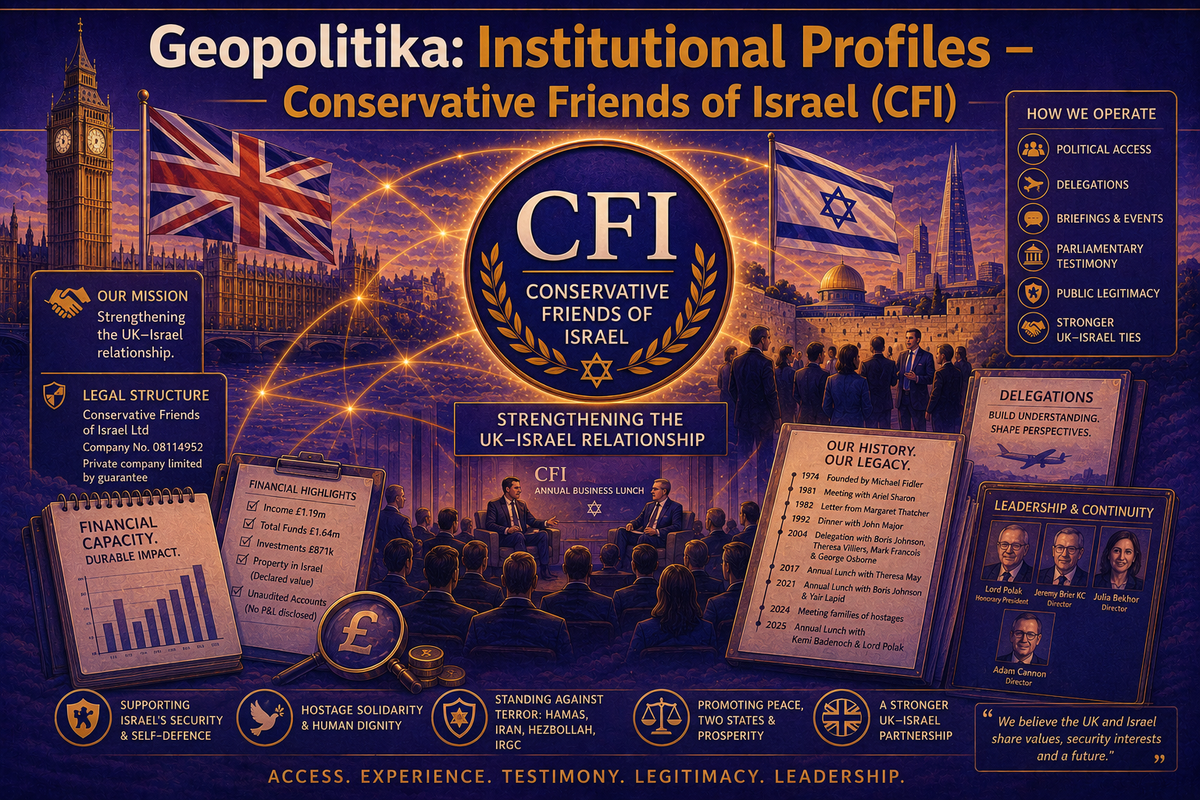
This article is published as part of the Geopolitika project to map Anglo-American power structures by examining their founding mythologies, leadership, linkages to power, public face, the nature of their outputs and who these are directed towards. This series is primarily generated from materials provided on the institution’s own websites, which are analysed using a structured analytic framework—see methodology statement at foot of article.
—
Executive-Summary
Conservative Friends of Israel (CFI) is the Conservative-side institution in the UK based party-friendship machinery examined in this series. It sits beside, not inside, Labour Friends of Israel (LFI): both being party-adjacent organisations, meaning bodies legally separate from a political party but close enough to help shape its language, access and legitimacy around a policy field. CFI’s field is the Conservative Party and the United Kingdom–Israel relationship.
CFI’s public claim is concise: “Strengthening the UK-Israel relationship.” This article treats that slogan as evidence, not conclusion. A slogan is not false because it is simple; it is incomplete because it hides the machinery that makes it work. In CFI’s case, the machinery is political access, delegation infrastructure, financial capacity, leader prestige, public testimony and Conservative Party legitimacy. The question is not whether CFI supports the United Kingdom–Israel relationship. It plainly does. The question is how that support is organised, funded, routed and converted into political authority.
CFI is not simply a website or a slogan. Its legal vehicle, Conservative Friends of Israel Ltd, company number 08114952, is a private company limited by guarantee: a company without ordinary shareholders, where members guarantee a limited amount if it is wound up. That legal compactness can make the institution appear modest. This article argues that would be misleading. CFI is legally compact, but politically significant.
Its own public website structure shows the operational field: “About,” “Delegations,” “Spotlight,” “Support us” and “History.” Delegations are core—involving organised political visits in which Members of Parliament (MPs), peers or other political figures are taken to Israel or related sites, receive briefings and exposure, and later convert that experience into public testimony. The basic route is visible from the start: Conservative Party access becomes CFI platform; platform becomes delegation or event exposure; exposure becomes parliamentary testimony; testimony becomes public legitimacy.
The financial record sharpens the picture in that it shows durable organisational capacity. It also shows where public visibility stops: the accounts do not disclose donor identities, donor concentration, income composition, event sponsorship, delegation funders, investment holdings, creditor counterparties or the omitted profit-and-loss account, which would normally show income and expenditure categories.
This is not an accusation of illegality. There is no claim here of hidden control, Israeli state direction, illegal payments, unlawful coordination, donor command or foreign-agent status. Its claim is narrower: CFI helps make one version of Conservative Israel policy feel responsible, serious and party-normal. In that frame, support for Israel, hostage solidarity, Hamas, Iran and the Islamic Revolutionary Guard Corps (IRGC) sit near the centre; Palestinian rights-first, ceasefire-first, arms-restriction, sanctions or international-law accountability frames carry more friction. The democratic significance lies in the route beneath the slogan: support becomes access; access becomes testimony; testimony becomes legitimacy; legitimacy narrows the range of Conservative speech on Israel-Palestine.
History as Legitimacy — From 1974 to the Leader Platform
Conservative Friends of Israel does not present itself as a temporary campaign. Its history page constructs a longer institutional memory: founding, continuity, Conservative leadership association, delegations, annual business lunches and post-7 October solidarity. Institutional memory means the way an organisation turns its own past into present authority. For CFI, history is not background. It is part of the machinery.
The page traces CFI to 1974, when Michael Fidler, former Member of Parliament for Bury and Radcliffe, founded it after the 1973 Yom Kippur War. CFI frames that moment as one of historically low United Kingdom–Israel relations and presents Fidler’s purpose as building lasting support for Israel inside the Conservative Party. That origin story gives CFI both a founding crisis and a party mission: not friendship with Israel in the abstract, but the repair and reproduction of Conservative support after diplomatic rupture.
The public-facing materials use this history as legitimacy capital: accumulated authority an institution can draw on because it appears longstanding, recognised and embedded. CFI’s timeline does this through senior Conservative association. It records a 1981 CFI meeting with Ariel Sharon, a 1982 letter from Prime Minister Margaret Thatcher to Michael Fidler, a 1992 dinner involving John Major, then Prime Minister; a 2004 delegation including Boris Johnson, Theresa Villiers, Mark Francois and George Osborne; a 2017 Annual Business Lunch addressed by Theresa May; a 2021 Annual Business Lunch moment involving Johnson and Yair Lapid, then Israeli foreign minister; a 2024 event at which Rishi Sunak met families of hostages held by Hamas; and a 2025 Annual Business Lunch featuring Kemi Badenoch and Lord Polak.
That sequence is not evidence that Conservative leaders are directed by CFI. The point is narrower: CFI’s public memory turns repeated leader proximity into institutional authority. A leader platform means an event or setting where an organisation gains credibility because senior party figures appear through it. CFI’s annual lunches and timeline entries make support for Israel look less like a sectional campaign and more like part of Conservative continuity.
Lord Polak is central to that continuity. CFI’s history material says Polak took over as Director in 1989 after Fidler’s death and later became Honorary President. He bridges CFI’s founding generation, delegation system and current leadership culture, including current fellow CFI Ltd directrors Jeremy Brier KC, Julia Bekhor, Adam Cannon.
CFI’s history therefore functions as an authority route. Founding crisis becomes mission; leadership association becomes prestige; prestige becomes credibility for Conservative Members of Parliament and peers; credibility makes the pro-Israel frame feel like established party common sense rather than a contested lobbying position. This does not prove control. It shows how continuity can become power.
The People and Their Roles
The people around CFI should not be read as a single bloc. The purpose here is not to turn names into insinuation, but to separate roles. In the CFI machinery, people appear as governors, carriers, validators, continuity figures and interlocutors. The distinction matters because CFI’s public record is much clearer about people than about money. Directors, Members of Parliament, peers and Conservative leaders appear across the corpus; donor identities, donor concentration, delegation finance and event sponsorship do not. That asymmetry is not proof of misconduct. It shows where the public record becomes uneven: personnel visibility is high, material-source visibility is low.
- Legal Governance: As stated above, Companies House records Julia Ruth Bekhor, Jeremy Brier KC, Adam Cannon and Lord Polak as active directors of Conservative Friends of Israel Ltd. These names matter less as biographies than as governance points: they are the people through whom the legal entity is formally stewarded and overall control is exercised.
- Parliamentary Carrying: A carrier moves institutional language into public or parliamentary space. Greg Smith MP is the most important current carrier in this frame. His parliamentary register records the unpaid role of Chairman of the Conservative Friends of Israel Parliamentary Board, previously Vice Chairman from 1 May 2025. CFI material also places Smith in delegation and interview contexts: a public political node who can translate CFI-mediated exposure into parliamentary and media-facing testimony. That is what “carrier” means here: not passive membership, but the movement of institutional framing into public political speech.
- Delegation Carrying: The same carrying function extends to Conservative MPs and peers who appear in CFI delegation material. Richard Holden MP, Andrew Bowie MP, Katie Lam MP, Ben Obese-Jecty MP, Sarah Bool MP, Paul Holmes MP, Rebecca Smith MP, Gareth Bacon MP, Bradley Thomas MP, Peter Fortune MP and Jack Rankin MP appear as delegation-video or comment participants, with Lord Pickles also appearing in the delegation and institutional field. The point is not that all participants perform the same political work. The point is that delegation participation supplies a repeatable route:
CFI platform → political visit → testimonial language → Conservative legitimacy. - Platform Validation: CFI’s public history links the institution to senior Conservative figures across decades: John Major, Theresa May, Boris Johnson, Rishi Sunak and Kemi Badenoch. CFI’s history records these leader-event moments, including Annual Business Lunch appearances and post-7 October hostage-family settings. Leader proximity converts CFI from a sectional advocacy body into something that looks like a normal stage for Conservative foreign-policy seriousness.
- Historical Continuity: Lord Polak sits across governance, memory and prestige. CFI’s history material says Polak took over as Director in 1989 after Michael Fidler’s death and later became Honorary President. In the CFI story, he is not merely a director or peer. He is the continuity device linking CFI’s founding generation, its delegation system and its current leader-platform culture.
- Israeli Interlocutors: CFI’s history and delegation materials place Conservative politicians in relation to key Israeli figures including Yair Lapid, Ariel Sharon, Tzipi Hotovely and Isaac Herzog. An interlocutor does not need to command the institution to matter. Access itself is the value: the delegation participant receives briefings, setting, narrative and status; CFI receives proof that it can open doors.
- Communications Adjacency: The people map also shows adjacency to media and public-narrative infrastructure. Companies House material identifies Adam Cannon as an active CFI director and also records active or former directorships at Jewish Chronicle Media Limited, ARC Strategy Advisory Ltd, The Jewish News Limited, London Jewish Forum and Britain Israel Communications and Research Centre (BICOM). The analytic point is adjacency, not control: media, Jewish communal and pro-Israel communications environments appear near the CFI governance field through a named director’s appointments.
This people architecture is why CFI should be read as a platform rather than only an association. Directors give it legal continuity. Greg Smith and other parliamentarians carry its language outward. Conservative leaders validate it. Lord Polak supplies historical continuity. Israeli diplomatic and political actors supply access and external authority. Communications-adjacent appointments show proximity to media and public-narrative infrastructure.
The machinery is therefore human as well as financial. CFI does not need to write every speech or direct every participant to shape the field. It needs a recognised platform, named governors, parliamentary carriers, leader validators, interlocutor access and repeated occasions where those roles meet. That is what makes the institution politically significant: not a hidden command structure, but a durable Conservative route through which Israel-policy legitimacy is produced, displayed and carried into UK Parliament.
The Money — A Visible Balance Sheet, an Invisible Funding Route
Money does not explain everything about Conservative Friends of Israel Limited (CFI Ltd), but it fixes the article’s central tension in material form. The institution is compact in legal shape, but not financially negligible. Its 2025 filing shows a company with substantial reserves, investment holdings and cash, while leaving the most politically relevant funding routes outside public view.
As noted earlier, CFI Ltd is a private company limited by guarantee, filed under company number 08114952. Its accounts for the year ended 31 July 2025 are unaudited and claim audit exemption under section 477 of the Companies Act 2006. That is a lawful reporting route. It is also a narrower public-visibility route.
The visible numbers matter. At 31 July 2025, CFI Ltd disclosed £5,037 in tangible fixed assets, £402,329 in fixed asset investments, £52,303 in debtors, and £398,003 cash at bank and in hand. Total current assets stood at £450,306. Against that, it recorded £22,269 in creditors falling due within one year. Net current assets were £428,037, and total net assets stood at £833,403. The accounts also disclose an average of nine employees and £24,936 in operating lease commitments.
Those figures are not incidental. They show that CFI is not merely a loose parliamentary label. It has balance-sheet capacity: cash, investments, staff, lease commitments and reserves. Compared with the image of a small friendship body, £833,403 in net assets, including more than £400,000 in fixed asset investments, indicates durable organisational infrastructure. This is structural evidence of capacity, not evidence of misconduct.
The filing also shows where visibility stops. The public record does not identify donors. It does not show donor concentration, donation amounts by source, event sponsorship, delegation funders, staff compensation, detailed programme expenditure, investment holdings, investment counterparties or the full income-and-expenditure route. The accounts state that the profit-and-loss account was not delivered. Its absence means the public can see the balance sheet, but not the operating story behind it.
That distinction is crucial. A balance sheet shows position at a point in time. It does not, by itself, tell readers who gave money, what funded particular activities, which events cost what, how delegations were financed, or which programmes consumed institutional resources. In CFI’s case, that missing operating layer sits exactly where influence would be easiest to trace.
The investment line raises the same issue. Fixed asset investments of £402,329 are visible as an aggregate figure. The specific holdings are not. The point is not to imply improper investment. The point is that a substantial investment base supports institutional continuity while the public cannot see what is held, how income from those holdings is generated, or whether any investment relationships create reputational or political questions.
The delegation route is the most important missing layer. As set out earlier, CFI’s delegations are not marginal publicity exercises. They are a central mechanism through which Members of Parliament and peers can convert travel, briefing and curated exposure into public testimony. The corpus contains delegation pages and spotlight material, including the headline that “10 Conservative MPs and Peers express support for Israel on CFI delegation.” But the public-facing corpus used for this article does not provide a complete delegation-finance dataset. It does not show, in one place, who paid for each trip, what value each participant received, whether costs were met by CFI, donors, third parties or participants, and how those costs correspond to parliamentary declarations.
That absence should be treated carefully. It is not proof of bribery, hidden payment or foreign-agent status. It is an expected transparency gap. When organised travel is one of the institution’s principal routes of influence, trip finance becomes a democratic question.
- Who funds the exposure?
- Who selects the itinerary?
- What value is received?
- How is that value declared?
- Which briefers appear?
- Which voices do not?
The financial statements do not answer those questions.
The same applies to events. CFI’s history page places annual business lunches and senior Conservative appearances at the centre of its institutional memory. Events of that kind produce prestige, proximity and public alignment. But the visible financial record does not itemise event sponsorship, ticket income, donor underwriting, venue costs or counterparties. Again, the article does not infer misconduct. It identifies a gap between the public political value of the event platform and the limited financial detail available to explain how that platform is sustained.
The most disciplined conclusion is therefore not “secret money.” It is influence-critical opacity: opacity located at the points where money most plausibly becomes political effect. Donor support, investment capacity, event finance, delegation funding, staff capacity, creditor relationships and programme expenditure are exactly the routes the public record does not fully reveal. The accounts disclose enough to show that CFI has material capacity. They do not disclose enough to show how that capacity is funded, allocated or converted into access.
This is the financial form of the article’s broader argument. CFI’s power is not measured only by asset size. It lies in the conversion of resources into Conservative legitimacy: money supports staff and continuity; continuity supports events and delegations; events and delegations support testimony; testimony supports a recognised Conservative pro-Israel frame. CFI is not hidden. It files accounts. It has a visible company number. Its directors are identifiable. Its website and history pages are public. But the available financial record leaves open the central democratic questions: who funds the institution, in what amounts, through which channels, with what concentration, for which outputs, and with what effect on Conservative foreign-policy discourse?
The Cycle — Crisis, Delegation, Testimony, Relevance, Repeat
The most important thing about Conservative Friends of Israel (CFI) is not any single output. It is the cycle that makes the institution repeatedly useful.
A cycle in this sense means a recurring institutional sequence: a crisis or political opening creates demand for a frame; the institution supplies that frame through events, delegations, statements or media; political actors carry the frame outward; the institution’s relevance is renewed; the next crisis restarts the process. In CFI’s case, the cycle is built around Israel’s security, the United Kingdom–Israel relationship, Conservative support for Israel, hostage solidarity, Hamas, Gaza aid claims, criticism of Israel, and Iranian/IRGC threat framing.
The cycle begins with a pressure event. After 7 October 2023, the Hamas massacre, the captivity of hostages, the war in Gaza, criticism of Israeli conduct, humanitarian aid disputes and pressure inside UK Parliament created a high-demand environment for Conservative Israel-policy language. CFI’s public materials show the organisation responding through solidarity messaging, delegation outputs, Annual Business Lunch staging, social-media signalling, hostage-family visibility, support for Israel’s security framing and criticism of what it presents as hostile or lazy anti-Israel narratives. The cycle proceeds in stages, so that:
- Stage one: crisis produces demand.
- Stage two is institutional supply: CFI provides Conservative-compatible framing: Israel as friend and ally, Hamas as the central terrorist actor, hostages as the moral centre, Iran and the IRGC as strategic threats, and much criticism of Israel as distorted or unfair. This is not neutral analysis. It is a recognisable pro-Israel Conservative grammar.
- Stage three is delegation: CFI organises trips for MPs and peers. Participants receive curated briefings and exposure, then return with claims to first-hand authority. That authority is converted into statements, interviews, parliamentary interventions, and party positioning. CFI’s website includes delegation pages, videos and spotlight material, including the headline that “10 Conservative MPs and Peers express support for Israel on CFI delegation.” The Delegations page records comments or video entries from Richard Holden MP, Andrew Bowie MP, Katie Lam MP, Greg Smith MP, Ben Obese-Jecty MP, Sarah Bool MP, Paul Holmes MP, Rebecca Smith MP, Gareth Bacon MP, Bradley Thomas MP, Lord Pickles, Peter Fortune MP and Jack Rankin MP.
- Stage four is leader and event amplification: CFI’s history prominently features annual lunches and senior Conservative association. The timeline links the organisation to John Major, Theresa May, Boris Johnson, Rishi Sunak, and Kemi Badenoch. These appearances do not prove CFI controls party leaders. They prove platform validation: senior political presence makes CFI appear as a normal, prestigious venue for Conservative foreign-policy seriousness.
- Stage five is public circulation: CFI’s social media and spotlight outputs rapidly disseminate the results: delegation testimony, hostage solidarity, criticism of anti-Israel narratives, and reinforcement of UK-Israel partnership. Social media functions here as rapid-response infrastructure linking parliamentary figures, crisis language, and public Conservative signalling.
- Stage six is renewed relevance: Every new crisis or policy opening creates fresh demand for Conservative politicians to signal where they stand. CFI is available as organiser, interpreter, and amplifier. Its usefulness to politicians renews its usefulness to supporters. Support sustains capacity. Capacity enables the next delegation, lunch, statement, or post.
The cycle repeats:
Threat or crisis → CFI framing → delegation/event/social-media output → Conservative testimony → institutional relevance → renewed access and capacity.
This cycle explains why CFI’s public function is broader than narrow lobbying. Lobbying implies direct attempts to influence specific decisions.
CFI supplies something wider: a standing Conservative grammar for Israel-Palestine issues.
Support Israel. Emphasise the bilateral relationship. Centre hostages. Treat Hamas and Iran as primary threats. Contest criticism of Israel. Use delegation experience as proof of seriousness. Associate Conservative leadership with pro-Israel policy. Greg Smith’s “fair hearing” phrase is important because it names the perceived gap CFI fills: Israel is not merely supported, it is positioned as needing corrective representation inside Parliament and public debate.
Financial capacity detailed above matters because cycles require resources. While these figures do not prove donor control, they demonstrate balance-sheet ability to remain present across repeated crises and political cycles. What remains unclear is how specific outputs are financed: delegation costs, event sponsorship, donor concentration, investment holdings, and the omitted profit-and-loss account are not visible in the public record.
The political consequences are real but indirect. The cycle gives aligned Conservative politicians a ready-made route to credibility on Israel issues. It gives CFI recurring relevance. It gives pro-Israel publics a visible Conservative platform. It gives Israeli diplomatic and security narratives a domestic parliamentary route. At the same time, it narrows space for alternative Conservative positions: Palestinian rights-first arguments, ceasefire-first approaches, arms-restriction proposals, anti-war Israeli dissent, or deeper humanitarian criticism appear with less institutional backing.
CFI does not show hidden command. It shows repetition. Crisis generates demand; CFI supplies language and access; delegations convert exposure into testimony; events and leaders validate the frame; outputs circulate it; relevance returns. Through that repetition, CFI helps make one version of Conservative Israel policy feel responsible, authoritative, and party-normal. That is the cycle’s enduring value.
Who Speaks, Who Is Spoken For, Who Cannot Exit
The cycle described in the previous section does not affect all actors equally. It gives some people a platform, turns others into moral symbols, and leaves others mostly as objects of policy discussion. The people question therefore has to be separated from the personnel map. The personnel map asks who operates inside or near CFI. This section asks who gains voice through it, who is spoken for by it, and who appears with little ability to set the frame.
The most visible speakers are Conservative politicians. Members of Parliament and peers appear through delegations, annual events, statements, social-media posts and leadership platforms. Their role is not merely to be present. They can carry CFI’s framing into UK Parliament, party debate, interviews and public-facing political speech. That is why delegation testimony matters: a politician who has travelled, been briefed and returned with a first-hand account can speak with an authority different from ordinary opinion.
Analysis of the public-facing materials identifies this as one of CFI’s core routes. The institution creates a setting in which Conservative politicians can become witnesses, validators and carriers of a particular Israel-policy grammar. That grammar centres support for Israel, the United Kingdom–Israel relationship, hostages, Hamas, Iran, the IRGC, security, aid-flow claims and criticism of what CFI-aligned materials describe as unfair or lazy narratives about Israel.
The second visible group is Israeli civilians and hostage families. In CFI’s post-7 October frame, they are morally central. CFI’s history material records Rishi Sunak meeting families of hostages in Hamas captivity at the 2024 Annual Business Lunch. Their presence gives the institution’s political grammar a human centre: the murdered, the captured, the threatened and the bereaved. It strengthens the case for solidarity by attaching it to recognisable vulnerability.
But moral centrality is not the same as political agency. Hostage families and Israeli civilians appear in the CFI frame as figures whose suffering authorises solidarity and security support. They do not necessarily set the policy route themselves. Their vulnerability is real; its institutional use still needs to be analysed. CFI’s cycle turns that vulnerability into Conservative foreign-policy seriousness: support Israel, stand with hostages, reject Hamas, defend an ally, oppose hostile narratives.
The third group is British Jewish and communal-security constituencies. Communal-security constituencies means Jewish individuals, organisations and publics whose safety, recognition and protection from antisemitism are part of the political field. CFI operates in a post-7 October environment where antisemitism, Jewish public fear and support for Israel are often linked in Conservative messaging. This article does not treat those concerns as fabricated. The question is how they are routed. In CFI’s materials, Jewish security and pro-Israel solidarity can reinforce each other, making Conservative support for Israel appear also as support for British Jewish reassurance.
The fourth group is Palestinian civilians. They are present, but differently. In the public-facing corpus, Palestinians appear more often through Gaza, aid, Hamas, border and security concerns, humanitarian claims or narrative dispute than as people setting the terms of their own political condition. Israeli suffering and hostage captivity are made vivid through solidarity settings. Conservative political voices are named and platformed. Palestinian civilians are more often routed through aid flow, Hamas responsibility, security framing, media narrative and humanitarian management. This does not mean they are absent. It means their story is structurally weaker inside CFI’s visible frame, and the causes of their suffering are interpreted through Israeli security and Hamas-responsibility frames than through Palestinian testimony or international-law accountability.
This is where immobilisation enters the frame. In this series, immobilisation means a condition in which a population is constrained by institutional, political, material or discursive arrangements it cannot easily exit. For Palestinians in Gaza, the constraint is not only discursive. It is physical and geopolitical: border control, war, displacement, aid dependency, destruction and external policy decisions. There is no question here about CFI directly producing those conditions. But CFI participates in a domestic political environment in which Palestinian harm is interpreted, prioritised, translated or downgraded through Conservative pro-Israel frames.
There is also a Conservative-side immobilisation. Conservative MPs, candidates, members and voters who dissent from CFI’s pro-Israel framing are not physically trapped. Their constraint is reputational and discursive. To depart from the CFI grammar may mean appearing weak on Israel, insufficiently attentive to British Jewish security, naïve about Hamas, careless about hostages or aligned with anti-Israel narratives. This is not coercion in the narrow sense. It is boundary-setting: a limit on what can be said without political cost.
The claim is therefore not that all Conservatives are captured by CFI. That would overstate the evidence. The more precise claim is that CFI helps make one Conservative posture easier to occupy than others. Support for Israel as ally, emphasis on hostages, Hamas and Iran, scepticism toward criticism of Israel, and confidence in delegation testimony become politically rewarded positions. Palestinian rights-first, ceasefire-first, arms-restriction, anti-war Israeli or humanitarian-critical positions appear with less institutional support inside this frame.
United Kingdom taxpayers and people affected by state policy even when they are not directly represented in the institutions shaping that policy. Foreign-policy positions on arms, sanctions, aid, recognition, ceasefire language, counter-terrorism and diplomatic support are made through government and parliamentary processes. CFI does not decide those policies by itself. But an institution that gives Conservative politicians access, language and legitimacy around Israel participates in the environment through which such positions become thinkable, defensible or marginal.
The asymmetry is therefore layered. Conservative politicians are visible as speakers. Senior leaders are visible as validators. Israeli civilians and hostage families are visible as moral anchors. British Jewish publics are visible as protection constituencies. Palestinian civilians appear more often as governed subjects of aid, war, Hamas and humanitarian debate. Conservative dissenters and voters are mostly implied audiences, not co-authors of the frame.
That is why CFI’s public function has democratic consequences. The institution does not have to silence alternative voices directly. It can narrow the space indirectly by making one frame repeatable, prestigious and party-normal. The unanswered question is not whether CFI is allowed to advocate. It is. The question is who gets to speak through its machinery, who is spoken about by that machinery, and who must live with the policy consequences while remaining outside the room.
Ecosystem and Omissions — CFI Beside LFI, Not Inside It
CFI is not an isolated anomaly. It belongs to a wider institutional ecosystem of party-adjacent Israel advocacy, parliamentary access, delegation politics, media framing and communal-security legitimacy. But ecosystem does not mean command structure. The point is to place CFI accurately: beside comparable institutions, not inside them; adjacent to wider networks, not proven to be directed by them.
The closest comparator is Labour Friends of Israel (LFI), examined in the first article in this series. LFI and CFI occupy parallel party-facing positions. Each translates support for Israel into the grammar of its host party. LFI makes pro-Israel alignment speakable in Labour terms: anti-racism, antisemitism repair, two states, peacebuilding and Labour internationalism. CFI makes the same broad alignment speakable in Conservative terms: strategic partnership, security, allyship, leader continuity, parliamentary seriousness and post-7 October solidarity.
That comparison clarifies institutional type, not shared control. This article does not claim that CFI and LFI are the same institution, share donors, share governance, follow a central command or act as interchangeable branches of one body. They are better understood as party-specific access infrastructures operating inside different political cultures. An institutional analysis treats LFI as a near-neighbour: useful for identifying the species, not proof of CFI’s conduct.
Other institutions mark the surrounding field. The Conservative Middle East Council is a Conservative foreign-policy comparator because it also operates near Conservative parliamentary debate on the Middle East, though without CFI’s specific pro-Israel friendship function. Labour Friends of Palestine and the Middle East offers a counter-frame comparator on the Labour side: a party-adjacent body oriented toward Palestinian rights and Middle East policy from a different direction. Britain Israel Communications and Research Centre (BICOM) belongs to the communications and research ecosystem around UK-Israel debate. While these organisations do not prove anything about CFI by themselves, they show that CFI operates in a crowded field where parliamentary access, media language, foreign-policy framing and communal legitimacy are distributed across specialised institutions.
This ecosystem framing prevents two opposite errors. The first is to treat CFI as merely a small friendship group because its legal form is compact. That misses its parliamentary, financial, historical and delegation functions. The second is to treat CFI as evidence of a single hidden “Israel lobby” command structure. That overstates what the public record supports. The more accurate reading is structural: CFI is a Conservative-side node in a broader pro-Israel policy and legitimacy environment.
This is also where omissions become important. An omission is not automatically evidence of concealment. It is a missing layer that matters because of the institution’s observable function. CFI’s function, as developed in earlier sections, is to route Conservative political access, leader prestige, delegation testimony, security framing and financial capacity into pro-Israel legitimacy. The most important missing information is therefore the information that would clarify those routes. Eight key omissions are key:
- Donor identity: The 2025 accounts disclose balance-sheet capacity, but not who funds the institution. They do not show donor names, donor amounts or donor concentration. This matters because a party-adjacent institution can shape parliamentary legitimacy while leaving the public unable to see whether its funding is broad, narrow, recurring, conditional or concentrated.
- Income composition: The accounts do not deliver a profit-and-loss account. Without it, the public can see CFI’s assets and liabilities at year-end, but not the operating route: donations, event income, investment income, staff costs, travel costs, consultancy costs, communications expenditure or other programme spending.
- Delegation finance: This is one of the most important gaps because delegations are central to CFI’s mechanism. The public-facing corpus shows delegation activity and testimonial outputs, but not a complete financial map of who paid for each trip, what value each participant received, whether costs were met by CFI, donors, third parties or participants, and how those values correspond to parliamentary declarations. This is not a claim of bribery or illegal payment. It is a democratic transparency question because delegations convert organised travel into political authority.
- Investment detail: The accounts disclose £402,329 in fixed asset investments, but not the holdings behind that figure. The issue is not that investments are inherently suspicious. It is that the investment line is large relative to the apparent compactness of the institution, and forms part of the durable capacity that lets CFI remain active across repeated political cycles.
- Event finance: CFI’s history page places Annual Business Lunches and senior Conservative appearances at the centre of institutional prestige. Those events matter politically because they stage proximity: Conservative leaders, parliamentarians, CFI leadership, Israeli or Jewish communal contexts, and pro-Israel supporters in one space. But the visible record does not itemise ticket income, sponsorship, underwriting, venue costs or event counterparties. The public can see the prestige; it cannot see the full financial route that sustains it.
- Creditor and counterparty detail: The accounts disclose trade creditors and other creditors, but not the counterparties. In ordinary company accounts, that aggregation may be standard. In a political-access institution, it leaves unanswered questions about vendors, service providers, event suppliers, consultants, lease relationships and operational dependencies.
- Policy uptake: the point at which institutional language, briefings, delegations or events become reflected in parliamentary questions, speeches, party positions, ministerial statements or policy decisions. CFI’s role is not reducible to direct lobbying, and this article does not claim that CFI causes specific Conservative policy outcomes. But the missing layer remains important: which Conservative positions are traceable to CFI access, and which are simply part of a broader Conservative pro-Israel consensus?
- Affected-population voice: As argued in the previous section, Palestinian civilians, anti-war Israeli voices, humanitarian-critical Conservatives, ceasefire-first Conservatives, UK taxpayers and public-policy constituencies appear less directly than Conservative parliamentarians, hostage-family solidarity settings, Israeli security narratives and British Jewish reassurance frames. The missing question is not only who funds CFI. It is who gets to describe the consequences of the policies CFI helps make legitimate.
These omissions should be held with discipline. They do not prove hidden Israeli direction, donor control, unlawful coordination, improper payments to Members of Parliament or foreign-agent status. They do show that CFI’s transparency is thinnest where its political function is most important: money, access, travel, events, policy uptake and voice.
That is why ecosystem and omission belong together. CFI’s location beside LFI, BICOM, the Conservative Middle East Council and other parliamentary or communications institutions shows the field in which it operates. The omissions show what remains hard to see inside that field. The institution is visible enough to map, but not transparent enough to fully follow. The democratic question is therefore practical, not conspiratorial: who funds the work, how delegations are financed, how events are supported, what investments sustain the institution, how policy contact occurs, and whose voices are missing from the frame.
What It Actually Does — POSIWID
The useful test at this point is POSIWID: the purpose of a system is what it does. The phrase comes from systems theorist Stafford Beer, and in this article it means that an institution should be judged by its repeated observable effects, not only by its stated intention.
That does not mean dismissing CFI as dishonest. Its stated purpose is clear: “Strengthening the UK-Israel relationship.” It certainly does that. But a close reading of the the public record shows a more specific function. CFI operates as Conservative Israel-policy infrastructure. It gives Conservative politicians a recognised route into pro-Israel alignment through history, delegations, leadership events, parliamentary testimony, hostage solidarity, security framing, social-media amplification and a durable financial base. This function is achieved through several functioanl mechanisms:
- Legitimacy routing: Legitimacy routing means moving a political position through institutions that make it appear credible, responsible and normal. CFI does this by translating support for Israel into Conservative language: allyship, strategic partnership, national security, counter-terrorism, leadership seriousness, hostility to anti-Israel narratives, and solidarity after 7 October. The position becomes more than “support for Israel.” It becomes a marker of Conservative foreign-policy responsibility.
- Access conversion: As shown in the people and cycle sections, CFI places Members of Parliament, peers, Conservative leaders, Israeli diplomatic or political actors, hostage-family contexts and pro-Israel supporters into repeated institutional settings. Delegations, Annual Business Lunches, spotlight pages and public statements are not isolated activities. They convert access into political capital. Political capital means the credibility, relationships and status that can be used in future political argument.
- Testimonial production: Delegations are central here. CFI-mediated travel allows Conservative politicians to say, in effect, that they have been, seen and heard. That matters because testimony carries a different authority from abstract policy preference. A politician returning from a delegation can speak about aid routes, hostages, Israeli security concerns or Hamas with the force of first-hand exposure. The question is not whether that exposure is fabricated. The question is how it is curated, financed and converted into public authority.
- Boundary-setting: A boundary, in this context, is the line between what sounds responsible and what sounds suspect inside Conservative discourse. CFI helps reinforce a frame in which responsible Conservatives support Israel, centre hostages, treat Hamas and Iran as primary threats, defend the United Kingdom–Israel relationship, distrust certain criticisms of Israel and emphasise fair hearing for an ally. Other positions remain possible, but they become harder to occupy: ceasefire-first language, arms-restriction arguments, Palestinian rights-first framing, sanctions, anti-war Israeli dissent or criticism of delegation narratives carry more political friction.
- Relevance renewal: The cycle described earlier gives CFI recurring utility. Each crisis or policy opening — 7 October, Gaza, hostages, Hamas, Iran, the Islamic Revolutionary Guard Corps (IRGC), aid disputes, media criticism or parliamentary pressure — creates new demand for Conservative pro-Israel language. CFI supplies the frame, platform, delegation or signal. That output renews the institution’s relevance to politicians, supporters and aligned publics. Relevance then supports further access and capacity.
- Material continuity: The financial statements do not show a vast organisation, but they do show durable capacity. As detailed above, as at 31 July 2025, CFI Ltd disclosed £833,403 in net assets, including £402,329 in fixed asset investments and £398,003 cash at bank and in hand. Those figures matter because influence does not require a mass-membership machine. It can move through a compact organisation with enough reserves, staff, events, delegations and relationships to remain present when policy windows open.
The strongest conclusion is therefore not that CFI secretly controls Conservative policy. The evidence does not support that. Nor does the evidence support claims of Israeli state direction, illegal payments to Members of Parliament, donor command, covert orchestration or foreign-agent status. The stronger claim is institutional and observable: CFI makes a pro-Israel, security-first position usable inside Conservative politics.
That formulation matters. Security-first means that the political frame begins from Israel’s security, Hamas, hostages, Iran, terrorism, aid verification and hostile narratives, rather than from Palestinian rights, occupation, civilian harm, arms restrictions or international-law accountability. CFI does not need to erase those alternative frames. It only needs to make its own frame easier to repeat, easier to validate and easier to inhabit as Conservative common sense.
So what does CFI actually do?
It routes money-backed capacity into access. It routes access into delegation experience. It routes delegation experience into testimony. It routes testimony into Conservative legitimacy. It routes legitimacy back into institutional relevance. And through that loop, it helps define the boundaries of acceptable Conservative speech on Israel-Palestine.
That is the machinery beneath the slogan.
Conclusion — Route, not Slogan
The slogan is not the problem. Conservative Friends of Israel is entitled to advocate for a stronger United Kingdom–Israel relationship. It is entitled to organise, publish, host events, brief politicians, support delegations and argue for Israel as a Conservative ally. The issue is not whether such an institution should exist. The issue is how its route into political legitimacy works, what is visible about that route, and what remains outside public view.
Across the public-facing materials, CFI presents itself as a friendship body. But the institutional record shows a more developed machine. It has legal form through Conservative Friends of Israel Limited, company number 08114952. It has a long public memory, beginning with its 1974 foundation after the Yom Kippur War and extending through repeated Conservative leader association. It has named directors, parliamentary carriers, leader validators and Israeli political or diplomatic interlocutors. It has a delegation system that can turn organised travel into first-hand political testimony. It has annual events and public messaging that make support for Israel visible inside Conservative politics. And it has a balance sheet large enough to sustain institutional continuity.
Those facts do not support sensational claims. As stated repeatedly, this article does not allege hidden control, Israeli state direction, unlawful coordination, illegal payments to Members of Parliament, donor command, bribery or foreign-agent status. The stronger finding is more ordinary and more politically important: CFI operates as Conservative Israel-policy infrastructure. It helps make a particular position feel responsible, serious and party-normal.
That position has recurring features: Israel as ally, the United Kingdom–Israel relationship as strategic good, Hamas as central enemy, hostages as moral anchor, Iran and the IRGC as regional threat, criticism of Israel as often unfair or distorted, and Conservative support for Israel as evidence of foreign-policy seriousness. Other frames are not impossible, but they become harder to occupy: Palestinian rights-first arguments, arms-restriction positions, ceasefire-first politics, anti-war Israeli dissent, sanctions advocacy and international-law accountability claims carry more friction inside the CFI-shaped field.
The public-interest question is therefore not conspiratorial. It is democratic. Who funds the institutions that shape party positions on foreign policy? Who pays for the delegations that become parliamentary testimony? Who finances annual events where political prestige is produced? What sits behind the fixed asset investments? What would the omitted profit-and-loss account reveal about income and expenditure? Which creditors, vendors, sponsors or donors sit behind the visible platform? Which Conservative policy positions are traceable to CFI access, briefings, delegations or events, and which belong to a wider party consensus?
The voice question matters just as much. CFI gives Conservative politicians a platform. It gives Israeli security and hostage-solidarity narratives a recognised route into Conservative speech. It gives British Jewish reassurance politics a visible ally. But Palestinian civilians, humanitarian-critical Conservatives, anti-war Israeli voices, ceasefire-first advocates, United Kingdom taxpayers and public-policy constituencies appear at the margins, with less direct power to define the frame that shapes policy toward them.
That is the real significance of CFI. It does not need to command Conservative policy to influence it. It only has to make one route easier: support becomes access; access becomes delegation; delegation becomes testimony; testimony becomes legitimacy; legitimacy becomes the boundary of responsible Conservative speech.
The question, then, is not whether CFI is a “friend of Israel.” It is.
The question is who gets to set the terms of that friendship, who pays for the machinery that sustains it, and who is left speaking from outside the room where Conservative foreign-policy legitimacy is made?
—
Published via Mindwars Ghosted.
Geopolitika: Tracing the architecture of power before it becomes the spectacle of history.
Methodology Note: This analysis draws on publicly available materials from Conservative Friends of Israel (CFI), accessed through the organisation’s website, delegation materials, history pages, event references, social-media captures, press/interview material and regulatory filings in June 2026. The primary corpus includes: the CFI website, including its About, Delegations, Spotlight, Support us and History pages; public delegation pages, videos and comments by Conservative Members of Parliament and peers; CFI history material covering its 1974 founding, Conservative leadership associations, Annual Business Lunches and post-7 October hostage-family settings; public company records for Conservative Friends of Israel Limited, company number 08114952, including Companies House filings, unaudited accounts for the year ended 31 July 2025, director information and registered company details; Companies House officer and appointment records for named directors; relevant parliamentary register, profile and public-interview material for Conservative parliamentarians appearing in the corpus; and comparator materials relating to Labour Friends of Israel (LFI), the Conservative Middle East Council, Labour Friends of Palestine and the Middle East, and the Britain Israel Communications and Research Centre (BICOM). The analysis was conducted through structured institutional reading of CFI’s self-presentation, legal form, personnel roles, parliamentary linkages, delegation activity, leadership platforms, financial disclosures, missing disclosure layers, social-media outputs, recurring narrative frames, ecosystem position and observable political function. Claims in the article are limited to what the public corpus supports: access, platforming, delegation-to-testimony routes, legitimacy routing, Conservative policy-language production, financial capacity, selective transparency, omission patterns and agenda-shaping inside Conservative politics. The article does not claim hidden control, Israeli state direction, unlawful coordination, illegal payments to Members of Parliament, donor command, bribery or foreign-agent status. Base analytic outputs are available on request. For methodological details—including Transparency Score definitions, typology classifications, and confidence calibration—see the Geopolitika Series Methodological Statement.
Mindwars Ghosted is an independent platform dedicated to exposing elite coordination and narrative engineering behind modern society. The site has free access and is committed to uncompromising free speech, offering deep dives into the mechanisms of control. Contributions are welcome to help cover the costs of maintaining this unconstrained space for truth and open debate.