Operators: Michèle Flournoy – The Portability of National-Security Power
How government authority becomes expert legitimacy, strategic doctrine, private advisory value and corporate governance.
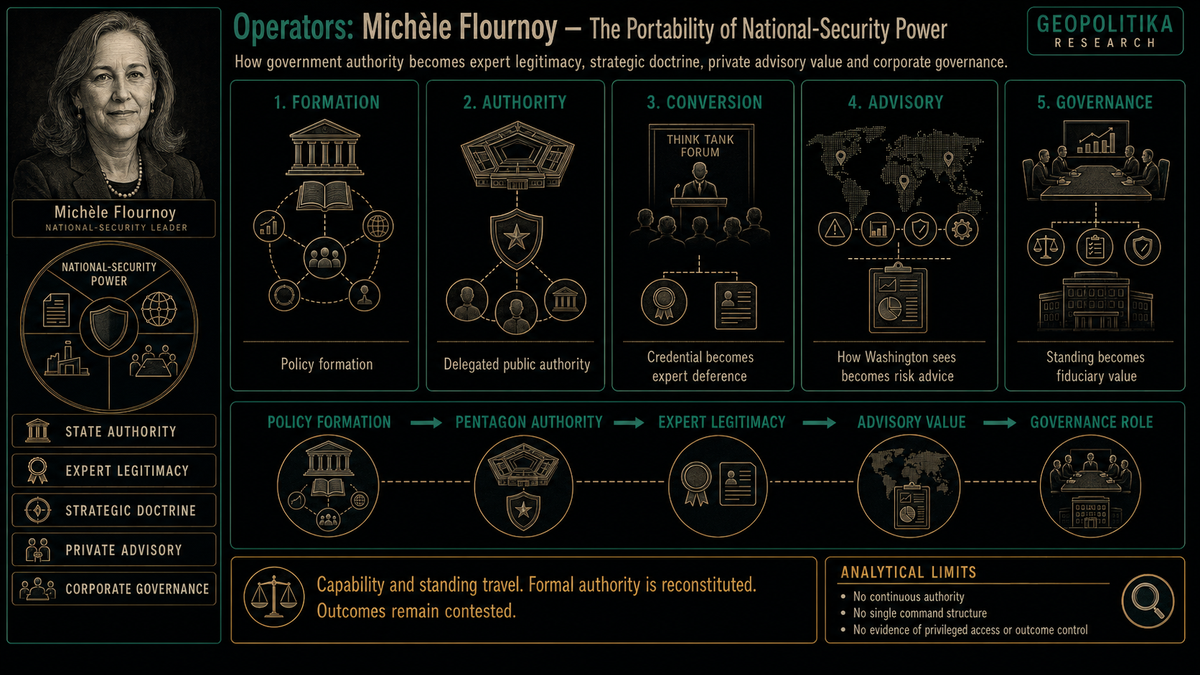
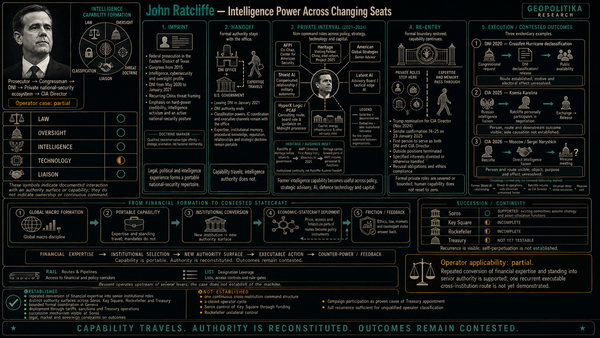
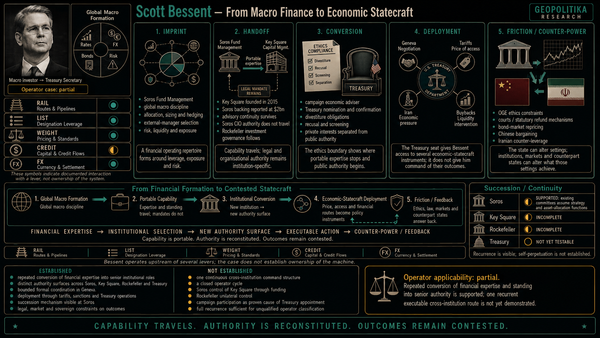
The last two Operators profiles followed different routes by which specialised capability becomes usable inside and outside the state. Scott Bessent carried global-macro expertise into the U.S. Treasury, where an office with legal authority turned a repertoire built around leverage, exposure and market risk into economic statecraft. John Ratcliffe moved in the other direction and back again: intelligence authority ended when he left government, his experience and standing remained useful across policy, advisory, capital and defence-technology settings, and formal authority had to be conferred anew when he returned as CIA Director. Michèle Flournoy presents a third configuration. Her strongest formal authority ended when she left the Pentagon in 2012, yet the experience, reputation and strategic worldview produced around that office continued to carry value across think tanks, elite policy forums, private strategic advisory and corporate governance. The question is therefore not whether Pentagon authority travelled with her. It did not. The question is what remained valuable after that authority disappeared, how later institutions converted it, and what kind of worldview travelled with the credential.
Executive Summary
Michèle Flournoy’s career is best understood as a sequence of institutional conversions rather than one continuous exercise of power. As Under Secretary of Defense for Policy from 2009 to 2012, she held formal, delegated authority inside the Department of Defense. BCG’s 2012 appointment announcement described her as the Department’s third-ranking official and principal adviser to the Secretary of Defense on national-security and defence policy, military plans and operations and National Security Council deliberations. That authority ended with the office.
What persisted was a compound asset: institutional knowledge, professional standing, relationships and a recognisable strategic worldview. Later institutions selected that package for different purposes. BCG provides early proof-of-market; CFR publicly converts the Pentagon credential into expert deference; WestExec makes national-security interpretation commercially visible; and Booz Allen later assigns the accumulated experience governance value.
The doctrinal record is more qualified than a simple hawk or neoconservative label permits. Flournoy is a durable internationalist and alliance-oriented strategist who supports deterrence and substantial military capability while also rejecting torture, treating force as one instrument among others, opposing direct U.S./NATO intervention over Crimea and describing China policy as competition that should not become open conflict between nuclear powers.
The critical problem is causal asymmetry. In Flournoy’s public framing, terrorism, fragile states, Russia and China tend to appear as threats that U.S. power must diagnose and manage, while antecedent U.S. and allied action is less visible. The article does not reverse that asymmetry into a claim that Washington caused every later adversarial action; it asks whether both sides remain visible as strategic actors.
That matters because the same frame later becomes useful outside government. In a 2021 PRISM interview Flournoy spoke of “the U.S. companies that I work with” navigating China, intellectual property, export controls, investment and national-security risk. What becomes portable is therefore not only knowledge of how Washington works, but knowledge of how Washington sees.
The evidence supports Flournoy as a bridge across distinct institutional functions, not as the controller of a single system. It does not establish a coordinated command structure, the sale of privileged access, contract causation or system-level control. The strongest supported proposition is narrower: prior state authority can be converted into expert legitimacy, advisory value and governance value while authority at each new seat remains institution-specific.
Who is Michèle Flournoy?
Michèle Flournoy’s route into the national-security establishment was academic before it was bureaucratic. According to her WestExec and CNAS biographies, she studied social studies at Harvard University and then completed a master’s degree in international relations at Balliol College, Oxford, where she was a Newton-Tatum scholar. Her current first-party biographies preserve that educational foundation before the long move into defence-policy work.
From there she entered the Washington defence-policy system and spent much of the 1990s moving between analysis and government. She served in the Pentagon as Deputy Assistant Secretary of Defense for Strategy and later as Principal Deputy Assistant Secretary of Defense for Strategy and Threat Reduction. In a 2021 CFR “Life Lessons Learned” discussion, Flournoy supplied a more personal account of that apprenticeship. She recalled working on the 1997 Quadrennial Defense Review under Ted Warner and being unexpectedly put in front of the Secretary, Chairman, service chiefs, combatant commands and senior departmental leadership to brief the defence strategy. Her recollection is useful because it shows the career being built inside the institution, not merely described retrospectively from the top.
The same CFR discussion makes clear how consciously Flournoy understands this as a professional formation. Gideon Rose described both of them as part of the civilian-defence-analyst “tribe”; Flournoy responded by defending the value of people who spend “years and years building depth of expertise, building policy experience, building knowledge.” She also pointed to a 30-year talent pipeline inside the defence establishment, noting that Kathleen Hicks and Christine Wormuth had begun as interns in her office decades before reaching senior leadership. That is not evidence of command or patronage over later careers. It is evidence of how the policy establishment reproduces professional expertise across generations.
After leaving government she became a distinguished research professor at the Institute for National Strategic Studies at the National Defense University, where her work included the Quadrennial Defense Review, and then a senior adviser at the Center for Strategic and International Studies. By the mid-2000s she was no longer simply participating in defence-policy institutions; she was helping to formulate arguments about how the national-security system itself should work. With Shawn Brimley she co-authored the 2006 article Strategic Planning for National Security: A New Project Solarium, and the following year co-founded the Center for a New American Security with Kurt Campbell.
CNAS was an important step in the ascent because it placed Flournoy at the junction between policy production and personnel formation. She served as its president before government, later returned as chief executive, and eventually became chair. In late 2008 she co-led Barack Obama’s transition team at the Department of Defense. A career that had already moved through Pentagon policy posts, defence research, CSIS and a newly founded think tank was now routed back toward executive government at a much higher level.
In 2009 Flournoy was confirmed as Under Secretary of Defense for Policy, serving until 2012. That was the decisive credentialing period. Her first-party biographies describe her as the principal adviser to the Secretary of Defense in the formulation of national-security and defence policy, oversight of military plans and operations and National Security Council deliberations; they also record her lead role in developing the 2012 Strategic Guidance and representing the Department in foreign engagements, the media and before Congress.
That experience became the foundation of much of Flournoy’s later foreign-policy credibility. It did not create the career from nothing: Harvard, Oxford, earlier Pentagon service, NDU, CSIS and CNAS all came first. But senior DoD office supplied the credential that later institutions repeatedly foregrounded. When CFR introduced her to an audience, when BCG recruited her into public-sector consulting, when WestExec marketed strategic advice, and when Booz Allen later described the value she brought to its board, the authority of that biography rested substantially on the fact that she had not merely studied national-security power. She had occupied one of the senior positions through which it was exercised.
From Government Authority to Expert Authority
Afghanistan turns the abstract phrase “government experience” into something concrete. In her 2009 Senate confirmation hearing, Flournoy entered office while the United States was fighting in Iraq and Afghanistan and while the incoming Obama administration was reconsidering both wars. The hearing record places Afghan force structure, border security, counter-insurgency, military resources and partner capacity directly inside the policy portfolio she was being asked to help shape.
The record also complicates any crude hawk label. When the hearing turned to interrogation policy, Flournoy stated: “I believe that torture should never be used by the United States, under any circumstances.” More broadly, her strategic record repeatedly treats military power as one instrument within a wider political, diplomatic and institutional strategy rather than as a self-sufficient solution.
The later 2021 PRISM interview shows how that government experience was retrospectively processed after Afghanistan’s wider failure had become impossible to ignore. Flournoy said the United States had achieved “certain narrow objectives” connected to counter-terrorism, while acknowledging that “the broader ambitions that several administrations have had for Afghanistan clearly have not been met.” Her criticism of the withdrawal focused on insufficient diplomatic leverage, inadequate planning for Afghan partners and the failure to create conditions capable of preventing the rapid collapse of Afghan security forces.
That account works in two directions. It demonstrates genuine familiarity with the machinery of war, alliance management and withdrawal. But it also illustrates how participation in consequential policy can survive principally as a credential even when the policy environment itself produced dire results. The failures of the wider intervention are acknowledged; the experience of having operated inside the machinery nevertheless continues to increase the authority of the speaker.
That is the more useful sense in which there is an element of legitimacy production around the government record. The expertise is not fictitious. The issue is that institutional presentation tends to foreground that Flournoy was there—advising senior officials, participating in strategy, dealing with force planning and interagency decisions—while the adverse outcomes associated with that policy era do not necessarily travel with the credential at equal weight. Afghanistan was not the only theatre attached to it: the validated record also places her inside the first Obama administration’s defence-policy environment around the Libya intervention debate and the 2012 Strategic Guidance. None of this makes her the personal author of every decision or downstream result. It establishes the experiential capital later institutions repeatedly selected.
The May 2016 CFR event, “A Conversation with Michele Flournoy”, makes that conversion unusually visible; presider Jamille Bigio introduced Flournoy as a “distinguished speaker” who “requires no introduction”, then immediately supplied the reason she should be heard: her service from 2009 to 2012 as Under Secretary of Defense for Policy, advising the Defense Secretary on national-security policy, military plans and operations and National Security Council deliberations. Bigio then made the conversion explicit: “It is a seat from which we’re very eager to hear her perspectives.”
The Pentagon seat itself was gone. Flournoy could no longer direct military plans or issue departmental guidance. What survived was the residual authority of having occupied it. Government authority had become expert authority. Experience inside the machinery was now a reason for an elite policy audience to accord greater weight to her interpretation of the world.
What travelled with that credential, however, was not simply procedural knowledge. It carried a substantive strategic orientation. The completed analysis finds the strongest support for internationalism and a qualified Atlanticism, while the evidence is insufficient to collapse Flournoy into a fixed neoconservative category. Her record on militarism is mixed: she supports substantial military capability and deterrence, but also places explicit limits around force and repeatedly embeds military instruments within wider alliance, diplomatic and institutional strategies.
The same 2016 CFR discussion gives that worldview an unusually compact public form. Asked about the major security challenges facing the next president, Flournoy began with “the rise of violent extremism”, a persistent and changing terrorist threat, Middle Eastern governance crises and fragile states. She described Vladimir Putin as drawing on a “KGB playbook” to restore Russian influence through coercion and force. China was treated more conditionally, as a power that might still integrate into the existing order but under Xi was showing growing signs of challenging the “rules based order”.
By 2021 the strategic frame had expanded further into technology and economic security. In PRISM, Flournoy called China the United States’ “principal competitor”, described it as the military “pacing threat”, and identified semiconductors, 5G, synthetic biology, cyber and space as fields shaping both economic and national-security power. Yet the same interview also says the objective is to manage that competition without allowing it to erupt into open conflict between two nuclear-armed powers.
Russia shows the same combination of adversarial framing and bounded instruments. In the 2021 interview she described Putin’s Russia as a “dedicated adversary” and portrayed the Russian leader as seeking security through external threat, covert influence and a sphere of dependent states. But she also said that neither the United States nor NATO regarded Crimea as a vital interest warranting direct military intervention. Her preferred instruments were sanctions, international pressure and support for Ukraine rather than direct war.
These qualifications matter. The argument is not that Flournoy carries a simple doctrine of permanent military intervention. It is that she carries a recognisable way of organising the world: which actors constitute threats, which alliances confer legitimacy, which instruments are appropriate, where escalation should stop, and what role American leadership should play.
That worldview is part of the portable asset.
The Pentagon supplied the experience. CFR demonstrates how that experience becomes expert legitimacy. The doctrine supplies the content of what the expert is being asked to interpret.
The next question is therefore not simply what does Flournoy believe? It is where does that interpretation of the world begin—and which strategic actions fall outside its causal frame?
The Strategic Actor Who Disappears From the Causal Story
The critical weakness of Flournoy’s worldview is not simply what it says, but where its explanations tend to begin. Across the sampled material, the United States repeatedly appears as the actor confronted by a deteriorating environment: terrorism, fragile states, Russian coercion, Chinese strategic competition and technological vulnerability. The policy question then becomes how Washington should respond. Less visible is the preceding question of how U.S. and allied policy had already acted upon the same environment.
That does not justify the reverse simplification that Washington caused everything. Russian, Chinese, Taliban, jihadist and other actors retain their own agency. Nor does omission from a finite interview establish that Flournoy deliberately suppresses contrary history. The narrower issue is agency allocation: adversarial action is foregrounded more consistently than American antecedent action.
Russia requires particular chronological care. As mentioned above, in her 2016 CFR appearance, Flournoy described Vladimir Putin as using a “KGB playbook” to restore Russian influence through coercion, military force, cyber activity and propaganda. Russia enters the account as an active revisionist power, while the United States and its European allies appear predominantly as actors confronted with the consequences.
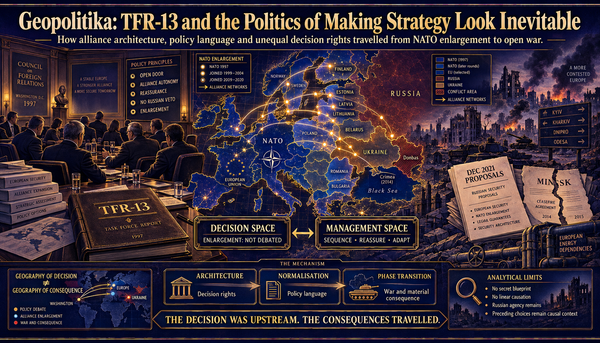
That framing has to be tested against history already available by 2016. A useful contemporaneous marker comes much earlier. In 1997, a CFR-sponsored Task Force report, “Russia, Its Neighbors, and an Enlarging NATO”, endorsed NATO enlargement as a deliberate U.S. and allied strategy for extending the Euro-Atlantic security order. The report simultaneously recorded that Russian leaders regarded enlargement as a threat to Russian security and feared that extending the military alliance towards Russia’s borders would create a new dividing line in Europe.
The Task Force did not treat those Russian objections as dispositive. It said it had not debated whether NATO should enlarge because the decision had effectively already been made and because the group agreed enlargement would strengthen Europe. Its preferred approach was to manage Russian concerns while negotiating “from a position of strength”, refusing to allow Moscow a veto over Alliance decisions and keeping open the possibility of future enlargement. The report also dealt directly with the Baltic states and Ukraine, recommending reassurance and deeper NATO cooperation while rejecting Russian efforts to constrain their future relationship with the Alliance.
This is not evidence that NATO enlargement caused later Russian conduct, or that Moscow lacked independent agency. It establishes something narrower and more relevant to the 2016 framing: by the time Flournoy described Russia as the active revisionist power confronting the West, the West had already spent nearly two decades deliberately reshaping the European security architecture while knowing that Moscow regarded some of those changes as threatening.
That makes the starting point consequential. Flournoy’s description of Russian action may be accurate in important respects, but if the causal story begins with Russia’s coercive response, an earlier round of Western strategic action recedes from view. The result is not necessarily a false account; it is an incomplete one in which one side’s agency is made more visible than the other’s.
Her 2021 Russia framing can be tested against a later and more explicit record. By then, RAND had published its 2019 study “Extending Russia: Competing from Advantageous Ground”, which assessed ways the United States might exploit Russian vulnerabilities and impose additional costs while managing escalation. Earlier work on this site examined that report through the three-part Extending Russia sequence: Part 1 of which focused on the cost-imposition portfolio; Part 2 examined the claimed movement from doctrine towards sanctions, proxy support, energy pressure and other theatres; and Part 3 turned the analysis back on the applying coalition and its own feedback costs.
None of those articles establish that Flournoy directed RAND, that RAND’s recommendations became U.S. policy as written, or that Russian decisions were caused by them. Their narrower relevance is chronological and contextual: before Flournoy’s 2021 description of Russia as a “dedicated adversary”, an openly published U.S. strategic literature already existed whose subject was how American power might increase Russian costs and exploit Russian vulnerabilities.
That changes the causal picture without reversing it. Russia remains an actor. The United States is restored as one too.
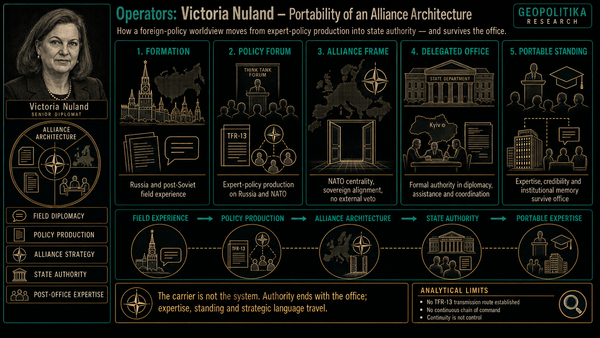
China offers a weaker but still relevant parallel. As the preceding Scott Bessent Operators profile noted, the Obama administration had already formalised a rebalance towards the Asia-Pacific before later economic and technology confrontation intensified, and Flournoy served in senior Pentagon policy authority during that period. That context restores reciprocal agency, but the present corpus does not show the same degree of causal truncation as cleanly as the Russia material. It should therefore be treated as contextual support rather than an equivalent case.
The analytical issue is therefore not whether American and adversarial acts are morally or legally equivalent. It is whether both remain visible as acts. Russian coercion is readily narrated as coercion; American sanctions or military positioning more readily enter as pressure, deterrence or reassurance. Chinese military and economic statecraft appears as strategic challenge; American military rebalancing and technology restrictions can appear as management of that challenge. The vocabulary may capture genuine differences, but it also allocates agency.
That is why this matters to an Operators profile. A strategic expert does not merely possess information. Expertise also determines where the historical problem begins and which actions remain inside the causal frame. Flournoy is particularly strong at explaining what U.S. power should do next. The harder question is how consistently her public account asks what U.S. power had already done before “next” arrived. The same truncation can also help explain the frame’s later commercial usefulness: a corporate client does not primarily need a reciprocal causal history of U.S.–Russia or U.S.–China relations. It needs to know how Washington classifies risk, what it is likely to securitise, and which activities may become subject to controls, sanctions, investment review or political pressure. An incomplete historical frame can therefore remain highly serviceable as a guide to the behaviour of the U.S. national-security state.
From Credential to Product — and Governance Value
The first clear public evidence that Flournoy’s government experience had acquired market value appears almost immediately after leaving office. In July 2012 BCG announced that she would join its Public Sector practice as a senior adviser. Senior partner Joe Davis said her “strategic insight and experience” would be “invaluable in helping our government clients tackle their most critical challenges.”
The source does not reveal her client list, engagement-level role or what particular work followed, so BCG should not carry more analytical weight than the record allows. It establishes something narrower but important: selection and valuation. Government experience was already being treated as a marketable asset. BCG is therefore best understood as early proof-of-market; WestExec is where the conversion becomes substantively visible.
Flournoy is a co-founder and managing partner of the strategic advisory firm, while a Florida corporate record separately lists her as a manager of WestExec Advisors LLC. The public record does not disclose the complete client roster, ownership allocation, fees or engagement-level authority, so claims about who paid for what, who controlled particular engagements or whether access itself was sold remain outside the evidence.
What is visible is the advisory function. In the 2021 PRISM interview, Flournoy described “the U.S. companies that I work with” as global businesses trying to remain competitive in China while protecting what she defined as U.S. national-security interests. She discussed intellectual-property controls, export restrictions, CFIUS and the distinction between passive investment and investment that carries access, decision rights or influence.
Her description is unusually useful because it shows the product from the inside. Companies are “walking through this minefield every day”, she said, and need a risk-management framework capable of reconciling commercial decisions with national-security concerns. She also argued for closer dialogue between senior government officials and private-sector counterparts so companies better understand what Washington is trying to protect and government better understands what firms are actually doing in China.
This is more precise than saying that WestExec sells a résumé. The commercially useful capability is interpretation: knowing how U.S. national-security institutions classify risk, which technologies or commercial exposures may become politically sensitive, how regulators distinguish acceptable from unacceptable activity, and how strategic doctrine may become administrative constraint.
The product is therefore not only knowledge of how Washington works. It is knowledge of how Washington sees.
That is also why the boundary between expertise and doctrine is difficult to draw. Deciding whether a Chinese investment is merely commercial, whether a technology is strategically sensitive, whether a supply-chain dependency is tolerable or whether a company is creating a national-security exposure requires more than procedural knowledge. It requires judgements about what constitutes a threat and which interests the United States should protect. Those judgements were not invented at WestExec; they sit inside the strategic worldview Flournoy had already articulated publicly.
The same feature that can make that worldview historically incomplete can therefore make it commercially useful. A company trying to anticipate export controls or CFIUS scrutiny does not primarily need a reciprocal history of Sino-American relations. It needs to know what assumptions American officials are likely to act upon, what Washington will classify as risk and where those classifications may become regulation, restriction or political pressure.
Booz Allen represents another conversion of the same accumulated asset. Its 2026 Definitive Proxy Statement identifies Flournoy as an independent director and chair of the Nominating and Corporate Governance Committee. The filing says her national-security and defence-policy expertise, government experience and understanding of military operations contribute to company strategy, direction and board oversight.
The proxy is unusually explicit about the value assigned to that background. Booz Allen describes Flournoy as a “recognized national security expert, strategic leader, and advisor” whose experience in “government, defense policy, and corporate governance” provides “valuable perspective” to the board and complements the company’s core client base.
Here the economic relationship is also visible. For fiscal 2026 the filing reported $365,045 in director compensation and 20,835 beneficially owned shares, less than one per cent of the class. Those facts establish economic interest and a fiduciary role. They do not establish operational management of government contracts, procurement decisions or client work.
The contrast with WestExec is useful precisely because the institutional forms are different. WestExec’s client economics and engagement structure remain comparatively opaque. Booz Allen’s public-company form exposes much more of the relationship: board status, committee role, compensation and share ownership.
The point is not that one institution is benign and the other suspect. It is that different institutions convert and disclose the value of the same accumulated national-security standing in different ways.
- At BCG, government experience is publicly valued as an input to client work
- At WestExec, national-security interpretation becomes the service itself
- At Booz Allen, accumulated experience and standing become part of corporate governance
The authority of the Pentagon has long since ended. The credential it created continues to find new institutional uses.
The Bridging Function — and Its Limits
Seen across the career, Flournoy’s significance is not that she controls all of these institutions. It is that the same person repeatedly occupies positions between institutions performing different national-security functions: policy formation, formal state authority, elite legitimation, private strategic advice and contractor governance.
The bridge is functional rather than conspiratorial. CNAS can produce policy proposals and personnel credibility. DOD can confer executable public authority. CFR can present prior government experience as a reason for expert deference. WestExec can turn national-security interpretation into a service for private clients. Booz Allen can incorporate the resulting experience into board governance. Personnel continuity across those settings does not make them one command structure.
What travels is a bundle whose components reinforce one another. Institutional knowledge gives substance to expertise; senior office gives that expertise credibility; elite venues reproduce the credibility as authority to interpret; doctrine supplies the interpretation with content; private advisory gives it exchange value; corporate governance gives the accumulated standing another formal role.
That is the deeper meaning of portability in Flournoy’s case. The authority of the Pentagon does not leave with the officeholder. But the social and economic residue of having exercised that authority can continue to circulate.
The distinction matters because a critical account becomes weaker, not stronger, if circulation is promoted into control. Flournoy did not retain formal Pentagon authority after leaving office, and movement among DOD, CNAS, CFR, BCG, WestExec and Booz Allen does not establish a single coordinated command structure.
Nor does the public record establish that WestExec sells privileged access, confidential information or guaranteed policy outcomes. Its complete client roster, ownership allocation, fees and engagement-level authority remain incomplete in the public record. The evidence therefore supports private strategic advisory and commercialisation of expertise, not a stronger claim about what any particular client purchased or what influence followed.
The same discipline applies to Booz Allen. Flournoy’s board position, compensation and beneficial share ownership establish a fiduciary role and economic interest. They do not establish operational management of federal contracts, procurement decisions or client work. Economic interest is not operational control.
There is also a temporal limit. Flournoy’s own substantive doctrinal statements in the material assessed run through 2021, while evidence of her institutional and governance roles continues through 2026. Those later roles show where her expertise was being used, but they do not establish that her 2021 positions remained unchanged.
The causal-asymmetry argument is bounded in the same way. The sampled material supports a critique of how Flournoy’s public framing distributes agency between the United States and its adversaries. It does not show that U.S. policy caused every later Russian, Chinese or terrorist action, or that Flournoy deliberately omitted American responsibility.
And this remains a one-person case. It can show how one unusually well-positioned national-security professional carries expertise, legitimacy and doctrine between institutional settings. It cannot by itself establish a system-wide pattern of coordination, command or control.
Those limits do not empty the case of meaning. They define the strongest proposition the evidence can carry: institutions repeatedly select Flournoy’s accumulated national-security experience, standing and worldview for new functions, while the authority conferred at each setting remains institution-specific.
Conclusion: The Power That Survives the Office
Previous Operators profiles established a simple distinction: capability can travel; formal authority must be conferred again. Flournoy advances that finding because her post-Pentagon career shows that re-entry into government is not necessary for state-derived capability to remain valuable. Her Pentagon authority ended in 2012; what survived was institutional knowledge, standing and a strategic framework for interpreting threats, alliances, technology and the legitimate use of American power.
The critical question is what travels with that credential. Flournoy’s public doctrine repeatedly places the United States in the role of diagnosing and managing disorder more readily than it places U.S. power inside the antecedent causal story. That limitation matters because the frame itself becomes portable: expert venues can legitimate it, advisory firms can apply it to corporate risk, and boards can value the experience from which it derives.
Expertise is not merely knowledge of institutions. It is also a way of seeing. When that way of seeing has been validated by government office and reproduced across policy, advisory and governance settings, it can travel a long way without carrying a single formal power from the original seat.
That is the Flournoy case: not a hidden command centre, not a continuous Pentagon mandate and not proof that the institutions around her act in concert. It is a more observable form of power—the conversion of state experience into legitimacy, legitimacy into deference, deference into marketable interpretation and accumulated standing into governance authority.
—
Published via Mindwars Ghosted.
Overlords: Mapping the Operators of reality and rule.
—
Methodology: This article develops a completed person-centred analysis from a curator-approved research corpus and a validated STRAT package. Current CORE-KNOWLEDGE was used only for structural orientation and continuity, not as proof of current-case propositions. The article preserves the validated distinctions between office-bound authority, expertise, institutional standing, advisory roles, governance roles, coordination and control. Primary receipts used here include the 2009 U.S. Senate Armed Services Committee confirmation record; BCG’s 16 July 2012 appointment release; CFR’s 20 May 2016 event record and appended transcript representation; Flournoy’s 2021 PRISM interview; WestExec’s current institution-native biography and an official Florida corporate record; and Booz Allen Hamilton’s 2026 definitive proxy statement. The evidence is temporally asymmetric by design: institutional-role and governance evidence is current through 2026, while substantive first-person doctrinal evidence in the authorised corpus is current through 2021. The 2016 CFR transcript representation has known transcription/name-rendering imperfections, so quotations are kept short and tied to the source record. Prior Mind-wars-Ghosted articles are used only for verified house continuity and comparison. The Scott Bessent and John Ratcliffe Operators profiles establish the preceding series distinction between portable capability and institution-specific authority. The Extending Russia trilogy supplies prior house analysis of cost-imposition strategy, doctrine-to-theatre claims and reflexivity/feedback; it is not treated as evidence that Flournoy directed RAND strategy or that U.S. policy caused particular Russian actions. The article does not infer control from funding, operator status from title or prominence, coordination from adjacency, intent from function, command from personnel centrality, or system-level conclusions from a single person. Absence in the sampled record is not treated as proof of deliberate concealment. Institutional role, compensation and governance evidence extending to 2026 are not treated as evidence of post-2021 doctrinal continuity. Base analytic outputs are available on request. For methodological details—see the Geopolitika Series Methodological Statement.
Mindwars Ghosted is an independent platform dedicated to examining elite networks, institutional power and narrative engineering behind modern society. The site has free access and is committed to uncompromising free speech, offering deep dives into the mechanisms of control.