Operators: Scott Bessent – How Market Expertise Became Economic Statecraft
How a global-macro investor became a Treasury Secretary deploying tariffs, sanctions and financial leverage across increasingly linked economic fronts involving Iran, China and Russia.
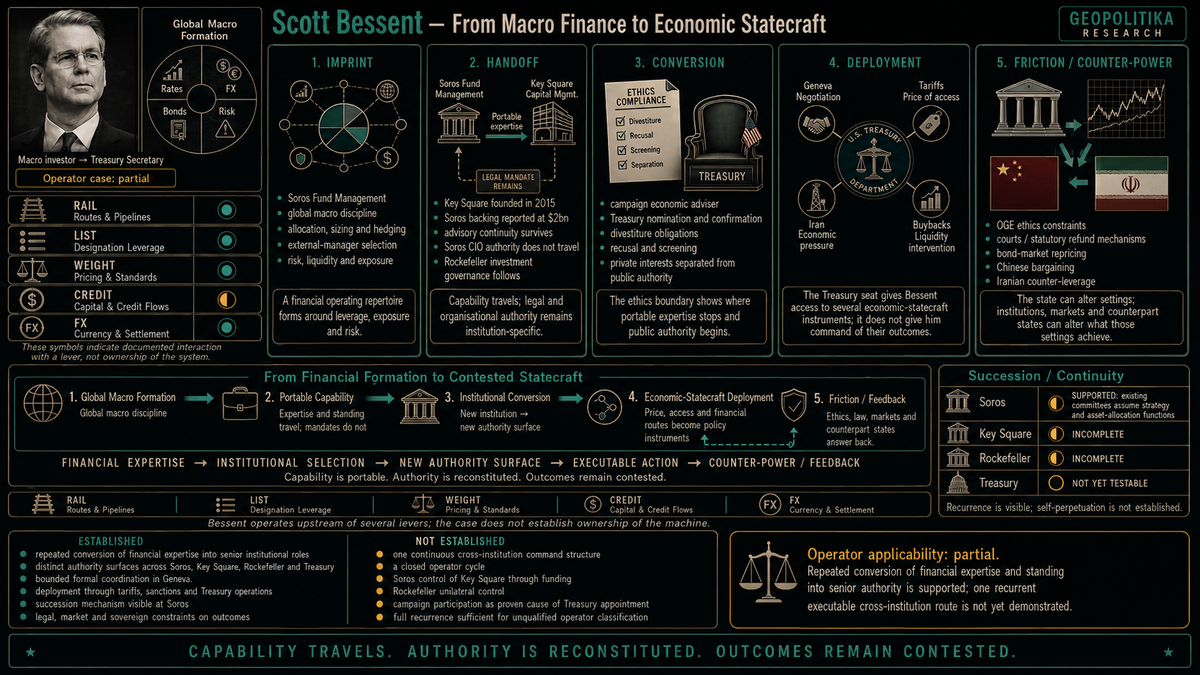
This article is published as part of the Geopolitika project to map structures of power by examining leadership, institutional position, relationships, public claims, executable instruments, outputs and downstream consequences. The Operators follows financial power through the people and institutions that shape access, eligibility, price and financial routes. Scott Bessent is examined here not as the centre of a hidden system, nor as the originator of economic warfare, but as a sequence of positions through which global-macro expertise, institutional standing, policy doctrine and public authority become usable in different settings. His Treasury role now sits inside a wider hybrid confrontation in which sanctions against Iran, financial exclusion of Russia, and tariffs and strategic-economic pressure on China increasingly intersect through trade, payment systems, commodities, market access and the dollar-centred financial order.
Executive Summary
Scott Bessent matters now because economic coercion is no longer a peripheral instrument of foreign policy. Against Iran, it has accumulated through decades of sanctions and financial restriction. Against Russia, the financial front expanded sharply after February 2022 into sanctions on major banks, sovereign finance and central-bank assets. Against China, the strategic reorientation predates the Trump tariff wars: the Obama administration formally described a long-term rebalance toward the Asia-Pacific, while later administrations increasingly treated trade, technology, supply chains and market access as matters of national security.
Bessent did not invent this repertoire. What makes his case distinctive is the convergence between a career formed in global macro—where sovereign policy, currencies, rates, liquidity and political shocks are variables to be priced—and a Treasury role in which the state deliberately changes some of those conditions for others.
An adversarial interpretation of that convergence appeared in The Duran’s 25 August 2026 Operation Economic Outcast: Bessent’s Economic War With China discussion. Its more speculative claims about Bessent’s motives go beyond the evidence examined here, but its central structural question is useful: if pressure on Iran requires Chinese buyers, banks or other intermediaries to comply with American sanctions, at what point does economic coercion against Iran become pressure on China? “Operation Economic Outcast” is used here as a media framing of that problem, not as the official name of a US government operation.
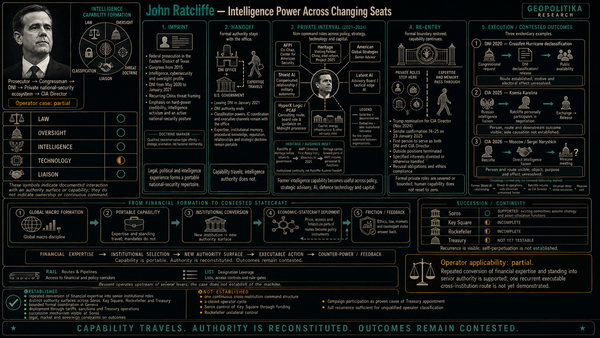
The evidence supports repeated conversion of financial expertise and standing into senior authority, but not one continuous cross-institution command structure. Soros Fund Management, Key Square, Rockefeller University, the Trump campaign and Treasury remain distinct institutions. Capability can travel; legal and organisational authority has to be granted anew at each seat.
Across China, Iran and Russia, the article tests how tariffs, sanctions, financial exclusion and adaptation operate through linked but distinct economic systems. The current Iran campaign provides the clearest Bessent-specific example of doctrine becoming executable administrative machinery: Treasury can announce strategy, while OFAC determinations, licence changes, designations, maritime guidance and intermediary compliance translate that strategy into executable pressure.
The machinery is distributed, and so is resistance. China can reject unilateral sanctions; Iran can preserve or seek alternative routes; Russia can reorganise around restrictions; markets can reprice intervention; courts can redistribute policy effects; and firms can adapt.
The resulting Operators finding is deliberately bounded: Bessent sits close to several powerful levers of economic statecraft—Rail, List and Weight—without thereby owning the system through which those levers operate.
Why Bessent Now — Economic Warfare Converges
Scott Bessent’s career is easiest to misunderstand if it is read simply as a résumé: Yale, Wall Street, Soros Fund Management, Key Square, Rockefeller University, Donald Trump’s 2024 campaign and finally the US Treasury. Read conventionally, it looks like professional ascent from global finance into public office.
The reason to examine him now is more immediate. The financial and military fronts around Iran are overlapping. Secondary sanctions aimed at Iranian oil and commerce encounter Chinese buyers and third-country banks. Russia has operated under a much broader Western sanctions and export-control regime since February 2022, including restrictions on major financial institutions and the Central Bank of Russia. China has faced tariffs and technology and supply-chain restrictions layered onto a strategic reorientation toward Asia that was already explicit under Barack Obama.
These fronts are not identical and should not be collapsed into one centrally directed operation. They are linked because the same international systems—dollar finance, correspondent banking, shipping, insurance, commodities, technology access and major consumer markets—can carry pressure across more than one theatre.
Economic warfare itself is not new. Iran has lived with successive US restrictions since the 1979 hostage crisis, with later measures reaching oil, banking, shipping and third-country transactions. Russia was already sanctioned after 2014, but the February 2022 invasion of Ukraine triggered a much wider effort to restrict financial institutions, sovereign finance, reserves, technology and trade. With China, the economic front developed differently: strategic rebalancing under Obama preceded the Trump tariff confrontation, which was later joined by technology, investment and supply-chain controls.
The instruments and legal bases differ, but all three theatres demonstrate how economic relationships can be repurposed as strategic leverage.
Public interpretation has consequently widened. Official language speaks of economic statecraft, enforcement and national security. Adversarial commentary goes further. Operation Economic Outcast portrays secondary sanctions on Iran as potentially becoming an economic confrontation with China and predicts that coercive use of the dollar-centred system could encourage states to reduce their dependence upon it. Its claims about Bessent’s psychology or alleged ambition cannot carry the argument here. The structural question can: what happens when coercion against one state requires compliance from another?
That is the question this article tests. Not whether Bessent secretly controls an economic-war machine, but how a person formed in the disciplines of allocation, leverage, liquidity and sovereign risk came to occupy a seat from which tariffs, sanctions, negotiation and financial-market operations can be deployed as instruments of state policy.
Earlier Operators: Part 3 — The Financial Governors framed financial governance through Rail, List and Weight: the routes through which value moves, the rules determining who may participate, and the settings that change the price or burden of access. Bessent’s Treasury role touches all three. What remains unproven is a single recurrent mechanism carrying identical authority across all the institutions through which his career has passed.
Imprinting and Handoff — Learning to Govern Through Risk
A label such as “hedge-fund manager” obscures the control surface. When Bessent returned to Soros Fund Management as chief investment officer in 2011, Bloomberg described him taking responsibility at a firm managing roughly $25 billion. The reported CIO functions included asset allocation, sizing major trades, managing internal teams, selecting and monitoring external managers, risk management, hedging and tactical investments.
Those functions organise risk through decisions. Someone determines where capital sits, which exposures are tolerable, how much leverage can be carried, when a position should be hedged and which external managers are trusted with capital. Bessent’s earlier career had already crossed Brown Brothers Harriman, the Olayan Group and Kynikos before he joined Soros in 1991, after which he spent much of the 1990s managing European investments and later headed global research and co-managed external-manager selection.
The chronology also places him inside Soros Fund Management during the 1997 Asian financial crisis. Treasury’s biography states that Bessent served as managing partner of the firm’s London office from 1991 to 2000. That establishes institutional proximity to the firm at the time; it does not establish that Bessent personally designed or executed Soros Fund Management’s Thai baht or Malaysian ringgit positions.
The earlier 1992 sterling episode makes the environment especially relevant. Bessent was already at Soros when the firm made the wager against the pound that became inseparable from the political memory of Black Wednesday. Five years later, the Asian crisis presented a less cleanly attributable but wider version of the same problem: market actors, fixed exchange-rate commitments, foreign reserves and sovereign credibility interacting under stress.
The point is not to recast hedge-fund speculation as state warfare. It is that global macro placed sovereign vulnerability inside the investable opportunity set. A government’s exchange-rate regime, reserve position, interest-rate policy or political credibility could become part of the terrain around which a private position was built.
The historical argument should remain bounded. Contemporary Southeast Asian leaders accused Soros and other speculators of attacking their currencies, while Soros Fund Management disputed stronger claims about its immediate trading role and Soros subsequently emphasised wider weaknesses in the international financial system. For Bessent, the more defensible implication is narrower: his apprenticeship took place inside a firm whose trading activity could become politically consequential because sovereign policy and market confidence were themselves financial variables.
That environment produced a repertoire built around leverage, exposure, liquidity, dependency, risk transfer, counterparty behaviour and the possibility that political decisions could reprice entire markets. In private finance, the task was to identify where sovereign policy might fail and position capital around the risk. In government, the direction can reverse: the state itself can alter the conditions facing counterparties.
The 2015 transition from Soros to Key Square shows what travelled and what did not. Soros was reported to be providing $2 billion to the new fund, and Bessent would continue advising the family office, but existing Soros committees were expected to assume investment strategy and asset allocation after his departure.
The distinction matters. Bessent carried expertise, professional standing, relationships, an advisory connection and the capacity to attract capital. He did not carry the Soros CIO mandate itself. Capital backing was not control, and continued advisory ties were not continuing institutional authority.
The same distinction appears at Rockefeller University. Bessent became a trustee in 2016 and later chaired its Investment Committee. A multibillion-dollar endowment made his financial expertise relevant, but a trustee chair operates within collective governance rather than with the direct portfolio authority of a hedge-fund CIO.
By the time Bessent entered presidential politics, what travelled was therefore broader than investment performance. It was practitioner standing: the credibility of someone accustomed to making decisions under conditions of macroeconomic uncertainty. The record supports repeated institutional selection of that capability without establishing Soros, Key Square, Rockefeller, the campaign and Treasury as one integrated mechanism pursuing a common purpose.
Authority does not travel intact from one institution to another. Capability does.
Treasury supplied a new authority surface.
Economic Warfare Across Three Fronts
Bessent’s public doctrine began taking shape before he entered government. In June 2024, in The Fallacy of Bidenomics: A Return to Central Planning, he attacked what he described as a return to “central planning”, contrasting it with tax reform, deregulation, private-sector innovation and productive capacity while also arguing that the rise of China required the United States to reduce its economic vulnerability to disruption. Five months later, in Let’s talk tariffs. It’s time to revitalize Alexander Hamilton’s favorite tool, he argued that tariffs could raise revenue, protect strategically important industries and create bargaining leverage, explicitly describing them as a “negotiating tool with our trading partners.”
The combination is more revealing than either proposition alone. Bessent was not advocating comprehensive state direction of the economy; he was arguing that market openness could be subordinated where sovereignty, productive capacity or national security were judged to be at stake. By June 2026, speaking at the Economic Club of New York, he described economic statecraft as the “disciplined use of America’s economic power”, linking sovereignty to supply chains, strategic industries and productive capacity.
The continuity with his macro background is methodological rather than conspiratorial. A macro investor asks where exposure sits, what depends on what and where leverage can be applied. A Treasury Secretary practising economic statecraft asks related questions at state scale: where is the country dependent, where do counterparties depend on access, which flows can be interrupted and which costs can be raised?
The market ceases to be merely the environment in which policy operates and becomes one of the instruments through which policy is executed.
China, Iran and Russia show three different ways that proposition is being tested.
a. China — Weight Becomes Bargaining Power
The doctrine became materially testable in Geneva in May 2025, when Bessent and US Trade Representative Jamieson Greer met Chinese Vice Premier He Lifeng for high-level talks over tariffs already imposed by both sides. The Chinese Ministry of Commerce subsequently recorded agreement to cancel or suspend substantial portions of the additional tariffs imposed during the escalation and to establish a continuing bilateral economic and trade consultation mechanism.
The route is unusually clear. Treasury and USTR participated in a formal US negotiating position; a Chinese vice-premier-level counterpart negotiated against it; tariff settings changed; and a continuing consultation channel was created. That demonstrates bounded coordination and an executable output without establishing that Bessent commanded Greer, controlled the wider US decision chain or directed China’s response.
In the language of The Financial Governors, tariffs are principally Weight: they alter the cost of access to a major market. Geneva shows that Weight can also become bargaining inventory, because a setting can be imposed, suspended, traded or renegotiated.
The burden, however, does not remain neatly attached to the nominal target. Reuters reporting on Chinese exporters documented margin pressure, contract renegotiation, uncertainty and attempts to shift production or supply chains. On the US side, the distribution was measurable. The Congressional Budget Office estimated that foreign exporters would absorb only about 5 per cent of tariff costs and that, after domestic price adjustments, US consumers would face price increases equivalent to roughly 95 per cent of the cost. A Federal Reserve Bank of New York analysis reached a similar conclusion from observed trade data, finding that nearly 90 per cent of the economic burden of the 2025 tariffs fell on US firms and consumers.
That distribution became still more visible after the courts invalidated the IEEPA tariffs at issue. CBO later projected that most of the approximately $166 billion collected under that authority would be refunded, while Bessent characterised the resulting payments to importers as a “corporate bonanza” and “corporate welfare”. The tension is revealing: the legal refund flowed to the importer of record, while much of the original economic cost had already been transmitted through firms and consumer prices. The tariff therefore works by changing a chain of costs rather than by making the foreign state named in the policy simply “pay”. The relevant question is where the Weight finally settles—and who receives relief if the setting is later reversed.
This is why the Obama-era Asia “pivot” belongs in the context without becoming a direct causal precursor to Trump tariffs. The Obama administration’s Asia-Pacific rebalance was strategic across diplomatic, security and economic domains. Later tariff, technology and supply-chain restrictions were different instruments. The continuity is strategic attention to China and the region, not one unchanged economic-war policy.
b. Iran — From Long Coercive History to Administrative Machinery
Iran has the deepest economic-war history of the three. US restrictions date back to the aftermath of the 1979 hostage crisis and subsequent executive action, with later measures extending into oil, finance, shipping and secondary sanctions. Bessent therefore enters an existing coercive architecture rather than inventing one.
The policy lineage is also visible in elite strategy literature. Brookings’ 2009 Which Path to Persia? Options for a New American Strategy toward Iran presented a menu ranging from engagement and sanctions to military action and regime-change pathways. The earlier Geopolitika: Which Path to Persia? article interpreted that document more critically as an example of policy-option normalisation: coercive routes made thinkable, practicable and narratively manageable before political circumstances select among them. That earlier analysis provides context, not evidence that Bessent is executing a Brookings script.
By August 2026, Bessent was presenting economic pressure as a possible substitute for renewed kinetic escalation. CNBC’s 20 August interview captured that framing before policy moved from threat to implementation.
Four days later, Treasury launched a package converting strategic language into administrative instruments: sectoral determinations under Executive Order 13902, suspension of specified general licences with a wind-down period, designations, sanctions-risk guidance and enhanced due-diligence expectations around Iranian maritime transactions.
A focused analysis of the policy episode discussed under the Operation Economic Outcast framing shows launch-stage legal and administrative conversion, not completed strategic success. The distinction matters. A government can make sanctions executable without thereby demonstrating that the target has been isolated, that third parties will comply or that the political objective has been achieved.
This is where List and Rail stop being metaphors. OFAC can alter the legal status of entities, sectors and transactions; Rail becomes economically consequential when banks, correspondent institutions, insurers, brokers, shippers and other intermediaries change behaviour around those classifications.
The machinery is distributed. Treasury and OFAC can change legal and administrative settings; the State Department can engage foreign governments; law-enforcement bodies can participate in bounded actions; private intermediaries decide whether transactions remain worth the risk. That distribution extends coercive reach while also limiting personal command over what happens downstream.
The 24 August package makes the conversion chain unusually legible. A political objective becomes a sectoral determination; that determination changes legal risk around specified activity; licence suspensions narrow previously usable pathways while a wind-down period manages transition; designations identify actors; and guidance translates the new environment for financial and maritime intermediaries.
None of those steps guarantees strategic success. Together, however, they show how cabinet-level doctrine becomes administrative code.
The China problem follows immediately. Reporting indicated that Chinese buyers accounted for more than 80 per cent of Iran’s shipped oil, while Beijing rejected unilateral sanctions. That does not establish an operational Iran-China sanctions-evasion mechanism, nor does it prove that China was the hidden primary target of the package. It does establish that isolating Iran depends on decisions by powerful third parties that may reject Washington’s premise.
This is where the hybrid-war framing matters. Financial pressure intersects with shipping, energy flows, diplomacy, cyber activity, military signalling and the possibility of kinetic escalation. Bessent presents economic coercion partly as a means of reducing the need for military force; critics invert the proposition and argue that if banks, ports, insurers, refineries and third-country governments become objects of pressure, the battlefield has shifted into systems normally treated as commercial infrastructure.
That is the strongest question raised by Operation Economic Outcast. If secondary sanctions require China to choose between Iranian commerce and access to American financial and commercial systems, pressure on Iran can become pressure on China. The programme predicts a wider economic war and accelerated de-dollarisation. Those outcomes remain interpretive and unproven. What survives scrutiny is the structural dilemma: a Rail is coercively useful because others depend on it, yet repeated coercive use can increase the incentive to reduce that dependence.
The strategic test is therefore not whether every transaction stops. Sanctions can bite by increasing financing costs, insurance costs, settlement risk, legal exposure, routing complexity and the discounts demanded by buyers. The operative question is what preserving the transaction now costs—and whether the target can build or deepen another route.
Earlier Operators work examined Juan C. Zarate as a sanctions architect, tracing the conversion of counter-terror finance into designation, exclusion and compliance mechanisms. Bessent’s case is different. The evidence examined here does not show him originating that architecture; his role is closer to cabinet-level deployment of inherited sanctions infrastructure within a broader doctrine of economic statecraft.
c. Russia — What Happens When the Target Builds Around the Rail?
Russia is not a Bessent-origin case, but it is the clearest recent comparator for what happens when sustained economic exclusion meets a large state capable of adaptation. On 24 February 2022, the US Treasury announced sweeping restrictions on Russia’s largest financial institutions and access to capital. Days later, Treasury prohibited transactions involving the Central Bank of the Russian Federation, the National Wealth Fund and the Ministry of Finance. Subsequent sanctions, export controls and allied measures expanded the effort to restrict Russian access to finance, technology and markets.
For this article, Russia matters less as proof that sanctions succeeded or failed than as evidence that economic coercion changes the system it uses. Once a large state is partially excluded, it has incentives to redirect trade, payments, reserves, currencies and counterparties. Whether those alternatives fully substitute for Western rails is a separate empirical question. The strategic point is that adaptation itself becomes part of the contest.
The Russia experience therefore shows why exclusion produces a dynamic rather than a terminal state. Sanctions may reduce access to particular channels while encouraging rerouting through other currencies, jurisdictions, commodity relationships or payment arrangements. Adaptation does not by itself prove that sanctions failed, because substitution can be partial, costly and inefficient, but it changes what success has to mean.
A coercive strategy must therefore be judged not only by what it blocks on day one, but by the costs it imposes over time relative to the target’s capacity to reorganise around the restriction.
Taken together, the three fronts are linked without becoming one case. China shows Weight converted into bargaining power; Iran shows List and Rail converted into administrative machinery; Russia shows what happens when sustained exclusion creates incentives to build around the Rail.
The hybrid-war environment is relational. Policy applied to one node can change incentives across the wider network, and the effectiveness of coercion increasingly depends not only on the power of the instrument at launch but on how counterparties adapt, bargain, reroute and build alternatives.
Private Architecture, Institutional Boundaries and Friction
Bessent did not arrive at the US Treasury as a blank public official. He brought with him a long private history spanning investment partnerships, fund interests, property, fiduciary relationships, philanthropy and a family background that Treasury itself describes as multigenerational and involved in agriculture, publishing and hospitality. The same official biography records family philanthropy including Yale scholarships, the H. G. Bessent Library and the McLeod Rehabilitation Center at Shriners Children’s Hospital in Greenville.
His family appears again, in a different register, in his January 2025 confirmation statement, where he thanked his spouse, John Freeman, and their children Cole and Caroline, and identified his sister Paige McLeod Bessent and his late sister Wyn Nicole Bessent. The point is not to turn those relationships into a political dynasty—the evidence does not establish one—but to locate the person entering office inside a private social and institutional environment that had to be distinguished from the authority of the public role.
That distinction becomes concrete in the ethics record. Bessent’s amended ethics agreement addressed Key Square, retained holdings, outside positions, divestiture obligations and recusal requirements. It also recorded that he had resigned in December 2024 from Classical American Homes Preservation Trust and Middleton Place Foundation, with a one-year impartiality restriction applying to particular matters involving those entities unless specifically authorised.
The agreement matters because the transition into government was not simply biographical. Bessent entered office with private interests and institutional relationships that had to be handled through resignation, divestiture, retention subject to restriction, recusal or later amendment. Those disclosures are evidence of material relationships and obligations; they are not, by themselves, evidence of misconduct, corrupt intent or covert coordination.
The chronology shows the boundary being enforced rather than merely declared. Bessent was confirmed on 27 January 2025, with specified compliance obligations originally due by 28 April and certification by 5 May. On 5 May he filed a certification reflecting partial rather than complete compliance, and on 11 August the Office of Government Ethics formally notified the Senate Finance Committee that some original deadlines had not been met.
Two days later, OGE issued a supplementary compliance letter, recording that several remaining holdings were illiquid or difficult to transfer, that disposal efforts were continuing, and that Treasury ethics officials had established a screening process while those interests remained unresolved. The remaining divestiture deadline was extended to 15 December 2025.
The transaction filings show the process occurring in practice. The 14 July periodic transaction report records post-confirmation sales including Old Farm Partners and Key Square-related interests, with Old Farm Partners, sold on 28 January, reported in the statutory range of $100,001–$250,000. A later December report records further dispositions, including Totem Management Seed at $250,001–$500,000 and Greengage Global Holdings at $100,001–$250,000.
The subsequent final compliance certification closes that sequence by recording completion of the divestitures required under the operative amended framework. The later completion does not erase the earlier missed deadlines; it completes the chronology.
Taken together, these records make the ethics process more than a compliance footnote. They show the state drawing a boundary around a person whose private life intersected investment vehicles, property, fiduciary positions, philanthropy and family relationships, and deciding which aspects could coexist with public authority and which had to be resigned, sold, screened or restricted.
That is also where the family context becomes relevant rather than ornamental. The evidence does not support a family-controlled political or economic mechanism, but it does show that Bessent entered government from a wider private architecture including family philanthropy, civic institutions, property and investment structures. Family therefore matters as part of the environment around the office-holder, while the ethics process shows where public authority required that environment to be separated from Treasury power.
The same principle appears in succession. When Bessent left Soros Fund Management to establish Key Square, Bloomberg reported that existing committees at Soros would assume responsibility for investment strategy and asset allocation. His personal CIO mandate ended while the institution retained machinery capable of continuing the function.
R5.ockefeller presents a different institutional model. Its records show Bessent elected to the Board of Trustees and later chairing the Investment Committee, but inside collective governance rather than unilateral control.
Across these episodes, authority does not travel intact with the person. Expertise, reputation and relationships can remain portable, but legal authority, ownership rights and institutional mandates must be reconstituted in each setting. At Soros, succession returned functions to institutional machinery; at Rockefeller, authority was collective; at Treasury, private interests had to be separated from public power through ethics controls.
The private architecture therefore matters not because it reveals a hidden family or financial command structure, but because it shows what had to be separated before accumulated capability could be converted into public authority.
The boundary itself is part of the mechanism.
Weight Meets the Market — What the System Actually Does
The most useful test of economic power is not what an institution says it can do, but what happens after it changes a setting and the rest of the system responds. That distinction is especially visible in the market Treasury knows most intimately: its own debt.
In August 2026, with long-dated US government bonds under pressure, Treasury doubled the size of its long-end buyback operations to at least $4 billion per operation. Reuters reported an initial easing in yields before selling pressure returned, with the benchmark 10-year Treasury around 4.70 per cent and the 30-year at 5.249 per cent.
The mechanism was real. A Treasury buyback removes selected securities from circulation, creates a buyer for holders and can improve liquidity in particular parts of the curve. In the language of The Operators, it is predominantly a Weight intervention: the state acts inside the market that prices its own borrowing and attempts to alter one of the conditions through which that price is formed.
What the episode demonstrates is the difference between capacity to intervene and capacity to command. Treasury could affect liquidity and the immediate trading environment, but it could not determine the yield at which investors would ultimately agree to hold government debt. Inflation expectations, fiscal deficits, Federal Reserve policy, anticipated issuance and global demand for dollar assets remained independent inputs into the price.
That distinction runs through the Bessent case. Institutional power is easiest to see at the point where a tariff, designation, licence change or transaction is issued. The harder question comes afterwards: what does the system actually do with it?
A useful way of posing that question is POSIWID—the purpose of a system is what it does. Used carefully, the concept does not imply that observed effects reveal secret intention. It shifts attention from stated purpose alone toward the functions produced when particular capabilities meet particular institutional settings.
This is also where counter-power becomes analytically visible. Counter-power does not require another actor to defeat Treasury or nullify the original measure. It begins where another actor can change participation, price, route, timing or effect. A court can change the legal effect of a tariff; a market can change the price at which sovereign debt clears; a foreign government can refuse, retaliate or bargain; a bank or insurer can decline a transaction; a firm can reroute supply; a sanctioned state can invest in an alternative payment or trading relationship. The relevant question is not whether Treasury remains powerful, but whether another actor retains enough independent capacity to alter what Treasury’s intervention becomes downstream.
The Treasury-market episode is valuable because the state is acting inside a system over which it possesses extraordinary structural advantages, yet the outcome remains contested. Treasury can alter liquidity conditions; investors still price inflation, fiscal risk, monetary policy and expected debt supply. The sovereign can change a setting without dictating the market’s final judgement.
The same logic runs across the three economic fronts. A tariff can create bargaining leverage without determining where its burden ultimately settles. A sanction can change legal risk without ensuring that every intermediary makes the same decision. Financial exclusion can impose substantial costs while simultaneously strengthening incentives to reroute trade or build alternative mechanisms.
This is why Rail, List and Weight are better understood as a theory of settings than a theory of omnipotence. Rail identifies the routes through which value can move; List identifies who or what may participate without attracting exclusion or penalty; Weight identifies the price or burden attached to participation.
An office-holder close to those settings can exercise considerable power because altering any one of them changes the environment confronting other actors. The downstream system, however, still contains independent decision-makers, alternative routes and feedback effects.
The coercive value of American sanctions, tariffs and financial access derives partly from the size of the US market, the reach of dollar finance and the difficulty many actors face in replacing those relationships. Yet use of those advantages also changes incentives elsewhere. Counterparties may comply, bargain, absorb the cost, reroute or invest in substitutes.
The relevant question is therefore not simply whether an instrument “worked”, but what it actually did. A tariff may extract a concession while redistributing costs and provoking retaliation. A sanction may halt some transactions while pushing others into more expensive routes. A buyback may improve liquidity temporarily while leaving the market’s broader judgement unchanged.
Those functional effects are the proper measure of the lever.
Conclusion — Capability Travels, Authority Is Reconstituted
That functional test locates Bessent more precisely than either official rhetoric or claims of total control.
Across his career, the capability that repeatedly travels is financial competence: allocation, leverage, exposure, liquidity, risk and the behaviour of counterparties. What changes is the institutional surface through which that competence becomes usable.
At Soros Fund Management, it supported investment authority over allocation, trade sizing, managers, hedging and risk. At Key Square, it sat inside founder, executive and investment authority. At Rockefeller, it became useful within collective investment governance. In the Trump campaign, financial standing and economic expertise became advisory assets. At Treasury, the scale changed again: tariffs, sanctions, negotiation, financial access and debt operations became objects of policy rather than merely variables to be priced.
The direction of the relationship had reversed. The investor who once asked how sovereign decisions might affect markets now occupied an institution capable of making decisions markets had to price.
That reversal does not turn Treasury into an instrument of personal command. Bessent did not invent the financial architecture through which sanctions or market access operate, and earlier Operators work on The Financial Governors and Juan C. Zarate dealt more directly with the construction and institutionalisation of those systems. Bessent enters further downstream historically but further upstream politically: a cabinet-level official deploying inherited machinery within an increasingly explicit doctrine of sovereignty and economic statecraft.
Iran, Russia and China are not one centrally directed case, but they increasingly interact through the same financial and commercial systems. Secondary sanctions on Iran encounter Chinese buyers and third-country banks; pressure on Russia has encouraged adaptation around restricted financial routes; tariffs and technology controls on China interact with supply chains, commodities and strategic industries. A measure directed at one node can alter incentives elsewhere.
Bessent therefore sits at a consequential point in that network. Treasury can alter legal status, financial access, transaction risk and the cost of participation. It can combine sanctions, tariffs, negotiation and market operations within a broader conception of national power. It cannot determine every downstream reaction.
The career is best understood as a series of conversion episodes, not one uninterrupted operator route. Financial expertise contributes to investment authority; investment authority contributes to institutional standing; standing creates advisory and policy access; public office converts that accumulated capability into the ability to alter economic settings at state scale. Each transition requires a new institutional grant of authority.
That limit is analytically important. The evidence supports repeated conversion of expertise and standing into senior institutional authority, but not one continuously operating mechanism carrying an identical mandate from Soros through Key Square, Rockefeller, the campaign and Treasury. Nor does Treasury authority amount to command over courts, markets, counterpart governments, financial intermediaries or the wider international system.
The significance of Bessent lies instead in showing how expertise formed in private markets can become usable inside the state; how a repertoire built around leverage, liquidity, exposure and risk can become compatible with tariffs, sanctions, market access and economic sovereignty; and how substantial state power can coexist with persistent feedback from the systems it attempts to govern.
The buyback episode provides the cleanest miniature of the argument. Bessent had moved from analysing markets to participating in the state’s attempt to alter their conditions, but the market retained the capacity to answer.
The same is true beyond bonds. China can bargain. Iran can preserve or seek other routes. Russia can reorganise around restrictions. Banks and insurers can over-comply or withdraw. Courts can alter implementation. Firms can pass costs through supply chains.
The state can change settings, sometimes with enormous effect, without owning the totality of what follows.
That is the Operators finding.
Capability travels; authority is reconstituted; effects remain contested.
The operator can alter the code. He does not own the system.
Published via Mindwars Ghosted.
Overlords: Mapping the Operators of reality and rule.
—
Methodology: This article is based primarily on a structured analysis of Scott Bessent’s career, institutional positions, public doctrine, relationships and executable authorities through 24 August 2026. The Iran section additionally draws on a focused analysis of the 24 August sanctions package alongside the Operation Economic Outcast commentary. The sanctions analysis establishes the legal and administrative measures actually launched; the commentary is treated as adversarial interpretation rather than evidence of Bessent’s private motives.” Additional context includes official US material on the historical Iran sanctions programme, the February 2022 Russia sanctions, the Obama administration’s Asia-Pacific rebalance, Brookings’ 2009 Which Path to Persia?, the earlier Geopolitika analysis of that document, the supplied Operation Economic Outcast discussion and retrospective material on the 1997 Asian financial crisis. These sources are used for historical comparison, framing or interpretation and do not automatically convert contextual proximity into Bessent-specific causation. Funding was not treated as proof of control. Professional proximity was not treated as coordination. Titles were not treated as proof of operator status. Institutional continuity was not treated as command continuity. Family relationships were not treated as evidence of political or economic coordination. Historical roles were not projected automatically into current authority. The 1997 Asian-crisis discussion is deliberately bounded. Bessent’s documented Soros dates place him at the firm during the crisis, but the evidence examined here does not establish his personal responsibility for the specific Thai baht or Malaysian ringgit positions attributed to Soros Fund Management. Likewise, the Russia and Obama-era China material supplies strategic context rather than Bessent-specific causal findings. The 24 August Iran analysis establishes launch-stage legal and administrative conversion, not post-wind-down compliance, population-wide civilian effects, successful isolation or long-run political outcome. The article therefore distinguishes executable state action from downstream strategic success. Base analytic outputs are available on request. For methodological details—see the Geopolitika Series Methodological Statement.
Mindwars Ghosted is an independent platform dedicated to examining elite networks, institutional power and narrative engineering behind modern society. The site has free access and is committed to uncompromising free speech, offering deep dives into the mechanisms of control.