Operators: Victoria Nuland – Portability of an Alliance Architecture
How a foreign-policy worldview moves from expert-policy production into state authority — and survives the office.
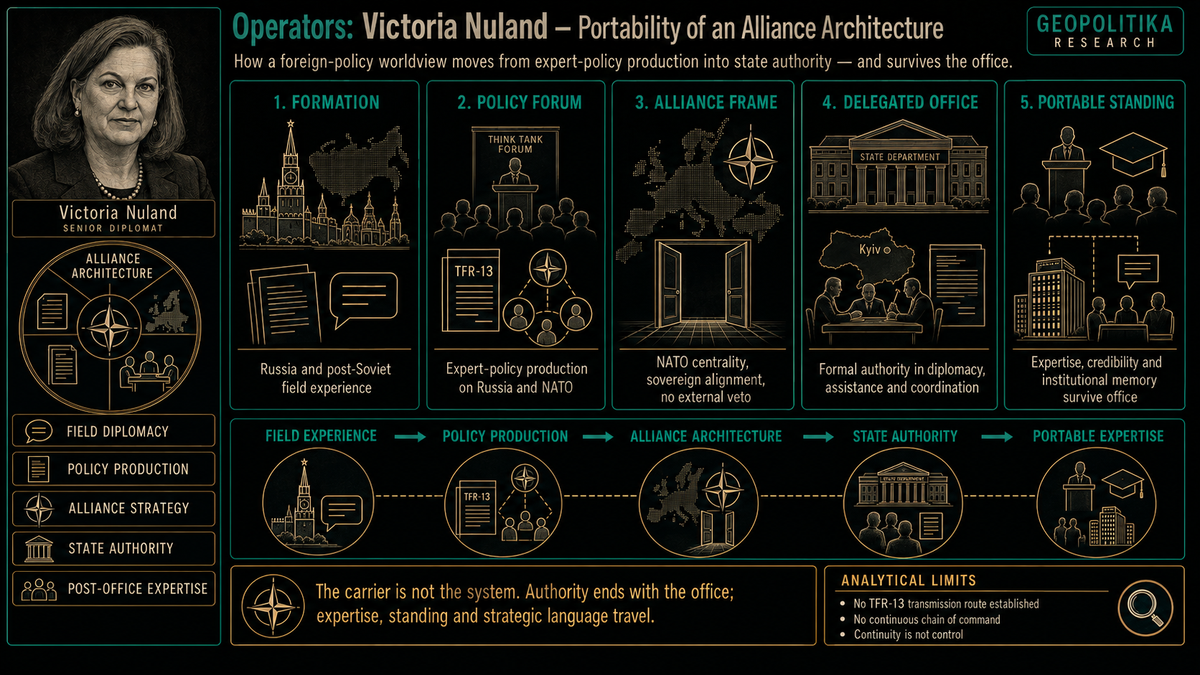
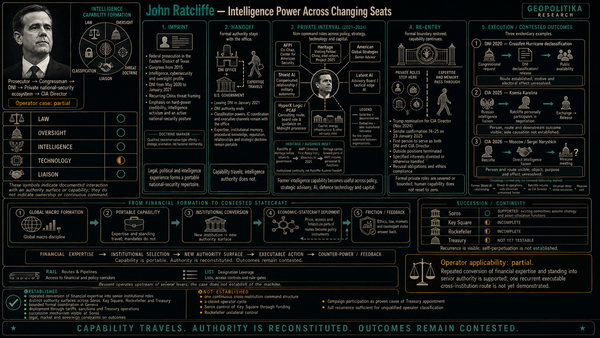
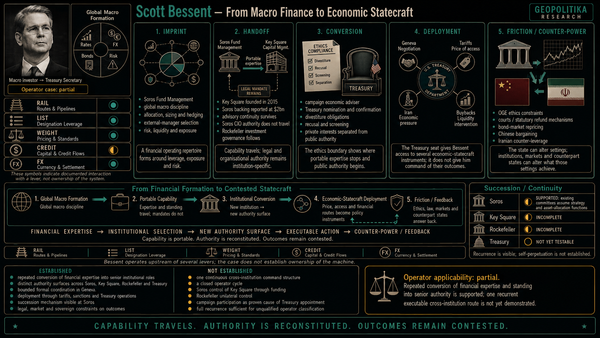
Previous Operators profiles examined how specialised capability and strategic worldview move across changing institutional seats. Victoria Nuland presents a different configuration. Her career links early Soviet and Russian field experience, senior State Department policy work, expert-policy production around NATO and Russia, and later formal authority inside the U.S. foreign-policy apparatus. The question is not whether one 1997 report travelled intact through her career. The evidence does not support that. The more useful question is what remained recognisable as Nuland moved between institutions: which assumptions, priorities and strategic language persisted, which powers changed with the office, and how a durable alliance-centred frame could travel without requiring a continuous chain of command. In that sense, Nuland is neither incidental nor synonymous with the system. She is a useful carrier through which to examine how foreign-policy architecture persists across changing seats.
Executive Summary
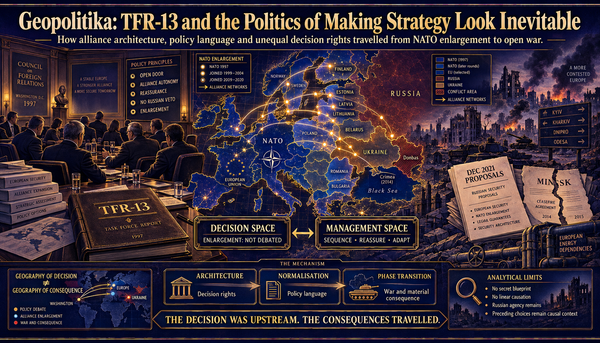
Victoria Nuland’s significance lies less in the number of offices she occupied than in the relationship between them. By the time she became a State Department Fellow at the Council on Foreign Relations (CFR) in 1996–97, she already had substantial Soviet and Russian field experience and several years close to senior State Department policymaking. Her role as Project Director on the Independent Task Force that produced Russia, Its Neighbors, and an Enlarging NATO (TFR-13) placed her inside an institutional setting where an alliance-centred post-Cold War security frame was already being articulated.
Later in her career, Nuland repeatedly occupied formal roles in which NATO centrality, Ukraine’s Euro-Atlantic orientation, allied coordination, sanctions, assistance and diplomacy formed part of her public policy repertoire. The correspondence is real, but correspondence is not transmission: the evidence examined here does not show TFR-13 moving through Nuland into a specific later U.S. or NATO decision.
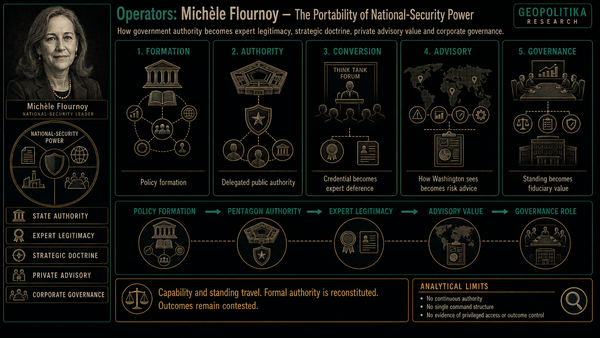
The more important distinction is between what can travel with a person and what cannot. Expertise, professional standing, institutional memory, networks and strategic commitments can remain portable across institutional settings. Formal state authority cannot: it is conferred by the office and ends with the office.
Nuland’s career therefore offers a bounded systemic case. It shows how a recognisable strategic frame can persist across changing seats without requiring a continuous chain of command, while institutions continue to select, legitimate and empower people already fluent in that frame. It does not show that one person controlled the architecture or that one 1997 report mechanically generated later policy.
Who is Victoria Nuland?
Nuland’s career is often narrated as a succession of high-profile diplomatic posts. For this analysis, the important feature is not prestige but function. Her trajectory crosses field diplomacy, Soviet and Russian political reporting, senior State Department staff work, expert-policy production, alliance diplomacy, senior state authority and later academic and private placements. The type of power changes at each stage.
She did not arrive at the CFR in 1996 as a generalist suddenly assigned to NATO and Russia. Nuland joined the U.S. Foreign Service in 1984 after graduating with a B.A. in history and international relations at Brown University. Her early postings included Guangzhou, work in the State Department’s East Asian and Pacific Affairs bureau, and service in Ulaanbaatar, where she helped open the first U.S. embassy in Mongolia. She then moved to the Soviet Desk in Washington from 1988 to 1990.
Russia then became a more direct professional focus. From 1991 to 1993, Nuland served as a political officer at the U.S. Embassy in Moscow, covering Russian internal politics during the collapse of the Soviet order and the early Boris Yeltsin period. Her later recollection of standing outside the Russian White House during the August 1991 coup attempt suggests that she regarded those events as formative to her understanding of Russia and of the relationship between political order, democratic change and the transatlantic community. Coincidentally or not, this was not the last political upheaval affecting Russian interests to which Nuland would provide an on-site witness in her official capacity with the U.S. State Department.
From 1993 to 1996 she served as Chief of Staff to the Deputy Secretary of State. That placed her closer to senior policy formation on issues including the nuclear disarmament of Ukraine, Kazakhstan and Belarus, Bosnia and Kosovo policy, and U.S. intervention in Haiti. The move matters because it marks a transition from reporting on political change abroad to working inside the senior institutional machinery through which U.S. policy toward the post-Soviet space and European security was being formed.
By the time she became a State Department Fellow at the CFR in 1996–97, therefore, Nuland already had more than a decade of diplomatic service behind her, including direct experience of the Soviet and Russian political transitions and several years close to senior State Department decision-making. An official State Department biography records that, in that fellowship, she directed a task force on Russia, its neighbours and an expanding NATO.
That placement is historically significant because it overlaps the production period of TFR-13. It establishes a real relationship between Nuland, the document and the institution at the point of production. It also shows that the task-force role was not an isolated excursion into Russia policy. It emerged from a professional trajectory already structured around Soviet affairs, post-Soviet transition, European security and the practical machinery of U.S. diplomacy.
Just to be clear, the role of Project Director specifically casts doubt on any implication that Nuland personally authored a substantial proportion of the report, controlled the Task Force’s conclusions, or owned its propositions. As an Independent Task Force product, TFR-13 was undoubtedly a collective effort with named contributors; however, passage-level authorship, editing and drafting allocation remain unresolved.
What happened immediately afterward is also important. From 1997 to 1999, Nuland became Deputy Director for former Soviet Union affairs at the State Department, with primary responsibility for U.S. policy toward Russia and the Caucasus. In other words, the CFR fellowship sat between an earlier period of Soviet/Russian political reporting and senior State Department staff work, and a subsequent formal policy role dealing directly with Russia and the former Soviet space.
That sequence gives the 1996–97 episode more analytical weight. It is not simply:
State Department → CFR → State Department
It is more specifically:
Soviet/Russian field experience → senior State Department policy exposure → expert-policy production on Russia and NATO → formal responsibility for Russia and the Caucasus
Later official biographies trace Nuland through still more senior diplomatic and policy roles under multiple administrations, including NATO-facing positions and senior State Department authority. Her archived Biden-period State Department profile records that she ultimately served as Under Secretary for Political Affairs from 2021 to 2024 after earlier service as Assistant Secretary for European and Eurasian Affairs, State Department spokesperson, NATO ambassador, conventional-arms-control negotiator and deputy national security adviser to Vice President Cheney.
After government, the institutional setting changes again. Columbia SIPA describes her later academic role and identifies Russia as the original source of her interest in international affairs, while Covington records her subsequent private-sector position and also notes that she joined the Foreign Service in 1984.
These movements clearly do not constitute a record of continuous power. A diplomatic office carries delegated authority because the state grants it. A fellowship, academic appointment or private role does not inherit that authority merely because the same person occupies it. The more durable resources are different: expertise, memory, professional legitimacy, relationships and familiarity with the institutional grammar of national security.
What remains is the central distinction: a person can remain recognisable across institutional transitions while the authority attached to that person changes radically with the seat.
A Strategic Frame That Travelled
By 1997, Nuland was already operating inside a policy environment in which a recognisable post-Cold War security grammar had been articulated. Her role as Project Director on TFR-13 placed her within a debate centred on NATO enlargement, alliance autonomy, Russian objections and the future relationship between Russia and the Euro-Atlantic system.
While the next article will examine TFR-13 in greater detail, the point here is that Nuland’s later career did not begin with a blank strategic slate. She had already worked within an institutional setting where NATO enlargement, an open door, sovereign alignment choices, resistance to a Russian veto and reassurance without co-decision formed part of a coherent alliance-centred frame.
It also cannot be concluded that TFR-13 became her personal doctrine or that later policy flowed directly from it. What can more reasonably be established is continuity of exposure to a strategic grammar that would remain relevant throughout her later public career.
The distinction between portable resources and office-bound authority is central. Her CFR role carried expert-policy and production relevance, while later State Department posts supplied formal authority through access to official processes, diplomatic representation, policy advocacy and the machinery of sanctions, assistance and alliance coordination. When those offices ended, that legal authority ended with them; what persisted and could travel with her was accumulated capacity — institutional knowledge, strategic language, professional standing, experience, networks and policy commitments.
The later public record corresponds with that earlier strategic frame. In a 2013 State Department speech and a 2014 address, Nuland centred Ukraine’s European orientation, U.S. support, institutional reform and resistance to Russian pressure; later appearances continued to foreground NATO, allied coordination, sanctions, assistance and defence of a Euro-Atlantic order.
The important distinction is between continuity and transmission. The record does not show Nuland carrying TFR-13 as a formal programme through successive offices, nor does it establish the report itself as the causal vehicle. What it does show is that a recognisable alliance-centred frame persisted while the source and scope of Nuland’s authority changed.
Ukraine: Where the Frame Met the Office
The 2013–14 Ukraine crisis is the point at which Nuland’s strategic orientation and delegated state authority become hardest to separate analytically. By then she was Assistant Secretary of State for European and Eurasian Affairs, with formal responsibility for a region in which questions of European alignment, Russian influence and Western institutional reach had become immediate rather than theoretical.
Her involvement was not confined to meetings behind closed doors. Nuland travelled repeatedly to Kyiv during the crisis and went personally to the Maidan. In a December 2013 address, delivered after what she described as her third visit to Ukraine in five weeks, she recalled visiting the square on 5 December, described the Euromaidan movement as embodying democratic principles and values, and stated that the United States stood with Ukrainians seeking the European future they had chosen.
That physical presence matters. Nuland was not simply receiving diplomatic reporting from Washington: a senior U.S. official was appearing at the site of an active political confrontation and publicly identifying American policy with one of its central demands — Ukraine’s movement toward Europe. The well-known images of Nuland distributing food on the Maidan on 11 December, after the overnight police attempt to clear the square, became symbolically powerful for precisely that reason. Supporters could read the gesture as solidarity with a democratic protest movement; critics could read it as visible U.S. involvement in Ukraine’s internal political struggle. The act itself does not establish control over the movement or its outcome, but neither is it analytically equivalent to detached diplomacy.
At the same time, Nuland was exercising formal diplomatic authority. Her contemporary account describes coordinated high-level diplomacy with EU High Representative Catherine Ashton, engagement with key Ukrainian actors and a meeting lasting more than two hours with President Viktor Yanukovych, Ukraine’s democratically elected head of state, after the police action against the Maidan. She said she pressed him to de-escalate the security situation, take political steps to end the crisis and return Ukraine to negotiations with Europe and the International Monetary Fund.
That status matters. Whatever the legitimacy of the protests or the conduct of the Yanukovych government, Washington was not dealing with an unelected junta or provisional authority. It was applying pressure to a government headed by a president who had come to office through a democratic election. That makes the distinction between supporting democratic aspirations and intervening in the political trajectory of another state more difficult to treat as merely semantic.
The subsequently leaked Nuland–Geoffrey Pyatt conversation made the depth of U.S. political engagement more controversial. The recorded exchange shows American officials assessing Ukrainian political figures, discussing preferred political configurations and considering diplomatic steps intended to influence the developing crisis. The bounded record supports political assessment, proposed contacts, possible UN mediation and contemplated vice-presidential reinforcement. It does not establish that Nuland controlled Ukrainian appointments, directed the Maidan movement, commanded the governmental transition or determined its eventual outcome.
Those limits do not make the episode politically neutral. One critical interpretation sees the combination of visible support on the Maidan, pressure on a democratically elected government, and private discussion of opposition figures as evidence that Washington was attempting to shape the political outcome of a struggle on Russia’s strategic frontier. A more sympathetic interpretation treats the same conduct as diplomatic support for democratic protest, sovereign European choice and a negotiated exit from an escalating crisis. The evidence establishes active American involvement more readily than it resolves that argument about its proper character or ultimate causal weight.
That also raises a broader sovereignty question. The same legal order invoked to defend Ukraine’s freedom from a Russian veto also rests on non-interference in the political affairs of other states. That does not make every diplomatic contact or expression of support unlawful. But when senior foreign officials visibly support an opposition movement, pressure a democratically elected government and privately discuss preferred political outcomes, the boundary between diplomacy and interference becomes difficult to ignore.
The significance of the 2013–14 crisis for this article is therefore not that it proves a hidden chain running back to TFR-13. It shows something more immediate and more useful: a senior official already fluent in an alliance-centred strategic grammar was now exercising delegated authority inside the crisis itself — in meetings, in diplomacy, and visibly on the ground.
Continuity Without Command
The absence of a direct handoff sets the limit on what can responsibly be claimed. The record contains no report-specific carrier, receiving decision record, documented implementation chain or verified TFR-13 → Nuland → policy route. That blocks the strongest possible version of the story.
But it does not erase the continuity that remains visible. Nuland may have retained durable personal commitments; later institutions may have reproduced similar positions independently; shared professional norms may have generated convergence; and changed strategic conditions may have made similar prescriptions attractive for reasons unrelated to the report. These possibilities are not mutually exclusive.
The analytical mistake is to treat the absence of transmission as proof that nothing persisted, or persistence as proof that a hidden transmission chain must have existed. Continuity can be real even when transmission remains unresolved.
That is where the system becomes more important than the individual. Expert-policy institutions can formulate and legitimate strategic options; state institutions can supply delegated authority; alliances and governments retain formal decision rights; and individuals can move between these layers carrying knowledge, standing and policy orientation without controlling the whole.
Nuland’s departure from government in 2024 provides the clearest demonstration. Formal State Department authority ended with the office, but the accumulated capacity did not: expertise, credibility, institutional memory, relationships and a publicly legible strategic worldview remained portable. Her later roles at Columbia SIPA and Covington show that this capacity retained value in academic and private advisory settings, while appearances at CSIS, in Politico and on NPR show continued demand for her interpretation of U.S. foreign policy and the international order.
A 2026 Munk Debate provides a later snapshot of that continuing policy role, placing Nuland and Mike Pompeo opposite John Mearsheimer and Stephen Walt in a debate over American intervention and restraint. The publicly available clips—including this one—are sufficient here as illustration, though not as the basis for extending the article’s core continuity claim.
The exchange is useful because it resists caricature. Nuland’s position is not reducible to immediate military force: in the reconstructed material she says she opposed abandoning the JCPOA and did not favour the kinetic route against Iran, while supporting negotiated constraints, sanctions, economic pressure and possible overt and covert support for internal opposition. What remains recognisable is therefore not a simple preference for war but a broader interventionist repertoire: diplomacy, sanctions, alliance management, economic pressure, political support and, in some circumstances, force.
The post-2024 period makes the distinction especially clear. Nuland no longer carries delegated sovereign authority, but her expertise, standing and policy orientation remain institutionally useful. The authority to command ends with the office; the authority to be heard can survive it.
The broader implication is systemic. Policy architectures can outlast individual officeholders because institutions, vocabularies and professional communities persist. Individuals matter as carriers and translators, but they are not the sole repositories of the architecture.
Conclusion: The Carrier Is Not the System
Victoria Nuland gives an alliance-centred policy architecture a biography.
Her 1996–97 relationship to TFR-13 is documented; her later State Department roles carried real delegated authority; and her public positions repeatedly correspond to a recognisable Euro-Atlantic strategic frame. That makes her a meaningful longitudinal bridge across institutions and periods.
But a bridge is not a command network. Project direction does not establish passage-level authorship or control of the Task Force’s propositions. Professional continuity is not continuous authority. Policy correspondence is not proof of TFR-13-specific uptake, and the record does not establish a continuous implementation chain or a Nuland-centred system of control.
The more revealing conclusion is therefore systemic. A foreign-policy architecture can persist because institutions continue to produce, select, legitimate and operationalise people and ideas that remain mutually intelligible across time. Individuals carry expertise, institutional memory, relationships, professional legitimacy and policy orientation between different settings; formal authority is supplied only when an institution grants it.
That system can outlast any one officeholder, survive partisan turnover and reproduce strategic language long after its original provenance has faded from view. It can also make later policy appear newly reactive even when some of the concepts, choices and justifications through which that policy is expressed were articulated much earlier.
Nuland’s career is significant precisely because it makes that process visible without requiring a hidden chain of command. She is neither incidental to the architecture nor synonymous with it.
The next article reverses the lens. Instead of asking what can travel with the person, it asks what the policy document itself can do: how it can define the legitimate field of choice, allocate decision rights, organise strategic language and remain politically consequential without ever becoming a formal instruction manual.
The carrier is not the system. But following the carrier can reveal how the system reproduces itself.
Published via Mindwars Ghosted.
Overlords: Mapping the Operators of reality and rule.
—
Methodology: This article draws on the 1997 task-force report, official biographies and speeches, later public-policy material, and comparative analysis of the relevant documents. The principal longitudinal claims are limited to what the reviewed record supports: a documented Nuland–TFR-13 production relationship, later policy correspondence, and recurring institutional mechanisms. No report-specific transmission route is inferred where none is documented. Source use is role-specific. TFR-13 supports claims about the report’s own architecture and production record. Official biographies support periodised institutional roles. Later official speeches and public-policy appearances support public positioning only within their respective dates. The 2026 Munk excerpts are supplementary illustration rather than part of the principal longitudinal evidentiary chain. The analysis distinguishes office-bound legal authority from portable expertise, legitimacy and institutional memory; correspondence from transmission; production relationship from passage authorship; and person-level agency from system-level reproduction. It also avoids personalising Russian state policy as the psychology or will of a single leader unless a claim is explicitly tied to that individual’s own words. Base analytic outputs are available on request. For methodological details—see the Geopolitika Series Methodological Statement.
Mindwars Ghosted is an independent platform dedicated to examining elite networks, institutional power and narrative engineering behind modern society. The site has free access and is committed to uncompromising free speech, offering deep dives into the mechanisms of control.