Geopolitika: TFR-13 and the Politics of Making Strategy Look Inevitable
How alliance architecture, policy language and unequal decision rights travelled from NATO enlargement to open war.
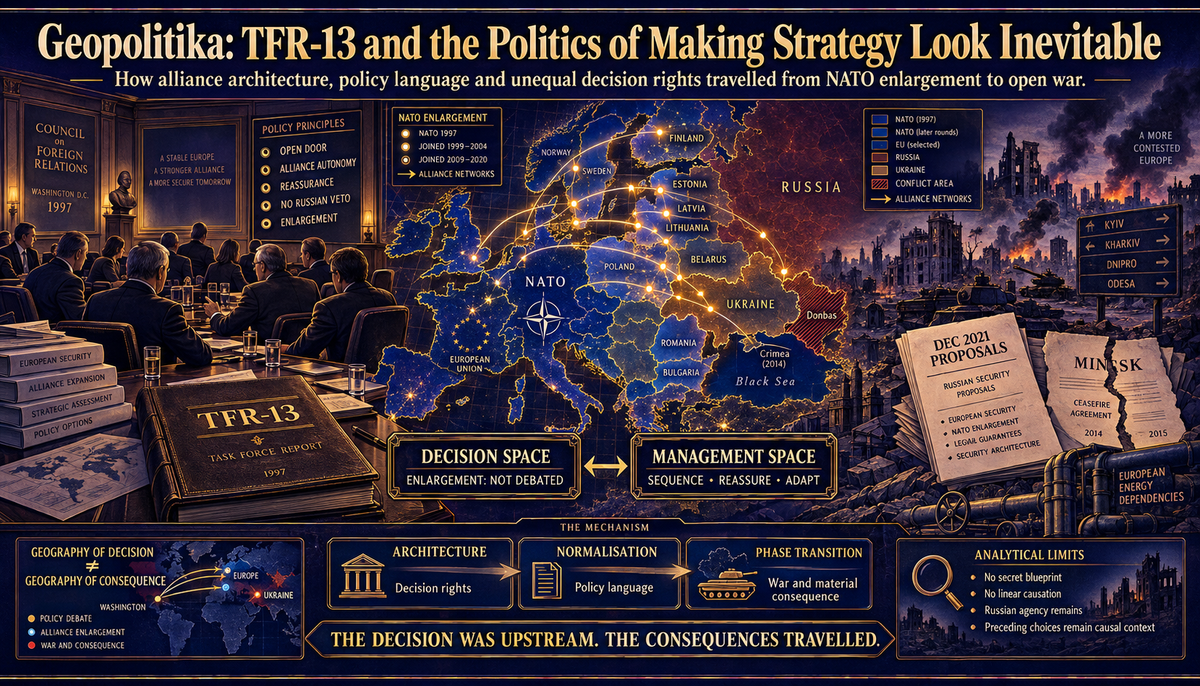
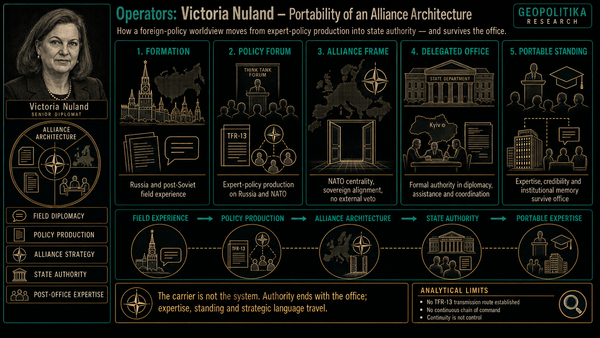
The first article in this pair followed Victoria Nuland through changing institutional seats and asked what could travel with the person when formal authority could not. This article reverses the lens. The principal object here is Russia, Its Neighbors, and an Enlarging NATO, the 1997 Council on Foreign Relations (CFR) task-force report referred to here as TFR-13.
The question is not whether the report became a secret blueprint for later policy. The evidence does not support that. The more useful question is what political work the document performed inside an enlargement process already underway: how it organised strategic choices, defined admissible concessions, allocated decision rights and gave durable language to an alliance-centred conception of European security.
Seen from that angle, TFR-13 matters less as a dormant text than as part of an institutional repertoire already in motion. The road to 2022 is therefore not a straight line from paper to war, but a sequence in which architecture, normalisation, pressure and causal framing accumulated over time.
Executive Summary
Russia, Its Neighbors, and an Enlarging NATO (TFR-13) makes one of its most important moves before its detailed recommendations begin. The Task Force says it did not debate whether NATO should enlarge because that decision had already been taken and because the group agreed enlargement would strengthen and stabilise Europe. The largest political choice is therefore removed from the question set. What remains becomes a problem of management: how to enlarge, reassure Russia and preserve alliance freedom of action.
The architecture is clear. NATO and its members retain admission autonomy. Russian objections are acknowledged but cannot acquire veto power. Cooperation is offered, but not on terms that subordinate Alliance decision-making to Russian consent.
That distributes authority unevenly. NATO members make admission decisions; aspirants may seek entry; Russia may object but receives no formal co-decision right. Populations living inside the resulting security space may bear militarisation, sanctions and war without equivalent procedural authority over the decisions shaping those burdens. The geography of decision and the geography of consequence are not the same.
The article then follows how that architecture became normalised. Later strategic literature increasingly moved toward cost imposition, exploitation of vulnerabilities and diagnosis of Russian behaviour. Clint Reach’s The Origins of Russian Conduct provides one example of a framing in which Russia becomes the behavioural object requiring explanation while earlier Western strategic choices recede into background conditions.
That makes where the history begins important. Russian objections were recorded in 1997; confrontation intensified through 2014 and the unresolved Minsk process; and in December 2021 Moscow proposed an alternative security architecture in treaty form. NATO rejected the central demand to end further enlargement while reaffirming its open-door position.
The February 2022 transition to large-scale interstate war in Ukraine is therefore treated as a phase transition rather than a clean rupture. Russian state agency remains part of that history, but so do the preceding Donbas conflict, failed settlement process and incompatible security architectures.
The wider finding is not one of secret command or linear causation. It is the reproduction of alliance-centred decision autonomy and policy framing. TFR-13 did not dictate what followed; it preserves a moment when the architecture, its alternatives and its distribution of decision rights were still visibly political choices.
What Was TFR-13 — and Who Produced It?
Published in 1997, TFR-13 was the report of an Independent Task Force sponsored by the Council on Foreign Relations. Senator Richard G. Lugar chaired it and Victoria Nuland served as Project Director. As the previous article examined in more detail, Nuland’s role places her inside the report’s documented production environment, but does not establish passage-level authorship or control over the Task Force’s conclusions.
The report itself expressly states that CFR takes no institutional position on its recommendations; responsibility rests with the Task Force. That distinction matters. Sponsorship is not command, and a policy forum is not a government department. TFR-13 had no treaty authority, no military command and no power to admit states to NATO. But it was produced at a moment when NATO enlargement was already moving from political choice toward institutional execution, giving the report significance as a venue for defining how that programme should proceed and how Russian objections should be handled.
Its production environment was itself revealing. Participants included senior figures with direct experience of Russia, NATO, the State Department, the National Security Council, policy planning and the Joint Staff. Alongside Lugar and Nuland were Thomas Pickering, former U.S. ambassador to Russia and incoming Under Secretary of State for Political Affairs; Peter Rodman, a former State Department Policy Planning director and National Security Council official; Jeremy Rosner, a former Clinton National Security Council official who later served in a formal role concerned with NATO-enlargement ratification; and Brigadier General Gary M. Rubus, whose career included the Joint Staff and service as U.S. air attaché in Moscow.
But that community was not intellectually uniform. Robert Zoellick and Paul Wolfowitz submitted an additional comment; Arnold Kanter argued for a substantial pause before any second tranche of enlargement; Robert Blackwill stressed strategic and geopolitical criteria; and Brent Scowcroft dissented more fundamentally, warning against unlimited NATO expansion and favouring a broader OSCE-centred architecture.
That disagreement matters. TFR-13 should not be reduced to a single author, a single mind or a unified Western position. Chairmanship, project direction, membership, drafting, additional comment and dissent are different functions. The report records a contested policy environment in which alternative architectures remained available.
Its political significance therefore lies not in proving coordination beyond the documented production setting, but in showing who was entitled to define the problem, which options were treated as respectable, and which assumptions were already narrowing the field of choice.
The Decision Already Made
The report’s sharpest political move is also its most understated. The Task Force says it did not debate whether NATO should enlarge. NATO had already made that decision, and the group agreed enlargement would contribute to a Europe that was “stronger, more stable, and a better partner for the United States.”
A branch of the policy tree is closed.
Once enlargement is removed from debate, the remaining questions become managerial: what sequence to use, which future candidates to leave eligible, how much military adaptation is necessary, how to reassure Russia, how arms control should be adjusted, and how Ukraine and the Baltic states should be drawn closer to NATO.
The political choice occurs upstream; downstream argument can then be presented as expertise.
That is why the familiar think-tank “policy shelf” metaphor is too static for TFR-13. The report was not written, shelved and rediscovered later. It was produced inside an active policy process in which enlargement had already moved from contested strategic choice toward implementation.
A better description is an institutional repertoire: a set of strategic premises, options and legitimating phrases that circulates while policy is being made and remains available as personnel and circumstances change. TFR-13 articulated and standardised such an institutional repertoire. Enlargement was framed as stabilising. The open door was preserved. New members were to become full members rather than a second tier. Russia could be consulted and reassured but could not acquire a veto. NATO was to retain the freedom to decide and act without Russia present. The Baltic states and Ukraine were to be drawn progressively closer to Alliance structures.
The report is explicit about the constraint. It argues that enlargement and improved NATO-Russia relations need not be incompatible, but insists that the Alliance negotiate from a position of strength and not allow itself to be “held hostage” by Moscow. The possibility that Russian opposition might itself justify reopening the enlargement decision is therefore excluded by design.
That repertoire is carried not only through decisions but through language. TFR-13 repeatedly allocates legitimacy through terms that later become familiar: open door, sovereign choice, no spheres of influence, alliance autonomy, reassurance, reciprocity, stability, democratic integration. Each phrase compresses an argument.
“No Russian veto,” for example, sounds like a procedural principle. But it also encodes a distribution of agency: NATO members may determine membership; aspirants may seek it; Russia may object but has no recognised right to determine the outcome. Likewise, the proposition that states may freely choose their security arrangements treats alliance choice as an expression of sovereignty while treating a neighbouring power’s security objection as something that must not become a constraint.
A policy architecture can lose its provenance while retaining its vocabulary.
That is the deeper significance of TFR-13. Within its own policy frame, it converted a contested strategic choice into an administratively normal one while preserving the language through which that choice could continue to appear legitimate, technical and increasingly difficult to reopen.
Decision Rights, Reassurance and Reciprocity
The architecture becomes clearer when decision rights are separated from security burdens.
NATO members possess the formal authority to invite new members. Applicant states possess agency: they can seek admission, reform institutions and orient foreign policy toward the Alliance. Russia possesses agency too: it can object, negotiate, accommodate or resist. But none of those non-member actors has the same procedural power as the Alliance over the admission decision.
That asymmetry has geographic consequences. Populations in Ukraine, Russia, the Baltic region and the wider European security space may bear the effects of military adaptation, sanctions, strategic pressure, mobilisation and conflict, while lacking equivalent authority over the architecture that produces them.
The geography of decision and the geography of consequence are not the same.
TFR-13 does not simply ignore Russian concerns. It records Russian opposition, recognises Russian security fears and recommends consultation, arms-control measures, economic engagement and a NATO-Russia charter. But reassurance has a strict limit. Consultative structures must not obstruct NATO decision-making, subordinate the Alliance to another body or prevent NATO from meeting and deciding without Russia.
Your security concern is recognised. Your preferred remedy is structurally inadmissible.
That matters because it shows that Russian objections to enlargement were not invented retrospectively. TFR-13 itself records them while enlargement was still being institutionalised. Recognising that fact does not validate Russia’s preferred solution; it simply restores the dispute to the causal history.
By December 2021, that counter-position had moved from objection to proposed legal architecture. Moscow’s draft security agreements sought limits on further NATO enlargement, restrictions on military activity and a force-posture baseline linked to the NATO-Russia Founding Act era. The proposals were unacceptable to NATO and the United States in important respects, but they made the reciprocity dispute explicit.
The question was no longer only whether Russia objected to enlargement. It was whether the European security order would recognise any reciprocal limit on the movement of military infrastructure toward a rival great power’s borders.
The familiar Mexico or Cuba thought experiment is useful only after that record is established. If Mexico entered a Russian-led military alliance, or Russian strategic systems were deployed close to U.S. territory, would Washington regard Mexico’s sovereign choice as extinguishing any special American security claim?
The situations are not equivalent; geography, capabilities, treaties and weapons differ. The comparison tests the universality of the principle, not factual sameness.
The harder systemic question is whether some great powers are permitted to translate proximity into a legitimate security concern while others are told that proximity confers no special right at all.
From Architecture to Pressure
By 2019, the policy literature had moved into a different phase. RAND’s Extending Russia examined ways the United States could exploit Russian vulnerabilities, impose costs and stretch Russian capacity while managing escalation. Whatever one thinks of the individual recommendations, the change in policy function is revealing.
TFR-13 articulated an alliance-centred design for the post-Cold War security architecture. Later strategic analysis increasingly asked how pressure could be applied within a relationship that had become more openly adversarial.
The policy field was moving from designing the order to testing how an opponent could be constrained within it.
That shift does not establish a single implementation chain. A strategic recommendation is not proof of later adoption, and one policy paper does not demonstrate coordinated execution across institutions. But such documents do show what had become thinkable, discussable and professionally legitimate inside the strategic-policy environment.
The language of the problem changes with that shift. Once the underlying architecture is treated as established, attention can move away from the choices that produced it and toward the behaviour of the actor resisting it. NATO enlargement, alliance adaptation, sanctions, military assistance and other Western actions remain in the chronology, but they increasingly appear as background conditions. Russian behaviour moves into the explanatory foreground.
Clint Reach is useful here not because he is uniquely important, but because his 2021 National Defense University article, The Origins of Russian Conduct, exemplifies a wider analytical tendency. The title places Russia in the position of the behavioural object to be interpreted: Russia has conduct; the policy audience has the task of diagnosing it.
That standpoint is also visible across Reach’s wider work on competition, deterrence, Russian limits and strategic vulnerability. The point is not that such analysis is illegitimate, or that titles prove hostility or private intent. It is that Russia is repeatedly rendered as the object of analysis, while the United States more often appears as the organising perspective from which diagnosis and response are constructed.
The wording also echoes George Kennan’s The Sources of Soviet Conduct, reproducing an older strategic grammar in which the adversary’s behaviour is diagnosed so that an appropriate response can be formulated.
Conceptually, a different hypothetical title — say, The Origins of Post-Cold War Russia-West Confrontation — would demand a different causal field. NATO enlargement, Russian internal development, Western strategic choices, Russian responses and subsequent escalation would all have to appear inside the same explanatory problem. The Origins of Russian Conduct narrows that field before the argument begins.
That narrowing matters because TFR-13 shows that the earlier architecture was itself a political choice, not a neutral background condition. Once enlargement, alliance autonomy and the limits of Russian influence had been normalised, later analysis could more easily treat resistance to that architecture as the problem requiring explanation.
Where the Story Begins
Where the last section concerns how the policy field moved from architecture to pressure, the next question is where the history is allowed to begin once open war starts.
A narrative can contain accurate facts and still distort causation by deciding which earlier events remain explanatory and which are demoted to background. After February 2022, much public discussion understandably centred on Russia’s invasion. The danger is that the chronology then contracts around the invasion itself, leaving the preceding security dispute visible only as context — or dismissing attempts to restore it as repetition of Russian justification.
TFR-13 makes that compression difficult. The report records Russian objections to NATO enlargement in 1997, while the post-Cold War architecture was still being institutionalised. It also records the answer: enlargement would proceed, Russia could be reassured and consulted, but Moscow would not receive a veto or co-decision right. The dispute over alliance expansion, alignment and the limits of Russian influence therefore did not originate in 2022.
Nor does the relevant chronology jump directly from 1997 to the full-scale invasion. As the previous article showed, the 2013–14 Ukraine crisis placed that strategic grammar inside a live political confrontation. Western officials openly supported Ukraine’s European orientation, senior U.S. officials were visibly present during the Maidan protests, and Washington was actively engaged with both government and opposition figures. That record does not establish Western control of the uprising or the political transition. It does establish that Western involvement was part of the history rather than an invention added after the fact.
The Minsk agreements belong in the chronology for the same reason. Minsk I and II attempted to contain the conflict that followed 2014, but their implementation became deeply contested and ultimately failed. Later statements by key participants complicate the conventional account of those agreements as a straightforward peace process. Petro Poroshenko said Minsk gave Ukraine time to strengthen its armed forces; François Hollande said the agreements bought Ukraine time to improve its military position; and Angela Merkel later argued that the 2014 agreement had given Ukraine time to become stronger. Those statements do not by themselves prove that Minsk was conceived by all parties as a deliberate deception, but they do make it harder to treat the intervening period simply as a neutral peace process later shattered without relevant prehistory.
References to NATO enlargement, Maidan or Minsk can therefore be dismissed after 2022 as “Russian talking points.” Some are certainly deployed propagandistically by Moscow. But an argument does not become historically false because Russia also uses it. The relevant question is whether the underlying event is documented and what causal weight the evidence can reasonably bear.
A relational conflict requires a relational history.
Russia’s 2022 invasion remains an act of Russian state agency. Restoring the preceding chronology does not transfer that decision to Washington, NATO or Kyiv. It does something analytically different: it prevents the causal story from beginning at the moment one side’s agency becomes most visible while earlier decisions by the other side are converted into neutral background.
That is the deeper value of TFR-13 in this article. It preserves a layer of the story from before the architecture became normal. What later appears as the natural background of European security can still be seen there as a set of choices, objections and rejected alternatives.
2022: Phase Transition
The confrontation had already moved from political dispute back toward formal bargaining over the structure of European security. On 17 December 2021, Moscow published two draft agreements: a treaty on security guarantees between Russia and the United States and an agreement between Russia and NATO member states. The drafts attempted to convert longstanding Russian objections into reciprocal legal constraints. Among the NATO-facing provisions were a halt to further enlargement, explicitly including Ukraine; limits on military activity in specified areas; and a proposed return of force deployments to the positions prevailing on 27 May 1997 for states that had joined NATO after that date.
The proposals were far-reaching and unacceptable to NATO and the United States in key respects, but that is precisely why they matter to the chronology. By the end of 2021, the dispute was no longer simply over whether Moscow disliked the existing order. Russia had placed an alternative European security architecture on the table in legal form. The unresolved question was whether any part of that architecture — particularly limits on enlargement, deployments and military proximity — would be treated as negotiable.
The wider confrontation sharpened further in January 2022. NATO publicly reaffirmed its open-door policy, stood by the Bucharest commitment concerning Ukraine and Georgia, coordinated directly with Kyiv through the NATO-Ukraine Commission, and rejected Moscow’s demand for a legally binding end to further enlargement. At the 12 January NATO-Russia Council, the central disagreement was explicit: Russia sought limits on future enlargement; NATO insisted that membership decisions belonged to the Alliance and applicant states.
It is within this context that the February 2022 transition to large-scale interstate war in Ukraine should be understood: not as an isolated, spur-of-the-moment initiative, and not as the ignition of a dormant conflict. It followed eight years of fighting in the Donbas, including repeated shelling of populated areas around Donetsk and Luhansk, ceasefire violations and a cumulative conflict-related death toll of roughly 13,000–14,000 people before the new phase of war began. That figure includes civilians and combatants on both sides; it should not be collapsed into a claim that all were civilians killed by Ukrainian forces. OHCHR reporting nevertheless makes clear that the conflict had already imposed a substantial human cost long before February 2022.
The political alignment inside the Donbas was also more complicated than a simple Moscow-controlled proxy model suggests. For much of the period after 2014, Russia withheld formal recognition of the self-proclaimed Donetsk and Luhansk People’s Republics and continued to treat the Minsk framework as the preferred route. Figures associated with those republics periodically criticised Moscow for not going further — pressing for recognition, stronger backing and a more decisive break with Kyiv. Sergei Lavrov publicly described recognition as counter-productive in 2016, while separatist figures later complained that Moscow had waited too long.
That matters because the Donetsk and Luhansk authorities presented their struggle as one of political separation and resistance to Ukrainian military pressure, while Moscow for years stopped short of formally endorsing full independence. The resulting triangle — Kyiv, the separatist republics and Moscow — contained overlapping but not identical objectives. Reducing it to a single Russian command structure erases those tensions just as surely as reducing the conflict to Ukrainian aggression would erase Russian material and political support.
Seen in that context, February 2022 is better understood as a phase transition in an already active conflict and security confrontation, not as the beginning of the story. Russian state agency in choosing large-scale military action remains part of that account. So do the preceding Donbas war, the unresolved Minsk process, Moscow’s December 2021 counter-proposals, NATO’s continued open-door position, and the failure of the competing security architectures to produce a settlement acceptable to both sides.
A better description is phase transition: managed strategic confrontation became large-scale war.
The old architectural questions also returned almost immediately under wartime conditions. The negotiations of March 2022 again placed neutrality, security guarantees, alignment, territory and external guarantors on the table. That does not establish that a completed peace agreement existed and was subsequently sabotaged. It does show that questions earlier treated as settled principles or inadmissible concessions re-entered bargaining once their consequences were being paid in war.
The 1997 proposition had been that NATO enlargement, bounded reassurance and a workable relationship with Russia could coexist. By 2022, whatever relative causal weight is assigned to the actors involved, that coexistence model had failed.
And that failure returns the article to TFR-13. The report did not cause the war, but it preserves an earlier moment when the architecture was still visible as a choice: enlargement would continue, Russian objections would be managed, and co-decision would remain outside the acceptable settlement. Twenty-five years later, some of those same questions had returned under radically higher stakes.
Weakening, Fragmentation and Material Consequence
Once the confrontation moved into large-scale war, the political horizon widened. Earlier strategic literature had already explored cost imposition and the exploitation of Russian vulnerabilities. After 2022, the debate increasingly encompassed not only battlefield defeat and economic weakening but the future territorial and constitutional form of the Russian Federation itself.
A June 2022 essay by Alexander Etkind, The Future Defederation of Russia, was therefore not an isolated instance. During the same period, the Free Nations of Post-Russia Forum began holding meetings in Warsaw, Prague, Gdańsk and Helsingborg devoted explicitly to questions of Russian decolonisation, self-determination and possible successor political formations. In January 2023, the discussion reached the European Parliament in Brussels, where an event was formally listed under the title Imperial Russia: Conquest, Genocide and Colonisation. Prospects for Deimperialisation and Decolonisation.
The forum’s own programme went considerably beyond predicting spontaneous fragmentation. It described the objective in terms of the “decolonization” of the Russian Federation and envisaged the emergence of multiple new political entities across a “post-Russian space.” That does not make the forum synonymous with EU, NATO or Western government policy, even when events were hosted in parliamentary or policy institutions. It does establish something narrower and important: the possible territorial reorganisation of Russia had become an organised subject of political advocacy and strategic discussion, including inside prominent Western institutional venues.
Etkind’s essay therefore belongs to a wider field rather than standing alone. His argument was primarily predictive; other actors moved from prediction toward advocacy. The distinction matters, but so does the convergence of subject matter: by 2022–23, discussion of Russia’s future increasingly extended beyond deterrence or weakening toward the possibility of a substantially different territorial order.
Those strands should not be collapsed into a single proposition. There is a material difference between weakening Russian military capacity, reducing Russian strategic leverage, applying regime pressure, treating fragmentation as a possible consequence, welcoming fragmentation as an outcome, and pursuing dismemberment as a continuous policy objective. The evidence reviewed here supports the presence of the first several in different parts of the strategic debate. It does not establish the last.
The language of weakening nevertheless deserves scrutiny because military capability is only one form of power. A state whose forces, economy, trade routes and external relationships are degraded may also lose bargaining power over the terms on which others engage with it. A state need not be conquered to become more exploitable; weakening its capacity to set the terms of external engagement can alter who gains leverage over its markets, resources and political choices.
That is a structural possibility, not evidence that access to Russian resources was the designed purpose of sanctions or war. A stronger claim would require evidence of concrete mechanisms: ownership transfers, asset disposition, pricing structures, sanctions design, market access or post-conflict arrangements.
Europe’s energy relationship with Russia makes that distinction especially important. The confrontation developed alongside deep European dependence on Russian energy and raw-material flows. After 2022, sanctions and strategic decoupling did not remove those material requirements. They reorganised routes, prices, suppliers and dependencies, redistributing costs and opportunities among states, industries, households, producers and intermediaries.
The material question is therefore not reducible to whether one side “won” economically. It is about how confrontation reallocates leverage. Who gains access to replacement markets? Who acquires pricing power? Which industries receive new demand? Which households absorb higher costs? Which states become more dependent on alternative suppliers? And which actors gain greater influence over the terms on which energy, capital and strategic goods move?
That returns the article to the question of burden. The people who finance and endure strategic confrontation are not necessarily those who define its objectives or capture its downstream advantages. War, sanctions and market reorganisation therefore have to be analysed not only in moral and security terms but in terms of who pays, who gains leverage, and who acquires greater freedom to set the terms of exchange.
The significance for TFR-13 is indirect but important. The 1997 report was concerned with alliance architecture, decision rights and the management of Russian objections. By the 2020s, the consequences of that architecture were being worked out through military, economic and political instruments far beyond the original policy room. The question had moved from who was entitled to define the architecture to who bore the consequences as that wider security order entered confrontation and war.
Conclusion — The Architecture in Motion
TFR-13 did not sit on a shelf waiting for history. It belonged to history while that history was being made.
Published in 1997, it entered an enlargement process already moving from political choice toward institutional execution. Its significance lies less in proving that later policy followed a hidden blueprint than in showing how a particular security architecture was normalised: enlargement as stabilisation, the open door as sovereign choice, Russian objections as concerns to be managed rather than claims capable of reopening the underlying decision, and NATO autonomy as the boundary beyond which reassurance would not extend.
Over time, those premises became background. Later analysis could then focus increasingly on Russian behaviour, vulnerabilities and resistance, while earlier Western institutional choices receded from the causal foreground. The chronology traced here — from TFR-13 through 2014, Minsk, the Donbas war, the December 2021 Russian treaty proposals and the January 2022 rejection of limits on NATO enlargement — makes that compression harder to sustain.
The system-level finding is therefore narrower than a claim of conspiracy or continuous command. Across the evidence examined here, the observable function was the reproduction of alliance-centred decision autonomy and policy framing across expert-policy and official institutional venues. That remains a case-bounded conclusion, not a claim about the entirety of the Euro-Atlantic system.
Put differently: the architecture repeatedly preserved the Alliance’s authority over enlargement and its own institutional decision-making while treating opposition to that order as something to be consulted, reassured, managed or resisted — but not as an equivalent source of decision authority.
That is why TFR-13 matters. Not because it caused 2022, nor because it proves that one person or institution controlled what followed, but because it preserves an earlier stage of the process before the architecture had become invisible through familiarity.
The document did not dictate the future. It helped define the terms on which one future became normal, another became increasingly inadmissible, and the costs of maintaining that distinction were eventually borne far beyond the rooms in which the architecture was designed.
Published via Mindwars Ghosted.
Geopolitika: Tracing the architecture of power before it becomes the spectacle of history.
—
Methodology: This article draws principally on the 1997 TFR-13 report, the documented production relationship surrounding it, later policy documents and public commentary used to trace changing strategic frames. It distinguishes documented roles from authorship or control, policy correspondence from direct transmission, and official public justification from the wider strategic purposes that policy may serve.The analysis treats the 2021 Russian security proposals as a documented counter-position to the post-Cold War alliance architecture. It treats later discussion of Russian fragmentation as evidence that such outcomes entered political and strategic discourse, not as proof that fragmentation was a unified or continuous Western objective. The discussion of Clint Reach's The Origins of Russian Conduct is a reading of the document's framing and argument, especially its title, Kennan lineage and causal allocation. It does not infer authorial bad faith from the word “conduct”. The argument concerns the function of the framing, not a claim about private intent. Claims about resource exploitation are deliberately bounded. Strategic weakening can alter bargaining power and create conditions favourable to exploitation, but the present sources do not establish that acquisition of Russian resources without payment was the designed purpose of sanctions or the war. Any stronger claim would require evidence of concrete mechanisms linking policy design to resource ownership, access or post-conflict disposition. Base analytic outputs are available on request. For methodological details—see the Geopolitika Series Methodological Statement.
Mindwars Ghosted is an independent platform dedicated to exposing elite coordination and narrative engineering behind modern society. The site has free access and is committed to uncompromising free speech, offering deep dives into the mechanisms of control.