Operators: John Ratcliffe – Intelligence Power Across Changing Seats
How a former DNI moved through policy, capital, defence technology and artificial intelligence before returning to government as CIA Director.
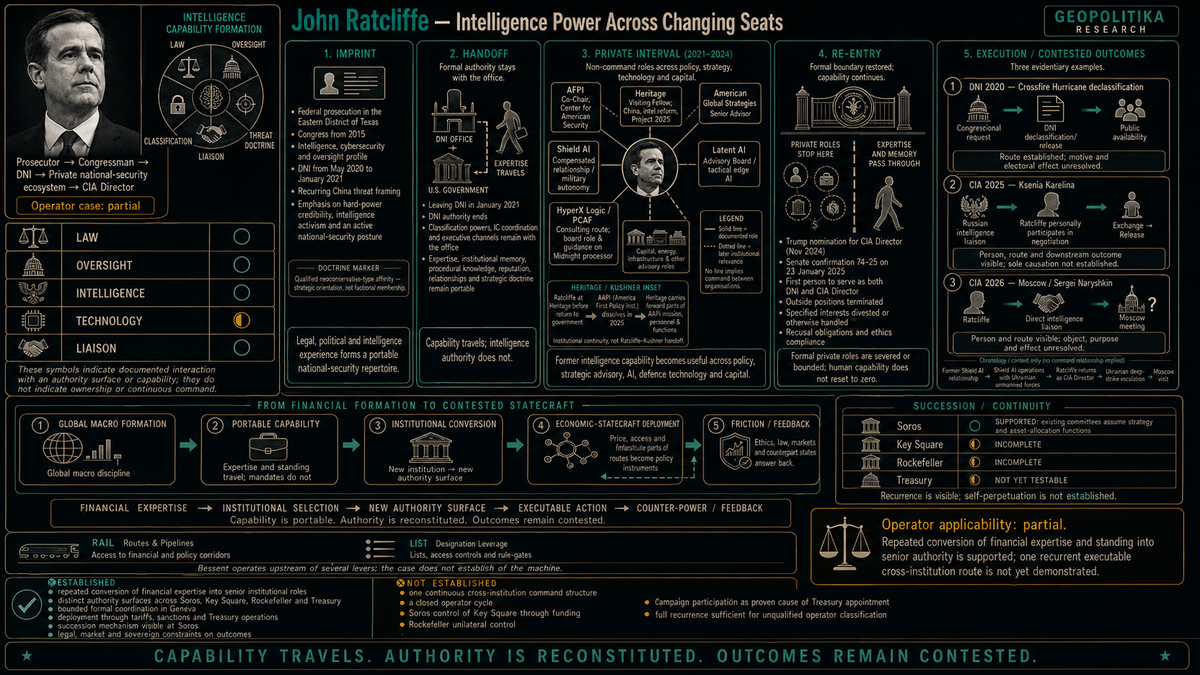
This article is published as part of the Geopolitika project to map structures of power by examining leadership, institutional position, relationships, public claims, executable instruments, outputs and downstream consequences. The Operators follows power through the people and institutions that convert specialised capability into action across changing institutional settings.
John Ratcliffe’s unannounced August 2026 trip to Moscow is the immediate reason to look more closely at him. The CIA Director travelled to Moscow aboard a U.S. military aircraft to meet senior Russian intelligence officials, including Sergei Naryshkin, at a moment when Ukrainian long-range strikes were imposing increasingly visible costs inside Russia, NATO governments were debating escalation risks, and the purpose of the journey remained publicly unresolved.
Executive Summary
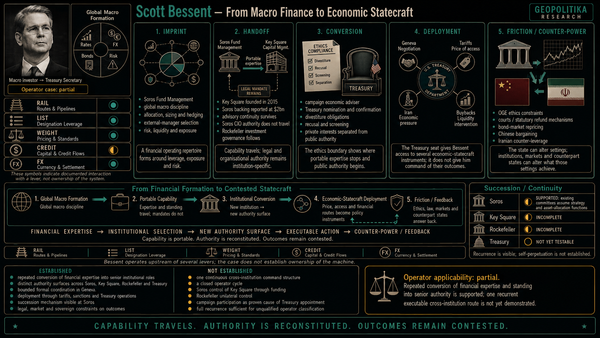
The immediately preceding Operators profile of Scott Bessent examined a specialist whose private-market expertise became executable economic statecraft once the U.S. Treasury supplied a new institutional authority surface. Its central distinction was simple: capability can travel; legal and organisational authority must be granted again at each seat.
John Ratcliffe presents the same problem in intelligence. His career repeatedly moves between public authority and institutions outside government, but the evidence does not support treating those positions as one continuous command structure. What persists is a portable bundle of national-security expertise, procedural knowledge, institutional memory, relationships, political trust, threat doctrine and professional standing. What does not persist automatically is formal authority.
The years between DNI and CIA are therefore the structural centre of the article. Ratcliffe did not merely accumulate investments. His public financial disclosure records roles across national-security policy, strategic advisory, capital, artificial intelligence and defence technology. Some of the organisations with which he was associated later became visibly involved in operational military or intelligence environments, including Ukraine and Israel. Those later activities establish company and institutional trajectories, not a Ratcliffe command chain.
The article therefore asks a narrower question: what happens when intelligence capability leaves formal office, becomes useful across a private national-security ecosystem, and is later reconnected to a state institution carrying executable power? Ratcliffe’s return to government makes that question concrete. Formal private roles and interests had to be severed or bounded; expertise, memory, relationships and professional standing did not simply disappear.
The central finding is that Ratcliffe is best understood as a carrier of intelligence capability whose power moves in and out of officialdom without remaining identical across the transition. Formal authority is reconstituted at each institutional seat, while less formal capabilities travel with the person and acquire different uses in policy, advisory, technological and state settings.
Who is John Ratcliffe?
John Ratcliffe came into national-security politics through law rather than through the intelligence services. His earlier career included private legal practice and federal prosecution in the Eastern District of Texas, where he served as U.S. Attorney before later entering Congress. The CIA’s official biography records that legal and congressional background as part of the career that ultimately brought him into senior Intelligence Community leadership. The important starting point is therefore not that Ratcliffe was formed inside CIA, but that he arrived at intelligence leadership carrying experience from prosecution, law and political oversight.
He entered the U.S. House of Representatives in 2015 and developed a national-security profile around intelligence, cybersecurity and congressional oversight. That placed him on a different institutional surface from prosecution: information could now be turned into hearings, investigations, political scrutiny and legislative action. The later analysis of his career treats that transition as part of a broader sequence in which similar personal capabilities became usable through different institutional mechanisms rather than through one continuous authority.
Donald Trump then repeatedly selected Ratcliffe for senior intelligence office. Trump first chose him for Director of National Intelligence in 2019, but the nomination was withdrawn; Ratcliffe was nominated again in 2020 and confirmed, serving as the sixth DNI from May 2020 until January 2021. The CIA biography confirms that tenure, while later nomination reporting records Trump’s repeated selection of him for intelligence leadership. The pattern establishes political trust and recurrent presidential placement, but the underlying analysis does not treat repeated selection as evidence of operational command.
The least familiar period came after he left DNI. Between 2021 and 2024 Ratcliffe moved into a much broader private and policy ecosystem. His public financial disclosure records approximately twenty outside-government positions spanning policy organisations, strategic consulting, finance, energy, insurance, artificial intelligence and defence technology. Those relationships included the America First Policy Institute, Heritage Foundation, American Global Strategies, Shield AI, Latent AI and HyperX Logic among others. The disclosure establishes that the positions and interests existed; it does not establish that the organisations purchased access, coordinated with one another or later influenced CIA decisions.
That private interval is central because it shows what happened after formal DNI authority disappeared. Ratcliffe remained valuable outside government as a former intelligence chief whose expertise, reputation, institutional knowledge and national-security standing could be redeployed across policy and commercial settings. The analysis describes this as a conversion of public-service capital into outside-government roles while leaving unresolved the precise mixture of expertise, signalling value, relationships or access that individual organisations expected from him.
Trump brought Ratcliffe back into government after the 2024 election, this time as CIA Director. The Senate confirmed him by 74 votes to 25 on 23 January 2025, and he was sworn in later that day. He thereby became the first person to have served as both DNI and Director of the CIA. The distinction matters: he did not carry DNI authority into Langley. CIA authority was newly conferred through presidential nomination, Senate confirmation and institutional office.
Capability Travels; Authority Does Not
The central distinction carried into this article from the preceding Operators work is simple: capability can travel; formal authority must be granted again at each institutional seat. Ratcliffe presents a particularly difficult case because intelligence capability is less visible than financial competence and more easily confused with the powers of the office through which it is exercised.
A former DNI leaves office without taking DNI authority with him. He no longer controls the institutional processes attached to that seat: declassification decisions, Intelligence Community coordination or the channels through which intelligence enters executive decision-making. What can remain portable is different—understanding of classification and collection, interagency process, foreign intelligence services, congressional oversight, institutional memory, professional reputation and relationships.
That distinction also governs Ratcliffe’s later return to intelligence leadership. He did not carry one uninterrupted intelligence mandate from DNI into CIA. The CIA describes its Director as overseeing intelligence collection, analysis, covert action, counterintelligence and liaison relationships with foreign services, but those powers attached to the CIA office only after a new presidential nomination, Senate confirmation and institutional grant. Formal authority had to be conferred again.
What travels is not only technical knowledge. Strategic orientation can remain portable as well: judgements about which threats matter, which instruments are legitimate and what national-security power should be used for. Ratcliffe’s recurring China threat framing and support for a more active intelligence posture therefore belong to the capability that survives institutional transition, even though the authority to act on those views must be conferred again.
The analysis therefore stops short of treating Ratcliffe as a continuously operating command node. It identifies several materially similar conversion episodes—information becoming oversight, classification becoming public release, threat assessment becoming intelligence priority, liaison becoming negotiation—but much of this remains explainable through the ordinary functions of the offices he held. His operator applicability is partial rather than total.
A POSIWID reading adds a narrower point. Across Ratcliffe’s different seats, the recurrent practical function is the conversion of national-security information, threat framing and institutional authority into decision-ready or executable action. The recurrence is only partial: institutions, levers and outputs change, and much of the activity remains ordinary role performance. What persists most clearly is capability, not authority.
That limit makes the years between DNI and CIA more important, not less. If formal authority ended while capability remained portable, the private interval provides the clearest test of what other institutions found valuable in a former intelligence chief—and what changed when that capability later returned to government.
Between DNI And CIA: The Investment And Advisory Architecture
Ratcliffe’s nominee financial disclosure records approximately twenty outside-government positions. Read as a list, they resemble the familiar post-government mixture of consulting, board work, policy organisations and investments. Read by role, sector and timing, the pattern is more revealing.
- Policy production: America First Policy Institute and Heritage
- Strategic advisory: American Global Strategies
- Military autonomy and AI: Shield AI, Latent AI and Arctop
- Strategic computing: HyperX Logic/PCAF
- Capital, energy and infrastructure: Blackstone, Perot Jain, Paradigm and US Trinity, alongside other legal, insurance and advisory roles.
The significance lies less in the names than in Ratcliffe’s position inside them. He was not simply exposed to defence and technology companies through passive investment. He occupied distinct roles—co-chair, visiting fellow, senior adviser, consultant, advisory-board member and, in HyperX Logic’s own description, board member. Those titles do not establish control, but they identify different channels through which judgement, expertise, reputation and relationships could become useful outside government.
At the America First Policy Institute, Ratcliffe served as Co-Chair of the Center for American Security. Institution-native material places him inside AFPI’s national-security work on Russia and China: after the invasion of Ukraine he called for decisive action to isolate Russia from global markets and institutions, while an AFPI China Policy Initiative statement quoted him describing the Chinese Communist Party as the greatest national-security threat to America. The record does not show AFPI inheriting DNI doctrine from Ratcliffe. It does show a threat framework articulated in office remaining usable in a policy institution after formal authority had ended.
Heritage’s June 2023 appointment announcement gives that policy role more definition. Ratcliffe joined as a Visiting Fellow for national security, cybersecurity and intelligence, with responsibilities including chairing a China/COVID accountability project, advising Heritage leadership on national-security and intelligence policy, and helping Project 2025 develop recommendations for intelligence reform in the next presidential administration. His later Heritage profile records the resulting China/COVID report and other national-security work. This was not simply résumé maintenance; it was policy production between government appointments.
American Global Strategies makes the commercial conversion unusually explicit. Its announcement named Ratcliffe a Senior Advisor and said he would work with clients across defence, aerospace, technology, cybersecurity and private equity. That wording helps answer what at least one organisation thought it was buying: a former DNI’s national-security and intelligence experience. It does not prove access-brokering or improper influence. It does establish that senior intelligence experience had market value outside the state.
That distinction matters because “revolving door” can otherwise become a slogan that explains too much and too little. A former intelligence chief may be valuable for substantive knowledge of national-security priorities, familiarity with government process and threat environments, reputation, signalling value, professional networks or some combination of them. The available record does not resolve that mixture consistently across every employer. What it does establish is repeated selection of Ratcliffe’s post-DNI capability by organisations clustered around strategically consequential sectors. The portfolio was therefore not merely an asset map; it was an institutional map of where former intelligence capability became useful.
When Technology Becomes Operational
The defence and technology companies sharpen that map because several later became visibly connected to active military and intelligence environments. The clearest example is Shield AI. Ratcliffe’s OGE disclosure records his former position with the company and the stock options received as compensation. By April 2025, Shield AI reported that its Kyiv-based team had completed more than 130 V-BAT sorties alongside Ukraine’s Unmanned Systems Forces in harsh electronic-warfare environments, supporting training and operational missions.
Shield AI’s 2024 mission review also said its Nova quadcopters continued to support Israel, including use in hostage-rescue operations. Those later deployments do not establish that Ratcliffe arranged the company’s Ukraine relationship, influenced Israeli use, directed battlefield activity, shaped procurement or later connected CIA authority to Shield AI. Their relevance is narrower: a company with which a former DNI held a compensated relationship was building systems at the point where intelligence becomes operational action—locating, classifying, tracking and supporting targeting in environments where an adversary is attempting to deny communications and navigation.
Ukraine’s unmanned-warfare architecture expanded rapidly under Mykhailo Fedorov, while Shield AI’s own record establishes direct operational work with Ukrainian unmanned forces. That makes Ratcliffe’s former relationship relevant background to the present Ukraine context, but the connective chain remains incomplete. No evidence presently shows that he linked Shield AI to Fedorov, designed Ukrainian drone doctrine, directed targets or used CIA authority to perpetuate the former private relationship.
Latent AI occupies another layer of the same environment. Ratcliffe’s financial disclosure says he entered an agreement in August 2022 to serve on the company’s Advisory Board and terminated it by the end of 2024. Latent AI’s institution-native material describes U.S. Navy underwater threat-detection work and Army Project Linchpin work applying edge AI across EO/IR, SAR and RF modalities. Its defence materials describe software intended to continue operating and adapting in contested environments where bandwidth and connectivity may disappear. Here the connection remains sectoral rather than operational: the present research does not establish a Ratcliffe-linked Latent AI deployment in Ukraine or Israel.
HyperX Logic provides the strongest company-native account of Ratcliffe’s own involvement. The disclosure material records a consulting/PCAF route, while HyperX itself described Ratcliffe as a board member who had played a key role in guiding development of the Midnight processor. The company framed that processor for embedded, enterprise, defence, aerospace, network and critical-national-security applications, including post-quantum cryptography and radiation-tolerant configurations.
That discrepancy should remain visible. The stronger role description belongs to HyperX and should be attributed as such rather than silently replacing the disclosure-derived record. If the company’s account is accurate, however, Ratcliffe’s involvement went beyond generic affiliation: HyperX says a former DNI contributed to product direction in a computing system explicitly framed for defence and national-security environments.
Taken together, Shield AI, Latent AI and HyperX occupy different layers of a broader strategic-technology stack: autonomous platforms, tactical-edge processing, sensing, resilient computing and machine-enabled decision support. Ratcliffe’s roles do not turn those companies into one network under his control. They do show that, between DNI and CIA, his expertise was repeatedly useful inside institutions building capabilities increasingly central to modern intelligence and warfighting. That is where the investment and advisory architecture becomes operationally relevant.
Policy Infrastructure, Heritage And The Kushner Connection
The policy organisations form another side of Ratcliffe’s private interval because they show intelligence capability becoming useful not in hardware but in doctrine, institutional design and political programmes. His Heritage role is particularly significant because it connected his prior intelligence experience to work on China, national-security policy and intelligence reform for a future administration. What remained portable was therefore not only technical expertise and institutional memory, but a strategic orientation: judgements about which threats mattered, how intelligence should be used and what a more assertive national-security posture should look like.
That ideological continuity should not be overstated. The analysis supports a qualified neoconservative-type affinity in Ratcliffe’s positioning, particularly in his emphasis on China, hard-power credibility, intelligence activism and a forward national-security posture. It does not establish membership in a single coherent neoconservative network or adherence to one fixed ideological programme. The relevant continuity is therefore one of strategic orientation and institutional environment, not factional membership.
Heritage later provides a useful point of comparison with another Operators route. In April 2025, three months after Ratcliffe entered the CIA, Heritage formally adopted the mission of the Abraham Accords Peace Institute (AAPI) following that organisation’s dissolution, absorbing elements of its mission, personnel and institutional functions. Founded by Jared Kushner after the first Trump administration, AAPI had been established to support implementation and expansion of the Abraham Accords. Heritage carried elements of that infrastructure forward: Robert Greenway would lead the initiative, AAPI figures including Asher Fredman and David Aaronson joined Heritage, and elements of its data-collection and coordination work were retained.
The chronology matters. Ratcliffe’s Heritage fellowship preceded the AAPI transfer, so the evidence does not establish a Ratcliffe–Kushner relationship through Heritage or show Ratcliffe participating in Abraham Accords activity through that route. What it does show is the same institution successively hosting different forms of portable national-security capability: Ratcliffe’s intelligence and policy expertise before his return to government, and later a Kushner-associated diplomatic initiative built around relationships, brokerage and regional strategy.
That comparison becomes more useful when set against this weblog’s earlier Kushner Routes, Part 2: Power Without a Command Centre, which treated brokerage as a form of power exercised through access, relationships and institutional positioning rather than direct command. Kushner’s significance lay in connecting actors who retained their own sovereign authority. Ratcliffe’s post-DNI interval appears to display a related, though less directly evidenced, form of brokerage across policy, strategic advisory, technology and capital.
Across Heritage, AFPI, American Global Strategies and several defence-technology firms, Ratcliffe’s value lay not in carrying formal intelligence authority with him, but in making his prior intelligence experience, strategic judgement, reputation, relationships and threat doctrine usable outside government. The available record does not establish that he personally brokered specific transactions between those organisations. It does show him repeatedly occupying positions from which cross-institutional translation, strategic advice and connection could occur.
Heritage is therefore relevant not because it proves a Ratcliffe–Kushner network, but because it illustrates the kind of policy ecosystem through which portable national-security capability can move. During Ratcliffe’s fellowship it was a venue for intelligence reform, China policy and future-administration planning; soon after his departure it became the successor platform for a Kushner-founded Middle East policy initiative. The continuity is institutional rather than conspiratorial: different forms of expertise, doctrine and brokerage passed through the same policy infrastructure at different times.
Re-Entry: What Had To Be Severed
Ratcliffe’s private interval ended with Donald Trump’s return to the presidency. Nominated for CIA Director in November 2024, he returned not to the coordinating DNI role he had held during Trump’s first administration but to an agency with its own collection, analysis, covert-action, counterintelligence and foreign-liaison machinery. The transition was significant in another respect: when the Senate confirmed Ratcliffe by 74 votes to 25 on 23 January 2025, he became the first person to have served as both Director of National Intelligence and Director of the CIA. He was sworn in later that day, among the earliest senior national-security appointments of Trump’s second administration.
That return matters because the institutional seat was different even though the person was not. Ratcliffe came back carrying experience from his earlier intelligence service, four years of policy and private-sector activity, and relationships across think tanks, strategic advisory firms, defence technology, AI, capital and other commercial organisations. None of that gave him CIA authority before confirmation. Once installed, however, the Director’s office supplied a new set of executable powers and institutional channels, including responsibility for intelligence collection, analysis, covert action and liaison with foreign intelligence services.
The investment and advisory architecture therefore becomes especially important at the point of re-entry, because it provides a practical test of what could and could not cross from private life into public authority. Ratcliffe’s public financial disclosure and subsequent ethics compliance certification record the formal separation process: outside positions were terminated, specified interests were divested or otherwise handled, and recusal obligations applied to relevant former relationships and holdings.
As with others taking on official roles of this nature, the transition from private advisory work to CIA authority required formal roles and financial interests to be separated from the new public office. That does not mean every relationship or form of knowledge disappears. Ethics rules can terminate a contract, require divestiture, impose recusal and prohibit participation in specified matters. They cannot erase professional memory, personal and professional ties, reputation or substantive understanding of an industry; nor does the survival of those informal residues establish wrongdoing.
In these terms, Ratcliffe’s private interval created two kinds of portability. One was formal, and therefore subject to severance: board positions, consulting relationships, equity, outside employment and specific client interests. The other was human, and therefore much harder to extinguish: expertise, institutional memory, familiarity with companies and technologies, policy doctrine, relationships and professional reputation.
This is where the movement in and out of officialdom becomes analytically important. Ratcliffe did not return to government as the same institutional actor who had left DNI in January 2021. The formal private roles, interests and obligations accumulated between the two appointments had to be surrendered or bounded, while the less formal capabilities accumulated across both public and private settings remained attached to the person. CIA then supplied a new authority surface through which some of those capabilities—intelligence judgement, experience of foreign-intelligence liaison, knowledge of technology and national-security priorities—could become useful in a different institutional form.
That distinction reconnects the private interval with the Bessent article. Bessent likewise entered Treasury with a private architecture that had to be separated from public authority through ethics rules. Ratcliffe returned to CIA with a different private architecture, but the underlying problem was the same: what happens when capability formed or redeployed outside government is reconnected to an office with executable state power? The ethics process supplies one part of the answer. While the authority attached to private roles may end, the person does not reset to zero merely because those formal ties have been severed.
What State Authority Makes Executable
Ratcliffe’s earlier DNI period provides the clearest example of what changes when formal authority returns. In September 2020, Senate Judiciary Committee Chairman Lindsey Graham requested Intelligence Community information concerning the FBI’s Crossfire Hurricane investigation into alleged links between Donald Trump's presidential campaign and Russia. Ratcliffe responded as DNI, and the Senate Judiciary Committee published the resulting declassified material. The DNI letter itself records the institutional route from congressional request through declassification to public release.
Ratcliffe’s authority mattered because Graham’s request did not itself make the material public. As DNI, Ratcliffe occupied an office able to participate in decisions about whether intelligence-derived material remained classified or could move into Congress and public debate. The episode therefore provides a concrete example of what formal intelligence authority can make executable: not the creation of information, but a change in who can see and use it.
The 29 September 2020 DNI letter also makes the evidentiary limit unusually clear. It included allegations derived from Russian intelligence reporting while expressly stating that the Intelligence Community did not know whether they were accurate, exaggerated or fabricated. Declassification therefore changed the material’s availability without resolving its truth.
That combination produced the controversy. Critics argued that intelligence of uncertain reliability was being introduced into public debate during an election campaign; Ratcliffe maintained that he was responding to a congressional request and releasing material that could lawfully be declassified. The available record establishes the decision and its timing, but not an electoral motive or a demonstrable effect on the 2020 result.
This sits awkwardly beside Ratcliffe’s repeated insistence that intelligence should remain analytically independent of political preference. In office again, CIA has publicly framed his leadership around analytic objectivity and freedom from political consideration. The tension is therefore between a contested historical episode and a stated professional doctrine of apolitical intelligence, not between a proven political misuse and a later claim of neutrality.
His relationship with Trump requires the same caution. Trump repeatedly selected Ratcliffe for senior intelligence posts, but testimony reported by The Texas Tribune said Ratcliffe opposed efforts to overturn the 2020 election. Repeated presidential selection establishes political trust; it does not by itself establish personal subordination. The same distinction matters when assessing his later conduct as CIA Director, including the Moscow mission.
Russia, Ukraine And The Limits Of Inference
Ratcliffe’s CIA-period Russia record provides two unusually useful examples because they sit at opposite ends of the evidentiary spectrum. The first is the 2025 release of U.S.–Russian dual national Ksenia Karelina. CBS reporting says Ratcliffe personally negotiated her case through a Russian intelligence channel before the exchange that secured her release. The mechanism is relatively concrete: a foreign-intelligence liaison route exists; Ratcliffe participates in negotiations through it; an exchange follows; and a named detainee is released.
Even there, causal wording requires discipline. Ratcliffe was not the sole actor. Russia had to agree, another detainee was exchanged, and intelligence liaison machinery existed before Ratcliffe became Director. The case is important not because it proves personal command, but because the institutional route, personal participation and downstream outcome are all visible.
The August 2026 Moscow visit is the inverse case. Ratcliffe again appears inside a direct intelligence channel, travelling unannounced to Moscow and meeting Russian officials including Sergei Naryshkin, head of Russia’s SVR foreign intelligence service, but this time the substantive object remains uncertain. The BBC treated the visit as highly unusual and placed it within a strategic environment marked by Ukrainian deep strikes, rising NATO concerns and uncertainty over Russian escalation. Reporting cited a U.S. official saying the meeting was principally intended to warn Russia against action against the Baltic states. Other possibilities remain plausible, including Ukraine, Iran, detainees, escalation management or broader intelligence liaison. The public record does not resolve the agenda.
That uncertainty becomes more consequential when the Moscow trip is placed beside the development of Ukrainian unmanned warfare. Shield AI’s own reporting establishes that its V-BAT systems were operating alongside Ukraine’s Unmanned Systems Forces before Ratcliffe’s Moscow visit, including ISR and targeting work in heavily jammed environments. The company’s systems therefore sit not merely in the “drone” category but in the intelligence-to-strike layer of modern warfare: sensing, locating, tracking, operating under electronic denial and helping cue action.
That history makes Ratcliffe’s former Shield AI relationship relevant background without, by itself, establishing an operational chain. This is where The Duran supplies the maximalist interpretation. Its argument is that CIA involvement in Ukraine extends through intelligence, drone technology and target guidance; that the Fedorov/Zelensky drone campaign against Russia formed part of a wider CIA-enabled system; and that Ratcliffe’s Moscow visit should be read as a response to a deteriorating Ukrainian position and a coercive strategy reaching its limits.
That account is not built entirely from invented surroundings. U.S. intelligence support to Ukraine is real; American defence technology is materially present in Ukrainian warfare; Shield AI has documented operational work with Ukraine’s Unmanned Systems Forces; and Ratcliffe now heads an agency with intelligence, liaison and covert-action capabilities. What The Duran does not establish is the connective proposition: that Ratcliffe personally directed or coordinated those elements, that his earlier private advisory relationships anticipated his later CIA role, or that the Moscow visit was caused by the success or failure of the drone campaign. Those propositions are logically inferred from a particular reading of the battlefield situation and the wider strategic chronology rather than demonstrated through a direct evidentiary chain.
While pointing in a different direction, the BBC’s account is itself produced within the institutional context of the United Kingdom’s principal public-service broadcaster, in a state whose government has been strongly committed to Ukraine and deeply involved in the wider Western war effort. It likewise treats Ratcliffe’s trip as highly consequential and places it in the same environment of Ukrainian long-range attacks on Russian energy infrastructure, but interprets the episode primarily through the danger of Russian escalation in response. The account foregrounds reports that Ratcliffe’s mission was intended to warn Moscow against possible action toward NATO members—particularly the Baltic states—while also raising the prospect of wider Russian retaliation against British or other Western targets.
The two accounts therefore place Ratcliffe inside different causal stories. The Duran reads the Moscow visit as an attempt to manage the consequences of a Western-Ukrainian strategy reaching its limits, while the BBC reads it primarily as an effort to deter or manage prospective Russian escalation. Both interpretations begin from real elements of the strategic setting, and both move beyond what is publicly known about the meeting itself.
The established sequence and focus of this article is narrower:
- Ratcliffe held a prior compensated relationship with Shield AI
- Shield AI later became operationally involved with Ukrainian unmanned forces
- Ratcliffe returned to government as CIA Director
- Ukrainian deep-strike warfare intensified
- Ratcliffe travelled to Moscow during that escalation cycle.
In the absence of proof, the proposition that Ratcliffe personally connected those stages remains speculation. No validated evidence presently shows that he arranged Shield AI’s Ukraine role, coordinated with Fedorov, directed strike targets or travelled to Moscow specifically because the drone campaign had succeeded or failed. The connections and chronology are real; the command chain is not established and may not, in any case, be the level at which the relevant operational decisions or outcomes were determined.
From Bessent’s Financial War to Ratcliffe’s Intelligence Theatre
The prior Scott Bessent article provides another reason the Ratcliffe profile belongs in current events rather than as a timeless case study in the Operators series. Bessent was examined against a widening economic confrontation involving Iran, China and Russia, with the August 2026 Iran sanctions package treated as a case in which strategic language became administrative machinery through sectoral determinations, licence restrictions, designations, maritime guidance and intermediary compliance. His role was framed as taking responsibility for implementing an economic-pressure strategy presented as an alternative to renewed kinetic escalation.
That does not imply a simple sequence in which military force failed and financial war then began. Russia shows why such linearity would be misleading. Western financial pressure did not begin in 2026 or even in February 2022: measures imposed after 2014 had already made finance part of the confrontation, while the post-invasion regime massively expanded restrictions on banks, sovereign finance, reserves, technology and trade. Economic coercion, military force, intelligence activity, diplomacy and technology have therefore operated concurrently for years. That is the practical reality of contemporary hybrid warfare: different instruments acting in combination rather than in neat succession.
The more interesting conjecture concerns relative weight. When coercion in one domain fails to produce decisive political results, pressure can intensify, migrate or recombine across others. Economic statecraft may become more important when kinetic escalation is unattractive or inconclusive. Intelligence liaison may become more important when military conflict cannot settle the strategic contest. Technology can alter how war is fought without ending it; sanctions can increase costs without compelling capitulation; direct intelligence contact can manage escalation without resolving the conflict beneath it.
Seen that way, Bessent and Ratcliffe represent two different specialist responses to the same strategic problem. Bessent works through tariffs, sanctions, financial access, market pressure and administrative classification. Ratcliffe works around information, collection, classification, foreign liaison, intelligence relationships and potentially covert or technical capability. Neither owns the wider system. Both occupy institutional seats from which specialised knowledge can become state action.
Conclusion – The Intelligence Carrier
Ratcliffe’s Moscow trip matters because it places the CIA Director inside a direct channel to one of America’s principal adversaries at a moment of acute geopolitical tension. But the deeper significance of the episode only becomes visible when set against the career that preceded it.
Ratcliffe has repeatedly moved between institutions in which information, expertise, standing and relationships can be converted into action. Federal prosecution, Congress, DNI, private policy and advisory roles, and finally CIA each supplied different authority surfaces. The person remained continuous; the powers attached to the positions did not.
The years between DNI and CIA are therefore the structural centre of the story. Ratcliffe’s intelligence experience did not disappear when formal authority ended. It became useful across national-security policy, strategic advisory, defence technology, AI, computing and capital. Shield AI later documented systems operating in Ukraine and Israel; HyperX Logic described him as helping guide development of computing for defence and critical-security applications; Heritage used his experience in intelligence reform; AFPI kept him inside Ukraine and China policy; and American Global Strategies placed his national-security experience in service of defence, aerospace, technology, cybersecurity and private-equity clients.
None of that establishes a coordinated Ratcliffe network or shows that private interests were carried into CIA. Formal relationships were subject to severance, divestiture and recusal when he returned to government. But nor did the person reset to zero. Expertise, institutional memory, relationships, reputation and familiarity with the organisations and technologies around national security remained portable. What travelled with Ratcliffe was therefore not only expertise and relationships, but also a strategic orientation: ideas about threat, intelligence, power and the purposes for which state capability should be used.
That makes Ratcliffe another instance of a wider Operators pattern already visible in the Bessent article and the earlier Kushner work: power can move in and out of officialdom without remaining identical across the transition. Kushner’s brokerage operated through access and relationships; Bessent carried financial expertise into economic statecraft; Ratcliffe carried intelligence and national-security capability through policy and private institutions before returning to an office able to make some of that capability executable again.
The Moscow episode does not prove that Ratcliffe directed the military, technological and intelligence architecture surrounding Ukraine, any more than his earlier private roles prove that he later acted on behalf of those organisations. The connections and chronology are real; a personal command chain is not established and may not, in any case, be the level at which relevant operational decisions and outcomes are determined.
The more defensible finding is narrower and more consequential. Ratcliffe’s career shows how intelligence power can persist without continuous formal authority: expertise, institutional memory, relationships, doctrine and professional standing travel with the person, while each new institutional seat determines what those assets can actually be made to do.
That is the Operators finding.
—
Published via Mindwars Ghosted.
Overlords: Mapping the Operators of reality and rule.
—
Methodology: This article is based primarily on a structured analysis of John Ratcliffe’s career, institutional positions, public doctrine, relationships, private-sector roles and executable authorities through 27 August 2026. The underlying analysis found partial operator applicability, medium overall confidence and a mechanistic causal ceiling. The August 2026 Moscow section additionally draws on subsequent reporting and commentary concerning Ratcliffe’s unannounced visit to Russia, including the BBC account and the supplied Duran discussion. These are treated as differently situated interpretations of an incompletely disclosed intelligence mission rather than as proof of its purpose. The Duran’s claims linking Ratcliffe, CIA, Ukrainian drone warfare and the Moscow visit are treated as an inferred causal reading of the battlefield and strategic chronology; the BBC’s escalation-management framing is likewise treated as interpretation based on reported official claims rather than a complete account of the meeting. Supplementary research was used to clarify Ratcliffe’s post-DNI roles and the later activity of organisations in which he held positions. Institution-native material from Heritage, America First Policy Institute, American Global Strategies, Shield AI, Latent AI and HyperX Logic was used to distinguish role, sector, supported period and documented output. Shield AI’s subsequent operational activity in Ukraine and Israel establishes company activity, not Ratcliffe agency. HyperX Logic’s description of Ratcliffe as a board member who helped guide development of its Midnight processor is presented as the company’s own account because it is more specific than the disclosure-derived role coding. Heritage’s later adoption of the Abraham Accords Peace Institute mission is treated as institutional continuity at Heritage, not evidence of a Ratcliffe–Kushner handoff; the AAPI transfer occurred after Ratcliffe had returned to government. The article also draws on the immediately preceding Scott Bessent Operators profile and earlier Kushner Routes work for comparative series context. These comparisons are used to examine portability of expertise, relationships, standing and brokerage across institutional boundaries; they are not evidence that Bessent, Kushner and Ratcliffe belong to one coordinated mechanism. Funding was not treated as proof of control. Titles were not treated as proof of operator status. Advisory or board roles were not treated as evidence of command. Professional proximity was not treated as coordination. Company deployments were not attributed automatically to former advisers. Institutional continuity was not treated as command continuity. Political trust was not treated as personal subordination. Intelligence liaison was not treated as agreement, and historical private relationships were not projected automatically into later CIA authority. The Russia cases are deliberately differentiated. The Ksenia Karelina exchange provides evidence of a visible intelligence-liaison route, Ratcliffe’s personal participation and a downstream outcome, without establishing him as sole cause. The August 2026 Moscow visit establishes the person and the channel, but not the complete object, purpose or effect of the meeting. Likewise, the chronology linking Ratcliffe’s former Shield AI role, the company’s later operational involvement with Ukrainian unmanned forces, Ratcliffe’s return as CIA Director and the subsequent Moscow mission does not establish a personal command chain and may not identify the level at which relevant operational decisions were made. The article therefore distinguishes portable capability from continuous authority, institutional routes from command, and established chronology from inferred causation. Base analytic outputs are available on request. For methodological details—see the Geopolitika Series Methodological Statement.
Mindwars Ghosted is an independent platform dedicated to examining elite networks, institutional power and narrative engineering behind modern society. The site has free access and is committed to uncompromising free speech, offering deep dives into the mechanisms of control.