Geopolitika: The Kushner Routes, Part 2. Power Without a Command Centre
How family access, presidential delegation, diplomacy and sovereign capital connect without becoming one organisation.
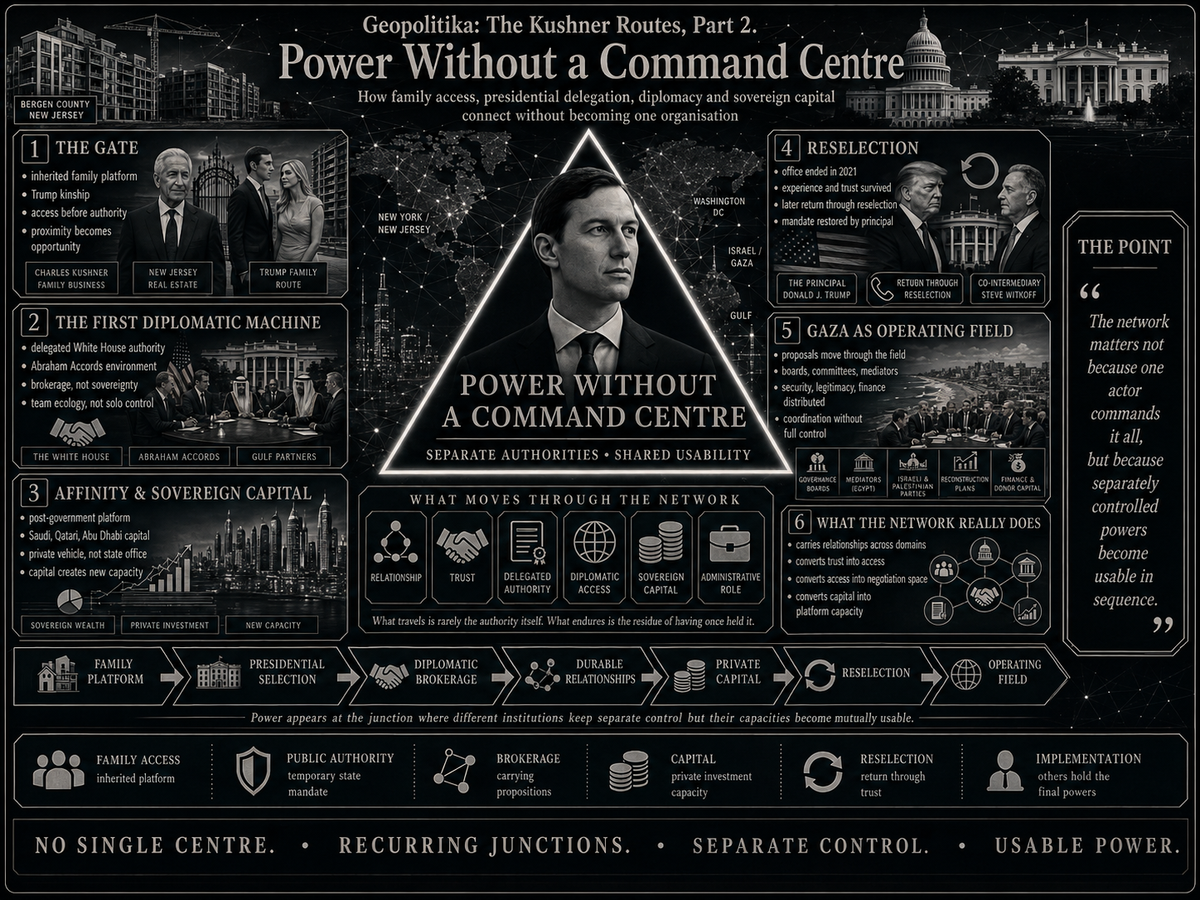
This article is published as part of the Geopolitika project to map Anglo-American power structures by examining their founding mythologies, leadership, linkages to power, public face, the nature of their outputs and who these are directed towards. This series is primarily generated from materials provided on the institution’s own websites, which are analysed using a structured analytic framework—see methodology statement at foot of article.
—
Executive Summary
Part 1 in this series followed Jared Kushner before the network became visible. It traced the accumulation of family position, political access, diplomatic experience, relationships and private investment capacity, ending with a distinction that becomes the starting point here: relationships can create openings, but they cannot appoint officials, sign treaties, invest sovereign money, grant legal rights or implement political plans by themselves. Those conversions require institutions, principals and other actors whose authority does not belong to Kushner.
Part 2 asks what happens when the assets accumulated across those different phases begin to connect. The answer is neither the simple nepotism story nor its mirror image, the idea of a hidden Kushner organisation directing governments, investors and intermediaries from a single centre. The stronger evidence describes something more fragmented and, in some respects, more consequential: a set of relationships through which different forms of power become usable across domains while remaining under separate control. Donald Trump can select Kushner and confer public authority for a defined purpose; foreign leaders retain sovereign authority of their own; diplomatic colleagues can carry proposals alongside him; Gulf sovereign funds can provide capital to Affinity Partners; corporate transactions can produce specific ownership and governance rights; and, years after a formal White House role has ended, Trump can select Kushner again because experience, trust and relationships have survived the office that originally produced them. The latest person-level analysis supports a recurring intermediary or conversion function only in bounded form and explicitly rejects a general cross-institution command architecture.
Gaza provides the most developed case. There, Trump, Kushner, Steve Witkoff, Tony Blair, Israeli officials, Palestinian actors, regional mediators and newly created governance bodies occupy the same operational field. Proposals move through the field; presidential sponsorship gives some of them institutional weight; negotiations produce further handoffs; boards and administrative bodies acquire defined functions. Yet security authority, representational legitimacy, bargaining power and implementation capacity remain distributed among actors who retain different interests and can continue to disagree.
Kushner’s recurring advantage is therefore narrower than command and more interesting than access alone. His power repeatedly appears at the junctions where separately controlled forms of authority, relationship and capital become mutually usable. The network matters because those junctions exist. It remains a network rather than an organisation because no one actor owns all the capacities that have to pass through them.
A Network Is Not an Organisation
The word network is useful because it directs attention away from formal organisational charts, but it carries a danger of its own. Once enough lines are drawn between politicians, diplomats, investors and family members, the diagram begins to suggest a coherence that the evidence may not support. Relationship becomes association, association becomes coordination, and coordination quietly becomes control. In Kushner’s case the temptation is especially strong because the same regions, families and institutions recur across apparently separate phases of his career.
The network examined here is necessarily bounded. It is not an exhaustive map of Kushner’s business or geopolitical relationships, which are plainly more extensive than the collections analysed for this series. It is the network that has fallen out of those collections: the people, institutions and recurring routes for which the evidence is sufficiently developed to analyse. Absence from the map therefore means only that a relationship has not been established through the present analytical corpus.
More importantly, the lines on that map represent different things. Marriage is a relationship. Appointment is a transfer of formal authority. A meeting may provide access without producing coordination. A negotiation becomes more consequential when proposals, concessions or decisions actually move through it. An investment is a material flow, but the existence of funding does not prove political direction. Ownership can create legal rights without producing operational control over an entire company. The person analysis preserves those distinctions explicitly: supported relationships are not promoted automatically into handoffs, coordination patterns, operator status or command, and the overall person-level ceiling remains mechanistic rather than systemic.
This is why Kushner becomes analytically more interesting when “influence” is broken apart rather than treated as a single resource. His career crosses a family property business, presidential politics, state diplomacy, sovereign wealth and private investment, but the power available in each domain has a different institutional source. What can be carried from one phase into another is therefore not necessarily the authority itself. Often what survives is the residue of having once occupied the position: a relationship, knowledge of a principal, a reputation, familiarity with a process, or a platform capable of receiving capital and converting it into another form of capacity.
The first route through which that distinction becomes visible is the family.
The Gate
Charles Kushner gave his son an inherited position inside Kushner Companies, but the significance of that relationship was not simply that Jared was born wealthy. Charles’s criminal case accelerated a succession process in which an existing family institution became a platform for greater responsibility, giving Jared managerial experience and access to a business architecture he had not created from scratch. Part 1 treated that episode as one of several contingencies that left behind something portable rather than as the first move in a predetermined political design.
Marriage into the Trump family created a different kind of opening. Kushner married Ivanka Trump in 2009, placing him inside another wealthy family with a rapidly expanding political trajectory. But kinship did not itself make him a public official. It was Trump’s campaign and then the presidency that converted family proximity into political usefulness and, eventually, delegated state authority. The distinction matters because the latest person analysis supports the family relationship as materially relevant to access while rejecting the stronger claim that the Kushner and Trump families formed an integrated political-business command structure.
In that sense, Trump is not simply another well-connected person in the network. He is the gate through which proximity becomes formal public capacity. Presidential selection placed Kushner inside institutions whose powers remained state powers even when he was allowed to exercise them. As senior adviser, he could enter negotiations with the authority of an administration behind him; when he left government in January 2021, that authority did not follow him into private life.
What did follow him were the relationships and experience accumulated while the authority existed.
That difference becomes central to everything that comes next. Public authority is temporary and institutionally delegated. Relationships can be much more durable. The first administration created a setting in which Kushner could build direct familiarity with leaders and negotiators who possessed power independently of Trump, and in which repeated contact could produce the kind of trust that might remain usable even after the government role itself had ended.
The First Diplomatic Machine
The Abraham Accords are often narrated through personalities: Trump, Kushner, Netanyahu, Gulf rulers. The person analysis supports a material Kushner role in several of the normalisation and regional mediation tracks, but it also makes clear that those outcomes emerged from multi-actor state processes rather than from one intermediary’s personal authority. Supported routes include U.S.-facilitated UAE–Israel and Bahrain–Israel normalisation, collective U.S. team involvement around Sudan and Morocco, and Saudi–Qatar/GCC mediation. Kushner’s contribution is mechanistic and material; sovereign decisions, formal state machinery and the wider U.S. team remain independent nodes.
That is why Avi Berkowitz deserves more attention than he often receives in the simplified Kushner story. Several of the diplomatic routes were not Kushner acting alone but Kushner operating within a small negotiating ecology whose functions could be divided among American officials, ambassadors and foreign principals. The existence of that team does not make Kushner unimportant; it makes the actual mechanism clearer. His role could be central to access or brokerage while remaining one component of a process in which drafting, technical negotiation, legal formalisation and sovereign approval were performed elsewhere.
The UAE route shows this particularly well. Kushner’s relationship with ambassador Yousef Al Otaiba was geopolitically material because communication between trusted interlocutors could help carry propositions between Washington, Abu Dhabi and Israel. Yet Al Otaiba was not part of a Kushner organisation, and the UAE did not surrender its independent strategic calculation simply because an American intermediary possessed access. The relationship mattered because the actors on either side retained powers the other needed.
The same is true of Benjamin Netanyahu. A working relationship with the Israeli prime minister could make direct discussion possible and reduce the distance between a White House proposal and the Israeli principal who would ultimately have to accept or reject it. But access to Netanyahu did not transfer Israeli sovereign authority to Kushner. The political decision remained Israeli.
Mohammed bin Salman occupies another important position because his relationship with Kushner later appears in both diplomatic and private-capital contexts. That recurrence can easily create the impression of a single continuous relationship whose political and financial functions merge. The evidence requires the opposite discipline. Mohammed bin Salman as political principal, the Saudi state as sovereign actor, and the Public Investment Fund as an investment institution are related but analytically distinct. A personal relationship may help explain access; an investment can establish a material financial link; neither, without an evidenced route, proves that one institution directed the decisions of another.
Morocco provides a particularly clear demonstration of why the endpoints matter. Normalisation was associated with a linked U.S. position on Western Sahara. Whatever the merits or consequences of the bargain—a question to which this series will return later—neither element could be produced by Kushner’s relationship network alone. U.S. recognition required the authority of the American state, Moroccan normalisation required a Moroccan sovereign decision, and Israeli obligations required Israeli consent. Personal access could help create the negotiating route through which those institutional decisions became possible, but the intermediary did not own the powers being exchanged.
The sequence is therefore more accurately understood as an opening that becomes usable through access, access that supports negotiation, negotiation that reaches sovereign principals, and sovereign principals whose decisions can then be formalised and implemented by institutions. Kushner mattered inside that sequence without controlling all of it.
The agreements’ survival after his departure from office reinforces the distinction. Governments, embassies and commercial relationships continued to exist after Kushner no longer possessed a White House mandate. The output had become institutionalised enough to outlive the person who had helped broker it. In other words, a relationship-based route could produce something more durable than the authority of the intermediary himself.
When Kushner left Washington, he therefore carried away neither American sovereign power nor control of the agreements. He carried a more portable stock: familiarity, personal relationships, a reputation for having participated in deals that had actually been concluded, and knowledge of how particular principals and institutions operated.
The next phase tested whether those assets could be converted into private capacity.
What Survives Office
Affinity Partners is where the analytical distinction between portable relationship capital and non-portable state authority becomes hardest to avoid. Kushner’s government mandate had ended, yet some of the same regional geography in which he had worked as an American diplomatic intermediary became an important source of capital for his new private investment platform. The person analysis supports that overlap and treats the transition as a partial route in which regional relationship capital was redeployed into private investment, while leaving investor motive and any policy exchange unresolved.
The scale matters. The analysed record reports a $2 billion allocation from Saudi PIF to Affinity and material backing from other Gulf sources, including the Qatar Investment Authority and Abu Dhabi-based Lunate. Those flows gave Kushner’s post-government institution something fundamentally different from the authority he had possessed in Washington: a privately controlled platform capable of deploying large pools of institutional capital.
That overlap warrants scrutiny precisely because the same broad regional relationships appear across public and private phases. But scrutiny is not the same as causal promotion. The person analysis does not establish that Gulf capital purchased American policy, that a sovereign-fund investment reflected a quid pro quo, or that Affinity’s investors controlled Kushner’s later diplomatic behaviour. The financial relationship establishes capital, incentives and structural adjacency; a return path from Gulf capital into U.S. policy authority has not been demonstrated.
The distinction becomes particularly useful when looking at QXO. Here, some of the language of “influence” can be replaced by more precise legal concepts. Affinity-linked investment created a securities position and governance relationship that can be described through beneficial ownership, voting and dispositive rights, and a board seat. The latest person analysis treats such private-capital roles separately from public diplomacy and explicitly resists turning commercial participation into evidence of political motive or command.
That matters because it reveals how differently power is produced in the two domains. In government, Kushner’s ability to act depended on presidential delegation and the formal machinery of the state. At Affinity, capacity comes through ownership, fund structure, investors, contracts and corporate rights. Both can make him consequential, but they do so through different institutional mechanisms.
The network becomes analytically interesting not because these mechanisms secretly fuse, but because the same person can move between them while retaining relationships formed in an earlier setting. A former diplomatic relationship may later coexist with a financial relationship; a reputation acquired in government may make a private institution more credible to investors; a private platform may in turn increase Kushner’s independent economic capacity. What the present evidence does not establish is that the private money then flows back into public authority as a causal command mechanism.
That gap is important, because Kushner’s later return to diplomacy can be explained without positing continuous hidden power.
It can be explained through reselection.
Reselection
The break between 2021 and Kushner’s later diplomatic return is not a nuisance in the chronology. It is one of the most informative features of it.
If Kushner had retained continuous governmental authority after leaving the White House, his later appearance in diplomacy would simply be continuation. The person analysis instead treats departure and return as evidence of role discontinuity followed by reactivation. Formal first-term authority ended; the relationships and experience accumulated while exercising it survived; Trump’s later decision to use Kushner again supplied the new political mandate.
That produces a bounded portability mechanism. The analytical record supports movement from 2017–2021 White House diplomatic experience and counterpart relationships into 2025–2026 mission-specific diplomacy through presidential reselection combined with retained trust and experience. It does not support the idea of an autonomous Kushner office persisting across administrations.
Kushner’s own language is instructive here. In explaining why he and Steve Witkoff could be useful in renewed diplomacy, he has emphasised experience and trusted relationships. As self-description, that does not prove indispensability or establish that outcomes depended uniquely on him. But it accurately identifies the kind of asset that can survive institutional discontinuity. A title expires. Familiarity with a leader, knowledge of how a negotiation previously unfolded, or a reputation for delivering messages directly to a president can endure.
Witkoff’s presence also reveals that the later brokerage architecture is not simply a restoration of Kushner’s old portfolio. The person analysis supports Kushner and Witkoff as material co-intermediaries in later diplomacy while refusing to infer hierarchy or a wider command system. This matters because repeated joint appearance can otherwise produce another false organisational inference: the assumption that one must be the other’s subordinate or that they operate as a permanent unit.
A more careful reading is that Trump can repeatedly select individuals he trusts for mission-specific negotiation, and that Kushner’s earlier experience can make him useful within such a configuration even though his authority still derives from the political principal rather than from an institution he personally controls. The person analysis accordingly distinguishes the presidential principal, the intermediary, formal and technical institutions, and private capital as separate components of the later architecture.
The current role also requires caution. The person analysis explicitly preserves uncertainty about the exact scope of Kushner’s 2026 formal authority because a complete primary appointment or delegation instrument is not present in the supplied corpus. The significance of his re-entry is therefore clearer than the legal precision of every later title.
Gaza is where this reselection becomes most visible as an operating system rather than as another entry on a résumé.
Gaza: When the Network Becomes an Operating Field
The analysed Gaza collection moves the discussion from relationships and personal roles into a more developed field of governance, security, negotiation and redevelopment. It documents Kushner and Tony Blair carrying post-war ideas to Trump; repeated Kushner consultations with Netanyahu; the creation or announcement of new board and administrative structures; later engagement with Hamas; regional mediation; and proposals for reconstruction and capital mobilisation. It does not establish Kushner as sole author of that architecture, and its own production analysis leaves the full drafting lineage incomplete.
That limitation makes the case more useful rather than less, because Gaza shows what happens when a relationship network encounters a problem that no intermediary can solve with access alone.
The first route is relatively straightforward. Reporting in the collection supports Kushner and Blair presenting post-war Gaza ideas to Trump. The movement through that route is intelligible: proposals originating or developed within a planning field reach the president through trusted intermediaries. Yet the route itself does not tell us which proposal elements originated with which person, nor does presentation establish automatic presidential adoption. Blair’s participation is supported; Kushner’s participation is supported; sole authorship by either is not.
By January 2026, the public architecture had become more institutional. The Board of Peace, a Gaza Executive Board and a National Committee for the Administration of Gaza were described as parts of a governance structure in which strategic oversight, resource mobilisation and technocratic administration would be distributed among different bodies. Kushner appears inside that architecture, but membership in a board is not equivalent to ownership of the system.
Other individuals further complicate authorship. Nickolay Mladenov appears in a high-representative role linking the Board to implementation; Ron Dermer appears in reporting around Israeli post-war planning; Yakir Gabay is reported as having played a material role in crafting the redevelopment plan and sitting on the Gaza Executive Board. Their presence does not imply shared command or a unified authorship group. It shows that the design field contains differentiated functions.
The state and non-state actors whose cooperation would be required are more important still. Israel retains security and territorial powers that an American intermediary cannot simply confer upon himself. Netanyahu remains a political principal whose government can approve, delay or reject elements of a plan. The collection documents repeated Kushner-Netanyahu consultation, but consultation is a relationship between separate authorities rather than evidence that either commands the other.
Hamas occupies another form of power altogether. The plan architecture treats it as an armed actor whose disarmament and removal from governing authority are central objectives, yet later reporting places Hamas representatives in direct meetings with Kushner in Egypt. An organisation can therefore be both a target of an intended settlement and a negotiating counterparty whose cooperation remains necessary to aspects of that settlement. That is bargaining power, not formal legitimacy, and the distinction matters.
The Palestinian Authority introduces a different problem: representational legitimacy. PA officials are reported objecting that direct U.S.–Hamas contacts risked bypassing or marginalising their claim to speak for Palestinians. The disagreement therefore concerns not only substantive policy but the architecture of representation itself—who is entitled to negotiate, who is treated as an administrative partner, and whose consent counts at which stage of the process.
Egypt, meanwhile, appears as mediator and host of talks, while the UAE appears in a partially supported reconstruction-funding route. Each additional actor adds a capacity that others do not possess. The United States can sponsor a plan and create diplomatic pressure; Israel retains indispensable security authority; Hamas retains a capacity to obstruct or bargain; the PA claims political representation; regional states can mediate, finance or confer wider legitimacy; prospective investors may eventually supply capital; governance bodies can define administrative responsibilities.
This is not a system without coordination. Quite the opposite: the collection records real coordination routes, institutional design and repeated negotiation. What it does not show is a single centre capable of compelling every other node to conform. The later stages of the process preserve substantive disagreement over sequencing, legitimacy and implementation, demonstrating that coordination can coexist with independent decision-making and refusal.
The redevelopment dimension makes this even clearer because it extends power from diplomacy into material design. Public proposals envisage technocratic administration, security conditions, reconstruction, capital mobilisation and a transformed built environment. Yet the same collection leaves important questions unresolved about land title, neighbourhood continuity, resident consultation, allocation rules, implementation and the precise rights of those who would live under the resulting architecture. The analysis also does not establish a formal resident-level co-design or consent mechanism in the supplied material.
Those issues belong more fully to a later article in this series, which will examine the geography of decision rights and burdens. Here their significance is narrower. They show what happens when an apparently interpersonal mode of power becomes institutional. Access to a president may get a proposal into the room, but implementation requires organisations capable of assigning administrative roles, controlling territory, providing security, mobilising finance and adjudicating claims about representation and property.
Kushner appears at several of those interfaces. That is materially significant. It is not the same thing as possessing all of the capacities that meet there.
What Moves Through the Network
By this point, “network power” can be defined more precisely. The useful question is not how influential Kushner is in the abstract, but what kind of object moves through a particular relationship and what institution is needed to complete the conversion.
Presidential trust, for example, can become negotiating access when Trump delegates a mission. A family relationship can help explain proximity to the principal but does not itself supply the public mandate. Relationships with foreign leaders can make direct communication possible, yet the leaders retain sovereign authority over what their states will accept. Negotiators can carry proposals between principals, but they cannot make the principals prefer the proposed bargain. Capital moves through a different legal architecture again: investment commitments become fund capacity, securities transactions create ownership rights, and board appointments create governance positions whose scope is defined by corporate law and agreements rather than by diplomatic status.
The analyses identify these flows separately. Presidential trust and delegation support negotiating access; Gulf capital supports Affinity as a private investment platform; formal normalisation can support connectivity; and relationships established during public service can survive into later phases without proving that state authority itself has become private property.
Keeping those objects separate also clarifies what does not automatically move through the network. A marriage does not transfer presidential authority. A relationship with a foreign ruler does not place that state under Kushner’s control. An investment by PIF does not demonstrate Saudi direction of American policy. Joint negotiating activity with Witkoff does not establish a hierarchy between them. Consultation with Netanyahu does not make Kushner author of Israeli policy. Membership of a governance board does not by itself confer command over other institutions whose cooperation the plan requires.
Those limits are not defensive caveats appended to an otherwise expansive theory. They are what make the theory useful.
Kushner is easiest to misunderstand when all the distinct capacities around him are collapsed into a single word—influence—and then treated as though influence accumulated continuously regardless of institutional setting. The evidence describes a more discontinuous pattern. At one moment he can possess delegated political authority because Trump has selected him. At another he can possess private economic capacity because he owns and operates an investment platform. At another he can possess access because a foreign principal is willing to take the call. At another he can possess a governance position defined by a board or corporate instrument. The same person moves among these capacities, but their sources remain different.
What makes his position unusual is that the residue of one phase can make the next phase easier to enter. A diplomatic record can contribute to reputation. Reputation can contribute to later selection. Relationships established in office can remain available when the office has disappeared. A private platform can provide independent organisational and financial capacity. The interim four-analysis synthesis describes this as a partial reputation-and-access loop while explicitly finding no established return cycle in which Affinity’s Gulf capital directs later public policy.
That distinction brings us back to Part 1’s central sequence. A relationship may produce an encounter, the encounter may reveal an opportunity, and the opportunity may be reframed into something that looks tractable. But the conversion into executable power occurs only when an authorised institution turns the idea into an appointment, agreement, investment, ownership right, governance structure or implementable policy.
Kushner’s recurring position is near those conversions.
The latest person analysis describes that operator status cautiously: a recurring conversion or intermediary function is supported, but a general operator or coordination architecture exceeds the evidence. That is enough to explain why he can repeatedly appear in consequential places without requiring a hidden command centre behind them.
The Junction, Not the Command Centre
Part 1 ended by arguing that accumulated relationships, experience and institutional capacity can begin to resemble architecture even when they were not assembled according to a master plan. It also insisted that architecture does not mean central design: the institutions producing those accumulated options can retain different owners, interests and decision-makers.
Part 2 shows what that looks like once the relationships become operational.
Charles Kushner’s fall accelerated succession inside a family company. Marriage connected Jared to another family, but Trump’s political victory and presidential selection were required to convert proximity into public authority. Middle East diplomacy then gave Kushner experience with foreign principals and participation in negotiations capable of producing state agreements. Leaving government terminated the formal mandate while leaving some relationships intact. Affinity created a new private institution through which large pools of outside capital could be raised and deployed. Later presidential reselection allowed retained experience and relationships to become politically usable again, now inside a different diplomatic configuration in which Witkoff also occupied a major role. Gaza then brought several of these mechanisms into one field: presidential authority, personal brokerage, international planning, security power, governance institutions, regional mediation and prospective reconstruction capital.
None of those institutions needs to belong to Kushner for him to matter at the point where they meet.
But the importance of that junction cannot be converted into evidence that he controls the whole network. Presidents still authorise. Governments still decide. Sovereign funds still make investment decisions through their own institutions. Companies define legal rights through contracts and securities. Armed actors can negotiate or refuse. Administrative bodies can acquire responsibilities that do not derive from Kushner personally. Communities ultimately live with the consequences of plans developed far above them.
The Kushner route lies between those endpoints.
It is the route by which one actor’s access, proposal, authority, capital or institutional output can become another actor’s usable input. Its power lies in the repeated ability to reach those interfaces; its limit lies in the fact that the actors on the other side retain capacities and interests of their own.
That is power without a command centre.
It also creates the next question in the series, because Kushner does not merely operate through these relationships. Across his public appearances he repeatedly offers an explanation of why this method should work: get closer to the principals, understand what they really want, move beyond inherited assumptions, align incentives and make the problem executable.
The next article moves from the architecture of the network to the architecture of that explanation.
Next — The Kushner Routes, Part 3: Kushner in Three Rooms
How access, experience and deal-making become claims about expertise, causation and what counts as a realistic political solution.
—
Published via Mindwars Ghosted.
Geopolitika: Tracing the architecture of power before it becomes the spectacle of history.
Methodology Note: This article draws on the public record assembled for The Kushner Routes: biographical and institutional profiles; U.S. Justice Department records; education and corporate records; investment-adviser and financial disclosures; reporting on Affinity Partners; Kushner’s memoir; long-form interviews and public appearances; official White House material; and reporting used in the Albania investigation. First-person accounts are used as evidence of Kushner’s self-presentation, role perception and description of relationships, not as independent verification of every event or outcome. Financial disclosures are used as evidence of material relationships, incentives, ownership and capital flows; they are not treated as automatic evidence of misconduct, intent, purchased policy or conscious coordination. Family relationships are kept separate from formal public authority, and roles held in different periods are not collapsed into a single continuous mandate. The article does not claim knowledge of private intentions, undisclosed communications or conduct not established in the cited public record. Base analytic outputs are available on request. For methodological details—see the Geopolitika Series Methodological Statement.
Mindwars Ghosted is an independent platform dedicated to exposing elite coordination and narrative engineering behind modern society. The site has free access and is committed to uncompromising free speech, offering deep dives into the mechanisms of control.