Geopolitika: The Kushner Routes, Part 3. Kushner in Three Rooms
How access, experience and deal-making become claims about expertise, causation and what counts as a realistic political solution.
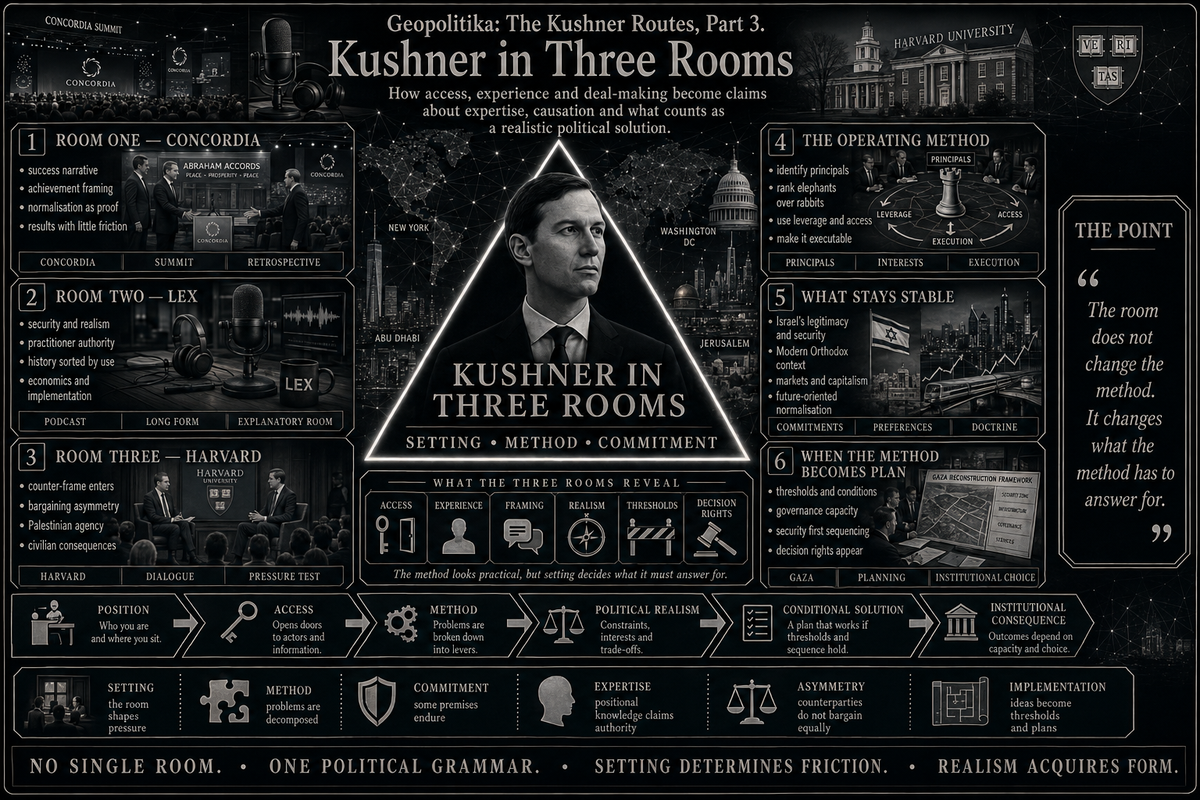
This article is published as part of the Geopolitika project to map structures of power by examining their leadership, institutional position, relationships, public claims, outputs and downstream consequences. The Kushner Routes follows Jared Kushner not as a biography but as a sequence of positions through which family access, public authority, relationships, capital and ideas become usable in different settings. This series is primarily generated from publicly available materials, which are analysed using a structured analytic framework—see methodology statement at foot of article.
—
Executive Summary
Part 1 of The Kushner Routes examined what Jared Kushner accumulated before and during his rise as a political actor: family position, access, relationships, reputation, capital and a recurring belief that difficult problems can be reorganised around incentives, principals and execution. Part 2 followed those assets into government and diplomacy, arguing that Kushner’s importance repeatedly appeared at junctions between powers controlled by other actors rather than through a single organisation he commanded. Part 3 turns from those routes to the explanatory method that accompanies them.
Three long public conversations provide the clearest view. At the 2022 Concordia Annual Summit, Kushner revisits the Abraham Accords from a setting organised around achievement and retrospective explanation. In the Lex Fridman Podcast, he is given several hours to connect security, history, economics, leadership and diplomacy into a broader account of political realism. At Harvard’s Middle East Dialogues with Tarek Masoud, the same method encounters a more sustained counter-frame centred on bargaining asymmetry, Palestinian agency, civilian consequences and the question of who gets to define the terms of a realistic solution.
Across the three rooms, Kushner repeatedly privileges direct experience, principals, interests, leverage, measurable outcomes, governance capacity, economic incentives and implementability. Yet method cannot determine by itself which facts enter the problem as decisive. Judgments about which security concerns are binding, which histories remain politically relevant, which actors deserve credibility and which conditions another party must satisfy are shaped by commitments as well as technique.
Those commitments are narrower than either ideological caricature or claims of pure pragmatism would suggest. Israel’s legitimacy and security occupy a durable place in Kushner’s public worldview; Modern Orthodox Judaism remains relevant biographical context without functioning as a shortcut to political motive; market organisation appears as a real but period-specific policy preference; and future-oriented normalisation recurs as a diplomatic doctrine in which agreements become more durable through travel, trade, communications, investment and institutions capable of carrying them forward.
The argument here is therefore that commitments, method and setting interact to determine political salience. Concordia allows the success narrative to operate with relatively little friction; Lex gives practitioner experience and business reasoning substantial explanatory authority; Harvard forces the method to account more directly for variables it tends to compress. The rooms do not reveal three different Kushners so much as three different pressure conditions on the same political grammar.
By 2026, several categories that appear in those conversations as ways of explaining politics also appear in the evolving Gaza planning architecture as institutional choices and thresholds. That does not mean the interviews contained a hidden blueprint for the later plan, but it does raise the question that carries the next part of the series into what happens when a definition of political realism acquires decision rights?
The Grammar Already in View
Part 1 already established that Kushner is unusually explicit about how he believes difficult political problems should be approached. Across his memoir and public appearances, complexity is something to be decomposed: identify the actual decision-makers, understand the interests beneath their public positions, separate fundamental constraints from accumulated procedural clutter, use relationships to communicate directly and construct an arrangement that each principal can regard as advantageous. Economic activity matters because it can turn promised improvement into something measurable; implementation matters because an agreement that remains only on paper has not yet altered the world it describes.
Part 2 showed why this grammar fits Kushner’s institutional position. An intermediary whose usefulness depends on moving between separately controlled institutions has reason to think in terms of interfaces, because he rarely possesses every authority required to produce the outcome himself. The practical problem becomes one of discovering what the actor on each side can actually decide, what each needs from the others and what must change before a previously blocked route becomes usable.
The unanswered question lies one stage earlier. Setting aside conventional diplomatic assumptions does not reveal a politically neutral list of “root causes” underneath them. Deciding that one issue is an elephant and another a rabbit already ranks them; calling one history a grievance and another a security lesson affects their political admissibility; treating a government as a principal, an armed organisation as an obstacle, an investor as an implementation partner or a population as a beneficiary places those actors differently inside the problem before bargaining has begun.
This does not mean Kushner’s method is fraudulent because it presents itself as practical, nor that every categorisation follows from an undisclosed motive. It means that practicality cannot explain its own premises.
To understand those premises, four things have to remain separate: biographical identity, durable commitment, period-specific policy preference and operating method. Religious identity may shape a person without proving a foreign-policy preference; a strong commitment to Israel does not establish agreement with every Israeli policy; an explicit endorsement of capitalism supports a genuine preference in the setting in which it is expressed without explaining every political decision across a career; and a method built around interests and execution can coexist with several commitments rather than substituting for them.
That distinction gives the three rooms their analytical value. They are not sincerity tests. They allow us to see which elements of Kushner’s worldview remain comparatively stable, which become more prominent in particular settings and, most importantly, which assumptions become visible only when another person refuses to accept the problem exactly as he has defined it.
What Method Cannot Explain by Itself
Kushner frequently presents his approach as an escape from ideology, and the appeal of that claim is easy to understand. If political actors have spent decades repeating incompatible narratives, a negotiator who asks what they want now can appear less doctrinaire than the people defending inherited positions. If the alternative to another conference about historical justice is an agreement producing flights, trade and diplomatic recognition, “results” can begin to acquire their own claim to neutrality.
Yet results are not self-defining, because someone still has to decide what qualifies as success. A secure Israel is one possible result; Palestinian political sovereignty can be another. Economic growth is a result, as is preservation of a community’s political control over its land. Reductions in violence, diplomatic recognition, private investment, territorial claims and popular consent can all be treated as political goods, but they are neither automatically commensurable nor necessarily aligned.
Kushner’s public record contains enough evidence to identify several relevant commitments and preferences, without supporting their compression into a single ideological type:
- Israel and Zionism. The strongest durable finding is a core Zionist commitment in the narrow sense that Israel’s legitimacy and security are treated as valid political objectives. The evidence does not support converting that commitment into a territorial, maximalist or specifically religious-Zionist subtype, while support for Israel cannot substitute for evidence that Kushner endorses every action of an Israeli government.
- Modern Orthodox Judaism. Kushner’s observance and Modern Orthodox identification belong to his religious and social context, particularly where he himself invokes Jewish history, Israel or communal experience. Religious identity alone does not establish political motive or policy preference.
- Markets and capitalism. At Harvard in 2024, Kushner says that “capitalism is like a very powerful force towards improving people's lives”. Later Gaza redevelopment material makes market-led reconstruction more explicit. These statements support genuine policy preferences in identifiable periods and settings, rather than a licence to infer a timeless doctrine explaining every domain of his political activity.
- Future-oriented normalisation. Across his explanations of the Abraham Accords, Kushner repeatedly treats peace as something strengthened through practical interaction—travel, trade, communications, investment and relationships that increase the value of maintaining an agreement. This is better understood as a recurring diplomatic doctrine than as evidence of a broader ideological label.
The plurality matters because it allows Kushner simultaneously to prioritise Israeli security, favour wider Arab-Israeli integration, speak positively about markets, advocate Palestinian economic improvement and later acknowledge Gaza civilian suffering without forcing those positions into either perfect coherence or simple hypocrisy.
Period matters as much as plurality. The 2024 Harvard discussion contains some of Kushner’s most controversial Gaza language, including discussion of moving civilians temporarily while Israeli operations continued and of Gaza’s development potential. Later, at Hostages Square in 2025, his public remarks combined support for Israel with hostage return, Gaza civilian suffering and bridge-building. The later statement does not erase the earlier one, but neither can the earlier statement be projected forward as an exhaustive description of his later position.
“Commitments + method” is therefore more useful than either “ideology” or “pragmatism” on its own. Commitments help define which outcomes enter the field as legitimate, method shapes how the actor attempts to reach them, and the room determines how much of that prior ordering can remain implicit.
Room One — Concordia: Success Without Much Friction
At the 2022 Concordia Annual Summit, Kushner speaks about the Abraham Accords after leaving government, in a setting organised around an achievement already strongly associated with his White House tenure. The conversation is neither a negotiation nor an encounter with a counterparty whose position he is trying to change; it is a retrospective explanation of why, in his telling, the method worked.
Kushner describes the process through listening, iteration and the search for a bargain that could satisfy the people capable of making the decision. His most compact formulation is that “peace is really about the future”, which he contrasts with political and diplomatic concentration on “past grievances or being right.” His team, he says, was not trying primarily to establish who was right but to be logical and give the leaders involved a “win win opportunity to pursue their interests”, while improving security and economic opportunity for their populations.
Most of the grammar identified in Part 1 is visible in that formulation. Leaders are the decisive bargaining units; interests create the route towards agreement; future improvement becomes an important test of legitimacy; and history becomes politically dangerous when attachment to it prevents a practical bargain.
What Concordia adds is Kushner’s conception of success after the signature. Normalisation is not complete merely because officials issue a communiqué. He points instead towards the interaction that follows: communications become possible, travel expands, economic links develop and Israelis and Arabs encounter one another through channels that previously did not exist. Within this account, one of the strongest signs that an agreement was politically intelligent is that people begin using the structures it created.
There is considerable force to that argument. An agreement whose practical barriers remain intact is plainly weaker than one that changes everyday possibilities, although the retrospective structure also determines what becomes easiest to see. Observable outputs can be used as evidence that the method worked, while political claims not resolved by the bargain become more readily legible as the grievances from which the successful parties moved on.
The distinction becomes especially important in relation to Palestinians. The Abraham Accords demonstrated that Arab governments and Israel could reach bilateral agreements without first resolving the Israeli-Palestinian conflict. That is an empirical fact about the order in which agreements occurred; it does not by itself establish that Palestinian political claims became less legitimate, that bypassing those claims improved the eventual prospects of settlement, or that the same future-oriented logic should govern a negotiation in which Palestinians themselves constitute the principal affected political population.
Concordia places relatively little pressure on those questions, allowing the Accords to function chiefly as proof of concept: inherited diplomatic orthodoxy treated one sequence as necessary, Kushner’s team pursued another, agreements followed and practical interaction expanded.
The setting therefore amplifies a particular claim to expertise. Kushner speaks as someone who was inside the process and can point to an observable outcome. Practitioner experience and results reinforce one another: conventional approaches discounted the route; the route nevertheless produced agreements; therefore those who travelled it possess knowledge that conventional analysis had failed to capture.
That may be a defensible claim about the achievement itself. What the room cannot establish is whether the same hierarchy of knowledge should govern every subsequent political problem.
Lex gives Kushner much more space to make that larger case.
Room Two — Lex: Making Politics Logical
The Lex Fridman Podcast #399 gives Kushner something Concordia does not: enough time for separate claims about negotiation, security, history, economics, leadership and Palestine to form an integrated explanatory world. The value of the conversation is therefore not simply that Kushner expresses more opinions, but that the interview reveals how he ranks competing forms of political knowledge.
One recurring distinction lies between practitioner knowledge and conventional expertise. Kushner describes entering Middle East policy to find that “conventional thinkers” had organised the region through inherited categories which, in his telling, did not adequately capture what political leaders and populations actually wanted. Elsewhere, discussing public advocacy for Palestinians, he describes many participants as “ill-informed as to the facts on the ground”, arguing that those who genuinely seek better Palestinian outcomes should direct more of their anger towards Hamas.
Whether each person so classified is actually ill-informed is not something the phrase itself can establish. Its analytical importance lies instead in the sorting function it performs: before competing causal accounts have been fully compared, some speakers have already been placed inside or outside the category of politically realistic knowledge.
Business language strengthens that authority. Kushner repeatedly describes development proposals as things that can be costed, tested against investors and translated into a “business plan”. References to a detailed economic programme and claimed business consensus help turn a disputed political proposition into a feasibility question: if investment requirements, employment, infrastructure and governance can be specified, political scepticism begins to appear less like disagreement over sovereignty or legitimacy and more like resistance to an implementable opportunity.
There is an important evidentiary limit. The detailed underlying economic plan invoked during the Lex discussion is not itself supplied by the interview, which means the conversation can show how Kushner uses the existence of such planning as evidence of feasibility without independently proving that every assumption within it was sound or that the affected population accepted its terms.
The same distinction between claim and function becomes especially important when the discussion turns to Hamas. Kushner’s causal account increasingly concentrates responsibility for Palestinian suffering and political failure on Hamas and on leadership decisions which, in his view, perpetuate destructive conflict. At one point the inference is presented as sufficiently clear that there is “only one logical conclusion”.
The rhetorical effect of logical closure is significant because it changes the status of competing explanations. Once a conclusion is presented as the necessary product of rational analysis rather than as a weighting among contested causes, disagreement can more readily be classified as ignorance, sentiment or unwillingness to face reality.
Yet the discussion itself also contains evidence that the causal field is larger. Fridman raises civilian evacuation burdens and the effects of siege elsewhere in the conversation, while at another point he paraphrases Kushner’s position as Hamas being the enemy of Palestinian progress and flourishing. That paraphrase is significant to the way the conversation develops because it simplifies and reinforces the causal account, but it remains the interviewer’s formulation rather than independent evidence that Hamas is the sole cause of Palestinian political and material conditions.
History is treated through a similarly selective test. Kushner warns against allowing inherited grievances to legitimate perpetual conflict, yet Jewish historical vulnerability remains admissible as part of the explanation for Israeli insecurity and political behaviour. This need not be treated as a contradiction, because histories can perform different political functions; the more important observation is that Kushner is not universally anti-historical.
Some histories are presented as burdens politics must escape, while others remain relevant because they explain vulnerability, security or the conditions under which coexistence appears possible. The method does not eliminate history so much as judge which history remains politically actionable.
Lex therefore reveals something more consequential than an anti-expert temperament. Kushner’s political realism rests upon an epistemic hierarchy in which access to principals, participation in negotiations, economic modelling, implementation plans and observable outcomes carry substantial authority. Conventional expertise can be downgraded where it appears attached to failed assumptions; public advocates can be dismissed as ill-informed where they reject the causal structure Kushner regards as evident; and historical narratives can be treated differently depending on whether they support security and future agreement or preserve claims regarded as obstacles to them.
The room is not wholly deferential. Fridman introduces counterpoints and moments of friction, but he also reformulates parts of Kushner’s explanation in ways that increase its conversational coherence. What emerges is therefore partly co-produced: a long-form environment in which Kushner is able not only to state conclusions but to establish the rules by which some political knowledge appears more realistic than other knowledge.
Harvard makes those rules work considerably harder.
Room Three — Harvard: What Challenge Puts Back Into the Frame
The Harvard Middle East Dialogues conversation with Tarek Masoud is the most revealing of the three rooms because the interviewer repeatedly contests not only Kushner’s conclusions but the construction of the actionable problem itself.
Kushner explains his outsider position with characteristic precision, saying that “my disadvantage was that I didn't have any context, and my advantage was that I didn't have any context”, which allowed him, in his account, to take a “first principles, result oriented approach”.
The attraction of first-principles reasoning is that it appears to reach beneath inherited assumptions, although political application still requires somebody to determine which principles come first.
Kushner’s metaphors show how he performs that ranking. He describes telling colleagues to “stop chasing rabbits” and concentrate on the “elephants”, distinguishing what he regarded as fundamental causes from politically distracting symptoms. Elsewhere, discussing pressure on Mahmoud Abbas, he says the strategy was to create a dynamic in which “the train was moving forward with or without him”, close off “escape paths” while still providing a “golden bridge” towards agreement.
The metaphors translate bargaining into a form of option architecture. If a counterparty possesses alternatives that make rejection easy, those alternatives can be narrowed; if the cost of rejection rises, an acceptable route towards agreement should remain available. Formal decision authority is not necessarily removed, but the environment in which the decision is exercised is altered.
Masoud repeatedly presses on what becomes obscured when that process is described solely as rational deal construction.
A Palestinian leader does not bargain merely as an individual choosing among offers. He operates through constituencies, rival political organisations, inherited claims, weak institutions and a profound asymmetry in material capacity. Israel and the United States possess powers the Palestinian side does not, meaning that an option can be formally available without the circumstances surrounding acceptance being remotely symmetrical.
The “golden bridge” becomes particularly revealing when read from those different locations. From the designer’s perspective, the bridge preserves an acceptable route towards agreement after less productive options have been closed. From the weaker party’s perspective, eliminating “escape paths” can also represent coercive narrowing. Neither description automatically cancels the other; the political difference lies in who controls the architecture of available choices.
A similar tension appears when Kushner discusses Palestinian statehood. He does not reject a future state in principle, but frames political advancement through institutional and security conditions, speaking of creating the circumstances through which Palestinians could “earn” statehood by establishing viable institutions and satisfying conditions Israel could regard as secure.
The logic is familiar: political aspiration becomes conditional on governance capacity, institutional performance and risk management. Masoud’s interventions make visible the political question hidden inside the apparently technical one—who defines satisfactory performance, and who decides when the threshold has been met?
This does not render every security condition illegitimate. It means that conditions imposed by the stronger party form part of the distribution of power even where they may address genuine security concerns.
The economic discussion produces an analogous problem. Kushner’s endorsement of capitalism is unusually explicit: “capitalism is like a very powerful force towards improving people's lives”. The statement fits his wider conviction that markets, investment, property and functioning institutions can improve political prospects by increasing the material value of stability.
That proposition deserves to be assessed on its own terms. Economic deterioration, corruption and lack of opportunity can plainly contribute to political instability, but the analytical question is what work prosperity is being asked to perform. Economic improvement can affect welfare and incentives; it cannot by itself resolve sovereignty, political representation, equality or consent unless those questions are assumed to become secondary once material conditions improve.
Harvard is therefore the room in which the distinction between beneficiary and political principal becomes hardest to avoid. Kushner repeatedly speaks about improving Palestinian lives, building institutions and generating opportunity; Masoud repeatedly returns to a different issue, asking in effect what political agency belongs to Palestinians themselves within the proposed solution.
That intervention is not merely a moral objection appended to an otherwise technical model. It changes the causal account. If Palestinian political agency is itself a material variable, a proposal cannot be evaluated only by whether powerful principals consider it secure, economically rational and administratively workable. Representation, acceptance and the distribution of decision rights become part of implementation rather than commentary from outside it.
Harvard does not cause Kushner to abandon interests, leverage, institutions or results. It demonstrates instead that the same method looks different once another participant continually forces excluded or compressed variables back into the actionable problem.
Three Rooms, One Method
Placed alongside one another, the conversations show why setting belongs beside commitments and method.
At Concordia, Kushner speaks with the authority of retrospective achievement. The Abraham Accords already exist, practical interaction can be presented as evidence of success, and the venue places comparatively little pressure on unresolved claims lying outside those agreements.
Lex produces a different form of authority by giving Kushner explanatory breadth. Security, history, leadership, economics and diplomacy can be assembled into a wider theory of political realism, while the interviewer alternates between challenge and reformulation. Practitioner experience and business reasoning consequently acquire considerable epistemic weight.
Harvard produces the greatest friction because Masoud contests the construction of the actionable problem itself, insisting that bargaining asymmetry, Palestinian agency and civilian effects sit alongside the variables Kushner prefers to foreground.
The rooms therefore do not change the basic method; they change what the method has to answer for.
That matters because the contest over expertise is not simply a contest over possession of facts. It concerns which forms of knowledge are allowed to define the problem before the search for a solution begins.
Kushner’s claim to expertise is unusually positional. He has sat with principals, participated in negotiations, watched decisions being made and seen agreements move into implementation. Such experience provides information that many outside observers cannot possess directly, and dismissing it simply because he did not enter the field through a conventional diplomatic career would substitute credentialism for analysis.
Positional knowledge nevertheless has its own field of vision. Proximity to a principal makes that principal’s constraints unusually legible; it does not necessarily make the experience of populations affected by the principal’s decision equally visible. Knowing which proposal a leader will accept is not identical to knowing which settlement an affected population regards as legitimate, and detailed understanding of what will unlock a government’s cooperation does not automatically reveal what the people living downstream consider politically tolerable.
The difference is therefore better understood as a difference in location rather than a simple division between expertise and ignorance.
Concordia lets Kushner demonstrate his model largely through success. Lex lets him assemble the model at length. Harvard forces more of what lies outside its principal-centred field of vision back into the conversation.
What survives all three settings is a durable preference for making politics executable.
The significance of that preference becomes clearer when executability stops being a metaphor.
When the Grammar Leaves the Room
By 2026, public descriptions of the evolving Gaza planning architecture provide a concrete example of categories moving from political explanation into institutional design.
The later record also establishes a more substantive Kushner role than public presentation alone. In the extended 60 Minutes interview with Kushner and Steve Witkoff, Witkoff describes Donald Trump as giving the negotiating team substantial latitude while maintaining frequent presidential contact, and describes Kushner drafting plan text during a negotiating session with Witkoff and Israeli official Ron Dermer. That supports delegated practical authority and substantive drafting within a distributed process; it does not establish Kushner as sole author, sovereign decision-maker or commander of subsequent implementation.
The distinction is important because the Gaza architecture involved multiple sources of authority and production: presidential sponsorship, Kushner and Witkoff’s negotiating work, Israeli counterparties, Tony Blair and other planning participants, institutional White House outputs, proposed Palestinian administrative structures, security organisations and later implementation negotiations. The January redevelopment presentation itself also had contributors beyond Kushner.
What matters here is not ownership of the whole architecture, but the continuity of political categories within it.
At Davos, Kushner introduced the redevelopment masterplan with the assertion “There is no Plan B”. In the same policy setting he argued that Gaza’s dependence on aid was unsustainable and advocated “free market economy principles”. The wider architecture envisaged a technocratic Palestinian administration under international oversight, while security and demilitarisation conditions became linked to withdrawal, reconstruction and the circumstances in which private investment could enter.
These categories need to remain analytically separate. Kushner’s market language supports a period-specific policy preference in the redevelopment setting, rather than proof of a permanent ideological doctrine. Technocratic administration is an institutional choice embedded in the proposed governance architecture, not sufficient evidence by itself of a durable personal commitment to technocracy. Security-conditioned demilitarisation performs a different function again, acting as an implementation and sequencing requirement.
What joins them is not a single ideology but an emphasis on executability. Security becomes a threshold that affects what may happen next; governance becomes an institutional problem with a proposed administrative form; capital becomes a prospective mechanism of reconstruction once earlier conditions are satisfied; and “There is no Plan B” presents one architecture as the practical route around which implementation should proceed.
The later record therefore makes possible a more precise connection to the three rooms. Kushner’s interviews do not secretly predict Gaza, and recurrence of language cannot establish predetermined policy. But a political grammar can matter when the person using it is given delegated authority and participates in drafting, because categories that once organised explanation can enter documents, negotiations and proposed institutions.
At that point, a judgment about security can help define a reconstruction condition. A preference for administratively competent governance can appear as a technocratic body. A belief in markets can shape a redevelopment strategy. A judgment that one option is feasible can influence which alternatives are presented as institutionally actionable.
Those are observable routes from political categorisation to institutional consequence, although they remain mediated by other actors whose authority is their own. Trump retains presidential authority; Israel and Hamas possess distinct capacities to accept, obstruct or condition implementation; Palestinian institutions and regional intermediaries retain roles of their own; proposed administrative and security bodies cannot be treated as extensions of Kushner merely because he participated in drafting or presentation.
The significance lies precisely in that distinction. Kushner does not need to control every actor for the categories he helps formulate to become consequential. Delegated access and drafting capacity can make a political conception usable inside an institutional process without converting the entire process into personal command.
That is where the problem posed changes form.
The interview rooms allow us to ask what Kushner regards as realistic and why. An implementation architecture requires us to ask who has the authority to act on that realism, who can refuse it, and whose interests are translated into binding conditions rather than merely acknowledged in the language surrounding them.
From Political Realism to Institutional Design
Across the three rooms, Kushner’s political method remains strikingly consistent. He identifies principals, separates what he considers root causes from distractions, tests what actors can accept, seeks to alter incentives and available choices, and favours arrangements capable of being translated into institutions, investment and implementation. The rooms differ chiefly in how much pressure they place upon the assumptions entering that method.
At Concordia, retrospective success gives the method authority: the Abraham Accords are presented as evidence that moving past inherited diplomatic assumptions could produce agreements that became tangible through travel, trade, communications and interaction. On Lex, the method expands into a theory of political knowledge in which direct experience, access to decision-makers, economic modelling and implementation capacity receive high epistemic standing, while some conventional expertise and advocacy are discounted as detached from political realities as Kushner understands them. At Harvard, Masoud repeatedly contests the boundaries of that realism by returning bargaining asymmetry, Palestinian political agency, civilian suffering and unequal power to the centre of the discussion.
The result is neither an ideologically empty pragmatist nor a figure whose politics can be mechanically deduced from one comprehensive doctrine. The public record suggests a more layered structure in which commitments affect which outcomes begin as legitimate, method determines how the political problem is decomposed, and setting determines which assumptions can remain implicit and which have to be defended.
That combination helps explain why the same method can appear both flexible and selective. Future-oriented bargaining can break through diplomatic orthodoxies while making some historical claims less politically salient than others. A focus on principals can simplify negotiation while pushing dispersed or weakly represented populations farther from the centre of the actionable problem. Market reasoning can identify incentives, financing and implementation capacity while leaving sovereignty, consent or political equality only partially answered. Security conditions can address genuine risks while simultaneously determining when another actor’s political or material aspirations are allowed to advance.
None of those tensions invalidates the method. They identify the field it is best designed to see.
The later Gaza record makes the implications more concrete. Kushner’s role there includes delegated negotiating authority and substantive drafting within a wider process, while categories familiar from his public political language appear in proposals for security sequencing, technocratic administration, market-led reconstruction and capital mobilisation. Their appearance does not establish that rhetoric caused policy or that one man controlled the architecture; it shows instead how a recurring political grammar can become more consequential once its user occupies a position from which ideas can be converted into negotiating text, proposed institutions and implementation thresholds.
That distinction is central to the series as a whole. Part 1 followed the accumulation of relationships, experience, reputation and capacity around Kushner. Part 2 showed how those assets become usable at junctions between institutions that retain powers of their own. Part 3 has examined the explanatory structure accompanying those routes: what Kushner regards as politically realistic, what forms of expertise he privileges, which commitments shape the field of acceptable outcomes, and what different conversational settings force his method to recognise.
The next stage moves from explanation to allocation.
Once security becomes a threshold, somebody has to decide whether it has been met. Once a technocratic administration becomes the proposed governing vehicle, someone has to determine its powers and its relationship to the people it will administer. Once reconstruction becomes dependent upon investment, institutions must decide when territory, governance and property are sufficiently settled for capital to move. Once one architecture is presented as the practical route forward, the ability to alter, refuse or appeal against that architecture becomes a question of political power rather than rhetorical persuasion.
Part 4 therefore begins where the three rooms end. The question is no longer simply what Jared Kushner considers realistic.
It is who gets to decide once that realism becomes architecture.
Next — The Kushner Routes, Part 4: The Missing Map
What appears when Kushner’s diplomacy is mapped by who decides, who is represented and who bears the consequences.
—
Published via Mindwars Ghosted.
Geopolitika: Tracing the architecture of power before it becomes the spectacle of history.
—
Methodology Note: This article draws on the public record assembled for The Kushner Routes, with particular emphasis on Kushner’s 2022 Concordia discussion of the Abraham Accords, the long-form Lex Fridman interview, the 2024 Harvard Middle East Dialogues conversation with Tarek Masoud, public material supporting period-specific commitments and preferences, and later public descriptions of Gaza planning and redevelopment. First-person interviews are treated as evidence of self-presentation, expressed position and explanatory method rather than as independent verification of every event or causal claim described by the speaker. Interviewer interventions are analysed where they materially challenge, reinforce or reformulate an argument; silence or non-challenge is not treated as agreement. Commitment claims are periodised and bounded to the evidence supporting them. Religious identity is not treated as proof of political preference; support for Israel is not converted into support for every Israeli government policy or into a stronger territorial or religious-Zionist position; market-oriented statements are not projected across periods in which they were not established; institutional preference for technocratic administration is not automatically converted into a durable personal commitment; and later humanitarian language is preserved alongside, rather than used to erase, earlier Gaza positions. The Gaza material is used here to show how categories identified in Kushner’s earlier public explanations later appear within a documented planning and negotiating process. The evidence supports delegated practical negotiating authority and a substantive drafting role, but not sole authorship, unilateral authority, implementation command or a static plan across all versions. Proposed governance, security, financing and redevelopment structures are distinguished from completed outcomes. The article does not claim knowledge of private intentions, undisclosed communications or conduct not established in the cited public record. Base analytic outputs are available on request. For methodological details—see the Geopolitika Series Methodological Statement.
Mindwars Ghosted is an independent platform dedicated to exposing elite coordination and narrative engineering behind modern society. The site has free access and is committed to uncompromising free speech, offering deep dives into the mechanisms of control.