Geopolitika: The Kushner Routes, Part 1. Jared Kushner Before the Network
Family, Affinity Partners and Jared Kushner’s story of how relationships become opportunity, and opportunity becomes power.
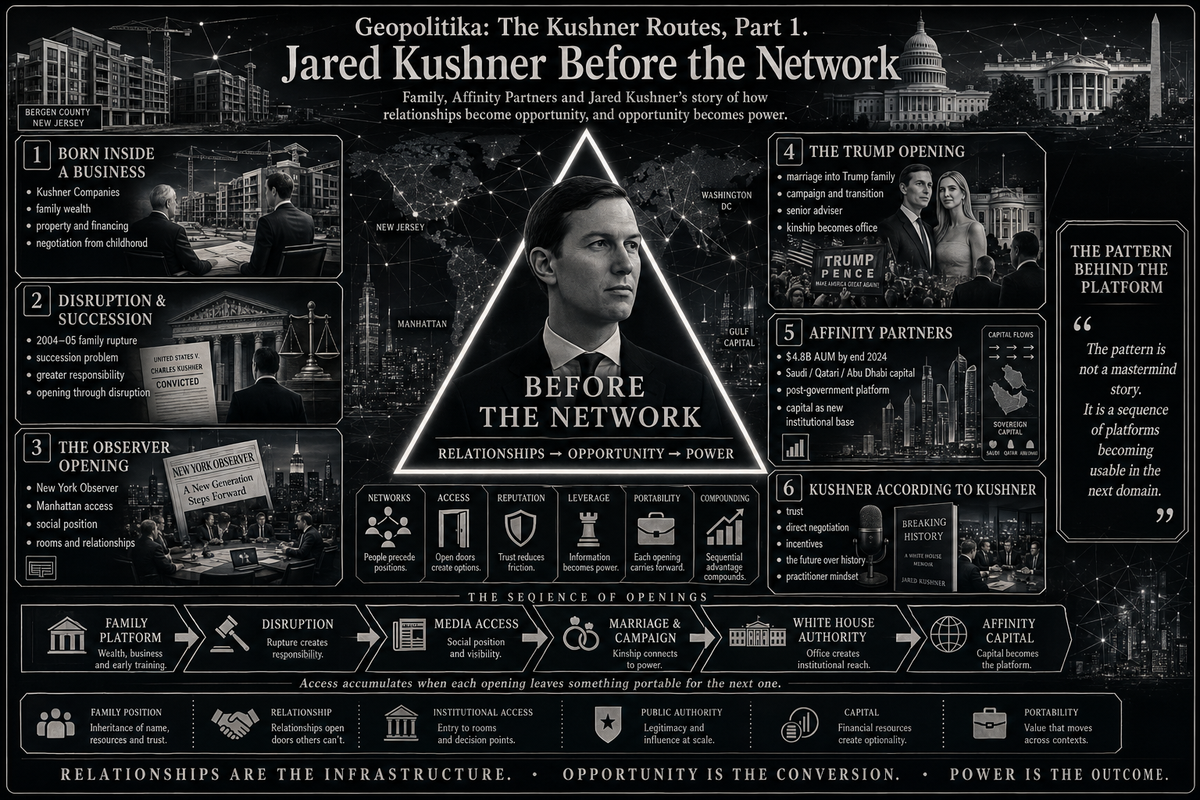
This article is published as part of the Geopolitika project to map Anglo-American power structures by examining their founding mythologies, leadership, linkages to power, public face, the nature of their outputs and who these are directed towards. This series is primarily generated from materials provided on the institution’s own websites, which are analysed using a structured analytic framework—see methodology statement at foot of article.
—
Executive Summary
Jared Kushner has never won elected office, never led a sovereign state and did not come to Washington through the conventional diplomatic or civil-service ladder. Yet his adult career has repeatedly crossed fields that are usually treated as separate: a family property empire, Manhattan media, a presidential campaign, the White House, Middle East diplomacy, Gulf sovereign wealth and private investment. That combination makes him less interesting as a celebrity son-in-law than as a study in how platforms, relationships and capital can accumulate and be redeployed across domains.
This is not a biography of Kushner. Biographies are available elsewhere. What this series offers instead is a structural reading: an analysis of how access, opportunity and institutional position accumulate across a career. It analyses publicly available materials that provide a multifaceted view of his trajectory: the family and business history that preceded Washington; his education and early property and media roles; the criminal case that removed his father from the centre of the family business; his marriage into the Trump family; his public-service and Middle East record; the formation and financing of Affinity Partners; his memoir, speeches and long-form interviews; and later episodes in Albania, the Gulf and Gaza.
This first article asks three narrower questions: where did Kushner come from, what did he build after government, and how does he explain his own way of operating?
The resulting portrait is more contingent than either the “mastermind” or “nepotism” caricature suggests. Family wealth and kinship plainly supplied platforms and access, but evidently not presidential authority, diplomatic agreements or investment decisions. Kushner's own accounts consistently emphasise problems, relationships, trust, direct negotiation, economic incentives and the future rather than inherited disputes. They also repeatedly describe outcomes as emerging through a mixture of deliberate action and circumstance.
Affinity Partners is the institutional expression of his post-government phase: a private investment manager, owned by Kushner, that by the end of 2024 reported $4.8 billion in assets under management and had attracted large commitments from Saudi, Qatari and Abu Dhabi-linked capital. It turned Kushner’s post-government standing into a new institutional platform, while drawing substantial capital from the same broad region in which he had recently operated as an American diplomatic intermediary.
First-person accounts are treated here as evidence of self-presentation, not as complete explanations of events. Financial relationships establish capital, incentives and institutional dependence; they do not by themselves establish purchased policy, corruption or foreign direction. Family relationship explains proximity, not public authority.
Those distinctions matter because the next article asks a harder question: what happens when the relationships, authority and capital accumulated in different phases of Kushner's life begin to interact?
Why Kushner?
The public image of Jared Kushner has always been oddly unstable. In one telling, he is simply a wealthy heir who married the president’s daughter. In another, he is the hidden strategist behind a sprawling political and financial network. Both versions make the same mistake: they begin with the finished picture.
This series reads his career in sequence instead. The relevant pattern is not that every stage was planned in advance, but that Kushner repeatedly entered situations in which an existing platform, relationship or disruption created a new opening. What he retained from one phase—a relationship, reputation, institutional position, knowledge of a principal or access to capital—could remain useful when the next opening appeared.
That is what makes Kushner worth examining structurally. His trajectory is plainly unusual, but it concentrates in one career a set of mechanisms that are often harder to see when dispersed across many actors: family position, institutional access, personal relationships, public authority, reputation and capital becoming portable across domains. His career is therefore useful not because it is typical, but because it makes unusually visible how access accumulates, how opportunities become institutional positions and how assets acquired in one domain can later become useful in another.
It also raises the larger question that runs through this series: whether consequential power has to reside in a single institution or command centre, or whether it can accumulate through relationships, offices, firms and vehicles whose powers remain formally separate but become useful to one another over time. Before examining that network, it is worth starting with the environment in which Kushner first learned to recognise and use openings.
Born Inside A Business
Kushner grew up in Livingston, New Jersey, the eldest son of real-estate developer Charles Kushner and Seryl Kushner. His paternal grandparents were Holocaust survivors who arrived in the United States after the Second World War; his grandfather worked as a carpenter before moving into housebuilding in New Jersey. Charles expanded that base into the business that became Kushner Companies.
Kushner was therefore born not simply into wealth but into the operating environment of a family business. A 2017 Time profile describes him accompanying his father to construction sites and prospective properties while other children went to camps or games. In his later Lex Fridman interview, Kushner similarly recalled being brought into his father’s meetings from an early age. Property, financing, negotiation and the dependence of large projects on counterparties who have to keep saying yes were part of the household before they became professional subjects.
His schooling followed the elite track available to that family. He attended the Modern Orthodox Frisch School, studied government at Harvard University, and then law and business at New York University. Those credentials sat alongside a much older education in family ownership, property and negotiation.
His Jewish upbringing also mattered to the standpoint he would later bring to Middle East politics. His paternal grandparents’ experience as Holocaust survivors, his Modern Orthodox education and his family’s place within American Jewish institutional and philanthropic life formed part of the background from which he later spoke about Jewish vulnerability, Israel and security. The significance of that standpoint becomes clearer in his own later accounts, particularly in the different weight he gives to historical vulnerability, security and competing claims about the past. It should not be confused with the formal authority he acquired only after entering government, nor treated as a sufficient explanation of the positions he later took.
The family structure broke in August 2004 when Charles Kushner pleaded guilty to 18 federal counts involving tax offences, witness retaliation and false statements to the Federal Election Commission. On 4 March 2005, a U.S. Department of Justice sentencing record shows that he was sentenced to 24 months in prison.
The conviction did not create the family business, its money or its connections. It did create a succession problem. Charles could no longer occupy the same position he had held and Jared—then in his mid-twenties—assumed greater responsibility. His first major opening therefore emerged not from a planned expansion but from disruption inside a structure he had inherited.
That distinction introduces a rhythm that recurs later: an existing arrangement changes, a gap opens, and Kushner is already close enough to the assets and decision-makers to move into it.
In 2006, at 25, he made a conspicuous move beyond the family company’s core property business by buying the New York Observer, the small salmon-coloured weekly read by New York’s political, property and media elite. Contemporary reporting put the price at nearly $10 million. In his later memoir, as recounted by Vanity Fair, Kushner described seeing both a digital opportunity and a chance to build useful business relationships.
The purchase is revealing because the asset was small relative to the family property empire but unusually valuable as a social position. The Observer placed a young real-estate heir inside the conversation of Manhattan power and supplied an early example of something that would recur throughout his career: an institution can be valuable not only for what it owns, but for the people, rooms and relationships it makes reachable.
In 2009 Kushner married Ivanka Trump, daughter of Donald Trump. At the time, the marriage connected two New York property families. It did not give Jared Kushner public authority.
That conversion came later.
The Trump Opening
Before 2016, Donald Trump was Kushner’s father-in-law. After Trump became a serious presidential candidate, that family relationship acquired a new use.
Kushner became involved in the campaign, then the transition. When Trump won the presidency, family proximity could be converted into something it had never been before: access to the American executive. Kushner entered the White House as a senior adviser.
That office matters because it separates kinship from authority. Ivanka made Trump family. Trump’s election made him president. Presidential appointment supplied Kushner’s governmental role.
The breadth of that role was extraordinary for someone without prior public office. Among the assignments that became most consequential was Middle East diplomacy. By 2019 Kushner was publicly presenting the administration’s Peace to Prosperity workshop in Bahrain, bringing political officials, businesses, builders, international institutions, investment funds and capital allocators into a programme that treated economic development as part of a route through political conflict.
The same period placed Kushner in direct dealings with leaders who had their own agendas. Benjamin Netanyahu wanted outcomes for Israel. Gulf rulers wanted their own security, economic and regional outcomes. Trump held American presidential authority. Kushner’s usefulness came from operating between principals whose interests could overlap without being identical.
The Abraham Accords became the most visible result of that phase. For the purposes of this first article, the more important consequence is biographical: Kushner left his first period in government with a set of relationships that a New Jersey property heir and newspaper owner would not otherwise have possessed.
Formal office could end. Those relationships did not have to.
Affinity: The Vehicle After Government
When Kushner left the White House in January 2021, he lost the legal authority that came with his government position. He launched Affinity Partners later that year .
That distinction is essential to understanding the firm. Affinity is not a continuation of the White House by another name. It is a private investment manager. Its importance lies in what Kushner chose to build once public office ended and in who chose to supply it with capital.
The regulatory record identifies the adviser under the corporate name A Fin Management LLC. According to a March 2025 Reuters report based on regulatory filings, Kushner was the sole owner. The same filing-based report said Affinity’s assets under management rose from $3 billion at the end of 2023 to $4.8 billion at the end of 2024.
The geography of that capital is central to the firm’s public significance.
Saudi Arabia’s Public Investment Fund invested $2 billion in Affinity, according to congressional investigators cited by Reuters. In 2024, the firm secured another $1.5 billion from two existing investors: the Qatar Investment Authority and Abu Dhabi-based Lunate. Kushner is quoted in an investment podcast saying that the additional capital gave the fund “more firepower” and in another that “the firm’s investment strategies are driven by market opportunities and are not influenced by political considerations.”
Those figures describe an institution, not Kushner’s personal bank account. Assets under management are investor capital entrusted to a manager and deployed through funds and investment vehicles. But the scale matters. Within a few years of leaving government, Kushner had built a platform with several billion dollars under management and unusually large backing from the same broad region in which he had served as a senior American diplomatic intermediary.
That overlap is the fact. Its implications are the subject of Article 2.
For now, the important point is what Affinity changes in Kushner’s history. Until 2021, his major institutional platforms had largely been inherited, purchased or conferred: the family property company, the Observer, the Trump campaign and the White House. Affinity was a post-government platform organised around Kushner himself and his ability to attract outside capital.
It is critical to hold in mind that “Kushner” and “Affinity” are not interchangeable. The 2026 Sazan Island controversy illustrates why. Reporting identifies Kushner as a personal investor in the proposed Albanian resort, while project representatives told Al Jazeera that the development is being led by Sazan Real Estate Development LLC, not Affinity Partners, and that participating investors are acting “in their personal capacity.” Atlantic Incubation Partners, which received strategic-investor status for the project, has nevertheless been reported as linked to Affinity. The project therefore belongs within Kushner’s wider investment and relationship network, but the available evidence does not establish that it is an Affinity-managed asset or that Affinity is acting as investment manager for the participating investors.
The distinction between a person, his firm and a project vehicle is not legalistic clutter. It is how the actual machinery becomes visible.
Kushner According To Kushner
Kushner is not a figure whose conception of himself has to be reconstructed from occasional remarks. He has explained himself at considerable length. Beyond his memoir, he has participated in numerous long-form interviews, podcasts and conference conversations in which he revisits the same episodes, describes how he approaches problems, identifies the qualities he considers decisive and, often, explains why conventional political or institutional actors failed where his own approach succeeded. Taken together, these appearances amount to a substantial corpus of self-interpretation.
Across it, a recognisable explanatory grammar emerges. Difficult political and commercial situations are repeatedly translated into questions of relationships, incentives, counterparties, trust, leverage and execution. Kushner places considerable weight on practitioner knowledge, direct access, personal judgement and demonstrable outcomes, and correspondingly less on inherited process, institutional orthodoxy and historical argument. Problems become tractable when the right people are identified, interests are correctly understood, unnecessary intermediaries are removed and an executable arrangement can be found.
That vocabulary is not politically neutral simply because it presents itself as practical. It determines what counts as relevant knowledge and what can be discounted as impediment. History can become baggage; procedure can become bureaucracy; institutional expertise can become conventional thinking; political disagreement can become a failure to recognise incentives; and questions of legitimacy or representation can recede behind the test of whether an arrangement can be made to work. Kushner’s self-presentations therefore matter not merely as testimony about particular negotiations, but as unusually abundant evidence of the conceptual machinery through which he describes—and legitimates—his own exercise of power.
Opportunity as a habit of seeing
Kushner’s 2022 memoir, Breaking History: A White House Memoir, is a work of self-construction, and that is precisely what makes it useful here. It shows which events he chooses to organise around himself, what forms of agency he emphasises and how he explains the relationship between circumstance and action.
His account of buying the New York Observer offers a compact example. As mentioned above, Kushner described the newspaper as both an asset that could be modernised and a way to build useful relationships. The logic recurs throughout his later political accounts: an apparently entrenched situation contains an opportunity that becomes visible once the right person is close enough to see it, and relationships then create routes that inherited procedures have failed to open.
This is also central to Kushner’s preferred image of himself. He repeatedly casts himself as the outsider who succeeded because he was prepared to ask basic questions, discount orthodoxies that had produced poor results and deal directly with principals. Conventional expertise is often judged by its failures, while practical and business knowledge is validated by outcomes. The comparison is not neutral, but it reveals the role Kushner assigns himself: the practitioner who sees possibilities that established institutions have overlooked.
The future as negotiating ground
At the 2022 Concordia Annual Summit, Kushner condensed the approach into a short formulation:
“Peace is about the future.”
The attraction of that idea is straightforward. Parties trapped in incompatible historical narratives can sometimes make progress only by asking what arrangement each side might accept now. Kushner consistently favours that present-tense bargaining space, in which historical grievance is subordinated to incentives, interests and practical connectivity.
The limitation follows from the same method. A framework designed to escape inherited grievance can also reduce the analytical weight given to the structures that produced the present bargaining position. The long-form 2023 Lex Fridman Podcast interview makes this particularly clear.
Kushner describes private access and discretion as working assets because they allow an intermediary to understand what principals actually need, test proposals and carry possibilities between actors who cannot always state their positions publicly. He also identifies his own standpoint with unusual candour. Discussing the Israeli-Palestinian security question, he says he was “more favorable to Israel’s perspective”, making clear that his account is that of a participant with a defined weighting rather than a detached reconstruction of events.
That admission also gives analytical significance to the biographical standpoint established earlier. Kushner’s Jewish upbringing, his grandparents’ experience of the Holocaust and his familiarity with Israeli security arguments do not by themselves explain his diplomatic positions. They do, however, form part of the historical repertoire through which he makes the conflict intelligible. Jewish vulnerability and Israeli security remain available in his account as historically grounded considerations with present consequences, even as Palestinian historical argument is more readily treated as something negotiation must move beyond.
His treatment of history follows the same pattern. Recalling Palestinian negotiations, Kushner says he wanted a present answer rather than another “history lesson.” Yet history does not disappear from his own reasoning: historical vulnerability, religious attachment and inherited security concerns remain relevant where they help explain present Israeli claims. His pragmatism is therefore better understood as selectively historical than simply anti-historical. The asymmetry lies not in remembering history on one side and forgetting it on the other, but in which histories remain authorised to structure the present. Past claims gain or lose weight according to whether they can be converted into present negotiating variables.
The same conversion occurs with political complexity more broadly. Conflicts become questions of leadership, incentives, investment, governance and implementation; political possibility begins to resemble a business problem in which the task is to identify the interests, find workable counterparties and produce an executable plan. That mode of reasoning can clarify what otherwise appears immovable, but it also tends to privilege forms of power that can be translated into decisions and transactions while giving less attention to power already embedded in territory, military control, legal status or unequal capacity to refuse.
This is why the Lex interview is most useful as evidence of how Kushner makes political problems legible. Its value lies not simply in what he says happened, but in the categories through which he explains why events happened and what kinds of solutions he regards as realistic.
The grammar travels
The same vocabulary remained visible after Kushner left government. In the 2024 Middle East Dialogues at Harvard Kennedy School, he spoke as a former presidential adviser who had become a private investor, yet political questions about the region continued to intersect with development, property, economic potential and the conditions under which investment might become possible.
The significance is not that investment secretly explains his diplomatic positions. It is that Kushner habitually treats economic organisation as part of political problem-solving. That instinct was visible at the Bahrain workshop before Affinity existed and remained visible after he became an investment manager. His institutional role changed, but the underlying grammar persisted: a difficult situation becomes tractable once a relationship reveals an opportunity and that opportunity can be translated into an arrangement capable of execution.
The important question, then, is what happens between recognising such an opportunity and making it real.
From Opportunity To Executable Power
The proposed Albanian resort offers an unusually clear example because here the opportunity story is almost literal.
In the version reported by CNA, Kushner describes a 2021 Mediterranean trip on a friend’s yacht, time in Albania and a later meeting with Prime Minister Edi Rama. Ivanka Trump’s account, reproduced in reporting on the project, is even more accidental in tone: a stop, a swim, a hike and an island they found captivating.
The story also serves Kushner’s preferred self-presentation. It casts the opportunity as contingent and largely apolitical—a chance encounter—while the institutional conversion that followed required state action, strategic-investor status and dedicated project entities. A relationship creates movement, movement produces an encounter, and the encounter reveals an opportunity. But that is only the beginning of the actual power process. A beautiful island cannot classify itself as a strategic investment; a private conversation cannot confer development status; and an investor cannot allocate land, issue permits or convert a proposal into legal rights merely by recognising its potential. Those transformations depend on institutions.
In the Sazan case, at least part of that conversion is already visible. Atlantic Incubation Partners received strategic-investor status for the project, while Sazan Real Estate Development LLC is identified as the entity leading the development. Those facts do not yet explain the complete chain of land rights, approvals, financing, environmental review and state decision-making. They do mark the point at which the opportunity ceases to exist only as a private perception or proposal and enters institutional forms capable of giving it legal and administrative effect.
The distinction is also why Jared Kushner personally and Affinity Partners must remain separate. Reporting identifies Kushner as a personal investor in the Sazan project, while project representatives told Al Jazeera that Sazan Real Estate Development LLC is leading the development and that the participating investors are acting in their personal capacities rather than through Affinity. The project belongs within Kushner’s wider relationship and investment network, but the available evidence does not establish it as an Affinity-managed asset.
What matters for this article is the distance between seeing an opportunity and obtaining the power to execute it. Someone has to convert private interest into strategic-investor status, control access to land, approve development rights, supply or arrange capital, carry the project through legal entities and determine how environmental, legal and public-access objections affect the project once it has become institutionally actionable.
Seen across Kushner’s own accounts, the recurring sequence is:
Relationship → encounter → opportunity → deal-language reframing → managerial solvability → institutional conversion → executable power
The early stages are the ones Kushner narrates most naturally. Relationships create access; access reveals possibilities; and political or commercial difficulties are reframed as questions of incentives, trust, counterparties and execution. The decisive transition comes later, when institutions convert possibility into authority, approvals, financing, legal rights and physical outcomes.
None of those conversions requires Kushner personally to command every institution involved. That is precisely what makes the chain structurally interesting. The question is not where a hidden command centre sits, but how separately held forms of access, authority and capital can become connected in sequence, so that one institution’s output becomes another actor’s usable input.
That is where the opportunity story becomes a power story. It is also where the next articles in this series begin.
The Accumulation Of Options
Read in sequence, Kushner’s career looks less like the execution of a long-term plan than the accumulation of usable positions.
His father’s conviction created an unexpected succession opening inside an existing family platform. The Observer added entry into Manhattan’s media and business conversation. Marriage connected him to the Trump family; the 2016 campaign made that relationship politically useful; and Trump’s victory allowed presidential appointment to convert proximity into public authority. Middle East diplomacy then produced experience and relationships with foreign principals, while leaving office ended the formal mandate without erasing those relationships. Affinity gave Kushner a private institution through which outside capital could be raised and deployed, and later opportunities arrived after that accumulated stock of access, experience and institutional capacity already existed.
The pattern does not require a master plan. It depends on the ability to retain the useful residue of one opening long enough for it to matter in another. That residue might be a relationship, a reputation, knowledge of a principal, familiarity with an institution, a record of having closed a deal, access to capital or an organisational platform capable of carrying the next opportunity.
Over time, successful contingencies can begin to resemble architecture because each leaves behind more options than existed before it. But architecture need not mean central design. An accumulation of options can become structurally powerful even when the institutions that produce them retain different owners, authorities, interests and decision-makers.
This is why neither of the familiar Kushner caricatures is sufficient. “Nepotism” explains an important route into political access but says little about what happened after appointment. “Mastermind” imposes a coherence and prior design that the evidence does not require. A more useful picture is cumulative: Kushner repeatedly enters openings that depend on institutions and principals he does not control, acquires something portable from them, and later encounters situations in which those accumulated assets can be useful again.
The central question is therefore not whether he secretly planned a route from New Jersey real estate to Middle East diplomacy and Gulf-backed investment. It is what becomes possible once enough relationships, experience, reputation and institutional capacity have accumulated.
Conclusion — Before The Network
Jared Kushner begins this series as a person formed by a particular sequence: family property, early exposure to deals, elite education, crisis-driven succession, media ownership, marriage into another business family, presidential politics, direct contact with foreign leaders and, eventually, an investment institution of his own.
His public account of that journey is remarkably consistent. Problems can be reframed, relationships can open routes that formal processes have left blocked, interests can be aligned and economic organisation can make political outcomes appear more practical and durable.
The analysis also reveals the limit of that account. Relationships do not confer governmental authority; ideas do not sign treaties; capital does not grant itself legal rights; investment opportunities do not allocate land; and plans do not implement themselves. Institutions perform those conversions.
Affinity Partners makes the next question unavoidable because it placed a private platform owned by Kushner and backed by billions of dollars of institutional capital alongside relationships and experience accumulated during public service.
This first article has established the man, the vehicle and the operating grammar. Article 2 asks what happens when those elements are placed inside the network of institutions that hold authority, allocate capital, grant access and turn possibilities into outcomes.
Next — The Kushner Routes, Part 2. Power Without a Command Centre
How family access became political authority, diplomacy became durable relationship capital, sovereign money became investment capacity, and a private intermediary became publicly useful again.
—
Published via Mindwars Ghosted.
Geopolitika: Tracing the architecture of power before it becomes the spectacle of history.
Methodology Note: This article draws on the public record assembled for The Kushner Routes: biographical and institutional profiles; U.S. Justice Department records; education and corporate records; investment-adviser and financial disclosures; reporting on Affinity Partners; Kushner’s memoir; long-form interviews and public appearances; official White House material; and reporting used in the Albania investigation. First-person accounts are used as evidence of Kushner’s self-presentation, role perception and description of relationships, not as independent verification of every event or outcome. Financial disclosures are used as evidence of material relationships, incentives, ownership and capital flows; they are not treated as automatic evidence of misconduct, intent, purchased policy or conscious coordination. Family relationships are kept separate from formal public authority, and roles held in different periods are not collapsed into a single continuous mandate. The article does not claim knowledge of private intentions, undisclosed communications or conduct not established in the cited public record. Base analytic outputs are available on request. For methodological details—see the Geopolitika Series Methodological Statement.
Mindwars Ghosted is an independent platform dedicated to exposing elite coordination and narrative engineering behind modern society. The site has free access and is committed to uncompromising free speech, offering deep dives into the mechanisms of control.