Geopolitika: The Kushner Routes, Part 4. The Missing Map
What appears when Kushner’s diplomacy is mapped by who decides, who is represented and who bears the consequences.
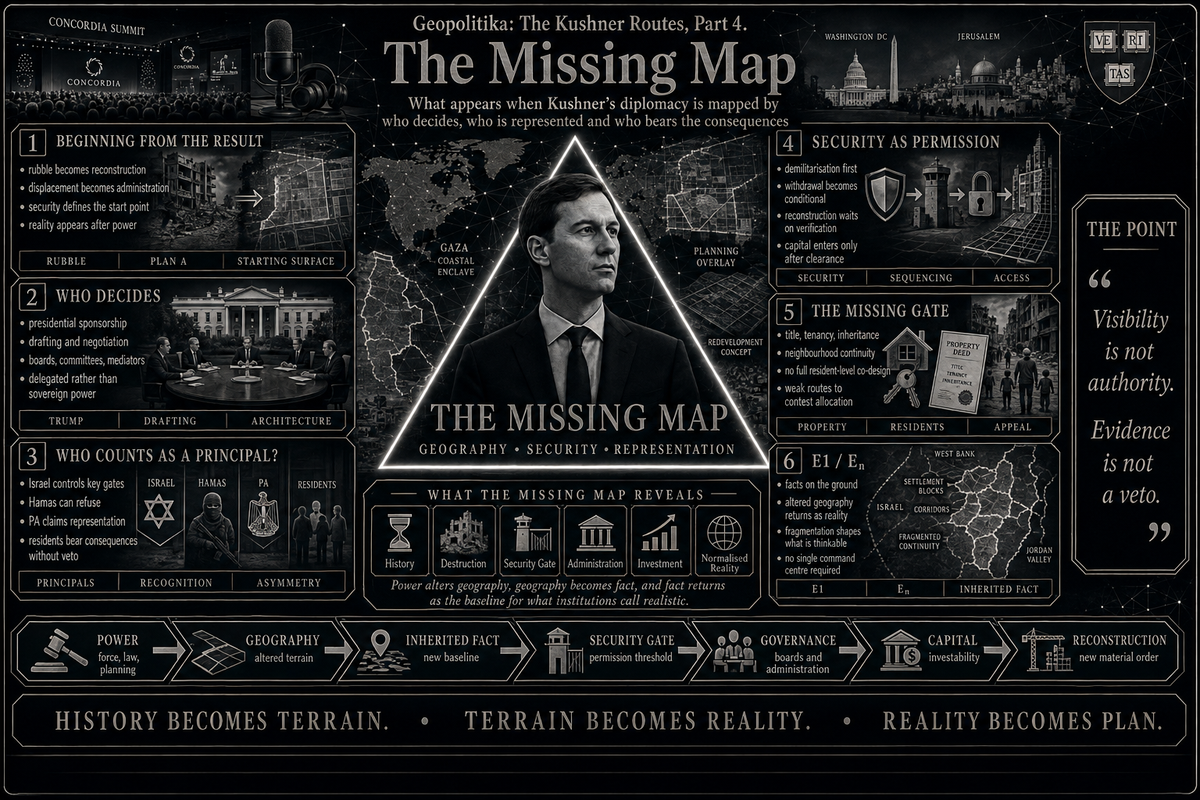
This article is published as part of the Geopolitika project to map structures of power by examining their leadership, institutional position, relationships, public claims, outputs and downstream consequences. The Kushner Routes follows Jared Kushner not as a biography but as a sequence of positions through which family access, public authority, relationships, capital and ideas become usable in different settings. This series is primarily generated from publicly available materials analysed using a structured analytic framework—see methodology statement at foot of article.
—
Executive Summary
Part 1 of The Kushner Routes examined how Jared Kushner accumulated access, relationships and private institutional capacity. Part 2 showed how those assets could connect separately controlled forms of authority without becoming a command system, while Part 3 examined how practitioner experience and deal-making become claims about what is realistic and executable.
Part 4 asks what happens one stage earlier: what if the “facts on the ground” from which Kushner’s realistic politics begins are themselves accumulated products of earlier power?
Palestine supplies an unusually stark case. Francesca Albanese’s 2024 report describes the Nakba as an ongoing process beginning in 1948 and places Gaza’s destruction within a settler-colonial history of displacement, replacement and territorial consolidation. That is Albanese’s interpretation, not the only possible account. Independently, the International Court of Justice concluded in 2024 that Israeli settlement, infrastructure and legal practices have fragmented the occupied Palestinian territory, entrenched Israeli control and been designed to create “irreversible effects on the ground”.
This article takes the Israeli government’s contemporary designation E1 and reverses its apparent historical logic. E1 is an official name for a settlement-development area between East Jerusalem and Maale Adumim; read against a history beginning with the Nakba, that “1” cannot plausibly mark the beginning of the mechanism examined here. Using mathematical notation, “Eₙ” becomes shorthand for an unspecified iteration of a series in which power alters the map, the alteration acquires permanence, and the resulting geography returns to later politics as an inherited fact.
Kushner enters this history at a particular junction. His Gaza Plan A converts a devastated territory into questions of recognised principals, demilitarisation, security, administration, reconstruction and investment. The claim is not that Plan A caused Gaza’s destruction or proves a concealed intention behind the war. It is that Plan A determines how a transformed landscape becomes politically legible: rubble becomes reconstruction, displacement becomes administration and housing, Israeli security becomes an upstream condition, Palestinian civilian security becomes largely a downstream promise, and reconstruction becomes connected to the conditions under which capital can enter.
The missing map therefore asks how accumulated power becomes geography, how geography becomes reality, how classifications determine what counts as a practical problem, and how an architecture designed to make that reality executable can itself shape what later politics is required to accept as normal.
The Map That Shows the Wrong Thing
Political maps are good at showing territory but less effective at showing how territory became what it is. A map of Gaza can identify roads, neighbourhoods and crossings while a redevelopment presentation overlays housing, infrastructure and investment zones; a West Bank map can show settlements, Palestinian towns and E1.
What neither kind necessarily shows is the political history buried inside the lines. A destroyed neighbourhood appears as damaged space after the decisions that produced the destruction recede from view; a settlement appears as geography after the legal and political processes required to establish it become background. Political outputs can acquire the appearance of physical givens.
Part 3 showed Kushner approaching political problems through principals, interests, security requirements, incentives, institutional capacity and executable outcomes. The method asks what can actually be made to happen. Its limitation becomes visible when the reality being made executable is itself an accumulated product of earlier power.
The missing map therefore needs a time axis: not simply who controls which gate now, but how previous decisions produced the terrain on which those gates stand.
1948 → Eₙ: When Power Becomes Geography
The historical counter-map matters because there is more than one place from which the present can be made to begin.
In Genocide as colonial erasure, Francesca Albanese places Palestinian displacement inside a settler-colonial framework in which land is central both to Indigenous self-determination and to territorial acquisition, displacement and replacement. Her report describes the Nakba as “ongoing since 1948” and argues that it accelerated dramatically after October 2023.
That framing is contested, but its analytical significance lies in what it refuses to allow: Gaza cannot simply appear in 2025 or 2026 as a damaged territory awaiting competent reconstruction. Its physical condition is itself placed inside a history requiring explanation.
E1 is misleadingly numbered if read as the first iteration of the mechanism it exemplifies for the purposes of this map. It is the official name of a contemporary Israeli planning project, not the beginning of the territorial process traced here. Read against the history beginning with the Nakba, it is better understood as Eₙ: one more point through which Israeli political power alters geography so that the altered geography becomes a series of facts that later politics inherits and normalises. The notation is schematic; it does not imply identical causes or one continuous command structure.
The International Court of Justice independently anchors that mechanism. Its 2024 advisory opinion described settlements, associated infrastructure, the wall and extensions of Israeli law as entrenching control and producing intended “irreversible effects on the ground”; it also found that these policies fragment Palestinian territory and obstruct self-determination.
Albanese supplies the most explicit historical interpretation used here, but Eₙ does not depend on accepting it in full. A security-state account would describe many interventions through war, deterrence, borders and responses to attack rather than settler colonialism. The systems test survives the disagreement: do exercises of power alter material and legal geography, and do those alterations later return to diplomacy as inherited facts?
Different governments, institutions and movements have pursued different aims across different periods. The point is not to flatten that history into one intention. It is that the output of one political moment can become the apparently given reality of the next.
Stafford Beer’s principle that the purpose of a system is what it does—POSIWID—therefore directs attention from an unprovable common intention to recurring output. If alterations of territory repeatedly constrain the futures regarded as practical at the next stage, the cumulative effect matters whether or not every participant intended the same endpoint.
Kushner arrives very late in this history. But he arrives on a landscape the history has already made.
Plan A: Beginning From the Result
The Gaza architecture begins from the present condition of the territory and asks how that condition can be transformed. That is an understandable starting point for an implementation plan. It is also politically consequential because the choice of starting point determines which questions are treated as operative.
Physical devastation becomes principally a reconstruction problem; mass displacement becomes a question of housing and administration; Hamas becomes principally a security and demilitarisation problem; governance becomes an institutional-design problem; and economic recovery becomes a question of creating conditions under which investment can begin.
In Kushner’s own explanations, these categories fit together. His earlier public discussion of the Israeli-Palestinian conflict gave pronounced weight to Israeli security and to arrangements he regarded as practically achievable. Part 3 traced that grammar through the Concordia, Lex Fridman and Harvard interviews: identify the principals, distinguish the “elephants” from the “rabbits”, move beyond inherited assumptions, align incentives and make the problem executable.
The argument is not that Kushner’s Plan A produced Gaza’s destruction or that Gaza was destroyed in order to enable redevelopment—although the latter has been credibly argued elsewhere. The records forming the core of this series were not selected to test either proposition. The systems question is what happens after destruction has transformed the physical surface on which political action is expected to operate.
Plan A begins from that transformed surface. Rubble becomes reconstruction; displacement becomes administration and housing; governance becomes institutional design; destroyed urban space becomes terrain on which a masterplan can be drawn. The danger is that destruction of the physical order can also abstract from the claims embedded within it—residence, title, tenancy, inheritance, neighbourhood continuity, return and political memory—so that a densely inhabited political geography begins to appear as available planning space.
Plan A therefore does not merely respond to the landscape. It determines how the landscape is made politically legible. Plan A is a premise before it becomes an outcome: the situation is organised through the architecture subsequently presented as its practical solution.
An Architecture in Motion
Plan A itself evolves. The Gaza record now extends beyond speeches and redevelopment visualisations into negotiation, drafting, institutional design and implementation sequencing.
The original 20-point framework has been followed by a more detailed 15-point implementation roadmap. The later roadmap reaffirms rather than replaces the earlier plan and makes Hamas disarmament, Israeli withdrawal, verification, governance transfer and reconstruction mutually consequential stages. By August 2026, the central dispute was sequencing: Israel continued to demand full Hamas demilitarisation before withdrawal and reconstruction, while Hamas conditioned implementation on reciprocal Israeli action. (Reuters, Aug. 17)
The production record is distributed, but Kushner’s role is substantive. In the extended 60 Minutes interview, Steve Witkoff recalled a negotiating session with Kushner and Israeli minister Ron Dermer in which language was being circulated through Qatari intermediaries while “Jared was drafting.” Presidential access, negotiation and textual production briefly occupied the same room. That does not establish that Kushner originated every provision or controlled every participant; it places him materially where bargaining became an artefact capable of structuring what followed.
The same record shows the limit of that conversion power. Plan A has no single implementation switch. Hamas can withhold disarmament; Israel can withhold withdrawal or reconstruction permission; mediators can alter sequencing but cannot independently compel either principal. A highly designed architecture can remain immobilised by powers outside any central command.
Much remains architecture rather than accomplished outcome: full weapons decommissioning, Israeli withdrawal, security deployment, final governance transfer, reconstruction finance, resident-level property mechanisms and the physical redevelopment itself remain incomplete, contested or unresolved.
Who Designs, Who Authorises, Who Administers
Donald Trump is not merely another node in the network described in Part 2. As president, he supplies the American political authority without which Kushner’s personal access does not become state-backed negotiating capacity. Kushner and Witkoff can carry that authority into bargaining and drafting, but it remains delegated rather than sovereign.
The January White House structure separates strategic oversight, Palestinian civil administration and security implementation. The Board of Peace is assigned strategic oversight and resource mobilisation; its founding Executive Board combines senior political and diplomatic actors with figures from international finance and investment. The National Committee for the Administration of Gaza (NCAG), led by Ali Sha’ath, is assigned day-to-day civilian administration, while the International Stabilization Force operates through a separate security route. Kushner sits on both the founding Executive Board and the Gaza Executive Board.
That arrangement does not settle the representation question. The Board’s own report says the NCAG commissioners are Palestinians from Gaza approved by consensus among Palestinian factions, but also that the committee was designed to meet fiduciary and accountability standards required by donors and international partners, with World Bank support. Factional consensus and professional competence can confer acceptance and administrative capacity without amounting to a population mandate. Who selects and can remove the administrators, to whom are they accountable, whose standards define success, and how can Gazans themselves hold them politically answerable?
Office also creates an institutional stake in the architecture that creates the office. That does not show NCAG members will act against Gazan interests or justify imputing private motives. It means Palestinian identity and technical competence do not answer whether administration of Plan A is substituting for political authorship of what Gaza should become. An August 2026 PCPSR survey found only 32 per cent trusted the NCAG and 24 per cent the Board of Peace—evidence of a legitimacy problem, not uniform rejection.
Kushner’s position is revealing because he does not disappear once negotiation becomes institutional design. Having participated materially in bargaining and drafting, he reappears in the strategic tier intended to oversee what follows. His Board membership matters less as evidence of command than as evidence of where he is placed within an architecture he helped produce.
The question is therefore not simply whether Palestinians participate, but which Palestinians are authorised to participate, by whom, at what level and under which accountability regime. Presidential trust becomes negotiating access; access becomes drafting; drafting becomes institutional architecture; and Kushner remains unusually close to the junction at which one form of power becomes usable by another.
Who Gets to Count as a Principal?
Part 3 examined Kushner’s preference for dealing with principals: actors capable of delivering the decision required to move a process. Part 4 adds a prior question: who decides which actors will be recognised as principals in the first place?
Principal status is partly material. Israel is unavoidable because its government and military control decisions indispensable to withdrawal and security. Hamas occupies a radically different legal and political position, yet a process requiring its disarmament cannot erase its capacity to refuse. The Palestinian Authority asserts a representational claim, while regional states can mediate or finance.
But principal status is also recognitional. Sponsors and negotiators determine whom they approach, whose refusal must be accommodated and which identities actors carry into the process. Hamas enters Plan A not simply as a Palestinian political and armed organisation but as a terrorist organisation under U.S. law. The conduct underlying that designation includes attacks on civilians and hostage-taking prohibited by international humanitarian law; yet the ICRC stresses that attacks on lawful military objectives do not become terrorism merely because the organisation carries a terrorist label.
Classification changes political admissibility. The United States is not a neutral tribunal outside the conflict: it sponsors Plan A, has long materially supported Israel’s military and classifies Hamas under its own law. None of that makes prohibited Hamas violence lawful. It means one of Plan A’s starting categories has been produced by a participant in the political field rather than discovered by a neutral authority.
Gaza residents occupy a different position. They are central to the plan’s humanitarian justification, yet having the largest stake does not create principal status. A beneficiary is someone for whom an outcome is said to be beneficial; a principal is someone whose agreement, refusal or recognised representation the architecture must encounter before it can move.
Benjamin Netanyahu makes the tension unusually visible. He is indispensable because Israel controls decisions Plan A cannot implement without it. He is also the prime minister under whose government the campaign producing much of Gaza’s destruction was conducted. In November 2024 the International Criminal Court issued an arrest warrant after finding reasonable grounds to believe Netanyahu bore criminal responsibility for specified war crimes and crimes against humanity committed in connection with Israel’s military campaign in Gaza. Those allegations have not been adjudicated at trial. The effort to pursue international accountability has instead been met by political and legal countermeasures, including U.S. sanctions against ICC personnel and, separately, against UN Special Rapporteur Francesca Albanese under the same ICC-related sanctions regime.
The Kushner and Netanyahu families also have a longstanding personal relationship, while Kushner has acknowledged that his earlier approach was substantially more favourable to Israel’s security perspective. Those facts do not establish Netanyahu’s control over Kushner or make family familiarity a causal explanation of Plan A. They show that identification of “relevant principals” occurs inside existing relationships, classifications and unequal power.
Earlier Kushner routes through Western Sahara and Sudan likewise showed governments capable of exchanging recognition, normalisation or economic concessions while affected populations occupied a less direct place in the bargain. Gaza magnifies that asymmetry because security, administration, property, reconstruction and physical geography are all being reorganised within the same architecture.
The people whose homes and political geography have been transformed do not acquire equivalent decision authority because they bear those consequences.
“There Is No Plan B”
This is where Kushner’s realism becomes agenda power.
At the January 2026 presentation, Kushner described the redevelopment architecture with the assertion, “There is no Plan B.” A month later, at the first Board of Peace meeting, Secretary of State Marco Rubio made the institutional logic explicit: “There is no plan B for Gaza”; Plan A was presented as “the only path forward”, the sole alternative in this construction being a return to war.
The significance lies not in proving that no alternative ideas exist. It lies in the way political alternatives acquire—or fail to acquire—enough institutional backing to count. Plan A is associated with peace, rebuilding and forward movement; the recognised alternative is renewed war. Other architectures—different approaches to security, Palestinian representation, governance, reconstruction, property, restitution or political settlement—are erased from the picture.
That distinction makes the binary stronger. There may be no rival architecture presently possessing the combined backing of the United States, Israel, regional mediators, international institutions and prospective capital required to compete operationally with Plan A. But the absence of comparable institutional traction is not evidence that Plan A and war exhaust the political possibilities. It is evidence of how the distribution of power determines which possibilities become executable enough to count as alternatives at all.
A more fundamental alternative might begin with accountability, return, restitution, Palestinian political authorship, different security premises or a challenge to the territorial facts treated by Plan A as already given. Such alternatives do not become institutionally consequential merely because they exist or because affected people prefer them. They require sufficient power to reopen questions the authorised process has already moved beyond.
“No Plan B” therefore does more than describe the weakness of competing proposals. It converts their lack of institutional power into evidence of their lack of political realism. Actors inside the architecture can modify sequencing and implementation; actors outside it can hold different conceptions of the future without possessing an equivalent route through which those conceptions must be adjudicated.
The question is no longer simply who can produce another plan. It is who has enough power to put the starting assumptions back onto a table from which Plan A has already removed them.
When Security Becomes Permission
The most consequential gate in the Gaza architecture is described simply as “security”, but the apparent neutrality of that word conceals political classifications already made upstream.
In Plan A, the security condition operating upstream is principally Israel’s security, defined through Hamas disarmament, broader Palestinian demilitarisation and verification. Those requirements condition withdrawal, governance transfer, reconstruction and ultimately the point at which capital can enter. The roadmap therefore determines whose armed capacity must disappear before the next political stage becomes permissible.
Hamas emerged decades after the 1948 Nakba and within a geography already shaped by dispossession, occupation, blockade, settlement and territorial transformation. Palestinian resistance occurs inside the geography produced by Eₙ; it does not explain the existence of that geography.
That distinction does not legalise every act committed in the name of resistance. Hamas forces have deliberately attacked civilians, taken hostages and fired indiscriminate rockets, conduct prohibited by international humanitarian law. But the ICRC makes clear that the label attached to an organisation cannot replace analysis of the act itself.
Nor does the designation terrorist organisation arrive from an institution standing outside the conflict. The United States sponsors Plan A, is Israel’s dominant external arms supplier and designates Hamas as terrorist. SIPRI calculates that the United States supplied 68 per cent of Israel’s major-arms imports in 2021–25; all of Israel’s active combat aircraft are U.S.-supplied. Washington also provides a standing baseline of $3.3 billion annually in Foreign Military Financing plus $500 million for missile-defence programmes.
That does not establish American command over Israeli military decisions or make Hamas attacks lawful. It means the state helping to define the security problem is not institutionally equidistant from the actors it classifies: Washington materially sustains much of one side’s superior military capability, designates the principal armed organisation on the other as terrorist, mediates between them and sponsors an architecture in which Palestinian demilitarisation conditions reconstruction.
Nor is Hamas synonymous with Gaza. PCPSR’s August 2026 survey found that only 33 per cent of Gazans identified Hamas as their political preference, yet 62 per cent opposed Hamas disarming before a complete Israeli withdrawal. At the same time, 65 per cent agreed that armed resistance had failed to protect Palestinians or end the occupation and had contributed to Gaza’s destruction, while 61 per cent preferred a two-state solution based on the 1967 borders.
Those results resist simple narratives. A Gazan can oppose Hamas, judge armed resistance strategically disastrous, favour a negotiated state and still oppose disarmament while Israeli forces remain. Plan A compresses distinctions the population itself makes:
support for Hamas ≠ support for armed resistance ≠ opposition to disarmament before withdrawal ≠ support for attacks on civilians ≠ rejection of negotiation
The larger asymmetry is historical and material. Israel exercises overwhelmingly greater military, territorial and institutional power over Gaza and the wider occupied Palestinian territory. The physical landscape on which Plan A operates—the displacement, destroyed housing, infrastructure and rubble—was produced overwhelmingly through Israeli state military power. Article 33 of the Fourth Geneva Convention prohibits collective penalties and punishment of protected persons for offences they did not personally commit.
Plan A consequently does not ask two comparably situated armed actors to become peaceful. It requires the organised armed capacity of the Palestinian side to disappear before reconstruction can fully proceed, while the far greater military capacity of the occupying state remains intact and enters the architecture through the security conditions Israel may demand, withdrawal decisions it controls and verification arrangements through which compliance is judged.
Palestinians living under occupation retain rights to security, dignity and self-determination; those rights do not become conditional merely because of the actions of a particular militant group within their community, whether terrorist-designated or not. Israeli civilians likewise have a right to security, and attacks on them do not become lawful because Palestinians live under occupation. But an architecture that makes Israeli security the prerequisite for rebuilding territory Israel’s military has largely destroyed turns unequal power into unequal priority: the stronger party’s security becomes a condition, while the weaker population’s security and rights become outcomes promised later. That hierarchy is reinforced by the form of the bargain itself. Demilitarisation is concrete, verifiable and difficult to reverse; withdrawal, reconstruction, economic recovery and a future political pathway remain contingent, discretionary performances to be delivered later by Israel, the United States, the Board, donors and other actors whom Gazans do not control.
A Board of Peace official has said that Israel is not expected to make “irreversible moves” on trust before verified performance. The counter-question is why the Palestinian side should accept an irreversible loss of leverage in exchange for promises carrying no iron-clad guarantees and whose fulfilment it has no equivalent power to compel. The June 2026 U.S.–Iran MOU gives that question practical force. Chatham House and RUSI argued that the agreement could function as a pause in which the parties bought time and repositioned themselves rather than as a durable settlement. That does not prove Plan A is secretly designed only to disarm Hamas; it shows why its declared destination cannot itself serve as a guarantee.
Plan A may genuinely seek to exchange demilitarisation for withdrawal, reconstruction and a Palestinian political future. But it can also be read as a pacification architecture whose most concrete early achievement is the reduction of Palestinian coercive capacity while the promised benefits remain contingent. If demilitarisation occurs and those later promises fail, Palestinian leverage remains diminished.
Pacification can therefore become a system output even if the promised political settlement never arrives. The classification problem is who gets to define one form of coercion as the obstacle that must disappear, another as the security capacity whose requirements must be satisfied, and then determine which side must make the irreversible move first.
When Permission Becomes Investability
The security gate leads directly into an economic one.
At the January Board of Peace ceremony, Kushner argued that an economy in which “85% of the GDP of Gaza has been aid” was unsustainable and said Gaza should instead be approached through “free market economy principles”, giving residents the capacity to “thrive and have a good life”.
The criticism of dependency is striking when placed beside the political economy of the state whose security Plan A places upstream. The United States has committed $38 billion in military assistance to Israel for 2019–28, including a baseline $3.3 billion a year in Foreign Military Financing and $500 million annually for missile defence; during the Gaza war Congress appropriated billions more. By contrast, U.S. contributions to UNRWA—the principal humanitarian agency serving Palestinian refugees across Gaza, the West Bank and neighbouring states—were $371 million in 2023 and $121.6 million in 2024 before funding was suspended (note that UNRWA funding serves a population of over 5 million registered refugees across multiple territories). Dependence on external support is therefore not treated consistently as a political pathology: Palestinian reliance on aid is presented as something that dignity and market discipline should replace, while Israeli reliance on sustained U.S. military financing is incorporated into the security order on which that market transition is itself made conditional.
That does not make humanitarian aid and military assistance economically identical. Their purposes, recipients and institutional forms differ. But the contrast exposes a deeper asymmetry in the governing logic: external support is problematised when it sustains Palestinian society, yet normalised when it sustains the coercive capacity of the stronger state.
Kushner’s alternative to aid dependency is therefore not independence from external power so much as a different relationship to it. Gaza is expected to move from humanitarian support towards an economy capable of attracting capital, but access to that capital depends on security, governance and legal conditions defined largely by institutions outside Gaza. Dependency is not abolished; it is reorganised—from humanitarian aid, with its own constraints, to investment, whose conditions are determined by actors and institutions outside Gaza.
The redevelopment architecture consequently moves through a succession of judgments: secure enough → governable enough → legally legible enough → investable enough. Before private capital treats Gaza as an investment proposition, institutions must determine that security, administration, access, property and enforceable rights are sufficiently settled for capital to accept the risk.
The scale makes those judgments material. The reported Project Sunrise proposal put its first decade at about $112.1 billion and projected more than $55 billion in long-run investment returns; later Board reporting estimated recovery and reconstruction needs at $71.4 billion and recorded $17 billion in pledges by mid-2026. These are proposals and pledges rather than completed flows, but they show an architecture intended to convert political stabilisation into a large redevelopment proposition.
In the 60 Minutes conflict-of-interest exchange, Kushner said neither he nor Witkoff would award Gaza contracts or decide who did business there. Yet contract awards are downstream. The White House assigns the Executive Board portfolios including reconstruction, investment attraction, large-scale funding and capital mobilisation, and Kushner sits on both the founding and Gaza Executive Boards. The conflict question therefore exists before procurement.
That overlap is especially consequential because Kushner simultaneously runs Affinity Partners, whose capital has included billions from Saudi, Qatari and Abu Dhabi-linked investors. Reuters reported a $2 billion Saudi commitment and later capital from the Qatar Investment Authority and Abu Dhabi-based Lunate. This does not establish that Gaza policy was designed to enrich Affinity or that sovereign investors control Kushner’s diplomacy.
Kushner’s response is revealing: what critics call conflicts of interest, he told 60 Minutes, he and Witkoff call “experience and trusted relationships.” The same relationship can have dual functionality—diplomatic access in one setting, private economic value in another. Public usefulness does not erase commercial significance; commercial significance does not prove corrupt intent. The structural conflict lies in the overlap itself.
That becomes particularly consequential when reconstruction reaches what used to be somebody’s home.
Residents, Property and the Missing Gate
A redevelopment map can show towers, housing districts, roads and economic zones more easily than it can show the accumulated claims already embedded beneath them.
Property in Gaza is not merely an asset. It contains residence, inheritance, tenancy, family history, neighbourhood continuity, displacement and political meaning. A destroyed building does not erase property claims because it has become rubble; a neighbourhood does not lose its cultural and social significance merely because its physical structures have been erased. Indeed, arguments advanced by Israel itself concerning Jewish historical attachment to the land depend on the same underlying proposition: physical absence, political displacement or subsequent control do not by themselves extinguish historical connection.
This is where the comparison with terra nullius becomes useful, provided its limits remain explicit. Gaza has not been legally declared empty or ownerless territory, and its circumstances are not those of British Australia. The analogy is functional rather than doctrinal. Colonial law in Australia operated for generations while effectively disregarding Indigenous proprietary relationships; The Mabo judgment later rejected that foundational fiction and recognised that prior relationships to land did not disappear simply because another sovereignty had been asserted.
The analogous danger in Gaza emerges after the rubble. If destruction allows prior residence, ownership and social geography to recede from the planning frame, territory can become administratively legible as if newly available for comprehensive redesign. It is not literally empty; it risks being functionally emptied of some of the claims that made the previous geography politically dense.
The displacement record makes that danger harder to treat as hypothetical. Later Plan A materials assure Gazans that they will not be forcibly displaced and present reconstruction as intended to improve life for the existing population. Earlier rhetoric surrounding Trump’s proposed U.S. “takeover” of Gaza contemplated relocation in substantially different terms, while Kushner had separately discussed Gaza’s development potential. The responsible treatment is not to select one period and erase the other: later assurances do not remove the earlier relocation discussion, while the earlier rhetoric does not prove that the later plan secretly preserves an unchanged forced-transfer intention.
The contradiction lies in what reconstruction is understood to restore. One frame treats devastation as a temporary condition from which residents, property claims and political life should be re-established. Another makes comprehensive redevelopment imaginable from a landscape whose urban fabric has already been destroyed. The difference is whether reconstruction carries prior claims into the future or regularises the transformed landscape as the baseline from which the future will be allocated.
The available Plan A record remains incomplete on precisely that issue. It does not establish a comprehensive resident-level co-design mechanism, population-wide appeal structure or complete property-adjudication regime capable of determining title, replacement housing, interim residence and the distributive consequences of redevelopment. That absence should not be exaggerated into a claim that every reconstruction project will dispossess existing owners or that residents possess no political, legal or social means of resistance. The missing gate is more concrete: the institutional infrastructure through which people can establish title, contest decisions, preserve neighbourhood claims, seek remedy and alter the distribution of reconstruction benefits and burdens.
The question is therefore not simply what should be built next, but which rights and claims survive into whatever is built next. Destruction can remove buildings without extinguishing ownership, memory or political attachment; reconstruction can nevertheless convert a transformed landscape into new property, administrative and infrastructural arrangements that later acquire the status of inherited fact.
That is why Albanese’s colonial-erasure counter-frame matters here. Its relevance is not that Gaza has literally become empty land, but that the destruction of a prior order can make its surviving claims easier to subordinate to the institutional logic of the order that replaces it.
This is tighter because it removes the separate “Displacement Contradiction” reset and makes the sequence continuous:
property claims → rubble → administrative legibility → displacement rhetoric → restoration versus regularisation → missing resident-level gate
E1 is Another Eₙ
The Israeli project officially named E1 concerns planned settlement construction between East Jerusalem and Maale Adumim. It has long generated international opposition because development there would further fragment West Bank territorial continuity and make the geographic basis of a Palestinian state connected to East Jerusalem more difficult to realise.
In August 2025, Israeli Finance Minister Bezalel Smotrich described the revived project explicitly as a way to “bury” the idea of a Palestinian state by creating “facts” on the ground. The plan involves more than 3,400 settlement housing units.
Its name supplies the later payoff to the notation introduced at the beginning of this article. E1 is officially E1 because that is the planning designation of this particular project. For the historical counter-map it is another Eₙ, another point at which political action changes the factual geography inherited by subsequent politics.
The ICJ’s analysis makes the cumulative mechanism difficult to dismiss as metaphor. It found that settlement expansion and associated infrastructure fragment Palestinian territory, entrench annexation and create intended irreversible effects that impede Palestinian self-determination.
This does not establish a causal route from Kushner, the Board of Peace or Plan A to E1. Kushner does not control Israeli settlement policy, and Israeli institutions possess decision routes independent of his Gaza architecture. Nor does the evidence support treating Gaza reconstruction and E1 as components of one centrally commanded programme. Their independence is part of the finding.
One route in which Kushner plays a material role preserves a prospective political horizon involving Palestinian self-determination. Another route controlled by Israeli institutions alters the geography from which such an outcome would have to be constructed. The first does not command the second, but the credibility of the first cannot be assessed as though the second did not exist.
E1 therefore belongs in The Missing Map not because it enlarges Kushner’s causal responsibility but because it shows where his conversion power stops. A two-state solution need not be formally abolished in diplomatic language to become progressively less executable in geography. Successive territorial facts can leave the language of two states intact while diminishing the contiguous land from which the second state would have to be made.
The present E1 is not the first E. It is one unusually visible contemporary Eₙ in a process whose previous outputs have already shaped the map on which Plan A operates.
What the Map Cannot Show
There is one final asymmetry in the map, and it is geographical, evidentiary and institutional.
Gaza is not poorly documented. Palestinian journalists and residents, UN agencies, medical workers, humanitarian organisations, legal bodies and international reporters have generated an enormous and contested record. The deeper problem is that the production of evidence and the production of binding decisions occur in different places and carry very different institutional weight.
Presidential authority, strategic planning, negotiations and capital are concentrated largely outside the territory being reorganised. Evidence about what those decisions mean travels in the opposite direction—from homes, hospitals, aid networks, journalists and residents towards governments, boards, courts and global publics. By April 2026, the Committee to Protect Journalists had documented at least 207 Palestinian journalists and media workers killed in Gaza, including 32 cases in which it found evidence of deliberate targeting in direct reprisal for journalistic work. Journalists cannot determine an Israeli withdrawal, disarm Hamas, approve the governing architecture or release reconstruction capital. The map can contain the evidence and still exclude its producers from the architecture that redraws the map.
The same asymmetry appears in the distribution of blocking power. Israel controls decisions indispensable to withdrawal, access and security implementation. Hamas retains a different capacity because disarmament cannot be produced by an institutional chart. Regional mediators matter because they sustain channels between parties unable to reach agreement directly; the Board and related institutions matter where strategic oversight and resource mobilisation are organised; investors can withhold capital if preceding conditions are judged inadequate.
The Palestinian Authority combines a representational claim with far less control over several decisive gates. Gaza residents can organise, resist, document, protest, litigate where routes exist and impose legitimacy costs, but the public architecture establishes no equivalent population-level threshold that must formally be satisfied before Plan A proceeds. Agency can exist without a veto; evidence can be compelling without becoming a decision right; a population can bear the greatest burden without acquiring corresponding authority over whether the architecture advances.
This is where Kushner’s position becomes most revealing. His public explanations are expansive on principals, incentives, security, administrative competence, implementation, reconstruction and investment, but much thinner on resident-level property adjudication, political authorship of redevelopment, rights carried through displacement, mechanisms for rejecting the masterplan itself, or guarantees available if upstream actors fail to perform after demilitarisation.
That silence should not be converted into evidence that Kushner has never considered such questions. It is evidence about the public architecture of his method. Questions become most developed where they can be translated into executable decisions by recognised principals; prior claims, distributive justice and affected-population authority remain less institutionally specified.
The missing map may therefore reflect a boundary of the method itself: what is difficult to translate into a deal, gate, administrator, investor or implementation mechanism is also easier to leave outside the operative frame. Visibility is not authority. Evidence is not a veto.
That conclusion also locates Kushner more precisely. Part 1 asked how relationships become opportunity and opportunity becomes power. Part 2 showed that those conversions depend on institutions whose powers remain their own. Part 3 examined the categories through which Kushner determines what is realistic and which principals can make a solution executable. Part 4 adds the missing upstream condition: the reality being converted at the junction has itself already been produced by earlier power.
Kushner does not command that history, the Israeli state, Hamas, Palestinian society, E1, international institutions or the capital expected eventually to enter reconstruction. His significance lies elsewhere: he repeatedly occupies positions where conditions produced by separately controlled actors can be translated into problems recognised principals and institutions can act upon.
Presidential trust becomes access; access becomes drafting; drafting becomes institutional architecture; security becomes a gate; governance becomes a vehicle; reconstruction becomes a project; capital becomes an implementation route. Kushner’s method is intensely attentive to what can be done next.
The missing map asks what disappears when the conditions determining “next” are treated as given. It therefore contains both material and classificatory power: the power to alter the terrain, and the power to determine what the actors inhabiting that altered terrain will subsequently be called, which of their capacities are legitimate, and which must disappear before politics can resume.
The Facts on the Ground
Part 3 asked how Kushner decides what is realistic. Part 4 has asked where that realism begins.
In Palestine, the answer cannot be separated from the production of the landscape itself. Eₙ matters because outcomes of earlier power can cease to look like outcomes and begin to look like the environment within which responsible politics must operate.
Kushner’s particular skill is making such environments executable. He does not need to command the processes that produced the terrain in order to identify the actors who can move it, the security thresholds that can unlock it, the administrators who can govern it or the capital that may rebuild it. That is why the method is powerful—and why its starting assumptions matter.
The rubble makes the problem tangible. Physical destruction does not extinguish histories, rights or political claims, yet an architecture organised around what can now be secured, administered, financed and built can begin as though the operative question is simply what should occupy the space next. The terra nullius analogy belongs there: not because Gaza has legally become empty land, but because destroyed political geography can become administratively available while embedded claims struggle to regain equivalent weight.
E1 shows the same temporal problem outside Gaza. While Plan A seeks to stabilise one transformed Palestinian geography, an independently controlled Israeli route continues producing territorial facts elsewhere. The routes need not be centrally coordinated for their effects to bear on Palestinian self-determination.
The harder finding is therefore not simply that yesterday’s power becomes today’s reality. It is that history can disappear again once its outcomes become administratively workable. A changed distribution of land, security, property or authority can cease to appear as the result of coercion and begin to appear as the sensible baseline from which implementation proceeds.
If Palestinian demilitarisation becomes durable while withdrawal, reconstruction or political autonomy remain contingent, the altered distribution of leverage survives any failure of the agreement. If redevelopment proceeds without strong routes for prior claims to constrain it, the reconstructed city can embody decisions that later negotiators inherit as facts.
The missing map therefore ends with a different question: who has enough power to stop an inherited reality from becoming normal simply because it has been made workable?
Kushner’s method begins from what is there and asks how to make it executable. The Missing Map asks what becomes permanent in the act of making it work.
Next — The Kushner Routes, Part 5: The View From the Junction
What Jared Kushner reveals about how power moves — and who remains outside the frame.
—
Methodology Note: This article draws on the public record assembled for The Kushner Routes, particularly later Gaza negotiation, governance and redevelopment material, Kushner’s public explanations of his method and external legal and historical sources used to test the assumptions through which contemporary political geography becomes politically legible. Eₙ is an analytical device, not a claim that Israeli policy since 1948 constitutes one continuously commanded plan. It takes contemporary E1 and reverses its apparent temporal implication: E1 is treated as one late visible instance of a mechanism through which territorial, military, legal or infrastructural outputs can become inherited factual inputs. Albanese’s “ongoing Nakba” and settler-colonial interpretation is a substantive counter-frame; the ICJ’s 2024 advisory opinion separately anchors findings concerning settlement, fragmentation, annexation, irreversible effects and Palestinian self-determination. POSIWID examines recurring outputs rather than hidden intention. The argument does not require that Gaza was destroyed to enable Plan A, that Kushner controls Israeli settlement policy, or that Gaza reconstruction and E1 form one coordinated programme. The terra nullius comparison is functional rather than doctrinal: Gaza has not been legally declared ownerless land; the analogy concerns the risk that destruction can render a dense geography of residence, property and political claim administratively legible as apparently available planning space. Proposed institutions and outcomes are distinguished from completed implementation; security deployment, governance transfer, financing, resident consultation and appeal mechanisms, property allocation and realised redevelopment remain incomplete or contested. Domestic terrorist designations are distinguished from international humanitarian law. Prohibited attacks on civilians, hostage-taking, indiscriminate violence and collective punishment remain prohibited irrespective of whether the perpetrator is a state or non-state actor. U.S. military sponsorship does not establish U.S. command over Israeli operations; Hamas’s political support does not make Gazans collectively responsible for its acts. The Iran MOU is used only as a bounded comparator for the difference between written reciprocity and enforceable performance, not as proof of concealed intent in Plan A. Kushner’s role is rendered as substantive negotiation, drafting and strategic participation, not sole authorship or command. The overlap between his diplomatic relationships, Board responsibilities and Affinity Partners’ sovereign-backed capital is treated as a structural conflict-of-interest problem, not evidence of quid pro quo or private-profit causation. Earlier relocation rhetoric and later no-displacement assurances remain periodised; the ICC allegations against Netanyahu have not been adjudicated at trial. The article’s claim is narrower: the realities through which practical politics operates have histories, and institutions that make those realities executable can become part of the history inherited by what comes next. For methodological details—see the Geopolitika Series Methodological Statement.
Mindwars Ghosted is an independent platform dedicated to exposing elite coordination and narrative engineering behind modern society. The site has free access and is committed to uncompromising free speech, offering deep dives into the mechanisms of control.