Geopolitika: Mapping Power – Part 4. Immobilisation
The people who cannot leave.
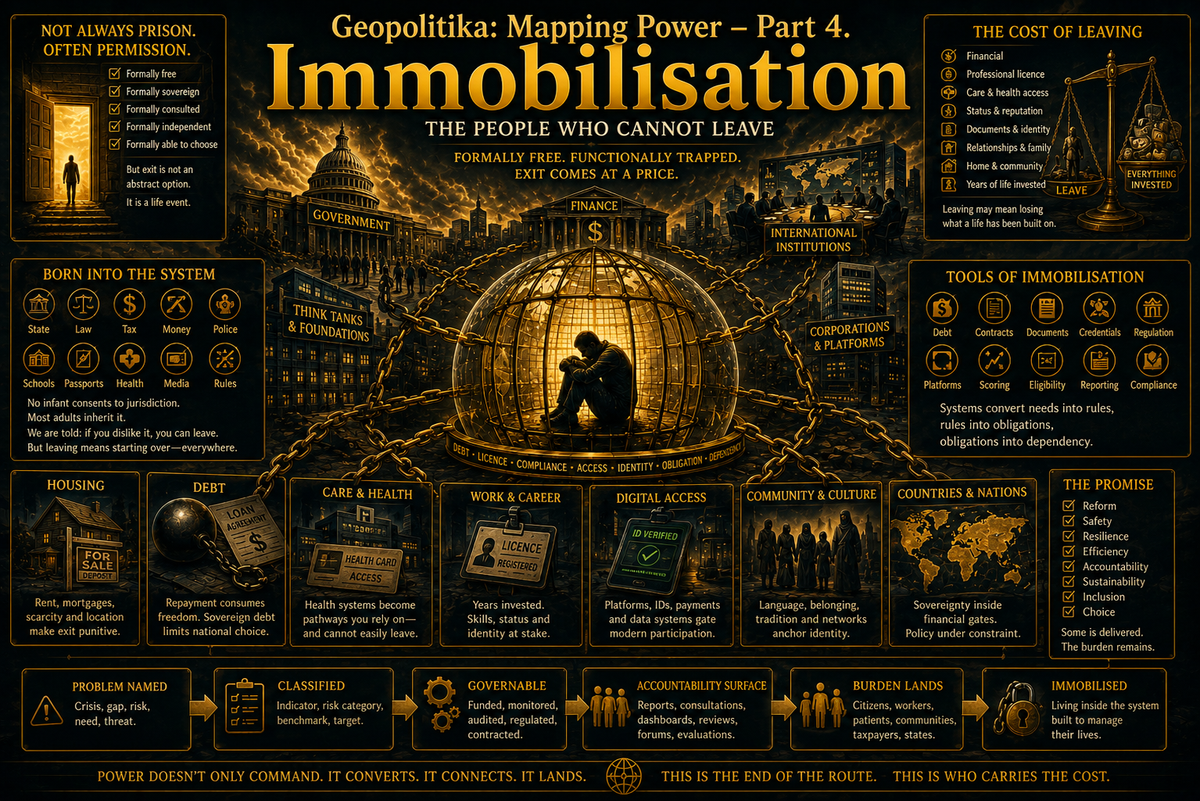
Part 1 of this series looked at power through absence: the missing geographies, missing donors, unnamed beneficiaries, and missing linkages that make the institutional record partial. Part 2 looked at handoffs: the points where power changes form as it moves from one institution to another. Part 3 looked at switchboards: the people, boards, forums, regulators, secretariats, civic offices, professional bodies, and programme teams that carry authority across boundaries and make those handoffs reliable.
Part 4 asks what happens at the end of the route. Every absence hides someone. Every handoff lands somewhere. Every switchboard has an endpoint. The question is not only who funds, who frames, who convenes, who regulates, or who coordinates. The question is who has to live inside the systems those processes create.
That is the subject of this article: immobilisation.
Immobilisation is the condition of being unable to leave a system without serious loss. That loss may be financial, professional, legal, social, emotional, familial, communal, bodily, reputational, or existential. It may involve money, licence, care, status, documents, credentials, access, home, language, identity, relationships, accumulated labour, or years of life already invested.
It does not always look like imprisonment. Often it looks like ordinary dependence: a licence, a credential, a debt term, a payment rail, a reporting duty, a professional standard, a platform account, a procurement contract, an eligibility rule, a behavioural diagnosis, an access gate, a family obligation, a local community, a mortgage, a school, a clinic, a career, or a country.
The person remains formally free. The institution remains formally sovereign. The community remains formally consulted. The worker remains formally able to choose. The professional remains formally independent. The citizen remains formally represented.
But exit is not an abstract option. It is a life event.
Leaving may mean losing livelihood, reputation, home, language, family proximity, community standing, professional identity, care pathways, educational continuity, legal status, accumulated credentials, pension rights, social recognition, or the only system one knows how to navigate.
That is where the map becomes human.
This article is dedicated to the receiving end: the people, institutions and places that may be formally included, served, protected, consulted, modernised, financed, represented, or governed, but cannot easily refuse the system built around them.
Immobilisation by design
Immobilisation is not always a malfunction. In many systems, it is part of the structure.
Citizenship is the deepest example. Most people are born into a state, a legal order, a tax system, a monetary system, a school system, a policing system, a passport regime and a body of laws before they can understand any of them. Later, this arrangement is described as a social contract.
But the social contract is not a contract in any ordinary sense. It is a fiction of legitimacy. No infant consents to jurisdiction. Most adults never consciously give informed consent to the total structure that governs them. They inherit it, depend on it, and are told that if they dislike it, they can leave.
Some do leave. Emigration is real, and immigrants often consent more formally than native-born citizens ever do. They apply, sign forms, meet entry conditions, accept visa rules, swear oaths, pass tests, pay fees, and knowingly exchange one jurisdiction for another. In that sense, immigration can involve a more conscious act of consent than birth citizenship.
But it is still not exit from the structure. It is movement between structures. The destination has its own laws, taxes, documents, police, schools, medical systems, labour rules, housing markets, cultural codes, speech boundaries, professional gates, immigration controls and conditions of residence. The immigrant may consent to these more explicitly, but the choice is still made under constraint: one must be admissible somewhere, able to afford movement, able to qualify, able to adapt, and willing to accept the losses that departure imposes.
Leaving a country is therefore not like leaving a club. It is movement between gates. Citizenship is not only a status. It is a jurisdictional enclosure around ordinary life.
The same pattern appears in housing. The renter is formally free to move, but deposits, rent inflation, local scarcity, employment location, school zones, family commitments and moving costs can make exit punitive. The mortgage holder is formally an owner, but debt, interest rates, insurance, maintenance, local property markets and family dependence can turn ownership into another form of attachment. Home becomes shelter, identity, investment, liability and trap at the same time.
Debt works in a similar way. Personal debt narrows choice through repayment. Mortgage debt ties decades of life to income, interest rates and asset values. Sovereign debt does the same at national scale. A state may be formally sovereign, but if its currency, credit rating, imports, fiscal capacity and access to capital depend on lender confidence, then sovereignty operates inside a financial gate. IMF and World Bank programmes make this visible, but the deeper structure is broader: modern monetary and development systems often make debt not an exception, but an operating condition.
Careers create another form of immobilisation. A profession may be entered voluntarily, but once someone has spent years acquiring qualifications, paying education costs, building a reputation, gaining registration and organising family life, housing and debt around that occupation, exit becomes expensive. The professional is free to leave in theory. In practice, leaving may mean abandoning sunk time, identity, income, status, pension rights, networks and a life built around recognition by the gate.
These are not marginal cases. They are ordinary systems.
Citizenship, housing, debt, careers, professional registration and family life all create attachments that make people governable through the cost of leaving. Some of those attachments are necessary. Some are chosen. Some are beneficial. But they also create leverage.
Immobilisation is therefore not only something imposed from outside. It is built into the architecture of normal life: the passport, the lease, the mortgage, the loan, the licence, the credential, the registration, the family obligation, the local school, the professional pathway, the currency, the tax record and the state.
The system does not have to forbid exit. It only has to make life depend on staying.
Immobilisation In Practice
In cataloguing more than 1,500 institutions across states, foundations, banks, universities, regulators, professional bodies, think tanks, security organisations, development agencies, corporate platforms, philanthropic networks, civic offices and international bodies, one pattern appears again and again.
Modern power rarely immobilises named individuals one by one. It immobilises categories. Debtor populations. Licensed professionals. Registered patients. Credentialed workers. Platform users. Benefit recipients. Farmers. Students. Migrants. Homeowners. Renters. Taxpayers. Citizens. Target communities. Risk groups. Vulnerable populations. Developing states. Strategic regions. Eligible applicants. Non-compliant actors. Recognised stakeholders.
These categories are not just descriptive. They are administrative positions.
Once a population has been named, it can be measured. Once measured, it can be classified. Once classified, it can be funded, monitored, disciplined, supported, insured, excluded, included, reformed or governed.
The pattern is visible in sovereign debt. A country may remain formally sovereign, but once it is classified as distressed, unstable, high-risk, reform-deficient or in need of assistance, its population becomes subject to decisions made through creditors, lenders, ratings agencies, finance ministries, central banks and international programmes. The category is not “people who personally borrowed money.” It is a debtor population. The cost of adjustment is distributed across wages, prices, public services, taxes, subsidies, pensions, infrastructure and future policy space.
It is visible in professional regulation. A doctor, psychologist, lawyer or dentist is not usually governed as a private individual, but as a member of a licensed category. The professional must remain registered, current, compliant, insured, supervised, credentialed and recognisable to the gate. Again, the issue is not that standards are automatically illegitimate. The issue is that recognition becomes conditional on remaining inside the category’s governing architecture. To leave the standard may mean leaving the profession.
It is visible in agricultural and development systems. A farmer may appear as an individual chooser in a market, but the institutional category is different: smallholder, beneficiary, food-security subject, climate-resilience participant, certified producer, credit recipient or development target. Once the category is built, inputs, credit, buyers, data, insurance, subsidy, certification and training can be routed through it. The farmer is not physically trapped. But market access, finance and legitimacy may increasingly depend on remaining legible to the programme.
The same logic appears in digital identity, platform access, public-health pathways, migrant administration, housing finance, welfare eligibility and philanthropic inclusion. The system names a population, builds a category around it, attaches conditions to that category, and then treats those conditions as ordinary administration.
That is the recurring architecture. Across the institutional record, the same sequence appears in different forms: a problem is named, a category is created, a standard is introduced, a programme is funded, a gate is built, a dependency forms, and a review process keeps the category inside the frame.
In one domain, this looks like fiscal discipline. In another, professional regulation. In another, digital identity. In another, platform access. In another, medical guidance. In another, development assistance. In another, security compliance. In another, philanthropic inclusion.
The language changes. The structure persists.
The Problem Of Consent
There is an obvious objection here.
If you want to be a doctor, lawyer, dentist, psychologist, teacher, pilot or engineer, then you have to accept the standards of that profession. If you want to remain registered, you have to keep up with the rules. If you want to use the system, you have to accept its conditions.
That objection is partly right. Standards are not automatically oppressive. A society can reasonably require competence, ethics, safety and accountability from people who hold specialised powers over others. Patients need protection from bad doctors. Clients need protection from bad lawyers. Children need protection from bad teachers. Buildings, bridges, medicines, aircraft and financial systems cannot be governed by private preference alone.
So the issue is not whether conditions exist. The issue is what kind of consent those conditions assume, and what happens when refusal is no longer practical. At the individual level, this is already difficult. A professional may choose to enter a field, but that choice becomes more complicated once years of training, debt, status, livelihood, identity and public usefulness are tied to continued recognition by the gate. “Accept the conditions or leave” sounds simple only if leaving does not destroy the life built around entry.
But the deeper problem is collective. How does an individual consent to a sovereign debt incurred in their name? How does a community consent to trade rules agreed through a treaty process it barely sees? How does a population consent to monetary arrangements, alliance commitments, security doctrines, development frameworks, sanctions regimes, procurement systems, digital identity infrastructure, or a war entered by the state that claims to represent it?
This is where immobilisation moves from personal dependency to political condition. Most people do not choose the legal order into which they are born. They are assigned a state, a territory, a monetary system, a tax system, an education system, a policing system, a passport regime, a professional order, a treaty environment and a body of laws before they can understand any of them. Later, this arrangement is described as a social contract.
But the social contract is not a contract in any ordinary sense. It is a fiction of legitimacy. It performs a role similar to the older doctrine of divine right. Divine right explained why kings could rule by locating authority in God, lineage and sacred order. The social contract explains why modern states can rule by locating authority in presumed consent, citizenship and membership of the polity.
The formula changed. The function remained. Rule comes first. The story of rightful rule comes after.
This does not necessarily mean all law is illegitimate, or that society can exist without binding rules—much as one might debate the legitimacy of how the power to set those rules came to be. It means the language of consent is often too thin for the reality of governance. Most citizens never consciously give informed consent to the full structure that governs them. They inherit it. They are educated inside it. They are taxed by it, policed by it, documented by it, conscripted into its categories, and judged by it.
And the subjects most affected are often not visible as decision-makers at all. They appear as debtor populations, target communities, vulnerable groups, strategic regions, developing states, border populations, benefit recipients, licensed professionals, registered patients, platform users, migrant categories, security risks, non-compliant actors, or recognised stakeholders. These are the people and places that appear in the absent geographies: named as objects of policy, finance, security, reform, development or protection, but rarely present as authors of the systems acting upon them.
The answer is usually: if you do not like it, leave. But leaving is itself permissioned. One must have money, documents, destination rights, language, health, family flexibility, employability, legal status and somewhere else willing to receive them. Some people do leave, and immigrants often consent more formally than native-born citizens ever do. They apply, sign forms, accept visa rules, meet entry conditions, pay fees, swear oaths and knowingly exchange one jurisdiction for another.
But this is still not exit from the structure. It is movement between structures. The destination has its own laws, taxes, police, schools, medical systems, labour rules, housing markets, speech boundaries, professional gates, immigration controls and conditions of residence. The immigrant may consent more explicitly, but only does so as a condition of entry.
That gap is fundamental.
Immobilisation begins where a system says “you are free to leave,” while every available exit is costly, conditional, collective, or controlled by another system.
What the map shows
This series began with absence. Across the organisations analysed across the wider Geopolitika project, the same picture keeps emerging. Power does not usually appear as a single command centre. It appears as an architecture of permission.
A foundation funds a programme. A think tank frames a problem. A regulator sets a standard. A professional body defines recognition. A lender imposes conditions. A platform controls access. A secretariat keeps the process moving. A civic office gives inherited power a constitutional face. A donor framework turns need into indicators. A procurement system turns public capacity into vendor dependence.
None of these steps has to contain the whole system. That is the point. Each organisation may describe its own role as narrow, technical, beneficial, necessary, charitable, advisory, protective or administrative. Many of those descriptions may be partly true. But when the organisations are read together, the pattern becomes harder to ignore.
People, institutions and places remain formally free. They may be consulted, included, supported, protected, modernised, financed, represented or served. But they are increasingly positioned inside systems where meaningful exit requires money, recognition, licence, credential, status, data access, platform access, creditor agreement, institutional approval, destination rights or behavioural compliance.
That is immobilisation.
It is not always imposed by force. Often it is built through dependency, maintained through procedure, justified through protection, softened through inclusion and normalised through repetition.
The deepest question is therefore not only who governs.
It is who can refuse.
- Can the person leave without losing livelihood, care, status, family, community or recognition?
- Can the institution leave without losing funding, legitimacy, infrastructure or operating capacity?
- Can the community leave without being treated as backward, obstructive, risky or ungrateful?
- Can the population leave a debt, treaty, war, alliance, monetary system or legal order entered in its name?
If refusal is survivable, the system may be demanding but not immobilising. If refusal is ruinous, the map has reached its endpoint. Power has become a gate. And someone has to live on the wrong side of it.
Published via Mindwars Ghosted.
Geopolitika: Tracing the architecture of power before it becomes the spectacle of history.