Geopolitika: Mapping Power – Part 2. The Handoffs
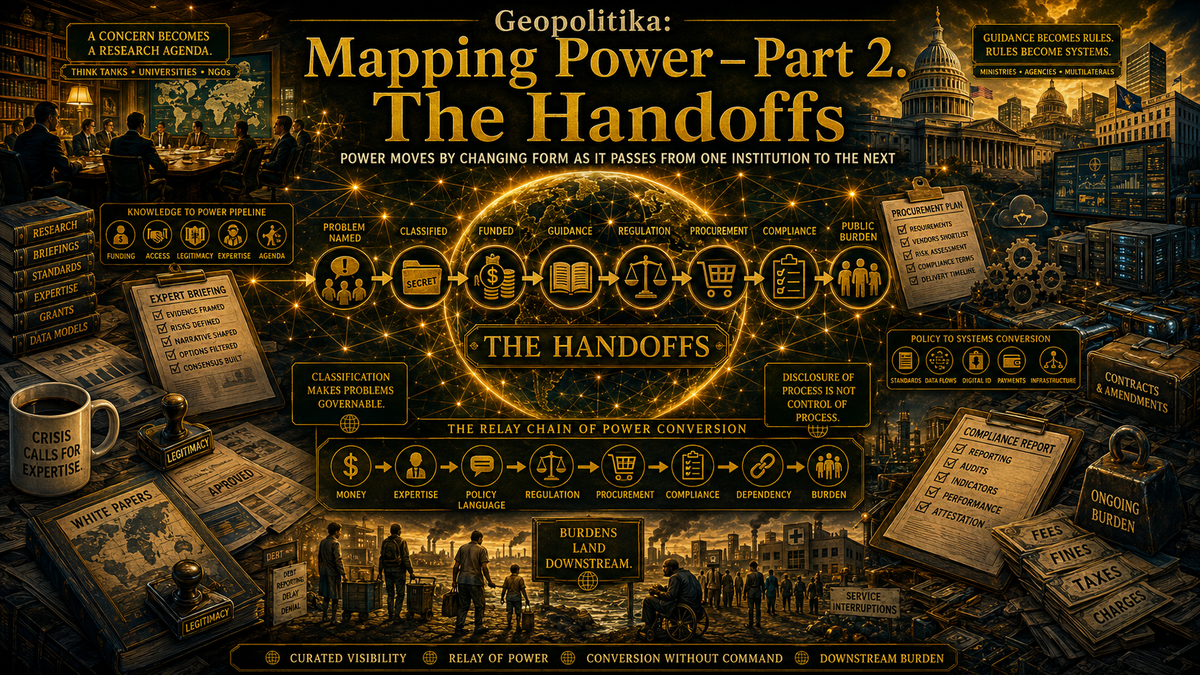
A handoff is the point where one kind of power becomes another.
In Part 1 of this series, I looked at institutional power through what was missing: absent geographies, missing donors, unnamed beneficiaries, and the people who appear only at the edge of the record.
The point was not that everything is hidden. In many cases, institutions disclose quite a lot. They name partners, publish reports, list donors, release accounts, cite affected communities, and describe accountability processes. But the disclosures often stop short of the connective tissue. We can see pieces of the system, but not always the full pathway from benefit to burden. Visibility becomes something that is curated—if not by intent, then by effect.
This second article looks at what happens after that. If Part 1 asked where the map goes quiet, Part 2 asks how power keeps moving through the quiet.
The useful word here is handoff.
A handoff is the point where one kind of power becomes another. Money becomes expertise. Expertise becomes policy language. Policy language becomes regulation or procurement. Regulation becomes compliance. Compliance becomes market structure. Market structure becomes dependency. Dependency becomes public burden.
This does not require a secret order or a single controlling actor. A donor does not need to write legislation if a funded research world can turn donor priorities into serious policy language. A corporation does not need to govern directly if its products become infrastructure that public systems depend on. A multilateral organisation does not need to command a ministry if indicators, reviews, loans, reporting frameworks, and technical assistance define what “responsible governance” looks like.
The handoff is a conversion, not necessarily an instruction. That distinction matters. Public debate often gets trapped between two bad options. Either institutions are treated as neutral bodies simply doing their stated jobs, or they are imagined as pieces of one hidden command structure. The institutional record suggests something more ordinary and more durable.
Power often moves because different institutions are good at different conversions. One actor funds. Another researches. Another convenes. Another writes guidance. Another sets a standard. Another builds the system. Another enforces eligibility. Another carries the cost. No single step has to contain the whole architecture for the architecture to work.
That is the layer this article examines: not who commands the whole system, but how power changes form as it passes from one institution to the next.
The basic relay
The handoff usually begins with a problem:
A crisis is named. A gap is identified. A threat is framed. A development need, health risk, market failure, security concern, sustainability problem, or capacity deficit is made visible.
That visibility matters. Once a problem has been named, it can be classified. It becomes an indicator, a risk category, a benchmark, a target, a review finding, a compliance issue, or a procurement need.
Once classified, it becomes governable. It can be funded, monitored, audited, regulated, contracted, insured, reported, reviewed, priced, or built into a digital system. It can be placed into grant cycles, dashboards, loan conditions, public-private partnerships, procurement pipelines, standards regimes, or implementation plans.
Then an accountability surface appears. There are consultations, annual reports, transparency pages, evaluations, grievance mechanisms, stakeholder forums, sustainability disclosures, dashboards, and lessons-learned documents. These are not fake. They may record real activity and real institutional effort.
But they often account for the process without giving control over the process to the people most affected by it.
Finally, the burden lands downstream. The debtor population receives fiscal discipline. The farmer receives input dependency. The ministry receives reporting obligations. The patient receives programme logic. The consumer receives market structure. The taxpayer receives rescue costs. The worker receives restructuring. The public receives necessity.
The handoff chain does not need to be malicious to be powerful. It only needs to be repeatable. After enough repetition, the relay begins to feel natural. Crisis calls for expertise. Expertise produces classification. Classification calls for management. Management calls for funding, compliance, procurement, review, or infrastructure. The people at the end of the chain are told they are receiving reform, safety, resilience, efficiency, accountability, sustainability, inclusion, or choice.
They may receive some of those things. They also receive the burden of living inside the system built to deliver them.
Where the relay appears
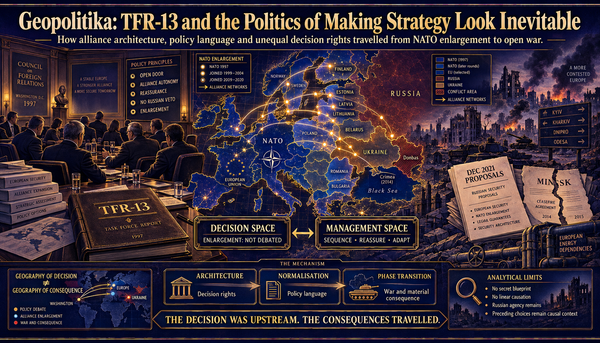
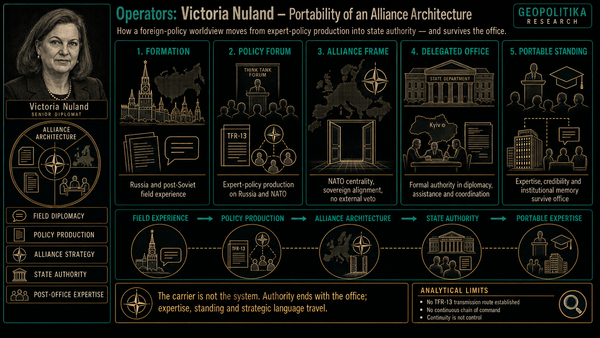
The same relay appears in different forms across the institutional record. In the policy world, it often begins with research. A concern held by donors, officials, companies, or elite networks becomes a research agenda. The research agenda becomes a report, briefing, task force, op-ed, conference panel, or expert quote. That language then travels into hearings, ministries, media debates, strategy documents, grant programmes, and procurement plans.
The think tank does not need to govern directly. Its power lies in making certain options sound serious before the public has fully noticed that the menu has been narrowed.
In finance and development, the relay often begins with instability. A country faces debt stress, inflation, currency pressure, weak growth, fiscal crisis, or investment risk. The problem is translated into the language of sustainability, reform, credibility, resilience, market confidence, or governance capacity. From there, it can become loan conditions, surveillance, review cycles, fiscal rules, spending limits, restructuring terms, or technical assistance.
The result may be described as responsible management. It may also mean that the social cost of adjustment is carried by people who had little say in designing the adjustment path.
In corporate and platform systems, the relay begins with public need. A society needs food, medicine, logistics, cloud capacity, digital identity, payments, energy, cybersecurity, media infrastructure, educational tools, or behavioural data. Private actors provide the tools. Over time, those tools become the operating environment. Public agencies, workers, consumers, farmers, patients, schools, and communities then depend on systems they do not control.
The company does not have to “take over” the state. It only has to become the infrastructure through which the state, market, or profession functions.
In health and behavioural governance, the relay can become more intimate. A risk is identified. Experts define a threshold. Authorities issue guidance. Procurement supplies the tools. Platforms, employers, schools, professional bodies, or service providers turn the guidance into access conditions. Behaviour is monitored, nudged, scored, or corrected.
The language is protection, safety, trust, public health, inclusion, or evidence. The practical effect may be that ordinary activity becomes conditional on passing through a system of permission.
These examples are different, but the movement is similar. A problem is translated into a form that another institution can use. The translation may be reasonable. It may even solve part of the problem. But it also moves authority away from public argument and into systems of classification, funding, compliance, procurement, and access.
That is the handoff.
Alignment without command
The strongest conclusion from the handoff layer is not that one actor commands the system. It is almost the opposite. The system is powerful because it does not need one actor to command it.
Different institutions do different jobs. A foundation funds. A think tank translates. A regulator standardises. A company supplies. A bank prices risk. A professional body controls recognition. A media outlet makes the language familiar. A public agency implements.
Each actor can describe its role narrowly and often sincerely. The foundation is supporting research. The think tank is producing analysis. The regulator is protecting standards. The company is solving a problem. The bank is managing risk. The agency is following procedure.
But the outputs fit together. A funded project becomes a report. A report becomes a policy frame. A policy frame becomes guidance. Guidance becomes a standard. A standard becomes procurement. Procurement becomes infrastructure. Infrastructure becomes dependency. This is alignment without command.
Bad analysis often looks for a master key. It assumes that if there is no central instruction, there is no system. But many systems reproduce themselves without central instruction. Markets do. Bureaucracies do. Professions do. Security establishments do. Standards regimes do. Digital platforms do.
The relay works because one institution produces what another institution needs. A crisis creates demand for expertise. A standard creates a market. A review creates pressure for reform. A funding stream creates capacity for an agenda. An omission protects another actor from scrutiny.
The parts fit. That is enough.
The accountability surface
A striking feature of many handoffs is that accountability does not disappear. It becomes procedural.
There are reports, consultations, audits, transparency pages, annual reviews, stakeholder forums, dashboards, grievance mechanisms, sustainability disclosures, and lessons-learned documents. These are not necessarily fake. They may contain real information. They may expose real failures. They may record real institutional work.
But visibility is not the same as control. The real question is not whether an institution publishes something. The real question is whether the affected people can change the terms of the system they are inside.
Can the debtor population refuse the adjustment path? Can the farmer refuse the input structure without losing market access? Can the patient refuse the programme logic without losing care? Can the professional refuse the standard without risking livelihood? Can the community refuse the project without being treated as obstruction? Can the public refuse procurement framed as security necessity?
If the answer is no, then accountability may be present as performance but absent as power.
This is where handoffs lead directly to immobilisation. A handoff is not complete when one institution passes a problem to another. It is complete when the burden arrives somewhere and the receiving population has limited ability to refuse, redirect, reshape, or leave.
The accountability surface tells the public that the system can see itself. The deeper question is whether those inside the system can change it.
Examples — From Classification to Everyday Practice
The distinction is simple:
CONSPIRACY_FX converts scepticism into a manageable category. Fact-checkers make the category usable. Platforms make the category consequential. The permission mesh makes the category administrative.
The same structure appears across the wider institutional map.
The FSMB profile shows the medical-regulatory version. The institution does not need to command every state board. It supplies the connective machinery: credential verification, physician data systems, licensure applications, examination records, board portals, regulatory education, policy advocacy and AI guidance. The profile names the operating machine directly: problem → standardising tool → institutional authority → recurring dependence. The category begins as public protection: competent doctor, disciplined doctor, verified doctor, unsafe doctor, professional conduct. Once encoded in data systems, applications and board processes, the category becomes practice. The physician is not merely judged once; he is made legible across jurisdictions.
The IPA profile shows the ideological-advocacy version. The Institute of Public Affairs presents itself as a defender of freedom and limited government, but the profile finds a production system that converts donor-aligned priorities into media amplification, parliamentary submissions, youth programmes, polling, cultural framing and rapid-response commentary. It describes the IPA as performing “homeostatic regulation of policy boundaries” while defending neoliberal economic settings, carbon-based energy and traditional social hierarchies. Here, classification works through political identity: mainstream Australian, freedom defender, censor, elite, activist, anti-growth bureaucrat. These labels become usable inside media, parliament, donor circuits and youth formation. The think tank does not only argue. It trains categories of legitimacy.
The ECFR profile shows the foreign-policy version. ECFR presents itself as an independent European think tank, but the profile reads it as a narrative relay node and feed-forward controller inside the European foreign-policy establishment. Its output system is heavy on commentaries, media appearances, podcasts and events, with policy briefs forming only a small portion of total output volume. Its categories—strategic autonomy, de-risking, European sovereignty, post-Western Europe, spoiler actor—do not stay in reports. They migrate into elite media, EU policy language and decision-maker common sense. Classification becomes policy atmosphere.
These examples show the same operating sequence:
Category → Tool → Repetition → Social Practice → Gate
- In FSMB, the category is professional safety and licensure status
- In IPA, the category is freedom versus elite control
- In ECFR, the category is responsible European strategy versus spoiler deviation
- In CONSPIRACY_FX, the category is conspiracy mentality
- In fact-checking, the category becomes everyday practice: crazy uncle, anti-vaxxer, science denier, rabbit-hole casualty, unbeliever.
That is the behavioural handoff. The expert node names the category. The media or professional node repeats it. The public learns to recognise it. The platform, board, employer, service portal or policy system makes it consequential.
Classification becomes habit. Habit becomes administration.
What picture of power emerges?
Reading upward from the handoff records, power looks less like a pyramid and more like a relay corridor.
At one end are crises, gaps, risks, needs, threats, and development problems. At the other end are policies, markets, standards, contracts, review systems, debt terms, procurement pipelines, compliance burdens, and access gates. In between are institutions that specialise in translation.
The central mechanism is not secrecy. It is conversion.
Power becomes durable when it can move through respectable forms: research, philanthropy, technical assistance, public-private partnership, evidence-based policy, standards, procurement, sustainability, security, resilience, accountability, inclusion, and reform.
Each form has its own legitimacy. Each can be defended in isolation. But when read together, the pattern becomes harder to ignore. Problems are repeatedly converted into systems that benefit actors closer to capital, expertise, classification, and infrastructure, while burdens land on populations with less capacity to refuse.
That is the handoff architecture. It is not a claim that every actor intends every downstream effect. It is a claim that the system repeatedly produces the same kind of movement.
Crisis becomes coordination. Coordination becomes classification. Classification becomes funding, compliance, procurement, review, or access control. Review becomes accountability surface. Burden moves downstream.
Part 1 showed where the map goes quiet. Part 2 shows how the movement continues through that silence. Part 3 will examine the coordination roles—the boards, committees, secretariats, advisory councils, platforms, envoys, trustees, programme managers, regulators, professional bodies, standards forums, and convening structures—that make these handoffs reliable. If handoffs are the movements, coordination roles are the switchboards.
—
Published via Mindwars Ghosted.
Geopolitika: Tracing the architecture of power before it becomes the spectacle of history.