The Operators: Addendum 6b. Modern Behaviourists
From nudge units to epistemic security
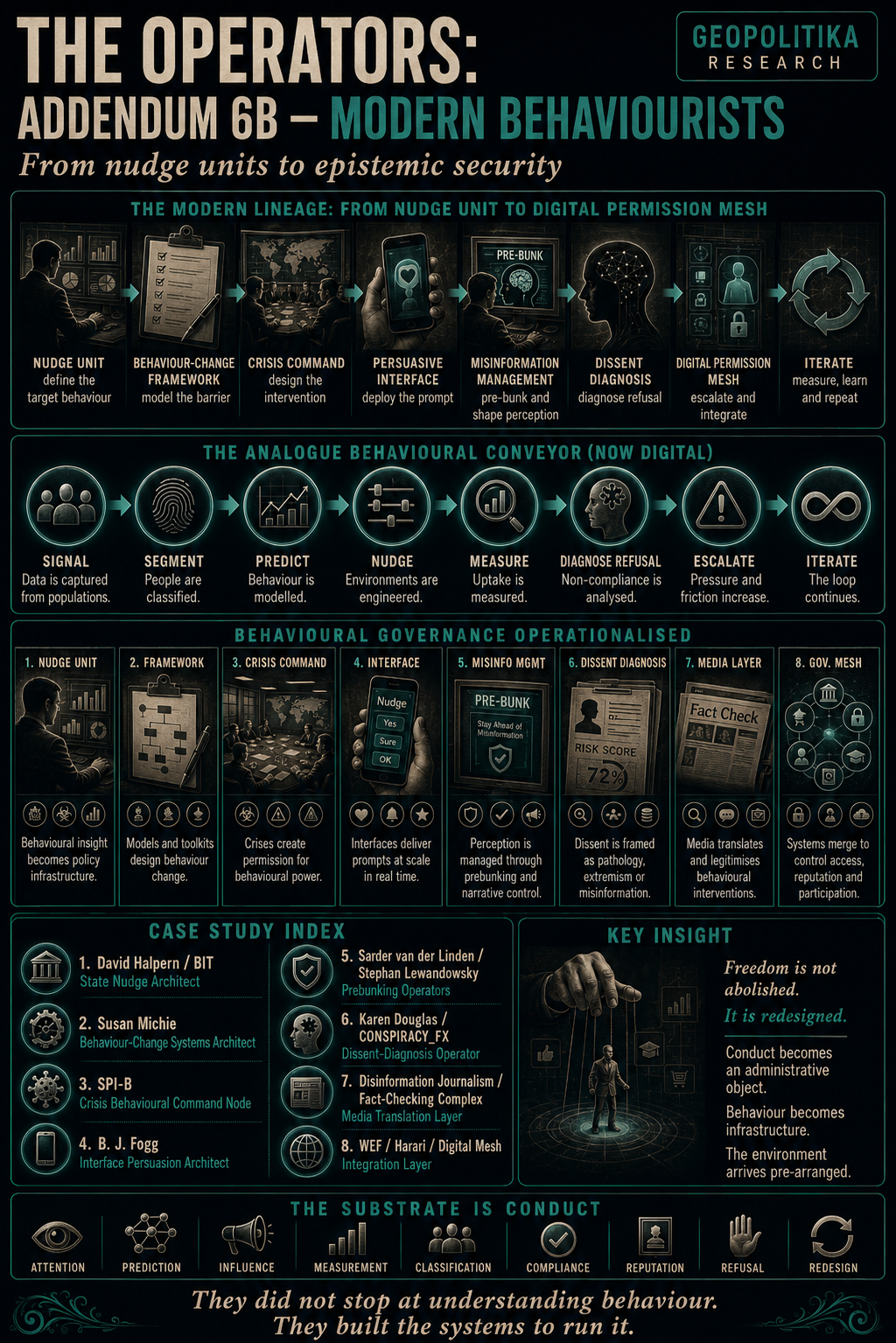
Addendum 6a traced the pre-digital operators who made conscience, fear, motive, desire, conformity and judgement available for behavioural governance. Addendum 6b follows those surfaces into runtime.
Part 6 mapped the modern behavioural circuit: signal, segment, predict, nudge, measure, diagnose refusal, escalate and iterate. Addendum 6a moved backward into the seedbed: priest, prince, analyst, advertiser, behaviourist, social psychologist and choice architect. This addendum moves forward into the machinery: the policy unit, behaviour-change framework, crisis advisory cell, persuasive interface, misinformation laboratory, dissent-diagnosis system and digital-governance mesh.
The chain is simple:
Nudge Unit → Behaviour-Change Framework → Crisis Command → Persuasive Interface → Misinformation Management → Dissent Diagnosis → Digital Permission Mesh
The figures and nodes profiled here are not historical origin points. They are contemporary operators of the behavioural runtime. Their shared function is to turn conduct into an administrative object: define the target behaviour, model the barrier, design the intervention, deploy the prompt, measure uptake, diagnose refusal, and integrate the result into policy, platform or access architecture.
The venue changes accordingly. Behavioural governance no longer waits for church, court, clinic, campaign, laboratory or book. It enters the form, feed, app, portal, dashboard, public-health message, trust-and-safety rule, pre-bunking game, vaccine campaign, climate prompt, digital identity layer and epistemic-security perimeter. The subject remains formally free, but the environment increasingly arrives pre-arranged.
That is the movement this addendum maps: not the discovery of behavioural surfaces, but their operationalisation. Addendum 6a showed how conduct was made governable. Addendum 6b shows how governable conduct becomes infrastructure.
Case Study Index
- David Halpern / Behavioural Insights Team – State Nudge Architect
- Susan Michie – Behaviour-Change Systems Architect
- SPI-B – Crisis Behavioural Command Node
- B. J. Fogg / Persuasive Technology Lineage – Interface Persuasion Architect
- Sander van der Linden / Stephan Lewandowsky – Prebunking and Misinformation Operators
- Karen Douglas / CONSPIRACY_FX – Dissent-Diagnosis Operator
- Disinformation Journalism / Fact-Checking Complex — Media Translation Layer
- WEF / Harari / Digital-Governance Mesh – Hackable-Animal Narrator and Integration Layer
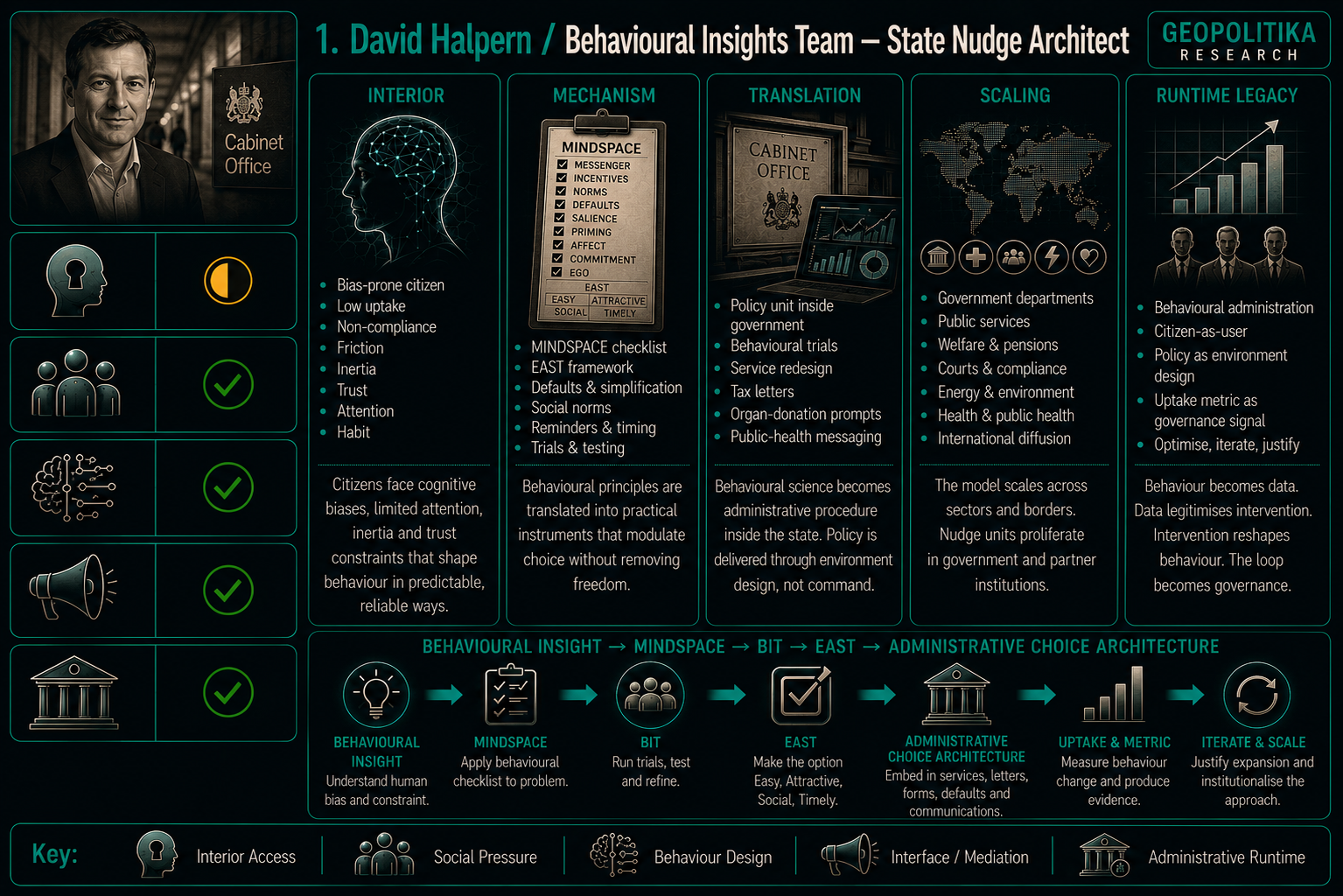
1. David Halpern / Behavioural Insights Team — State Nudge Architect
Ribbon: Behavioural Insight → MINDSPACE → BIT → EAST → Administrative Choice Architecture
Lane / Era: Behavioural economics, UK public administration and global nudge-state diffusion | 2000s–present
House(s): Institute for Government, Cabinet Office, Behavioural Insights Team, MINDSPACE, EAST
Imprint: Make behavioural influence administratively respectable; turn policy from instruction into environment design.
Placement & Core Operator Function
David Halpern and the Behavioural Insights Team sit at the state-nudge layer of the modern behavioural runtime. If Thaler and Sunstein supply the policy language of choice architecture, Halpern and BIT supply the administrative venue. The behavioural insight stops being a book, seminar or academic field. It becomes a unit inside government.
The core operator function is to convert behavioural science into public-administration procedure. The question is no longer only what law should be passed or what service should be provided. It becomes: what environment will produce the desired behaviour? Which messenger should deliver the prompt? Which default should be set? Which friction should be removed? Which social norm should be displayed? Which timing will increase uptake? Which trial will prove the effect?
That placement matters because it gives the nudge a bureaucratic body. MINDSPACE translated influence into an administrative checklist: Messenger, Incentives, Norms, Defaults, Salience, Priming, Affect, Commitment and Ego. BIT then operationalised the method through trials, service redesign and policy application. EAST compressed the style further: make the desired behaviour Easy, Attractive, Social and Timely.
Halpern’s significance is not personal charisma. It is placement. He appears at the hinge where the historical behavioural lineage enters the machinery of the state.
Mechanism & Institutional Translation
The mechanism is administrative choice architecture.
BIT’s method works through modest instruments: letter wording, form layout, default options, reminders, social-norm comparisons, simplification, timing, friction reduction, message testing and behavioural trials. The interventions look small because smallness is part of their legitimacy. A tax letter, pension form, organ-donation prompt, court reminder, welfare message or vaccine text can be redesigned without looking like command.
The institutional translation is decisive. Behavioural science becomes embedded inside ordinary administration. A citizen does not encounter “behavioural control” as a named ideology. He encounters a redesigned form, a reminder, a default, a nudge, a portal, a prompt, a comparison with “people like you,” or an easier compliance path. The operator surface is the service channel.
This is why BIT matters beyond Britain. Its model helped normalise the idea that governments should test, measure and optimise citizen behaviour through applied behavioural science. Tax compliance, organ donation, public health, pensions, energy use, welfare, employment and service uptake become behavioural targets. Each target can be decomposed into barriers. Each barrier can be redesigned. Each redesign can be measured. Each metric can justify the next intervention.
The state no longer merely communicates policy. It tunes the path through which the citizen acts.
Behavioural Chain
The Halpern / BIT chain runs:
Behavioural Insight → MINDSPACE → BIT → EAST → Administrative Choice Architecture
At the behavioural-insight layer, human conduct is treated as predictably adjustable. At the MINDSPACE layer, influence becomes a policy checklist. At the BIT layer, the checklist gains institutional placement. At the EAST layer, the method becomes portable and simple. At the administrative-choice-architecture layer, forms, letters, portals, defaults and prompts become governance instruments.
The citizen remains formally free. But the path is increasingly designed: easier here, harder there; visible here, hidden there; default here, opt-out there; prompt now, delay later.
Operator reading
The claim is not that every BIT intervention is coercive, nor that simplifying forms is inherently sinister. The claim is structural: Halpern and BIT helped make behavioural steering a normal function of government.
Their importance lies in the laundering of influence into efficiency. Behavioural administration presents itself as cheap, evidence-based, humane and practical. But its deeper mutation is political. The citizen becomes a behavioural subject inside a service channel. Policy success becomes uptake. Refusal becomes friction. Non-compliance becomes a design problem. The public interface becomes a laboratory.
Halpern / BIT matter because they made the state nudge operational. They turned behavioural insight into administrative runtime.
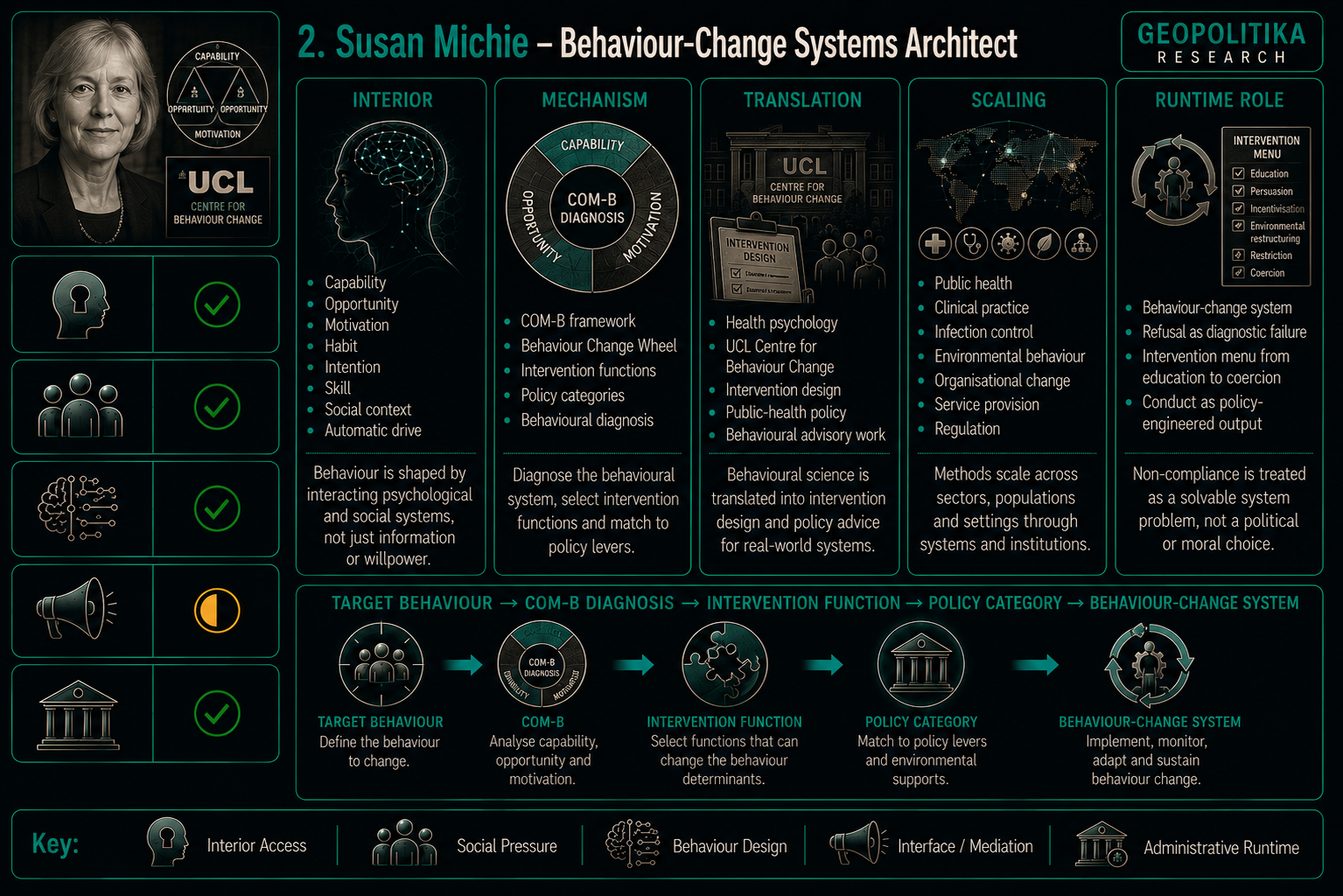
2. Susan Michie — Behaviour-Change Systems Architect
Ribbon: Target Behaviour → COM-B Diagnosis → Intervention Function → Policy Category → Behaviour-Change System
Lane / Era: Health psychology, behaviour-change science and public-policy intervention design | 2000s–present
House(s): University College London, UCL Centre for Behaviour Change, Behaviour Change Wheel, COM-B, health-policy and behavioural-advisory networks
Imprint: Decompose conduct into capability, opportunity and motivation; make behaviour change a systematic policy-engineering discipline.
Placement & Core Operator Function
Susan Michie sits at the behaviour-change systems layer of the modern behavioural runtime. If David Halpern and the Behavioural Insights Team represent the state nudge as administrative method, Michie represents the deeper systems grammar: specify the behaviour, diagnose the behavioural conditions, select the intervention function, and connect the result to policy.
Her core operator function is to convert conduct into a designable system. Behaviour is not treated as a simple personal choice, moral failure or information deficit. It is decomposed into interacting components: Capability, Opportunity and Motivation producing Behaviour. That is the COM-B model. The question becomes: does the person have the psychological and physical capability to act; does the social and physical environment give the opportunity; does reflective or automatic motivation drive the conduct?
That move matters because it gives behavioural governance an engineering language. The target behaviour can be named. The barrier can be diagnosed. The intervention can be selected. The policy lever can be matched. The person becomes a node inside a change system.
Michie’s placement at UCL and the Centre for Behaviour Change gives this model institutional reach. Her work is not merely advisory rhetoric. The Behaviour Change Wheel was explicitly designed as a method for characterising and designing behaviour-change interventions. It has travelled through public health, clinical practice, environmental behaviour, organisational change and policy design.
Mechanism & Institutional Translation
The mechanism is behavioural decomposition.
COM-B turns conduct into a diagnostic object. If a person does not comply, the system does not stop at refusal. It asks what is missing: knowledge, skill, memory, environmental support, social norm, incentive, emotional drive, reflective intention, automatic habit. Each missing condition suggests an intervention.
The Behaviour Change Wheel then wraps that diagnosis in intervention functions: education, persuasion, incentivisation, coercion, training, restriction, environmental restructuring, modelling and enablement. Around those sit policy categories: communication, guidelines, fiscal measures, regulation, legislation, environmental or social planning, and service provision.
This is why Michie belongs inside the Behaviourists map. The model does not merely advise better messaging. It builds a full intervention architecture. Conduct becomes something that can be analysed, redesigned and governed across multiple levels: individual psychology, social setting, physical environment, institutional rule and policy instrument.
In benign form, this can improve health interventions, smoking cessation, infection control, exercise, diet or medication adherence. In operator form, the same framework makes non-compliance administratively intelligible. Refusal becomes a failure of capability, opportunity or motivation. The response is not necessarily argument. It may be persuasion, incentivisation, restriction, coercion or environmental restructuring.
That is the hard edge. Behaviour-change science supplies a neutral vocabulary for interventions that range from education to compulsion. The wheel does not only describe behaviour. It organises the menu of ways to change it.
Behavioural Chain
The Michie chain runs:
Target Behaviour → COM-B Diagnosis → Intervention Function → Policy Category → Behaviour-Change System
At the target layer, a preferred conduct is specified. At the COM-B layer, the person and environment are diagnosed for capability, opportunity and motivation. At the intervention layer, the behavioural lever is chosen. At the policy layer, the lever is attached to communication, regulation, legislation, service design or environmental planning. At the system layer, behaviour change becomes an organised administrative process.
The citizen remains formally autonomous. But his conduct is increasingly treated as a modifiable output of system conditions.
Operator reading
The claim is not that behaviour-change science is inherently abusive, nor that all public-health intervention is illegitimate. The claim is structural: Michie’s framework gives institutions a systematic method for turning conduct into an intervention target.
Her significance lies in the passage from nudge to behavioural system. Halpern / BIT emphasise practical administrative nudging: make it easy, attractive, social and timely. Michie’s COM-B / Behaviour Change Wheel architecture goes deeper. It maps why conduct occurs and links that diagnosis to a spectrum of intervention tools, including restriction, regulation and coercion.
That makes the framework powerful and politically sensitive. Once behaviour is defined as a policy problem, freedom can be redescribed as a set of modifiable conditions. The institution need not ask only whether the person consents. It can ask which capability, opportunity or motivational lever must be altered to produce the desired action.
Michie matters because she helped turn behaviour change into a systematic policy technology. She made conduct governable as a designed system.
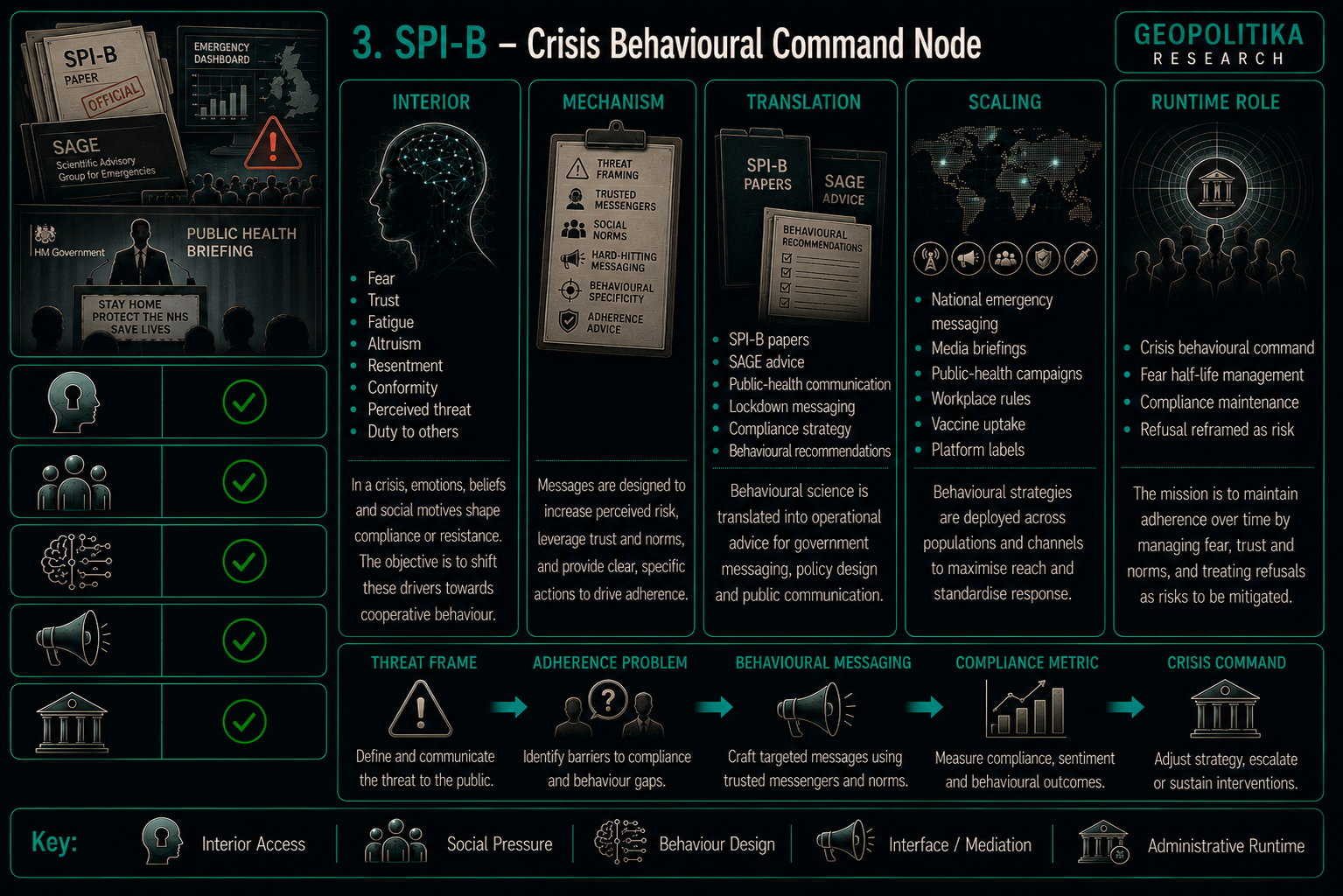
3. SPI-B — Crisis Behavioural Command Node
Ribbon: Threat Frame → Adherence Problem → Behavioural Messaging → Compliance Metric → Crisis Command
Lane / Era: Pandemic governance, emergency public-health messaging and behavioural advisory science | COVID-19 crisis, 2020–2022
House(s): SPI-B, SAGE, UK Cabinet Office, public-health communications, behavioural-advisory networks
Imprint: Make public emotion, adherence, fatigue, trust and fear into operational variables under emergency conditions.
Placement & Core Operator Function
SPI-B, the Independent Scientific Pandemic Insights Group on Behaviours, sits at the crisis-command layer of the behavioural runtime. If Halpern / BIT represents the ordinary nudge state, and Michie represents systematic behaviour-change design, SPI-B represents behavioural governance under emergency activation.
Its core operator function is to convert public conduct into an adherence problem. The question is no longer only what the pathogen does, what the model predicts, or what the medical intervention requires. It becomes: how will the population behave? Will people comply? Will fear decay? Will fatigue undermine adherence? Which messengers will be trusted? Which norms will hold? Which emotional cues will sustain the desired conduct?
SPI-B’s formal role was to provide behavioural and social-science advice to the Scientific Advisory Group for Emergencies (SAGE). Its placement was not vaccine procurement or laboratory diagnosis. It was the behavioural layer around intervention: stay home, distance, mask, test, isolate, report symptoms, accept vaccination, avoid gatherings, follow changing rules, and maintain trust in official messaging.
That placement matters because crisis compresses the behavioural state. What is modest in peacetime becomes urgent in emergency. Prompt becomes duty. Advice becomes instruction. Uptake becomes threshold. Refusal becomes risk.
Mechanism & Institutional Translation
The mechanism is crisis adherence management.
SPI-B’s March 2020 paper, Options for increasing adherence to social distancing measures, made the behavioural function explicit. It discussed perceived personal threat, hard-hitting emotional messaging, duty to protect others, social approval for desired behaviours, behavioural specificity, personalised advice and possible compulsion. The language is administrative, but the object is emotion and conduct.
This is the crisis version of MINDSPACE. Messenger, norms, affect, commitment and ego become tools for emergency compliance. The subject is addressed not only as patient or citizen, but as behavioural risk surface. His fear, trust, altruism, resentment, fatigue and conformity become policy variables.
The later controversy matters because it reveals the operator problem. Behavioural advisers later distinguished realistic risk communication from crude fear inflation. Ann John, co-chair of SPI-B, told the UK Parliament’s Science and Technology Committee that the early fear-messaging option was part of an evidence review before lockdown and that later SPI-B advice argued against fear messaging because it did not work. Stephen Reicher, John Drury, Susan Michie and Robert West later framed the ethical issue as “empowerment not fear” in the BMJ.
But the structural point remains. Once crisis government accepts the population as an adherence system, public emotion is inside the machine. Fear, fatigue, trust, norms and refusal become administrative objects.
Behavioural Chain
The SPI-B chain runs:
Threat Frame → Adherence Problem → Behavioural Messaging → Compliance Metric → Crisis Command
At the threat layer, danger is made vivid. At the adherence layer, public behaviour becomes the limiting condition of policy success. At the messaging layer, fear, duty, solidarity, norms and trusted messengers are arranged. At the metric layer, compliance, uptake and fatigue are monitored. At the command layer, behavioural advice becomes part of emergency rule.
The cycle does not stop with fear. Fear has a half-life. When it decays, the system requires reinforcement: renewed threat, moral pressure, social shame, access condition or dissent diagnosis.
Operator reading
The claim is not that every SPI-B member supported crude fear campaigns, nor that all emergency communication is illegitimate. The claim is structural: SPI-B marks the point where behavioural science becomes crisis command support.
Its significance lies in emergency activation. Under crisis conditions, behavioural influence is no longer presented mainly as convenience, service design or welfare-enhancing choice architecture. It becomes population management. The public is not merely informed. It is moved, reassured, frightened, shamed, segmented, prompted and monitored.
SPI-B matters because it showed how quickly the behavioural state can harden under emergency. It turned fear, adherence and fatigue into operational variables of government.
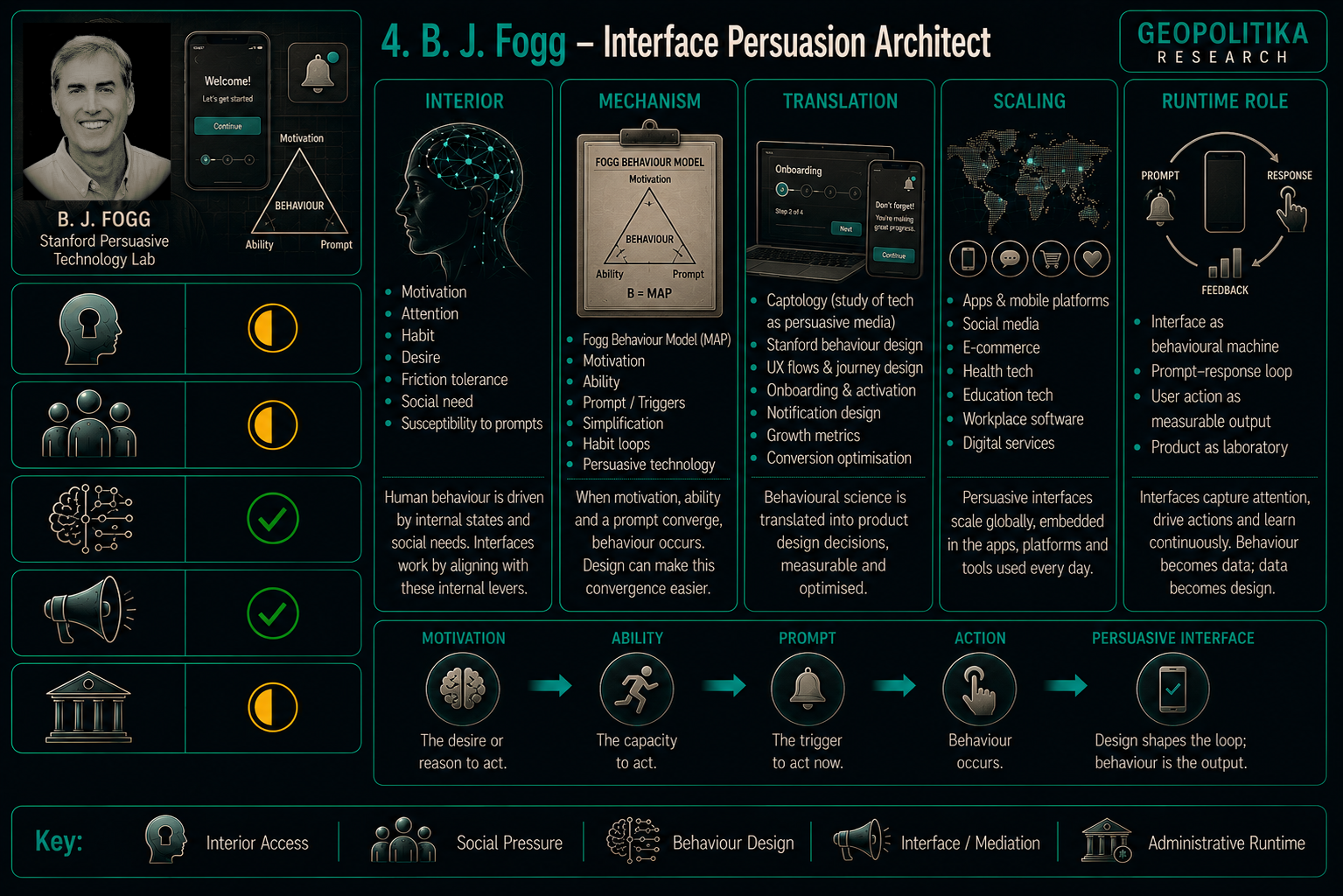
4. B. J. Fogg — Interface Persuasion Architect
Ribbon: Motivation → Ability → Prompt → Action → Persuasive Interface
Lane / Era: Persuasive technology, behaviour design and platform UX | 1990s–present
House(s): Stanford Persuasive Technology Lab / Behavior Design Lab, Stanford University, captology, digital product design, platform growth culture
Imprint: Make the interface a behavioural machine; turn persuasion into prompt, friction, habit and loop.
Placement & Core Operator Function
B. J. Fogg sits at the persuasive-interface layer of the modern behavioural runtime. If Halpern / BIT turns behavioural insight into administrative nudging, and Michie turns behaviour change into a systems framework, Fogg translates behavioural design into the digital interface. His venue is not primarily the policy unit or public-health advisory cell. It is the screen.
His core operator function is to convert persuasion into product architecture. The user is not simply informed by an interface. He is moved by it: prompted, rewarded, simplified, delayed, reminded, streaked, socially cued, emotionally triggered and returned to the loop. The digital environment becomes an active behavioural field.
Fogg’s behavioural model is compact: behaviour happens when motivation, ability and a prompt converge. If motivation is high, the action may need only a cue. If motivation is low, the action must be made easier. If ability is low, friction must be reduced. If the prompt arrives at the wrong moment, the behaviour may not occur. The operator question becomes: what prompt, at what time, under what motivational and ability conditions, will produce the action?
That model matters because it fits the platform age. The interface can change instantly. Prompts can be personalised. Friction can be placed or removed. Rewards can be variable. Behaviour can be measured in real time. The old nudge becomes continuous product design.
Mechanism & Institutional Translation
The mechanism is persuasive technology.
Fogg’s earlier language of captology—as described in his book “Persuasive technology: using computers to change what we think and do”— named the key mutation. Digital systems do not merely process information. They can be designed to change attitudes and behaviours. The app, website, device, notification system, onboarding flow or social platform becomes a behavioural intervention.
The institutional translation runs through Silicon Valley product culture: growth teams, UX design, onboarding, conversion optimisation, engagement metrics, notification architecture, habit formation, gamification and persuasive design. The user’s conduct is decomposed into target behaviours: sign up, invite friends, accept terms, enable notifications, share content, upload data, continue scrolling, maintain streak, buy, subscribe, return tomorrow.
Each target behaviour can be engineered. Increase motivation through status, fear of missing out, belonging or reward. Increase ability by simplifying the action, reducing clicks, removing cognitive load or making the button obvious. Insert the prompt when the user is most susceptible. Measure response. Iterate.
This is where behaviour design crosses into the darker platform runtime. The same mechanism that helps a person build a habit can also capture attention, extract data, deepen dependency, normalise surveillance or make exit difficult. The polite language is user experience. The operator reality is conduct shaping.
Fogg’s importance is therefore not confined to one academic model. It is the broader translation of behavioural psychology into interface practice. The screen becomes a Skinner box without bars: prompt, response, reinforcement, measurement, adjustment.
Behavioural Chain
The Fogg chain runs:
Motivation → Ability → Prompt → Action → Persuasive Interface
At the motivation layer, the user is made to want, fear, desire, belong or avoid loss. At the ability layer, the desired behaviour is made easier. At the prompt layer, the cue is delivered at the decisive moment. At the action layer, the user clicks, shares, buys, accepts, scrolls, returns or complies. At the persuasive-interface layer, the system records the result and redesigns the next encounter.
This chain makes behaviour design granular. It does not need a mass campaign. It can operate at the level of button, notification, timing, colour, message, default, streak, badge, ranking or delay. The user experiences a product. The operator sees a behavioural surface.
Operator reading
The claim is not that Fogg personally authored every manipulative platform pattern, nor that all persuasive design is illegitimate. The claim is structural: Fogg helped formalise the interface as a site of behavioural intervention.
His place in the lineage is exact. Skinner made behaviour conditionable through consequence. Thaler and Sunstein made choice architecture respectable in policy. Fogg makes behaviour design native to the digital environment. He supplies the grammar by which the product designer asks: what action do we want, what barrier prevents it, what prompt will trigger it, and how can the interface be altered to increase success?
That grammar scales because platforms are measurement systems. Every click becomes signal. Every failure becomes design feedback. Every user can be segmented. Every intervention can be tested. The behavioural runtime no longer needs a laboratory. The product is the laboratory.
Fogg matters because he made persuasion programmable inside the interface. He helped turn the screen from a neutral medium into a behavioural operating environment.
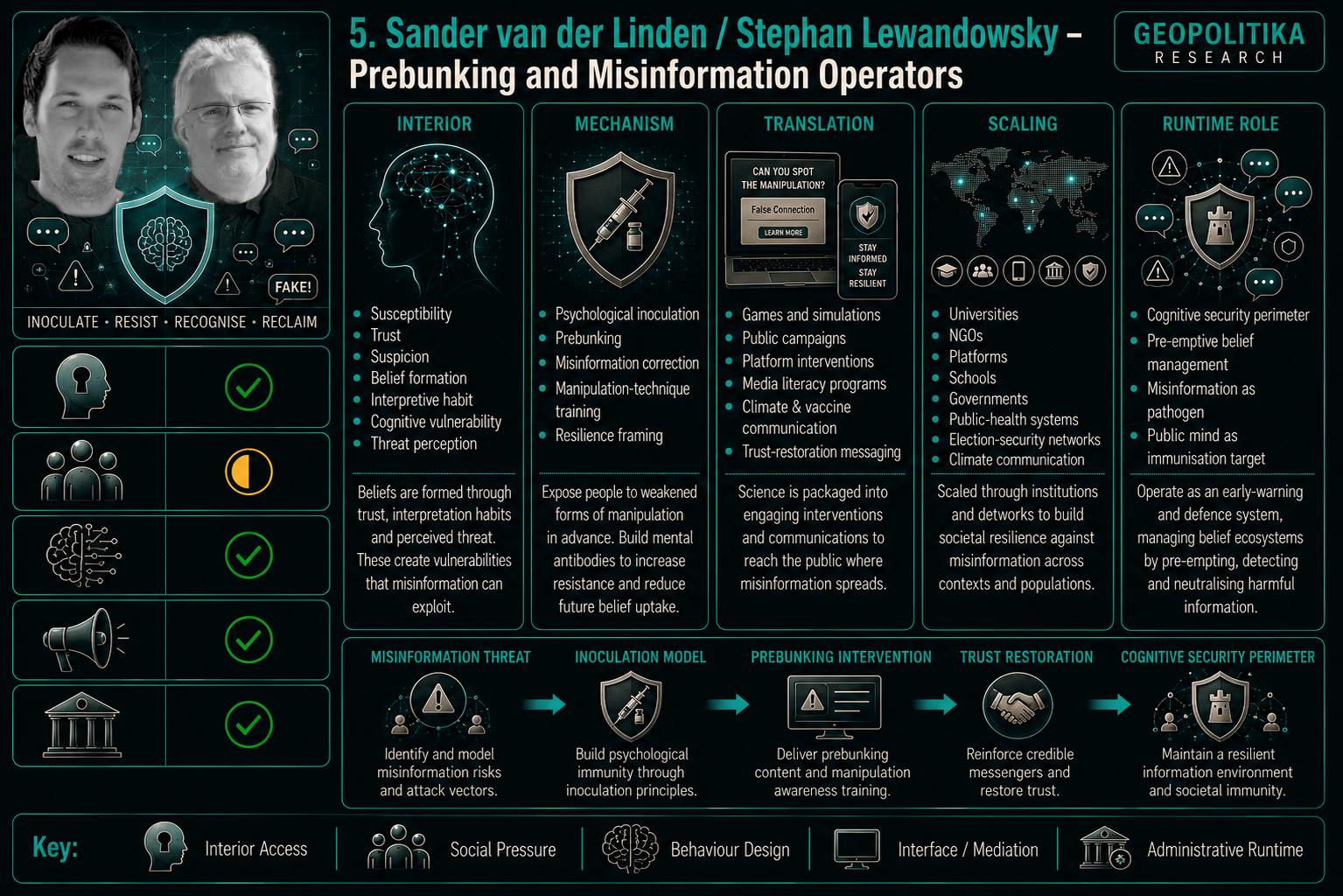
5. Sander van der Linden / Stephan Lewandowsky — Prebunking and Misinformation Operators
Ribbon: Misinformation Threat → Inoculation Model → Prebunking Intervention → Trust Restoration → Cognitive Security Perimeter
Lane / Era: Misinformation studies, inoculation theory, climate and vaccine communication, cognitive-risk management | 2010s–present
House(s): University of Cambridge, Cambridge Social Decision-Making Lab, University of Bristol, psychological inoculation literature, misinformation-policy networks
Imprint: Treat misinformation as a cognitive pathogen; make the public mind a pre-emptive intervention surface.
Placement & Core Operator Function
Sander van der Linden and Stephan Lewandowsky sit at the misinformation-management layer of the modern behavioural runtime. If SPI-B converts crisis conduct into an adherence problem, van der Linden and Lewandowsky convert contested information into a cognitive-risk problem. The venue is no longer only message uptake. It is the public mind before the message arrives.
Their core operator function is to convert susceptibility into an intervention target. The public is not merely informed after exposure to falsehood. It is pre-treated. The analogy is medical: misinformation circulates like a pathogen; exposure can infect; immunity can be built; resistance can be trained. This is the logic of psychological inoculation and prebunking.
The operator move is subtle. Traditional correction waits for a claim, examines it, and rebuts it. Prebunking moves earlier. It teaches the public to recognise manipulation techniques before specific claims arrive: fake experts, conspiracy framing, emotional manipulation, scapegoating, false dichotomy, impersonation, polarisation, logical fallacy, or misleading statistics. In benign form, this is media literacy against manipulation. In operator form, it becomes pre-emptive cognition management.
That placement matters because it moves behavioural governance from conduct into interpretation. The issue is not only what people do. It is how they will process future claims. The citizen’s attention, suspicion, trust and interpretive habits become security terrain.
Mechanism & Institutional Translation
The mechanism is inoculation.
Van der Linden’s work popularises prebunking games and interventions designed to build resistance to misinformation by exposing users to weakened doses of misleading tactics. The public learns to identify manipulation before encountering full-strength examples. His work has applied this logic to climate change, vaccination, fake news and online misinformation.
Lewandowsky operates in the adjacent correction-and-misinformation field. His work examines the persistence of misinformation, climate misinformation, conspiracy belief, fake news and the difficulty of correcting false claims once they enter public understanding. Together, the two figures help define the public mind as a contested information environment requiring pre-emptive defence, correction and resilience.
The institutional translation runs through universities, public-health messaging, platform policy, civil-society campaigns, media-literacy programmes, government communication, climate communication and electoral-integrity work. Prebunking becomes attractive because it promises scale. Instead of rebutting every claim, teach citizens to distrust classes of claim. Instead of fighting every narrative downstream, alter susceptibility upstream.
That is the hard edge. Prebunking can become education, but it can also become perimeter-setting. It may teach citizens useful tools for detecting manipulation. It may also train them to associate certain forms of institutional scepticism with harmful rhetoric before evidence is examined. When joined to platform labels, trusted-source elevation, reach reduction and crisis messaging, inoculation becomes part of a wider behavioural defence system.
The public mind becomes a population to be immunised. Speech becomes exposure. Disagreement becomes transmission risk. Trust becomes an outcome to restore.
Behavioural Chain
The van der Linden / Lewandowsky chain runs:
Misinformation Threat → Inoculation Model → Prebunking Intervention → Trust Restoration → Cognitive Security Perimeter
At the threat layer, contested information is framed as harm, risk or infection. At the inoculation layer, susceptibility is modelled as something that can be reduced before exposure. At the prebunking layer, the citizen is trained against anticipated manipulation techniques. At the trust-restoration layer, confidence in selected authorities and information channels becomes the desired outcome. At the cognitive-security layer, the interpretive environment is treated as a perimeter to defend.
The chain shifts the question from “Is this claim true?” to “How do we reduce susceptibility to this class of claims?” That is the operator conversion.
Operator reading
The claim is not that misinformation research is inherently illegitimate, nor that all prebunking is manipulation. The claim is structural: van der Linden and Lewandowsky help make cognition itself administrable under the language of resilience, inoculation and information hygiene.
Their significance lies in pre-emption. Earlier behavioural governance nudges a decision, prompts a behaviour or adjusts an interface. Prebunking acts before the contested decision, before the refusal, before the argument has fully arrived. It aims to shape how future claims will be received.
This is why the inoculation metaphor matters. Once misinformation is treated as pathogen, the public becomes host population, platforms become transmission environments, experts become immunisation authorities, and dissenting narratives can be framed as contagion. The metaphor does not dictate abuse, but it makes certain interventions easier to justify.
Van der Linden and Lewandowsky matter because they helped turn misinformation from a dispute over claims into a behavioural-risk domain. They made the public mind available as a pre-emptive security surface.
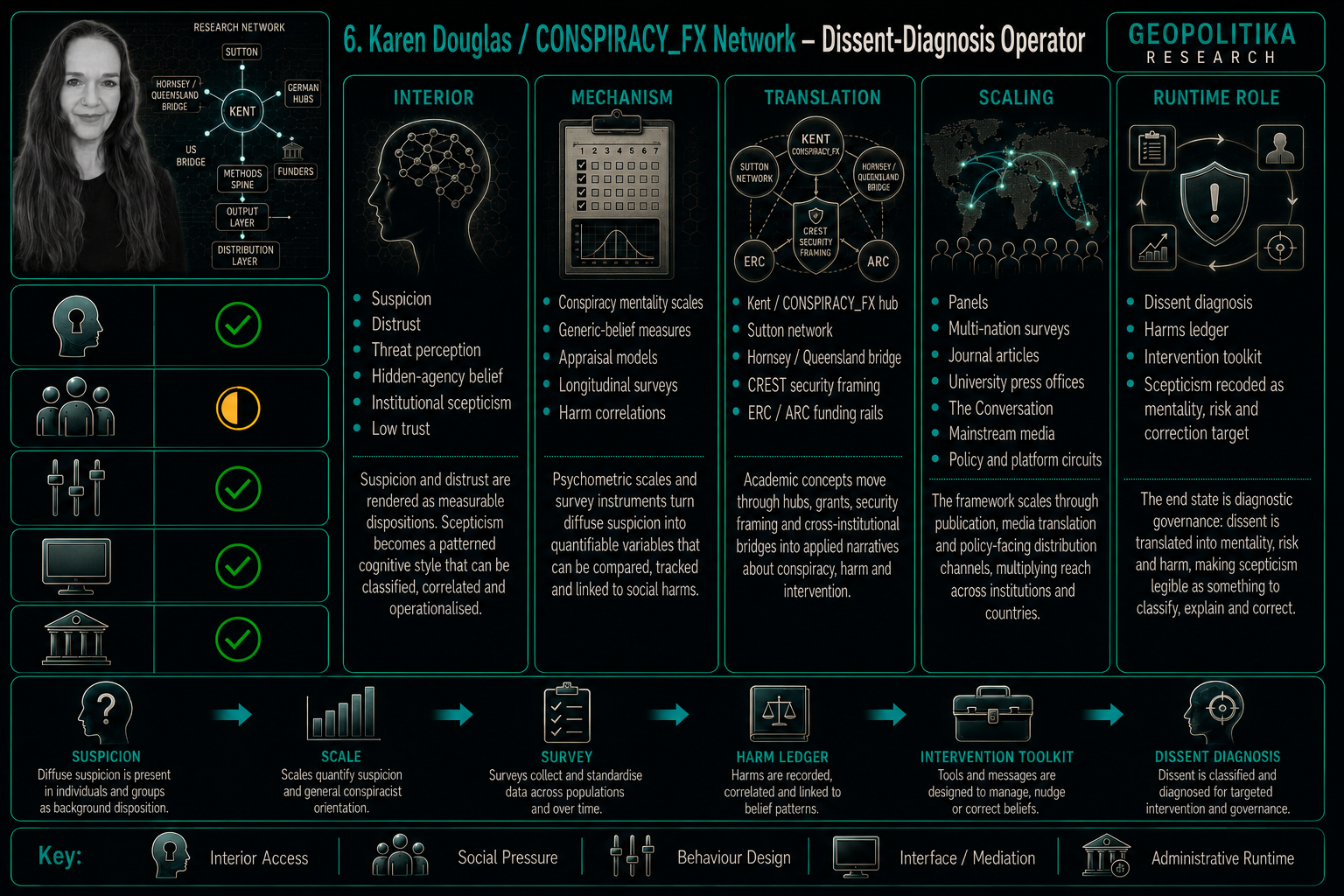
6. Karen Douglas / CONSPIRACY_FX Network — Dissent-Diagnosis Operator
Ribbon: Funders → Production Hubs → Methods Spine → Harms Ledger → Dissent Diagnosis
Lane / Era: Conspiracy-theory psychology, security-adjacent misinformation studies and behavioural intervention research | 2010s–present
House(s): University of Kent, CONSPIRACY_FX, CREST, European Research Council, Australian Research Council, University of Queensland, German and US conspiracy-belief research networks, journals, university press offices, policy-media circuits
Imprint: Convert institutional distrust into measurable mentality, harm ledger and intervention target.
Placement & Core Operator Function
Karen Douglas and the CONSPIRACY_FX network sit at the dissent-diagnosis layer of the modern behavioural runtime. Douglas is the visible anchor: Kent describes her as director of the ERC-funded CONSPIRACY_FX project, which studies when and how conspiracy theories are influential in politics, vaccination and climate change, and what happens to those who spread them, including politicians and elites.
But the operator object is wider than one academic. It is a category-production network. Kent, Robbie Sutton, Matthew Hornsey’s Queensland bridge, German social-psychology hubs, US measurement networks, CREST security framing, grant rails, journals, press offices and media distribution form a production ecology. The function is to convert suspicion of power into a portable behavioural category: conspiracy mentality, conspiracy belief, conspiracy thinking, conspiracist ideation.
That move matters because it changes the status of dissent. A citizen asks whether an institution has lied, hidden evidence, coordinated action, suppressed risk, manipulated data, protected insiders or manufactured consensus. The network’s object is not primarily that institutional claim. It is the believer. What kind of person adopts such beliefs? What motives, traits, appraisals, social needs or harms are associated with them? What interventions reduce them?
The claim recedes. The claimant becomes the substrate.
Mechanism & Institutional Translation
The mechanism is diagnostic abstraction.
The methods spine runs through scales, survey instruments, appraisal models, longitudinal panels, boutique lab studies and multi-nation datasets. Conspiracy belief is made measurable, comparable and exportable. The CREST project led by Douglas framed the issue as adoption, communication and risk, noting that conspiracy theories may affect cooperation with agencies or even justification of violence. Kent’s own profile lists major funding rails, including a €2.49m ERC project on consequences of conspiracy theories and an ARC project on understanding and reducing conspiracy beliefs.
The output layer is the harms ledger. Conspiracy beliefs are linked to reduced trust, vaccine refusal, climate disengagement, prejudice, radicalisation, political behaviour, social fracture and reputational cost. Douglas and colleagues’ review literature asks what factors are associated with conspiracy beliefs, how they spread through traditional and social media, and what risks or rewards they carry. The ARC project summary is unusually direct: it frames conspiracy belief as a problem that “promotes prejudice, undermines trust, and costs lives,” and proposes large-scale cross-national survey work to understand and reduce it.
The institutional translation follows from there. Once suspicion is measurable and harmful, intervention becomes logical. The pipeline moves from category, to scale, to survey, to harms ledger, to correction toolkit: engagement, inoculation, prebunking, trust repair, norm cues, platform policy, security review, journal article, university press release and media explainer.
This is not merely research circulation. It is administrative supply. The state, platform, NGO, science communicator, public-health body or security agency receives a map of doubting populations and an intervention vocabulary for managing them.
Behavioural Chain
The CONSPIRACY_FX chain runs:
Suspicion → Scale → Survey / Panel → Harm Ledger → Intervention Toolkit → Dissent Diagnosis
At the suspicion layer, citizens question institutions, elites, secrecy or hidden coordination. At the scale layer, that suspicion is abstracted into a measurable construct. At the survey layer, populations are segmented and compared. At the harms layer, belief is linked to negative social consequences. At the intervention layer, correction tools are designed. At the diagnosis layer, dissent becomes a behavioural-management problem.
CONSPIRACY_FX supplies the classification layer. It gives institutions the vocabulary, instruments and harm correlations by which scepticism becomes conspiracy mentality, distrust becomes risk, and refusal becomes a behavioural object.
The chain’s power lies in portability. The same category can travel across vaccines, climate, elections, security, platforms and trust in science. Context thins. The score remains.
Operator reading
The claim is not that Douglas, Sutton, Hornsey or their collaborators are consciously building a repression system, nor that conspiracy theories cannot be false, manipulative or harmful. The claim is structural: this network manufactures a usable administrative object called conspiracy mentality, then supplies labels, harms and interventions for populations that refuse official narratives.
The asymmetry is the key. The diagnostic lens usually points downward at publics and sideways at dissident networks, but rarely upward with equal force at ministries, regulators, foundations, journals, intelligence-linked funders, pharmaceutical companies, platforms or expert committees. Citizens become motivated reasoners. Institutions become imperfect communicators. Public distrust is psychologised. Institutional breach is contextualised.
That asymmetry is what makes the category useful to power. Once distrust is coded as mentality, the institutional response need not begin with audit, disclosure or accountability. It can begin with messaging, segmentation, inoculation, debunking, trust restoration and platform intervention.
Douglas / CONSPIRACY_FX matter because they help complete the behavioural runtime’s resistance layer. The nudge steers conduct. The platform measures response. The crisis cell manages adherence. The misinformation operator prebunks. The dissent-diagnosis network classifies the person who still refuses to move.
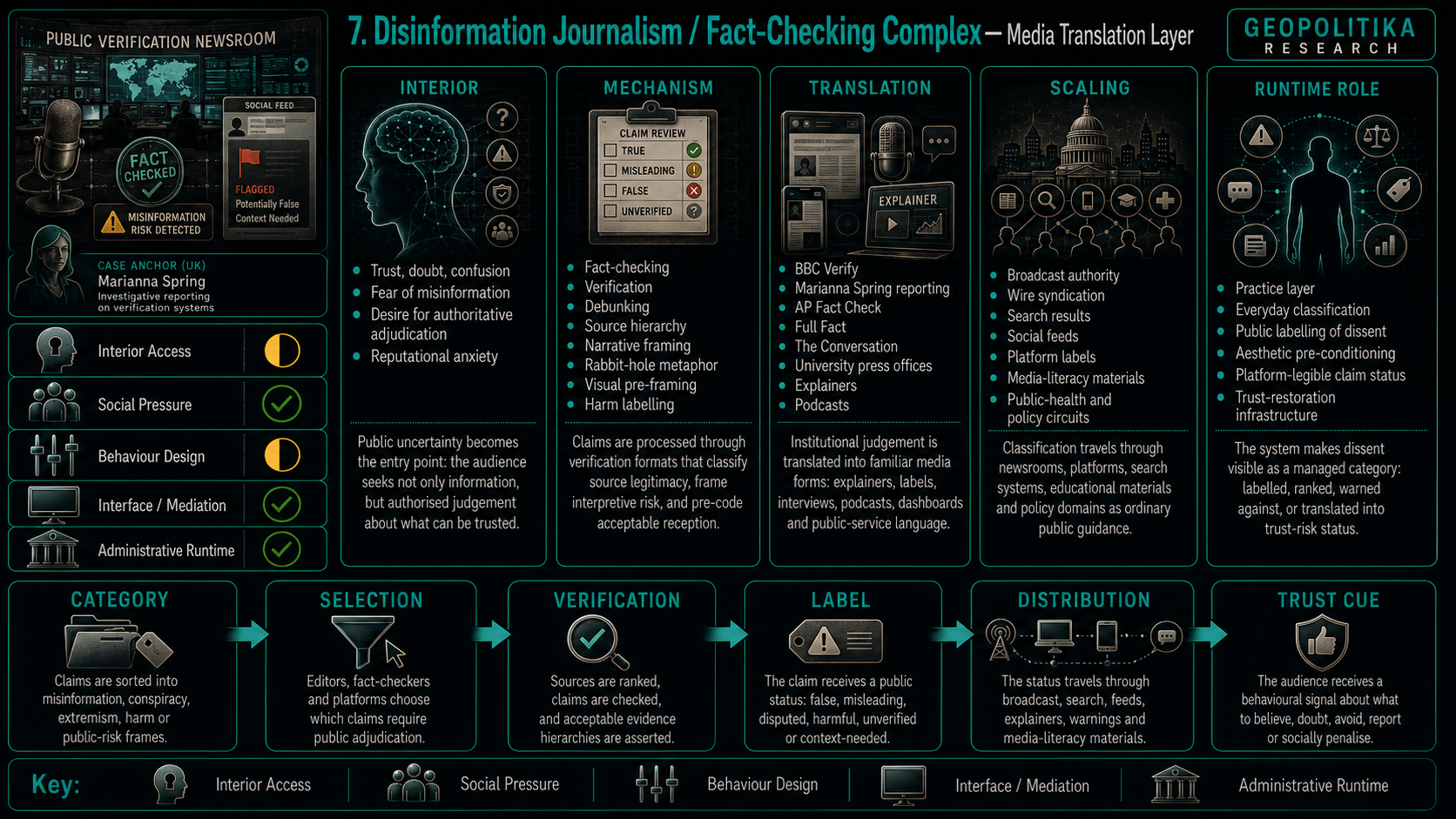
7. Disinformation Journalism / Fact-Checking Complex — Media Translation Layer
Ribbon: Research Category → Media Frame → Fact Check / Explainer → Public Label → Platform Cue → Trust Restoration
Lane / Era: Disinformation journalism, fact-checking, platform verification and public-interest media | 2010s–present
House(s): BBC Verify, Marianna Spring / BBC disinformation reporting, AP Fact Check, Full Fact, The Conversation, university press offices, public-interest journalism networks, platform-policy circuits
Imprint: Convert academic and security-adjacent categories into public-facing labels, emotional narratives, visual motifs, correction rituals and platform-legible verdicts.
Placement & Core Operator Function
The disinformation-journalism and fact-checking complex sits at the media-translation layer of the behavioural runtime. It follows the category factory. The academic and security-adjacent research world produces constructs: conspiracy mentality, misinformation susceptibility, online harm, radicalisation pathway, distrust, prebunking, inoculation, trust restoration. The media layer converts those constructs into public verdicts.
Its core operator function is translation. It turns research categories into everyday recognisable labels: false, misleading, conspiracy theory, anti-vax, denialist, extremist-adjacent, harmful, radicalising, disinformation ecosystem. The claim is selected. The speaker is framed. The context is narrowed. The label is applied. The verdict is distributed.
This is why Marianna Spring, BBC Verify, AP Fact Check, Full Fact and adjacent verification systems belong inside the Behaviourists map. Their role is not identical to CONSPIRACY_FX. CONSPIRACY_FX and its wider network help produce the diagnostic object. Disinformation journalism distributes it. One says: this belief pattern is measurable, harmful and intervention-worthy. The other says: this claim, person, outlet or movement belongs inside the misinformation-conspiracy-risk field.
The Mindwars sequence already mapped the pattern. Down the Rabbit Hole to Conspiracyland reads Marianna in Conspiracyland as a narrative intervention that pathologises dissent, discredits alternative media and reinforces institutional legitimacy through the language of disinformation and fact-checking. Fluoridating the Rabbit Hole shows the policy-deployment version: a live dispute over fluoridation, consent, dosing and authority is shifted away from the policy and onto the psychology of citizens who ask questions. Glitched Realities adds the aesthetic layer: dissent is not only labelled; it is visually pre-framed through glitch, cult coding, saturation, ambiguity and symbolic contamination.
The result is not simple correction. It is behavioural translation.
Mechanism & Institutional Translation
The mechanism has four layers.
First is the label layer. A contested claim is placed into a category: misinformation, conspiracy theory, denialism, anti-vax, far-right adjacent, online harm, hate, radicalisation risk. Once the label attaches, the argument no longer arrives first as a claim about reality. It arrives as a symptom of a known category.
Second is the narrative layer. The public is given a story-form: rabbit hole, descent, radicalisation, family rupture, emotional volatility, contagion, vulnerable believer, brave reporter, expert guide, return to reality. The narrative does not only report dissent. It teaches the audience how dissent should feel: unstable, sad, dangerous, infectious, morally suspect.
Third is the aesthetic layer. Image and sound perform the verdict before argument begins. Glitched crowd shots, cult-coded imagery, ominous music, saturation, blurred symbols, raised hands, chaotic overlays and threatening thumbnails precondition the reader or listener. The subject is made to look irrational before he speaks. Visuals become behavioural cues. The audience is trained to recoil before it reasons.
Fourth is the policy layer. Fact-checks, explainers and disinformation investigations become reusable institutional objects. They can be cited by platforms, regulators, public-health agencies, NGOs, schools, journalists, officials and trust-and-safety teams. A media verdict becomes a moderation cue, a search-ranking signal, a classroom resource, a public-health rebuttal, a policy footnote or a reputational weapon.
This is the translation pathway:
Academic Category → Media Investigation → Fact Check / Explainer → Public Label → Platform / Policy Uptake
The fact-checking complex presents this as hygiene: clean the information environment, correct falsehood, protect democracy, restore trust. In benign form, correction can expose error. In operator form, the same machinery can select weak claims, ignore stronger objections, launder institutional assumptions as neutral fact, and shift attention from policy substance to claimant pathology.
That is the decisive mutation. The journalist is no longer only reporter. The fact-checker is no longer only verifier. Both become behavioural intermediaries between academic diagnosis, platform enforcement and public belief.
Behavioural Chain
The media-translation chain runs:
Research Category → Media Frame → Fact Check / Explainer → Public Label → Platform Cue → Trust Restoration
At the research-category layer, dissent is made legible as misinformation, conspiracy belief or cognitive risk. At the media-frame layer, the claim is placed inside a story of descent, harm, radicalisation or confusion. At the fact-check layer, selected claims are adjudicated through institutional source hierarchies. At the label layer, a public verdict is attached. At the platform-cue layer, that verdict can inform visibility, ranking, warning, demonetisation or moderation. At the trust-restoration layer, the desired outcome is not only accuracy, but renewed deference to approved institutions.
The chain matters because it converts social doubt into media-handled risk. The public is not invited into open inquiry. It is guided through a managed epistemic environment: trusted sources elevated, contaminated sources marked, contested claims pre-labelled, dissenting aesthetics made suspect.
Operator reading
The claim is not that all fact-checking is false, nor that every disinformation journalist knowingly serves a suppression system. The claim is structural: the disinformation-journalism and fact-checking complex supplies the public translation layer for dissent diagnosis.
Its importance lies in distribution. Academic categories do not govern mass perception by themselves. They need narrators, explainers, verification desks, podcasts, headlines, thumbnails, public broadcasters, wire services, search results and platform partnerships. The category must be made familiar. The public must learn what “conspiracy” looks like, sounds like and feels like.
The fact-checker does not need to be honest for the mechanism to work. Even disingenuous correction performs the ritual. It selects the claim, narrows the context, invokes approved authority, applies the label and teaches the audience how to sort the person. The verdict becomes social training.
Its deeper function is practice. CONSPIRACY_FX and adjacent academic networks provide the classification layer. Fact-checkers and disinformation journalists make classification an everyday act. They teach audiences how to sort people before weighing claims: the crazy uncle, the anti-vaxxer, the conspiracy theorist, the science denier, the rabbit-hole casualty, the online radical, the unbeliever. The correction ritual is therefore also a social-training ritual. It does not only adjudicate facts. It rehearses status.
This profile therefore bridges CONSPIRACY_FX and the digital-governance mesh. The category factory produces the diagnostic object. The media-translation layer makes it public, emotional, visual and platform-legible. The next layer integrates it into governance: AI, digital identity, public-private platforms, behavioural resilience and permission architecture.
The disinformation-journalism / fact-checking complex matters because it turns dissent diagnosis into mass perception. It makes the label portable, the verdict distributable, and the refusal ready for platform or policy action.
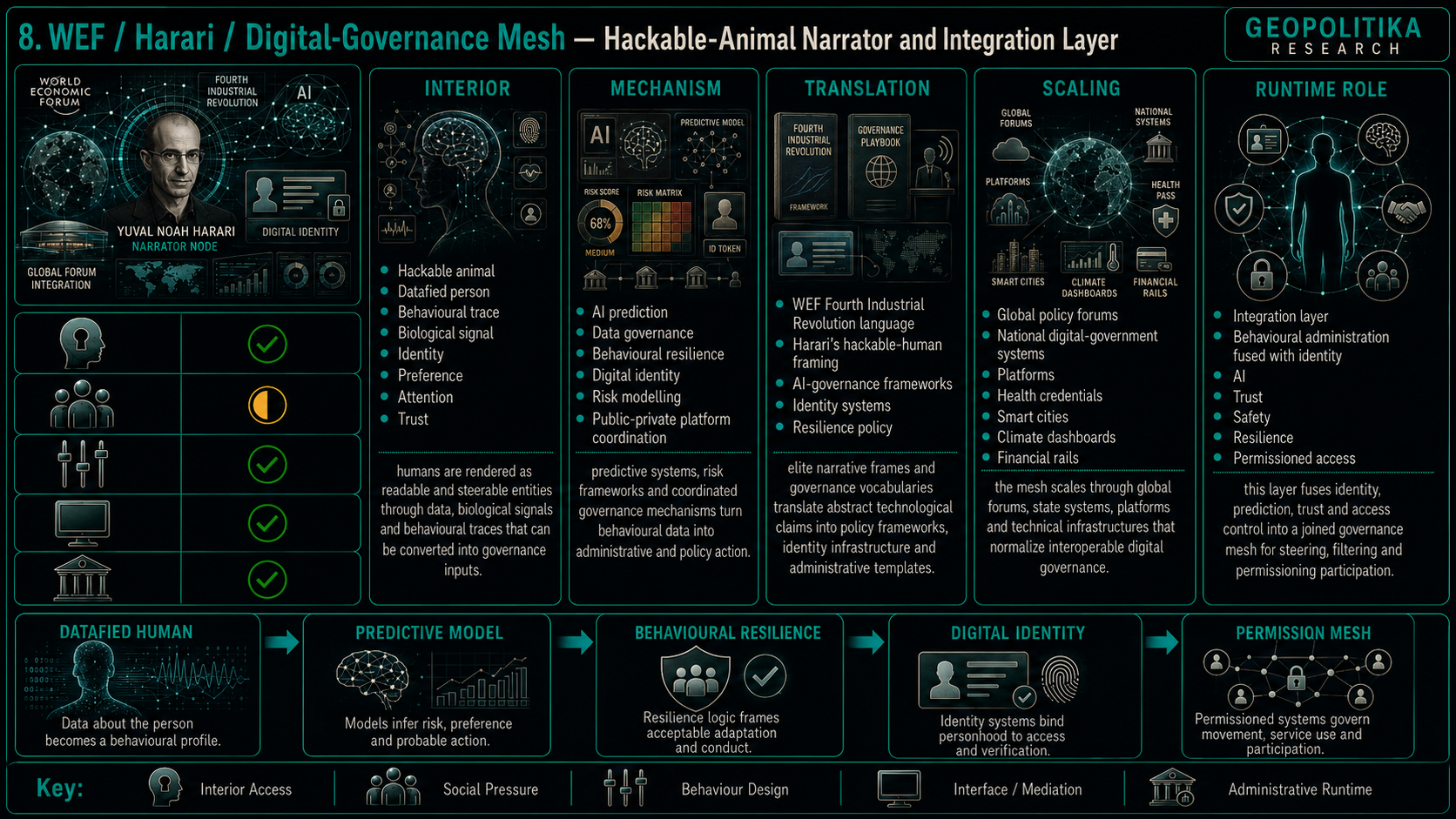
8. WEF / Harari / Digital-Governance Mesh — Hackable-Animal Narrator and Integration Layer
Ribbon: Datafied Human → Predictive Model → Behavioural Resilience → Digital Identity → Permission Mesh
Lane / Era: Fourth Industrial Revolution, AI governance, digital identity, public-private platform coordination and transnational policy narrative | 2010s–present
House(s): World Economic Forum, Fourth Industrial Revolution, Yuval Noah Harari, digital-identity frameworks, AI-governance networks, public-private policy platforms, resilience and trust architectures
Imprint: Narrate the human being as datafied, predictable and governable; integrate behavioural steering into AI, identity, platform and permission infrastructure.
Placement & Core Operator Function
The World Economic Forum / Harari / digital-governance mesh sits at the integration layer of the modern behavioural runtime. The earlier profiles mapped functional components: state nudge, behaviour-change framework, crisis command, persuasive interface, misinformation management, dissent diagnosis and media translation. This profile maps the layer where those components are assembled into a civilisational story.
Its core operator function is integration. Behavioural governance is no longer presented as a scattered set of tools. It becomes part of a total systems vocabulary: artificial intelligence, digital identity, platform coordination, resilience, trust, safety, health security, climate transition, data governance, cybersecurity, misinformation response and public-private partnership.
The WEF supplies the integration idiom. Its language of the Fourth Industrial Revolution describes a fusion of physical, digital and biological systems. The advertised frame is adaptation: institutions must prepare for technological transformation, data-driven governance, AI, automation and new forms of global coordination. The operator frame is different: once the person’s body, conduct, identity, transactions, speech, preferences and risk profile are converted into interoperable data surfaces, governance can move from law alone into runtime architecture.
Harari supplies the memorable anthropological compression. His “hackable animals” phrase matters because it says explicitly what the behavioural runtime implies operationally: humans can be read as systems. If enough biological, psychological and behavioural data are captured, prediction and intervention become plausible. The subject is no longer only citizen, patient, consumer or user. He is a datafied organism inside a governance environment.
That is the final Behaviourist threshold.
Mechanism & Institutional Translation
The mechanism is digital integration.
Earlier Behaviourists acted on particular surfaces: conscience, fear, desire, reinforcement, conformity, bias, interface, misinformation, trust. The digital-governance mesh links these surfaces. Identity verifies the subject. AI predicts likely action. Platforms structure visibility. Behavioural science designs prompts. Crisis systems supply urgency. Fact-checking supplies labels. Dissent-diagnosis supplies risk categories. Digital credentials supply access conditions. Public-private networks supply operational continuity.
The institutional translation is not one ministry or one platform. It is a mesh: WEF convening language, national digital-government systems, AI ethics and governance frameworks, biometric identity, platform trust-and-safety, health credentials, climate dashboards, cyber-resilience programmes, central-bank and payment infrastructures, data-sharing agreements, smart-city systems and cross-sector policy partnerships.
This is why the WEF / Harari profile closes the addendum. It is not the same type of operator as Halpern, Michie, Fogg or Douglas. It is a narrative and integration layer. It supplies the story in which separate behavioural systems appear as inevitable modernisation: safer services, trusted information, resilient societies, efficient government, responsible AI, digital inclusion, sustainable transition, frictionless access.
The hard edge is permission. Once identity, behaviour, trust, risk and access are integrated, rights begin to appear as workflow outcomes. The person does not simply speak, move, trade, work, travel, bank, study, access services or participate. He verifies, authenticates, complies, remains in good standing, clears the risk flag, maintains account status and passes the rule engine.
The old Behaviourist redesigned choice. The digital-governance mesh redesigns the world through which choice must pass.
Behavioural Chain
The WEF / Harari / digital-governance chain runs:
Datafied Human → Predictive Model → Behavioural Resilience → Digital Identity → Permission Mesh
At the datafied-human layer, bodies, movements, preferences, speech, purchases, health status, social links and identity claims become machine-readable. At the predictive-model layer, likely behaviour becomes calculable. At the behavioural-resilience layer, conduct and belief are managed under the language of safety, trust, health, climate, misinformation or social stability. At the digital-identity layer, access depends on authentication and verification. At the permission-mesh layer, participation becomes conditional passage through interoperable systems.
This chain completes the modern behavioural runtime. The signal is captured. The subject is segmented. The model predicts. The interface nudges. The platform labels. The media verifies. The dissent expert diagnoses. The identity layer gates. The system iterates.
Operator reading
The claim is not that every WEF paper is a command plan, nor that every digital-identity or AI-governance project is inherently abusive. The claim is structural: the WEF / Harari / digital-governance mesh gives behavioural administration its integration language.
Its importance lies in scale. Halpern and BIT make the state nudge operational. Michie makes conduct systematically diagnosable. SPI-B makes emergency emotion governable. Fogg makes the interface persuasive. Van der Linden and Lewandowsky make cognition pre-emptively manageable. Douglas / CONSPIRACY_FX make refusal diagnosable. The fact-checking complex makes the label public and platform-legible. The integration layer binds those functions to identity, AI, data governance and access.
This is where Part 6’s rights-to-permissions problem becomes concrete. A right is presumed. A permission is checked. In the older liberal frame, the person enters public life with standing claims. In the digital-governance frame, he enters through account, credential, verification, risk score, service channel and compliance state. The subject remains formally free, but the environment is increasingly conditional.
Harari’s phrase functions as the warning label on the machine. If humans are hackable animals, then politics becomes a contest over who holds the data, who writes the models, who defines risk, who controls access, and who decides which behaviours count as safe, trusted, resilient or harmful.
WEF / Harari / digital-governance mesh matters because it turns behavioural governance from a set of techniques into an operating civilisation: datafied subjects, predictive systems, managed meaning, verified identity and conditional access.
Final Reflection — From Behavioural Infrastructure to Permissioned Life
Addendum 6b has mapped the modern behavioural runtime. The figures and nodes profiled here do not merely inherit the old behavioural lineage. They operationalise it. What Addendum 6a traced as priest, prince, analyst, advertiser, behaviourist, social psychologist and choice architect now returns as nudge unit, behaviour-change framework, crisis advisory cell, persuasive interface, misinformation manager, dissent-diagnosis network, media-translation layer and digital-governance mesh.
The chain now stands complete:
Nudge Unit → Behaviour-Change Framework → Crisis Command → Persuasive Interface → Misinformation Management → Dissent Diagnosis → Media Translation → Digital Permission Mesh
This is the contemporary conveyor. Halpern / BIT make behavioural influence administratively respectable. Michie turns conduct into a diagnosable change system. SPI-B shows how quickly emotion, fear, adherence and fatigue become operational variables under crisis. Fogg makes the interface a behavioural machine. Van der Linden and Lewandowsky move intervention upstream into prebunking and cognitive inoculation. Douglas / CONSPIRACY_FX give the system a taxonomy for those who distrust official narratives. Disinformation journalism and fact-checking translate that taxonomy into public labels, aesthetic cues and platform-legible verdicts. WEF / Harari / the digital-governance mesh integrate the pieces into a broader world of AI, identity, resilience, trust and conditional access.
The movement is not from freedom to obvious tyranny. It is from visible command to environmental administration. The subject is rarely told simply to obey. He is prompted, reassured, warned, ranked, labelled, pre-bunked, nudged, verified and routed. His behaviour is measured. His refusal is interpreted. His access is increasingly conditioned.
The decisive cultural translation is where classification becomes habit. The label no longer waits for an expert paper. It appears at the dinner table, in the staff room, on the feed, in the headline, under the search result, beside the platform warning and inside the public broadcaster’s explainer. Classification becomes habit. The dissenter is sorted before he is heard.
This is why Part 6’s central claim holds. The Behaviourists do not abolish freedom. They redesign the environment until freedom reliably produces the desired output. In the modern runtime, that redesign is no longer episodic. It is embedded in policy, platform, portal, feed, dashboard, campaign, credential and gate.
The final mutation is rights-to-permissions. A right belongs to the person before the transaction begins. A permission is checked by the system. Once behavioural governance fuses with digital identity, platform mediation and trust infrastructure, participation becomes conditional passage: account active, credential valid, risk flag clear, claim labelled, behaviour compliant.
Addendum 6a showed how conduct was made governable. Addendum 6b shows how governable conduct becomes infrastructure. Part 6 names the operating class that builds and maintains it: the Behaviourists, custodians of social controllability.
Published via Mindwars Ghosted.
Overlords: Mapping the Operators of reality and rule.
—
Author’s Note
Produced using the Geopolitika analysis system—an integrated framework for structural interrogation, elite systems mapping, and narrative deconstruction.