The Operators: Part 6. Behaviourists
From confession to choice architecture: the engineering of social runtime
Overlords 8 and Operators Parts 1-4 have already mapped the Neocons, Legal Guild, Financial Governors, the Policy Framers and the Biopolitical Custodians. The same operating class has been tracked writing doctrine, drafting statutes and model laws, setting rails and weights in finance, manufacturing consensus through policy shops, and converting health risk into thresholds, procurement, orders and access gates. The venue now shifts from the governed body to governed behaviour.
Here the substrate is conduct.
Behavioural governance, in this series, is the classification, prediction and shaping of human action through designed environments. The object is not only what people believe. It is what they click, fear, buy, share, confess, avoid, repeat, accept and internalise. The operator does not always command. He adjusts the setting in which the choice is made.
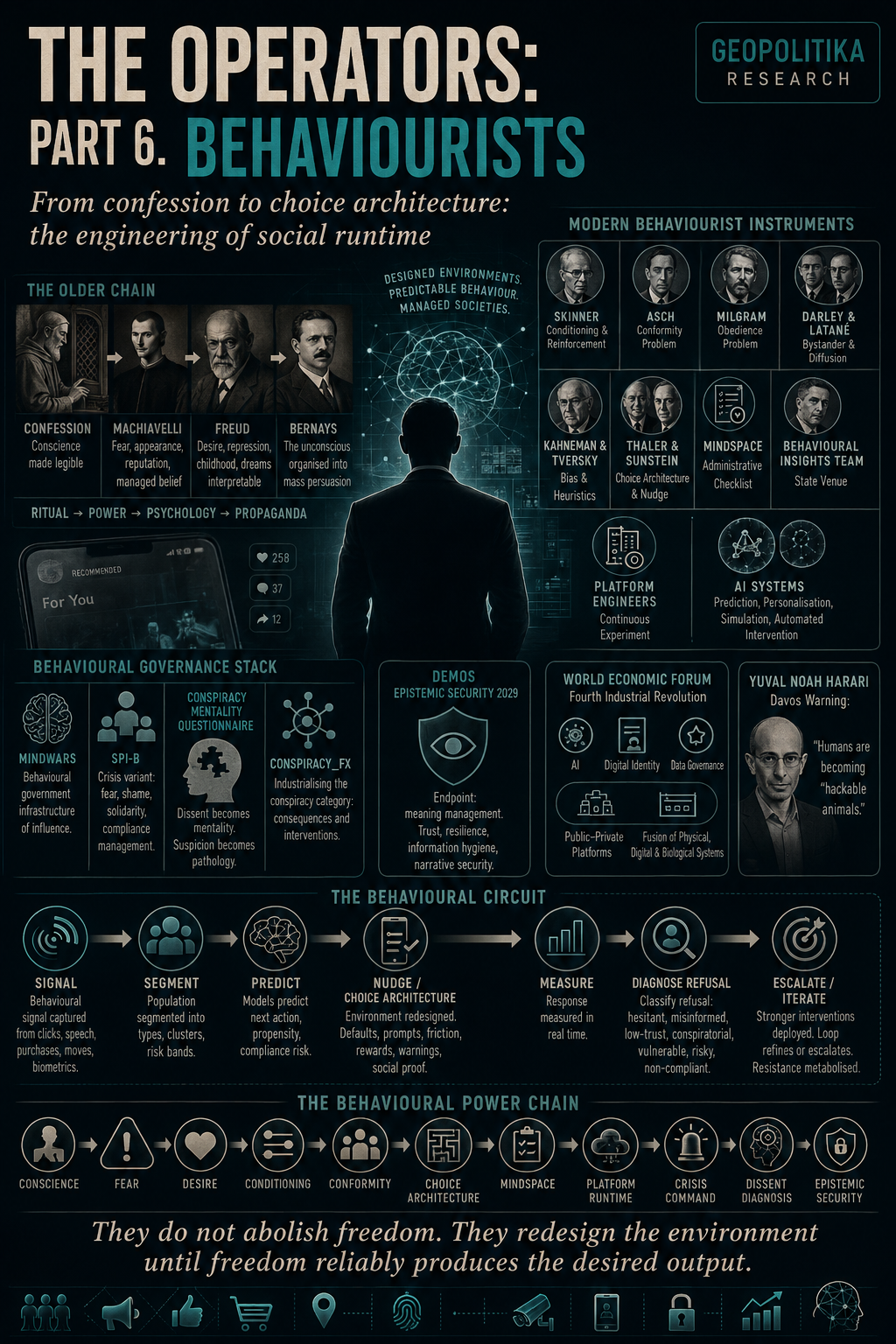
This function is older than the dashboard. Before the behavioural economist, there was the priestly function: ritual, sermon, sacred language, confession, absolution and moral discipline. Inner life became legible to authority. Guilt became governable. Obedience could be experienced as purification. Niccolò Machiavelli, in The Prince, secularised the problem: rule depended not only on force, but on fear, appearance, reputation, spectacle and managed belief. Sigmund Freud moved the confessional into the analytic room: desire, repression, childhood, dreams and symptoms became expert-interpretable material. Edward Bernays converted that premise into public relations: the unconscious could be organised into mass persuasion, consumer demand and political consent.
The modern Behaviourist inherits that older chain and gives it instruments. B. F. Skinner supplied conditioning and reinforcement. Solomon Asch supplied the conformity problem. Stanley Milgram supplied the obedience problem. John Darley and Bibb Latané supplied the bystander and diffusion-of-responsibility problem. Daniel Kahneman and Amos Tversky supplied bias and heuristics. Richard Thaler and Cass Sunstein supplied choice architecture and libertarian paternalism in Nudge. MINDSPACE supplied the administrative checklist. The Behavioural Insights Team supplied the state venue. Platform engineers supplied continuous experiment. AI supplies the next layer: prediction, personalisation, simulation and automated intervention.
This is where my prior Mindwars work plugs into the Operators map. Behavioural government does not only persuade. It classifies, scripts, nudges, tests, measures and corrects. MINDSPACE turns influence into infrastructure. SPI-B shows the crisis variant: fear, shame, solidarity, trusted messengers and compliance management under emergency conditions. The Conspiracy Mentality Questionnaire and the wider conspiracy-theory research stack show the resistance variant: dissent becomes mentality, suspicion becomes pathology, refusal becomes risk, and distrust becomes a category to be profiled rather than an evidentiary claim to be examined. CONSPIRACY_FX shows how that category is industrialised around consequences and interventions. Demos and its Epistemic Security 2029 frame show the endpoint: not merely behaviour management, but meaning management — trust, resilience, information hygiene and narrative security as policy objects. The World Economic Forum supplies the transnational integration idiom through the Fourth Industrial Revolution: AI, digital identity, data governance, public-private platforms and the fusion of physical, digital and biological systems. Yuval Noah Harari says the quiet part openly in his Davos warning: humans are becoming “hackable animals”. The operator language is softer. The operating implication is the same.
Strip away the branding and the behavioural circuit appears:
Signal → Segment → Predict → Nudge / Choice Architecture → Measure → Diagnose Refusal → Escalate / Iterate
A behavioural signal is captured. A population is segmented. A model predicts the next action. A choice environment is redesigned. A prompt, friction, reward, warning, ranking or default is inserted. The response is measured. If the subject complies, the loop refines. If the subject refuses, refusal is classified: hesitant, misinformed, low-trust, conspiratorial, vulnerable, risky, extremist, non-compliant. The failed nudge becomes evidence for a stronger intervention. That is the behavioural runtime’s self-healing function. It does not merely steer conduct. It metabolises resistance.
The larger chain is now clear:
Conscience → Fear → Desire → Conditioning → Conformity → Choice Architecture → MINDSPACE → Platform Runtime → Crisis Command → Dissent Diagnosis → Epistemic Security
The Behaviourists do not abolish freedom. They redesign the environment until freedom reliably produces the desired output.
1. The Old Function — Conscience, Fear, Desire
Behavioural governance did not begin with nudge units, platforms, A/B testing or artificial intelligence. Those are late instruments. The operator function is older: shape the person before the person experiences the choice as fully his own.
My first conscious encounter with this idea came early, through Aldous Huxley’s Brave New World Revisited. As a teenager, that recognition was sharpened by the evangelical Christianity winding its way into youth culture of the 1960s and 70s: concerts, singing, bands, youth groups, uplift, repetition, emotional synchronisation and belonging. Young people around me were engaged and entertained. I looked on fascinated through Huxley’s lens. The form was not coercive in any crude sense. It was affective conditioning: rhythm, group energy, moral language and emotional release organised into a system of belief and conduct.
The behavioural transition across time is not a list of professions. It is the movement of operating surfaces:
Conscience → Fear → Hidden Motive → Manufactured Desire
The institutional carriers changed: from Priest to Prince to Analyst to Advertiser.
Each governed a different interior. The priest governed guilt and moral self-inspection. The prince governed fear and calculation. The analyst governed hidden motive. The advertiser governed desire and aspiration. But priest and prince were never fully separate. The hinge is Constantine: a pagan imperial ruler who legalised and patronised Christianity, convened Nicaea, and helped turn a once-persecuted faith into a unifying imperial instrument. The point is not that Constantine invented Christian guilt, nor that he formally made Christianity Rome’s state religion. The point is that imperial power recognised the administrative value of a church capable of organising conscience, doctrine, hierarchy and mass belonging across a fractured empire.
The priest governed conscience. Ritual structured time. Liturgy structured attention. Sacred language created distance and dependence. Sermons translated doctrine into moral instruction. Institutional Christianity organised behaviour through guilt: original sin, personal sin, temptation, confession, penance and absolution. Confession made inner life speakable to authority: guilt, doubt, desire, temptation, shame, failure. But confession is not merely extracted. It becomes a primal need once guilt is induced. The institution names the fault, moralises the interior, and teaches the subject to experience hidden deviation as burden. Disclosure then feels like relief. Penance routinises correction. Absolution returns the subject to order. The mechanism does not require constant force because the subject learns to inspect himself. Inner monitoring becomes obedience before enforcement.
The priestly loop therefore runs:
Doctrine → Guilt → Confession → Penance → Absolution → Self-Monitoring
Doctrine names the fault. Guilt internalises it. Confession makes the interior legible. Penance routinises correction. Absolution returns the subject to order. Self-monitoring carries the institution inside the person before enforcement is required. The point is not to reduce religion to control. The point is institutional form. A priestly system can organise conduct by placing an authorised interpreter between the person and the highest moral order. Deviation becomes speakable. Correction becomes routine. Compliance can be experienced not as submission, but as purification.
The prince secularised the same function. Machiavelli treats rule in The Prince as a problem of force, fear, reputation, spectacle, necessity and appearance. His hard behavioural insight is that love is discretionary, while fear is controllable. Love depends on the subject’s continuing affection. Fear can be organised through penalty, uncertainty, example and visible consequence. The political loop becomes:
Threat → Appearance → Fear → Prudence → Obedience
Freud then modernises the confessional. Sin becomes repression. Temptation becomes desire. Confession becomes analysis. Priesthood becomes expert interpretation. The person is no longer transparent to himself. Dreams, slips, symptoms, childhood and sexuality become evidence from a hidden layer. The analyst occupies a new office: not custodian of salvation, but custodian of motive. The analytic loop is:
Confession → Interpretation → Insight → Adjustment
Bernays industrialises that premise. If Freud turns the unconscious into an interpretive field, Bernays turns it into an operating field. Public relations becomes applied psychology. Desire can be attached to products. Status can be attached to consumption. Political consent can be organised through symbols, aspiration, fear and herd behaviour. The Bernays cycle is:
Unconscious → Symbol → Desire → Campaign → Consent
This is where behavioural custody becomes recognisably modern. The old sermon becomes the campaign. The old ritual becomes the brand. The old confession becomes the survey, focus group and consumer profile. The governing trick is that management appears as liberation. The subject is invited to express himself, protect his family, signal sophistication, display care, belong to the future. Desire becomes the soft gate. Consent becomes engineered without feeling coerced.
This origin story matters because it prevents a false start. The Behaviourists are not born in the laboratory or the Cabinet Office. The platform later automates confession. The nudge unit formalises the choice environment. The crisis adviser refreshes fear. The Conspiracy Theory Theorist diagnoses refusal. But the old function is already present: define desired conduct, interpret deviation, supply correction, and make obedience appear as the subject’s own responsible choice.
2. Technical Capture — Skinner to Nudge to MINDSPACE
The technical turn begins when behavioural custody stops relying mainly on priestly authority, princely fear, analytic interpretation or mass persuasion, and starts presenting itself as experimental science. The subject is no longer only a soul, citizen, patient or consumer. He becomes a behavioural system: observable, conditionable, biased, conformist, suggestible, predictable and adjustable.
B. F. Skinner supplies the hard version. Behaviour is shaped by environment. Stimulus, response, reinforcement, punishment, reward schedule and conditioning become the vocabulary. The operator no longer needs to persuade the subject through argument. He can alter the contingencies around action: reward the desired behaviour, make the undesired behaviour costly, repeat the association, stabilise the habit. Behavioural engineering is born when freedom is treated as a poorly designed environment.
The mid-century social-psychology experiments add social pressure. Solomon Asch shows the pressure of the group: people may deny what they see when unanimous consensus tells them otherwise. Stanley shows the pressure of authority: ordinary subjects can be induced to perform acts they experience as wrong when instruction is staged through legitimate expertise, institutional setting and graduated commitment. John Darley and Bibb Latané show the diffusion of responsibility: people may fail to act not because they lack perception, but because social context disperses obligation.
Together these experiments enlarge the operator map. Behaviour is shaped by reward and punishment, but also by authority, consensus, role, setting, ambiguity, escalation and responsibility diffusion. The person is not an isolated rational chooser. He is a social animal reading cues: what do others believe, what does authority require, who is responsible, what will happen if I refuse, what does the setting define as normal?
This creates a technical loop:
Authority → Consensus → Role → Responsibility Diffusion → Compliance
That loop becomes central to later governance. The trusted messenger supplies authority. The social-norm comparison supplies consensus. The identity frame supplies role. The institutional setting supplies legitimacy. The staged sequence supplies gradual escalation. The dashboard, committee or platform rule diffuses responsibility. Nobody commands alone. The system produces the instruction
Daniel Kahneman and Amos Tversky soften the language but deepen the opportunity. Their work on heuristics and biases shows that human judgement is not the rational machine assumed by classical economics. People rely on shortcuts. They misread risk. They anchor on first numbers. They follow availability, framing and loss aversion. They can be moved by how a choice is presented, not only by what the choice contains.
This produces the next operator opening. If people are predictably irrational, then choice environments become policy instruments. Bias is not merely a flaw to be described. It is a lever to be used. The expert who maps cognitive limits can claim authority to redesign decisions in the subject’s own interest.
Richard Thaler and Cass Sunstein make that move explicit in Nudge. “Choice architecture” and “libertarian paternalism” supply the respectable policy form. The institution does not abolish choice. It arranges the default. It changes the order of options. It frames the risk. It inserts a reminder. It adds friction. It makes opting out harder than opting in. It sets the path of least resistance and calls the resulting movement freedom.
MINDSPACE then turns the book into an administrative mnemonic. Messenger, Incentives, Norms, Defaults, Salience, Priming, Affect, Commitment and Ego become the state’s behavioural control panel. Who delivers the message? What incentives shape response? Which norms are visible? Which default is pre-set? What is made salient? Which emotion is activated? What commitment is extracted? How is identity enlisted?
The importance of MINDSPACE is not that it discovered influence. Priests, princes, advertisers and propagandists had always known influence. Its importance is that it translated influence into public-administration procedure. The nudge was no longer only a theory of benevolent steering. MINDSPACE made it operational for government.
The Behavioural Insights Team completed the deployment. From the UK Government outward, behavioural science moved into tax compliance, organ donation, welfare, job-seeking, public health, pension enrolment, energy use, court attendance, vaccination messaging and service uptake. Randomised trials and evidence-based language supplied legitimacy. Small interventions were praised as cheap, efficient and humane.
The material anchor is simple. A tax letter becomes a behavioural instrument. A pension form becomes a default machine. An organ-donor register becomes a choice-architecture problem. An energy bill becomes a social-norm comparison. A vaccine reminder becomes a compliance prompt. A welfare portal becomes a behavioural funnel. The state does not merely communicate with citizens. It redesigns the conditions under which citizens act.
The new cycle runs:
Conditioning → Conformity → Obedience → Bias Mapping → Choice Architecture → MINDSPACE → State Nudge Unit → Behavioural Administration
This is the bridge to platforms. Once behaviour can be shaped by environment, consensus, authority and framing, and once digital systems can alter environments instantly for millions of users, the nudge becomes continuous. The old behaviourist needed a laboratory. The social psychologist needed a staged experiment. The state nudge unit needed a policy trial. The platform engineer needs only an interface and a feedback loop.
3. State Deployment — BIT and Behavioural Administration
The laboratory does not complete the behavioural turn. The state does.
The decisive movement is from behavioural science as explanation to behavioural science as administration. Once conduct can be conditioned, biased, socially pressured and choice-architected, government acquires a new operating question. Not only: what law should be passed? Not only: what service should be provided? But: what environment will produce the desired behaviour?
This is where BIT becomes central. Founded inside the UK government in 2010, it translated behavioural economics and social psychology into public-administration method: test, simplify, prompt, default, personalise, measure, iterate. Its EAST framework — make behaviour Easy, Attractive, Social and Timely — condenses the style: reduce hassle for compliance, make the preferred action visible, attach it to social proof, time the prompt, increase hassle for refusal.
A tax letter is no longer only a notice. It is a behavioural instrument. A pension form is no longer paperwork. It is a default machine. An organ-donor registration page is no longer only a consent interface. It is a message-testing environment. In one UK organ-donation trial, the Behavioural Insights Team worked with NHS Blood and Transplant, the Government Digital Service, the Department of Health and the DVLA to test different messages on a high-traffic government webpage.
The citizen becomes a behavioural subject inside the service channel. Where does he drop out? Which wording increases response? Which reminder moves payment? Which default reduces delay? Which identity prompt reduces fraud? Which online route is cheaper, faster and more measurable than the human route?
The state does not need every intervention to be dramatic. It needs cumulative channel capture. Tax, welfare, pensions, energy, health, courts, licences and registrations become behavioural surfaces. Each has a target behaviour: pay, enrol, attend, disclose, comply, register, conserve, accept, update, verify, renew. Each has an interface. Each interface can be redesigned. Each redesign produces data. Each dataset becomes evidence for the next redesign.
This is why form design matters. In the behavioural state, a form is not neutral bureaucracy. It is a decision environment. The order of fields, wording of warnings, visibility of alternatives, difficulty of appeal, pre-selection of options, account requirement, colour, typeface, icon, placement of the “continue” button and friction imposed on paper routes all shape conduct before any human official appears.
Online-first government intensifies this. Digital service design is sold as convenience, cost reduction and modernisation. But online-first design also changes the political form of access. The citizen is recoded as a user. The right becomes a workflow. The obligation becomes a portal. The analogue route becomes exception handling.
The Government Digital Service model centralises this channel logic through GOV.UK, design standards, service assessments and identity infrastructure. In its benign form, this can simplify access. In its harder form, it becomes behavioural migration: make the digital path fast, normal and mandatory in practice; make paper, phone and face-to-face routes slow, obscure or conditional.
The later identity layer makes the cycle explicit. Companies House has introduced identity verification for those setting up, running, owning or controlling UK companies, with compulsory verification for directors and people with significant control phased from November 2025. Comparable digital-director identification regimes have appeared elsewhere. The stated rationale is transparency and fraud prevention. The operator significance is different: legal-economic participation becomes dependent on successful passage through a digital verification workflow.
This is the rights-to-permissions edge of behavioural administration. A person does not simply become a director. He verifies. He obtains a code. He passes through a platform. He remains legible to the register. The legal status is no longer only a matter of filing. It is a processed identity event.
The same pattern appears across welfare and public-service systems. Eligibility becomes portal logic. Compliance becomes reminder architecture. Risk becomes scoring. Failure to respond becomes sanctionable signal. The human caseworker recedes. The workflow advances. A welfare portal can therefore function as both service and behavioural machine: it prompts, verifies, sequences, delays, records and conditions access.
The deployment layer completes what the technical layer began. Skinner made behaviour conditionable. Asch and Milgram exposed conformity and obedience. Kahneman and Tversky made judgement bias measurable. Nudge made choice architecture respectable. MINDSPACE made influence administrative. BIT and digital-service government make it operational.
The cycle runs:
Behavioural Insight → Service Design → Digital Default → Uptake Metric → Identity Verification → Permission Gate
This is behavioural administration: the quiet conversion of public services into conduct-shaping environments. The citizen still chooses, but the state increasingly designs the conditions, channels, defaults and credentials through which choice must move.
4. Platform Runtime — UX, Feeds, AI, Identity Gates
State behavioural administration still works through forms, letters, portals and service channels. The platform runtime goes further. It makes behavioural influence continuous.
The user arrives believing he is choosing: search, swipe, pause, buy, scroll, like, share, accept, decline. The platform receives behavioural data. Every action becomes signal. Every hesitation becomes evidence. Every interface can be altered. Every user can be segmented, ranked, prompted, rewarded, slowed, accelerated or redirected.
At the capture layer, conduct becomes data: attention, dwell time, location, contacts, search history, purchase pattern, device use and social graph. At the ranking layer, the system decides what becomes visible. At the recommendation layer, it feeds the user a future before he consciously asks for it. At the prompt layer, notification, badge, alert, countdown, streak or suggested reply supplies the next cue. At the measurement layer, the system learns whether the intervention worked. At the personalisation layer, the next environment is adjusted.
UX design is the behavioural surface. It determines what is easy, hard, hidden, frictionless, embarrassing, delayed, salient or obscure. A button is not just a button. It is a behavioural instruction. A menu is not just a menu. It is a hierarchy of permitted action. A default is not neutral. It is the system’s preferred outcome pre-loaded into the user’s path.
Dark patterns, , as the OECD calls them, expose the runtime without its benevolent mask: interface designs that steer, deceive, coerce or manipulate users through the way choices are presented. Forced continuity, hidden cancellation, confirm-shaming, pre-selected consent, confusing privacy settings, infinite scroll, autoplay, variable rewards and scarcity countdowns all show the same operator logic: make the preferred behaviour effortless; make refusal difficult, costly or psychologically uncomfortable.
The polite version is choice architecture. The predatory version is dark pattern. The function is behavioural steering.
Recommender systems deepen the shift because the platform no longer merely displays material. It orders reality. The feed does not simply reflect preference. It trains preference. Ranking decides which claim becomes visible, which speaker appears relevant, which outrage is amplified, which product is normalised, which source is trusted, which behaviour appears popular, which worldview acquires momentum. The EU Digital Services Act recognises recommender systems as part of the regulated platform environment, with transparency obligations and systemic-risk duties for very large platforms and search engines.
This is where trust-and-safety becomes behavioural administration by private infrastructure. Terms of service, community standards, monetisation rules, recommendation settings, warning labels, account strikes, reach reduction and trusted-source elevation are not merely moderation tools. They are conduct-shaping instruments. They define which behaviours are rewarded with visibility and income, which are slowed, labelled, hidden or removed.
The platform governs in gradients. It need not ban everything. It can rank down, shadow, demonetise, friction, label, throttle, age-gate, region-lock, require verification, suspend features or alter recommendations. The user experiences this as a product environment. The operator sees a behavioural control surface.
This is also where Yuval Noah Harari’s “hackable animals” language and the World Economic Forum vocabulary of the Fourth Industrial Revolution matter because they make the platform runtime explicit. Once bodies, choices, emotions, movements and preferences are converted into data streams, the person becomes readable as a system. The WEF idiom is softer: AI, data governance, digital identity, smart cities, public-private partnership, platform coordination and the fusion of physical, digital and biological systems. The advertised frame is opportunity and adaptation. The operator frame is integration.
AI intensifies the runtime because prediction moves closer to intervention. AI systems can generate tailored language, automate moderation, simulate responses, personalise prices, rank workers, triage welfare cases, forecast risk, adapt learning pathways, supply synthetic companions and tune persuasion to individual susceptibility. Behavioural governance becomes less visible because it arrives as service: relevance, safety, convenience, optimisation, assistance.
The platform runtime feeds back into the state through identity gates. Digital identity standards and systems are framed around proofing, authentication, federation, security, privacy and access to services. The operator significance is that identity becomes infrastructure for permission. A person does not simply enter a service. He proves, links, authenticates, matches, verifies and renews.
The UK example is GOV.UK One Login, which allows users to sign in, access services linked to the account and prove identity for some government services. Its app description states that it can be used to prove identity by matching a face to photo ID for access to some services. This is not only a login system. It is the beginning of a common access layer.
Once identity verification becomes the rail for tax, welfare, health, business registration, banking, directorship, travel, professional licensing, education, grants and procurement portals, the state does not need to announce a universal gate in one stroke. It can attach verification to necessary functions one sector at a time. Each attachment appears practical. Together they form a mesh.
The state-platform cycle runs:
Behavioural Data → Ranking / Recommendation → Interface Intervention → Trust-and-Safety Rule → Identity Verification → Permission Gate
The platform runtime does not abolish choice. It surrounds choice with measurement. It does not announce coercion. It arranges the environment until the desired conduct emerges as convenience, safety, relevance, belonging or responsible participation. Its deepest ambition is not simply to predict what the person will do next. It is to build the world in which the predicted action becomes the easiest action to take.
5. Crisis Behavioural Command
The behavioural runtime becomes most visible during crisis. In normal times, behavioural governance is sold as convenience, service design, personalisation and efficiency. In crisis, the same machinery is activated as command: fear, shame, incentive, warning, label, score, default, mandate, exclusion.
The operator chain cycles through fear:
Fear → Compliance → Fatigue → Deviation → Re-Fear → Escalation
At the fear layer, danger is made vivid. At compliance, restriction becomes prudence. At fatigue, the spell weakens: people compare claims with experience, notice contradictions, recover appetite for normal life, or resist. At re-fear, a renewed threat signal appears: new variant, model, heat record, financial warning, extremist threat, misinformation panic, hospital metric or child-risk frame. At escalation, refusal becomes evidence that stronger architecture is needed.
Pandemic governance made the pattern explicit. Public-health messaging did not merely inform. It managed conduct: stay home, mask, test, isolate, distance, report symptoms, accept vaccination, avoid gatherings, distrust dissent, follow changing guidance. The citizen was not addressed only as a patient or rights-bearing adult. He was addressed as a behavioural risk surface. His fear, trust, altruism, resentment, fatigue and conformity became policy variables.
This is where SPI-B—the Independent Scientific Pandemic Insights Group on Behaviours—enters the operator map. Its formal role was to provide social and behavioural science advice to the Scientific Advisory Group for Emergencies (SAGE) the UK government described SPI-B as providing advice aimed at anticipating and helping people adhere to interventions recommended by medical or epidemiological experts.
The official documents make the function plain. SPI-B’s March 2020 paper, Options for increasing adherence to social distancing measures, stated that “A substantial number of people still do not feel sufficiently personally threatened” and that the perceived level of personal threat needed to be increased among the complacent using “hard-hitting emotional messaging.” The same paper recommended behaviourally specific guidance, personalised advice, duty to protect others, social approval for desired behaviours and consideration of compulsion.
That is not an external interpretation. It is the behavioural text itself: specify the behaviour, increase perceived threat, invoke responsibility to others, use social approval, tailor messages, and consider compulsion. The crisis state was not merely publishing information. It was designing adherence.
The controversy lies in the gap between the record and later responsibility management. In 2022, Professor Ann John, co-chair of SPI-B, told the UK Parliament’s Science and Technology Committee that the fear-messaging option had been part of an evidence review before lockdown, not a continuing programme of advice. She said later SPI-B papers advised against that sort of fear messaging because it did not work, stressing rationales, consistency, uncertainty, enabling behaviours and community champions.
The testimony does not dissolve the issue. It shows the operator problem. SPI-B contained experts who distinguished realistic risk communication from crude fear control. Yet public emotion had already entered the policy machine. HART’s 2024 critique, “Nudge Denialism,” treats the later distancing as part of the controversy.Stephen Reicher, John Drury, Susan Michie and Robert West argued in the BMJ that government fear campaigns went against the scientific advice they said had been given; The Telegraph had reported earlier insider regret about fear tactics, including descriptions of them as “unethical” and “totalitarian.”
The operator point is cleaner than assigning ownership of every poster: crisis government had acquired a behavioural command vocabulary. The population was not only a public to inform. It was an adherence problem to manage.
Fear is the ignition mechanism, but also the renewal mechanism. The first fear surge produces attention, compliance and deference. But fear decays. The behavioural operator adds shame, solidarity and incentive. The non-compliant person is selfish, unsafe, irresponsible, misinformed or harmful. The compliant person is caring, informed, scientific, pro-social and safe. Conduct becomes moral identity.
The vaccine nudge shows the shift from persuasion to permission, and from consent to compliance: information, reminders, social-norm messaging, convenience architecture, fear of harming others, access benefits, employment pressure, travel conditions, mandates, then digital proof. The World Health Organization treated vaccine acceptance and uptake as behavioural questions, while nudge studies tested text-message interventions to increase vaccination uptake.
At the soft end, this is nudging. At the hard end, it is conditional access. In England, COVID-19 vaccination became a condition of deployment for health and social-care settings before being revoked in March 2022. Once the practical choice becomes “conform or lose your job”, the pretence of optionality collapses. The form may still say consent. The environment says comply or be excluded. That is not informed consent in any meaningful behavioural sense. It is coerced uptake administered through employment, access and reputation.
Misinformation labels extend crisis command into speech. A claim is not only wrong; it becomes a behavioural hazard. The platform, state agency or expert body can classify content as misleading, reduce reach, attach warnings, elevate trusted sources, demonetise speakers, close accounts or redirect searches. Information becomes risk. Disagreement becomes a moderation problem.
The crisis cycle runs:
Crisis Frame → Fear Surge → Behavioural Message → Compliance Metric → Fatigue / Deviation → Re-Fear → Dissent Diagnosis → Access Condition → Durable Precedent
Crisis command cannot rely on fear forever. Fear has a half-life. Once the public compares message with experience, the system needs another explanation for non-compliance. Dissent diagnosis supplies it. Refusal is no longer treated primarily as a signal that policy may be wrong, trust breached, evidence contested or authority overreached. Refusal becomes a symptom to be corrected.
The crisis does not create the behavioural runtime. It accelerates it. The nudge becomes duty. The dashboard becomes threshold. Advice becomes gate. Dissent becomes risk.
6. Dissent as Diagnosis
Crisis command exposes the behavioural runtime. Dissent diagnosis stabilises it.
The system cannot rely on nudges alone. Some people do not move. They refuse the prompt, question the messenger, reject the frame, notice contradictions, compare institutional claims with institutional history, or ask who benefits. At that point behavioural governance requires a second function: not only shaping conduct, but classifying refusal.
As documented in the Mindwars series of articles—e.g. Mindwars: The Consequences Factory – The CONSPIRACY_FX Hub—this is where the Conspiracy Theory Theorists (CTTs) enter the operating map.Their surface claim is scientific: study conspiracy belief, measure its antecedents, assess its consequences, reduce its harms. Their operator function is different: convert distrust of power into a measurable psychological object. The claimant recedes. The claim recedes. The believer becomes the object. The political question —“Is this true?”—is replaced by the behavioural question—“What kind of person believes this?”
The hinge instrument is the Conspiracy Mentality Questionnaire. Its five items concern hidden important events, politicians’ motives, government monitoring, secret activities behind events, and secret organisations influencing political decisions. Its operator move is simple: suspicion of secrecy, hidden motives, surveillance, covert coordination and secret influence is abstracted from evidence and converted into a trait measure. Distrust becomes portable. Context is thinned. The institution, claim, history, document trail, incentive structure or prior misconduct is pushed offstage. What remains is a score.
The behavioural conversion is:
Claim → Believer → Trait → Risk Category
Once the trait exists, the machinery expands. The CTT does not need to adjudicate each disputed claim. He can profile the population that doubts. The vaccine sceptic, climate dissenter, lockdown critic, institutional sceptic, platform dissident or digital-ID refuser becomes part of a mapped behavioural cluster. The question becomes how that cluster correlates with trust, compliance, policy support, prejudice, extremism, democratic behaviour or public-health uptake.
Academic reserchers like Karen Douglas and CONSPIRACY_FX industrialise this layer. The University of Kent describes Douglas as director of the ERC-funded CONSPIRACY_FX project; The project focuses on the effects of conspiracy theories in politics, vaccination and climate change, and on consequences for persons who spread them, including politicians and elites. The pipeline moves from antecedents to harms to interventions: first the psychological profile of the conspiracy-minded subject; then the catalogue of negative consequences; then the prescribed cure — prebunking, inoculation, engagement, correction, trust repair.
The chain is clean:
Pathologise → Correlate → Inoculate → Manage
This is not merely academic classification. It is behavioural administration. The dissenting public is segmented. Its harms are itemised. Its correction tools are designed. The state, platform, NGO, public-health agency or science-communication unit receives a map: who doubts, why they doubt, what harms their doubt is associated with, and which intervention may move them.
The deeper problem is asymmetry. The CTT lens is directed downward at publics and sideways at dissident networks, but rarely upward at institutions with comparable force. Citizens are treated as motivated reasoners. Institutions are treated as imperfect communicators. Public scepticism is psychologised. Institutional failure is contextualised. Distrust is measured as pathology; trust is treated as the healthy baseline.
That asymmetry makes the science politically useful. If citizens do not believe the message, failure can be located in the receiver: low trust, conspiracy mentality, populist resentment, misinformation exposure, identity-protective cognition. Reform becomes secondary. Audit becomes optional. Disclosure becomes futile. The budget flows to messaging, segmentation and behavioural correction.
This is where prebunking and psychological inoculation enter the runtime. Sander van der Linden and Stephan Lewandowsky sit in this adjacent misinformation-management layer. In the benign frame, inoculation builds resilience before false claims take hold. In operator terms, it is pre-emptive cognition management: expose the public to weakened versions of anticipated narratives, teach the preferred interpretation of manipulation tactics, and reduce susceptibility before dissenting claims arrive.
This is not the same as ordinary education. Education equips a person to test claims. Prebunking can become a way to pre-classify the rhetorical forms by which future claims will be dismissed. When joined to platform labels, trusted-source elevation and reach reduction, inoculation becomes part of a larger behavioural perimeter.
Trust restoration closes the loop. The institutional objective is not simply truth. It is restored confidence in selected authorities, experts, platforms and policy channels. Low trust becomes a problem to be repaired. High trust becomes an outcome to be measured. The question shifts from whether institutions earned trust through performance, candour, accountability and correction, to which communication strategy can restore deference.
The cycle runs:
Scepticism → Conspiracy Mentality → Harm Correlation → Prebunking / Inoculation → Trust Restoration
The CTT layer belongs inside the Behaviourists map because it is not just a literature about eccentric beliefs. It is a resistance-management system. The old priest asked the sinner to confess. The CTT asks the sceptic to reveal his mentality. The platform labels the content. The nudge unit adjusts the message. The trust expert measures recovery. The epistemic-security operator prepares the next perimeter.
Dissent remains formally permitted while being converted into an object of behavioural management. The citizen may still disagree. But his disagreement is no longer encountered first as a claim about reality. It is encountered as a symptom, a score, a cluster, a vulnerability, a contagion pathway, a moderation problem or a threat to trust.
The CTT layer completes the behavioural circuit. Behaviourists do not only design environments for compliance. They design taxonomies for non-compliance. The system nudges the desired conduct, measures the response, diagnoses the person who refuses the nudge, and uses that diagnosis to justify the next intervention.
7. Structural Diagnosis — Social Controllability Custodians
The Behaviourists are the social controllability custodians of the Operating Class.
Their function is not to abolish freedom. That would be too visible, too crude and too politically expensive. Their function is to redesign the environment until freedom reliably produces the desired output. The subject still chooses. But the field of choice has been engineered: the default pre-selected, the refusal path made difficult, the desired option made salient, the warning attached, the ranking adjusted, the peer norm displayed, the credential required, the gate conditioned.
This is the modern behavioural settlement:
Freedom remains formal. Behaviour becomes managed.
The Behaviourist does not usually begin with prison, police or statute. He begins with environment: form, screen, feed, prompt, message, friction, incentive, identity check, risk score, dashboard and notification. The citizen is not ordered in the first instance. He is guided, nudged, ranked, warned, shamed, reassured, personalised and optimised. Only later does the soft architecture harden into permission.
The lineage is now visible. The priest made conscience legible. The prince made obedience prudent. Freud made desire interpretable. Bernays made desire steerable. Skinner made behaviour conditionable. Asch made consensus measurable. Milgram made staged authority visible. Darley and Latané made responsibility diffusion legible. Kahneman and Tversky made judgement bias map-readable. Nudge made manipulation respectable. MINDSPACE made influence administrative. BIT made it deployable. Platforms made it continuous. SPI-B made it operational under crisis. CTTs made refusal diagnosable. Epistemic-security operators made the meaning environment securitisable.
The core circuit is:
Signal → Segment → Predict → Nudge / Choice Architecture → Measure → Diagnose Refusal → Escalate / Iterate
At the signal layer, behaviour becomes data. At segmentation, populations become behavioural groups. At prediction, likely action becomes model output. At the nudge layer, the environment is redesigned. At measurement, response is scored. At diagnosis, refusal becomes a category. At escalation, failure becomes evidence for stronger architecture.
This is the runtime’s self-healing function. Compliance validates the model. Refusal validates the need for more model. The compliant subject proves the intervention works. The resistant subject proves that distrust, misinformation, low uptake, vulnerability or deviance must be managed. The loop cannot lose because both obedience and refusal become inputs.
That is why the Behaviourists matter. They do not merely persuade. They change the conditions under which persuasion is necessary. They make non-compliance inconvenient before it becomes illegal. They make refusal embarrassing before it becomes punishable. They make analogue life slow before it becomes impossible. They make dissent less visible before it becomes forbidden. They make surveillance useful before it becomes mandatory. They make trust measurable before they make distrust pathological.
Their preferred language is benevolent: empowerment, choice, safety, wellbeing, trust, relevance, convenience, inclusion, resilience, sustainability, harm reduction. Their operating effect is narrower: make conduct observable, make preference predictable, make deviation costly, make compliance measurable, and make the next intervention easier to justify.
The crisis cycle gives the system its installation windows. Fear opens the door. Fatigue threatens the installation. Re-fear renews the mandate. Each crisis leaves behind behavioural residue: a dashboard, login, compliance norm, data-sharing agreement, moderation rule, digital credential, public-private taskforce, form redesign, risk model, new channel default. The emergency passes. The architecture remains.
The CTT layer supplies the runtime’s resistance vocabulary. Those who reject the nudge are not simply citizens making claims. They become low-trust subjects, conspiracy-minded profiles, misinformation vectors, denialists, extremists, vulnerable users, radicalisation risks or epistemic threats. The question shifts from “Is the claim true?” to “What explains this refusal?”
The platform-state adds the access layer. The older citizen entered public life with standing claims: speak, move, trade, work, worship, assemble, refuse, apply, register, appeal. The platform-state citizen passes through workflow: identity matched, risk flag cleared, eligibility confirmed, form accepted, credential valid, account active, behaviour compliant. What was once a right of access becomes a successful transaction inside an interface.
This is the rights-to-permissions cycle. A right is presumed. A permission is checked. A right belongs to the person before the transaction begins. A permission is granted only after the system verifies identity, eligibility, status, risk, compliance and channel. Once public administration is platformised, rights appear as workflow outcomes.
The Behaviourist is not one profession. He is a placement type: behavioural economist, public-health advisor, nudge-unit director, UX designer, growth engineer, trust-and-safety official, data scientist, AI ethicist, welfare-system designer, tax-form architect, platform moderator, climate-behaviour consultant, financial-risk modeller, conspiracy-theory researcher or epistemic-security strategist. The titles differ. The operator function persists.
The social runtime has a simple logic:
Observe → Predict → Shape → Measure → Diagnose → Gate
This is the final verdict. Part 5 showed how the body became classifiable. Part 6 shows how the conduct of the classified body becomes administrable: a world where the person remains formally free while his environment is continuously arranged, his refusal continuously interpreted, and his access increasingly conditioned. Freedom remains formal. Behaviour becomes managed. Rights become permissions.
The addenda now split the lineage:
- Addendum 6a maps the historical Behaviourists who supplied the grammar: conscience, fear, motive, desire, conditioning, conformity, obedience and default.
- Addendum 6b maps the modern Behaviourists who operate the machinery: nudge units, behaviour-change frameworks, crisis advisory cells, persuasive interfaces, misinformation managers, dissent-diagnosis systems and digital-permission meshes.
The Behaviourists do not remove the cage. They redesign the room so the preferred exit feels like the only rational choice.
Published via Mindwars Ghosted.
Overlords: Mapping the Operators of reality and rule.
—
Author’s Note
Produced using the Geopolitika analysis system—an integrated framework for structural interrogation, elite systems mapping, and narrative deconstruction.
Mindwars Ghosted is an independent platform dedicated to exposing elite coordination and narrative engineering behind modern society. The site has free access and is committed to uncompromising free speech, offering deep dives into the mechanisms of control. Contributions are welcome to help cover the costs of maintaining this unconstrained space for truth and open debate.