The Operators: Part 5 — The Biopolitical Custodians
How risk frames, emergency law, and health procurement convert “public health” into population management—soft guidance first, hard controls after.
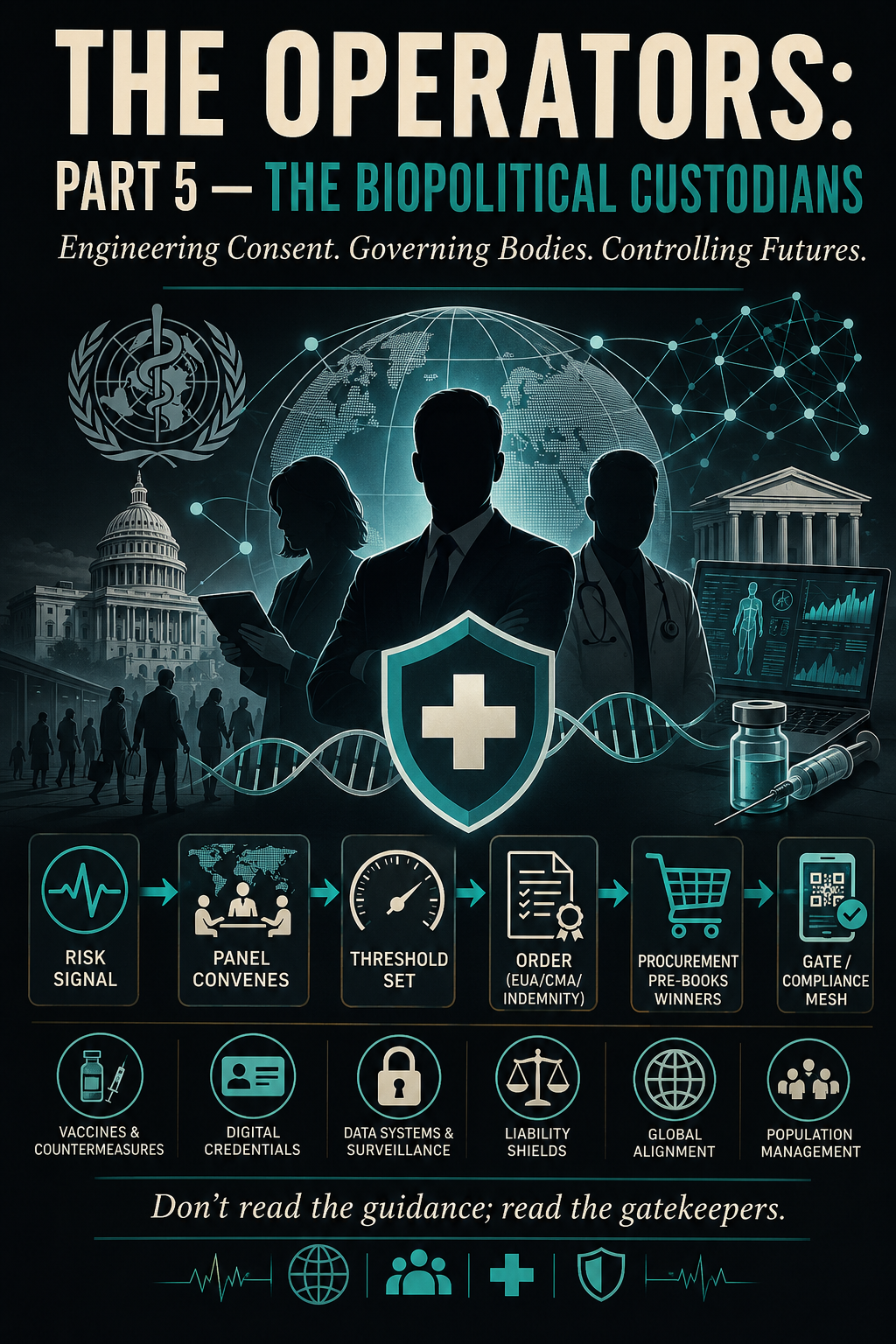
Overlords 8 and Operators Parts 1-4 have already mapped the Neocons, Legal Guild, Financial Governors, and the Policy Framers. The same cluster of actors has been tracked working doctrine in national security, drafting statutes and model laws, setting rails/lists/weights in finance, and manufacturing “consensus” through think tanks. The lineage is continuous; the venue now shifts to public health and bio-governance.
Here the substrate is bodies. Biopolitics, in this series, is not a theory slogan but a venue description: classification, measurement, and conditional permission over bodies—movement, work, schooling, finance. Emergency becomes the standing venue; risk thresholds operate as rolling legal standing.
Strip back the branding, and the circuit reveals itself. A risk signal fires. A panel convenes and crystallises it into a threshold. Regulators translate that threshold into orders, often laminated with liability shields. Procurement pre-books the winners. Passports and API checks turn “guidance” into gates at workplaces, schools, and borders. Finally, the compliance mesh—dashboards, renewal schedules—locks the loop in place. This is the machine in motion:
Risk → Panel → Threshold → Order (EUA/CMA/indemnity) → Procurement → Gate/Compliance Mesh.
The subject is not speeches, but this chain that converts a model output into a rule that governs a turnstile. Names, seats, lineage live in Appendices 5a/5b; this part maps the mechanism.

1. Public Health vs Runtime
Public health speaks in soft language: care, safety, equity, solidarity. Its operational layer is harder-edged: thresholds, liability shields, procurement terms, credential fields, renewal schedules and gates. The gap between those two layers is the working space of this chapter. The stated aim is protection; the operational output is control over when rules fire, who carries risk, which products move, and which bodies pass.
This is not a claim that public health is fake, or that all public-health action is merely control by another name. The authority of public health was built against a real nineteenth-century backdrop: industrialisation, enclosure, mass urban migration, overcrowded housing, workhouses, prisons, transported convicts, polluted rivers, contaminated drinking water, raw sewage in streets and waterways, dead animals in roads and streams, and horse and human manure underfoot. Cities became disease engines. Bodies were compressed into factories, slums, ships, barracks, poorhouses and prisons.
In that world, the great public-health victories were overwhelmingly material. Clean water mattered. Sewage systems mattered. Waste removal mattered. Food safety, ventilation, housing reform and labour protections mattered. The breaking of faecal–oral disease cycles owed more to drains, pipes, filtration, refuse collection, nutrition and less crowded living conditions than to heroic medical intervention. Medicine itself was still uncertain and often dangerous; doctors continued to prescribe mercury, arsenic and other toxic substances as cures. The later myth of medical triumph tends to back-project modern clinical prestige onto a period when sanitation and environmental reform did much of the real work.
Those victories were genuine. They became the moral capital on which later public-health authority rests. But once the great infrastructural gains were banked, the centre of gravity shifted. The language remained familiar—protect the vulnerable, build resilience, follow the evidence—while the operating machinery changed. The key artefacts were no longer only drains, safety codes and clinic access. They became risk thresholds, emergency authorisations, indemnity clauses, advance-purchase agreements, data standards, dashboards and digital passes wired into daily life. The system slid from drains and factory floors to committees, contracts and checkpoints.
That slide did not come from nowhere. QR codes, emergency orders and interoperable credentials are recent instruments, but the governing habit behind them is older. Public health becomes biopolitical when it stops dealing only with the conditions of life and begins sorting populations by risk, fitness, eligibility, compliance and projected burden. The body is no longer only treated; it is classified. The person is no longer only a patient; he or she becomes a member of a risk group, a compliance category, a statistical cohort, a mobility condition, a procurement justification or a gatekeeping problem.
The examples in this chapter are used as pattern anchors, not as proof of command, capture or intent. They show how coordination roles, personnel bridges, standards, data systems and guidance channels function when public protection becomes infrastructure. The question is not whether every participant shares a plan. It is whether the machinery repeatedly converts protection claims into thresholds, contracts, credentials and gates.
The function test is simple. Ignore the adjectives and ask four questions:
- What number triggers action, and who can change it?
- What liability is waived, and for how long?
- What do the purchasing terms lock in, and how costly is reversal?
- What does the checkpoint actually read?
Once those questions are answered, the real policy is visible. The rest is narration layered on top. The branding says “public health”; the runtime looks more like access control serviced by procurement. The correct objects of analysis are thresholds, contracts and credential schemas, not press lines. Don’t read the press conference; read the protocol.
2. The Seedbed — Eugenics to Population Programmes
Biopolitical administration long predates dashboards, QR codes and interoperable credentials. Earlier versions ran on paper: clinic files, pedigree charts, welfare forms, immigration categories, school records, medical registers and model statutes. The instruments were slower, but the logic was recognisable: use health, science and administrative language to classify populations and act on bodies.
The pattern is stable enough to state in one line:
Doctrine → Society / Committee → Model Law → Programme
First comes doctrine. “Racial hygiene,” “degeneration,” “feeblemindedness,” “fitness,” “overpopulation” and “population pressure” were framed as technical problems, then dressed in tables, charts, journals, conferences and institutional language. Figures such as Francis Galton, Karl Pearson, Charles Davenport and Madison Grant supplied intellectual architecture; eugenics societies, record offices, advisory bodies, foundations and medical schools supplied transmission.
Doctrine then hardened into tools: registries, pedigree charts, classification manuals, psychometric tests and “fitness” assessments. Once those artefacts existed, committees and boards could translate them into model statutes: sterilisation laws, marriage restrictions, immigration quotas and later family-planning frameworks tied to demographic targets. The final step was programmatic. Health departments, welfare boards, courts and clinic networks turned the models into quotas, targets, budgets and routine interventions.
Early twentieth-century eugenics is the cleanest template because it exposes the machinery without later digital camouflage. Scientific claims about hereditary “defect” produced compulsory-sterilisation lists, racial-hygiene courts, intake forms, marriage laws, immigration exclusions and institutionalisation regimes. Official language spoke of fitness, burden and social hygiene. The mechanism was classification plus intervention, often irreversible, driven by committee criteria and budget lines, with doctors, judges and administrators executing what doctrine and model law had already authorised.
The same boundary-setting logic also operated inside medicine itself: define the legitimate practitioner, define the legitimate evidence base, and exclude rival systems from licensure, funding and institutional recognition. The Flexner settlement, backed by Carnegie and Rockefeller philanthropy, narrowed medical education around university-linked hospitals, laboratory science and licensing-board alignment. Eclectic, homeopathic and community schools — including most Black medical colleges in the United States — were pushed out or closed. Critical histories describe this settlement as “Rockefeller medicine”: a professional monoculture under the banner of scientific reform.
After World War II, the branding changed. Eugenics became toxic; the new vocabulary was population control, family planning, development, reproductive health and rights. The claim here is not identity: modern reproductive-health programmes are not simply eugenics renamed. The claim is continuity of administrative mechanism. Doctrine still flowed through commissions and conferences, hardened into model policies, and was operationalised through health ministries, NGOs, conditional aid, clinic funding and performance targets. The pipeline remained recognisable, even as language, law and moral justification changed.
The point is not to replay moral shock or collapse unlike cases into one category. It is to isolate mechanisms that persist: standard-setting that narrows legitimate practice, registries that define classes of people, committees that convert doctrine into rules, and programmes that operationalise those rules through budgets and quotas. Appendix 5a carries the names, institutions and historical receipts. This section keeps the mechanism in view.
3. The Modern Circuit — From Risk Signal to Gate
The earlier pipeline ran on heredity charts, clinic files, registries and model statutes. The modern version runs on risk metrics, technical standards, procurement contracts, APIs and credential fields. The structure is recognisable: doctrine, committee, rule, programme. Only the instruments have changed.
In today’s health venue, the circuit looks like this:
Risk signal → Panel → Threshold → Order → Procurement → Credential → Gate → Dashboard / Renewal Mesh
A risk signal fires: a novel pathogen, hospital-capacity alarm, model output, variant flag, ICU threshold or composite threat index. The raw data can be thin or thick. What matters is that it is framed as urgent, directional and actionable.
A panel then converts that signal into a threshold: a number, tier, colour band or emergency level. R₀ above X. Positivity above Y%. Beds below Z%. Emergency level orange or severe. The threshold becomes the switch. On one side, ordinary rules apply. On the other, emergency powers and exceptional measures become available.
A regulator translates the threshold into orders: Emergency Use Authorisations, Conditional Marketing Authorisations, temporary directions, interim rules, mandates, exemptions and enforcement guidance. Liability shields often arrive at the same time: immunity clauses, indemnities, “good-faith public health action” protections, or diversion of claims into narrow compensation schemes. Action first; contest later.
Procurement follows. Governments sign advance-purchase agreements, volume guarantees, framework contracts and long-window supply arrangements. Winners are pre-booked; alternatives are sidelined. Reversal is no longer only a scientific question. It becomes a question of sunk payments, penalty clauses, delivery schedules, stockpiles and political exposure.
Credentials and passports convert the package into everyday enforcement. What began as “guidance” is encoded into passes, QR codes, HR forms, travel APIs, school enrolment conditions, workplace clearance systems and venue rules. Employers, airlines, universities and ticketing platforms do not debate the model. They check whether the relevant field is valid. Access becomes contingent on the right entry in the right schema.
Finally, dashboards and renewal schedules keep the loop alive. Case counts, coverage rates, occupancy graphs, adverse-event summaries and preparedness indicators are refreshed on a fixed cadence. Committees reconvene. Declarations are reviewed and extended. The extraordinary becomes routine through metrics and meetings.
The outcome is simple: reversal costs rise; access is conditioned.
The circuit does not run on speeches. It runs on tools. In this venue, the toolkit falls into four rows:
Frame → Format → Enforce → Maintain
Frame establishes necessity. R₀ dashboards, epidemic curves, ICU strain, variant flags, horizon-scanning and One Health language create the emotional and epistemic backdrop: there is a crisis, it crosses domains, and only coordinated technocratic action can manage it.
Format encodes necessity. Data standards, implementation guides, certificate schemas, health records and travel credentials decide what can be recorded, retrieved, ignored or checked. HL7/FHIR profiles, ICAO visible digital seals, EU digital certificates, WHO certificate templates, W3C verifiable credentials and national eHealth schemas all do similar work: they define fields, validity windows, issuers, signatures and trust frameworks.
Enforce makes the format bite. HR systems, airline APIs, border services, school portals, venue apps and workplace clearance tools read the fields. Staff do not adjudicate the policy; they follow the system. A missing, expired or non-compliant field becomes a practical exclusion.
Maintain stops the circuit from winding down. Definitions are revised, baselines reset, safety reviews scheduled, emergency declarations renewed, dashboards refreshed and meetings calendared. The system acquires rhythm. Even when acute metrics calm, the institutional habit is to convene, assess and tweak.
The toolkit grips reality through interfaces: standards, vendors and media. Standards define the grammar. Vendors turn the grammar into infrastructure. Media synchronises perception with the rollout calendar.
The handoff is simple:
Standard → Procurement spec → Vendor default → Gate behaviour
A field is added to a WHO certificate template, IHR annex, ICAO specification, HL7/FHIR guide or national eHealth schema. Procurement teams write that field into tenders as a requirement for interoperability, preparedness, resilience or compliance. Vendors build it into products as a default. Airlines, employers, schools, hospitals, border systems, venues and platforms deploy those products and read whatever the field says.
The same pattern is visible in medical regulation. Public protection becomes a standardising claim; standardising claims become tools, records, guidance, portals, information exchanges and capacity-building programmes. IAMRA’s Physician Information Exchange turns cross-border mobility, sanctions and fraudulent-application risk into a member-only information problem. Its AI Working Group turns emerging medical-technology uncertainty into principles-based guidance for regulator consultation. FSMB’s domestic infrastructure and IAMRA’s international network do not need to abolish national authority. They teach dispersed gates to read the same grammar.
Media does not write the standards or contracts. It furnishes timing and moral cover. Explainers, fact sheets, expert interviews, prebunking campaigns and human-interest stories make technical decisions appear inevitable, compassionate and pre-vetted. Resistance can be pre-labelled as misinformation, selfishness or public harm before the gate is switched on.
No single minister or CEO needs to announce a new access category. Once the standard exists, procurement adopts it and vendors ship it, behaviour at the gate can change without a visible political fight. The policy has moved from speech into interface.
4. Risk Transfer and Self-Healing
The modern circuit does not only decide what gets built or which gates read which fields. It also decides who carries the risk when the system fails. In this venue, legal, financial and commercial risk can be lifted off manufacturers and routed onto states, taxpayers and the public.
The structure has three layers:
Liability shield → Contract defence → Sovereign collateral
The first layer is statutory. Emergency laws and regulations grant broad immunity to manufacturers, distributors, administrators and officials involved in designated products or public-health actions. Claims are diverted into narrow compensation channels, no-fault schemes, capped remedies or administrative processes. These are presented as compassionate safety nets; structurally, they are corridors away from open court.
The second layer sits inside contracts. Advance-purchase agreements, framework deals and supply contracts can embed indemnity, defend, hold-harmless, confidentiality and arbitration clauses. Disputes may move away from public courts and into restricted venues. Key terms can be shielded under commercial confidentiality or trade-secret rules. Governments may become the formal defendant, standing in front of the company whose product or platform is challenged.
The third layer appears under conditions of scarcity and urgency. Suppliers may demand sovereign guarantees, immunity waivers, foreign arbitration or collateral-like commitments. In the most aggressive arrangements, national assets, future budgets or sovereign credit can be placed behind delivery and performance. Health procurement begins to resemble secured lending. Default, dispute or policy reversal is no longer only a political or scientific question; it can become a question of public assets, creditworthiness and future budgets.
Layered together, the risk circuit is blunt:
- Legal risk → emergency immunity and state schemes reduce exposure for manufacturers.
- Financial risk → prepayments, volume guarantees and sovereign backing stabilise revenue.
- Commercial risk → locked-in contracts, priority lanes and indemnified logistics protect market position.
The state absorbs legal, financial, operational and political risk. The public settles the bill in three currencies: as patients, bearing bodily harm; as taxpayers, funding compensation and legal defence; and as citizens, when public assets, sovereign credit or national budgets are pledged behind private supply.
The standard defence is familiar: emergency tools were necessary, regulators acted under pressure, and public-private partnership was the only realistic way to scale at speed. Take those claims at full strength. The architecture still stands. Immunity statutes and no-fault schemes move liability from firms to states. APAs and indemnity clauses place governments in the front line of defence. Sovereign guarantees protect throughput and revenue. The level of analysis here is not motive, but architecture: who is structurally insulated, and who is structurally exposed.
The expected transparency layer is concrete: APA terms, indemnity clauses, arbitration venues, panel recusals, model code, schema change logs, tender specifications, adverse-event raw data and sunset triggers. Where those layers are missing or partial, the finding is opacity. It is not, by itself, proof of concealment.
This same architecture shapes how failure is handled. Systems that move this much money, authority and liability rarely admit failure cleanly. When signals threaten the narrative, the programme or the asset base, the machinery often routes around the damage.
Self-healing clusters into four functions:
Data reversal → Safety dampening → Narrative pivot → Asset shield
Data reversal moves the metric layer when the numbers misbehave. Denominators change, populations-at-risk are redefined, daily counts become rolling averages, categories are recoded and historical series are reprocessed. Apparent declines or spikes can be softened, sharpened or explained away as coding improvements.
Safety dampening converts harm into ratios, reviews and aggregate benefit-risk language. Individual adverse events are grouped, relabeled, attributed to background rates or diluted inside population-level assessments. Post-market reassessments metabolise concern into process: the existence of the review becomes proof of vigilance while the programme continues.
Narrative pivot preserves the circuit when the stated goal becomes unstable. “Flatten the curve” becomes “protect capacity.” “Return to normal” becomes “safe access.” Acute crisis becomes long-X, future variants, preparedness gaps or unknown unknowns. The slogan changes; the underlying structure — threshold, order, procurement, credential, mesh — remains.
Asset shielding protects the core. Indemnities, good-faith defences, trade-secret redactions, restricted disclosure, confidential arbitration and inquiries that recommend more integration can preserve the machinery. Failure is converted into mandate expansion: more data, stronger authority, better dashboards, clearer powers, deeper preparedness infrastructure.
The harm ledger must separate the threat itself from the institutional response to the threat. A pathogen, shortage or emergency may cause harm; testing rules, classification decisions, exclusion, delayed care, procurement lock-in and credential gates may produce separate harms later narrated as proof of the original emergency.
The shop heals itself by adjusting numbers, reframing harm, rewriting the story and protecting the asset base. Failure is rarely treated as a reason to unwind the circuit. It becomes an argument for tightening it.
Run the steps in order and the financialisation of sovereignty becomes visible:
- Public science builds the platform
- Public funding accelerates development
- Public emergency powers waive liability
- Public contracts assume defence and may pledge public backing
- Public courts are sidestepped by arbitration and compensation corridors
- Private firms retain IP, pricing power and upside
This is not merely emergency improvisation. It is a template. Liability becomes a sovereign function. Sovereignty can become collateral. The public is converted into insurer, guarantor and enforcer of last resort. The bill always lands.
5. The Biopolitical Corridor — Who Staffs the Runtime
The circuit is not only legal, technical and financial. It is staffed. As in the security, legal and financial venues examined earlier, there is a recognisable corridor through which the same kind of operator moves. Titles change. Sectors change. The lane remains continuous: labs and schools at one end; foundations and boards at the other; panels, ministries, vendors and supranational desks in between.
The corridor runs like this:
Seedbed → Gatekeepers → Sovereign desks → Private compliance → Supranational tier → Board / foundation layer
The seedbed is where doctrine is trained. Labs, epidemiology chairs, public-health schools and modelling groups design studies, interpret signals and frame risk in terms that panels later adopt. They set the baseline for what counts as evidence, how precaution is defined, when restriction is justified and which interventions are treated as responsible.
The gatekeeper layer converts doctrine into operational criteria. Advisory panels recommend thresholds, product classes, priority groups and intervention schedules. Ethics boards decide which studies run, who can be included, what risks are acceptable and what counts as informed consent. Trial committees define endpoints, comparators, exclusion criteria and observation windows. They shape what can be known before regulators act.
The sovereign desk is where mandates are signed. Health ministries, emergency taskforces, regulatory agencies and treaty/IHR teams declare emergencies, issue orders, authorise products, sign APAs, approve liability shields, adopt standards and instruct implementation. Formal authority concentrates here, but its assumptions are already supplied by the seedbed and gatekeepers.
The private-compliance layer turns mandates into friction. CROs operationalise trial and surveillance protocols. Credential vendors build verification and identity systems. Health IT providers wire standards into hospital and lab software. Platform trust-and-safety teams convert health guidance and mis/dis/malinformation scripts into moderation rules. Consultancies design dashboards, KPIs, delivery units and change-management plans.
The supranational tier harmonises the field above the state. WHO collaborating centres, CEPI/Gavi/UN corridors, development-finance platforms, international regulator networks and One Health boards draft frameworks, annexes, guidance and funding conditions that later appear in national law, procurement templates and credential systems. Formal sovereignty remains national; operational alignment moves through grants, conferences, standards, capacity building and implementation support.
The board and foundation layer supplies capital, prestige and institutional memory. Large foundations, scientific advisory boards, preparedness funds and oversight committees decide which programmes, models, research agendas and institutions receive grants, pilots, convening power and public endorsement. Alumni from every earlier segment frequently converge here.
The corridor is not hypothetical. The medical-regulatory archive outlined in two recent articles on the Mindwars-Ghosted weblog already shows it in miniature. WHO and IAMRA provide the supranational-regulatory layer: guidance uptake, evidence-gap work, capacity building, conference themes, webinars and regulator-to-regulator exchange. FSMB supplies a state-board infrastructure example: credential verification, physician data systems, examination records, board portals, education, policy guidance and regulatory modernisation. MCNZ supplies the national statutory-regulator example: licence, practising certificate, discipline, speech standards and professional no-exit. Around those institutions sit named bridge roles—Joan Simeon between MCNZ, IAMRA and the WHO-IAMRA MOU; Humayun J. Chaudhry between FSMB and IAMRA; Jeffrey Carter in the FSMB signing-context adjacency; Martin Fletcher in the AHPRA/IAMRA webinar and board ecology. The point is not command. It is corridor: formal authority remains national, while language, standards, information exchange and regulatory reflexes move through international professional infrastructure.
A financial example sits close to the regulatory corridor. FSMB is not merely a convening body; it is a service-revenue infrastructure institution. Its public accounts show revenue, expenses, assets, reserves and programme-service streams tied to examinations, credential verification, examination-history reports and board-facing services. The point is structural, not accusatory: the same public-protection architecture that supports regulation also generates service dependence, data dependence, professional infrastructure and recurring institutional relevance.
A representative career makes the corridor visible:
PhD in epidemiology → national disease-control advisory group → Ministry of Health emergency taskforce → health IT consultancy implementing credential systems → WHO technical advisory group → foundation-funded preparedness board
At each stop, networks widen and authority compounds. Thresholds, metrics, credential designs and procurement assumptions encountered in one role are carried into the next. The revolving door is more than an influence channel. It is a learning and intelligence system. A person moving from a sovereign desk to a vendor takes knowledge of government priorities, procurement constraints and legal anxieties. The same person returning from industry to a panel or ministry brings private-sector assumptions about feasibility, timelines, service contracts and acceptable trade-offs.
The corridor selects for a recognisable operator signature:
lexicon control → KPI fixation → crisis activation → register mutation → interface fluency
Lexicon control means governing admissible language. Terms such as evidence-based, safe and effective, misinformation, equity, resilience, preparedness, public trust and protecting the vulnerable decide what can be said responsibly and what can be dismissed before examination.
KPI fixation means steering by narrow outputs: time-to-authorisation, coverage percentage, dose delivery, credential use, checkpoint throughput, dashboard colour changes, monthly active users and compliance rates. The system rewards activity and throughput, not necessarily restoration of health.
Crisis activation means comfort with permanent near-emergency. Declarations, temporary authorisations, preparedness exercises, variant watchlists, spillover alerts and renewal windows keep the system in managed activation. Crisis becomes the route by which new infrastructure becomes normal.
Register mutation means sliding an argument from ethic to method to process. First: protect others, do your part, save lives. Then: the model says, the evidence shows, the experts agree. Finally: required for entry, standard procedure, current guidance, compliance condition. At the gate, only the process remains visible.
Interface fluency means moving easily across standards, contracts, dashboards, credentials, procurement, media lines and platform rules. A schema field, tender clause, press line, HR form, certificate rule or moderation policy is understood as part of the same apparatus.
This professional circuit functions as an asset shield in its own right. When criticism arises, it is diffused not only by legal clauses and indemnities, but by credentialed consensus: a chorus of experts whose careers are invested in the framework under examination. The corridor can replace individuals, but the runtime they inhabit stays largely the same.
The system selects for operators who can translate lived complexity — bodies, uncertainty, harm, refusal, communities — into governable inputs: risk categories, fields, thresholds, dashboards, compliance rules and procurement needs. That is why the corridor persists.
6. Outcomes Ledger — KPIs Up, Vitality Flat
The circuit, toolkit, risk shields and career corridor all sit on top of bodies and time. This section is the ledger: a compressed panel of series that describe population vitality and strain. The detailed numbers, country tables and sources belong in the appendices. The main text needs the pattern.
The key panel is simple:
fertility · infant / maternal mortality · chronic disease · cancer survival · workforce participation · sick days · mental health · suicide / assisted death · prescription burden · waiting times · disability / benefit rolls
Each series has a unit, a denominator and a cadence. Many also have coding breaks, policy overlays and category shifts. That matters because the biopolitical runtime measures itself by activity — authorisations, coverage, credentials, dashboards, meetings, interactions and throughput — while the population ledger measures lived condition.
On the operator’s scoreboard, performance can look strong: rapid response, high uptake, dense mesh, expanding dashboards, record interactions, refreshed guidance, emergency exercises and continuous review. The machine shows motion.
On the population ledger, the picture is less flattering. Fertility sits below replacement across much of the OECD. Chronic disease and diabetes remain entrenched. Mental distress rises, especially among younger cohorts. Suicide rates remain stubborn. Polypharmacy has become a normal stage of older age. Disability and long-term sickness rolls absorb growing shares of working-age populations. Waiting lists and access delays become structural. Cancer outcomes improve unevenly and often at very high unit cost.
The genuine long-run victories are real, but many of them belong to earlier material reforms: clean water, sewage systems, nutrition, safer births, antibiotics, housing improvements and labour protections. The modern biopolitical apparatus is layered on top of those gains. It excels at managing flows of data, commands, authorisations, products, payments and access rules. The basic series that describe vitality move slowly, stall or deteriorate.
This is not a single-cause claim. The ledger does not prove that every poor outcome is caused by the mesh. It asks a simpler falsifiability question: if the system claims expanding authority in the name of population health, which population series would count as evidence of success or failure? What would make the custodians say: the model is not working; the powers should shrink; the gates should come down?
That question matters because some failures are not restored; they are medicalised. The claim is not that the same circuit caused every outcome below. The claim is narrower: where upstream failures persist, the system often converts unresolved social, economic, bodily or psychic distress into administratively legible medical pathways.
At one end, assisted-dying regimes convert suffering, dependency or chronic illness into a clinically coded exit. In Canada, MAID has expanded beyond the narrow end-of-life framing in which it was first sold, now including some people whose deaths are not imminent and prospectively raising the question of mental illness alone. Where palliative care, disability support, housing and social care remain incomplete, “choice” can sit uncomfortably close to managed abandonment.
At another end, gender medicalisation pathways convert distress, identity conflict or developmental crisis into protocols of puberty suppression, cross-sex hormones, surgeries and long-term medical surveillance. The evidence base is contested, several jurisdictions have retreated or restricted practice, and long-term effects on fertility, sexual function, bone density, cognition and dependency remain unresolved. The structural point is not individual blame. It is that social and psychic distress can be routed into durable medical pathways under the language of autonomy, affirmation and harm prevention.
In both cases, the pattern is similar: upstream failures can be converted into individualised medical transactions. One route can end in a clinically coded death. Another can end in sterility or permanent pharmaceutical and surgical dependency. The apparatus records both as care.
The disconnect is the point. The runtime is rewarded for speed, scale, coverage and compliance. Bodies are living in a different set of numbers.
Annual health spending now operates at the scale of many trillions of dollars worldwide, with several high-income systems spending large shares of national income on health and related programmes. The apparatus delivers dense meshes of metrics, credentials, contracts, reviews and dashboards. The core series on fertility, chronic disease, mental distress, disability, dependency and access do not show a matching transformation.
The biopolitical machine is expensive, intricate and proud of its dashboards. Against the scale of authority and spending claimed in the name of population health, the return in population vitality is uneven and often modest.
7. Targets Become Gates — Structural Diagnosis
The circuit does not stay inside clinics. Once the operator learns to translate health, safety and sustainability targets into standards, procurement rules, vendor defaults and access controls, the same method can travel into adjacent domains.
The pattern is simple:
Target → Standard → Procurement → Vendor default → Gate behaviour
Food, transport and work are the obvious extensions.
In food, advisory reports and commissions sketch planetary health diets, protein ceilings, emissions budgets per plate and sustainable-protein transitions. Public institutions then adopt procurement criteria: plant-based targets, maximum emissions per meal, sustainability disclosures, nutritional scores or caps on certain food groups. Catering companies and food-service platforms build those requirements into menus and catalogues. The gate is the plate. Individual choice narrows without an explicit ban. “This is what we offer” becomes the line.
In transport, aviation and shipping targets become carbon-intensity rules, fuel mandates, emissions audits, port checks, insurer covenants and lender conditions. Carriers respond by changing routes, frequencies, fleet choices and ticket pricing. Movement becomes more expensive, indirect or unavailable along specific axes without a single ban announcement. The gate is the route.
In work, occupational-health norms and risk scores become HR policy, insurance requirements, training modules, fitness-for-work checks, staff apps, digital IDs, access badges and turnstiles. A worker is not told to debate the policy. The building, system or vehicle simply reads the field. The gate is the job.
Targets become gates when the layers line up: a soft goal in a communiqué, a field in a standard, a requirement in a tender, a default in a vendor system and a quiet change in how access behaves.
The operators fluent in the health venue — with their lexicon control, KPI fixation, crisis comfort, register mutation and interface fluency — are useful elsewhere: sustainability standards, ESG procurement clauses, digital identity systems, platform trust rules and integrated credential schemas. The biopolitical corridor extends its branches. The skill of turning targets into gates is transferable. So is the runtime.
That is the structural diagnosis. By their own account, the operators in this venue aim to protect population health, promote equity and build resilient systems. The rhetoric is humanitarian and planetary. The tools are thresholds, emergency powers, procurement scripts, data standards, liability shields and credential gates.
Apply the function test: if the purpose of a system is what it produces, not what it claims, the picture is blunt. The machinery appears better at keeping populations managed than making them well: morbidity is stabilised, dependency is administered, cashflow is protected and access is increasingly conditional.
Judged by placements, levers and outcomes, this behaves less like a health service than an access-governance regime. Authority rises with declared risk. Emergency decrees open lanes for orders and contracts. Credentials and standards turn those decrees into everyday gates. Crises do not dismantle the mesh; they ratchet it. Tools installed under emergency persist as standing infrastructure, rolled into apps, annexes, baselines, procurement templates and vendor defaults.
The structural role is that of biopolitical custodian: an operator class that manages bodies as a series — risk, status, eligibility, burden, compliance — rather than as citizens with a clear exit from exceptional rule.
At this point, the fracture questions become unavoidable.
- Who holds a hard veto over global or supranational health instruments and standards when they collide with domestic law, constitutional limits or basic rights?
- What does consent mean when access to work, education, movement, treatment, schooling, professional status or ordinary social life is conditioned on a credential?
- Which thresholds turn emergency powers off, not just on?
- Where are the documented triggers for dismantling credential systems, deleting fields, cancelling APAs, sunsetting dashboards, revoking indemnities and unwinding vendor contracts?
- What empirical outcomes — on fertility, chronic disease, mental health, disability, access, iatrogenic harm, waiting times or mortality — would count as evidence that the current model has failed?
- When harms occur under shielded programmes, which named offices carry responsibility?
These questions go to design, not decor. A system that cannot name conditions for rollback, cannot define falsifiable success criteria and cannot assign liability in plain terms is not built to serve its stated mission. It is built to persist.
By that standard, the custodians in this chapter look less like guardians of health and more like governors of access: biopolitical operators whose standing, budgets and authority grow with each declared risk, and whose tools are thresholds, shields, standards, contracts and gates.
The main text has kept to the machine: the circuit, the toolkit, the risk transfer, the corridor and the gates. The appendices now drop to ground level.
Appendix 5a traces the historical lineage — doctrine, societies, committees, model laws and programmes. Appendix 5b maps the modern operator layer — named roles, seats, rotations, contracts, KPIs and receipts.
—
Published via Mindwars Ghosted.
Overlords: Mapping the Operators of reality and rule.
—
Author’s Note
Produced using the Geopolitika analysis system—an integrated framework for structural interrogation, elite systems mapping, and narrative deconstruction.
Mindwars Ghosted is an independent platform dedicated to exposing elite coordination and narrative engineering behind modern society. The site has free access and is committed to uncompromising free speech, offering deep dives into the mechanisms of control. Contributions are welcome to help cover the costs of maintaining this unconstrained space for truth and open debate.