Geopolitika: Institutional Profiles – Medical Council of New Zealand (MCNZ)
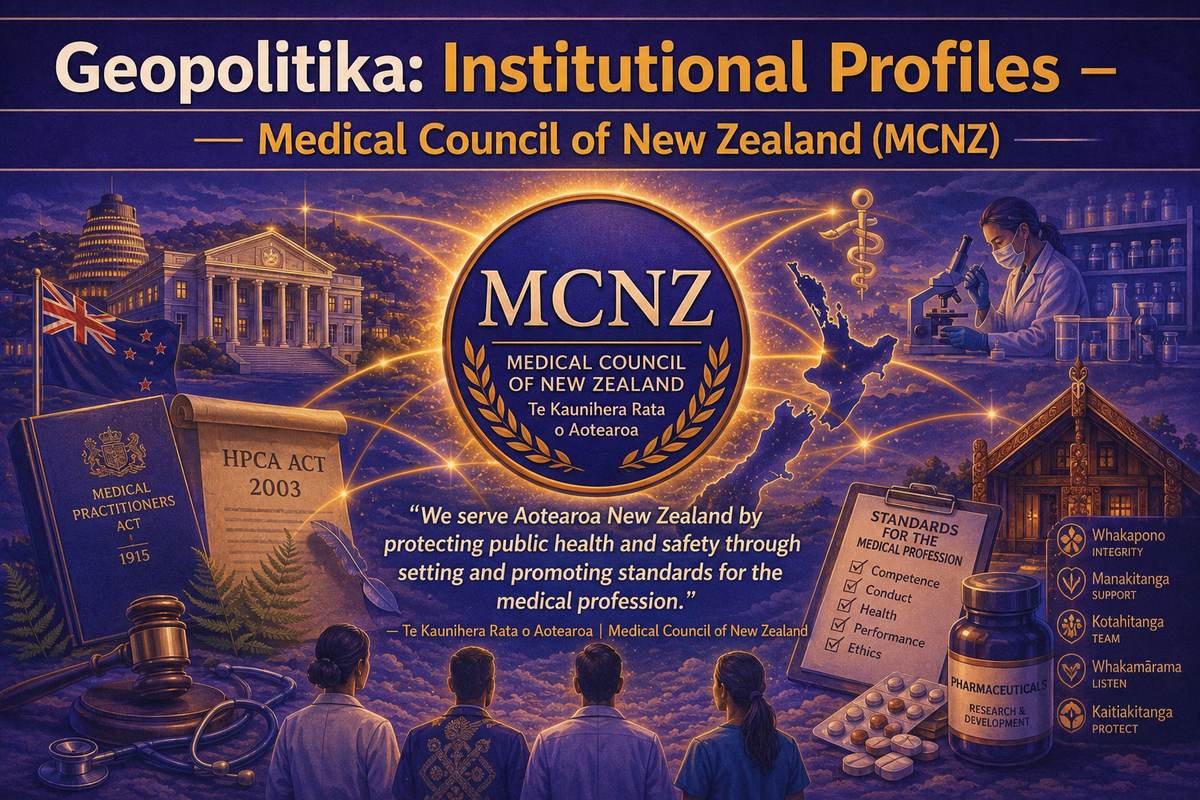
This institutional profile forms a part of the Geopolitika project to map Anglo-American power structures by examining their founding mythologies, leadership, linkages to power, public face, the nature of their outputs and who these are directed towards. These profiles are primarily generated from materials provided on their own websites, which are then analysed using a structured institutional analysis framework—see methodology statement at foot of article.
—
"We serve Aotearoa New Zealand by protecting public health and safety through setting and promoting standards for the medical profession."
— Te Kaunihera Rata o Aotearoa | Medical Council of New Zealand, mission statement
This is what the Medical Council of New Zealand (MCNZ) claims.
What follows is not a conventional exposé, but a structural examination of how this state-mandated regulator actually functions. The analysis looks beyond MCNZ's formal roles and self-presentation to examine its conduct during and after the COVID-19 pandemic—a moment of acute pressure that revealed, rather than created, the institution's underlying dynamics, latent functions, and relationship with citizens and the state.
Founded in March 1915 under the Medical Practitioners Act, MCNZ emerged from a specific moment in the history of medical regulation. Five years earlier, the Flexner Report—funded by the Carnegie and Rockefeller foundations—had reshaped medical education across the English-speaking world. Flexner's criteria privileged the laboratory-based, pharmaceutical model promoted by Johns Hopkins and Rockefeller's industrial fortune. Homeopathy, eclecticism, and other modalities were systematically eliminated. Over 160 medical schools in the United States fell to just 76. Alternative ways of understanding health and healing became not just marginalised but illegal or uninsurable.
MCNZ's founding reflected this same logic of professional consolidation. The organised medical profession captured state power to enforce a single, narrow definition of legitimate medicine. From its inception, the institution was designed to serve professional and commercial interests while claiming to serve the public. Reconstituted under the Health Practitioners Competence Assurance (HPCA) Act 2003, MCNZ is a body corporate and registered charity based in Wellington. It registers and monitors approximately 20,530 practising doctors and produces annual reports, workforce surveys, standards, and disciplinary decisions. Its declared mission is to protect public health and safety by setting and promoting standards for the medical profession. Its stated values include Te Reo Māori interpretations of the terms Whakapono (integrity), Manakitanga (support), Kotahitanga (team), Whakamārama (listen), and Kaitiakitanga (protect).
The evidence that follows—drawn from MCNZ's annual reports (1983–2025), website content, leadership biographies, public filings, and cross-referenced with external sources including NZ Doctors Speaking Out with Science (NZDSOS), HPDT decisions, High Court judgments, and Internet Archive captures—points to an institution that functioned as a legitimacy engine for government health policy during the pandemic, followed by a hunt for COVID era dissenters in the profession and systematic archival cleansing to limit retrospective accountability.
The pandemic did not transform MCNZ. It exposed its core operating logic under pressure.
Note: After this article was written in late May 2026 the MCNZ’s Chair and Deputy Chair were effectively replaced by the Minister when their terms were not renewed. See: “Simeon Brown removes Medical Council leaders over ‘ideological agenda’”
The Formal Structure MCNZ Retains (and What It Has Removed)
The Health Practitioners Disciplinary Tribunal (HPDT) claims to be an independent statutory body, separate from MCNZ. MCNZ's role is to receive notifications, refer serious cases to a Professional Conduct Committee (PCC) for investigation, and, if it judges that grounds exist, lay charges before the HPDT, which hears evidence and imposes sanctions.
MCNZ's website still hosts detailed procedural pages explaining this process: “Conduct and competence concerns,” “Professional Conduct Committee,” and “Performance Assessment Committee.” Its “Informed Consent” statement guarantees patients the right to refuse treatment and receive full risk information—rights that MCNZ's pandemic enforcement actively suppressed.
Most significantly, MCNZ's “Publication of notices about orders or directions” policy—commonly known as the naming policy—came into effect on 1 April 2020, shortly after New Zealand's first COVID-19 lockdown. The policy explicitly promises publication where it is in the public interest, stating that naming doctors can improve public confidence in the disciplinary process. This policy page is still live.
However, much of the substantive record of how that machinery was used during the pandemic has been removed or made significantly harder to find. Specific COVID-19 guidance documents, media releases, and related announcements have been retired or redirected. Searches on MCNZ's own website for the names of several doctors who faced 'disciplinary action' for questioning pandemic policies now return zero results—even though some of those decisions remain accessible on the separate HPDT website. As of mid-May 2026, all but one of the case-study doctors are not discoverable through MCNZ's own search functionality.
MCNZ's September 2024 newsletter uses Te Reo Māori headings before English. The effect being that in multi-cultural country with a majority English-speaking population, the needs of most readers are placed secondary.
Examples of four MCNZ registered doctors who publicly questioned aspects of New Zealand's COVID-19 policies and vaccine mandates and became the subject of disciplinary proceedings are found in the case-studies below: Dr Samantha Bailey, Dr Peter Canaday, Dr Alison Goodwin, Dr Caroline Wheeler and Dr Bruce Dooley. (Dr Bailey was struck off the register and ordered to pay costs of $148,000. She has claimed she had already resigned from the medical register before proceedings advanced—a resignation her ex-practitioner husband had apparently successfully made years earlier without question. Whether MCNZ handled resignations from dissenting doctors differently remains a contested point that cannot be fully verified from public materials alone.)
The Architecture: Personnel and Power
MCNZ employs approximately 95 staff. A Council of 12–13 members governs it, comprising eight doctors and four laypeople under the HPCA Act 2003. Every current and recent Council member sits at the intersection of government advisory, corporate health, health insurance, philanthropy and professional medical networks. The institution’s Network Centrality Score is 4 out of 5—a major node connecting multiple elite sectors..
Council Leadership
- Dr Rachelle Love (Chair to June 2026) is of Nga Puhi and Te Arawa descent. She holds academic positions at the University of Auckland. She serves on the Royal Australasian College of Surgeons (RACS) Māori Health Committee and the Sleep Health Association. She is also Trustee of the Hearing Research Foundation of NZ, a charity funded by Perpetual Guardian which is a key provider of estate planning services in New Zealand.
- Simon Watt (Deputy Chair to June 2026) is a consultant at Bell Gully (a major New Zealand law firm and part of Large Law Firms NZ Ltd) and simultaneously serves as legal adviser to Pharmac —the government agency responsible for pharmaceutical funding. He was also a COVID-19 vaccine negotiator with Pfizer for the New Zealand government. Watt bridges MCNZ, Pharmac, and the legal sector, with documented government advisory roles during the pandemic.
- Joan Simeon (CEO) is former Chair of the International Association of Medical Regulatory Authorities (IAMRA). She speaks at international conferences, including in developing nations like Zambia. MCNZ sits inside international regulatory elites who share personnel, frameworks, public-private-philanthropic partnership funding apparatus, and enforcement approaches across jurisdictions.
- Dr Stephen Child (Council member) is simultaneously Chief Medical Officer of Southern Cross Health Society—New Zealand’s largest private health insurer and owner of healthcare real estate. This constitutes a direct governance overlap and conflict of interest between MCNZ’s regulatory Council and the corporate health sector that financially profits from the medical workforce MCNZ controls. He is also on the Board of Action for Smokefree (ASH) and regularly engages with GP training via the Goodfellow Unit.
- Prof Marie Bismark (Council member) was previously a lawyer with Buddle Findlay (also part of Large Law Firms NZ Ltd) whilst being a Fellow at Harvard University. Now she’s a professor of Public Health at the University of Melbourne, a Governance Board member of Australia’s GMHBA Health Insurance and a company director with board roles at the Royal Women’s Hospital and retirement village corporate Summerset. Her latter role is particularly relevant to point out because NZ has such a significant percentage of older population signed-up to the retirement lifestyle “Right to Occupy” contracts. All residents, staff, and visitors to those institutions were mandated to have COVID-19 vaccinations.
- Prof Ron Paterson (Council member) is a former New Zealand Health and Disability Commissioner, former Ombudsman, and former board member of the Health Quality & Safety Commission.
- Ming-chun Wu (Council member) is a council member for the Chinese Medicine Council and has held senior roles at Te Puni Kōkiri / Ministry for Māori Development, the Ministry of Business, Innovation and Employment, Department of Conservation, Department of Internal Affairs, the Ministry of Social Development, and the Ministry of Education.
- Christine Anderson (Registrar) previously served as Registrar of the Pharmacy Council of New Zealand.
Board Composition
- Over 30% of Council members have direct government backgrounds (Paterson, Watt, Wu, Anderson)
- 46% have corporate overlaps (Child, Bismark, Wu)
- No current Council member has a background in non-medical health professions, consumer advocacy, or critical public health scholarship.
International and Domestic Bridges
Joan Simeon chairs IAMRA. Former Chair Dr Curtis Walker participated in a Federation of State Medical Boards (FSMB) work group—the US body that coordinates medical regulation across 70 state and territorial boards. Domestically, MCNZ connects to Pharmac, Te Whatu Ora (Health New Zealand), Southern Cross Health Society, the Health and Disability Commissioner, and multiple professional colleges.
The Architecture: Funding and Influence
MCNZ’s 2025 Annual Accounts show total revenue of NZ$24.457 million. Non-exchange revenue (mainly practising certificate fees and disciplinary levies) contributed NZ$17.095 million. Exchange revenue (application fees, examination fees, interest and other income) added NZ$7.362 million. Total expenses reached NZ$25.849 million, resulting in a deficit of NZ$1.392 million for the year.
Despite the reported deficit in 2025, MCNZ is not short of money. It holds substantial cash reserves, short-term investments, and NZ$3.551 million in capital assets. The balance sheet as at 30 June 2025 shows total assets of NZ$16.862 million, including NZ$13.311 million in current assets (NZ$2.383 million in cash and cash equivalents and NZ$10.033 million in short-term investments) and NZ$3.551 million in non-current assets—which raises questions about what these assets are and the ethics of (tax-exempt) income derived from them.
What the Accounting Policy Says
MCNZ’s financial statements distinguish between non-exchange and exchange transactions.
Non-exchange revenue includes practising certificate fees and disciplinary levies, recognised in full at the start of the practising year. It also includes disciplinary recoveries — fines and costs awarded by the Health Practitioners Disciplinary Tribunal.
Exchange revenue includes application and registration fees, NZREX examination fees, and vocational registration income.
The Council states it receives no government funding and operates on a full cost-recovery model from doctor fees. It provides no detailed breakdown of fee income by doctor type (GPs, specialists, or international medical graduates), no donor lists, and no sponsorship disclosures.
What the Numbers Reveal
Practising certificate fees from 20,530 doctors form the bulk of MCNZ’s income. Each practising doctor pays roughly NZ$950 plus levies.
Disciplinary activity shows a striking pattern. Disciplinary expenses rose to NZ$4.127 million (up 36%), while disciplinary recoveries collapsed from NZ$662,000 in 2024 to NZ$92,000 in 2025 (down 86%). The net result of this was the Council spending over forty times more in 2025 on discipline than it recovered.
Revenue received in advance grew nearly 50% in a single year. Doctors paid NZ$881,000 for services not yet delivered. This is standard accounting practice, but it means MCNZ holds a tax-exempt, interest-free, loan from the profession it claims to serve.
The Closed Loop
MCNZ describes its funding model as “full cost-recovery.” The framing gets the power relationship backwards. Doctors are trapped.
- Loop One: Statutory Lock-In: The Health Practitioners Competence Assurance Act 2003 requires doctors to hold a current practising certificate from MCNZ. A doctor cannot legally practise without paying MCNZ. There is no alternative regulator and no exit.
- Loop Two: Disciplinary Recoveries: When MCNZ prosecutes a doctor and the Tribunal finds against them, it can award disciplinary recoveries (fines and costs) back to MCNZ. The same doctors who fund MCNZ through mandatory fees can also be fined by MCNZ, with the money returning to the Council. When MCNZ disciplined (and continues to try to strike-off) dissenting doctors during and after the covid era pandemic, those doctors were paradoxically effectively paying their own tax-paid dollars for their own prosecution through their practising fees.
The regulator acts as prosecutor, beneficiary, and—through the fees—the source of its own prosecution budget. This feature is permitted, not mandated. Fines could be directed to a separate fund. MCNZ does not advocate for that change.
Corporate Convergence
Alongside past evidence of the revolving doors of power, multiple corporations maintain documented simultaneous personnel overlaps with MCNZ:
- Dr Stephen Child serves as both a MCNZ Council member and Chief Medical Officer at Southern Cross Health Society.
- Simon Watt serves as MCNZ Deputy Chair while acting as a consultant for the law firm Bell Gully and legal adviser to Pharmac.
These overlaps do not prove improper influence. They demonstrate how personnel networks connect the regulator with major health insurers, commercial law firms, and pharmaceutical funders.
Opacity and Accountability
MCNZ publishes revenue, expenses, assets and liabilities. That is not the problem. The problem is what it chooses not to explain: no breakdown of fees by doctor type, no disclosure of how the disciplinary reserve is used, no explanation for why disciplinary expenses rose sharply while recoveries collapsed, and no clear accounting of revenue received in advance.
Doctors cannot see exactly how their mandatory fees are allocated. The public cannot easily assess whether disciplinary priorities serve public protection or institutional self-preservation. The statutory monopoly ensures compliance. Opacity limits accountability.
The Outputs: What MCNZ Published, Erased, and Redirected
Between 2020 and 2025, MCNZ produced between twenty and thirty major outputs annually. These include annual reports, workforce surveys, professional standards, media releases, and disciplinary decisions. The Council publishes guidance on topics ranging from informed consent to artificial intelligence. It issues statements on prescribing, telehealth, and cultural safety. It produces a data dashboard showing current registration statistics. And it maintains evergreen procedural pages describing how it investigates and disciplines doctors.
But the most significant outputs for understanding MCNZ's pandemic function are those it later removed from live access. Using the Internet Archive, four original MCNZ webpages were recovered from February 2025. They are no longer accessible on the live site. A fifth output category – disciplinary records for dissenting doctors – remains accessible on the independent HPDT website but is not findable via MCNZ's own search.
The pattern is not accidental link rot. MCNZ did not simply delete outdated material. It kept the headings and links visible, creating the illusion that the content is still there, then redirected the links to the homepage. The headings remain. The content is gone. No archive is provided.
Using the Internet Archive, four original MCNZ webpages were recovered from February 2025.
- Document 1 (26 March 2020): Chair Dr Curtis Walker wrote directly to “all practising doctors” at the beginning of the national lockdown, issuing binding instructions on prescribing limits and endorsing the rapid shift to telehealth. He closed with thanks and a call to keep well. Significance: MCNZ actively directed clinical practice during the emergency. This page is no longer accessible on the live site.
- Document 2 (16 February 2021): A media release showing MCNZ acting at the “request of the Director-General of Health” to extend a special COVID-19 scope of practice. It listed excluded applicants—doctors with cancelled or suspended registrations—and stated the scope would expire on 31 March 2022. Significance: Direct coordination between MCNZ and the Ministry of Health, operationalising government workforce policy. This page is no longer accessible.
- Document 3 (20 August 2021): The clearest statement of MCNZ’s enforcement posture. Responding to a GP who texted patients that he did not support COVID vaccinations, Walker declared there was “no place for anti-vaccination messages in professional practice” and listed sanctions including suspension and referral to a PCC and ultimately the HPDT. Significance: MCNZ acted as a narrative enforcer, not merely a recommender. This page is no longer accessible.
- Document 4 (21 August 2021): Sent the day after the enforcement release, this message adopted a different tone, thanking doctors for being “at the frontline” and acknowledging personal pressures. It included a link to MCNZ’s “our COVID-19 response” page—a page that no longer exists. Significance: Together, the 20 and 21 August communications constitute a classic carrot-and-stick approach. Both pages are no longer accessible.
MCNZ’s website still contains headings and links to some COVID-19 content. Clicking those links does not lead to the original guidance. It leads to the homepage. The headings remain. The content is gone. No archive is provided.
As at 25 May 2026, searches of MCNZ’s website for the surnames of three of the four dissenting doctors listed below (Bailey, Canaday, and Goodwin) returned zero results. The HPDT retains the Bailey decision on its own independent website. MCNZ’s own search function cannot find these doctors.
Case Study 1: Dr Samantha Bailey
Dr Samantha Bailey was struck off the register and ordered to pay costs of NZ$148,000. She claims she had already resigned from the medical register before proceedings advanced. Her husband, Dr Mark Bailey, declined to renew his practising certificate in 2016. MCNZ apparently accepted his resignation without disciplinary action. His name was quietly removed from the register. Bailey alleges that when she elected not to renew her own practising certificate in 2021, MCNZ pursued her anyway. The High Court upheld MCNZ’s disciplinary actions against her as lawful (Bailey v Medical Council of New Zealand [2024] NZHC 1234). But searches for “Bailey” on MCNZ’s website return zero results, even though the HPDT retains the decision. Whether MCNZ handled resignations from dissenting doctors differently remains a contested point that cannot be fully verified from public materials alone.
Case Study 2: Dr Bruce Dooley
Dr Bruce Dooley discovered that the Medical Council of New Zealand does not operate independently. As detailed on NZ Doctors Speaking Out with Science (NZDSOS), he traced connections from MCNZ through IAMRA to the Federation of State Medical Boards (FSMB), a private American organisation based in Texas, and to the WHO.
The FSMB has operated since 1912. Most doctors have never heard of it. It is a private corporation that, through international agreements, influences medical boards globally. The connections Dooley identified include:
- Joan Simeon, CEO of MCNZ, served as Chair of IAMRA—the international arm of the FSMB
- Dr Curtis Walker, ex-chair of MCNZ, sat on an FSMB work group
- Dr Rachelle Love, current Chair of MCNZ, and Ms Mereana Kim Ngarimu, former lay member of MCNZ, sit on the cultural safety working group of IAMRA
Dooley argues these are not coincidences, they are the architecture of a captured profession. His position on the FSMB and its influence over the medical profession world-wide are documented in a series of articles on the NZDSOS’s website dated 2022-2023 , such as “The FSMB’s Impact on Global Medicine”, “Dark Truth Revealed: Medical Censorship, Dubious Networks and the Medical Council of New Zealand” and “Ongoing Lock Step Scenarios: The Peril of Post-Covid-19 Medical Globalism”. The HPDT’s in absentia findings against Dooley are summarised on the MCNZ’s website here. Notably, as pointed out by NZDSOS in an article “Struck off for Practicing Medicine – The MCNZ’s Unreasonable Crusade,” nothing he was accused of is illegal and the off-label prescription of drugs he is accused of is a long standing practice of medicine.
Case Study 3: Dr Caroline Wheeler
Dr Caroline Wheeler was found guilty of medical malpractice and bringing discredit to the profession. The Tribunal upheld various, but not all, of the 18 charges. Together, these constituted professional misconduct.
Each legal team provided recommendations on penalties: suspension, censure, re-education, conditions on future practice, fines, and costs. The Tribunal reserved its final decision. It noted that the penalty was not meant to be punitive but rather to mitigate future risks, in part by sending a warning to other practitioners.
Case Study 4: Dr Bernard Conlon
Over 1,500 patients received early treatment protocols from Dr Bernard Conlon. The results showed no deaths and only six hospital admissions—four of those in fully vaccinated individuals.
Local colleagues complained about his position on the novel mRNA injections. Over four and a half years, Dr Conlon has faced an ongoing disciplinary process that started in late 2021 and included a four-month suspension during the height of a community COVID outbreak. A two-week Tribunal hearing has just been held at the end of the nearly four-and-a-half-year process.
Case Study 5: Dr Alison Goodwin
Following various presentations and public speaking engagements, a few anonymous members of the public and anonymous fellow health professionals reported Dr Goodwin to the MCNZ for ”spreading misinformation”. There were no patient complaints and no demonstration of any harm.
In Sept 2021 the MCNZ contacted Dr Goodwin and advised that they had ”become aware of online videos and publications in which she discussed the COVID-19 pandemic and anti-vaccination messaging”.
Over the next three months there were a series of communications back and forth with the MCNZ which culminated in a decision to interim suspend her APC (Annual Practicing Certificate) while her conduct was investigated further by a Professional Conduct Committee (PCC). The suspension took effect on the 13 Jan 2022 and was in place for 10 months until the MCNZ granted an APC on 7 Nov 2022. THIS IS Quoted from NZDSOS
Case Study 6: Dr Matt Shelton
Already on the Council’s radar as a leader of NZDSOS, GP Dr Shelton was censured for a mass text to his patients on the eve of the start of the rollout to children in August 2021, advising people do their own due diligence and of the need for caution, especially in pregnancy. After refusing to sign a “voluntary undertaking” to get in line he was suspended in December. The HDC asked for people scared he might interfere with their personal vaccinations to put in complaints against him also. The HDC found he had used the practice text system improperly. After losing in court the MC finally convened a Professional Conduct Committee to investigate him and it laid charges with the HPDT. As yet, the case has still not been heard.
Of note, all the doctors who challenged their suspensions by the MCNZ won in court—Canaday, Shelton and Goodwin. Justification, self-reflection, apology or restitutions are lacking from the MCNZ to the doctors concerned, let alone on website. In Dr Shelton’s case the MCNZ set out to resuspend him almost immediately after losing the case and being told to let him back to work.
Absent from the Record: Oaths, Ethics, and Evidence
MCNZ maintains a detailed and frequently updated catalogue of professional standards. Its standards page, last updated in October 2024, provides specific guidance on advertising, artificial intelligence in patient care, cultural safety, commercial organisations and conflicts of interest, complementary and alternative medicine, cosmetic procedures, disclosure of harm, good medical practice, informed consent, prescribing, professional boundaries, telehealth, and more than a dozen other topics.
The Council is clearly capable of producing detailed, current standards on a wide range of issues. Yet several foundational ethical principles are conspicuously absent from its framework:
- Primum non nocere — First, do no harm. The most fundamental principle in the Western medical tradition does not appear as a formal standard.
- Informed consent under emergency use authorisation. The COVID-19 vaccines were deployed under emergency use provisions, meaning the usual requirements for completed long-term safety and efficacy data had not been fully met. MCNZ issued no guidance on how doctors should navigate informed consent in this context, including the need to disclose uncertainties.
- Conscientious objection. MCNZ provided no framework for how doctors should handle situations where they believed a mandated or strongly promoted intervention might cause harm. Instead, it declared there was “no place for anti-vaccination messages” in professional practice.
- Vaccine injury identification, reporting, and management. Despite the unprecedented scale of the rollout, MCNZ issued no dedicated standard on recognising, reporting, or managing suspected adverse events. The updated “Prescribing” and “Disclosure of harm” standards do not specifically address population-level iatrogenic harm or contested mortality data.
- Engagement with disputed safety statistics. When independent researchers and disciplined doctors presented data on vaccine-related injuries and deaths that diverged from official figures, MCNZ made no visible effort to examine or contextualise those claims. It did not commission reviews or publish analyses. It simply ruled certain speech out of bounds “for the safety of the public”.
What These Absences Signify
MCNZ is not a public health agency or a scientific research body. Its formal mandate is to ensure doctors are competent and fit to practise. One could argue that questions of vaccine policy and population-level risk assessment fall outside its scope.
That defence is unconvincing for two reasons.
- First, MCNZ actively inserted itself into these debates. It declared there was “no place for anti-vaccination messages,” referred cases, and supported disciplinary action against dissenting doctors. Having chosen to act as an enforcer of prevailing policy, it cannot retreat to a narrow regulatory mandate when questioned on the ethical implications.
- Second, core medical ethics—first, do no harm, informed consent under conditions of uncertainty, and the duty to weigh potential harm—are not peripheral policy matters. They are the bedrock of legitimate medical practice. An institution that claims to set and uphold professional standards cannot systematically sidestep these principles without undermining its own legitimacy.
MCNZ has detailed standards for advertising, cosmetic procedures, and commercial conflicts of interest. It has none for “first, do no harm” in the context of mass novel pharmaceutical deployment.
The recovered documents show what MCNZ later removed from public view. The standards page reveals what it never put there in the first place.
Together, they paint a picture of an institution that is exhaustive where it chooses to be — and silent where it matters most.
Tensions in the System MCNZ Maintains
MCNZ operates as a major hub connecting government agencies (Ministry of Health, Te Whatu Ora, Pharmac), corporate health interests (Southern Cross), commercial law firms (Bell Gully), and international regulators (IAMRA, FSMB). Seven core structural tensions run through this system:
- Transparency vs. Archival Cleansing:
MCNZ’s data dashboard shows current registration statistics. But COVID-19 content—including the four recovered documents—has been removed. The naming policy promises publication; MCNZ’s practice has been de-publication. Functional interpretation: Homeostatic Regulation. The institution manages its public record by separating present transparency from past erasure. - Due Process vs. De-publication:
The High Court upheld MCNZ’s disciplinary actions against Dr Samantha Bailey as lawful (Bailey v Medical Council of New Zealand [2024] NZHC 1234). Due process was followed. But searches for “Bailey” on MCNZ’s website return zero results. The public cannot find the record through MCNZ’s own search. Functional interpretation: Legitimation on paper; accountability impeded in practice. - Independence vs. Government Appointment:
MCNZ claims independence from government and that the Minister of Health appoints Council members. This structure is not unique to MCNZ—many statutory bodies are constituted with ministerial appointment to ensure public accountability while claiming operational independence. Functional interpretation: Homeostatic Regulation. The system manages tension by separating governance from operations. - Protect Public vs. Support Doctors:
MCNZ’s dual mandate creates inherent tension. Disciplining a doctor may “protect the public” but harms the doctor professionally and personally. This tension is universal to professional regulation. Functional interpretation: Boundary Maintenance. The professional capture of “public protection” makes the two mandates functionally indistinguishable. - Transparency vs. Opaque Funding:
MCNZ’s data dashboard is public. Its fee breakdown by doctor type is not. MCNZ’s funding model (100% from doctor fees, no government appropriation) insulates it from political pressure but creates structural dependence on the regulated profession. The MCNZ and HPDT share a postal address, deepening the opaqueness of these entities’ claimed independence. Functional interpretation: Legitimation. Transparency on workforce data distracts from opacity on funding. - The Simeon/IAMRA Bridge:
Joan Simeon chairs IAMRA internationally while MCNZ cleanses its COVID record domestically. There is no evidence that Simeon’s IAMRA role and MCNZ’s archival decisions are coordinated. The contradiction may be purely structural—different audiences, different faces.
Functional interpretation: Layered deniability (emergent, not necessarily intended). - Informed Consent vs. Pandemic Enforcement:
MCNZ’s informed consent statement, in line with the NZ Bill of Rights Act, guarantees patients the right to refuse medical treatment and receive full risk information. During the pandemic, the Council operated within a government-mandated vaccine framework. It chose alignment with policy over defence of patient rights, did not issue guidance acknowledging this tension, and prosecuted doctors who raised informed consent concerns. Reasonable people disagree whether genuine consent was possible under mandates. What is not contested is MCNZ’s subsequent decision to remove from live access the evidence of its enforcement actions. Functional interpretation: Boundary Maintenance backed by state power, followed by archival gatekeeping.
These contradictions are not random. They are sustained by internal system dynamics that shape MCNZ’s behaviour regardless of who holds specific roles.
How the System Maintains Itself
MCNZ operates through several reinforcing feedback loops:
- Workforce Data Loop: MCNZ conducts workforce surveys that document shortages. It then adjusts registration pathways to attract more international medical graduates. These graduates enter the workforce, new data is collected, and the cycle repeats. The loop continuously justifies expanded registration activity.
- Personnel Circulation Loop: Council members and senior staff move between MCNZ, Pharmac, Te Whatu Ora, Southern Cross, IAMRA, FSMB, and related commercial and professional entities . This circulation embeds ‘in-group’ thinking, strengthens a shared worldview and increases network density across the sectors.
- Mission Constraint Loop: When MCNZ pushes boundaries — for example, through disciplinary actions against dissenting doctors — balancing mechanisms activate. Transparency tools such as annual reports and data dashboards reassert the “protect the public” narrative.
- Archival Cleansing Loop: Public attention rises during controversial disciplinary cases. Once attention fades, MCNZ removes or de-indexes related COVID-19 content. The public cannot easily verify past actions, making sustained scrutiny difficult.
Emergent Properties
These loops produce several consistent outcomes:
- Plausible deniability distributed across the Council, CEO, Professional Conduct Committees, and the Tribunal — no single document reveals the full institutional strategy.
- A strong institutional brand of “right-touch regulation” that is repeated across outputs and outlasts individual office-holders.
- Archival gatekeeping: MCNZ increasingly controls not only what doctors can say, but what the public can easily remember about its pandemic-era decisions.
MCNZ also maintains clear internal boundaries. Its mission boundary largely excludes systemic critique of the medical profession itself, individualising failure instead. Its programmatic boundary focuses on individual doctor competence rather than macro-social determinants of health. Its personnel boundary reinforces medical hegemony by limiting influence from non-medical health professions. Its archival boundary now actively limits access to its own COVID-19 guidance and disciplinary records.
Conclusion: The Gap Between Promise and Practice
The Medical Council of New Zealand is not what it claims to be. This is a structural observation—and MCNZ’s own documentation makes it unavoidable.
The Flexner legacy was elimination: of alternative modalities, of competing knowledge systems, of any medicine not aligned with pharmaceutical capital. MCNZ’s 1915 founding reflected that same logic of professional consolidation. The pandemic legacy is erasure: of guidance, of announcements, of disciplinary records. The pattern is consistent across a century. At both moments, the profession consolidated its power by excluding what it could not control.
More than a century after its creation, MCNZ functions as a central node in an elite health policy ecosystem. Its personnel circulate through entities within government advisory, corporate health, and professional colleges. Its outputs amplified government pandemic policy and disciplined dissent with lawfare. Then, after public attention moved on, MCNZ erased the evidence. COVID-19 guidance removed. News articles redirected. Searches for key dissenting doctors—Bailey, Canaday, Goodwin etc —return zero results. The headings for some content remain, but the links redirect to the homepage. Only the procedural pages remain: conduct flowcharts, PCC rules, the naming policy itself. The machinery of transparency is preserved. The record of its use has been removed from live access.
The High Court upheld MCNZ’s actions as lawful. But legality is not accountability. The court assessed process, not public access. A process can be lawful and still be inaccessible.
The naming policy—published 1 April 2020, still live, promising publication in the public interest—remains a public document. The records of its application have vanished. The policy says MCNZ will name doctors to improve public confidence. The practice says MCNZ will make those names unfindable.
Public confidence requires transparency. Transparency requires memory. Memory requires that records be kept, not erased.
The Flexner legacy was elimination. The pandemic legacy is erasure. The pattern is consistent across a century. At both moments, the profession consolidated its power by excluding what it could not control.
Public confidence requires transparency. Transparency requires memory. Memory requires that records be kept, not erased.
—
Methodology Note: This analysis draws on publicly available materials produced by the Medical Council of New Zealand: annual reports (1983–2025), the website, leadership biographies, public filings, the Health Practitioners Disciplinary Tribunal decisions database, and the NZ Doctors Speaking Out with Science corpus. External sources include and HPDT decisions (Bailey decision pp 58–61), High Court judgment (Bailey v Medical Council of New Zealand [2024] NZHC 1234), protest documentation, and Internet Archive records of MCNZ’s original COVID-19 guidance and media releases. Search result confirmations for the doctors mentioned in the case studies were conducted on 26 June 2026 and, apart from Dr Dooley’s entry, the reminder returned zero results. The analytical framework is POSIWID (The Purpose of a System Is What It Does). Causal claims are confined to Level 3: outputs align with policy documents, archival cleansing is documented, search suppression is observed. Conscious intent cannot be proven without internal communications. Base analytic outputs are available on request. For methodological details, including Transparency Score definitions, typology classifications, confidence calibration and protocol logic—see the Geopolitika Series Methodological Statement.
The assistance of Dr Ursula Edgington and Dr Matt Shelton of NZDSOS in checking details for this article and suggesting amendments is warmly acknowledged.