Geopolitika: Institutional Profiles – International Holocaust Remembrance Alliance (IHRA)
From “Non-Legally Binding” to Institutional Force: How IHRA’s definitions travel inside the machinery that converts expert language and member-state consensus into standards, training categories, policy tools, funding conditions and institutional legitimacy.
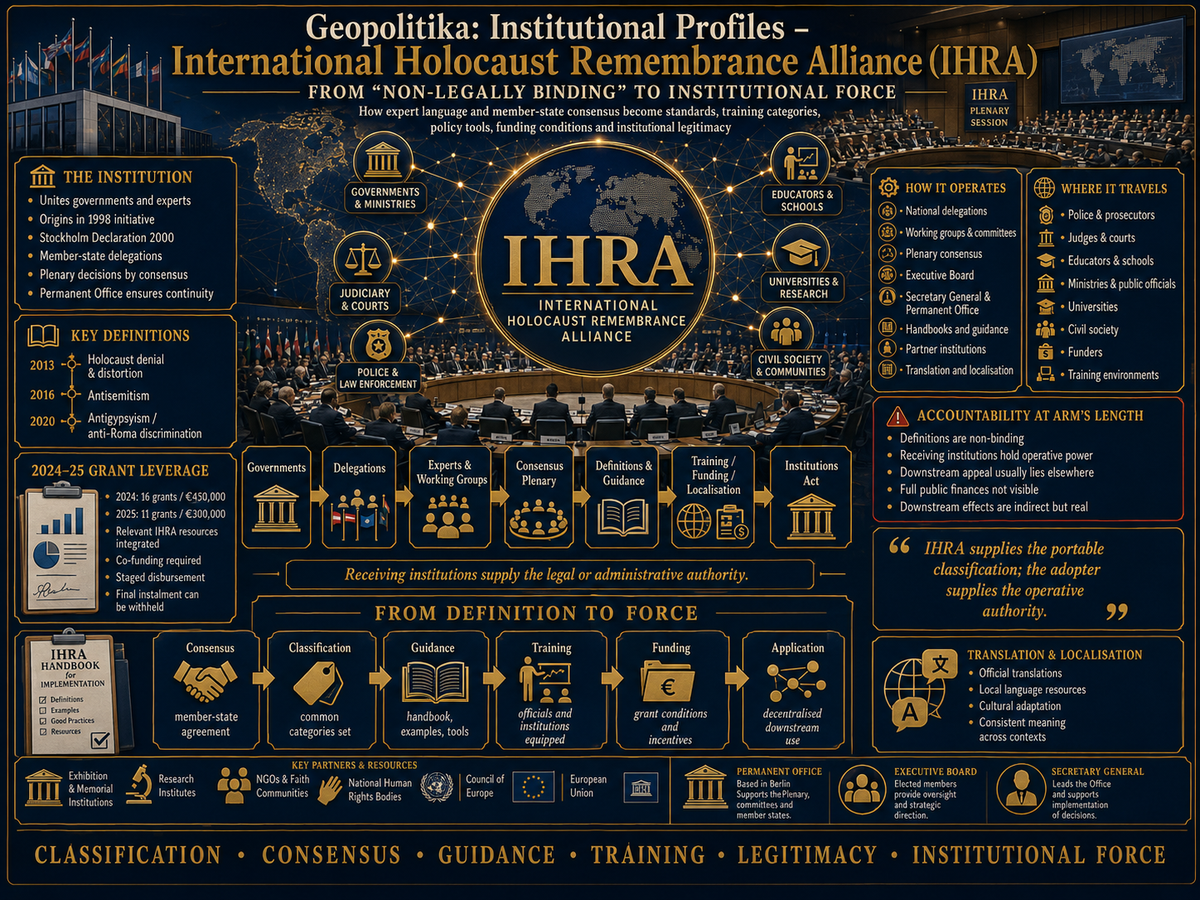
This article is published as part of the Geopolitika project to map Anglo-American power structures by examining their founding mythologies, leadership, linkages to power, public face, the nature of their outputs and who these are directed towards. This series is primarily generated from materials provided on the institution’s own websites, which are analysed using a structured analytic framework—see methodology statement at foot of article.
—
Executive Summary
On 26 May 2016, meeting in Bucharest, the International Holocaust Remembrance Alliance (IHRA) Plenary adopted what it expressly called a “non-legally binding working definition of antisemitism.” Five years later, a European Commission handbook described that definition being used to train police officers, prosecutors, judges, educators and state employees; to categorise antisemitic incidents; to support decision-making; and to help direct funding.
That movement—from a formally non-binding text to consequential uses inside other institutions—is the central fact of IHRA’s definitional role.
IHRA is not a legislature. The evidence does not show it commanding governments, police forces, universities or civil-society organisations. Its mechanism is more mediated. Governments appoint national delegations. Experts work through committees and working groups. A schedule of Plenaries, held twice a year and comprising member-country Heads of Delegation, adopt decisions by consensus. Definitions, recommendations and guidance then leave IHRA as portable institutional resources. Receiving organisations supply the legal, administrative or organisational authority that turns those resources into action.
The same distinction appears in IHRA’s finances. Its Grant Program gives the organisation a narrower form of direct leverage. In 2024, IHRA reported 16 grants and €450,000 distributed; in 2025 it reported 11 grants and €300,000. Grant rules in the analysed record require relevant IHRA resources and standards to be integrated into funded projects, set co-funding requirements, stage disbursement, and permit the final instalment to be withheld after reporting, audit and evaluation. That is real conditional power—but bounded to funded projects, not evidence of general control over recipient organisations.
IHRA’s power, in short, is less about issuing commands than about making classifications portable: converting expert work and intergovernmental consensus into language that other institutions can adopt, cite, teach, operationalise and build into their own procedures.
That is also the disciplined POSIWID finding. IHRA states that it exists to unite governments and experts around Holocaust education, remembrance and research and to counter denial, distortion, antisemitism and anti-Roma discrimination. Its recurring observable function is to produce common classifications, legitimacy signals and implementation infrastructure, with more direct leverage where money is attached.
History, Founding And The Architecture Of Authority
IHRA traces its origins to 1998, when former Swedish prime minister Göran Persson initiated what was then the Task Force for International Cooperation on Holocaust Education, Remembrance and Research. The 2000 Stockholm Declaration became its foundational political reference point. Its remit subsequently expanded from remembrance and education into an increasingly explicit definitional and policy-support role.
The chronology matters. IHRA began formally wrestling with Holocaust denial and distortion in 2010. Member countries adopted its working definition of Holocaust denial and distortion by consensus in Toronto on 10 October 2013. The antisemitism definition followed in 2016. A working definition of antigypsyism/anti-Roma discrimination was adopted on 8 October 2020.
These are not isolated publications. They reveal a repeatable institutional route.
IHRA describes itself as an organisation that “unites governments and experts.” Its own structural account divides the institution into five levels: political, expert, partner, grant and executive. National governments select their delegations. Those delegations contain policymakers and specialists. Working Groups identify priorities and make recommendations. The Plenary is the formal decision-making centre and, in IHRA’s words, makes decisions “on a consensus basis.”
The authority chain is therefore not mysterious:
national governments → national delegations → expert bodies → consensus Plenary → definitions, recommendations and guidance → receiving institutions
The Executive Board sits beneath that collective authority. IHRA states that it operates under the Plenary and assists the Secretary General in implementing Plenary decisions. The Permanent Office performs another crucial function: it “ensures continuity between IHRA Presidencies.”
This distribution explains why the completed analysis rejected a single-person-command model. Presidencies rotate. Officials change. Working groups, Plenary procedure, delegated executive structures and the Permanent Office preserve institutional continuity.
One legal-status issue remains unresolved. An IHRA personnel biography in the authorised corpus says the organisation became an “international organization” in 2024, while IHRA’s current structural material calls it a complex intergovernmental organisation. But the analysed corpus did not contain the constitutive instrument necessary to establish the exact legal basis or legal personality of that reported transition. That is a documentary limit, not a reason to invent one.
People: Bridges Rather Than A Command Pyramid
The personnel record is useful because it shows how institutional authority is carried without supporting the stronger claim that any one person controls IHRA.
For the 2026 Argentine Presidency, the current Chair is Marcelo Mindlin. IHRA’s own profile also identifies Mindlin as founder and chairman of Pampa Energía.
Michaela Küchler, Secretary General since 2025, is described as a career diplomat who joined the German Federal Foreign Office in 1988. Her office matters institutionally because the Secretary General leads the Permanent Office—the structure explicitly charged with continuity across rotating national Presidencies.
Robert J. Williams, appointed IHRA Advisor during the 2022 Gothenburg Plenary, is simultaneously identified as CEO and Finci-Viterbi Chair of the USC Shoah Foundation and as UNESCO Chair on Antisemitism and Holocaust Research. Again, the significance is a personnel bridge: expertise, institutional standing and networks travel with officeholders. It does not establish external command.
Hannah M. Lessing illustrates another route. IHRA records her as Managing Director of Austria’s National Fund for Victims of National Socialism, Co-Head of the Austrian delegation to IHRA since 2009, and an Executive Board member appointed in 2024.
Sir Andrew Burns, also appointed to the Executive Board for a three-year term in 2024, chairs Strategy Implementation at IHRA. Sir Andrew’s UK government profile lists appointments as British Ambassador to Israel (1992–95) and UK Special Envoy for Post-Holocaust issues (2010–15), among others.
The national delegations show another important personnel bridge. A 2022 New Zealand government file makes the selection process unusually visible. IHRA required New Zealand’s delegation to be headed by a senior governmental representative and to include between three and six expert delegates. New Zealand designated its Ambassador to Sweden, Andrew Jenks, as Head of Delegation, while the Ministry of Foreign Affairs and Trade worked closely with the New Zealand Jewish Council to identify expert candidates for approval by the Foreign Minister. Once appointed, those experts joined an official New Zealand delegation and were required to act consistently with the government’s interests and instructions from the delegation leadership.
The proposed experts were themselves closely embedded in New Zealand’s Holocaust-remembrance, Jewish communal and related educational infrastructure. Deborah Hart chaired the Holocaust Centre of New Zealand and had served with the New Zealand Jewish Council; Dame Lesley Max had served for many years as secretary of the Council; David Zwartz had been its president; and Shoshana Maasland sat on its executive. The fifth proposed expert, historian Paul Moon, had established New Zealand’s first undergraduate Holocaust course, developed in consultation with the country’s Jewish community. The New Zealand case should not be treated as a template for every member country, but it illustrates how expert participation can be sourced through domestic stakeholder networks and then incorporated into a formally governmental delegation.
These overlaps show how national government, diplomacy, Holocaust-remembrance institutions, Jewish communal organisations, academia and IHRA’s own executive structures intersect through personnel. But the evidence supports role portability and institutional bridging, not a hidden operator chain. Titles, prominence, shared affiliations and institutional adjacency were not treated as proof of coordination or control.
The more durable mechanism sits beneath the biographies: governments choose delegations; domestic institutions can help supply expert candidates; expert and political roles intersect in Working Groups and other bodies; the Plenary authorises; the Permanent Office persists across Presidencies; and the Executive Board carries delegated implementation functions. In that sense, personnel matter less as a command pyramid than as the human infrastructure through which expertise, governmental representation and institutional legitimacy are carried into and out of IHRA.
Money: Where IHRA’S Direct Leverage Becomes Clearest
IHRA’s complete institutional finances are not published on its website or in its activity annual reports. Those reports record programmes, decisions and selected grant outflows—in the low hundreds of thousands of euros—but not total revenue, total expenditure, assets, compensation, related-party transactions, procurement or a full member-contribution schedule. Public sources from a 2022 New Zealand FOI document show a baseline annual contribution of €30,000 for full members and €10,000 for longer-term observers, although individual national payments can be higher: Italy, for example, recorded a €52,000 IHRA annual fee for 2025. A Canadian government evaluation states that membership contributions support, among other administrative costs, an annual audit of the IHRA fund and Permanent Office, but that audit was not publicly available in the materials located and reviewed.
The visible contribution sums appear modest relative to IHRA’s institutional footprint. At the historically documented €30,000 rate, 35 members would generate about €1.05 million annually; even if Italy’s €52,000 2025 fee were hypothetically applied to every member, the total would be only about €1.82 million. Yet IHRA maintains a permanent international secretariat, convenes a substantial intergovernmental and expert apparatus and distributes hundreds of thousands of euros annually in grants. The available materials therefore do not permit a reconciliation between disclosed membership payments and the organisation’s full operating costs, nor do they provide audited institutional accounts or a complete counterparty map. This does not establish undisclosed funding; it establishes that the published financial picture is incomplete and not readily ascertainable from the public materials available.
What can be seen clearly is the Grant Program.
IHRA states that the program has funded more than 150 projects over the last decade and that it is supported by annual contributions from member countries. One Grant Strategy document says contributions come from each of 35 member countries.
The annual figures available in the record are precise but narrow. The 2024 Annual Report records 16 grants and €450,000 distributed. The 2025 Annual Report records 11 grants and €300,000 distributed.
The recipient record gives some sense of what that money actually buys. In 2024, the Babyn Yar Holocaust Memorial Center in Ukraine used an IHRA grant to advance its “Names Project,” aimed at recovering the identities and personal histories of Jews murdered at Babyn Yar. IHRA’s annual-report material says the project uncovered more than 200 previously unidentified victim names, added more than 100 photographs to an online archive containing 29,551 names, and, in partnership with Ukraine’s State Archival Service, digitised more than 7 million documents from 18 archival institutions. It also funded a two-day archival-research workshop for younger scholars.
Another grant went to the Salti Institute for Ladino Studies at Bar-Ilan University for “Tripas amargas” (Wombs of Sorrow), a project reconstructing the experiences of Sephardic Jewish women from Greece who were imprisoned in Block 10 at Auschwitz-Birkenau and subjected to Nazi pseudo-medical experiments. The work draws on administrative and medical records at the Auschwitz-Birkenau State Museum, survivor material and interviews with descendants, with findings intended for publication in Hebrew, Polish, English and Greek.
The wider 2024 grant slate shows the same range of purposes: projects included recording the Bessarabian “Roads of Death,” preserving oral histories of the genocide of Roma in Ukraine, using non-invasive technologies to investigate Holocaust sites in Latvia, developing education around the Holocaust and Roma genocide in the Balkans, researching the persecution of Roma and related groups in France, and studying the potential impact of an antisemitic lexicon on European students. IHRA describes the cohort as intended to collect and publish survivor testimony, develop tools for educators and policymakers, counter online Holocaust distortion and make previously inaccessible archives available.
These examples matter because the grants are not simply unrestricted transfers. They move money into archival recovery, testimony collection, education, research, memorialisation and anti-distortion work while carrying IHRA’s own programme requirements into the funded projects.
The 2025 report also records 21 Permanent Office staff members representing 15 full-time equivalents, giving a useful indication of the administrative apparatus maintaining continuity.
The grant conditions show the institution working in a more materially direct way than its definitions alone.
IHRA’s public Grant Program says funded projects are “required to make use of IHRA resources.” The Grant Strategy goes further: relevant IHRA standards and procedures are to be integrated into projects, including resources, charters and working definitions. The strategy states explicitly that applicants must integrate at least one relevant IHRA resource, while funded projects must have an international dimension and a substantive partner in another country.
The financial rules include a €30,000 maximum grant, a general requirement for at least 50% co-funding in the examined strategy, and a staged payment model: 70% initially and 30% after required reporting, audit and a positive evaluation. Where a member country directly benefits from a project—for example through education of civil servants—the examined rules specify minimum 40% member-country co-funding.
Most consequentially, IHRA reserves the right to withhold the final instalment when its Evaluation Board considers that a project has deviated substantially from the approved proposal.
This is an observable control surface: money is exchanged for project-level obligations, compliance, reporting and evaluation. The examples above show that mechanism operating in practice—from archival digitisation in Ukraine to university-based historical research at Bar-Ilan—while the Grant Strategy requires recipients to incorporate IHRA resources and align their projects with IHRA programme objectives.
It still has a boundary. Funding a project does not establish control over the recipient organisation as a whole. And because the full institutional accounts were absent, the Grant Program cannot be used as a proxy for IHRA’s entire financial architecture.
The Definitional Handoff: How Language Acquires Practical Force
The strongest way to understand IHRA is to follow an output from problem definition to downstream use.
Take Holocaust denial and distortion.
IHRA says that in 2010 it began “grappling seriously” with the spread of denial and distortion online. Experts and governmental representatives developed a working definition. Member countries adopted it by consensus in 2013. By 2022, IHRA could point to the United Nations General Assembly using that working definition in Resolution A/76/L.30 of 20 January 2022.
The institutional handoff is visible: an internally produced classification acquires Plenary legitimacy, leaves the originating institution, and becomes available to another body.
The antisemitism definition shows the same mechanism more sharply.
Formally, the 2016 definition is non-legally binding. But this has not confined it to the level of an abstract declaration. The 2021 Handbook for the Practical Use of the IHRA Working Definition of Antisemitism documents implementation across law enforcement, the judiciary, education and educational institutions, government and international funding, and civil society. IHRA’s own account of the handbook is more explicit: the definition features in training programmes for police and judges, is used to improve monitoring of antisemitic incidents, supports decision-making and identification processes, and can help direct funding to civil-society and human-rights organisations.
IHRA describes the definition’s broader institutional penetration in similar terms. Its current working-definition page says the tool has helped “educate and sensitize administrations, politicians, judges, police, teachers, media, and civil society.” The same page records a recommendation by the UN Special Rapporteur on freedom of religion or belief that governments incorporate the definition, alongside human-rights safeguards, into training and educational materials for public officials including police, prosecutors, judges, government employees, educators and national human-rights institutions.
The definition is therefore not merely endorsed at the political level and left on a website. It can become part of the professional formation and interpretive equipment of officials whose ordinary work involves classification, investigation, prosecution, adjudication, education, administration and the distribution of public resources. The formal text remains non-binding; the people trained to use it may nevertheless occupy positions in institutions with substantial legal or administrative authority.
The 2023 Dubrovnik Plenary makes the transmission route unusually visible. IHRA describes Plenaries as places where experts and political representatives exchange knowledge, but says the responsibility of delegates does not end there: they are expected to “take it back with them” and strengthen the political commitment of their governments. The Dubrovnik account stresses localisation—translation of IHRA material into national languages, adaptation to national circumstances and implementation at home—and describes delegates bringing IHRA resources to “relevant ministries” and sensitising officials there.
The Dubrovnik page is therefore significant not simply as evidence of networking. It both describes and models an institutional transmission mechanism: expertise and resources are developed and exchanged within IHRA; national delegates carry them back into domestic governmental structures; ministries and officials are sensitised to them; translated and localised resources make implementation easier; and those resources can then enter training, policy and administrative practice. IHRA’s own formulation is that translation is only the first step and that the resources achieve impact when used in local contexts.
IHRA’s transmission routes also extend through its Permanent International Partners, which participate in Working Groups and Committees and attend Plenary meetings as observers. Joint initiatives such as #ProtectTheFacts, developed with the European Commission, OSCE/ODIHR, United Nations and UNESCO, show how classifications and implementation resources can be amplified through adjacent international institutions. These are specific channels of cooperation and dissemination, not evidence of a common command structure: partner bodies retain their own authority.
The crucial actor at the far end of these chains is therefore not IHRA alone. It is the receiving institution—and, often, the officials trained within it.
A police force supplies police authority; a prosecutor or court, legal authority; a ministry, administrative authority; a school or university, educational and disciplinary authority; a funder, control over grants; a legislature or political body, lawmaking and policy authority. The effects are therefore felt through atomised events—on the street, in the courtroom, classroom, boardroom and parliament—where officers, prosecutors, judges, teachers, administrators, funders and policymakers make particular decisions using categories that have travelled through this institutional chain. IHRA supplies the portable classification, examples, implementation resources and legitimacy route; the adopter supplies the operative authority.
That distinction matters because training is itself a form of institutionalisation. A definition need not be enacted as legislation to influence how officials recognise a problem, what categories they use to record it, what conduct attracts scrutiny, what cases are escalated, what material is taught, or what projects qualify for institutional support. Its practical effects need not appear as a single coordinated intervention; they can accumulate through many discrete decisions inside institutions using the same classificatory framework.
The handbook and IHRA’s own pages establish offered uses, documented examples and institutional ambition; they do not by themselves demonstrate uniform adoption or measurable outcome rates across every profession or institution named.
The downstream consequences arise through the rules and powers of the receiving institution, but the definitional vocabulary can shape how those powers are exercised. The mechanism is therefore best understood as centralised production and legitimation, followed by decentralised application.
And the handoff can feed back into IHRA itself. Increased use generates practical questions, requests for guidance and demand for examples of implementation. IHRA and partner institutions respond with handbooks, toolkits, FAQs, recommendations and other resources that make further use easier. The 2021 antisemitism handbook makes that loop explicit: increased uptake created a need for guidance and exchange of practices.
The resulting institutional cycle is bounded but visible:
problem framing → classification → legitimation → uptake → implementation questions → new guidance → further uptake
That does not show that IHRA creates the underlying social problems, manufactures demand or centrally directs adopters. It shows something narrower: the consequences of uptake can themselves generate further institutional activity and reinforce IHRA’s role as a source of classifications and implementation guidance.
IHRA’s own policy-facing language captures the intended direction of travel. Its “For Policymakers” material describes its practical tools as “starting points for action.” The Dubrovnik account shows how those starting points are intended to move: from the Plenary, through national delegations and ministries, into local institutional practice—and, through experience of that practice, back into further guidance.
Accountability at Arm’s Length
The institutional record is considerably richer on how IHRA develops, legitimises and disseminates standards than on how people affected by their downstream application can hold IHRA itself to account.
That is partly structural. IHRA’s definitions are formally non-binding and its implementation role is principally advisory, educational and facilitative. It develops classifications, examples, handbooks and training resources; promotes their adoption and localisation; and encourages national delegates to carry them into ministries and professional settings. But the legal or administrative act at the end of that chain is normally performed by somebody else.
A police force supplies police authority; a prosecutor or court supplies legal authority; a ministry supplies administrative authority; a school or university supplies educational and disciplinary authority; a funding body supplies control over grants. IHRA can shape the classificatory framework while remaining institutionally removed from the individual decision made with it.
That arm’s-length structure has an important accountability consequence. IHRA’s visible governance mechanisms primarily answer upward and inward: to its member states, Plenary, delegated bodies and programme controls. Grant recipients face reporting, audit and evaluation. Annual reports disclose activities and selected programme figures. These mechanisms govern IHRA and the programmes it funds.
They do not establish a corresponding downstream accountability relationship between IHRA and a person affected by the application of one of its definitions.
If an individual disputes a police classification, prosecutorial decision, disciplinary measure, funding refusal or other institutional action informed by an IHRA-derived framework, the formal route of appeal or remedy would ordinarily lie against the receiving institution exercising the operative power, not against IHRA. IHRA can therefore remain influential in the production and legitimation of the category while being institutionally separated from responsibility for the particular act in which that category is applied.
This does not mean the receiving institution escapes accountability; precisely the opposite. It means accountability follows the formal exercise of power downstream. But it creates a distinctive division between definitional influence and remedial responsibility: the organisation that helped produce, legitimate and disseminate the classificatory framework may not be the organisation answerable to the person affected by its eventual use.
That distinction is especially important because training is itself a mechanism of institutionalisation. Once a definition becomes part of the professional formation or interpretive equipment of police officers, prosecutors, judges, teachers, administrators or policymakers, its influence can operate through many dispersed decisions rather than through a single directive traceable back to IHRA. The practical effect is decentralised; so too is formal accountability.
Jewish and Roma communities appear throughout IHRA’s mission and definitional work as intended or represented beneficiaries, but the corpus did not establish corresponding population-level decision rights within the consensus Plenary. Being the subject or intended beneficiary of institutional policy is not the same as having formal authority over the institution that develops it.
Nor does the evidence justify a general claim of downstream harm. The 2021 handbook establishes consequential uses of IHRA-derived classifications, but the completed analysis did not contain enough direct evidence from affected people to establish a general pattern of harm, inability to exit, failed appeal or ineffective remedy. A material external dissent position also exists around the breadth of the antisemitism definition and its boundary with anti-Zionism and criticism of Israel, but the available evidence was insufficient to establish a general IHRA suppression mechanism or censorship caused by IHRA itself.
The sharper finding is therefore about accountability architecture, not presumed outcomes.
The public record explains in considerable detail how standards move outward: expert production, consensus legitimation, partnerships, translation, training, ministries and local implementation. What it does not reveal is a corresponding route back to IHRA through which a person affected by those classifications can challenge their formulation, appeal their downstream use or obtain remedy from IHRA for a particular application.
That produces an asymmetry at the heart of the model: influence can travel downstream while accountability for its concrete exercise remains downstream too.
IHRA’s non-binding, advisory and educative status is therefore not merely a limitation on its power. It is also part of the way responsibility is distributed. The institution can help define the categories, promote their uptake and train others in their use without itself exercising the final coercive or administrative power—and therefore without becoming the ordinary locus of appeal when that power is exercised.
The unresolved evidence gaps remain important: direct evidence from affected populations; documented grievance or consultation routes capable of reaching IHRA itself; independent measurement of downstream outcomes; and evidence showing whether criticism arising from implementation systematically feeds back into revision of the definitions or guidance.
Those gaps are not evidence that no accountability exists anywhere. Receiving institutions may have courts, appeals, complaints procedures and political oversight of their own. The narrower and more consequential point is that the analysed record does not establish a direct accountability or remedy mechanism running from people affected by IHRA-derived classifications back to IHRA itself.
That is the accountability gap created by the arm’s-length model: IHRA helps supply the definition; another institution supplies the power; and the person affected generally confronts the latter, not the former.
What IHRA Actually Does: A Disciplined POSIWID Verdict
IHRA’s stated purpose is clear: bring governments and experts together to advance Holocaust education, remembrance and research and to counter denial, distortion, antisemitism and anti-Roma discrimination.
Its observable recurring function is equally clear.
IHRA converts expert work and consensus among government-appointed national delegations into portable, non-binding classifications carrying intergovernmental legitimacy, then supplies the guidance, partnerships and implementation infrastructure through which those classifications can travel into national and local institutions.
It standardises terms, gives them intergovernmental endorsement, circulates them through delegations, partners, handbooks, training resources and policy tools, and encourages their translation and localisation within national institutions. Receiving institutions then decide whether and how to operationalise them. Through grants, IHRA can go one step further and attach bounded material conditions to funded projects.
The recurring institutional pattern is therefore one of centralised production and legitimation followed by decentralised application. IHRA develops and validates the classificatory framework; ministries, police forces, courts, schools, universities, funders and other institutions supply the operative legal, administrative, educational or financial authority. The resulting effects can appear not as a single directive from IHRA but through dispersed decisions—in the street, courtroom, classroom, boardroom and parliament—made by actors using categories that have travelled through this chain.
The same architecture also shapes accountability. Because IHRA’s role is principally advisory, educative and facilitative, the institution can influence the categories used downstream without itself exercising the final coercive or administrative power. Influence travels outward; formal responsibility for particular acts usually remains with the receiving institution. That arm’s-length structure is not incidental to IHRA’s model. It is part of how a formally non-binding institution can acquire practical reach while remaining removed from many of the individual decisions made in its name or with its tools.
There is also a bounded reproduction loop. Uptake creates implementation questions; those questions generate demand for handbooks, FAQs, training, examples and further guidance; those resources in turn facilitate additional uptake. That does not show that IHRA manufactures the underlying social problems or centrally directs adopters. It shows that successful dissemination can itself reinforce IHRA’s institutional role as a source of definitions and implementation guidance.
That is the evidence-forward verdict.
IHRA is best understood neither as a powerless discussion forum nor as a command centre directing a transnational system. It is a mixed intergovernmental policy-framing, standard-setting, classification, legitimacy, training-support and convening institution whose outputs can acquire practical force when other institutions adopt and operationalise them.
The distinction between “non-binding” and “without effect” is therefore crucial. The first is a legal characteristic of the definitions. The second is contradicted by the documented record of uptake, training, localisation and institutional use.
Equally crucial is the distinction between influence and command. The evidence supports the first. It does not support the second. But the absence of command does not imply the absence of consequence: IHRA’s model is precisely one in which practical effects can be distributed through institutions that retain their own formal authority.
Conclusion
The machinery is visible once the institutional route is followed rather than inferred.
Governments select delegations. Experts develop priorities and language. A consensus Plenary authorises outputs. A Permanent Office preserves continuity. Executive structures implement decisions. Partners amplify selected initiatives. Delegates carry resources back into ministries and national settings. Definitions enter handbooks, training and professional practice. Receiving institutions supply operative authority. Grant money creates a narrower channel in which IHRA itself can impose conditions on funded projects.
That is how a formally non-binding institution can matter.
Its influence does not depend on issuing direct commands. It depends on producing classifications that can travel: from expert discussion to intergovernmental legitimation, from legitimation to training and localisation, and from there into thousands of individual institutional decisions. The effect is decentralised even when the classificatory framework has a common source.
That decentralisation also produces the central accountability problem.
IHRA can help formulate the category, legitimate it, promote its use, train others in its application and provide implementation resources, while the eventual police, judicial, educational, administrative, funding or political decision is made elsewhere. The person affected therefore ordinarily confronts the institution exercising the operative power, not IHRA itself.
This does not mean those receiving institutions lack accountability. Courts, complaints procedures, political oversight and internal review may exist downstream. Nor does the evidence establish that IHRA causes every consequence associated with the use of its definitions. The narrower point is structural: the route by which influence moves outward from IHRA is much more visible than any route by which accountability, contestation or remedy moves back toward it.
The unanswered question is therefore not whether IHRA secretly governs every institution that cites it; the completed evidence does not support that claim. The sharper question is what happens after a portable classification enters a police service, ministry, court, university, funding body or legislature—and whether the people affected by its application can meaningfully contest not only the individual decision, but the classificatory framework that helped shape it.
The analysed record shows in considerable detail how IHRA’s definitions are produced, legitimised, transmitted, localised and put to use.
It shows far less about how an affected person can reach back through that chain.
That asymmetry is one of the most important things the evidence leaves exposed.
—
Published via Mindwars Ghosted.
Geopolitika: Tracing the architecture of power before it becomes the spectacle of history.
Methodology Note: This article is based on a completed Institution-STRAT analysis of the International Holocaust Remembrance Alliance (IHRA), covering the available chronology from its 1998 formation through August 2026. The evidence included IHRA governance and organisational materials; Plenary, programme, partnership and personnel pages; working definitions, recommendations and implementation resources; annual reports and Grant Program materials; the IHRA Grant Strategy; the European Commission’s 2021 practical handbook on the IHRA Working Definition of Antisemitism; and official or institutional evidence of external reception, adoption, funding and use. Selected financial-disclosure points were additionally checked against public government records and official national payment or membership documents, with those sources identified in the text. The evidence concerning IHRA’s activities, intentions and claimed impact mainly originates with IHRA itself. It establishes what the institution says, promotes and reports doing, but does not by itself establish uniform adoption, downstream outcome rates or causation across receiving institutions. The causal ceiling is therefore bounded, route-specific institutional influence: stronger implementation language is used only where the evidence identifies a specific transmission route, receiving institution, documented use or material condition. Particular attention is given to the distinction between intergovernmental legitimation and whole-of-state endorsement; between influence and command; and between IHRA’s advisory and educative role and the operative authority exercised downstream by police, courts, ministries, educational institutions, funders and other adopters. Base analytic outputs are available on request. For methodological details—see the Geopolitika Series Methodological Statement.
Mindwars Ghosted is an independent platform dedicated to exposing elite coordination and narrative engineering behind modern society. The site has free access and is committed to uncompromising free speech, offering deep dives into the mechanisms of control.