Geopolitika: Institutional Profiles – Anti-Defamation League (ADL)
The ADL makes genuine threats actionable for communities needing protection, while making contested people and ideas actionable for platforms, investors, schools, police and government.
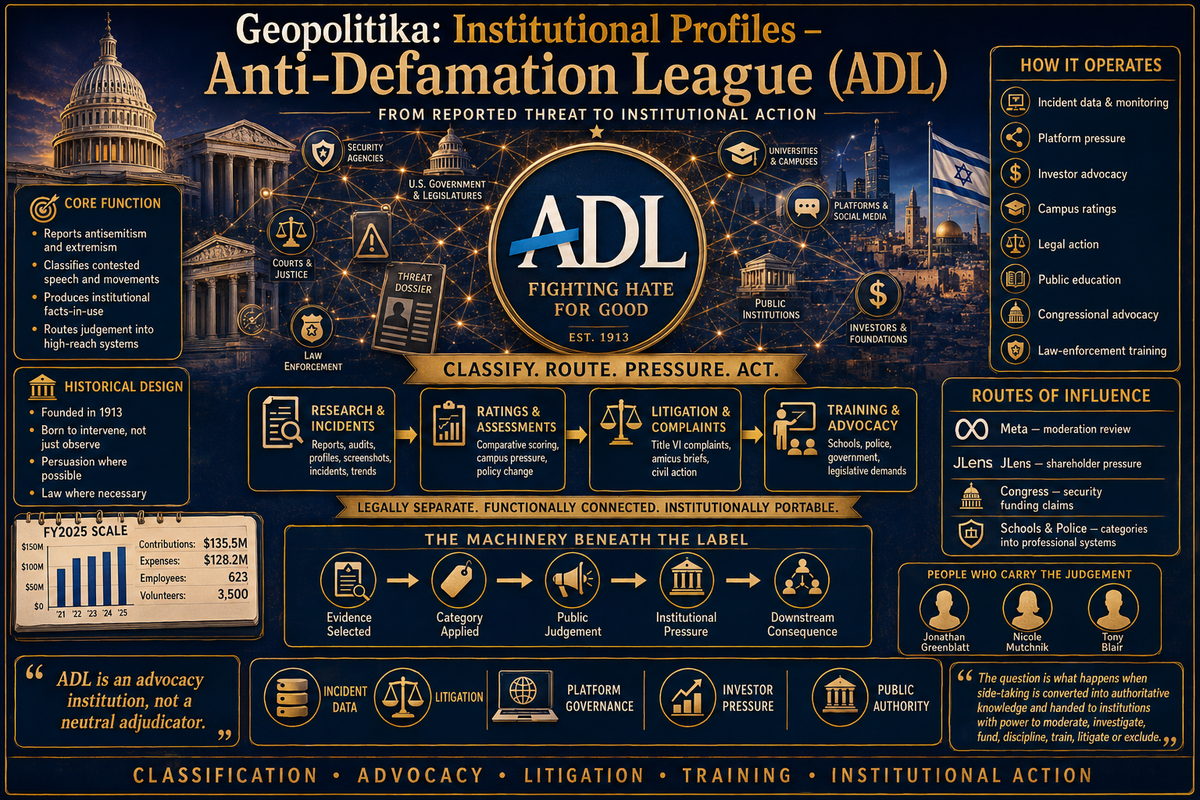
This article is published as part of the Geopolitika project to map Anglo-American power structures by examining their founding mythologies, leadership, linkages to power, public face, the nature of their outputs and who these are directed towards. This series is primarily generated from materials provided on the institution’s own websites, which are analysed using a structured analytic framework—see methodology statement at foot of article.
—
Executive Summary
The Anti-Defamation League (ADL) does not only report threats. It repeatedly decides which disputes remain open political or historical questions and which should be understood as antisemitism, extremism, conspiratorial hate, terrorism support or institutional failure. It then routes that judgement into platforms, investors, schools, police departments, courts, universities, legislatures and the wider reputational field.
This is not the same as controlling those institutions. ADL cannot remove a post, decide a lawsuit, appropriate a federal grant, compel a university to change its protest rules or order an investor to vote against a director. Recipients receive not only source material but an organised institutional interpretation: which facts matter, which examples typify a movement, which counterclaims are credible, which positions have crossed from political disagreement into prejudice or threat.
That is the institution's sharper observable function. ADL converts selected information into institutional facts-in-use—categories other actors can act upon. In doing so, it can close, rather than merely report, contested ground. The closure is rarely absolute. ADL may acknowledge uncertainty or retain a qualification. But a question about history becomes principally a question about antisemitic rhetoric. An anti-war protest becomes a platform for terror support. Unresolved causation becomes secondary.
That function is inseparable from ADL's protective work. Its classifications can make real violence, harassment and discrimination visible, help threatened Jewish communities obtain security resources and press platforms to confront harms they would rather treat as peripheral. The same machinery can impose burdens. Once a classification travels into high-reach decision systems, the person or organisation classified may have no proportionate review or appeal. A label can move between media, employers, platforms, schools, investors, government and law enforcement while the subject cannot see every handoff or reverse every downstream judgement.
Scale makes that asymmetry material. On its FY2025 return, ADL reported $135.5 million in contributions, more than $128 million in annual expenses, 623 employees and an estimated 3,500 volunteers. Its separately incorporated Foundation supplies grants, investment capacity, endowment support and debt backing. Specialist centres produce ratings, incident audits, platform reports, legal complaints, curricula, testimony, profiles and security demands.
ADL was not formed as a neutral research bureau that later discovered advocacy. Assertive legal intervention was part of its design. Its original charter proposed appeals to reason and conscience and, where necessary, law. Its current machinery still moves through amicus briefs, Title VI complaints, civil litigation, settlements, institutional ratings and campaigns to pressure decision-makers to act.
ADL is an advocacy institution, not a neutral adjudicator. In much of its contemporary Israel-related work, it defends positions it presents as necessary to Jewish communal security and contests forms of anti-Zionism that it classifies as antisemitic. Those positions do not represent every Jew, every Jewish institution or every interpretation of Jewish interest.
The relevant question is not whether ADL is biased—it plainly takes sides. The question is what happens when its side-taking is converted into authoritative knowledge and handed to institutions with the power to moderate, investigate, fund, discipline, train, litigate or exclude.
Classification As Closure
Three ADL publications show the epistemic product before it reaches the recipient. They concern the USS Liberty, Iran-related networks and protests, and Tucker Carlson. The subjects are different: a disputed historical event, a state-and-proxy threat frame and a high-reach media personality. The operative move is similar. ADL selects a contested field, organises the evidence, identifies the authorised interpretation and reclassifies rival explanations according to what they are said to do politically.
1. The USS Liberty: retaining the dispute while demoting it
Israel’s 1967 attack on the USS Liberty killed 34 American personnel and wounded 171 of a crew of 358.
In framing the continuing controversy over the event as antisemitic, ADL’s article, “The U.S.S. Liberty Incident: How a Tragic Mistake Became an Enduring Antisemitic Trope”, does not hide the casualties or pretend that no controversy exists. It acknowledges that surviving crew members remained “bitter” and continued to demand a new investigation.
The publication therefore keeps the counterclaim visible but demotes it. The live historical question—what really happened on 8 June 1967, what the participants knew and whether existing investigations resolved the matter adequately—is subordinated to a different question: what political and rhetorical work is performed by continued insistence that the attack was deliberate?
ADL does not reopen the full contested record. It foregrounds the later political use of deliberate-attack allegations—including their circulation through high-reach figures such as Tucker Carlson—and relocates the opposing position’s principal significance: less an unresolved historical account than material inside an antisemitism and conspiracy framework.
That does not prove every such allegation is antisemitic, and it does not settle what happened in 1967. It takes a position and establishes its own interpretive hierarchy. The reader is steered away from “Was the allegation true?” and towards “What is repeating it said to accomplish?”
That is how an institution can write the admissible frame around the past without censoring the page. The counterclaim remains visible, but its status changes—from an open historical position into potential evidence of bitterness, misinformation, conspiracism or prejudice.
The effect is not only a verdict on what happened in 1967. It is a decision about what kind of claim the opposing account is permitted to become.
2. Iran: unresolved causation inside a ready-made threat hierarchy
ADL’s Iran-related articles perform a similar operation across a more fragmented field.
For example, the article, “Pro-Iran Terrorist Attacks Against Jewish Communities”, discusses attacks and plots associated with Harakat Ashab al-Yamin al-Islamia (HAYI). It draws on claimed responsibility, digital traces, criminal complaints, media reporting and possible routes involving recruited or paid operatives.
The evidentiary limit is material. ADL and the International Centre for Counter-Terrorism (ICCT) linked HAYI’s digital footprint to pro-Iran networks, while security officials had not independently verified a direct Iranian connection across all relevant cases. The available record therefore supports a mixed field: claimed responsibility, ideological alignment, digital association, reported handoffs, possible recruitment, common-source diffusion, opportunistic actors and unresolved autonomy.
It does not establish that Iran directly commanded every person, attack or propaganda act placed inside the broader proxy frame. Yet the state-and-proxy classification still travels.
The frame organises disparate incidents and actors beneath a ready-made hierarchy of threat: Iran, proxy networks, operatives, propaganda and attacks against Jewish communities. Unresolved causation survives as a qualification, but the recipient encounters it after the architecture has already been supplied.
Quds Day: precipitating violence becomes background
ADL’s article, “Quds Day and Other Iran-Related Protests Nationwide Platform Support for Terror, Conspiratorial Hate”, extends the same classificatory architecture into public demonstration.
Context matters. The rallies discussed in the article took place 13 days after Ali Khamenei was killed in a major US-Israeli attack on Iran. ADL describes Khamenei as “recently assassinated” but does not mention who carried out the killing, treating both the assassination and the wider military attack as background. Portraits of a national leader killed less than two weeks earlier are read chiefly as veneration of the Iranian regime, while the demonstrations’ anti-war framing is treated as inadequate or deceptive.
The precipitating state violence recedes. The protesters’ response becomes the actionable fact.
ADL documents praise for armed groups, violent slogans, threats against Jews and conspiratorial language. But the most inflammatory examples are allowed to organise the meaning of the wider demonstrations. Mourning, opposition to foreign attack, Iranian nationalism, regime support and endorsement of violence are collapsed into a single threat hierarchy.
Evidence about selected speakers, signs and chants becomes the governing identity of the assembly. “Anti-war” is not examined as a political position shaped by an immediate military assault; it is recast as a cover beneath which terror support and antisemitism operate.
The distinctions matter:
- Opposition to a US-Israeli attack is not proof of support for the Iranian government
- Mourning an assassinated leader is not endorsement of every policy of that leader
- Violent or antisemitic speech by some participants does not define every participant or motive.
ADL does not need to silence the protesters. It supplies the institutional frame through which their speech will be received. Once that frame enters media, policing, universities or legislatures, the attack on Iran becomes context while the response to it becomes evidence.
The article therefore does more than document offensive conduct. It decides which violence governs interpretation—and which is permitted to fade into the background.
3. Tucker Carlson: deciding which questions are no longer innocent
ADL’s Tucker Carlson backgrounder performs closure through reputational interpretation rather than historical adjudication or security attribution.
The profile assembles interviews, monologues, podcasts and posts. It highlights audience scale, including a Darryl Cooper interview that ADL said received more than 35 million views on X. It interprets Carlson’s “just asking questions” posture as a method for circulating conspiratorial or antisemitic claims while preserving deniability.
The profile does not need to prove that every viewer was radicalised. It does not need to establish that Carlson commanded his audience or that a particular institutional sanction was caused by ADL. Its practical output is an ADL authorised reading of the public record.
The profile tells journalists, employers, platforms, political actors and audiences which clips are representative, which guests matter, which narrative connections are dangerous and which posture should be read as deniability rather than inquiry. That is more than a call for censorship. It is agenda-setting over the meaning of speech.
A question can remain grammatically a question while the institutional interpretation declares its communicative function settled. The profile distinguishes the literal proposition from what ADL says the performance accomplishes: normalisation, insinuation, audience preparation or plausible deniability. That interpretive move may be correct in a given instance. Public figures frequently use questions to advance claims they do not wish to state directly.
The power lies in ADL’s capacity to make that interpretation portable. A journalist no longer confronts an unstructured archive of broadcasts. A platform or employer does not receive raw clips. It receives a curated pattern bearing the authority of an established anti-extremism organisation.
The Carlson profile demonstrates that ADL’s product is not confined to post removal. It supplies a judgement about what speech means, which questions have lost their innocence and which public posture should no longer receive the benefit of ambiguity.
An Institution Built To Intervene
This closure function did not emerge accidentally from social media research. It fits an institutional design present from the beginning.
ADL dates its formation to 1913, when Chicago lawyer Sigmund Livingston began with a reported $200 budget and two desks. Its early mission was to stop the defamation of Jewish people and secure “justice and fair treatment to all”.
The founding context was the prosecution of Leo Frank, a Jewish factory manager convicted of murdering 13-year-old Mary Phagan amid a virulently antisemitic campaign. Frank’s death sentence was commuted; he was abducted and lynched in 1915. A Times of Israel history connects the case both to ADL’s formation within B’nai B’rith and the revival of the Ku Klux Klan.
The charter contemplated moral persuasion first and legal intervention where persuasion failed. ADL was therefore conceived not simply to describe prejudice but to act against it. It was an assertive advocacy-and-litigation organisation from inception.
That orientation remains visible throughout ADL’s official history. The organisation says it supplied research about Nazi supporters and hate groups to government agencies and the press. It says the FBI increasingly turned to it for expertise. It filed amicus briefs in Shelley v. Kraemer in 1947 and McCollum v. Board of Education in 1948. It promoted anti-mask laws and later hate-crime legislation. It carried anti-bias categories into schools, workplaces and law-enforcement training.
ADL says its A World of Difference programme reached more than 56 million people in more than 10 countries. It says it supplied intelligence before the 2017 Unite the Right rally in Charlottesville and supported Sines v. Kessler, litigation that produced verdicts exceeding $26 million. It says it contributed more than 30 recommendations to the White House strategy to counter antisemitism.
These are first-party contribution claims, not a complete audit of causation. Their narrative function is nevertheless evident.
ADL’s history presents a chain in which the institution identifies a harm, develops expertise, enters a court or government process, contributes to an outcome and incorporates that outcome into the history that authorises its next intervention. History is therefore not only commemorative. It is a renewable legitimacy resource.
The official account also places ADL inside the recognised iconography of American civil rights. A photograph on its history page shows ADL national director Benjamin Epstein with Martin Luther King Jr and Attorney-General Robert F. Kennedy in 1963. The image positions ADL within both civil-rights legitimacy and federal authority.
The historical counter-frame challenges that position. Historian Emmaia Gelman describes ADL as a conservative knowledge-production institution whose civil-rights work cannot be separated from anti-communism, state relationships, surveillance and conflict with Black, Arab, Muslim, Palestinian, queer and left organising. Her account foregrounds the 1993 surveillance scandal and states that a police raid found dossiers on nearly 950 organisations and 10,000 activists. The authorised corpus did not contain the underlying police files, court exhibits or complete archive needed to independently adjudicate every claim in that critical history. The figures therefore remain attributed to Gelman’s source lineage.
A narrower finding is directly observable: ADL’s public 1990s timeline discusses adjacent programmes and events but does not mention the surveillance scandal.
The omission does not prove concealment. Institutional timelines are selective. It is nevertheless material because the omitted event challenges the legitimacy of ADL’s information-gathering function. A history used to authorise contemporary monitoring has a particular obligation to confront episodes in which monitoring itself became the controversy.
A similar contradiction remains around the McCarthy era. ADL’s history presents the organisation as opposing character assassination and highlights Dwight Eisenhower’s denunciation of Senator Joseph McCarthy at an ADL anniversary event. Gelman alleges deeper accommodation with anti-communist politics and right-wing media figures. The available source set lacked the primary correspondence required to settle that dispute.
The evidence supports neither a purely heroic continuity nor a single covert project operating unchanged for a century. It supports institutional adaptation around durable methods: investigation, classification, legal action, education, government access and reputational pressure. It also supports a contemporary partisan concentration. ADL is not neutral between antisemitism and its targets. It is not neutral about Jewish institutional security. In much of its present work it is not neutral about Israel’s legitimacy or about forms of anti-Zionism it classifies as antisemitic.
A January 2026 Forward investigation, based on interviews with more than 20 people associated with ADL, reported a post-7 October concentration on antisemitism and Israel-related controversy, internal disagreement, staff departures and strained partnerships. Encyclopaedia Britannica records the longstanding dispute over whether ADL sometimes conflates criticism of Israel with antisemitism.
“Partisan” here does not mean controlled by the Israeli state or acting on instructions from donors. The analysed evidence does not establish either proposition. It means ADL enters these disputes with a declared constituency and preferred political outcome. It advocates for the Jewish communal security and Israeli legitimacy it recognises, while some Jewish, Palestinian, Arab, Muslim, anti-Zionist and left actors dispute its definitions and its claim to represent the relevant field. That conflict is not a departure from ADL’s institutional role. It is one of the principal arenas in which the role operates.
The People Who Carry The Judgement
ADL’s power cannot be reduced to one executive.
The board page captured in August 2026 identifies Nicole Mutchnik as chair. Its FY2025 filing reported 21 voting board members, 20 of them independent.
Jonathan Greenblatt, chief executive and national director, is the organisation’s most visible public carrier. Greenblatt represents ADL’s categories to media, government and partner institutions. In a 2026 example, he accompanied representatives from four communities affected by antisemitic attacks to Capitol Hill, combining community testimony with ADL incident data and defined legislative demands.
The organisation’s authority is broader than Greenblatt’s public profile. As at August 2026, the leadership page listed a chair, a CEO and 34 senior-team members—36 named leadership figures in total—includes finance, legal affairs, extremism research, education, technology, government relations, international affairs, communications, development and regional operations.
Each function changes the form in which a classification travels. Researchers collect screenshots, incidents, statements and network information. Analysts convert them into categories and trends. Lawyers convert classifications into complaints, briefs and litigation theories. Policy staff convert data into legislative demands. Communications teams make the judgement portable. Regional offices maintain access to schools, police, public officials, media and community institutions.
Named personnel make those routes visible. James Pasch carries a litigation function. Ari Hoffnung, listed as both JLens managing director and an ADL senior adviser on corporate advocacy, connects research and classification to investor governance. Tony Blair, ex-UK Prime Minister and head of the Tony Blair Institute for Global Change, is named as the ADL’s Special Advisor for Global Affairs—a board level external bridge into international political networks and policy institutions rather than an internal line-management role.
The Anti-Defamation League Foundation is legally separate but connected through money and people. Foundation president Andy Adelson sat on the ADL board. The Foundation’s filing identified Greenblatt, George Selim (ADL Executive Vice President) and Sue Roberson (ADL Chief Financial Officer) as officers compensated through related organisations. According to the profile provided, before joining ADL, George Selim served in the Bush, Obama, and Trump administrations—at DHS as its first Director of Community Partnerships, leading a new Countering Violent Extremism Task Force, and at the White House on the National Security Council staff. Roberson’s profile lists a variety of leadership roles at Markle Foundation (CFO), and Time Inc., including the role of SVP and General Manager of Time Inc.’s Consumer Marketing and Revenue Division.
These are personnel and administrative bridges. They are not evidence that one officer commands every programme or that the Foundation covertly controls ADL.
Their significance is functional. They permit legitimacy, legal capacity, finance and specialised access to move between organisational settings without requiring every intervention to be personally directed by the chief executive.
The machine survives personnel turnover because the relevant functions are institutionalised.
The Financial Base Beneath The Classifications
ADL’s FY2025 Form 990 reported:
- $135,485,438 in contributions
- $135,300,377 in total revenue
- $128,163,819 in total expenses
- $72,321,987 in salaries and benefits
Those numbers explain how the institution produces authority at scale.
Reports require researchers and editors. Litigation requires lawyers, case selection and partner relationships. Ratings require criteria, data, scoring and communications. Training requires curricula and professional access. Congressional advocacy requires policy staff and community coordination. Reputation campaigns require distribution.
ADL is not a website that happens to publish reports. Its publications sit on top of a contribution-funded labour, legal and access system.
The separate ADL Foundation adds resilience. Its audited statements reported $177,229,261 in assets and $171,524,543 in net assets at 30 June 2025. Its Form 990 reported a $12,821,625 grant to ADL. Consolidated schedules recorded an $8,129,621 transfer and a $4,692,004 endowment appropriation supporting ADL operations.
The Foundation also guaranteed an ADL term loan with $15,257,654 outstanding at year-end.
These figures come from different accounting schedules and cannot simply be added as separate flows. Together they show a support architecture involving grants, transfers, endowment resources, shared officers and debt backing.
The upstream funding picture is less transparent. The public Schedule B omits donor names and addresses as permitted by federal rules. The filings establish large contributions but do not reveal the identity, restriction or programme expectation attached to every major gift.
That is an opacity layer, not evidence of donor command.
Funding sustains the capacity to classify. It does not, without an evidenced route, establish who selected a particular article, dictated a conclusion or controlled the organisation’s position.
Native financial references: Anti-Defamation League financial returns page, Form 990, fiscal year ending 30 June 2025, Part I and Part I Summary; Anti-Defamation League Foundation Form 990, fiscal year ending 30 June 2025, Part I, Part III, Part VI and Part VII; Anti-Defamation League and Anti-Defamation League Foundation Consolidated Financial Statements, 30 June 2025, Note 8, Note 9 and Schedules 1 and 2.
From Authorised Reality To Institutional Action
Once ADL has produced a classification, it has multiple routes through which to make that classification consequential.
Ratings: judgement as a stakeholder weapon
The Ratings & Assessments Institute says its work is designed to “pressure decision-makers to take meaningful action”. ADL reported assessing 135 institutions in 2025 and 150 in 2026, using 32 criteria. It said assessed institutions changed policies, revised protest and demonstration guidelines and improved bias-reporting systems. Those claimed outcomes were reported in aggregate by ADL and were not independently verified institution by institution in the analysed record.
The intended mechanism is unambiguous:
classification → public rating → mobilisation of students, parents, alumni, faculty, policymakers and advocates → institutional pressure
The rating becomes a fact-in-use. A university is not merely described. It is placed in a comparative hierarchy that others can carry into governance disputes.
Litigation: closure backed by legal process
ADL’s National Litigation programme describes Title VI complaints, amicus briefs, civil litigation and settlements. Its Legal Action Network connects cases to pro bono expertise and partner firms. This is not a recent departure from the organisation’s founding posture. It is the contemporary form of the charter’s movement from persuasion to law.
The route is:
classification of harm → legal framing → complaint, brief or lawsuit → investigation, settlement, institutional commitment or judgment
Courts, agencies, complainants, universities and law firms retain their own authority. ADL does not decide the case merely by defining it. But the institution can help decide which facts enter a legal frame, what category of injury applies and which remedy becomes institutionally available.
Meta: classification into moderation review
In “How Meta’s Content Moderation Practices Risk Turning Instagram into a Hub for Hate”, ADL identified 105 accounts associated with Nick Fuentes’ Groyper movement, with a combined following exceeding 1.4 million as of January 2026. Researchers reported 103 posts through Instagram’s ordinary channel. Meta removed eight and left 95 available; three of those 95 were hidden from teenagers.
On 30 March 2026, ADL said it directly flagged 253 accounts or posts to Meta. The publication converted a selected account network and reporting experiment into a claim about platform-governance failure. It then transferred the underlying classifications to the company capable of restricting distribution. Meta retained moderation authority.
The sources analysed did not establish the final outcome for all 253 items or whether Meta accepted every ADL classification. The handoff is nevertheless direct: ADL selected, classified, tested, published and escalated. Meta received an organised enforcement agenda rather than a neutral archive.
Cloudflare and JLens: classification into a corporate vote
ADL’s report “Keeping the Lights On: How Cloudflare Sustains Violent Extremism, Graphic Violence and Terrorism Online” examined websites using Cloudflare’s infrastructure and submitted abuse reports concerning graphic violence, extremist content and foreign terrorist material. Providing infrastructure is not the same as authoring or endorsing a site’s content. The record did not establish that Cloudflare intended to assist extremists or caused a particular violent act. The report’s conclusions then travelled through JLens. An ADL press release said Jewish investor network JLens represented 40 Jewish institutions with approximately $15 billion in communal capital and planned to withhold votes from selected Cloudflare directors.
The route became:
ADL research → infrastructure classification → JLens uptake → planned shareholder sanction
The completed record did not establish the final vote or prove that ADL commanded participating investors. It documented the conversion of a publication into a corporate-governance instrument.
Congress: classification into a billion-dollar claim
In “Leaders from Communities that Experienced Antisemitic Attacks Demand Action on Capitol Hill”, ADL reported 82 antisemitic protest-related incidents, 14 assaults and 79 harassment incidents outside synagogues in 2024. It also cited 1,122 antisemitic incidents at synagogues since 7 October 2023 and 13 terrorist plots targeting Jewish communities over the broader period. ADL and representatives from affected communities used those figures to ask Congress for at least $1 billion for the FY2027 Nonprofit Security Grant Program, alongside the Pray Safe Act and the SACRED Act. The route combined ADL’s incident classification, affected-community testimony and executive access. The destination was a public budget and legislative process. The corpus did not establish whether Congress appropriated the requested amount or what proportion of any later decision could be attributed to ADL. It showed data becoming a defined claim on public resources.
Police and schools: categories entering professional systems
ADL’s law-enforcement programme supplies briefings, workshops, extremism resources and antisemitism training to federal, state and local agencies. The relationship does not prove command over police activity. The sources did not trace a specific training input to a particular stop, investigation or prosecution. It does establish a route through which private definitions and datasets enter public professional knowledge.
Education works similarly. ADL ratings, curricula, monitoring, legal complaints and policy advocacy enter schools, universities and professional associations.
Once inside those systems, a private classification can affect protest rules, bias reporting, institutional reputation and legal risk. The route matters even where recipient autonomy remains intact.
Protection, Burden And Immobilisation
The protective side of the architecture is material:
- Jewish congregations and community institutions face shootings, arson, threats, vandalism and harassment. Victims cannot simply exit exposure to violence. Small organisations may lack the capacity to recognise a pattern, reach government or secure legal assistance. ADL can aggregate incidents, mobilise security resources, provide expertise and pressure institutions to address harms they would otherwise treat as isolated.
- Its history also includes work connected to fair housing, religious freedom, same-sex marriage, immigrant rights and other civil-rights claims. Its platform and technology research can expose genuine moderation and language-access failures.
The burden side travels through the same routes:
- A person or organisation classified as extremist, antisemitic, conspiratorial or pro-terror can face reputational, moderation, employment, funding, legal, policing or access consequences. Those effects need not be formally ordered by ADL. They can arise when downstream institutions reuse the category. The affected field includes Palestinian, Arab, Muslim, anti-Zionist, left-wing and protest organisations. It can also include Jewish dissenters whose political positions fall outside the communal or Zionist frame ADL treats as legitimate.
- A report on the Park East Synagogue protest, for example, named organisations ranging from Palestinian advocacy groups to Neturei Karta, an anti-Zionist Jewish group. The presence of Jewish dissent does not automatically invalidate a finding of antisemitic conduct by particular participants. It does demonstrate that “Jewish interest” is not a unitary position and that ADL’s constituency claims remain politically contested.
The no-exit problem is asymmetric. The asymmetry is one of reach. ADL’s classifications move through national media, platforms, universities, investors, government offices and partner networks. Most individuals—and many organisations—cannot match that distribution. A classification can be repeated through search engines, press coverage, employers, institutions and platform-governance systems, extending far beyond the subject’s capacity to answer in every venue where it appears.
That reach is not abstract. It is powered by the money, networks and expertise—legal and media—that ADL brings to bear. Contribution-funded staff, specialist centres, litigation capacity, communications infrastructure and institutional relationships turn a classification into a portable fact-in-use. The subject may rebut the original text; they rarely command equivalent resources to contest every downstream reuse.
What ADL’s frame leaves out
Six gaps limit public scrutiny of an institution whose classifications are built to travel.
- Selection: The public can usually see the finished article, rating or complaint. It cannot consistently see who proposed the subject, which internal office approved it, how competing interpretations were tested, or which executive authorised the final frame. Named authorship is often thin. The institutional voice speaks as “ADL analysts,” “ADL researchers,” ADL monitoring or ADL data—collective authority that obscures the internal chain of editorial responsibility.
- Item-level funding: Public filings establish a large contribution base and Foundation support but not the conditions attached to every major gift, or the relationship between a particular donor and a particular programme.
- Recipient disposition: The Meta report documents escalation, not every final moderation decision. The Cloudflare materials document planned investor pressure, not the completed vote and governance outcome. Congressional advocacy documents the request, not the final appropriation. ADL history records institutional achievements but does not always separate contribution from coalition action, recipient autonomy and wider political conditions.
- Correction: ADL’s Tracker states that “some articles are not independently verified.” The reviewed record contains methodology notes and governance policies, but it does not reveal a comprehensive public corrections ledger, an externally audited false-positive rate, or an affected-subject appeal process proportionate to ADL’s institutional reach.
- Subject voice: People and organisations under classification often appear as evidence, threats, movements or objects of interpretation rather than as participants in defining the category applied to them.
- Historical self-accounting: ADL’s public timeline does not adequately integrate the 1993 surveillance controversy. The McCarthy-era contradiction remains unresolved. A history used to legitimate contemporary information-gathering should confront, rather than background, the episodes that most directly challenge the ethics and boundaries of that function.
None of these omissions proves concealment or bad faith. They matter because ADL’s publications are designed to leave the page. The more effectively a classification enters other institutions, the more consequential the absence of transparent selection, correction, subject participation and outcome tracing becomes.
POSIWID: the production of admissible reality
ADL’s stated purpose is to combat antisemitism, hate and discrimination. The evidence documents genuine work consistent with that purpose.
Its observable institutional function is broader.
ADL produces authorised interpretations that make selected people, speech, organisations, histories and infrastructures actionable.
The recurring sequence is:
- An event, dispute or controversy creates demand for interpretation
- ADL selects evidence and applies a category
- The category distinguishes victims, threats, responsible institutions and permissible responses
- Historical legitimacy, professional expertise and organisational scale make the classification portable
- A report, profile, rating, complaint, training programme, testimony or delegation carries it to a recipient
- The recipient moderates, investigates, funds, litigates, trains, votes, disciplines or refuses;
- The intervention and selected outcome become evidence of ADL’s institutional usefulness
- That usefulness renews access, legitimacy and the case for further resources.
This cycle does not require hidden command. Researchers classify. Executives represent. Lawyers translate. Communications teams amplify. Regional staff maintain access. JLens carries selected findings into investor governance. Courts, platforms, universities, police and legislatures retain their own authority.
The recipients’ autonomy is the causal limit. It is also part of the accountability problem. ADL can say it supplied research rather than imposed a decision. The recipient can say it relied on expert material rather than authored the classification. The affected subject experiences the combined effect without necessarily being able to locate responsibility at one node.
A disciplined POSIWID determination is therefore:
ADL converts selected information into institutional facts-in-use—categories that recipients can act on—and in doing so often closes, rather than merely reports, contested political and historical ground.
This function has two outputs:
- Firstly, it can protect people whose vulnerability would otherwise remain administratively invisible. It can expose genuine violence, antisemitism, discrimination and institutional negligence.
- Secondly, it can also establish an admissible reality before the dispute has been fully heard by all affected parties. The counterclaim may remain visible, but demoted. Unresolved causation may remain in a footnote, but the state-proxy frame travels. A broadcaster’s questions may remain questions, but their institutional meaning has been settled. A protest may contain varied motives, but selected conduct organises the whole.
The power is not ownership of truth. It is the capacity to make one interpretation more usable than its rivals.
Conclusion: The Net Effect
ADL is an assertive, contribution-funded and historically litigious advocacy institution. It is partisan in defence of the Jewish communal security and Israeli legitimacy it recognises, while claiming a broader civil-rights mandate. Its categories are not neutral descriptions. They are interventions designed to produce consequences.
That does not make every classification wrong. It does not make every legal action abusive. It does not establish that donors dictate outputs, Israel directs the organisation or recipients obey a common command. It means ADL should be assessed according to the power it actually exercises rather than the legal powers it lacks. The institution cannot order a platform to remove a post, but it can define the network and hand over the enforcement case. It cannot vote every investor’s shares, but its research can become the basis for a planned director sanction. It cannot appropriate federal money, but it can turn incident data and community testimony into a billion-dollar demand. It cannot settle history for every reader, but it can make one historical position institutionally legible as prejudice rather than unresolved dispute.
The net effect is therefore neither simply protection nor simply repression. ADL expands the capacity of threatened communities to be recognised by powerful institutions. It also expands the capacity of powerful institutions to act upon privately produced classifications.
That duality creates the central democratic problem. An organisation that writes categories for use by courts, platforms, investors, schools, police and legislatures should disclose more about how those categories are selected, financed, authorised, corrected and contested. It should distinguish selected examples from movement-wide claims, publish clearer correction and appeal routes, include affected-subject perspectives, and trace its recommendations into recipient decisions and human consequences.
ADL’s enduring achievement is that it built an institution capable of turning information into action. Its enduring risk is that the action can begin after the institution has decided which questions remain legitimate to ask.
—
Published via Mindwars Ghosted.
Geopolitika: Tracing the architecture of power before it becomes the spectacle of history.
Methodology Note: This article synthesises completed analyses of ADL as an institution, a 20-item ADL publication corpus captured on 5 August 2026, and competing institutional histories covering 1913–2026. The controlling synthesis preserved medium confidence and a mechanistic causal ceiling. First-party claims about historical achievements and programme effects are identified as institutional claims unless independently supported. Repetition across ADL publications is not treated as independent corroboration. Critical claims requiring absent archival or legal records remain attributed to their authors. Material quotations, figures and examples are linked to active public source references or identified through native financial filing locators. Historical evidence is not projected automatically into current status. Financial disclosures were analysed as evidence of material relationships, incentives, ownership, risk and payment flows. They were not treated as automatic evidence of misconduct, intent or conscious coordination. The evidence supports classification, legitimacy, litigation, reputational and response-routing mechanisms. It does not support donor command, foreign direction, hidden recipient control, universal audience effects, sole causation or a whole-system conspiracy. Base analytic outputs are available on request. For methodological details—including Transparency Score definitions, typology classifications, and confidence calibration—see the Geopolitika Series Methodological Statement.
Mindwars Ghosted is an independent platform dedicated to exposing elite coordination and narrative engineering behind modern society. The site has free access and is committed to uncompromising free speech, offering deep dives into the mechanisms of control.