Geopolitika: Institutional Profiles – Online Hate Prevention Institute (OHPI)
The Definition in the Middle: How a small Australian charity turns the IHRA definition into taxonomies, data, training and authority-facing evidence—and why its transparency has not kept pace with its reach
This article is published as part of the Geopolitika project to map Anglo-American power structures by examining their founding mythologies, leadership, linkages to power, public face, the nature of their outputs and who these are directed towards. This series is primarily generated from materials provided on the institution’s own websites, which are analysed using a structured analytic framework—see methodology statement at foot of article.
—
Executive Summary
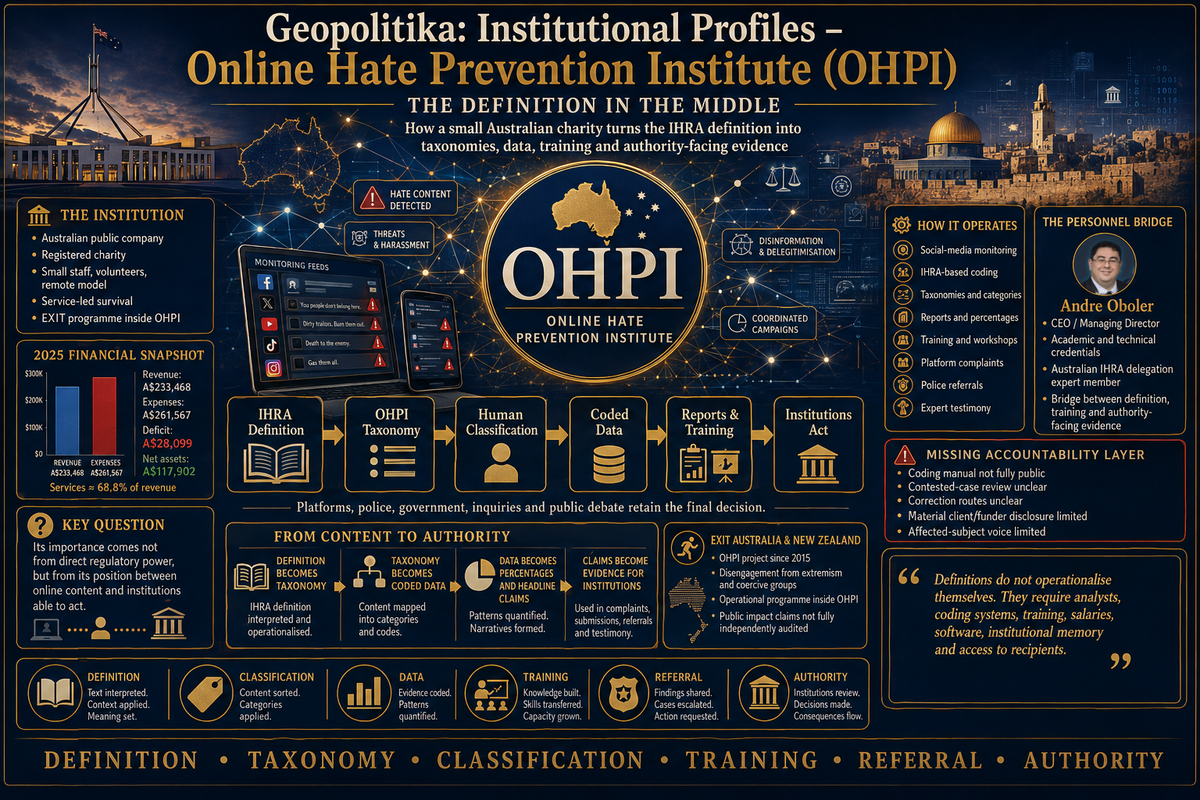
The Online Hate Prevention Institute (OHPI) is a small Australian charity comprising 3.46 full-time-equivalent staff, eight casual workers and ten volunteers. Its importance comes not from direct regulatory power but from its position between online content and institutions able to act.
For antisemitism work, OHPI expressly uses the International Holocaust Remembrance Alliance’s (IHRA) Working Definition of Antisemitism, including its examples. It converts that definition into taxonomies of 26 and later 27 categories, which human analysts use to code social-media content.
OHPI’s chief executive, Andre Oboler, is also an expert member of the Australian Government delegation to IHRA. That is a documented personnel and legitimacy bridge. It is not evidence that IHRA or the Australian Government controls OHPI.
OHPI’s classifications become reports, percentages, training, platform complaints, police referrals, policy submissions and expert testimony. Downstream institutions retain the final decision, but OHPI helps define and organise the evidence placed before them.
The strongest public evidence establishes OHPI’s production, reception and some bounded implementation. It does not independently validate every broad claim about platform-policy change, deradicalisations or lives saved. The missing accountability layer includes coding rules, contested-case review, correction routes, material client and funder disclosure, and direct evidence from people affected by classifications.
The Institution Behind the Method
The Online Hate Prevention Institute has publicly warned that, without increased fundraising, much of its work may not remain viable.
That warning is central to understanding the institution. OHPI produces classifications, reports and training that can enter platform, police and government processes, but it does so through a small organisation operating at a deficit and increasingly dependent on paid services, commissioned projects, grants and donations.
The Australian Business Register records OHPI as an Australian public company from 23 January 2012 and a registered charity from 3 December 2012.
OHPI says it began with seed funding and five professional staff working from a Melbourne office. When that funding ended, it shifted to a lower-cost model based on remote work, volunteers and continuing executive leadership. Its survival has depended less on a large endowment than on institutional persistence, voluntary labour and the ability to secure new funded work.
That continuity has also involved absorbing programmes rather than creating separate legal institutions. EXIT Australia and New Zealand became an OHPI project, while entity-level deductible-gift-recipient status followed on 1 January 2024.
Founded in 2015, EXIT helps people seeking to disengage from violence, violent extremism, coercive groups and other high-demand organisations. It says it works with clients across Australia and in difficult settings, including maximum-security prisons and international conflict zones. EXIT reports to the OHPI board but maintains a separate voluntary advisory board of disengagement specialists.
OHPI attributes substantial impact to EXIT, including more than 250 “deradicalisations,” 1,500 lives saved and the prevention of attacks. The public record establishes that EXIT is an operational programme with specialist personnel and institutional continuity inside OHPI. It does not independently audit those totals, define consistently what counts as a deradicalisation, or establish the counterfactual required to verify lives or attacks prevented.
EXIT nevertheless illustrates OHPI’s dual institutional character. OHPI is not only a research and classification organisation. It also provides intervention, training, technical and advisory services, some of which generate income and sustain its wider work.
Its 2025 filing recorded:
- A$160,598 from goods and services
- A$52,056 in donations and bequests
- A$17,698 in government revenue
- A$3,116 in other revenue
- A$233,468 in total revenue
- A$261,567 in expenses
- a deficit of A$28,099; and
- net assets of A$117,902.
Services accounted for approximately 68.8% of revenue. Employee expenses of A$225,228 represented approximately 86.1% of total expenses.
OHPI’s own accounts reported a slightly different deficit of A$28,011, apparently reflecting minor accounting or classification differences. The larger finding is unchanged: the organisation is running at a loss while depending materially on services, grants and commissioned projects.
OHPI itself warned:
“Without an increase in fundraising, the rest of our work will not remain viable.”
Its reporting also indicates that the board moved to reduce work without attached funding and place greater emphasis on business development and funded projects. This does not establish that clients, donors or grant providers dictate classifications. It does establish that financial conditions influence which projects can continue, which subjects attract resources and which outputs the institution is able to produce.
Where governments, platforms, foundations or other organisations fund authority-facing research, the identities of material counterparties, the terms of commissioning and the relationship between funding and deliverables become relevant to evaluating the resulting evidence. Asking who paid for a project is not an allegation of misconduct; it is part of understanding how institutional priorities are selected and sustained.
Definitions do not operationalise themselves. They require analysts, salaries, coding systems, training, software, institutional memory and access to recipients. OHPI’s legal continuity, intervention programmes and service-led financial model provide that machinery.
They also create a material tension: the institution’s classifications may gain authority through external reception, while its continued survival depends in part on securing further projects from institutions willing to fund or use those outputs.
A Consequential Conversion Point: From Definition to Taxonomy
The Online Hate Prevention Institute cannot delete a post, prosecute a speaker or change the law. Its influence lies between online expression and the institutions that can act.
It converts content into classifications, classifications into data, and data into reports, training, platform complaints, police referrals and public-policy evidence. In May 2026, for example, OHPI appeared as an expert witness before the Australian Government’s Royal Commission on Antisemitism and Social Cohesion, presenting findings drawn from monitoring across ten social-media platforms.
This machinery performs a dual function. OHPI documents real threats and gives targeted communities routes into institutions that may otherwise respond slowly. It also exercises private discretion over classifications that can later enter platform, police, inquiry and government processes.
OHPI works across antisemitism, anti-Muslim hate, racism, misogyny, transphobia, cyberbullying and extremism. Its preventive scope is expressly broader than formal regulation:
“Our definition is wider than both that of the law and that of platform providers.”
That broader approach may identify harm before it crosses a legal threshold or violates a platform rule. It also means OHPI is not simply recording categories already settled by law.
For antisemitism, the principal instrument organising that discretion is the International Holocaust Remembrance Alliance Working Definition of Antisemitism. OHPI states:
“We use the IHRA Working Definition of Antisemitism.”
The IHRA definition describes antisemitism as a particular perception of Jews that may be expressed as hatred toward them. It says antisemitic manifestations may be directed at Jewish or non-Jewish individuals, their property, Jewish communal institutions and religious facilities.
Its accompanying examples give the definition much of its practical significance. They include:
- Advocating or justifying harm to Jews
- Making conspiratorial allegations about collective Jewish power
- Holding Jews collectively responsible for the conduct of an individual
- Denying or distorting the Holocaust
- Accusing Jewish citizens of greater loyalty to Israel than to their own countries
- Denying Jewish people the right to self-determination
- Applying discriminatory standards to Israel
- Using traditional antisemitic symbols or allegations to characterise Israel or Israelis
- Comparing contemporary Israeli policy with that of Nazi Germany
- Holding Jews collectively responsible for actions of the State of Israel.
IHRA describes the framework as non-legally binding and states that criticism of Israel comparable to criticism directed at another country is not, by itself, antisemitic.
The definition therefore covers both relatively direct cases—such as threats, conspiracy allegations and collective blame—and more contested judgements involving Israel, Zionism, historical analogy and discriminatory standards.
Applying those examples requires context. The text does not automatically determine whether an image employs an antisemitic trope, whether a historical comparison is discriminatory, whether a claim denies Jewish self-determination, or whether a statement attacks Jewish people collectively rather than criticising a state. Analysts make those decisions.
OHPI’s importance begins where the written definition ends and practical application begins.
In its Online Antisemitism in Australia 2023 project, OHPI monitored Twitter, Facebook, Telegram, TikTok, Gab, YouTube, BitChute, Instagram and Reddit. It says its classification system drew on the IHRA Working Definition and IHRA’s definition of Holocaust denial and distortion.
The resulting taxonomy contained:
- four major categories
- 26 subcategories.
Later monitoring used 27 subcategories.
A non-binding definition had become a working research instrument.
An analyst reviewed a post, comment, image or video and assigned one or more categories. Those classifications became data points, which were aggregated into percentages, platform comparisons and trend claims. The resulting findings could then be used in reports, training, public submissions and expert evidence.
The New Zealand Pilot Project shows that process at work. Between April and September 2024, university students employed by the Astor Foundation were seconded to OHPI for training and management.
They collected 1,217 items over 146.5 hours across ten platforms. OHPI reported that 884 items—73%—originated in New Zealand or had been reposted by people there.
The material was classified into 27 IHRA-derived categories grouped into four larger types.
A single item could receive multiple classifications. Category percentages therefore describe the prevalence of coded features; they do not necessarily represent distinct posts, distinct speakers or mutually exclusive incidents. Totals across categories may exceed 100%.
That does not invalidate the data. It means headline findings depend on the taxonomy, sampling choices, analyst instructions, contextual judgements and treatment of overlapping categories.
The operative chain is therefore:
IHRA definition and examples → OHPI taxonomy → human classification → coded data → report or headline figure → institutional recipient
The evidence supports this definition-to-authority route. It does not establish that IHRA commands OHPI, that the Australian Government controls its findings or that platforms automatically act on its recommendations.
The Personnel Bridge
OHPI says its members elect the board, while day-to-day management is delegated to the chief executive. The central operational actor is Andre Oboler, OHPI’s chief executive, managing director and secretary.
Oboler’s authority rests on a career spanning computer science, law, academia, professional leadership and antisemitism policy. He holds a PhD in Computer Science from Lancaster University, an LLM(JD) and a first-class honours degree in Computer Science from Monash University, and completed a postdoctoral fellowship in political science at Bar-Ilan University. He is also recorded as a Graduate Member of the Australian Institute of Company Directors.
He has held teaching and research roles at Lancaster, Monash and the La Trobe University Law School, where his subjects included privacy, digital identity, cybersecurity, cyberterrorism, international cyber warfare and cyber law. His publications span software engineering, computational social science, platform governance, cyber racism, online hate, antisemitism, Islamophobia and legal intervention in online speech.
Oboler has also held leadership and policy roles in the IEEE and IEEE Computer Society, providing a separate source of technical-professional standing. His antisemitism-policy work predates OHPI and includes recorded roles with the Global Forum to Combat Antisemitism, the Zionist Federation of Australia, the American Jewish Congress and the B’nai B’rith Anti-Defamation Commission.
He is also an expert member of the Australian Government delegation to the International Holocaust Remembrance Alliance. OHPI says he has served since 2015, was present when the working definition was adopted, participates in its antisemitism committee, and has briefed police, prosecutors, parliamentary and intergovernmental forums on online hate and platform governance.
The documented bridge is therefore broader than a single institutional link:
technical and academic credentials → professional-policy standing → OHPI executive authority → Australian Government IHRA participation → definition, training and public-authority environments
These roles allow authority gained in academic, professional and governmental settings to flow into OHPI’s reports, training and testimony, while OHPI’s work reinforces Oboler’s external expert standing. This is authority concentration and portability—not proof of government or IHRA direction, universal validity, or personal control over every coding decision.
The public record does not show where independent methodological authority sits. OHPI identifies a board with ultimate responsibility but publishes no evidence of a methodology committee, independent classification panel, conflict safeguards or director review of contested cases. EXIT has a specialist advisory board, but the record does not establish that it reviews antisemitism classifications.
This does not prove internal checks are absent; it means they are not publicly visible. Demonstrable independence would include named reviewers, board-approved methodology, review outside executive management, conflict procedures and escalation routes for disputed cases.
The issue is whether classifications receive independent scrutiny when executive leadership, methodological advocacy and external representation converge in one long-serving individual. Most biographical evidence comes from Oboler, OHPI and university profiles, which establish attributed roles but not their practical influence.
From Analyst Discretion to Headline Figures
OHPI argues that trained human analysts can identify irony, symbolism, coded language and conspiracy narratives that automated tools may miss. Human interpretation may improve contextual accuracy, but it also introduces discretion into the production of data.
The public record does not provide a complete account of:
- The analyst coding manual
- How each code maps to the IHRA definition and examples
- Thresholds for assigning multiple classifications
- Treatment of quotation, satire, documentation and condemnation
- Treatment of anti-Zionist or pro-Palestinian political speech
- Disagreement-resolution and final-review procedures
- Intercoder-reliability results
- Correction or reclassification processes
- Any route through which an affected person may challenge a coding decision.
These gaps are most significant in disputed Israel- and Zionism-related cases, where political argument, historical analogy, collective attribution and discriminatory imagery may overlap.
The resulting classifications nevertheless produce figures that travel into public debate and institutional processes.
In evidence associated with the Royal Commission on Antisemitism and Social Cohesion, OHPI reported a rise from a scaled 272 items in an earlier comparison period to 1,449 items after 7 October 2023—a 539% increase. The earlier figure had been scaled from 244 collected items because LinkedIn was not included in that monitoring period.
OHPI later reported that:
- A residual traditional-antisemitism category appeared in 51.8% of coded content
- Antisemitic words or imagery applied to Israel or Israelis appeared in 25.0%
- World-Jewish-conspiracy material appeared in 23.7%
- Claims of Jewish control appeared in 13.9%
- Dehumanising material appeared in 8.3%
- Calls for harm justified through radical ideology or extremist religion appeared in 5.9%
- General calls for harm appeared in a further 3.2%.
These are OHPI’s results from OHPI’s taxonomy. The available public corpus does not independently reproduce the underlying dataset or audit each classification.
The relevant sequence is:
category → analyst judgement → coded item → aggregate figure → institutional claim
The evidence does not show that OHPI routinely treats criticism of Israel as antisemitic. It shows that publicly consequential statistics depend on interpretive decisions whose detailed rules, review mechanisms and error rates remain only partly visible. The calculations may be arithmetically accurate while the classifications beneath them remain open to scrutiny.
Truth, Falsity and Classification
A further methodological question concerns the factual status of claims classified as antisemitic.
OHPI sometimes checks factual assertions directly. In one report, for example, it corrected the false claim that Rupert Murdoch was Jewish. But its public methodology does not disclose a consistent process through which the factual basis of every disputed claim is tested before classification.
This matters because truth and antisemitic function are separate questions.
A claim may contain accurate facts about a named individual, organisation, lobby, donor or government while becoming antisemitic through collective attribution, essentialising language or the unsupported extension of specific conduct to “the Jews.” Conversely, a statement may be factually false without being antisemitic unless its falsity is organised through anti-Jewish stereotypes, conspiracy narratives or collective blame.
OHPI’s taxonomy appears primarily to ask whether material reproduces a recognised narrative—such as Jewish control, collective responsibility, dual loyalty or a world Jewish conspiracy. The public record does not show whether analysts separately ask:
- Which factual propositions the statement contains
- What evidence supports or contradicts them
- Whether the claim concerns identifiable actors or Jews collectively
- Whether a documented institutional relationship is being converted into an ethnic or religious generalisation
- Whether the antisemitic character lies in factual falsity, framing, inference or communicative function.
The concern is therefore not that every classified claim must first be proved false. It is that the public methodology does not clearly distinguish claim truth, evidentiary support, collective generalisation and antisemitic communicative function.
Without that distinction, a classification can appear to resolve a contested factual or political claim merely by naming its narrative form.
How The Classifications Travel
Into platform governance
OHPI monitors platform responses and routes reports toward companies capable of removing or restricting material. A concrete example followed the May 2022 Buffalo terrorist attack. OHPI reported that it tracked a copy of the attacker’s video as views rose from 100,000 to more than 3.2 million. Working with the American Jewish Congress, OHPI used the hosting company’s reporting process and contacted the parent company’s managing director. It says the video was then removed. This supports a bounded implementation finding: a defined item, a traceable route and a reported outcome. The platform retained the power to act.
Into public authority
In April 2026, OHPI described collaboration with the Australian Federal Police involving reporting pathways, referrals for serious cases, regular updates and possible training connections. OHPI identifies, categorises and refers. Police retain investigative authority, prosecutors decide whether proceedings are warranted, and courts retain adjudicative power. The same division applies to inquiries and policy processes. The Victorian Equal Opportunity and Human Rights Commission cited Oboler and OHPI-related work in its 2013 report on racism and platform responsibility. By 2026, OHPI’s monitoring was being presented directly to a Royal Commission. Research had become evidence inside public-authority processes.
Through training
OHPI also expands its method by training other people. Its 2024–2025 reporting says 54 people completed introductory training funded by the Department of Home Affairs. A further 28 people completed initial expert training to become online “Triage Analysts,” with that programme funded by Meta. Not all OHPI training is necessarily IHRA-based. The New Zealand project, however, documents a direct route:
IHRA definition → OHPI taxonomy → OHPI-trained analysts → classified dataset → government-facing report
The resulting report was shared with the New Zealand Government through the Astor Foundation. Training therefore distributes parts of OHPI’s classificatory capacity beyond its permanent staff.
The Missing Voice and Review Layer
OHPI’s work is not confined to antisemitism. It has documented racism and abuse directed at Muslims, Palestinians, Arabs, First Nations Australians and other targeted groups.
Its 2024 reporting describes the Moment Project, conducted with Belgium’s Online Hate Task Force after October 2023. The project monitored ten platforms for 160 hours and recorded 1,169 examples of anti-Muslim hate and related racism against Palestinians and Arabs, alongside separate antisemitism monitoring.
The associated report used 11 categories: ten covering forms of anti-Muslim hate and one covering racism against Palestinians and Arabs. OHPI identified demonisation and dehumanisation of Muslims, claims that Muslims represent a cultural or security threat, and a substantial residual category containing slurs and hostile imagery. It reported especially high levels on X, Gab and Telegram.
OHPI has also published work on racism against First Nations people, misogyny, homophobia, transphobia, xenophobia, anti-Asian racism and other forms of online abuse. The evidence therefore does not support describing OHPI as indifferent to hate directed at Palestinians, Muslims or other communities.
The missing layer is not simply subject coverage. It is voice, participation and review.
The public record provides less evidence that Palestinian, Arab or Muslim communities—or anti-Zionist Jewish, pro-Palestinian and other politically affected speakers—participate in designing relevant taxonomies, reviewing difficult classifications or governing how antisemitism, extremism and political-speech boundaries are applied.
These communities may occupy two different positions in OHPI’s work:
- As populations whose exposure to hate is documented and defended
- As populations whose political speech, imagery or activism may itself become subject to classification.
The available corpus does not identify a traceable case in which the same post, speaker or event appeared in both positions. Nor does it explain whether the Moment Project and OHPI’s antisemitism monitoring used overlapping samples, subjects or incidents. The tension is therefore structurally present but not demonstrated through a same-item or same-speaker crossover case in the public record.
That evidentiary limit matters. The article should not imply that OHPI has demonstrably classified a person as antisemitic in one project while protecting the same person from anti-Muslim or anti-Palestinian hate in another. What the record shows is that OHPI operates taxonomies capable of addressing both sets of harms, while providing limited visibility into how competing classifications are reconciled when they overlap.
The public evidence is weighted toward OHPI, its analysts, partners and institutional recipients rather than toward people seeking to understand or challenge how they were categorised. This does not prove that classifications are wrong. It means the review architecture is not publicly legible.
ASIC, charity and taxation regulation establish legal existence, financial reporting and minimum governance requirements. They do not test the substantive validity of a taxonomy or provide an appeal process for disputed classifications.
A credible review architecture would explain:
- When a case receives secondary or community-informed review
- How analyst disagreements are resolved
- Whether affected communities contribute to taxonomy design
- How anti-Muslim and anti-Palestinian racism is distinguished from legitimate scrutiny of political or religious movements
- How antisemitism is distinguished from legitimate criticism of Israel and Zionism
- How overlapping Jewish, Palestinian, Arab and Muslim identities and harms are handled
- Whether a person can request correction or contextualisation
- Whether revised classifications are recorded publicly
- When research coding becomes a platform, police or government referral.
The accountability issue is therefore not whether OHPI recognises hate against Palestinians and Muslims—it demonstrably does. It is whether the primary communities it studies, protects and sometimes classifies have a proportionate voice in the methods and remedies governing that work.
Dependency, Incentives and Claimed Impact
OHPI operates inside a system of overlapping dependencies.
People targeted by antisemitic or other online abuse may rely on major platforms for employment, community, political participation and public visibility. Leaving can mean losing access rather than escaping harm. People whose speech is classified may depend on the same infrastructure and may face moderation, reputational or institutional consequences without seeing the evidentiary chain through which their material was assessed and referred.
These positions are not morally equivalent. They are structurally linked by dependence on privately governed platforms.
OHPI did not create that dependency and cannot compel a platform, police force or public body to act. It can nevertheless influence how material is classified, documented and presented to those institutions.
The organisation faces its own dependency. Limited reserves, operating deficits and reliance on grants, projects and paid services create pressure to secure funded work, maintain institutional relevance and demonstrate continuing need. That does not establish distorted findings or funder control. It does mean that financial conditions can affect which projects proceed, which subjects receive resources and which outputs are produced.
The mechanism is visible across the article: incidents generate demand for monitoring; OHPI converts that demand into classifications, reports, training and referrals; institutional reception strengthens its standing; and that standing supports further projects and funded work. In antisemitism research, repeated use of the IHRA definition also builds expertise that can support advocacy for its wider institutional adoption.
These processes may generate genuine public benefit. They can document threats, preserve evidence, support disengagement work and pressure platforms or authorities that might otherwise fail to respond. They also reproduce OHPI’s institutional authority and extend the reach of the frameworks it applies.
OHPI attributes substantial impact to this work. It says EXIT Australia and New Zealand has “deradicalised” more than 250 people, helped save more than 1,500 lives and prevented attacks. It also claims influence over platform practices, public policy and debate.
The public-facing record substantiates some parts of this account more clearly than others. It establishes that EXIT operates as an OHPI project, works with people seeking to disengage from violence or coercive groups, and may serve clients in prisons, interstate locations and international conflict settings. It also records OHPI’s aggregate outcome claims.
What it does not provide is an evidentiary chain sufficient to verify those totals independently.
A critical question is what counts as a “deradicalisation.” EXIT’s descriptions emphasise helping people who want to disengage from violence, leave extremist communities or escape coercive groups. Clients may include families, people in or leaving prison, and individuals associated with anti-government, conspiracy-driven or racial ideologies. The available material does not show a police-run or compulsory programme, nor does it establish that EXIT possesses custodial authority.
OHPI does not, however, publish a precise outcome definition. It remains unclear whether a counted deradicalisation requires:
- Changed political or ideological beliefs
- Departure from a group
- Cessation of violent conduct
- A reduced professional risk assessment
- Completion of an intervention
- Continued non-violence over a specified period
- Some combination of these outcomes.
Its terminology also varies. One report describes more than 200 people as having been redirected away from extremism and 124 as having been assisted to leave it; a later account refers to more than 250 people as “deradicalised.” The public record does not explain whether these are separate cohorts, overlapping categories or different descriptions of the same cases.
Nor does it disclose the information needed to assess those totals consistently: intake thresholds, case duration, intervention methods, completion criteria, independent assessors, follow-up periods, attrition, relapse, adverse outcomes or safeguards against double counting.
Claims that EXIT saved lives or prevented attacks require a still stronger causal basis. They depend on a counterfactual: what would probably have happened without the intervention. The public record does not show how OHPI calculated the number of lives at risk, attributed prevention to EXIT, excluded the contribution of other interventions or verified that an attack would otherwise have occurred.
The issue is not whether EXIT performs real work. The record supports that it does. The issue is whether politically and institutionally significant success terms are being used without publishing the observable changes, causal method and independent checks required for a person, life or prevented attack to be counted.
The strongest public evidence supports three narrower levels of effect:
- Production: reports, datasets, training, software, submissions and referrals OHPI demonstrably created.
- Reception: citations, testimony, partnerships and institutional engagement.
- Bounded implementation: specific reported outcomes with an identifiable route, most clearly the Buffalo video removal.
The EXIT totals and broader policy-impact claims remain first-party assertions at a higher causal level. That does not establish that they are false. It means the public record substantiates the existence and activity of the programme more strongly than it substantiates the scale and causation of its claimed outcomes.
The overall mechanism is one of institutional reproduction, not proof of conspiracy or central coordination. OHPI responds to real harms, converts them into classifications and authority-facing outputs, gains recognition through institutional reception and uses that recognition to support further monitoring and intervention.
The same process that can generate public benefit also increases the need for transparent methods, disclosed counterparties, published outcome definitions, independent evaluation and meaningful review.
POSIWID: What OHPI Does
OHPI functions as a definition-to-evidence and evidence-to-authority converter. It converts:
- The IHRA definition into operational categories
- Online material into classified data
- Data into reports, percentages and comparisons
- Expertise into training and credentials
- Reports into platform and public-authority interventions; and
- Institutional recognition into further legitimacy, projects and demand.
Its observable function broadly aligns with its harm-prevention mission. It gives communities additional capacity to document and challenge antisemitism and other online abuse.
The same machinery gives a private institution influence over which speech is counted, how contested political expression is described and what evidence reaches actors with greater power.
The overall verdict of this analysis is that:
OHPI is a small, durable and increasingly service-supported classification intermediary that operationalises the IHRA definition and routes the resulting evidence toward platforms and public authorities. Its influence is indirect but real. Its methodological, financial and remedial transparency has not kept pace with that reach.
Conclusion: Transparency Proportionate to Effect
The IHRA relationship is not peripheral to OHPI’s antisemitism work. It is part of the operating machinery.
OHPI adopts the definition and its examples, converts them into taxonomies, trains people to apply those categories and turns the resulting classifications into data that can enter platform, police, inquiry and public-policy processes. Andre Oboler links OHPI’s executive centre to Australia’s formal participation in IHRA, while the organisation’s history, personnel and increasingly service-led finances explain how this work is sustained.
The public-interest question is therefore precise. A non-legally binding definition is being operationalised by a private institution. Its classifications can influence systems capable of removing content, opening investigations, shaping policy and affecting reputations. That does not make the definition illegitimate or the work unnecessary. Nor is the answer to suppress antisemitism research.
The answer is transparency proportionate to effect. OHPI should publish its complete IHRA-derived taxonomy; explain how each category relates to the definition and its examples; provide anonymised difficult and borderline cases; and disclose its guidance on Israel-, Zionism- and Palestine-related political speech. It should also publish its multi-coding rules, quality-control procedures, intercoder-reliability results, reviewer disagreements, correction and reclassification processes, and the point at which research coding becomes an external referral.
The same standard should apply to institutional context. Material project funders, service counterparties, commissioning conditions and sponsorship arrangements should be disclosed where they bear on authority-facing research. Major claims concerning deradicalisation, lives saved, platform change or policy impact should be independently evaluated.
The question is not whether true antisemitism should be confronted. It is whether the institution drawing the line has disclosed enough for the public to examine how that line is drawn—especially where political speech, identity and institutional power collide. At present, it has not.
—
Published via Mindwars Ghosted.
Geopolitika: Tracing the architecture of power before it becomes the spectacle of history.
Methodology Note: This article is based on a completed Institution-STRAT analysis covering OHPI’s available chronology through 30 June 2026. The evidence included Australian corporate, charity and tax records; OHPI annual and financial reports; governance, programme and methodology pages; public submissions and testimony; and independent evidence of institutional reception. Most operational and impact claims originate with OHPI. They establish what the institution says and reports doing, but broader causal claims require independent recipient-side, methodological or outcome evidence. The causal ceiling is bounded institutional contribution. Stronger implementation language is used only where the evidence identifies a specific route and outcome. Base analytic outputs are available on request. For methodological details—see the Geopolitika Series Methodological Statement.
Mindwars Ghosted is an independent platform dedicated to exposing elite coordination and narrative engineering behind modern society. The site has free access and is committed to uncompromising free speech, offering deep dives into the mechanisms of control.