Geopolitika: The Architecture of Israel-Aligned Influence
How access, advocacy, expertise and standards move through institutions.
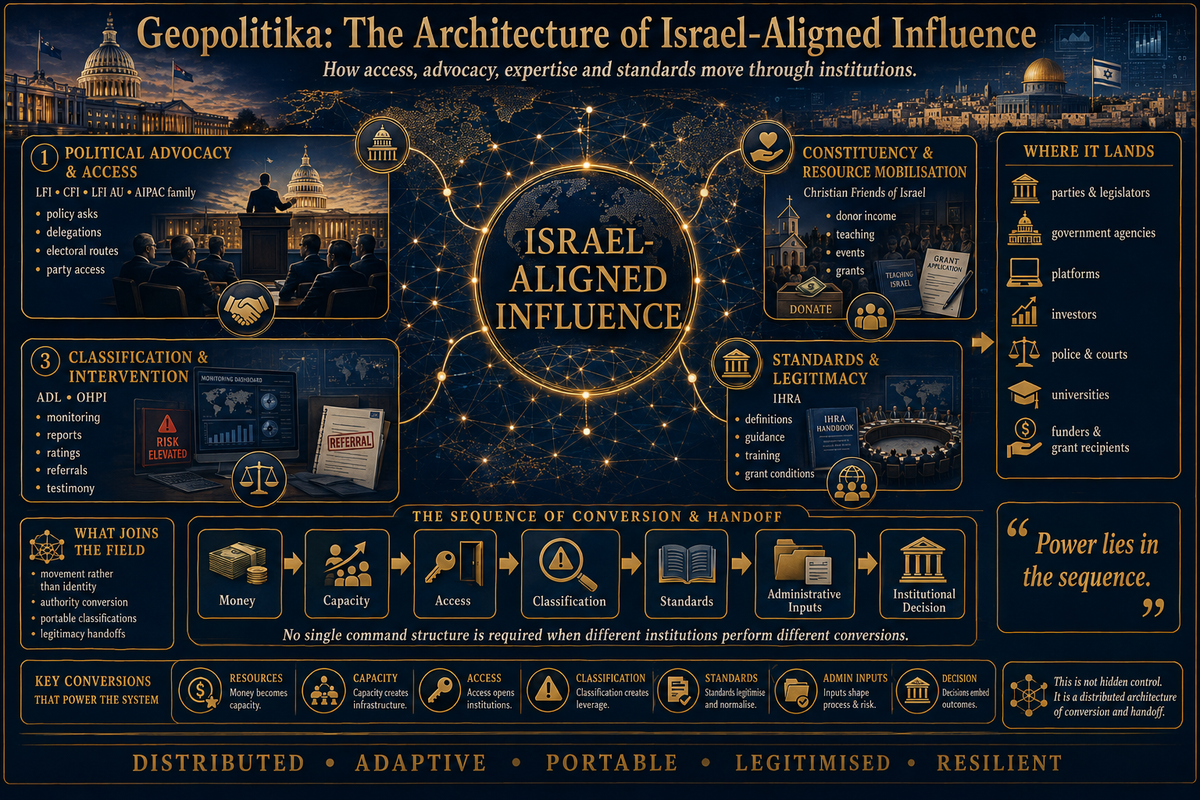
This article is published as part of the Geopolitika project to map Anglo-American power structures by examining their founding mythologies, leadership, linkages to power, public face, the nature of their outputs and who these are directed towards. This series is primarily generated from materials provided on the institution’s own websites, which are analysed using a structured analytic framework—see methodology statement at foot of article.
—
Executive Summary
This article is the roundup in a succession of profiles examining Labour Friends of Israel (LFI), Conservative Friends of Israel (CFI), Christian Friends of Israel (ChFOI), Labor Friends of Israel Australia (LFI AU), AIPAC and its associated political and educational machinery, the Anti-Defamation League (ADL), the International Holocaust Remembrance Alliance (IHRA) and the Online Hate Prevention Institute (OHPI). Read separately, they look like different species: parliamentary friendship groups, advocacy networks, a Christian charity, a US lobbying organisation, an anti-hate institution, an online-monitoring specialist and an intergovernmental remembrance body. Read together, a more useful pattern appears.
It is not a single command structure. The evidence does not establish one transnational controller, foreign direction of the field, donor control of the whole, or coordination merely because organisations address similar issues. What it does show is a distributed translation field.
Different organisations perform different stages of conversion. Some build political access and formulate policy asks. Some finance advocacy, projects or political activity. Some turn disputed social phenomena into data, classifications and rankings. Some carry expertise across institutional boundaries. Some convert expert work into standards. Downstream institutions—political parties, legislators, government agencies, platforms, investors, grant recipients and other administrative bodies—then decide whether and how those inputs become executable action.
The power lies in that sequence.
AIPAC’s filings show tens of millions of dollars moving through lobbying, political programmes and related electoral structures. ADL combines a nine-figure revenue base with classification, platform escalation and congressional advocacy. OHPI converts monitoring into reports, referrals and expert testimony. IHRA converts expert-governmental work into consensus-approved but formally non-binding definitions whose practical force depends on adoption elsewhere. Christian Friends of Israel converts donations into organisational activity and grants. The Friends of Israel groups operate closer to political parties themselves.
The dominant mechanism is therefore not hidden command. It is authority conversion: money into capacity; expertise into legitimacy; classifications into administrative inputs; access into policy opportunity; and institutional standing into language that other actors can use.
That distinction is the central finding of this series.
The Organisations — And The Jobs They Perform
The organisations fall into four functional groupings.
- Political advocacy and access: Conservative Friends of Israel and Labour Friends of Israel in Britain; Labor Friends of Israel Australia; and, at far greater financial and organisational scale, AIPAC together with AIPAC PAC, United Democracy Project and the American Israel Education Foundation. Their common function is proximity to political decision-making, although their legal forms, resources and methods differ sharply.
- Constituency and resource mobilisation: UK based Christian Friends of Israel is a distinct organisation from the political “friends-of” entities. Its record shows a charity converting donor income into staff, communications, events, teaching and grants, including a substantial funding route to projects in Jerusalem.
- Classification, monitoring and institutional intervention: the Anti-Defamation League and Australia’s Online Hate Prevention Institute produce categories, reports, incident data, assessments, referrals and advocacy capable of entering platform, legislative, investor and law-enforcement processes.
- Standards and legitimacy: IHRA occupies a different position again. Its central definitional authority is intergovernmental and consensus-based. Its working definitions are explicitly non-binding, but they are portable: once adopted or used by another institution they can become part of that institution’s own decision machinery.
We need to be careful not to flatten these roles into one amorphous “lobby”, or to mistake functional proximity for organisational unity. Christian Friends of Israel is not Conservative Friends of Israel. British Labour Friends of Israel is not Labor Friends of Israel Australia. AIPAC, AIPAC PAC, United Democracy Project and AIEF are distinct entities, even where formal relationships and personnel overlaps are documented. ADL is not OHPI. IHRA, meanwhile, supplies standards and definitions, but does not itself possess the legal or administrative authority exercised by the institutions that later adopt or apply them.
What joins the field is movement rather than identity: who produces an input, who carries it, who validates it, who receives it, and where decision rights finally sit.
I. Political advocacy and access: getting propositions to the decision point
The British Friends of Israel organisations
The British Labour and Conservative organisations occupy the most recognisable part of this field: political access organised inside the country’s two principal parties. But they differ in institutional depth and emphasis.
Labour Friends of Israel is the more developed policy-producing organisation. Its machinery extends beyond parliamentary friendship and delegations into policy papers, briefings, senior Labour platforms, staff and company governance, parliamentary chairs and vice-chairs, and relationships with outside specialists and communal institutions. Its network links MPs and peers with Israeli and Palestinian interlocutors, Jewish communal organisations, peacebuilding advocates and other policy actors.
Its product is therefore not simply access, but access, policy production and party-compatible legitimacy. Delegations place Labour politicians in contact with selected officials, civil-society bodies and political representatives; policy papers and events provide routes through which arguments can be made usable inside Labour politics. The exchange runs both ways: LFI gains standing from proximity to Labour power, while Labour actors gain access to LFI’s networks, policy material and curated political experience.
That senior-political adjacency has a long history. Tony Blair appears in LFI’s institutional record as a previous address figure, alongside Gordon Brown and later senior Labour speakers. Blair is now listed by ADL as its Special Advisor for Global Affairs. ADL’s profile also foregrounds his post-premiership work through the Tony Blair Institute for Global Change, including engagement with governments, Middle East peace and extremism.
It would be naive to treat such political and interpersonal linkages as inert simply because no formal command relationship is established. A former prime minister with continuing governmental access, an international policy institute, extensive Middle East engagement and an ADL advisory role carries substantial authority, relationships, policy experience and agenda-setting capacity between institutional settings. The important question is therefore not only whether organisations are formally connected, but what legitimacy, access and policy capacity travel with the people who connect them.
Conservative Friends of Israel performs a related but more concentrated role. Its strongest visible machinery lies in Conservative parliamentary relationships, delegations, senior political events and UK–Israel strategic-partnership signalling.
CFI repeatedly places MPs, peers and party leaders inside organised briefing, delegation and event environments, then provides routes through which those encounters return to Conservative politics as public testimony, political framing and expressions of strategic solidarity.
Its delegations are especially important because they convert organised exposure into eyewitness authority: parliamentarians travel, receive briefings, meet selected interlocutors and return able to speak from the standing associated with first-hand experience. Its annual business lunch performs a parallel function: senior Conservative participation lends prestige to CFI, while CFI supplies a recurring platform for Israel, security, hostage solidarity and the UK–Israel relationship to enter Conservative political signalling.
The contrast is therefore one of emphasis. LFI combines access with a denser policy-production and expert network; CFI concentrates more heavily on parliamentary access, delegations, leadership platforming and strategic-partnership legitimacy.
Their routes can be stated simply:
LFI:
policy production → expert and communal networks → parliamentary personnel → delegations and events → party and government-facing propositions
CFI:
delegations and briefing environments → Conservative parliamentarians and leaders → public testimony, leadership signalling and reinforcement of the UK–Israel strategic relationship
Both organisations therefore produce more than commentary. Their institutional product is organised political access and translation: repeated contact with preferred policy frames, interlocutors, briefings and events that can later be converted into speeches, policy propositions and party-political legitimacy.
That makes disclosure part of the mechanism. Who funds these organisations, who finances travel, how delegates and interlocutors are selected, which counter-positions are encountered, and what follows from repeated access are all relevant to understanding how the machinery works.
The front half of the route is comparatively visible: relationships, travel, policy production, events, senior-party platforms and interpersonal bridges. The recipient side is harder to reconstruct—how ministers, MPs, advisers and party structures weigh particular interventions, what competing inputs they receive, and when organised access becomes demonstrable influence.
The absence of a provable command chain does not mean the absence of power. It means that power has to be located more carefully—in access, authority, relationships, policy translation and the capacity to make particular arguments institutionally available where decisions are made.
Labor Friends of Israel Australia: language into party process
Labor Friends of Israel Australia provides a more granular example of party-facing translation.
Its website describes the organisation as dedicated to “fostering strong connections” between the Australian labour movement and Israel. Its public materials offer journalists comment, interviews, speakers and presenters; state an objective of strengthening support for Israel and a two-state solution across Labor; and provide a motion template beginning, “The Branch moves that state and federal conference…”
That is unusually clear institutional machinery. A policy position is not merely published. It is rendered into a form capable of entering a party procedure.
The same corpus states support for the IHRA Working Definition of Antisemitism and for its adoption inside the Australian Labor Party. The route is therefore visible:
external standard → advocacy organisation → party language and motion machinery → ALP decision process
What is not established is equally important. The analysis did not find a record proving that the ALP adopted the requested position because of LFI Australia, nor did it establish binding authority over the party.
The funding boundary is also explicit. LFI Australia says “100% of all funds raised will go towards the work of LFI” and says donations are not transferred to another organisation or political candidate. Its legal personality, donor identities, donation totals, accounts and expenditure remain unresolved in the analysed corpus.
AIPAC: access at financial and organisational scale
AIPAC shows the same broad conversion principle at a radically different scale.
Its own website presents lobbying and electoral work as central institutional functions. A regulated Form 990 covering 1 October 2022 to 30 September 2023 reported $79.40 million in revenue and $83.08 million in expenses. Salaries, compensation and benefits were $40.77 million. Programme spending included approximately $14.92 million for political activity, $14.23 million for information and member education, and $5.73 million for lobbying.
The same filing recorded a $2 million contribution to United Democracy Project and $786,500 in contributions to candidates.
Those figures matter because the organisational architecture is not inferred from proximity. It is documented.
AIPAC PAC was registered in December 2021 as a connected political action committee. United Democracy Project was registered in January 2022 as an independent-expenditure-only committee and is separately documented as affiliated with AIPAC. AIPAC PAC’s FEC filing names AIPAC as its connected organisation.
The publicly available records show what that capacity produces.
An AIPAC memo titled “Over $4 Billion for U.S.-Israel Cooperation” presented fiscal-year 2026 appropriations and programme conditions as concrete policy objectives. Another urged Congress to end US funding for UNRWA, called on the administration to press allies to do likewise, and advocated an alternative aid mechanism. Other memos do more than supply factual propositions: they establish frames. One declares “There is no moral equivalence”; another labels a genocide accusation “Dangerous Lies”; another places “Journalists” in quotation marks while arguing for reclassification of some Gaza casualties.
These are statements by AIPAC, not independent proof of the external events they describe. Their relevance here is institutional. They show an advocacy organisation converting contested events into compact political classifications and then attaching concrete prescriptions to them.
The personnel architecture provides continuity. The leadership analysis found Michael Tuchin serving as president by 2023–24 and board chair by October 2025; Bernie Kaminetsky moving from board membership into president-elect status in December 2024 and the presidency by 2025–26; and Elliott Brandt, a long-serving executive, becoming CEO at the end of 2024. Brandt’s earlier remit was described as extending across regional offices, development, events, marketing, communications and political activity in more than 100 congressional districts.
The significance is not that titles prove personal command. They do not. It is that institutional functions survive succession. Leadership carries organisational access and relationships forward while public authority remains outside AIPAC—with legislators, officials, candidates and voters.
The American Israel Education Foundation supplies another route. AIEF’s 2024 profile reported $59.2 million revenue, $51.7 million expenses and $206 million in assets. A House ethics disclosure records AIEF sponsoring James Notter’s 26 May–3 June 2024 travel to Israel, with reported expenses of $5,440.06.
That is an access handoff, not proof of a later vote or policy effect.
The recurring AIPAC sequence is therefore visible without requiring a theory of hidden control:
resources → staff and political infrastructure → access, electoral activity and policy artefacts → lawmakers and candidates → decisions remaining formally with public institutions → continuing organisational relevance and access
The last arrow—the actual causal effect on a particular decision—is often precisely where the public record becomes thinner.
II. Constituency mobilisation and grant transfer: Christian Friends of Israel
Christian Friends of Israel occupies a different structural position.
It must first be separated from Conservative Friends of Israel. The names and acronym overlap; the institutions do not. Christian Friends of Israel’s UK vehicle is documented as a company limited by guarantee incorporated on 3 December 2003, operating through a charity structure associated with CFI Charitable Trust. The analysis traces its wider organisational history back to the mid-1980s.
Its 2024 financial statements show £708,909 total income and £635,963 expenditure. The same accounts record £188,075 in grants, of which £154,146 went to CFI Jerusalem projects.
That is not circumstantial association. It is a documented material handoff.
At the same time, the accounts describe the UK body and Jerusalem operation as separately governed and financed. The evidence therefore supports:
donor and supporter income → UK charity capacity → staff, communications, teaching and public engagement → grants → Jerusalem project channel
It does not support the stronger proposition that funding establishes control over the recipient.
This distinction matters across the whole field. Material flow is evidence of a relationship. It is not automatically evidence of command.
Christian Friends of Israel also shows why political and cultural power cannot always be reduced to lobbying expenditure. Religious interpretation, constituency mobilisation, public teaching, events and charitable project support can supply legitimacy and durable audience infrastructure even where direct policy authority lies elsewhere.
Its institutional function is therefore closer to constituency reproduction plus material support than to AIPAC’s electoral architecture or IHRA’s definitional authority.
III. Classification and intervention: ADL and OHPI
If the advocacy organisations try to place propositions before political decision-makers, ADL and OHPI often operate one stage earlier: they decide what material is worth counting, classifying, reporting or escalating.
That can be a form of practical power even without sovereign authority.
ADL: classification designed to travel
ADL was formed in 1913 and today describes a mission extending beyond antisemitism to securing justice more broadly. In its own historical formulation, it says it chose a mission of securing justice “not only for Jews but for all people.”
Its contemporary institutional scale is substantial. The Form 990 for the year ending 30 June 2025 records $135,300,377 in total revenue and $135,485,438 in contributions—contributions slightly exceeding total revenue because other revenue categories netted negative. The filing reports 623 employees, an estimated 3,500 volunteers, and a 21-member voting board, 20 of whom were recorded as independent. Source: Anti-Defamation League Form 990, reporting period 1 July 2024–30 June 2025, Part I, native p.1.
That financial capacity is converted into research, classification, ratings, advocacy, education, training and legal intervention. ADL’s Ratings & Assessments Institute states unusually plainly that ratings are intended to “pressure decision-makers to take meaningful action.”
The route becomes concrete in the ADL articles.
In March 2026, ADL researchers reported directly flagging 253 accounts or posts to Meta in “How Meta’s Content Moderation Practices Risk Turning Instagram into a Hub for Hate”. That is a specific handoff from civil-society classification into platform-governance machinery.
A separate Cloudflare campaign documented in “Cloudflare Fails to Prevent Its Services Being Used by Websites that Spread Graphic Violence, Extremism, and Foreign Terrorist Content” demonstrates another route. ADL published research about sites using Cloudflare services; the same institutional account described JLens, an ADL-affiliated investor network, as representing 40 institutions and $15 billion in communal capital, with an announced intention to withhold votes from selected Cloudflare board members.
The movement here is:
research and classification → institutional publication → investor network → corporate-governance pressure
Congress provides another destination. In 2026 ADL brought leaders from four communities affected by antisemitic attacks to Capitol Hill and paired testimony and ADL data with legislative asks, including a request for no less than $1 billion for the Nonprofit Security Grant Program in FY2027 and support for the Pray Safe Act and SACRED Act.
The personnel layer reaches into former executive government as well. As noted in the LFI section above, former UK prime minister Tony Blair—historically an LFI address figure—is currently ADL’s Special Advisor for Global Affairs. His presence is best understood as an authority and legitimacy bridge, not evidence that LFI and ADL are coordinated. It illustrates the wider pattern running through this roundup: political experience, institutional standing and policy credibility can remain portable across formally separate organisations.
None of these routes means ADL commands Meta, Cloudflare investors, Congress or any of the other organisations covered in this analysis. They show something more precise: ADL produces information and classifications in forms designed to move into institutions that possess powers ADL itself does not.
That model also creates accountability problems. ADL’s own Tracker cautions that “some articles are not independently verified.” Meanwhile, its public Form 990 donor schedule lawfully withholds contributor identities. The financial record therefore shows contribution dependence without allowing a donor-by-donor test of influence.
And the historical picture is contested. For instance, Emmaia Gelman contended in a Boston Review article “The Anti-Defamation League Is Not What It Seems” dated 23 May 2019, that ADL’s self-history uses institutional longevity to support present legitimacy. The comparative history analysis found that its official history omits the 1993 surveillance scandal examined in critical accounts. That is an omission in institutional memory; it is not, by itself, proof of deliberate concealment.
OHPI: a smaller node with unusually visible bridges
The Online Hate Prevention Institute (OHPI) works at a much smaller financial scale, but its corpus shows a similar conversion mechanism.
OHPI is an Australian public company limited by guarantee and registered charity. Its current CK record, used here only for identity and continuity context, records 2025 revenue of AUD 233,468 and expenses of AUD 261,567; the underlying institutional analysis treats donor concentration, grant terms, service clients and sponsorship terms as incomplete.
The more revealing evidence is operational.
For its 2023–25 referendum project, OHPI reported working with the Australian Human Rights Commission and Meta while analysing 252 articles and 37,785 comments.
For a separate antisemitism-monitoring project with the Executive Council of Australian Jewry and Belgium’s Online Hate Task Force, it reported work across 10 platforms, 160 hours of monitoring and 27 categories.
Source: OHPI, Annual Activity Report 2023–2025, “The Referendum Project” and “Online Antisemitism reports”.
OHPI also reports working through referral and reporting pathways with the Australian Federal Police. In another incident, it says work with the American Jewish Congress and a hosting organisation contributed to removal of a terrorist-attack video after it had accumulated more than 3.2 million views. The analysis preserves that as a narrow reported outcome rather than a generalised proof of platform control.
Personnel make the bridge structure unusually visible. Andre Oboler is documented as OHPI’s CEO and Managing Director while also holding an adjunct academic role, serving as an expert member of the Australian Government delegation to IHRA, and participating in international antisemitism research networks.
In May 2026 he gave OHPI evidence to an Australian government Royal Commission based on routine monitoring across ten platforms, citing a 539% increase in the monitored phenomenon.
This is authority portability, not proof of personal command.
The same person can carry expertise between a specialist NGO, academia, a governmental delegation and a public inquiry. The important question is not whether that makes him an “operator”. The source analysis explicitly declines that promotion. The important question is what becomes portable: vocabulary, methods, evidence claims, technical authority and institutional credibility.
The OHPI route is therefore:
monitoring → classification → report/referral/testimony → platform, police, commission or policy body → recipient decision
Again, the last institution retains its own formal authority.
IV. Standards and legitimacy: IHRA and the receiving institution
IHRA sits at a critical point in the field because it turns expert and governmental work into language designed to travel.
Its structure is intergovernmental. IHRA says each national delegation is headed by a government representative and that the Plenary is its central decision-making body, operating by consensus. The evidence does not support unilateral command by a single member state, chair, expert committee or funder.
Its definitional record makes the authority boundary explicit.
IHRA says its Member Countries adopted the working definition of Holocaust denial and distortion by consensus in Toronto on 10 October 2013. On 26 May 2016 the Bucharest Plenary adopted what it expressly called a “non-legally binding” working definition of antisemitism.
That phrase—non-legally binding—is essential. It prevents a common analytical error.
IHRA does not automatically transform its definition into law, university discipline, police practice, party policy or funding decisions. Practical force arises when another institution selects, adopts or uses it.
A 2021 practical handbook described the definition being used for training police, prosecutors, judges, educators, state employees and monitoring bodies, for categorising incidents, supporting decision-making and helping direct funding.
The structural handoff is therefore:
experts and governmental delegates → consensus Plenary → portable definition → receiving institution → that institution’s own legal, administrative or organisational authority
That is exactly why the LFI Australia case matters. LFI Australia advocates adoption of the IHRA definition inside the ALP. The analytical record supports the advocacy edge; it does not support claiming that IHRA directed LFI Australia or that the ALP adopted the definition because of it.
IHRA also exercises a more conventional form of conditional leverage through grants.
Its 2024 Annual Report records 16 grants and €450,000 distributed across supported projects. Its grant rules provide for the balancing 30% of an allocation to be paid after reporting, audit and positive evaluation, while reserving the right to withhold the final instalment where a project substantially departs from its proposal.
This is genuine leverage, but bounded leverage. A funder can attach conditions to its own grant without thereby controlling the recipient institution in general.
IHRA therefore exposes the deepest recurring mechanism in the series: soft authority can become hard in the hands of somebody else.
The standard is non-binding at origin. The receiving institution supplies the binding capacity.
Omissions, Absences And Immobilisations
The most consequential absences in this field are not absences of activity. The organisations are often highly explicit about what they want to do: organise delegations, lobby legislators, publish policy proposals, classify incidents, report material to platforms, advise governments, promote definitions or fund projects.
What is disclosed much less consistently is the institutional machinery behind those interventions and the recipient-side consequences after they are made.
That asymmetry runs across the organisations examined here.
For Labour Friends of Israel, the public-facing institution is comparatively rich in policy positions, political personnel, delegations and events. What is much less visible is the material infrastructure supporting them. The analysed accounts do not identify donors or donor concentration; they do not show who financed particular delegations or events; creditor counterparties are not disclosed; and the filed financial material does not provide the sort of detailed profit-and-loss breakdown that would allow expenditure on policy work, staffing, travel and political engagement to be followed separately. LFI says it receives no funding from the Israeli government or Israeli Embassy and makes no donations to Labour MPs. Those are relevant disclosures, but they answer narrower questions than who does fund the organisation, on what terms, and which activities that money supports.
Conservative Friends of Israel presents a related transparency problem at larger disclosed balance-sheet scale. Its accounts show substantial cash, investments and net assets, while its public activity makes delegations, senior Conservative participation and political events highly visible. Yet the accounts do not identify donor identities or concentration, disclose the underlying investment holdings, isolate delegation expenditure, identify event sponsorship or provide comparable visibility into the financial support behind particular forms of political access. The organisation therefore makes the existence of access visible far more readily than its complete material provenance.
This matters because a delegation is not simply a trip. Its political meaning depends partly on who pays, who selects the participants, who selects the interlocutors, which locations and institutions are encountered, which are absent, and what continuing relationships follow. CFI and LFI publicise the resulting political engagement much more clearly than they expose every stage through which that engagement is constructed.
Labor Friends of Israel Australia presents an even sharper transparency problem. Its donation page accepts money from individuals and companies and states that “100% of all funds raised will go towards the work of LFI” and that donations are not tax deductible. It also says the money will not be transferred to another organisation or political candidate. But those statements do not identify who actually receives or controls the funds. “The work of LFI” names a purpose, not a legal recipient. The public material does not identify an ABN or ACN, incorporated association, registered charity, trust, company, governing body, responsible officer or published accounts behind the payment mechanism. Nor does it show whether donations pay for staff, events, research, advertising, speakers, travel, campaign services or other activity. The only supported answer to the question where does the money go? is therefore that LFI Australia says it goes towards “the work of LFI.” Beyond that, the public record does not allow the flow to be followed.
That omission matters because the organisation separately says it aims to support Labor candidates and campaigns. Its statement that donations are not passed directly to candidates does not resolve whether resources are used for non-cash forms of political support—research, events, introductions, media work, speakers, content, volunteer activity or services purchased by the organisation. The record does not establish which, if any, of those routes are used. What it establishes is a political fundraising mechanism whose recipient, governance and expenditure chain remain materially opaque.
With AIPAC, the position is almost reversed. Federal filings make enormous volumes of money visible. Organisational expenditure, lobbying, political programmes, contributions and the formal relationships connecting AIPAC, AIPAC PAC and United Democracy Project can be traced with much greater precision than in the smaller organisations.
But financial transparency does not resolve the other side of the mechanism.
AIPAC's public policy memos tell readers what Congress or the administration should do. They ordinarily do not identify the individual drafter, expose the complete internal editorial process, record competing internal positions or provide a revision history showing how a proposition was constructed before publication. Nor does the lobbying artefact itself tell the reader what happened after a legislator received it.
This is particularly important because AIPAC's documents frequently combine factual claims, classifications and concrete prescriptions. A memo can call for funding, sanctions or institutional replacement and make that intervention entirely visible while leaving the internal route by which the position was selected and the recipient-side route by which it became—or failed to become—policy outside the document.
The omitted actor is often the affected population as well. Palestinians, aid recipients, civilians or other subjects of the policy can appear in an advocacy document primarily as objects of security, humanitarian or governance arguments rather than as participants with equivalent power over how the problem itself is framed.
ADL exposes another version of the same asymmetry. Its financial filings establish substantial organisational scale and contribution income, but public donor reporting does not permit a donor-by-donor reconstruction of who supplied that contribution base or what conditions, if any, accompanied particular funding. That is legally permissible; it is nevertheless an analytical limit on testing whether significant funders have any relationship to the priorities being pursued.
More importantly, ADL publishes classifications designed to travel.
Its reports can become platform referrals, congressional testimony, legislative asks, investor interventions and institutional ratings. ADL has explicitly described its ratings work as intended to “pressure decision-makers to take meaningful action.” Once the organisation presents itself not merely as an observer but as a producer of information intended to provoke decisions, questions of methodology, correction and remedy become part of the power structure.
Yet the route is unevenly transparent. The originating classification is often public; the complete recipient-side deliberation is not. The reported account, organisation or person may have little visibility into why one civil-society classification was elevated within a platform or institutional process, what competing evidence was considered, whether the classification was later corrected and what practical avenue existed to contest it.
ADL's own Tracker acknowledges that some articles are not independently verified. That disclaimer is important precisely because an evidentiary product does not cease to have institutional consequences merely because its producer identifies methodological limitations.
The historical self-presentation raises a related issue. ADL's institutional history emphasises continuity of mission and legitimacy, while controversial episodes examined in external historical accounts are not given equivalent prominence. That is not evidence of deliberate concealment. It does demonstrate how institutional memory can be selective: the organisation decides which parts of its own past become most available as present-day legitimacy.
OHPI operates at smaller scale but makes the translation problem particularly visible. Its publications provide detailed accounts of monitoring projects, classifications, platform referrals, police engagement and expert testimony. What remains less transparent is the material and contractual ecology surrounding that work: donor concentration, the identity and terms of significant service relationships, the terms attached to platform sponsorship or support, and the full institutional decision trail after OHPI delivers a referral or expert assessment.
That distinction matters when monitoring becomes an input to another authority. OHPI may classify and refer material, but a platform decides whether content remains online; police decide whether a matter enters an enforcement process; a commission decides how testimony is weighted. Public-facing OHPI material is strongest on what OHPI observed and recommended and generally weaker on the complete internal deliberation of the bodies receiving those recommendations.
IHRA presents perhaps the clearest example of an institution whose formal limits are openly acknowledged while the downstream consequences remain dispersed.
IHRA explicitly describes its antisemitism definition as “non-legally binding.” Its formal documentation makes consensus procedures and the governmental character of national delegations visible. Its grant documentation also exposes defined funding mechanisms, including conditional final payments.
What the originating institution cannot itself show, however, is the complete practical life of its standard after adoption elsewhere.
Once an IHRA definition is taken up by a political party, university, police force, government agency, employer or other organisation, the meaningful questions move downstream: How is it incorporated? Who interprets it? What decisions does it inform? What evidentiary threshold applies? What appeal exists? What happens when legitimate political speech and prohibited conduct are disputed?
The phrase “non-legally binding” therefore establishes an important boundary around IHRA's own authority, but it does not answer what happens when another institution gives the definition administrative consequences using powers that IHRA itself does not possess.
That is the recurring omission across the field.
The organisations tend to be most transparent at the moment of institutional self-description and intervention: the delegation occurred; the policy paper was published; the account was reported; the congressional ask was made; the monitoring produced a figure; the definition was adopted; the grant was awarded.
They are less consistently transparent about selection, provenance, reception and remedy:
- Who funded the intervention?
- Who selected the evidence and interlocutors?
- Which alternatives were excluded?
- How was disagreement recorded?
- Who received the resulting input?
- How much weight did they give it?
- What practical consequence followed?
- Could the affected party challenge the classification or decision?
- And could an outsider reconstruct that process afterwards?
These are not equivalent gaps, and their existence does not prove improper conduct. They matter because power is often exercised at precisely those interfaces.
A politician travelling on a delegation does not encounter every possible account of a conflict. A platform user whose content is escalated does not necessarily participate in the institutional classification that precedes moderation. A community described through an external methodology does not necessarily control the categories into which it is placed. A grant recipient operates within the conditions imposed by the body providing the money. A party member can encounter a policy proposition after it has already been packaged by an organisation with political standing, expert contributors and access to senior figures.
The resulting asymmetry is not absolute immobilisation. Receiving institutions retain real powers of refusal. Parties can reject propositions. Legislators can vote differently. Platforms can decline referrals. Governments can disregard recommendations. IHRA's definitions do not acquire binding force merely because IHRA publishes them. People leave institutions and contest their direction. Electoral authority remains outside the advocacy organisation.
But formal capacity to refuse is not the same as equality within the process.
The more defensible finding is that voice, visibility and meaningful exit are unevenly distributed at the institutional handoff. The organisations producing advocacy, classifications, expertise or standards ordinarily possess greater control over the originating frame than the people who become its subjects. The receiving institution possesses greater control over the resulting decision than either. And the public often has substantially better visibility into the intervention being announced than into the route through which it was selected, received, contested and converted into action.
That is where the accountability deficit sits: not in an imagined absence of institutional activity, but in the opacity between visible intervention and consequential decision.
POSIWID: What Does This Field Actually Do?
The stated purposes differ dramatically.
One organisation says it builds political support for Israel. Another describes Christian solidarity and charitable work. ADL speaks in the language of combating antisemitism, extremism and hate. OHPI presents itself as an online-harm specialist. IHRA centres Holocaust remembrance and shared definitions.
POSIWID asks a different question: whatever the stated intentions, what does the observable system repeatedly produce?
The answer supported by the completed analyses is:
A distributed field converts advocacy, expertise, classifications, legitimacy, money and access into policy-ready or administratively usable inputs, while downstream institutions provide most of the executable authority.
That function can be seen in concrete routes:
- A charitable donor becomes organisational capacity and a Jerusalem project grant.
- An advocacy position becomes a party motion template.
- A lobbying budget becomes personnel, political programmes, electoral expenditure and policy briefs.
- A congressional trip becomes structured access without proving the later policy effect.
- A classification becomes a Meta escalation.
- A research report becomes an investor-governance campaign.
- Monitoring becomes police referral or Royal Commission testimony.
- Expert-governmental consensus becomes a non-binding definition.
- A non-binding definition becomes practically consequential when a party, university, police service, government department or other institution incorporates it into its own machinery.
The recurrent product is therefore not command but institutional usability.
The field makes particular claims easier to carry, particular categories easier to administer, particular constituencies easier to represent, particular policy requests easier to put before decision-makers and particular interventions easier to legitimise.
It also reproduces itself. Successful access generates relevance. Relevance attracts resources and personnel. Resources sustain further research, advocacy, events, monitoring, classification and access. Standards that are widely used generate demand for guidance about their use. Monitoring creates new datasets and institutional relationships that make further monitoring possible.
These are partial and institution-specific cycles. The record does not close them into one system-wide accumulation loop, and it does not establish a common directing intelligence behind them.
That causal boundary is not a concession. It is the finding.
The most important power here does not require a central command centre. It can arise from a division of labour in which different institutions repeatedly make information, language, money, legitimacy and access usable at the points where somebody else possesses the power to act.
Conclusion
The individual profiles in this series began with different organisations. The roundup changes the unit of observation.
Taken together, the evidence shows neither an undifferentiated “Israel lobby” nor a collection of unrelated civil-society bodies. It shows a field with identifiable functions and recurring handoffs.
CFI and LFI organise party-facing access in Britain. LFI Australia turns advocacy into party-ready language and seeks institutional adoption of a portable definition. Christian Friends of Israel turns constituency support into organisational capacity and grants. AIPAC operates a much larger lobbying, electoral, educational and policy-production infrastructure. ADL converts research and classification into platform, investor and legislative interventions. OHPI converts monitoring and specialist expertise into reporting, referrals and testimony. IHRA converts intergovernmental consensus into definitions that become practically consequential when receiving institutions use them.
No evidence presented here establishes one transnational commander, donor control of the field, foreign direction, or coordination simply from shared language and overlapping concerns. The strongest finding is more concrete and more useful.
Power moves through translation.
The decisive accountability question is therefore not merely who belongs to which network. It is what passes across each institutional boundary: money, definitions, classifications, evidence, access, political language, reputational authority or personnel—and what the receiving institution then does with it.
That is also where the next evidentiary burden lies. Donor conditions, recipient-side decision records, appeal and correction mechanisms, affected-population testimony and counterfactual outcomes remain thinner than the evidence showing the production of institutional inputs.
The series has shown the organisations one by one. The roundup shows the machinery between them.
—
Published via Mindwars Ghosted.
Geopolitika: Tracing the architecture of power before it becomes the spectacle of history.
Methodology Note: This article is based on a generated cross-analysis synthesis of the institutional profiles and artefact analyses covering Labour Friends of Israel, Conservative Friends of Israel, Labor Friends of Israel Australia, Christian Friends of Israel, AIPAC and its related political and educational entities, the Anti-Defamation League (ADL), the Online Hate Prevention Institute (OHPI) and the International Holocaust Remembrance Alliance (IHRA), across the full chronology available in the underlying analyses through August 2026. The evidence base includes organisational and governance materials; company, charity and regulatory filings; financial statements; policy papers and lobbying memoranda; parliamentary and political-event material; delegation records; leadership and personnel pages; working definitions and implementation resources; monitoring and classification outputs; grant and programme documents; platform, investor and congressional interventions; and official or institutional evidence of external reception, adoption, funding and use. Where relevant, the article also draws on documented personnel links and role sequences to examine how authority, expertise and legitimacy move between otherwise distinct institutions. The evidence concerning institutional activities, intentions and claimed effects is often produced by the organisations themselves. It establishes what they say, publish, fund, advocate, report doing and formally structure, but does not by itself establish uniform downstream adoption, hidden coordination, donor control, command relationships or causation of particular political or administrative outcomes. The causal ceiling is therefore bounded, route-specific institutional influence and authority conversion: stronger language is used only where the evidence identifies a specific material flow, personnel bridge, transmission route, receiving institution, documented adoption, implementation step or conditional funding relationship. Particular attention is given to the distinction between adjacency and coordination; access and control; funding and command; policy advocacy and policy effect; non-binding standards and downstream operative authority; and institutional self-description versus independently observable consequence.. Base analytic outputs are available on request. For methodological details—see the Geopolitika Series Methodological Statement.
Mindwars Ghosted is an independent platform dedicated to exposing elite coordination and narrative engineering behind modern society. The site has free access and is committed to uncompromising free speech, offering deep dives into the mechanisms of control.