Geopolitika: Institutional Profiles – Christian Friends of Israel (ChFOI)
Christian Friends of Israel presents as blessing Israel and serving the Church. Filings show a UK charitable company converting continuing-covenant theology into education, prayer, public solidarity, donor mobilisation and grants to separately governed Israel-facing projects.
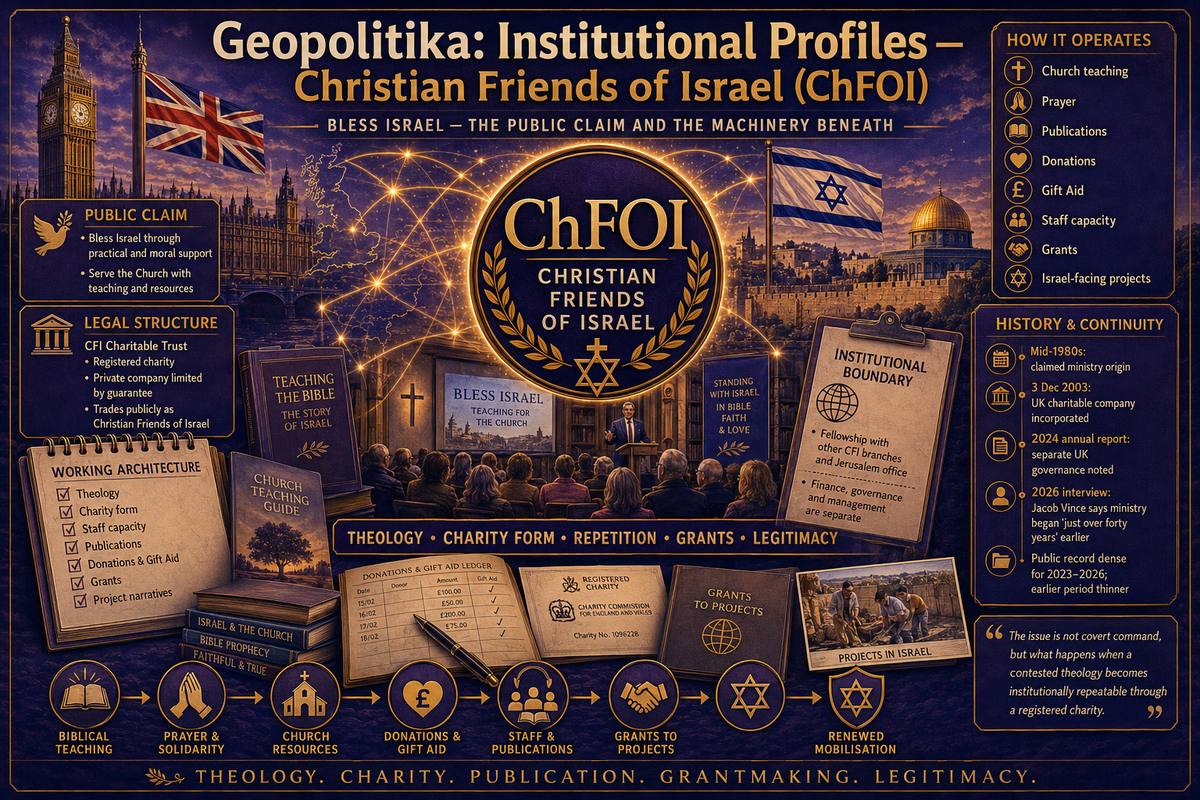
“Bless Israel” — The Public Claim and the Machinery Beneath
Christian Friends of Israel (ChFOI) presents itself through two linked aims: to “Bless Israel through practical and moral support” and to “Serve the Church with teaching and resources about God’s love and purposes for Israel and the Hebraic roots of the Christian faith.” On the surface, that is ministry language: prayer, education, friendship, biblical teaching and humanitarian concern. Read alongside the charity accounts, corporate records, project pages and institutional publications, it is also a working architecture. Theology supplies meaning; the charity form supplies decision rights and financial continuity; staff and publications supply repetition; grants connect the UK institution to Israel-facing work; project narratives return as renewed legitimacy and mobilisation.
The institutional boundary matters. The legal entity is CFI Charitable Trust, a registered charity and private company limited by guarantee that trades publicly as Christian Friends of Israel. The trust’s 2024 annual report describes fellowship with other CFI branches and the Jerusalem office while also stating that their finance, governance and management are separate.
Companies House records the UK charitable company as incorporated on 3 December 2003. In a 2026 interview, chief executive Jacob Vince described the ministry as having begun “just over forty years” earlier, placing the ministry’s claimed origin in roughly the mid-1980s. The publicly available materials are dense for 2023 to 2026 and thin for the earlier period, so the founding story should not be treated as fully resolved.
This article follows earlier profiles of Labour Friends of Israel (LFI) and Conservative Friends of Israel (CFI). However, where those bodies belong to party-political routes, ChFOI’s primary route is religious-charitable: church teaching, prayer, publications, donations, Gift Aid, staff capacity and grants. That distinction changes the question. The issue here is certainly not whether ChFOI secretly directs British politics; indeed, the public evidence concerning ChFOI does not imply Israeli-state direction, covert coordination with LFI, Conservative Friends of Israel or US based organisations like AIPAC, donor command, misuse of charitable funds or foreign-agent status. The more revealing question this article is concerned with is what happens when a contested theology is made institutionally repeatable through a registered charity.
The Theology That Organises Action
ChFOI’s distinctive power lies in interpretation. The institution teaches Christians how to understand Israel, the Jewish people, the Church and the Bible in relation to one another. That teaching is not decorative background to the charity’s work. It is the grammar that makes the work intelligible: why Israel matters, why Christians should care, why prayer and giving are presented as faithful action, and why alternative readings enter the field with less institutional authority.
The frame has a longer history. Christian Zionism belongs partly to British Protestant restorationist currents visible from the late eighteenth and early nineteenth centuries, in which Jewish return to Palestine was read through prophecy and providence. Those currents predated the late nineteenth-century emergence of organised Jewish political Zionism and helped create a British religious and political vocabulary in which Jewish restoration could be imagined as both biblical and geopolitical. In the twentieth century the Scofield Reference Bible, first published in 1909 by Oxford University Press and annotated by Cyrus I. Scofield, helped make a dispensational reading of Israel portable and familiar in parts of the English-speaking evangelical world. Scofield did not invent restorationism, and ChFOI cannot be reduced to Scofield, but the lineage helps explain why covenant, land, return and a distinct role for Israel can function as readily available institutional language.
That lineage is historically and contextually relevant, not proof that one doctrine defines Christianity as a whole. Christian Zionism remains contested within Christianity. Church of England statements, Vatican diplomacy and World Council of Churches interventions illustrate other Christian routes through the same field: condemnation of attacks on civilians alongside Palestinian rights, negotiated peace, restraint, justice and the direct witness of Palestinian Christians. Those positions are not evidence about ChFOI’s internal relationships. They establish the existence of competing Christian frameworks against which ChFOI’s own positioning can be understood.
ChFOI’s materials repeatedly return to covenant continuity, land, Jewish return, non-replacement, blessing Israel and the Hebraic roots of Christian faith. Its “Biblical References Concerning Israel” leaflet presents an eternal covenant, an enduring land promise and restoration claims. Jacob Vince’s 2026 interview is more qualified than a crude equation of biblical and modern Israel: he rejects a simple identity while treating covenant, land, exile and return as continuing “chords” that support present solidarity. The institution’s output therefore combines doctrinal continuity with contemporary action rather than relying on a single unqualified slogan.
The conversion sequence is visible. Israel is framed not only as a contemporary state but as a covenant-linked subject. Jewish return is placed within a providential history. Christian identity is reconnected to Jewish roots. The Church is positioned as needing correction where it has displaced or ignored Israel. The resulting action repertoire is teaching, prayer, friendship, public solidarity and material support. The corpus supports that institutional sequence. It does not measure how every individual reader, church or donor receives it.
A theology can be sincerely held and still function as infrastructure. ChFOI’s teaching provides a moral map in which Israel is biblically significant, Jewish vulnerability is central and Christian responsibility is practical. That map does not coerce every audience. Donors and churches can decline, disagree or leave. But the institution makes one response easy to recognise and easy to perform: learn, pray, attend, speak, give and support projects. The critical point is not to infer private belief from institutional language. It is to identify how institutional language narrows and organises the available actions.
The Charity Form, the Authority Route and the Money Flow
As mentioned above, the theological route is held inside a formal legal and administrative container. CFI Charitable Trust is charity number 1101899 and company number 04984515, a private company limited by guarantee without share capital. That form supplies corporate personality without ordinary shareholders. Statements submitted to the UK Companies Office show that at the end of 2024 the company had five members, each guaranteeing £1. No beneficial owner or share-control route appears in the record.
The decision route is clearer than the phrase “charity shell” suggests. The trustees are also company directors. The 2024 annual report states that the board retains overall direction and major financial decisions, while the chief executive manages day-to-day work with staff and remains accountable to the board. This is a functioning governance structure, not a nominal wrapper. Its practical power lies in control over UK teaching, publications, events, staff, fundraising and grant allocation.
The personnel record shows both continuity and renewal. D Linnell was appointed a director in October 2012 and appears as chair in the current corpus. Jacob Vince is identified as chief executive and public representative. John Caladine has served as company secretary since November 2007 and also controls Caladine Ltd, the accountancy supplier discussed below. The Companies House record shows later trustee appointments from 2022 onward and one resignation in 2025. Titles and longevity establish roles and institutional memory; they do not by themselves establish personal command, operator status or a family-control mechanism.
The 2024 accounts show a modest but durable institutional platform. Total income was £708,909, including £609,309 from donations and legacies, £45,305 from charitable activities and £54,295 from investments. Total expenditure was £635,963. Donations and legacies supplied about 86 per cent of income, making the institution strongly donor-dependent. Yet it was also asset-backed: year-end net assets were £915,653, including £451,586 in cash, £200,000 in investment property and £130,358 in fixed-asset investments. Those investments included Israel Bonds. The bond holding is evidence of financial alignment with the institution’s declared orientation; it is not evidence of foreign direction or coordination.
The balance sheet strengthens the continuity argument. ChFOI is not simply forwarding each incoming gift immediately. It maintains staff, cash, property, investments and designated reserves. The annual report identifies a £200,000 reserve target, described as roughly six months’ operating expenditure, alongside management, development, building and security designations. That capacity can keep teaching, relationship work, publications and grants operating across individual appeals and personnel changes. [8]
The disclosure is real but incomplete. The accounts show broad income categories, staff costs, assets, grants, restricted and unrestricted funds, and a related-party payment. They do not identify donors, donor concentration, donor conditions or the amount of Gift Aid reclaimed. Gift Aid matters because it can increase the value of eligible donations through UK tax relief. The donor selects the charity, but public tax relief participates indirectly in the material route. That is not an allegation of impropriety; it is a public-subsidy and transparency question.
The related-party payment should be stated exactly. CFI Charitable Trust paid Caladine Ltd £16,238 in 2024 and £12,150 in 2023 for accountancy support. The accounts disclose that John Caladine, the company secretary, controls the supplier. The dual relationship is a supported personnel bridge between company administration and an external service provider. Disclosure weighs against concealment. The absence of procurement alternatives, approval detail and board rationale leaves a narrower governance question unresolved; it does not establish misconduct, capture or personal control.
Grants, Separate Governance and Project Testimony
The most important documented handoff is the grant route. In 2024 CFI Charitable Trust recorded £188,075 in total grants: £154,146 to CFI Jerusalem projects, £33,799 to non-CFI projects and £130 in other grants. In 2023 the comparable figures included £112,681 to CFI Jerusalem projects and £23,791 to non-CFI projects. The movement is material and repeated. ChFOI does not merely teach, publish and pray in the United Kingdom; it allocates money to Israel-facing work.
The control boundary is equally important. The annual report states that the UK charity is in fellowship with other CFI branches and the Jerusalem office but that finance, governance and management are separate. Read together with the grant figures, the evidence supports a bounded operational handoff: the UK board decides and transfers grants; the recipient side administers projects. Funding establishes contribution. It does not establish that the UK charity owns, governs or commands the Jerusalem office, and the corpus does not independently resolve every recipient-side legal form. [10]
The project menu turns the material route into named fields of action. ChFOI’s pages refer to Emergency Aid for Israel, Wall of Prayer, Shevet Achim, Be’ad Chaim, Under His Wings, Open Gates, Forsake Them Not, Hope for the Future, Makor Hatikvah, Project First Fruits, Streams of Blessing and Communities Under Attack. First-party descriptions cover immigrant assistance, Ethiopian Jewish communities, Holocaust survivors, trauma, poverty, medical and family support, schools, congregations, believers and communities affected by attack.
These projects provide a concrete route from belief to action. Holocaust survivors make memory immediate. New immigrants make return practical. Trauma and emergency appeals make conflict urgent. Medical-aid narratives can present Israel as a site of care across communal lines. Pro-life and Messianic projects connect Israel-support to other Christian moral and ecclesial fields. The donor is not asked only to approve of Israel in the abstract. The donor is offered a menu of need, care, prayer and repair through which support becomes actionable.
Real assistance and ideological function are not mutually exclusive. A project can deliver material or pastoral help while also producing a selective public map of vulnerability, obligation and legitimacy. The corpus documents project titles, broad grant categories and institutional testimony. It does not contain grant agreements, recipient accounts, beneficiary ledgers, project-level final-use records or independent impact evaluations. The strongest defensible statement is therefore that ChFOI contributes financially to downstream work and controls its own narration of that work; implementation control and independent outcome magnitude remain unresolved.
This is the difference between a donation and an institutional route. A donation transfers money. A route supplies the transfer with doctrine, administrative form, a destination, a beneficiary category, a public story and a repetition mechanism. ChFOI raises money through a UK charity, funds staff and outputs, allocates grants, receives or publishes project testimony, and uses that testimony to renew the original call to friendship, prayer and giving. The route is visible even where the project-level record is not.
Teaching Time, Crisis Time and Institutional Reproduction
The mechanism operates on two clocks. The first is teaching time: the slower rhythm of courses, leaflets, magazines, conferences, tours, prayer networks and repeated biblical interpretation. The second is crisis time: emergency appeals, attacks, trauma, antisemitism, Holocaust memory, new-immigrant need and communities under threat. Teaching time forms a durable interpretive frame. Crisis time activates it.
The institutional sequence can be stated without claiming to observe every donor’s psychology: teaching and relationship work produce audience attention and support; support contributes to donations and organisational capacity; capacity sustains staff, publications, events and grants; project and public-engagement outputs return as new material for teaching and mobilisation. The accounts and output record support this loop at institution level. Individual audience-to-donation conversion rates and donor motives are not available.
This is more than episodic fundraising because the organisation stores continuity. Board authority, executive work, long-running administrative roles, reserves, property, investments, publications, events and recurring project categories allow the model to survive personnel turnover. Jacob Vince carries executive and representational capacity; D Linnell carries board continuity; John Caladine carries secretarial and accountancy interfaces. None is shown to be an indispensable command node. The model appears reproducible because its authority and routines are institutionally embedded.
A crisis therefore does two things. It creates an immediate reason to appeal, and it confirms the institution’s prior claim that Israel and Jewish communities require sustained Christian attention. A project update reports action while also supplying a morally legible image of what support has achieved. A prayer letter keeps Israel present between emergencies. The institution’s durability lies in the alternation: urgency activates; teaching stabilises; administrative capacity makes both repeatable.
Public Legitimacy and Relationship Infrastructure
ChFOI is not only a donor conduit. It produces teaching, magazines, conferences, tours, prayer structures, public statements and relationship work. The public materials place its representatives in Jewish-community and public settings including synagogues and rallies, the Church of England’s General Synod, embassy and briefing events, the launch of the Reform UK Jewish Israel Alliance and a We Believe Alliance briefing. Another institutional periodical records assistance at a BITUD event bringing Israeli, Palestinian and British trade unionists together.
These examples make the legitimacy function concrete. The institution carries religious claims, public presence and solidarity into church, Jewish-community and selected political interfaces. It can help normalise a continuing Christian bond with Israel, maintain relationships and contest frames it describes as supersessionist, prejudicial, antisemitic or aligned with BDS. Its practical power is agenda-setting and allocative, not statutory or coercive.
The limits are as important as the interfaces. Attendance at an event, shared language, common concern about antisemitism or an overlapping name does not establish coordination. The corpus supports ordinary relationships, public access and a bounded grant handoff. It does not establish common command with political Friends-of-Israel bodies, a political party, the Israeli state or every organisation present at the same event.
This is why “legitimacy institution” is a more exact description than “lobby” alone. ChFOI translates religious interpretation into public solidarity and administratively routable support. It participates in debate and relationship-building, but the corpus does not show that it commands policy, church decisions or the wider Israel-support field. Public engagement is demonstrated; adoption effects are not.
Affected Populations, Voice and Meaningful Exit
The populations inside the route occupy different positions. UK Christian supporters receive an action pathway: teaching, prayer, events, relationships and project giving. Churches can become repetition sites through courses, sermons, study groups, prayer meetings, magazines and visiting speakers. This gives supporters clarity and institutional forms through which to act.
Beneficiaries occupy a more mediated position. Holocaust survivors, immigrants, Ethiopian Jewish communities, trauma victims, low-income families, medical-aid recipients, congregations and communities under attack are visible because their needs anchor the charity’s public claims. They may receive real support, but their public meaning is usually organised through ChFOI or Jerusalem-office narration rather than independent beneficiary records. Help and mediation can coexist.
Palestinian and Arab populations are not wholly absent. The materials include claims about assistance to Arab populations, Palestinian babies and families, Arab and Jewish congregations, and an event involving Israeli, Palestinian and British trade unionists. But Palestinian political voice, Palestinian Christian theology and Arab Christian agency are less often presented as authoritative narrating positions than as beneficiaries or contextual populations within an Israel-centred frame. In this context, the issue is one of relative authority and voice, as opposed to total erasure.
When looking at the analytical concept of immobilisation, the question of meaningful-exit is bounded. Donors and church audiences participate voluntarily and generally have accessible alternatives. Association of support with biblical faithfulness may create social or doctrinal costs for some dissenters, but the corpus does not measure those costs or demonstrate coercion. Beneficiary dependence on projects may exist, but available alternatives and exit conditions are unknown. The evidence therefore supports limited soft constraint, not substantial immobilisation.
The accountability structure is similarly mixed. Charity Commission and Companies House reporting, trustee duties and independent examination provide substantive but bounded public scrutiny. They do not establish beneficiary decision rights, an accessible grievance route, independent project evaluation or donor visibility. The point is not that regulation is theatre, but rather that formal reporting shows institutional accounts more clearly than donor power, project remedy or affected-population voice.
Ecosystem, Omissions and the LFI / Conservative Friends of Israel / AIPAC Comparisons
While Christian Friends of Israel sits within a wider field of Israel-support, there is little to suggest coordination or organisation across religious and political institutional supporters. Labour Friends of Israel works through a Labour route: parliamentarians, policy framing, party education, delegations and political legitimacy. Conservative Friends of Israel works through a Conservative route: parliamentary relationships, delegations, testimony and party association. AIPAC belongs to a different United States route centred on Congress, candidates, lobbying and electoral mobilisation. Each of these organisations has its own historical and contextual explanation. Any questions of shared chain of command, common donors or coordinated strategy with ChFOI are not supported in the public materials.
ChFOI works through another route: church teaching, prayer, donor mobilisation, Gift Aid-enabled charity finance, public solidarity, and grants to Israel-facing projects. The comparison is useful, however, because it identifies functional difference. A Labour parliamentarian returning from an LFI delegation, a Conservative parliamentarian speaking after a Conservative Friends of Israel visit, an AIPAC-supported candidate and a church donor supporting ChFOI are not performing the same institutional act. They move through different legal forms, constituencies and authority routes.
At most, the comparison supports an ecosystem-level observation: support for Israel can be made normal within different constituencies through different institutions. LFI and Conservative Friends of Israel illustrate party-political normalisation. AIPAC illustrates a United States lobbying and electoral route. ChFOI illustrates church and charity normalisation. Calling that a division of labour is an analytical description of differentiated functions, not a finding that the bodies jointly planned or controlled one another. How the Israeli government and its various agencies might view this ecosystem is a different matter.
The omissions also differ by route. In party-political organisations, the difficult layers often concern delegation finance, donor concentration, event sponsorship, access and policy adoption. In ChFOI, the difficult layers are donor concentration, Gift Aid totals, grant conditions, recipient-side accounts, project-level final use, beneficiary voice and theological contestability. The forensic question is not “who secretly commands the network?” It is: “what moves, through which legal and institutional route, who can decide, who receives voice, and where does visibility stop?”
For ChFOI the answer is sufficiently clear to state without overclaiming. The route is religious-charitable. Authority comes from scripture as interpreted by the institution, charity status, board decision rights and public relationships. Money enters primarily through donations and legacies, supplemented by activity and investment income and potentially enhanced by Gift Aid. The institution funds its own staff and outputs, then allocates grants to separately governed projects. The principal unresolved layers are donor power, public-tax-relief scale, downstream grant conditions, project verification and affected-population voice.
POSIWID — What Christian Friends of Israel Actually Does
POSIWID means “the purpose of a system is what it does.” Used carefully, it separates stated purpose from recurring observable function without presuming insincerity. ChFOI’s stated purpose is charitable and educational: to bless Israel, serve the Church, encourage understanding, challenge prejudice, support prayer and assist communities. Those claims are visible across its materials and are consistent with its legal form and outputs.
In analytical terms, its observable institutional function is more specific: ChFOI is best classified as a mixed legitimacy, philanthropic-governance and service-delivery institution. It interprets Israel for church audiences, produces educational and prayer resources, builds public and Jewish-community relationships, raises and holds funds, pays staff, allocates grants and narrates project activity. It is neither only a humanitarian charity nor adequately described as a political lobby.
The practical power is allocative and interpretive. The UK board controls teaching priorities, publications, events, staff and grants. The institution contributes financially to downstream projects. It does not demonstrably control the recipient office, donors, political parties, churches or the wider Israel-support field. Its strongest documented causal level is contribution: the route helps produce teaching, mobilisation, public legitimacy and project funding, while wider policy effects and independent beneficiary outcomes remain unproved.
In plain terms, the machinery is as follows:
- Covenant, land, Jewish return, non-replacement and Hebraic roots supply the interpretive frame.
- Publications, courses, prayer, relationships and public appearances turn the frame into institutional attention.
- Donations, legacies, Gift Aid routes, reserves and investments make support financially repeatable.
- Grants connect the UK charity to Israel-facing work.
- Project and solidarity narratives return to supporters as renewed reasons to learn, pray and give.
No hidden command structure is required for this. ChFOI makes a contested interpretation administratively durable. It gives Israel-support a religious grammar, a charitable vehicle, a recurring funding route and a publicly narratable humanitarian form.
Conclusion — The Accountability Question Is the Route
The issue is not whether Christians may support Israel, whether a charity may fund humanitarian work or whether donors may give according to religious conviction. The issue is the route: how a contested interpretation becomes institutional authority, donor money, tax-supported giving, grants, project testimony and public legitimacy.
Christian Friends of Israel matters because it provides a non-parliamentary path through the wider Israel-support field. British Protestant restorationism and the later portability of dispensational ideas help explain the historical vocabulary available to it. The Church of England, Vatican and World Council of Churches help show that the Christian field remains contested. LFI, Conservative Friends of Israel and AIPAC help clarify that Israel-support also travels through party-political, lobbying and electoral routes. None of that background proves coordination with ChFOI. It explains the field in which ChFOI occupies a distinct religious-charitable position.
That position is analytically visible through the public facing materials. The accounts disclose income, expenditure, staff costs, assets, reserves, grants and a related-party accountancy payment. Governance documents identify board and executive authority. Publications show the doctrinal and public-legitimacy route. Grant figures establish material contribution to CFI Jerusalem and other projects. The same record stops short of donor concentration, Gift Aid totals, grant agreements, recipient accounts, beneficiary grievance routes and independent project evaluation.
The strongest conclusion is therefore bounded. ChFOI converts continuing-covenant teaching and friendship into education, prayer, public solidarity, donor mobilisation and grants. It controls its UK outputs and allocations and contributes to separately governed downstream work. It does not demonstrably command the wider church, political field or recipient institutions. Its significance lies in making one form of Israel-support theologically meaningful, administratively organised, financially repeatable and publicly legible as care.
—
Published via Mindwars Ghosted.
Geopolitika: Tracing the architecture of power before it becomes the spectacle of history.
—
Methodology Note: This analysis draws on a structured public-source corpus concerning CFI Charitable Trust, trading as Christian Friends of Israel (ChFOI), principally captured through 28 June 2026. The corpus includes the ChFOI UK website; mission, giving, project, study and publication pages; the teaching leaflet Biblical References Concerning Israel; issues of Enhance; a public interview with chief executive Jacob Vince; ChFOI Jerusalem project materials; the charity’s 2023 and 2024 annual reports and accounts; Charity Commission records; and Companies House filings on legal status, incorporation, officers and governance. CFI Jerusalem, other international branches and unrelated friends-of-Israel organisations were treated as distinct entities. The analysis examined institutional identity, chronology, governance, personnel, delegated authority, funding, assets, related-party disclosures, teaching, donor mobilisation, grant-making, public relationships, affected populations, accountability and missing disclosure layers. Particular attention was given to how theological interpretation is converted into education, prayer, donations, public solidarity and grants, and to the documented funding handoff from the UK trust to separately governed CFI Jerusalem projects and other recipients. Supported relationships were distinguished from coordination, control and common command. British Protestant restorationism, the Scofield Reference Bible, Oxford University Press, the Church of England, the Vatican and the World Council of Churches are included as explanatory context. Comparisons with Labour Friends of Israel (LFI), Conservative Friends of Israel (CFI) and AIPAC distinguish religious-charitable, party-political and electoral-advocacy routes; they do not establish coordination or shared governance. Claims are limited to what the corpus supports: institutional continuity, donor dependence, asset-backed capacity, teaching and public-engagement activity, Israel-facing grant-making and bounded opacity around donors, Gift Aid, grant conditions, recipient governance, beneficiary voice and independent outcomes. Base analytic outputs are available on request. For methodological details—including transparency score definitions, typology classifications, and confidence calibration—see the Geopolitika Series Methodological Statement.
Mindwars Ghosted is an independent platform dedicated to exposing elite coordination and narrative engineering behind modern society. The site has free access and is committed to uncompromising free speech, offering deep dives into the mechanisms of control.