Geopolitika: Institutional Profiles – Labour Friends of Israel (LFI)
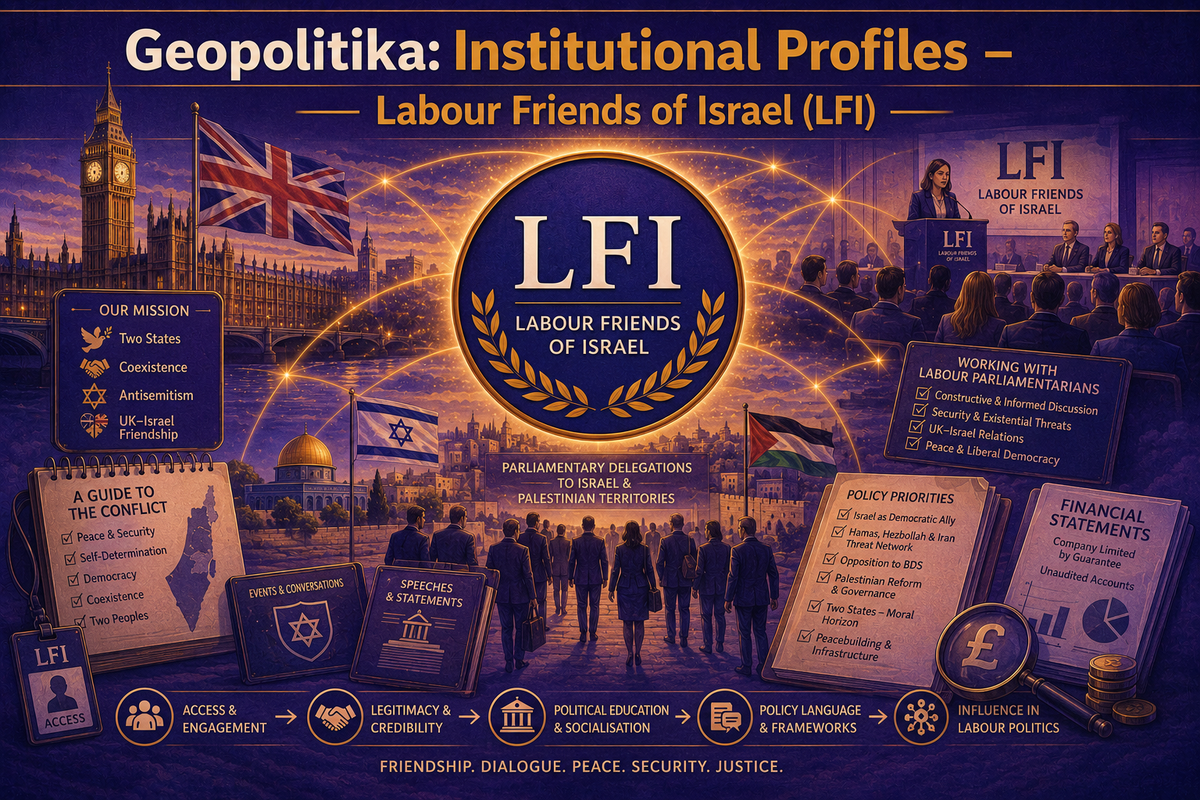
This article is published as part of the Geopolitika project to map Anglo-American power structures by examining their founding mythologies, leadership, linkages to power, public face, the nature of their outputs and who these are directed towards. This series is primarily generated from materials provided on the institution’s own websites, which are analysed using a structured analytic framework—see methodology statement at foot of article.
—
Executive Summary
Labour Friends of Israel (LFI) presents the casual observer with a paradox: at first glance, it looks like a modest organisation — a small company limited by guarantee, with limited disclosed assets, unaudited accounts and a public mission framed around two states, coexistence, antisemitism and UK-Israel friendship. Its own public language emphasises work with Labour parliamentarians, “constructive and informed discussion,” and a negotiated settlement with Israel “safe, secure and recognised” alongside a viable Palestinian state. On the other hand, LFI says it has organised visits to Israel and the Palestinian territories for “hundreds” of parliamentarians, candidates, advisers, Labour staff, researchers and trade unionists; it has counted a sizeable number of sitting Labour MPs among its parliamentary supporters; and it is a visible platform at high-profile moments in Labour’s Israel, antisemitism and foreign-policy politics.
That is the central tension this article examines, using LFI’s public-facing materials: company filings, policy papers, delegation pages, speeches, events and institutional records. Self-description is treated as evidence of positioning, not as proof of function. The question is not whether LFI secretly controls Labour policy. The record does not support claims of Israeli state funding, illegal payments, covert direction or hidden orchestration. The question is more ordinary, and more revealing: how does a compact institution convert access, legitimacy, political education and selective disclosure into influence
The answer lies in LFI’s operating pattern. It produces a Labour-compatible pro-Israel grammar: Israel as democratic ally and security partner; Hamas, Hezbollah and Iran as the central threat architecture; BDS and anti-normalisation as boundary violations; Palestinian politics as a problem of governance and reform; two states as the moral horizon; and peacebuilding as proposed fundable infrastructure. Its delegations turn that grammar into political experience. Its speeches and events give senior Labour figures venues to signal credibility on Israel, antisemitism and British Jewish security. Its financial record discloses enough to show modest scale, but not enough to reveal donor concentration, delegation finance, event sponsorship, creditor counterparties or the full operating model.
LFI should therefore be read not as an isolated body, but as one node in a wider ecosystem: Labour parliamentary politics, Jewish communal legitimacy, UK-Israel strategic advocacy, antisemitism-repair politics, regional-normalisation diplomacy and peacebuilding-fund advocacy. Comparable friendship-group structures provide context, not proof of coordination. The point is institutional position: LFI sits where several routes of legitimacy and access converge.
The article follows that machinery in stages: LFI’s public face and historical positioning; the people and institutions that give it reach; the money and missing financial layers; the policy outputs that reproduce its security-first framing; the beneficiaries and constrained actors; and finally the observable function of the system. Across those stages, the article follows routes rather than rumours: how institutional memory becomes legitimacy, how relationships become access, how delegations become authority, how policy papers become Labour-ready language, and how financial opacity limits public understanding of the system that sustains them. The central finding is that LFI is best understood as compact but durable political infrastructure. It routes credibility, access and policy language through normal democratic channels, helping define what counts as a responsible Labour position on Israel-Palestine.
History, Founding, and Power
Labour Friends of Israel is not a new pressure group formed in response to the post-7 October crisis. It is an old institution inside Labour politics, founded less than a decade after the establishment of the State of Israel. In evidence submitted to the UK parliament, LFI describes itself as “Established in 1957” and as an organisation supporting “a negotiated two-state solution for two peoples.” Other historical accounts place its founding at the 1957 Labour Party conference. The timing matters. LFI emerged when Israel could still be narrated, within much of the British labour movement, through anti-fascism, social democracy, post-Holocaust national self-determination and kinship with the Israeli labour tradition.
LFI’s 1957 founding also sat downstream of a longer British history of Zionism and Labour internationalism. The Balfour Declaration, issued in 1917 by Conservative foreign secretary Arthur Balfour, expressed British support for “a national home for the Jewish people” in Palestine. The Churchill White Paper of 1922, issued under Liberal colonial secretary Winston Churchill, reaffirmed that commitment while limiting its interpretation. These were imperial state documents, not Labour or Fabian texts. But by the time LFI was founded in 1957, British support for Zionism had also been absorbed into parts of the Labour and Fabian-influenced left, where Israel’s Labor Zionist institutions could be read through social democracy, planned development, anti-fascism and post-Holocaust self-determination.
That historical placement remains central to LFI’s public identity. It does not present itself as a generic Israel advocacy body or cross-party foreign-policy lobby. Its distinctive claim is Labour-specific: that support for Israel, opposition to antisemitism, two states and stronger UK-Israel relations can be made compatible with Labour values. LFI’s own two-state formulation is precise: Israel should be “safe, secure and recognised” alongside a “viable, democratic and independent Palestinian state.” It also links Labour’s history to Jewish self-determination and the State of Israel. Self-description is treated here as evidence of positioning, not as proof of function.
The same self-presentation gives LFI its contemporary shape. Its homepage says it works “closely with Labour parliamentarians” to strengthen relations between Britain and Israel and to promote coexistence “founded on peace and liberal democracy.” Its education function is described as promoting “constructive and informed discussion” within the Labour movement, including Israel’s “security and existential threats.” This is the key public formula: Labour parliamentarians, UK-Israel relations, peace, democracy, education and security are placed in one institutional frame. LFI’s public role is therefore not only to defend Israel, but to define what a responsible Labour position on Israel is supposed to sound like.
Over time, that positioning has adapted to changing political conditions. Earlier Labour-Zionist friendship language still appears, but it now sits alongside a more developed policy grammar: two states, coexistence, antisemitism, Israel’s security, opposition to BDS, Palestinian Authority reform, Iran, Hamas, Hezbollah, regional normalisation and UK-Israel partnership. LFI’s A Guide to the Conflict says a resolution is urgently needed to bring “peace and security” and to recognise the “legitimate right to self-determination” of both Jewish and Palestinian peoples. It also presents Zionism as Jewish national liberation and argues that support for Zionism does not preclude support for a Palestinian state.
This is the public face: a long-standing Labour-aligned institution whose language is peace, recognition, coexistence and self-determination. But the history also shows why that public face is politically useful. LFI sits inside Labour’s own story about itself. It can invoke anti-racism through antisemitism, internationalism through two-state diplomacy, security through Israel’s regional-threat frame, and party tradition through Labour’s historic relationship with Zionism and the Israeli left. It makes Israel advocacy legible to Labour politicians not as a departure from Labour identity, but as one recognised version of it.
That is where the power question enters. In this section, power is not yet about money, donors or personnel networks. It is about institutional location. LFI’s authority comes from occupying a recognised place within Labour politics for decades, then using that place to translate Israel advocacy into Labour-compatible language. It does not have to appear as an external demand. It can appear as Labour memory, Labour friendship, Labour anti-racism, Labour peace policy and Labour seriousness on security.
The historical point, then, is not merely that LFI is old. Longevity has given it a settled doorway into Labour politics. By the time contemporary arguments over Gaza, antisemitism, Zionism, BDS and UK-Israel relations arrive, LFI is already positioned as an institutional interpreter of what Labour support for Israel can mean. Its power begins there: in the conversion of long presence into a public role as translator and boundary-setter for Labour’s Israel position.
The People: Personnel and Power Networks
The institutional story becomes clearer when the people are named. Labour Friends of Israel is not powerful because it commands a mass membership machine. Its significance lies in the way a small organisation connects legal governance, Labour parliamentary authority, senior political platforming, Jewish communal legitimacy and Israel-policy advocacy.
The first layer is corporate governance. Labour Friends of Israel Ltd is a registered company, not only a political label. Its 2025 unaudited accounts list A. Cohen, J. Gerber, R. Simon, L. Ellman and J. S. Seitler as directors. This is the formal layer: legal responsibility, financial oversight and organisational continuity. It does not, by itself, prove political influence. But it establishes that LFI operates through an identifiable corporate vehicle, with named officers responsible for the entity behind the public platform.
The second layer is professional staff. Michael Rubin served as LFI director for a decade before stepping down in 2026. LFI’s own materials repeatedly identify him as “LFI director,” including in policy and commentary pieces on a Labour government’s Middle East agenda, post-Netanyahu politics, Israeli security and peacebuilding. Staff leadership matters because it converts episodic political support into institutional continuity: events are organised, delegations arranged, briefings produced, speeches hosted, policy papers circulated and relationships maintained between parliamentary cycles. LFI’s influence is therefore not reducible to one prominent speech or one parliamentary chair. It is reproduced through routine organisational work.
The third layer is Labour parliamentary leadership. Jon Pearce MP became LFI parliamentary chair in 2024, succeeding Steve McCabe, who stood down from parliament at the general election. LFI’s own announcement described Pearce as the newly elected MP for High Peak and the new parliamentary chair. Mark Sewards MP appears in LFI materials as an honorary chair and delegation lead, including a visit to Israel and Bahrain. Baroness Ramsay of Cartvale functions as the Lords-side figure and policy author, including through LFI’s regional-security paper A War for the Future of the Middle East. The point is not that these actors are controlled by LFI. It is that LFI provides an institutional setting in which Labour parliamentary authority can be connected to a specific Israel-policy frame.
The fourth layer is senior Labour platforming. Rachel Reeves, speaking at LFI’s 2025 annual lunch, thanked the LFI team, Michael Rubin and chair Adrian Cohen, and linked LFI’s work to “peace, coexistence and a two-state solution” and the fight against antisemitism. LFI’s annual-lunch material also records Keir Stramer addressing its 2024 annual lunch as prime minister and pledging UK action around the International Fund. “Platforming” here means something simple: LFI creates public venues where senior Labour figures can speak on Israel, antisemitism, British Jewish security and foreign policy in a setting that marks those statements as credible to a pro-Israel and Jewish communal audience.
The fifth layer is the wider Labour-facing bench. Figures such as Luciana Berger, Louise Ellman, Catherine McKinnell, Peter Prinsley, Damien Egan and Sharon Hodgson appear through LFI roles, events, delegations or support networks. Their significance is cumulative. They show how LFI’s frame travels through parliamentary supporters, former chairs, vice-chairs, delegation participants and public event speakers. In spite of being a LFI vice-chair, speaking out about Israel’s actions in Gaza resulted in Damien Egan and fellowLabour MP Simon Opher being denied entry to Israel when travelling as part of a Council for Arab-British Understanding delegation in September 2025.
The sixth layer is Jewish communal legitimacy. LFI’s event-world places it alongside institutions with distinct roles: the Jewish Labour Movement, a Labour-linked Jewish organisation; the Board of Deputies of British Jews, a representative communal body; the Jewish Leadership Council, a leadership and coordination institution; and the Community Security Trust, a communal-security and antisemitism-monitoring body. These bodies should not be collapsed into LFI. Their salience is that they help place LFI’s Israel-policy frame inside a wider legitimacy field: Labour repair after antisemitism conflicts, communal recognition, British Jewish security and anti-racist authority.
Delegations add the external-policy bridge. LFI says that over two decades it has taken “hundreds” of parliamentarians, candidates, advisers, Labour staff, researchers and trade unionists to Israel and the Palestinian territories, including meetings with Israeli and Palestinian ministers, Israeli Labor parliamentarians, academics and opinion formers. Public LFI materials also place Israeli figures such as Isaac Herzog, Mark Regev, Yair Golan, and Merav Michaeli in the delegation or Israel-policy environment. The transfer is simple but powerful: LFI organises the itinerary; participants receive a curated encounter with Israel-Palestine; that encounter becomes personal testimony; and personal testimony can then be used in speeches, policy positions, candidate formation or internal Labour debate.
Taken together, the personnel map shows why LFI matters. It sits where the Labour Party, UK Parliament, Jewish communal authority and Israel-policy advocacy meet. Its network is salient because different actors perform different institutional roles. Directors stabilise the legal vehicle. Staff convert relationships into continuity. Parliamentary chairs carry the frame into Labour and Westminster. Senior Labour speakers validate the platform. Jewish communal institutions add anti-antisemitism and communal-security legitimacy. Israeli political interlocutors add diplomatic and state-facing access. Delegation participants carry the experience back into Labour politics.
LFI’s power lies in the fact that these roles meet in one repeatable setting: senior Labour figures gain venues for signalling seriousness on Israel and antisemitism; LFI gains relevance through association with parliamentary and ministerial authority; communal institutions gain another route into Labour-facing legitimacy debates; and pro-Israel policy language gains a durable party-political home. The record supports connective tissue, access and legitimacy routing. It does not support claims of conspiracy, unlawful coordination or foreign direction.
The Money: Funding and Material Flow
The financial record confirms the article’s central paradox rather than resolving it. Labour Friends of Israel is politically visible, parliament-facing and institutionally connected; its legal vehicle, Labour Friends of Israel Ltd, is financially modest in the documents available. The company is registered in England and Wales as number 09562237, with a registered office at 3rd Floor, 86–90 Paul Street, London EC2A 4NE. Companies House lists it as active, and the accounts identify it as a private company limited by guarantee, rather than a share-capital company.
That legal form matters. A company limited by guarantee has members rather than shareholders. In LFI Ltd’s accounts, member liability is limited to an undertaking of no more than £1 on winding up. There is no visible ownership structure in the ordinary shareholder sense, and Companies House records no active person with significant control. That does not mean no one has influence over the organisation. It means the legal and financial record does not present influence as equity ownership.
The disclosed accounts cover an eighteen-month period from 1 January 2024 to 29 June 2025. They are unaudited: the company claims exemption from audit under section 477 of the Companies Act 2006, and apparently the members did not require an audit under section 476. The accounts were prepared under small-company provisions, and the profit-and-loss account has not been delivered. That is lawful small-company filing practice, but it is also where the public record narrows. The balance sheet is visible; the detailed income and expenditure story is not.
The visible balance sheet is small. At 29 June 2025, LFI Ltd reported £427 in tangible fixed assets, down from £963 in 2023. It held £114,481 in debtors, £96,556 in cash at bank and in hand, and total current assets of £211,037. Against that, it recorded £136,106 in creditors falling due within one year. Net current assets were £74,931, and retained earnings stood at £75,358. The average number of employees during the period was seven, up from six in 2023.
The notes sharpen the picture. The £427 in tangible assets consists of fixtures, fittings and computer equipment after depreciation. The debtors line is not itemised beyond “other debtors.” The creditors line is split into £33,643 in trade creditors, £9,128 in taxation and social security, and £93,335 in other creditors. The categories are disclosed; the counterparties are not. In plain terms, the public can see that money is owed to LFI and by LFI, but not who the relevant debtors, vendors or other creditors are.
This is why the financial question should be framed as material flow, not simply “how much money does LFI have?” Material flow means the movement of money, services, access, organisational capacity and political advantage. The accounts show enough to establish partial balance-sheet transparency: cash, debtors, creditors, retained earnings, employee count and audit status. They do not show donor identities, donor concentration, itemised income, itemised expenditure, delegation costs, delegation funders, event sponsorship, policy-paper commissioning arrangements, staff compensation or creditor counterparties. Financial disclosures show structural relationships and material flows. They do not establish intent or conscious coordination.
LFI’s own public self-description is important here. LFI says its work is supported by “members of the Jewish community” and others who share its commitment to Israel. It also states that it does not receive money from the Israeli government or the Israeli Embassy and does not make donations to Labour MPs. Those denials should be stated clearly because the public-facing materials contain no contrary funding records. The evidence does not support claims of Israeli state funding, Embassy funding or LFI donations to Labour MPs.
But those statements do not answer the wider material-flow question. They exclude some claims; they do not identify donors, amounts, concentration, conditions, event finance, delegation finance, policy-production costs or counterparties. Nor do they explain the relationship between modest fixed assets and LFI’s sustained capacity to organise briefings, events, delegations, speeches and parliamentary-facing policy work. The question is not whether the accounts prove misconduct. They do not. The question is how a compact organisation with only £427 in fixed assets and seven average employees sustains a high-connectivity role inside Labour politics.
That is the financial finding: not hidden control, but influence-critical opacity. The public record shows a small company with limited disclosed assets, cash and receivables sufficient for organisational activity, and aggregated liabilities that are not traceable to named counterparties. It also shows a missing profit-and-loss layer where income and spending categories would normally help readers understand the operating model. In an institution whose political value lies in access, delegations, policy production and legitimacy routing, those missing layers are not peripheral. They sit exactly where the mechanism operates.
Outputs and Synchronisation
LFI’s influence is most visible in what it produces. It is not only a friendship label, a company, or a parliamentary affinity group. Its public footprint includes policy briefings, research papers, weekly updates, delegations, speeches, events, statements and issue campaigns. Labour Friends of Israel presents these outputs as education, diplomacy and peace advocacy. Read together, however, its papers show something more specific: a security-first policy grammar in which Israeli state-security premises are translated into Labour language.
The named policy corpus is central. A Guide to the Conflict sets out LFI’s account of Zionism, conflict history, “land for peace,” two states, Israeli democracy, apartheid allegations, the Palestinian Authority, Hamas, Gaza and the Northern Ireland analogy. It says the guide is designed to outline history, explain “thorny issues,” tackle “myths” around Zionism and suggest how the peace process might be restarted. The educative posture matters: the guide is not merely giving background; it is training the reader in the categories through which Israel-Palestine should be understood.
Those categories are not neutral. Hamas, Hezbollah and Iran appear primarily through the familiar Western security vocabulary of terrorism, proxy war and regional destabilisation. A Guide to the Conflict says Hezbollah rebuilt its arsenal, attacked northern Israel and violated the UN Security Council resolution ending the 2006 war; it then describes Israel’s 2024 military operation in Lebanon as “limited.” Hamas is rendered through rockets, 7 October, “terror attacks,” “human shields” and the weaponisation of civilian infrastructure. Palestinian and Lebanese civilian suffering is not wholly denied, but the public materials give it less sustained explanatory weight than Israeli security. It is more often displaced into the language of Hamas rule, Gaza governance, stabilisation, reconstruction and the search for a “day after.”
The selectivity is also visible in LFI’s use of international law. Hezbollah’s alleged breach of a Security Council resolution is narratively prominent. Israel’s own long record of adverse Security Council findings is not treated with comparable salience. That matters because international law becomes legible when it confirms the adversary-threat frame, but less so when it implicates Israel’s conduct. Security Council Resolution 2334 reaffirmed that Israeli settlements in occupied Palestinian territory, including East Jerusalem, have “no legal validity.” Resolution 478 rejected Israel’s “basic law” on Jerusalem, and Resolution 497 declared Israel’s imposition of its laws and administration in the occupied Syrian Golan null and void. These are not minor background points; they are part of the legal terrain that LFI’s security-first ordering makes less central.
A War for the Future of the Middle East, authored by LFI’s House of Lords chair Baroness Ramsay of Cartvale, makes the regional frame explicit. It treats 7 October and Gaza as part of Iran’s wider strategy to “destroy Israel,” links Hamas, Hezbollah and the Houthis into a single threat environment, and places the war alongside Saudi-Israel normalisation and the India-Middle East-Europe Economic Corridor. The effect is to move Gaza out of a primarily Palestinian frame and into a regional security frame: Israel is positioned as a strategic actor resisting Iranian disruption, while Palestinian political claims recede behind the threat map.
After the War: Marginalising the Enemies of Peace turns that frame into policy. It calls for Palestinian Authority reform, donor pressure over education and payments, Israeli steps in the West Bank, sanctions against violent settlers, an IRGC proscription, a Middle East envoy, expansion of the Abraham Accords, a Gaza stabilisation and reconstruction summit, and an International Fund for Israeli-Palestinian Peace. The title itself is revealing: the problem is organised around “enemies of peace.” Hamas, Iran and rejectionist forces are made the principal obstacles; Israeli action is treated largely as response, condition or security context.
This is where LFI’s two-state language needs to be read carefully. It is real in the sense that LFI repeatedly invokes it. But in practice, the two-state formula functions in the papers as Labour-facing legitimacy for a security-first policy agenda. Laying the Foundations for a Two-State Solution makes the case for peacebuilding finance, drawing on Northern Ireland and the Alliance for Middle East Peace. Yet even here the practical route is donor coordination, coexistence programming and institutional funding, not confrontation with the facts on the ground: settlement expansion, territorial fragmentation, Gaza’s devastation and the dominance of Israeli security conditions. The horizon is Palestinian statehood; the operating programme is Israeli security, PA reform, anti-Hamas policy, anti-Iran policy, anti-BDS boundary-setting, regional normalisation and peacebuilding finance.
Delegations turn this policy grammar into political experience. LFI delegation pages describe visits to Israel and the Palestinian territories, meetings with Israeli and Palestinian figures, and encounters that allow Labour politicians to return with first-hand authority. The January 2024 solidarity delegation led by Louise Ellman followed 7 October and included a meeting with Israeli president Isaac Herzog. Such trips are not merely informational. They curate the order in which Labour figures encounter violence, memory, security, diplomacy and Palestinian governance. Delegations are therefore both output and input. They are an output because LFI organises and publicises them. They are an input because participants return with testimonial authority that can feed back into speeches, parliamentary positioning and Labour policy debate.
Synchronisation is the recurring cycle by which LFI reproduces relevance. A crisis or diplomatic opening occurs — 7 October, Gaza, antisemitism, Iran, Hezbollah, BDS, Palestinian Authority weakness, regional normalisation, or a Labour government policy window. That moment creates demand for Labour-compatible language. LFI supplies it through briefings, delegations, speeches, statements or policy papers. Those outputs make LFI useful to Labour politicians and policy audiences. Usefulness then supports further access, and access makes the next output more authoritative. This is not proof of secret coordination. It is an observable institutional cycle.
The finding is ordinary but important. LFI is effective because it repeatedly converts political moments into Labour-compatible pro-Israel outputs. Its papers do not simply balance competing claims. They place Israel’s security story at the centre, treat Hamas, Hezbollah and Iran as the main causal engine of violence, give less sustained weight to Israeli accountability in Gaza and Lebanon than to the adversary-threat frame, and keep two states as the moral vocabulary that allows the structure to remain acceptable inside Labour politics.
Consequences: Who Benefits, Who Pays, Who Is Immobilised
The consequences of Labour Friends of Israel are not evenly distributed. LFI’s public language is peace, coexistence, security and two states. But the practical effect of its work is to make one version of Israel-Palestine policy more available, more respectable and more institutionally usable inside the Labour Party. Political influence does not only work through money changing hands or direct command. It also works by narrowing the choices that appear legitimate. In this sense, “immobilised” means people or groups whose choices are narrowed because the policy frame has already been set around them.
The first beneficiary is LFI itself. Each crisis or policy opening gives it renewed relevance: 7 October, Gaza, antisemitism, Hamas, Iran, Hezbollah, BDS, Palestinian Authority weakness, regional instability and Labour’s credibility problems all become occasions for LFI statements, briefings, delegations, speeches and policy papers. Across the public-facing materials, the rhythm is consistent: conflict and threat create demand for policy language; LFI supplies that language through papers, delegations and events; those outputs reinforce its position as Labour’s recognised pro-Israel, two-state and anti-antisemitism interface.
Labour politicians also benefit. LFI provides access, education and a public platform. MPs and candidates can attend delegations, receive briefings, meet Israeli and Palestinian interlocutors, speak at events and return to Labour politics with a framed claim to seriousness on Israel-Palestine. LFI’s delegation material describes visits involving parliamentarians, candidates, advisers, Labour staff, researchers and trade unionists, and meetings with Israeli and Palestinian political figures. The benefit is not simply travel. It is political formation: participants can return with a curated experience of the conflict and a ready-made vocabulary for speaking about it.
Pro-Israel advocates inside Labour benefit for similar reasons. LFI packages support for Israel in a form that is legible as Labour politics: anti-antisemitism, two states, liberal democracy, opposition to Hamas and Iran, rejection of BDS, Palestinian Authority reform, peacebuilding finance and UK-Israel partnership. The effect is to make the pro-Israel position appear not as a factional demand, but as responsible Labour internationalism. LFI’s public materials make it possible for Labour politicians to support Israel, oppose antisemitism, reject Hamas and Iran, support Palestinian statehood, criticise extremist settlers, oppose BDS and back regional normalisation as one coherent package.
Jewish communal institutions also benefit, though not in a simple or uniform way. Organisations such as the Jewish Labour Movement, the Board of Deputies of British Jews, the Jewish Leadership Council and the Community Security Trust are not identical to LFI, and they should not be collapsed into it. But when LFI events and speeches place them in the same legitimacy field, they gain visibility, reassurance and a route into Labour’s anti-antisemitism and communal-security politics. In public speeches, these institutions appear alongside LFI as part of a broader Labour-facing architecture of Jewish communal recognition, anti-antisemitism repair and political reassurance.
The constrained actors are less visible. Labour members and voters outside the LFI frame are not silenced in any literal sense. They can still dissent. But the reputational costs of dissent rise when anti-Zionism, BDS or anti-normalisation are consistently framed as delegitimising, damaging or antisemitism-adjacent. That is discursive narrowing: the range of acceptable Labour speech on Zionism, BDS and Israel policy becomes smaller. The practical effect is not censorship by decree, but boundary-setting through repeated association.
Palestinian civilians are the clearest affected population. LFI recognises Palestinians as a people entitled to statehood, but its public corpus repeatedly filters them through governance and security categories: Palestinian Authority reform, Hamas rule, Gaza reconstruction, refugees, incitement, anti-normalisation and peacebuilding. Their direct speech is limited. They appear most often as the object of a policy solution rather than as the source of the frame. That is the consequence of a security-first grammar: Palestinians are present, but usually as a problem to be administered, moderated, reconstructed or represented through approved institutional channels.
Israeli dissenters are also constrained by the frame. LFI can incorporate Israeli centre-left figures, peacebuilders and critics of Benjamin Netanyahu, especially where they fit a two-state and anti-far-right position. But Israeli anti-war, anti-occupation, rights-first or dissenting voices are not central to the public corpus. The result is a controlled pluralism: Israeli politics appears divided, but mainly between a bad far right and a better security-compatible centre-left, not between occupation and liberation, or state violence and equal rights.
UK taxpayers and public-funding constituencies are implicated where LFI advocates UK seed funding, donor-state mobilisation, Gaza reconstruction frameworks and an International Fund for Israeli-Palestinian Peace. The point is not that LFI controls public money. It does not. The point is that it promotes policy routes that could mobilise public or multilateral funds while the people who would ultimately fund those commitments have no direct voice in the corpus. Public money appears as a policy instrument; public consent appears at a distance.
The consequence, then, is not coercion in the crude sense. It is political narrowing. LFI’s beneficiaries gain access, legitimacy, visibility, policy language and potential resource routes. Those outside its frame face higher reputational costs, reduced narrative space, or representation through elite policy categories. That is why the question is not only what LFI says it supports, but what its framework makes easier to say — and what it makes harder to say — inside Labour politics.
What It Actually Does
The useful test here is POSIWID: the Purpose Of A System Is What It Does. Applied to Labour Friends of Israel, that does not mean dismissing its stated commitments as fake. LFI repeatedly says it supports a negotiated two-state solution, coexistence, peace, opposition to antisemitism and stronger UK-Israel relations. Its homepage describes work with Labour parliamentarians, “constructive and informed discussion,” and policy initiatives aimed at Israel “safe, secure and recognised” beside a democratic Palestinian state. Those are real features of the public record—even though one could be justifiably sceptical about the achievability of such an outcome given facts on the ground.
But the observable function is more specific. LFI operates as Labour-compatible pro-Israel infrastructure: an access point, a legitimacy channel and a producer of policy grammar. It gives Labour politicians a route into pro-Israel alignment that can be spoken in Labour terms: anti-racism, anti-antisemitism, two states, peacebuilding, liberal democracy, security, opposition to Hamas and Iran, rejection of BDS and stronger UK-Israel relations. The institution is not merely a think tank, not merely a friendship group and not merely a company. It is a mechanism through which Israel-policy legitimacy is routed into Labour politics.
That function depends on four productive contradictions. The first is financial modesty with high connectivity. LFI Ltd’s accounts disclose a small visible balance sheet: £427 in tangible fixed assets, £114,481 in debtors, £96,556 in cash, £136,106 in creditors due within one year, £75,358 in retained earnings and an average of seven employees. The profit-and-loss account is not delivered, donor identities are absent, delegation finance is absent, and creditor counterparties are not named. Yet this modest disclosed structure supports policy papers, delegations, events, senior Labour speeches, parliamentary contact and Jewish communal interface. The power is therefore not asset scale. It is network position.
The second contradiction is peace language with security priority. LFI’s public vocabulary is full of two-state and coexistence language. But across the policy corpus, the practical ordering is security first. Hamas, Hezbollah, the Houthis and Iran are cast as an “Axis of Resistance” threatening the UK, allies, two states, normalisation and Israel’s existence. LFI says the two-state solution is the only route to peace, but also frames Iran and its proxies as seeking “perpetual war.” In that construction, Palestinian statehood remains the horizon, while the operating programme becomes Israeli security, Palestinian Authority reform, anti-Hamas policy, anti-Iran policy, anti-BDS boundary-setting, regional normalisation and peacebuilding finance.
The third contradiction is public visibility with influence-critical opacity. LFI is not hidden. Its website, policy papers, speeches, delegation pages and Companies House filings are public. It names directors, publishes arguments and states that it does not receive money from the Israeli government or Israeli Embassy, and does not donate to Labour MPs. It also says its work is supported by members of the Jewish community and others who share its commitment to Israel. Those statements matter and should be taken seriously. But they do not disclose donor identities, donor concentration, event sponsorship, policy-paper commissioning, delegation funding, profit-and-loss detail or creditor counterparties. The opacity is not total; it is located precisely where influence-relevant flows would be most visible.
The fourth contradiction is democratic normality with concentrated agenda-shaping power. LFI appears to operate through normal democratic channels: briefings, speeches, delegations, events, published papers, relationships with MPs and public advocacy. There is no need to posit hidden control to understand its salience. The available record shows something more ordinary and more durable: repeated access to Labour political space, recurring senior platforming, policy-ready framing and a routinised way of translating Israel’s security claims into Labour language. Its public materials describe close work with Labour parliamentarians and the strengthening of relations between Britain and Israel.
This is why LFI’s role should not be reduced to “lobbying” in the narrow sense. Lobbying suggests discrete attempts to persuade decision-makers on particular issues. LFI’s observable function is broader. It supplies a standing grammar: Israel as democratic strategic partner; Hamas, Hezbollah and Iran as the main engines of violence; BDS and anti-normalisation as delegitimising; Palestinian politics as a governance and reform problem; peacebuilding as proposed fundable infrastructure; and Labour credibility as something repaired through visible pro-Israel and anti-antisemitism commitments.
Delegations are the practical hinge. LFI delegation material describes Labour parliamentarians visiting Israel and the Palestinian territories, including post-7 October trips and meetings with political and civil-society actors. As with the aforementioned 2025 delegation led by Jon Pearce, such trips convert policy grammar into lived political authority: participants can say they have been, seen, met and understood. Speeches then convert that authority into public alignment. Policy papers convert it into recommendations. Events convert it into network reinforcement.
So what does LFI actually do? It makes a pro-Israel security-first position usable inside Labour politics. It does this while retaining enough peace, two-state, anti-far-right and coexistence language to remain Labour-compatible. Its power lies in that synthesis: a compact organisation with a modest visible balance sheet, partial financial opacity, strong parliamentary connectivity, high symbolic legitimacy and a repeatable policy vocabulary. The record supports structural influence, access, legitimacy routing and agenda shaping. It does not support claims of Israeli state direction, illegal payments, hidden control or covert orchestration.
Conclusion: Small Institution, Durable Infrastructure
The paradox is now clearer. Labour Friends of Israel does not need a large visible balance sheet to matter. Its significance lies in position, not scale. It occupies a durable doorway inside Labour politics, where support for Israel can be translated into the party’s own language of anti-racism, security, internationalism, peacebuilding and responsible government. That is why the institution should be understood less as a conventional mass organisation than as compact political infrastructure.
Across the public record, LFI’s stated purpose remains consistent: two states, coexistence, opposition to antisemitism, stronger UK-Israel relations and peace. But its observable function is more specific. It routes legitimacy, policy language, access and credibility through ordinary political mechanisms. It produces papers and briefings. It organises delegations. It hosts speeches. It gives Labour politicians venues in which to signal seriousness on Israel and antisemitism. It places Jewish communal legitimacy, parliamentary authority and pro-Israel policy advocacy in the same operating space.
That is not a story of hidden command. It is a story of agenda formation. LFI’s public materials repeatedly make one version of Israel-Palestine policy easier to say inside Labour: Israel as democratic ally and security partner; Hamas, Hezbollah and Iran as the central engines of violence; BDS and anti-normalisation as obstacles or delegitimising strategies; Palestinian politics as a problem of governance and reform; two states as the moral horizon; peacebuilding as proposed fundable infrastructure. Within that grammar, Israeli action is contextualised through security, while Palestinian and Lebanese suffering is more often routed through reconstruction, stabilisation or institutional reform.
What LFI shows is how influence can move by handoff: from donor-supported capacity to institutional platform, from platform to delegation, from delegation to personal authority, from authority to Labour speech, and from speech to the boundaries of acceptable policy.
The result is a form of political narrowing. Labour figures who align with this frame gain a ready-made language of credibility. Pro-Israel advocates inside Labour gain a durable institutional home. Jewish communal institutions gain visibility and reassurance in Labour-facing politics. LFI gains renewed relevance whenever crisis, antisemitism, Gaza, Iran, hostages, settlements, normalisation or Labour credibility return to the agenda. Those outside the frame — Palestinian civilians, Israeli dissenters, Labour members opposed to Zionism or BDS restrictions, and public-funding constituencies asked to support diplomatic or peacebuilding initiatives — appear with less direct voice.
This is why the financial modesty matters. The disclosed accounts do not show a large asset base. They show a small company limited by guarantee, modest fixed assets, cash, debtors, creditors, retained earnings and a small staff. But the gaps in the record sit precisely where influence would be clearest: donor concentration, event finance, delegation funding, profit-and-loss detail, creditor counterparties and policy-production costs. LFI’s own denials of Israeli government or Embassy funding and of donations to Labour MPs are important. They exclude claims the evidence does not support. They do not resolve the wider question of how material support, access and legitimacy flow through the institution.
The fundamental questions, then, are not conspiratorial. They are democratic. Who gets to define the responsible Labour position on Israel-Palestine? Who funds the institutions that shape that definition? Who is invited into the room, who is taken on the delegation, who is quoted in the briefing, and who appears only as a problem to be managed? When public or multilateral funds are proposed for reconstruction, peacebuilding or regional diplomacy, whose consent is treated as necessary?
Those questions point to the obvious research leads: donor concentration, delegation finance, access logs, meeting records, creditor counterparties, event sponsorship, policy-paper commissioning and the direct voice of affected populations. Until those layers are visible, the public record supports a disciplined conclusion: LFI is a compact but effective political infrastructure operating through normal democratic channels. It does not show covert control. But it does leave one central question: who gets to set the boundaries of acceptable Labour speech on Israel-Palestine—and through which routes of money, access, delegation, platforming and communal legitimacy are those boundaries drawn?
—
Published via Mindwars Ghosted.
Geopolitika: Tracing the architecture of power before it becomes the spectacle of history.
Methodology Note: This analysis draws on publicly available materials from Labour Friends of Israel (LFI), accessed via the organisation’s website, public policy pages, delegation records, event pages, speeches and regulatory filings in June 2026. The primary corpus includes: the LFI website, including its About page, policy initiatives, news archive, delegation pages and weekly issue materials; named LFI policy papers and briefings including A Guide to the Conflict, A War for the Future of the Middle East, After the War: Marginalising the Enemies of Peace and Laying the Foundations for a Two-State Solution; LFI speeches and event materials, including senior Labour platform appearances; delegation reports and public descriptions of visits to Israel and the Palestinian territories; and public company records for Labour Friends of Israel Ltd, including Companies House filings, unaudited accounts, director information, registered office details and persons-with-significant-control records. The analysis was conducted through structured institutional reading of LFI’s self-presentation, legal form, personnel networks, parliamentary linkages, Jewish communal references, policy outputs, delegation activity, financial disclosures, missing disclosure layers, recurring narrative frames and observable political function. Claims in the article are limited to what the public corpus supports: access, platforming, legitimacy routing, policy-language production, selective disclosure and agenda-shaping inside Labour politics. Base analytic outputs are available on request. For methodological details—including Transparency Score definitions, typology classifications, and confidence calibration—see the Geopolitika Series Methodological Statement.
Mindwars Ghosted is an independent platform dedicated to exposing elite coordination and narrative engineering behind modern society. The site has free access and is committed to uncompromising free speech, offering deep dives into the mechanisms of control. Contributions are welcome to help cover the costs of maintaining this unconstrained space for truth and open debate.